
White Onyx Stone Guide for Indian Homes

Most popular advice about this stone gets the order backwards. You're told to fall in love with a glowing slab first, then find somewhere to put it. Do it the other way round. Decide where white onyx stone can survive in your home, by contact, acid and abrasion, and only then choose a slab. A panel that looks perfect behind a pooja niche can be a poor choice beside a hob where lemon, masala and steel utensils meet it every day.
That placement first approach doesn't make the stone less appealing. It protects the one quality you are paying for, its translucency, and it stops a soft, calcite surface being asked to do a granite job. Once you understand what the material is, where it belongs, how it should be lit and fixed, and how to inspect it in the yard, the decision becomes much simpler and far less risky.
Table of Contents
- What White Onyx Is and How It Glows
- Where White Onyx Belongs in a Room
- Backlit Walls Panels and Decorative Pieces
- How to Cut Back and Fix the Slabs
- Keeping the Surface Clear After Installation
- Inspect the Slab Before You Commit
What White Onyx Is and How It Glows
A slab can be sold as onyx and still be the wrong material for the room you have in mind. In a Gurugram stone yard, a homeowner might show a seller a photo of a gemstone and ask for the same look across a wall. The name is shared, but the materials are different. Confusing them can lead to mistaken expectations about how an interior slab looks and behaves.
Architectural white onyx is a calcite-rich, banded carbonate sold as onyx marble. It is used in slabs for walls, vanity fronts and decorative panels. Its pale layers can transmit light, giving it depth that an opaque white marble does not have. For a practical comparison of the two stone families, see the difference between onyx and marble.
Two stones, one name
Gem onyx is a different material: cryptocrystalline quartz, usually shaped into small pieces for jewellery and carving. Its properties do not describe architectural onyx. A gemstone's reputation for hardness, for example, cannot tell you how a large calcite slab will respond to a knife, a hot pan or an acidic cleaner.
That distinction explains why descriptions of onyx can seem contradictory. One source may call it hard and durable while discussing quartz; another may warn that it scratches easily while discussing calcite-rich stone for interiors. Both may be right about the material they describe. Before assessing a slab, confirm which kind of onyx the seller means, then judge the actual stone rather than relying on its label.
Don't buy the word onyx. Buy the specific slab, after you've confirmed whether it's architectural onyx marble or something else.
How the layers form
The Indian Bureau of Mines marble publication describes onyx as a dense, crystalline form of calcium carbonate, typically deposited from cold-water solutions. It also describes the material as generally transparent to translucent, with varied colour layers formed through deposition. In simple terms, mineral-rich water built up successive layers. Changes in conditions gave those layers different colours, clarity and crystal patterns.
The layers work somewhat like thin sheets of frozen milk. Clearer areas let more light pass through; cloudier areas or tiny inclusions scatter it. That scattered light creates the stone's glow. It comes from light entering and moving through the layered structure, not from a surface coating. Polishing can make the face look cleaner, but it cannot create the same depth on its own.
Why white is a category, not a promise
White describes a colour and pattern range, not a separate mineral species. The historical Encyclopaedia Britannica account of onyx describes banded onyx with layers that can include white alongside black, brown, or red. A slab sold as white may therefore have grey clouding, ivory tones, faint gold veining or darker lines. Those variations can be part of the natural pattern rather than a defect.
The same historical account places Indian onyx in trade from the first century CE. It mentions material connected with Paithan and carried to Bharuch, as well as uses ranging from beads and ring stones to cups, bowls and cameo work. The history helps explain why the name covers more than one kind of object, but it does not tell you how a particular modern slab will look once lit.
For a buyer, the practical point is straightforward: white onyx is not a uniform shade-card product. Each slab comes from a layered deposit, so its glow, veins and pattern can differ from another slab in the same broad category. Two pieces can share a sales label and still give very different results on a wall.
What you'll actually see in the yard
White onyx slabs in the Indian market may have cloudy white-to-grey zones. In daylight, two pieces can appear similar. Place a torch or LED panel behind them and the differences become easier to see: one may glow evenly, while another shows a bright centre, dull grey patches or a vein that looks much darker when illuminated.
A face photograph is a poor substitute for this check. It records the surface under one light, but cannot show how translucency varies across the full slab. It may also conceal resin-filled fissures that become more visible when light passes through the stone. If the intended effect depends on a glowing panel, assess the slab with backlighting before cutting.
Hold on to this working definition: white onyx for interiors is a soft, layered, translucent calcite slab chosen for its light and pattern, not its toughness. That distinction makes it easier to assess the stone on its own terms, rather than expecting it to perform like a harder, opaque surface.
Where White Onyx Belongs in a Room
Don't start with whether this stone is good or bad for kitchens. Start with a map of contact. The StoneTrades white onyx guide describes white onyx as a calcite based stone at approximately Mohs 3, substantially more vulnerable to scratching than granite or engineered quartz, and able to etch with lemon, vinegar, wine, or some alcohol-based products. In an Indian kitchen, that risk isn't theoretical. Citrus, masala ingredients, oil, tea and frequent utensil impact are part of normal cooking.
Where white onyx stone is worth specifying
| Application | Verdict | Main risk | Prefer instead |
|---|---|---|---|
| Backlit feature wall | Excellent | Uneven glow if the slab is not dry-tested | No substitute needed for the look |
| Vanity top or front | Good | Cosmetics, perfume and standing water | Quartz if the basin is heavily used |
| Bar front or low-contact island | Good with care | Alcohol, citrus and glass bases etch or scratch | Quartz on a working drinks counter |
| Kitchen backsplash | Good | Oil and splash near the hob | Quartz or tile in the fry zone |
| Main cooking counter | Poor | Knives, lemon, masala, tea and heat | Quartz or granite |
| High-traffic floor | Avoid | Abrasion at roughly Mohs 3 to 4 | Granite |
| Exposed outdoor wall | Only if sheltered and non-freezing | Weathering and freeze-thaw | Indoor or covered feature |
Reading the table row by row
A backlit feature wall sits at the top for a reason. It's vertical, so nobody chops, drags or parks a hot kadhai on it. Its main risk is visual rather than mechanical, an uneven glow if you don't test the slab first. That's a solvable design problem, not a daily wear problem.
A vanity top or front can also work well, especially in a powder room or a primary bathroom where use is controlled. The threats are different here. Perfume, cosmetics and water left standing around the basin can mark the polish over time. If the basin is used heavily by children or guests who won't wipe spills, quartz is the calmer choice for the horizontal deck, even if you keep onyx on the front panel.
A bar front or low-contact island is a conditional yes. The vertical front is usually safe and looks superb when lit. The top edge and any serving ledge need more caution, because alcohol and citrus are both part of making drinks, and glass bases can scratch as they're slid across. Use coasters, keep the working mixing zone on a tougher material, and the onyx can stay as the visual face rather than the work surface.
Where the answer turns to no
A kitchen backsplash is often the smart compromise people miss. You get the pattern and, if you want it, the glow, without giving the stone the hardest job in the room. Keep it away from the direct fry zone if you can, or use quartz or tile where oil splashes daily and reserve onyx for a calmer stretch of wall.
The main cooking counter is where the popular advice fails most often. That surface meets knives, lemon halves, vinegar based marinades, turmeric, tea rings and heavy utensils in a single evening. A sealer can slow staining, but it cannot prevent acid etching or eliminate scratching. That's why the verdict rests on placement rather than treatment. Quartz or granite will serve you better there, and they won't force you to police every meal.
Placement rule: If hands, knives, pans and acids meet the surface every day, choose a harder stone and move the onyx to the wall.
High traffic floors and exposed outdoor walls ask for abrasion resistance and weather tolerance that this soft calcite doesn't offer. Lock the application before you choose a slab. The same block can be right for a powder room wall and wrong beside a hob, and deciding that early saves you from paying for beauty in the one place it can't last.
Backlit Walls Panels and Decorative Pieces
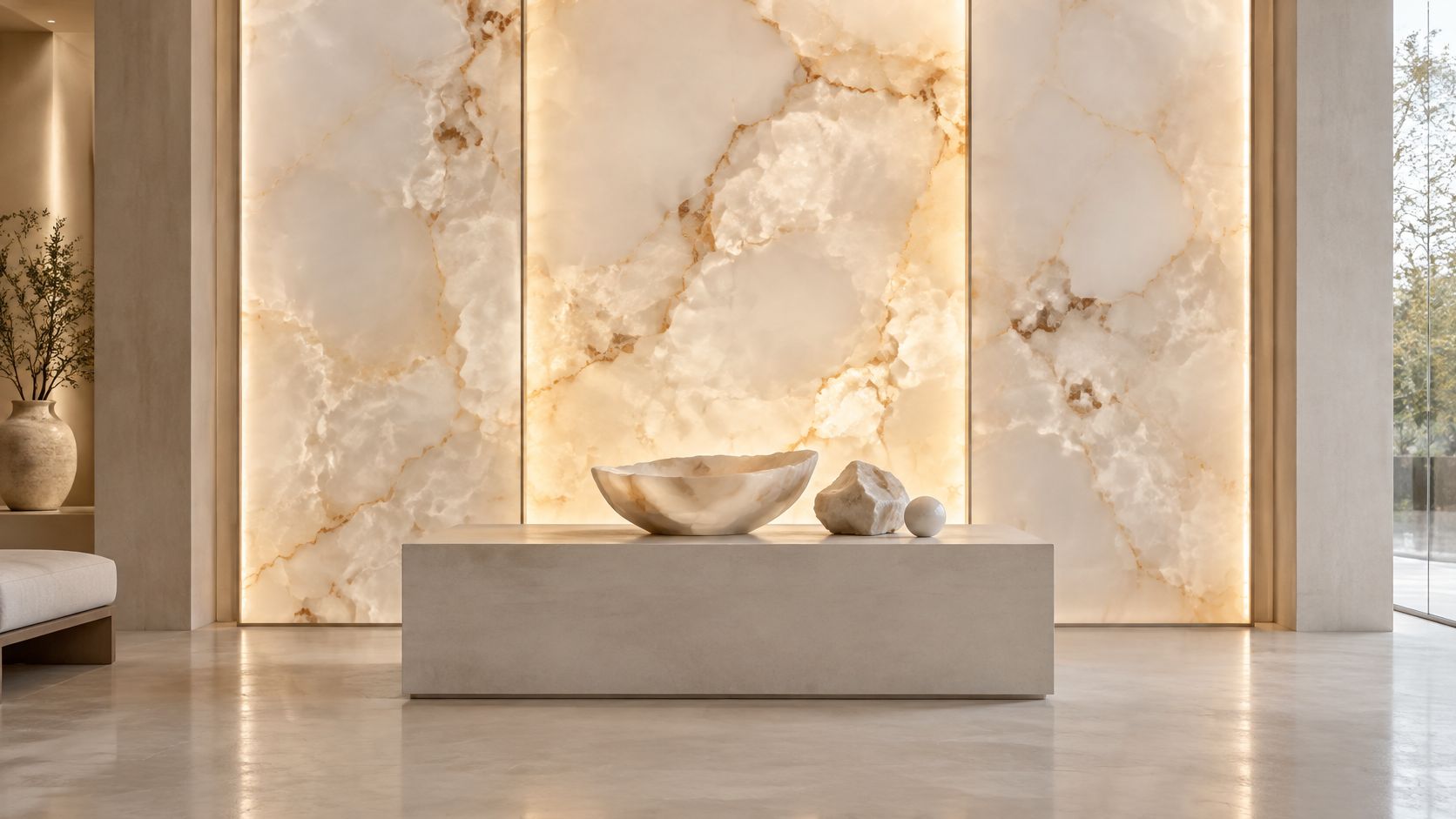
A backlit wall usually fails in a predictable way. The slab looked soft white in the yard, the LED strips went in as evenly spaced lines, and on switch on night the panel shows bright stripes, grey clouds and one vein that reads like a crack. Nobody chose a bad colour. They skipped the test that matters.
The effect below shows what you're aiming for, an even field of light rather than visible hot spots.
Test the slab, not the colour name
Translucency isn't uniform across a panel. Light travels through clearer calcite bands and scatters at inclusions, veins and crystal changes, so a white face can hide zones that go dull or dark under LEDs. The GlobalLinker white crystal onyx product listing notes Indian market material commonly supplied at around 20 mm thick with alternating cloudy white to grey zones and variable translucency. That's exactly why backlighting can't be designed from colour alone.
Dry test that exact slab against the intended LED system before fabrication. Spread the light source evenly behind the panel so bright spots don't exaggerate natural variation. A continuous LED sheet or closely spaced, diffused source usually reads better than bare strips. If your designer is also planning how the room photographs at night, photography-ready lighting strategies are useful background for balancing the panel against surrounding light, so the stone glows without blowing out the rest of the room.
Build the support before you chase the glow
Use a backing that's rigid, continuous and moisture resistant. Reinforce joints, cut outs and edge returns, because illuminated veining can visually magnify cracks and resin filled fissures. A hairline you accept in daylight can read as a dark river once the panel is lit, so mark those features during the dry test and decide, in writing, which ones are acceptable.
For NCR installations, keep the stone indoors or in a sheltered location. Exterior use is only suitable in non freezing conditions, and even then a covered panel is a safer brief than an exposed facade. Before cutting, record slab orientation, vein continuity across any book matched panels, lighting colour temperature and access for LED maintenance. Then sign an illuminated mock up. That signed test is your reference if the installed wall looks different later.
The short video below is useful for seeing how light changes the reading of the stone as viewing conditions shift.
Three uses that work in real rooms
- Reception or pooja feature wall: The panel becomes a soft light source, so keep nearby finishes quiet and let the stone carry the focus.
- Vanity or bar front: The glow does the decorative work on a vertical face, while a tougher material can handle the working top.
- Screens and niche linings: Smaller pieces let you use striking veining without committing a whole wall, and they're easier to reinforce and access.
Budgeting for the lighting, backing and access panel matters as much as the slab itself, and our overview of backlit onyx wall panels and their price factors helps you separate stone cost from system cost. Don't approve the cheaper light layout after approving an expensive slab. In a backlit installation, the light isn't an accessory. It's half the product.
How to Cut Back and Fix the Slabs
Cutting and fixing white architectural onyx calls for a gentler approach than granite. The useful comparison is with gem onyx: the Gemology Laboratory onyx characteristics page describes gemological onyx as cryptocrystalline quartz with Mohs hardness around 6.5 to 7. Architectural onyx is a calcite-rich marble, reported in the StoneTrades guide at Mohs 3 to 4. In practical terms, that calcite slab is far softer and weaker than gem onyx, quartz or granite. Treat it like a delicate sheet that needs full support, not a hard stone that can tolerate rough handling.
White onyx stone properties that change fabrication
| Property | Typical figure | Site consequence |
|---|---|---|
| Mohs hardness | About 3 to 4 | Far softer and weaker than gem onyx, quartz or granite; grit and knives can scratch it, so avoid floors and heavy prep zones |
| Usual slab thickness | 20 mm | A common format; large or cantilevered panels need backing |
Read the material as a site instruction
A slab can rest safely when it is fully supported and still crack if it projects unsupported. Picture a thin board resting on a counter: it carries weight differently once part of it hangs over an edge. Keep spans short, support the full panel, and do not treat a decorative slab as a structural shelf.
Approve a test piece from the actual slab before full fabrication. Veining and the visible face matter, but the placement does too. In Indian kitchens, keep onyx away from exposed food-preparation zones, where knives and abrasive grit can mark its soft surface. For NCR interiors, favour vertical cladding, vanity fronts and feature walls over high-contact floors or unsupported counters. A carefully supported counter may suit a project, but it needs a detail designed for the load rather than a slab expected to carry it alone.
The sequence below covers inspection, planning, cutting and fixing. Each step prevents a practical failure, from a mismatched vein direction to a panel that flexes after installation.
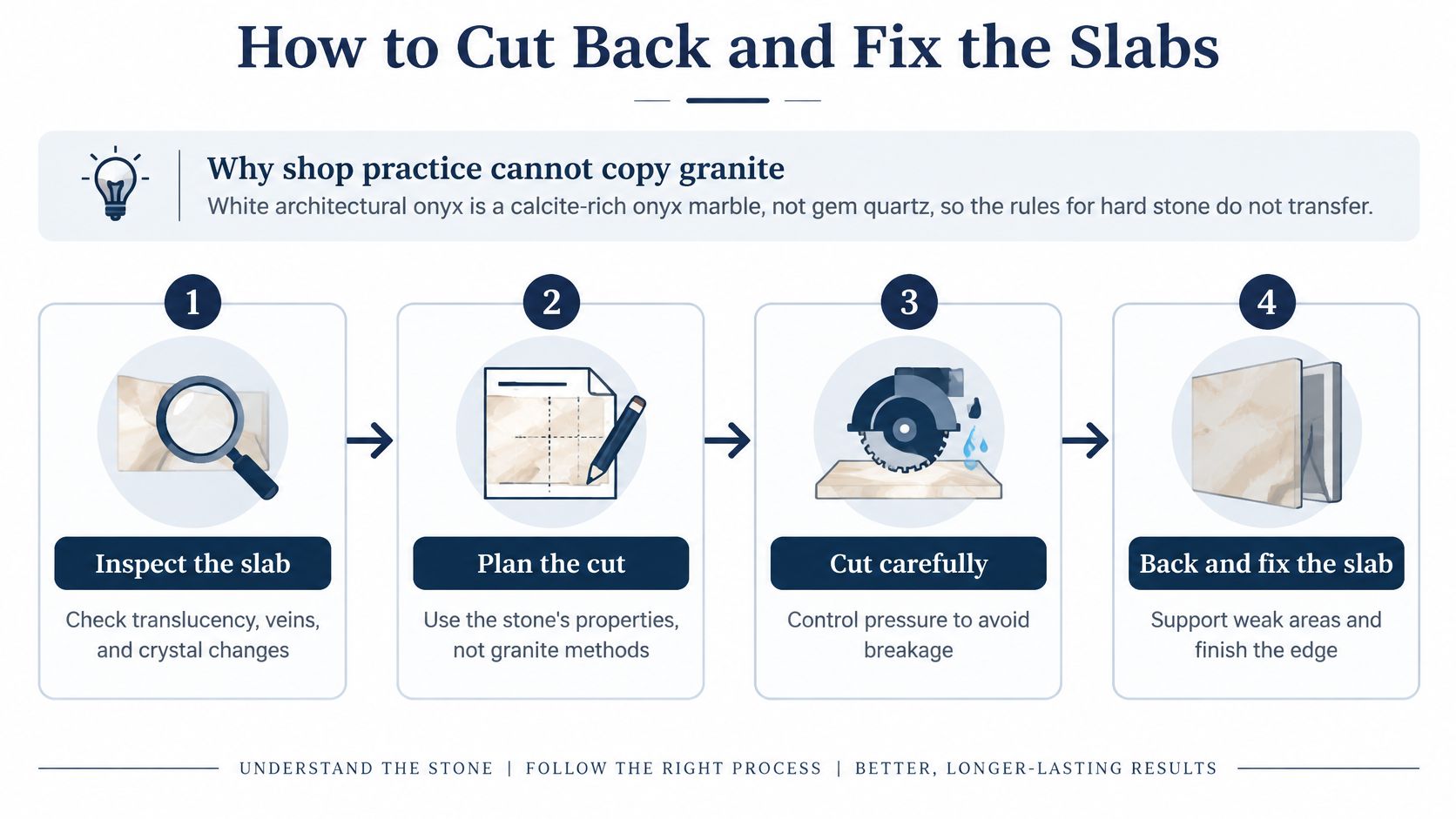
The fixing sequence, with the failure each step prevents
- Confirm use and loads: Set the panel size, location and any shelf or counter load before fabrication. This stops a decorative slab being detailed as structural support.
- Dry lay and mark veins: Lay out the slabs and mark the vein direction and show face before cutting. This helps book-matched panels meet with their pattern aligned.
- Cut with diamond tooling only: Use diamond tooling, a steady feed and proper cooling. Careful cutting helps limit chips along veins and resin-filled lines.
- Protect edges and limit overhangs: Guard exposed edges and avoid long unsupported projections. A free corner is vulnerable to bending and cracking.
- Add engineered backing: Large panels and cantilevers need engineered backing or a designed substrate. It spreads the load instead of asking a 20 mm slab to carry it alone.
- Reinforce weak points: Reinforce cut-outs, returns and joints locally. A basin opening or socket cut should not become the starting point for a split.
- Fix to a rigid support: Use a continuous, rigid, moisture-resistant support. For a lit panel, retain access so the lighting can be serviced without disturbing the stone.
- Protect through handover: Cover the face during wet trades, painting and snagging. Grit, cement slurry and dragged tools can mark a soft polished surface.
If a panel is damaged later, avoid improvised aggressive grinding. Specialists who restore worn stone surfaces use controlled honing and polishing, an appropriate approach for a soft calcite face. The showroom polish may draw the eye, but support and placement determine whether the slab stays intact.
Keeping the Surface Clear After Installation
Start by separating two marks people mix up. A stain sits in the pore. Oil, tea or a coloured liquid soaks in, darkens the stone, and may be reduced if you've used a penetrating sealer and you wipe fast. An etch is different. It's a dull spot where acid has eaten into the calcite polish itself. Lemon, vinegar, wine and some spirits can do that, and cleaner won't refill what's been dissolved.
Sealer doesn't stop etching. It buys you time against staining, nothing more. Scratches are the third category, from knives, grit trapped under a vase, or a dragged appliance. At this hardness, they're not a cleaning problem. They're physical damage to the surface, which is why prevention matters more than any product you buy later.
The daily routine that actually helps
Use a pH neutral stone cleaner and a soft cloth. Don't use vinegar, lemon based sprays or acidic bathroom cleaners, even if they work well on tiles nearby. Lift spills at once rather than wiping them in circles, which spreads the liquid into a wider ring. Blot, rinse with clean water if needed, and dry the area so nothing sits on the polish.
- Use trivets and boards: Hot pans go on trivets, and any food preparation happens on a board, never directly on the stone.
- Use coasters on bar tops: Alcohol is both a liquid risk and an acid risk, and glass bases scratch as they slide.
- Keep toiletries off the deck: In a powder room, perfume and some cosmetics can mark the polish near the basin, so use a small tray.
- Control grit: Wipe with a clean soft cloth, because dust dragged across the face can leave fine lines.
Finish choice affects how forgiving the surface feels day to day, and our guide to types of surface finishes explains why a high polish shows etches more clearly than a softer finish. That's worth deciding before installation, not after the first dull patch appears.
Mistakes that make damage worse
Don't scrub a dull patch with scouring powder. You'll cut the surrounding polish and turn a small etch into a cloudy area. Don't coat it with wax to hide it either. Wax can trap dirt, yellow unevenly and make proper honing harder later. If a dull spot appears, stop, identify what product sat there, and call a stone restorer for assessment and honing if needed.
Outdoors, even a sheltered panel needs caution in freezing conditions, so treat exterior use as the exception rather than the plan. Indoors, run one simple monthly check. Water should bead rather than soak in at once, the polish should still read clearly in raking light from a window, and any new dull spot should be traced to a specific product left on the face. That habit catches sealer wear and care mistakes while they're still small.
Inspect the Slab Before You Commit
A low listing price does not tell you whether a white onyx slab suits your project. One ExportersIndia listing for onyx stone slabs offered white onyx slabs at ₹140 per square foot in 2026. Separately, ExportersIndia's Udaipur onyx stone listings showed a listed Indian supplier offering white onyx marble cutter slabs, with a 20 mm thickness option at ₹125 to ₹180 per square foot in 2026. These are market signals for ordinary cutter material, not quotes for book-matched, backlit-ready or highly translucent slabs.
White onyx slab prices quoted in 2026
| Product | Price per sq ft | Note |
|---|---|---|
| White onyx stone slabs | ₹140 | Listed supplier offer, ExportersIndia |
| White onyx marble cutter slabs, 20 mm | ₹125 to ₹180 | Listed supplier range, ExportersIndia |
The slab price is only one part of the decision. Block quality, slab size and wastage affect the project cost, as do the lighting and backing system. A slab that glows unevenly can become an expensive choice after cutting and installation.
Five yard checks before you pay
Photos cannot show every detail that matters. Inspect the slab in person, especially if it will be backlit.
- View it dry, then lit: Check the face in normal light, then hold a torch or project LEDs behind it. If you need an even glow, avoid cloudy bands that turn opaque.
- Check vein continuity: For book-matched panels, lay the slabs in sequence and compare the pattern with the intended layout.
- Mark fissures and repairs: Note resin-filled fissures, pits and repaired cracks. Backlighting can make these features more visible.
- Confirm thickness and edges: Check the stated thickness, finish and whether the edges are sound enough for the planned profile.
- Record the show face: Confirm which side will be visible, mark its orientation and photograph the slab with those marks in view.
Choose a Polished or Backlit-ready finish when translucence is central to the design. Imported onyx is available in these finishes and comes from Turkey, Iran and Brazil. White Onyx has glacial translucence and gives pure light when backlit, but each slab has its own pattern and clarity. Origin identifies where the material comes from. Inspecting the individual slab shows how it will look in your room.
Varun Marbles has showroom galleries in Gurugram where you can see white onyx slabs in person and compare their finishes. Visit Sikanderpur Marble Market or HUDA Marble Market Sector 33–34 with your panel dimensions and placement in mind. For a countertop or another hard-working surface exposed to frequent contact, quartz or granite is a more suitable choice.