
Backlit Onyx Wall Panels Price Guide for India
There's no responsible universal Backlit Onyx Wall Panels Price, because translucent onyx alone can sit around ₹500 to ₹1,500 per sq. ft. before you've priced the light cavity, support, fabrication and installation. You're not buying a glowing surface by area. You're buying a slab, a structure behind it, an electrical system and the labour to make all three behave as one wall.
You're probably holding a design reference, a wall measurement and at least one confusing rate. Accept no comparison until every supplier prices the same slab grade, thickness, backing, lighting, controls, transport, installation and GST.
Table of Contents
- Why One Onyx Price Is Not a Project Price
- How a Backlit Onyx Wall System Works
- What Changes the Onyx Material Price
- Separate Lighting Support and Installation Costs
- Build a Quote-Ready Technical Specification
- Compare Residential and Commercial Project Scenarios
- Request an Accurate Quote from Varun Marbles
- Make the Final Price Decision With Confidence
Why One Onyx Price Is Not a Project Price
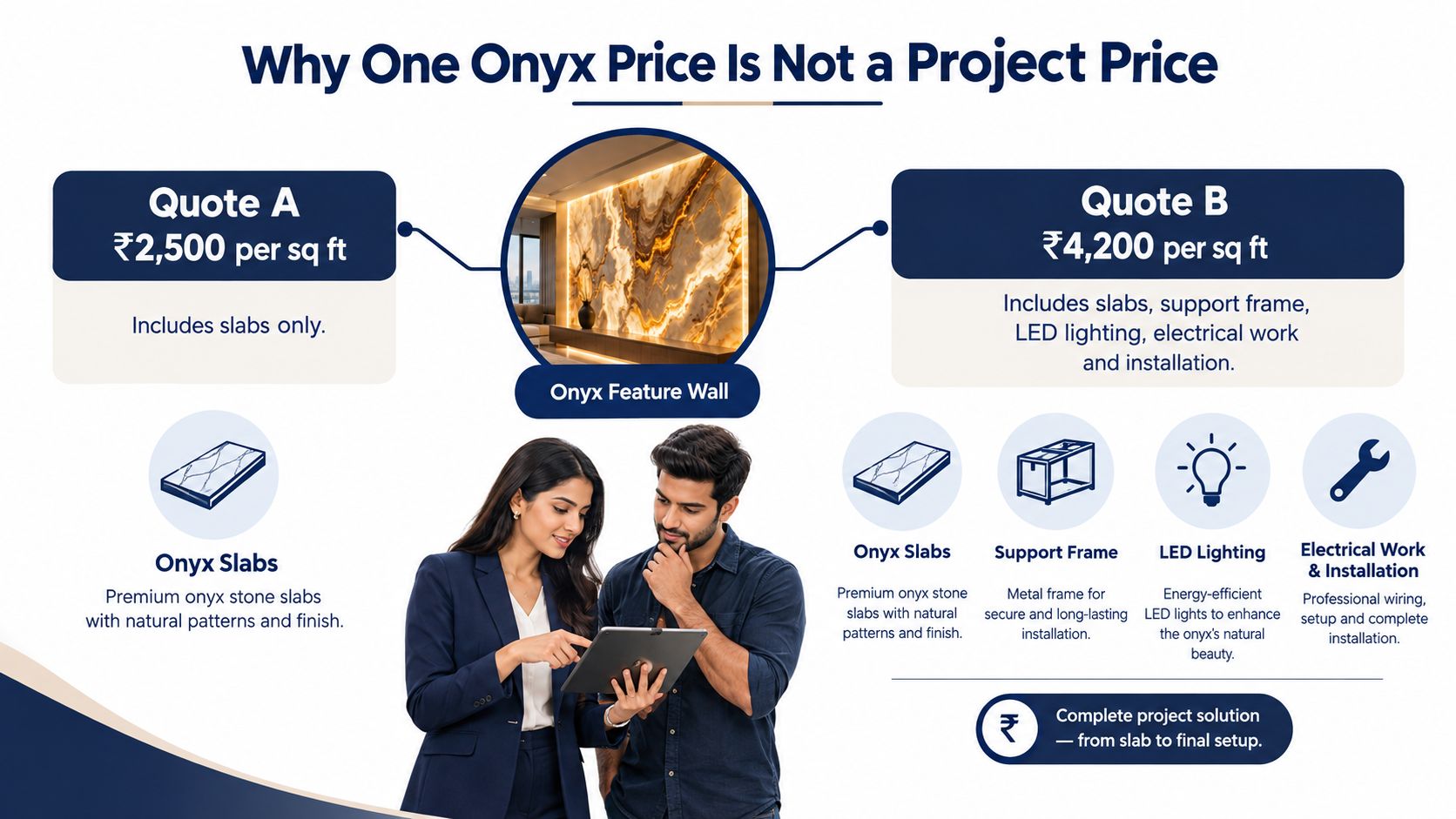
A homeowner in Gurugram wants a honey onyx wall behind a television. Supplier A quotes an attractive area rate for the slabs. Supplier B quotes more, but includes a support frame, LED modules, wiring, edge polishing and site installation.
On paper, A looks cheaper. On site, A's number grows when the electrician asks who is supplying drivers, the fabricator charges for reinforcement, and the installer discovers the wall needs levelling and a serviceable fixing system. Nothing unusual has happened. The first quote priced only a material, not the finished assembly.
The mental model to use
Treat the visible onyx as one line in a larger build-up. A credible installed price also covers slab selection and wastage, cutting, possible translucent reinforcement, backing, a flat support structure, the light cavity, diffuser, LEDs, drivers, dimming controls, wiring, transport, handling and installation. Taxes and exclusions sit on top, not inside an unexplained rate.
Industry benchmarks help you test whether a budget is plausible. They don't price your selected slab, your panel layout or your site conditions. Don't let a supplier present a generic stone range as a binding project quotation.
Practical rule: If a quotation doesn't say what sits behind the stone, you haven't received a price for a backlit wall.
What to separate before comparing
Ask each supplier to price these items in the same order:
- Stone supply: Named onyx, thickness, grade and whether the rate follows the actual slab selected.
- Fabrication: Cutting, matching, reinforcement, edge finish and joint treatment.
- Illumination: LED type, diffuser, drivers, controls and electrical labour.
- Installation: Support, fixing method, site preparation, transport and access requirements.
- Commercial terms: Wastage basis, GST, exclusions and responsibility for approvals.
That structure exposes the difference between two numbers. It also stops you paying twice for work hidden inside overlapping lump sums.
How a Backlit Onyx Wall System Works
Think of the wall as three connected layers. The onyx slab is the visible filter, the support frame is the skeleton, and the lighting assembly is the engine. Change one layer and the others usually need adjustment.
The diagram below shows the build-up you should expect a supplier to describe, rather than a vague promise of stone plus lights.
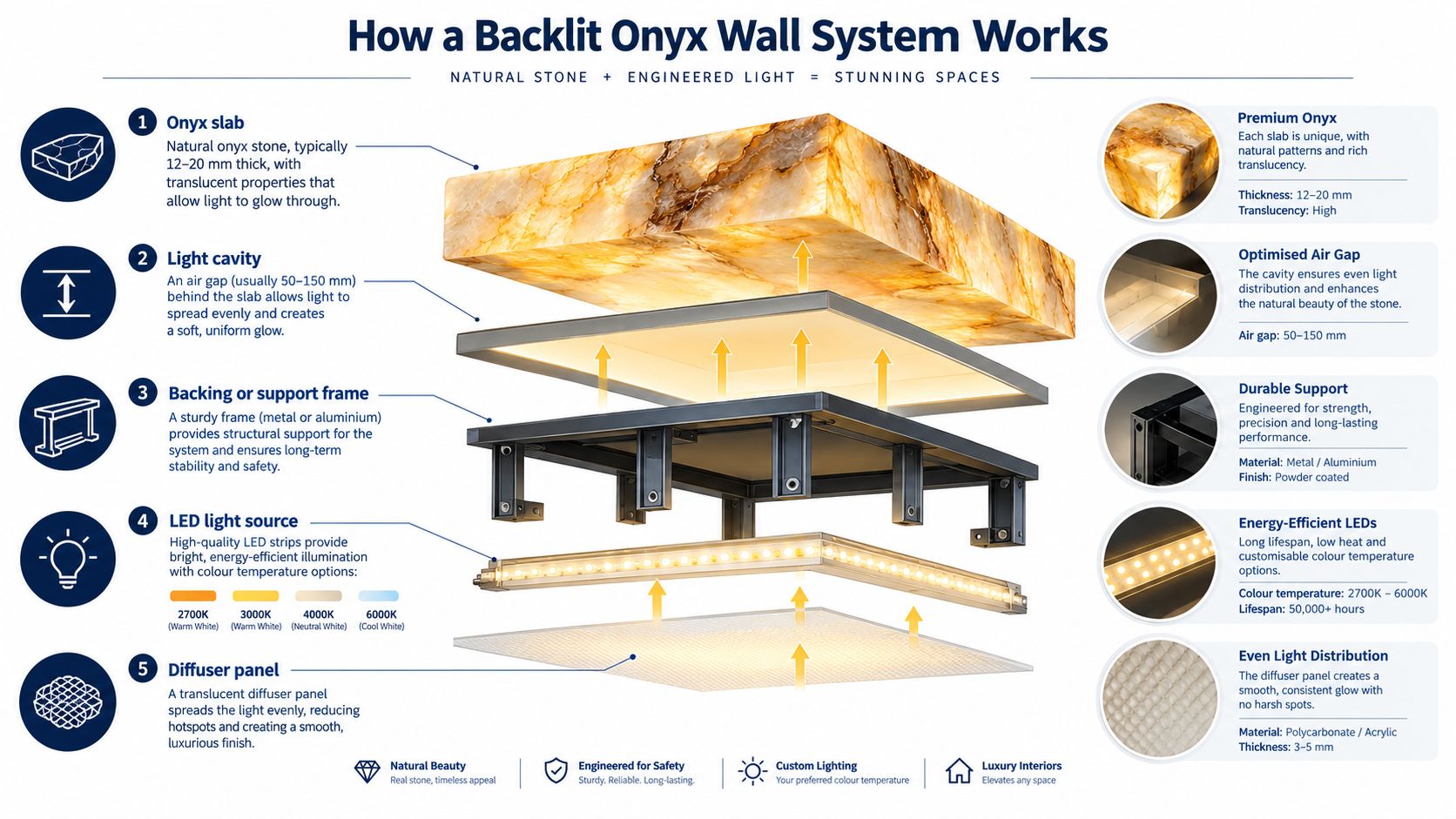
Light begins at LED strips or panels mounted behind the stone. A diffuser or controlled air gap spreads that light before it reaches the slab, reducing bright dots and dark bands. Drivers convert and control power, while dimmers or scene controls set the final intensity.
The support must hold each panel securely without opaque adhesive blocking the light path. It also has to stay flat. Even a slight bow can change the distance between LEDs and stone, making one area glow harder than another.
Judge the stone under working light
A slab that looks calm in a yard can become dramatic once illuminated. Veins darken, cloudy patches emerge and thin areas brighten. Reading about onyx marble texture and pattern behaviour helps, but it doesn't replace seeing your candidate slab against the intended colour temperature and diffuser arrangement.
This short visual reference is useful before you discuss panel joints and lighting positions with your designer or fabricator.
Five outputs to verify
- Even illumination: No visible LED points, stripes or unexplained dark corners.
- Secure retention: Panels fixed for their size, weight and location.
- Service access: Drivers reachable without dismantling finished stone unnecessarily.
- Heat control: Ventilation and spacing suitable for the specified lighting.
- Finished appearance: Joints, edges and vein flow checked with lights on and off.
Once you understand those dependencies, the pricing logic becomes straightforward. The stone creates the effect, but the hidden system determines whether that effect survives installation.
What Changes the Onyx Material Price
Onyx behaves like a theatre curtain made of stone. A more translucent piece lets light pass readily and can produce a soft, deep glow. That same quality reveals internal clouds, resin lines, backing shadows and abrupt colour changes you'd barely notice in ordinary light.
That's why translucency isn't a simple better or worse scale. You need enough light transmission for the design, plus enough consistency across panels to avoid a patchwork wall. A cheaper, highly variable slab can cost more after rejection, recutting and hotspot correction.
The material variables that move the rate
Provenance and rarity matter because colour, banding and block availability differ by quarry. Imported material also carries freight, handling and currency exposure, although you should ask for those elements in the quotation rather than guessing their share.
Colour uniformity and vein movement affect yield. If you want book-matched panels or continuous veining, the fabricator can't use every offcut. Consecutive panels may need to come from the same block and remain in sequence, which narrows the usable area.
Thickness changes both glow and risk. Thinner stone generally transmits more light but needs more careful handling and may require reinforcement. Thicker stone can feel more solid, yet it may need stronger, better distributed lighting to achieve the intended effect.
Panel size is equally important. Large pieces reduce joints but increase weight, transport risk and the cost of one fabrication mistake. Smaller modules are easier to handle and replace, although the joint pattern becomes part of the design.
What Indian benchmarks actually tell you
Published marketplace examples range from approximately ₹50 to ₹500+ per sq. ft. for ordinary onyx, while premium or imported examples reach roughly ₹975 to ₹2,100 per sq. ft., according to Indian onyx marketplace listings with thickness and colour examples. Treat that spread as evidence of variability, not as permission to budget at the bottom.
Separate cladding guidance places translucent onyx at approximately ₹500 to ₹1,500 per sq. ft. for the stone-and-cladding category, with professional installation charged separately, as set out in Indian natural stone wall cladding guidance. The categories overlap because suppliers define supply and cladding differently. Your quotation must define them precisely.
The cheapest slab is often the most expensive choice when matching, breakage and visual correction enter the job.
Selection is a cost control, not a luxury extra
Varun Marbles sources stone directly from quarries in Italy, Brazil, Turkey and India, hand-inspects slabs for vein, tone and translucency, and states that fewer than one in ten slabs are accepted into its gallery. View candidates in the imported onyx collection, then confirm the actual pieces in person. That discipline doesn't make natural variation disappear. It reduces the chance that you discover unacceptable variation after cutting has begun.
Separate Lighting Support and Installation Costs
Square-foot pricing works only for items driven by area. A backlit wall mixes area, length, fixed components and specialist labour. Compressing them into one rate hides the assumptions you'll later argue about.
Stone may be priced by slab yield or finished area. Surface preparation and support usually follow wall area. LED strip may follow running length, while drivers, controllers and electrician visits are separate items. Edge work can depend on panel count and profile, not just total square footage.
Use benchmarks to expose missing scope
A 2026 India benchmark gives ordinary wall-panel systems a broad installed range of ₹220 to ₹1,800 per sq. ft., while LED lighting is reported at approximately ₹150 to ₹300 per running foot and sheet installations commonly allow 10% to 15% wastage, according to Indian wall panelling cost guidance by material and complexity. Those are general panel figures, not a backlit onyx quotation. Their value is simpler. They prove accessories and measurement methods can change an advertised panel price materially.
For larger commercial estimates, your electrical consultant may use Exayard electrical estimating software to organise quantities and labour assumptions. Software doesn't validate the lighting design, though. The supplier still has to state module spacing, driver location, load, control method and access.
| Cost Component | Typical Measurement Basis | Details to Confirm |
|---|---|---|
| Onyx slab | Slab yield or finished area | Variety, thickness, grade, actual slab identity |
| Cutting and edges | Panel count, length or fabrication scope | Matching, reinforcement, profile, joint finish |
| Surface preparation | Wall area | Levelling, waterproofing where relevant, substrate condition |
| Support frame | Wall area or fabricated structure | Material, flatness, fixing method, panel retention |
| LED system | Running length or panel quantity | Output, spacing, colour temperature, diffuser |
| Drivers and controls | Item or circuit | Location, dimming method, replacement access |
| Electrical labour | Visit, circuit or project scope | Wiring route, load, testing, coordination |
| Transport and installation | Trip, area or project scope | Handling, site access, lifting, protection |
| Wastage and GST | Percentage or statutory charge | Calculation basis and whether exclusions apply |
The cavity is engineered scope
A diffuser, air gap and distributed LED layout aren't decorative extras. They're how you prevent visible hotspots. Likewise, a support system that allows a panel or driver to be serviced may cost more than adhesive fixing, but it protects you from destructive repairs later.
Reject any lump sum that won't identify these components. You don't need every screw itemised. You do need enough separation to change the stone, lighting or panel layout without repricing the entire wall from guesswork.
Build a Quote-Ready Technical Specification
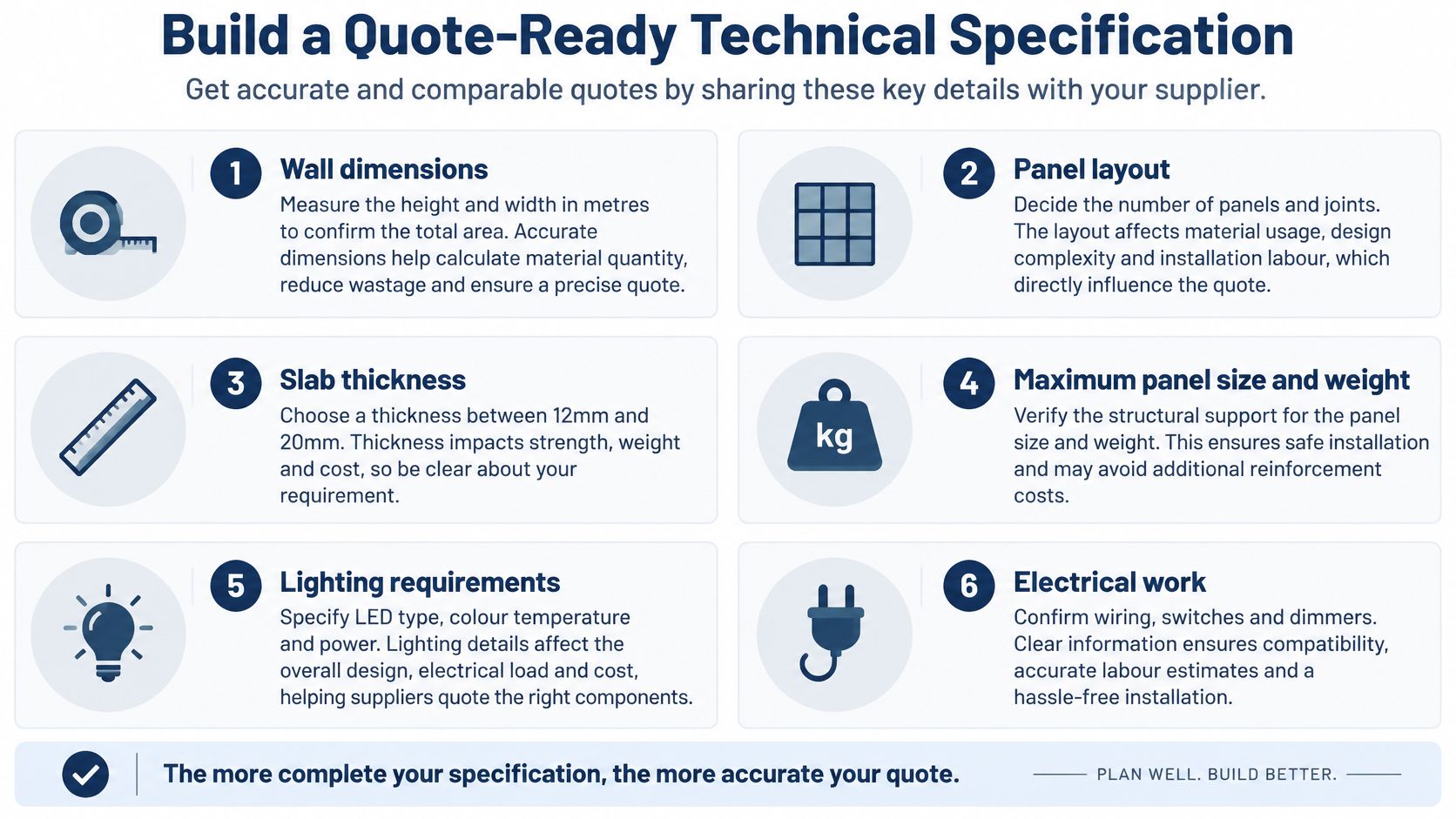
Start with the wall, not the slab photograph. Record finished height and width, obstructions, substrate type, nearby services and whether the wall is flat enough for the proposed system. Photograph the site and mark sockets, switches, skirting, cornices and access routes for large panels.
Next, freeze the panel layout. State panel dimensions, joint positions, maximum panel size and weight, slab thickness, edge profile and whether you expect book-matching or continuous veining. If the design relies on one dramatic vein, say so before slabs are reserved.
The checklist below turns those decisions into information a fabricator and electrician can price consistently.
Specify the light, not just the glow
- Define the source: Strip, module or panel, plus spacing and mounting method.
- Set colour temperature: Choose the intended warm or cool appearance and test it against the slab.
- Describe diffusion: Diffuser material, air gap and cavity depth.
- Name the controls: Switch, dimmer or scene control, including who supplies each part.
- Locate drivers: Accessible position, ventilation and replacement route.
- Confirm load: Circuit capacity, wiring route and testing responsibility.
Then request a mock-up under the final lighting arrangement. Check translucency, vein contrast, joint appearance and hotspot uniformity from normal viewing distances. Approve photographs only as records. Your eyes at the mock-up are the decision tool.
Put safety and lifetime cost in writing
India's fire-safety guidance states that combustible or flammable materials should not be used for wall panelling and that materials releasing toxic smoke or gases should not be used in those applications, as described in Indian fire safety guidance for building materials and escape routes. That means backing boards, adhesives, cables, insulation and driver enclosures need documentation as a complete assembly. Natural stone alone doesn't make the illuminated system compliant.
Ask who handles approvals, how heat is dissipated and how failed drivers are replaced. Also confirm decorative lighting won't obstruct required emergency or escape-route lighting. These questions belong in the specification, not in a hurried site conversation after panels arrive.
Approval rule: Select the slab if you like, but don't authorise full fabrication until the slab, cavity and lights have passed together.
Compare Residential and Commercial Project Scenarios
The same onyx can produce three very different quotations once use and operating conditions change. Don't force these scenarios into one specification. Price the risks that matter in each setting.
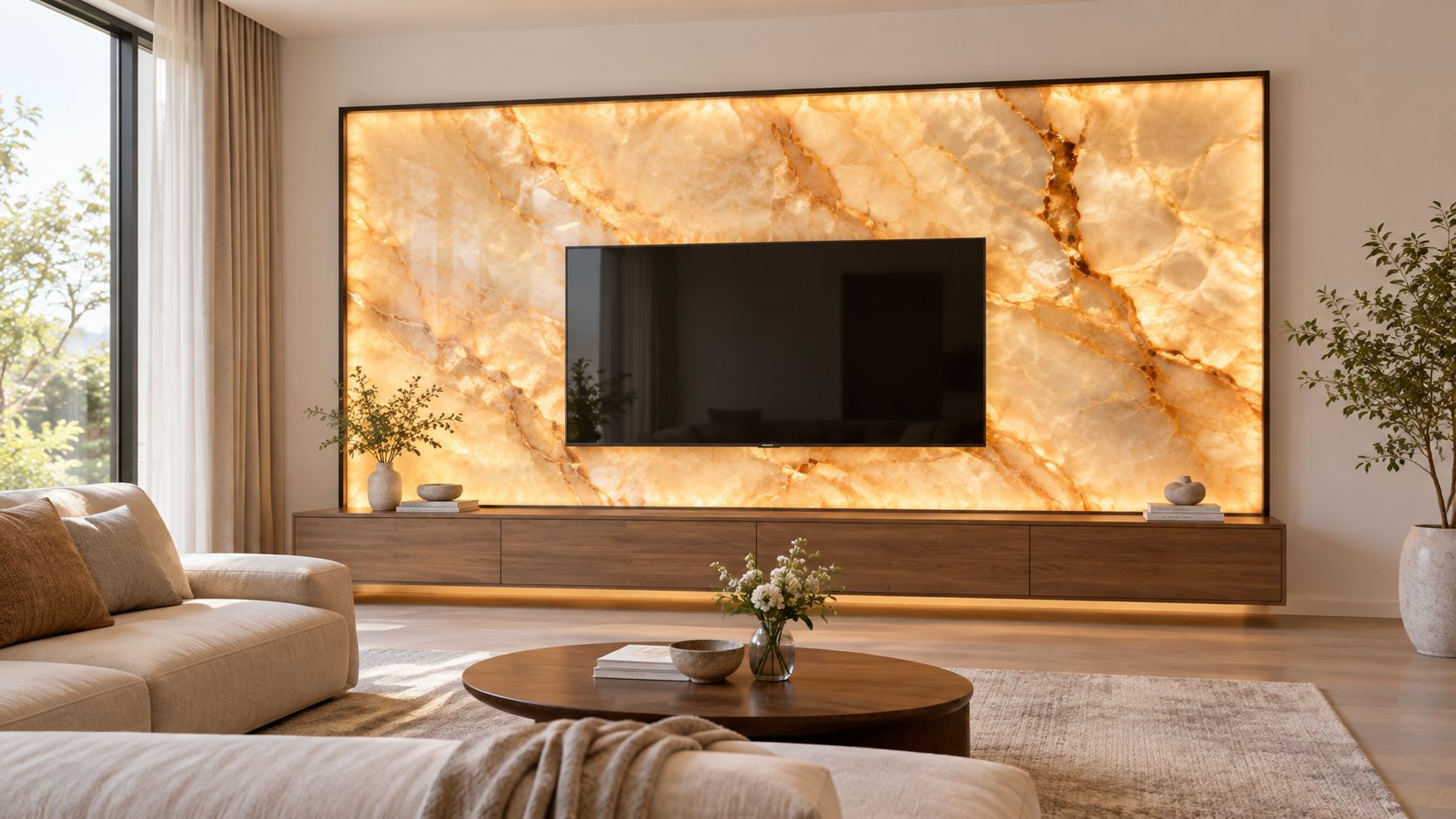
Residential media or living room wall
Your priorities are panel continuity, warm ambience and clean integration with joinery, speakers or a television. The wall is prominent but usually contained within one room, so slab matching and dimming quality deserve close attention.
Hidden drivers still need access. Homeowners often accept a removable side panel or nearby service point once they understand the alternative is cutting into finished work. Cost escalation usually comes from late slab changes, complex edges, difficult delivery access and electrical points that weren't coordinated with furniture.
Hospitality reception wall
A hotel or restaurant feature works harder. It's viewed at distance, photographed constantly and expected to stay consistent across a larger surface. Variation that feels artistic in a home may look like a defect behind a reception desk.
Prioritise panel sequencing, secure retention, maintenance access and approval coordination. Ask how one damaged section can be serviced without closing the whole front-of-house area for longer than necessary. Larger visual impact doesn't automatically require larger panels. A disciplined module can protect both programme and replacement options.
Retail and office fit-out
Commercial teams need repeatability. Standard module sizes, documented lighting components and clear replacement procedures matter because facilities staff will inherit the wall after handover.
Fire documentation for the complete assembly, operating hours, heat management and compatibility with fit-out sequencing can outweigh small differences in slab rate. A low initial price is poor value if the system delays approvals or every lighting repair becomes a stone removal exercise.
Across all three cases, the credible Backlit Onyx Wall Panels Price follows the same logic. Design intent sets the slab and lighting standard, operations set the service standard, and site conditions set the installation cost.
Request an Accurate Quote from Varun Marbles
Visit the Sikanderpur Marble Market or HUDA Marble Market Sector 33–34 showrooms in Gurugram with measurements and site photographs, not just inspiration images. You need to inspect candidate slabs, discuss finishes and understand how the actual material behaves before anyone reserves it.
Bring the finished wall dimensions, preferred panel layout, thickness, matching intent and edge profile. Add the proposed lighting colour, dimming method, driver location, available electrical point, delivery address and programme. If an architect or contractor controls part of the scope, identify that boundary clearly.
Send one enquiry pack to every supplier
- Drawings and photographs: Wall elevation, panel joints, obstructions and site access.
- Stone requirements: Preferred colour family, translucency, thickness and matching standard.
- Lighting requirements: Source type, controls, driver access and electrical responsibility.
- Fabrication scope: Cutting, reinforcement, backing, edge finishing and protection.
- Commercial scope: Transport, installation, wastage, GST, exclusions and approval duties.
Use the Varun Marbles contact page to start the enquiry, then insist on an itemised response. Ask whether the rate changes if the selected slab differs from the allowance. It often will, and that's acceptable if the quotation explains the trigger before you commit.
Questions that prevent site surprises
Ask who verifies site measurements and wall flatness. Confirm who supplies the frame, LEDs, channels, diffuser, drivers, controls and wiring, and who connects and tests the final circuit. Clarify whether panel removal is possible for maintenance.
Request the lighting mock-up as a named step before full fabrication. Also confirm slab reservation, cutting approval, transport protection and what happens if a panel breaks before installation. Those answers matter more than a persuasive opening rate.
Varun Marbles' role in sourcing, slab selection and fabrication coordination is most useful when you give the team a complete brief early. Bring the technical questions with you. Don't wait until the stone is cut to discover that lighting and support were somebody else's assumption.
Make the Final Price Decision With Confidence
Compare quotations only when they describe equivalent work. Line up slab variety and grade, thickness, panel sizes, matching, reinforcement, edge finish, support, cavity depth, LED specification, controls and service access. Then compare transport, installation, wastage, exclusions and GST.
The scale becomes clearer with a planning example. Published 2026 Indian benchmarks place natural-stone wall treatments at approximately ₹500 to ₹900 per sq. ft. installed, implying about ₹50,000 to ₹90,000 for 100 sq. ft. before specialised backlighting and related work, according to Indian wall finish cost comparisons for 2026. That's a benchmark for orientation, not an onyx offer.
Your approval checklist
- Slab approved: Actual pieces inspected and reserved for the agreed layout.
- Mock-up approved: Glow, joints and colour checked under final lighting.
- System documented: Support, diffuser, drivers, controls and access defined.
- Safety assigned: Assembly documentation and approval responsibilities named.
- Commercial scope closed: Wastage, logistics, installation, taxes and exclusions written down.
- Maintenance planned: Driver replacement, heat dissipation and panel access understood.
Pay for serviceability where it protects the installation. A modest saving on hidden components isn't a saving if it creates hotspots, blocks repairs or leaves approval gaps. Equally, don't upgrade the slab while leaving the lighting underspecified. The wall succeeds as a system.
Approve fabrication only after slab selection and the intended lighting arrangement have been validated together. That's the point at which a Backlit Onyx Wall Panels Price becomes dependable enough to sign.
Bring your wall measurements, panel layout and lighting intent to Varun Marbles to inspect suitable onyx slabs and develop an itemised quotation for the complete backlit assembly. Visit the Gurugram showrooms to judge vein, tone and translucency in person before you approve fabrication.