
What Is the Difference Between Onyx and Marble?
If a slab looks beautiful in a showroom, does that tell you whether it belongs beside a kitchen sink or behind an illuminated bar? Not necessarily. Onyx and marble can share colours, polish and even a sales label, yet those similarities don't establish how they'll perform after installation.
To understand what is the difference between onyx and marble, start with how each stone forms. Then connect that origin to light transmission, surface wear, fabrication and care. For a real purchase, the decisive evidence is the selected slab, its test reports and a maintenance plan, not the photograph or the name on the quotation.
Table of Contents
- Onyx and Marble Side by Side
- How Formation Shapes Looks and Light
- Hardness, Porosity and Durability Compared
- Matching Each Stone to Its Best Use
- Care Needs and What They Add to Cost
- Confirm the Stone Before You Commit
Onyx and Marble Side by Side
Marble is a metamorphic rock, usually limestone transformed by heat and pressure into interlocking crystals, while architectural onyx is a dense calcium-carbonate deposit laid down in layers from cold-water solutions.
That's the geological distinction. For buyers, the most noticeable difference is usually how the stones handle light: marble commonly presents a solid background with veining, while suitable onyx can reveal illuminated bands when lit from behind.
Onyx and marble compared on six criteria
| Feature | Marble | Onyx |
|---|---|---|
| Geological origin | Metamorphic rock formed through recrystallisation of limestone or dolomitic limestone | Dense calcium-carbonate deposit laid down from cold-water solutions |
| Typical pattern | Crystalline veining over a base colour | Layered, variegated colour bands |
| Translucency | Commonly opaque to semi-translucent | Generally translucent to transparent |
| Usual role | Floors, walls, counters and architectural surfaces | Backlit feature walls, bars, partitions and display elements |
| Care sensitivity | Needs protection against staining, acid etching and abrasive wear | Needs the same chemical precautions, plus careful assessment of bands, reinforcement and construction |
| Relative cost | Compare the selected variety, dimensions, finish and installed specification | Include specialist backing, lighting and fabrication where required, rather than comparing slab price alone |
Typical characteristics aren't slab guarantees
The trade name onyx marble is often applied to banded carbonate stone. It doesn't mean the material has the same geological origin or performance as conventional marble, and it doesn't guarantee that every part of the slab will transmit light evenly.
Neither material is a single, uniform product. A pale marble with restrained veining and a heavily patterned marble can present different fabrication challenges. Equally, an onyx slab with broad translucent areas may produce a different result from one containing dense, dark bands.
Cost needs the same caution. Without matching the slab dimensions, finish, support, edge treatment and installation scope, a cheaper quotation may exclude more work. A backlit wall quotation should include the lighting assembly and access for maintenance, not just the visible stone.
Buying principle: Compare completed surfaces doing the same job, not material names on separate price lists.
The practical choice comes down to these questions:
- Available light: Will the stone receive ordinary room lighting, or will a designed backlighting system reveal its interior?
- Expected use: Will people walk on it, prepare food beside it, splash it or mainly look at it?
- Accepted upkeep: Who will clean, inspect, reseal and arrange repairs after installation?
Answer those questions before narrowing the colour selection. They'll help you distinguish a visually appealing slab from one that suits the room.
How Formation Shapes Looks and Light
Think of marble as resembling a sugar cube whose grains have been transformed into a denser, interlocking solid. Onyx is closer to the idea of a stalactite, built through mineral deposition as water leaves material behind. These are visual analogies, not exact accounts of the geological processes, but they explain why the stones develop different patterns.
The Indian Bureau of Mines' marble review describes conventional marble as a metamorphic material and onyx as a dense crystalline calcium-carbonate deposit formed from cold-water solutions; it also notes that Indian mineral reporting has included calcareous stones such as onyx, travertine and certain limestones within the broader marble category. That commercial overlap is why a familiar name can conceal a different material.
Crystals create a different appearance from deposited layers
During marble formation, heat and geological conditions cause the original carbonate minerals to recrystallise. The resulting calcite or dolomite crystals interlock, producing the crystalline surface that can take a polish.
Mineral differences and the structure of the original rock contribute to the finished appearance. A slab may have a quiet background, fine veins, broad streaks or a more broken pattern. Calling all of these merely veined doesn't capture how differently they can look across a large floor or wall.
Onyx develops through successive deposition. Changes between deposited layers produce its characteristic bands, which may appear straight, curved, cloudy or irregular in the cut slab. Cutting direction matters because the fabricator is exposing a particular view through that layered material.
The difference is visible even in small decorative objects.
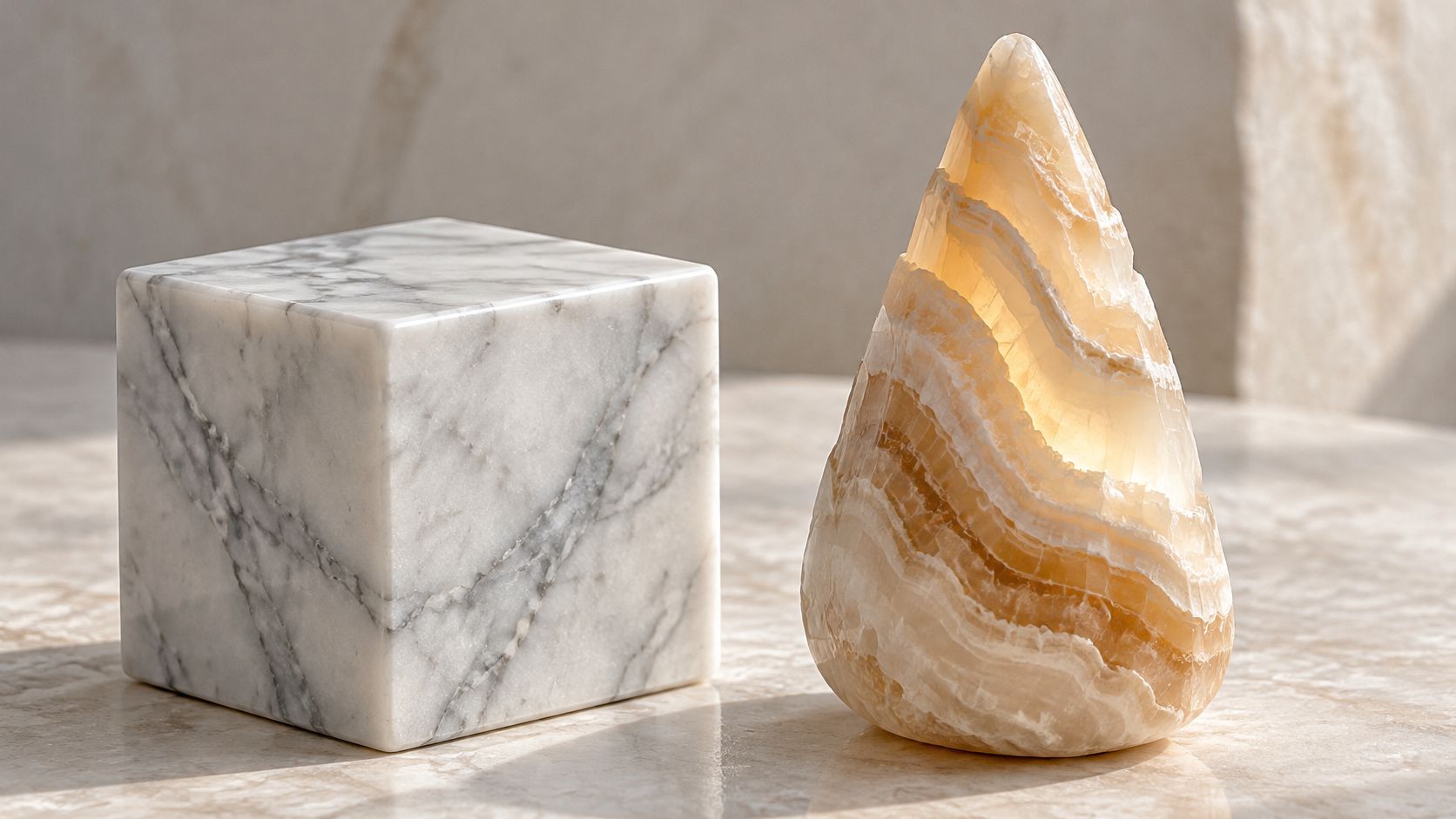
For a closer look at how those bands read across a surface, this guide to onyx marble texture helps connect pattern selection with the intended design. Use texture photographs to establish a preference, then inspect the actual slab rather than expecting another piece to match.
Light changes the buying decision
The Indian Bureau of Mines' later marble review describes onyx as generally transparent to translucent, with characteristic variegated colour layering, and records an occurrence in Kupwara district, Jammu and Kashmir. Onyx therefore isn't solely an imported material in the Indian geological context, although the origin of any offered slab still needs confirmation.
Consider a cream onyx slab under overhead showroom lights. It may look fairly subdued, with only a suggestion of its internal bands. When the supplier illuminates it from behind, some areas may glow warmly while denser bands remain darker.
That change is the attraction, but it also creates a specification task. You're selecting both a stone and a lighting assembly.
- Slab thickness: Assess light transmission through the intended finished thickness, not a thinner display sample.
- Band orientation: Check whether the chosen cut creates the movement you want across adjoining panels.
- Backing and support: Confirm that adhesives, reinforcement and substrates won't create unwanted shadows.
- Lighting and heat: Review lamp position, diffusion, ventilation and access for replacement.
Marble can also transmit some light in particular conditions, but don't assume that a pale colour guarantees a glowing wall. Similarly, the word onyx doesn't guarantee an even illuminated field.
At home, hold a loose sample against a cool light source and observe whether its bands glow evenly or look patchy. Treat that as an initial visual check only. Before approving a large installation, assess a mock-up using the selected slab construction and proposed lighting.
Hardness, Porosity and Durability Compared
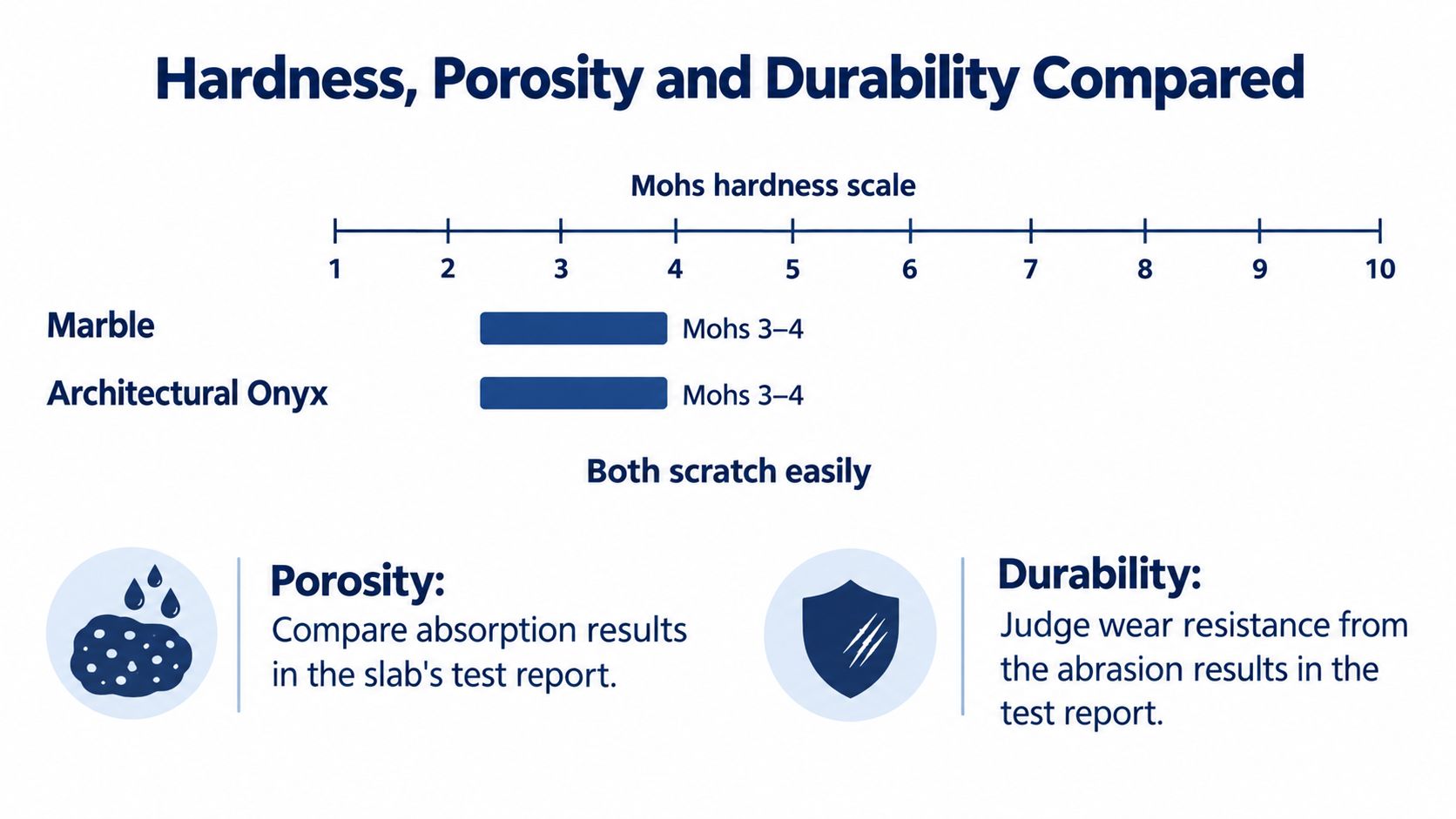
Drop a steel key on either stone and it will probably leave a mark. That small experiment captures the central truth of this comparison: onyx and marble sit close together on the hardness scale, so the differences that matter for a purchase lie in absorption, etching behaviour and how each stone responds to repair.
Performance of onyx and marble by test
| Test | Marble | Onyx | What It Means for You |
|---|---|---|---|
| Mohs hardness | Typically about 3 to 4 | Typically about 3 to 4 | Neither should be treated as scratch-proof; don't substitute a hardness ranking for wear testing |
| Water absorption | Measured per sample; the result belongs to that specific stone | Measured per sample; varies with the specific material and any resin treatment | Lower measured absorption helps assess wet-spill exposure, but doesn't establish stain immunity |
| Acid sensitivity | Carbonate surfaces can etch with lemon, vinegar and unsuitable cleaners | Carbonate onyx is also acid-sensitive | Use a compatible pH-neutral stone cleaner |
| Stain risk without sealer | Assess absorption, finish and intended exposure | Assess absorption, resin treatment and intended exposure | Confirm the approved sealing system before first use |
| Repairability | Honing and polishing can restore many affected surfaces | Bands, resin and translucency can complicate a visual match | Agree a repair method before buying |
Hardness isn't the same as durability
A scratch test asks a narrow question: how readily can another material mark the surface? It doesn't tell you whether a slab will resist repeated foot traffic, tolerate a fixing arrangement or remain attractive beside a wet basin. Hardness works like a single exam grade, useful, but no summary of the whole student.
Architectural onyx also shouldn't be confused with the silica-based gemstone called onyx. A gemstone description isn't a specification for a decorative building slab. Ask the supplier to identify the actual material rather than transferring properties from a name.
The illustration below gives a simplified comparison. Use it as an orientation aid, not as a substitute for material identification and testing.
Separate absorption, etching and staining
Porosity describes the tiny voids within stone; connected pores can provide routes for liquid to enter. Water absorption is a measured behaviour under test conditions. A polished face alone doesn't establish either property, because polishing closes the visible surface without changing the voids beneath.
Ask which specification the absorption result has been assessed against and whether the tested sample represents the supplied material. Resin treatment and surface finish also deserve documentation. Don't assume that one marble's result applies to every marble, or that every onyx absorbs more water.
Acid etching is different from staining. Lemon juice or vinegar can react with carbonate minerals and leave a dull patch, even when the liquid hasn't produced a coloured stain. An impregnating sealer doesn't make a carbonate surface acid-proof.
Stain prevention therefore needs both appropriate treatment and sensible use. Repair planning matters too: refinishing a broad marble surface may be relatively straightforward, while matching an onyx repair across bands and illuminated areas can require specialist assessment.
The Indian Bureau of Mines' review discussing BIS stone-quality testing identifies water absorption, porosity, abrasion resistance, durability and weathering among relevant checks, alongside compressive, tensile and shear strength. Request the tests relevant to the proposed application; premium and strong aren't performance evidence.
For wet installations, SouthRay Kitchen & Bath's guide to waterproofing natural stone shower walls is useful context for discussing the assembly behind the finish. Sealing the stone face isn't a replacement for a properly detailed waterproofing system.
If you're also assessing a different natural-stone category, a comparison of marble and quartzite can help frame the questions. Keep the same discipline: identify, test and specify the material being purchased.
Matching Each Stone to Its Best Use
For a backlit feature wall, suitable onyx is the more direct choice because light transmission is the intended effect. The recommendation becomes less automatic when the same material moves from a vertical panel to a surface exposed to glasses, cleaners, shoes or cooking.
Start with the job, then decide whether the stone can do it.
Best stone for each application
| Application | Better Fit | Why |
|---|---|---|
| Backlit feature wall | Onyx, after a lighting mock-up | Translucency can reveal the internal bands |
| Bar counter with protected top | Onyx | A protective surface can separate decorative stone from spills and impact |
| Kitchen worktop | Marble, with verified absorption and an agreed care plan | Repeated food and liquid exposure requires documented performance |
| Bathroom vanity | Marble, subject to moisture assessment | Wet-area detailing and practical repair options matter |
| High-traffic lobby floor | Marble, verified for abrasion | Abrasion results decide suitability |
| Exterior cladding | Neither by default | Weathering evidence and local exposure must support the choice |
Place the visual effect where it can be protected
A reception wall or bar front lets people appreciate onyx without using it as a working surface. The designer can concentrate on band alignment, panel joints, light diffusion and how the stone looks when the lighting is switched off.
A horizontal bar top is a different proposition. A low-use residential bar may accommodate carefully selected onyx, but sealing alone won't protect it from acid etching or a dropped bottle. Consider a separately designed protective top, use coasters and agree acceptable wear before ordering.
You can also introduce the appearance without committing to a fixed installation. Astro West's banded onyx decorative bowl illustrates how a movable object can bring banded stone into a room. That's a lower-commitment design choice than replacing a worktop, though decorative stone still needs appropriate handling.
Specify working surfaces for exposure
In a kitchen, tested marble can be a more manageable choice than untested onyx, but it isn't maintenance-free. Use chopping boards and trivets, and make sure the owner accepts the possibility of visible etching. A sealing plan addresses only part of that exposure.
For a bathroom vanity, examine the basin cut-out, tap penetrations, splashback junction and drainage. A familiar marble variety won't compensate for water collecting around a poorly detailed edge.
A lobby floor requires a different conversation again. Ask about abrasion, the proposed finish, cleaning equipment and repair access. For exterior cladding, add weathering, moisture movement, fixings and the local climate to the assessment.
Choose by the job the surface must do before choosing by the picture.
Marble often suits surfaces that need future refinishing and integration with a larger architectural scheme. Onyx is most persuasive where its optical effect is central to the design and the installation protects that effect from avoidable damage.
Care Needs and What They Add to Cost
Blot spills promptly with a soft cloth, clean with a compatible pH-neutral stone cleaner, and dry areas where water collects. Keep vinegar, lemon-based cleaners and abrasive pads away from both stones. Don't use bleach or other aggressive chemicals unless the stone-care specification expressly approves the product and dilution.
Make the routine realistic. A homeowner may be comfortable using coasters and wiping a vanity after use; a hospitality team needs a written cleaning procedure that staff can follow between shifts. A maintenance plan that relies on everyone remembering verbal advice won't travel well from installation to daily operation.
Assign responsibility before installation
The Bureau of Indian Standards' published stone standards listing includes IS 8759:2024 for maintenance and preservation of stone in buildings and IS 14223 Part 2:2025 for polished marble and similar stones; its published marble information also gives a reference maximum moisture absorption of 0.4% for the covered marble specification. That limit belongs to its stated scope, not to every stone sold under a marble label.
For your installation, obtain a written care schedule naming:
- Daily cleaning: The approved cleaner, cloth or mop, and spill-response method.
- Resealing responsibility: Who assesses the surface, selects the compatible treatment and arranges reapplication.
- Inspection points: Edges, joints, basin cut-outs, seams and areas where water tends to stand.
- Repair contact: Who can assess dull patches, chips, opened joints or a change in appearance.
Onyx installations need coordination beyond surface cleaning. Confirm how technicians will access lighting without damaging the stone, and how they'll inspect seams, backing and any resin-treated areas. Keep lamp heat and ventilation within the lighting designer's specification.
For marble work surfaces, understanding polished marble countertops can help owners decide whether a reflective finish suits their habits. Agree the finish and repair expectations together rather than choosing polish solely from a display.
Compare lifetime commitments, not just slab prices
Ask suppliers to separate the quotation into understandable components:
- Material selection: Grade, colour, dimensions and the amount of selective cutting needed for the pattern.
- Fabrication: Cut-outs, edge profiles, finishing, reinforcement and handling.
- Installation assembly: Supports, backing, adhesives, lighting and service access.
- Ongoing care: Cleaning products, inspections, resealing and professional refinishing where needed.
Cost check: Ask what happens when a light fails, a joint opens or the finish needs attention, and who pays to put it right.
A lower slab price can lead to a higher ownership cost if access is difficult or repairs require extensive dismantling. The useful comparison is a complete installed specification supported by a practical care plan.
Confirm the Stone Before You Commit
Confirm identity and performance before paying for the visual effect. The Indian Bureau of Mines' marble chapter distinguishes recrystallised marble from deposited, generally translucent onyx, supporting identification through the material itself rather than a broad trade description.
A supplier's sample is useful, but the final approval should relate to the reserved slabs. Record their identifiers and keep approved photographs alongside the specification.
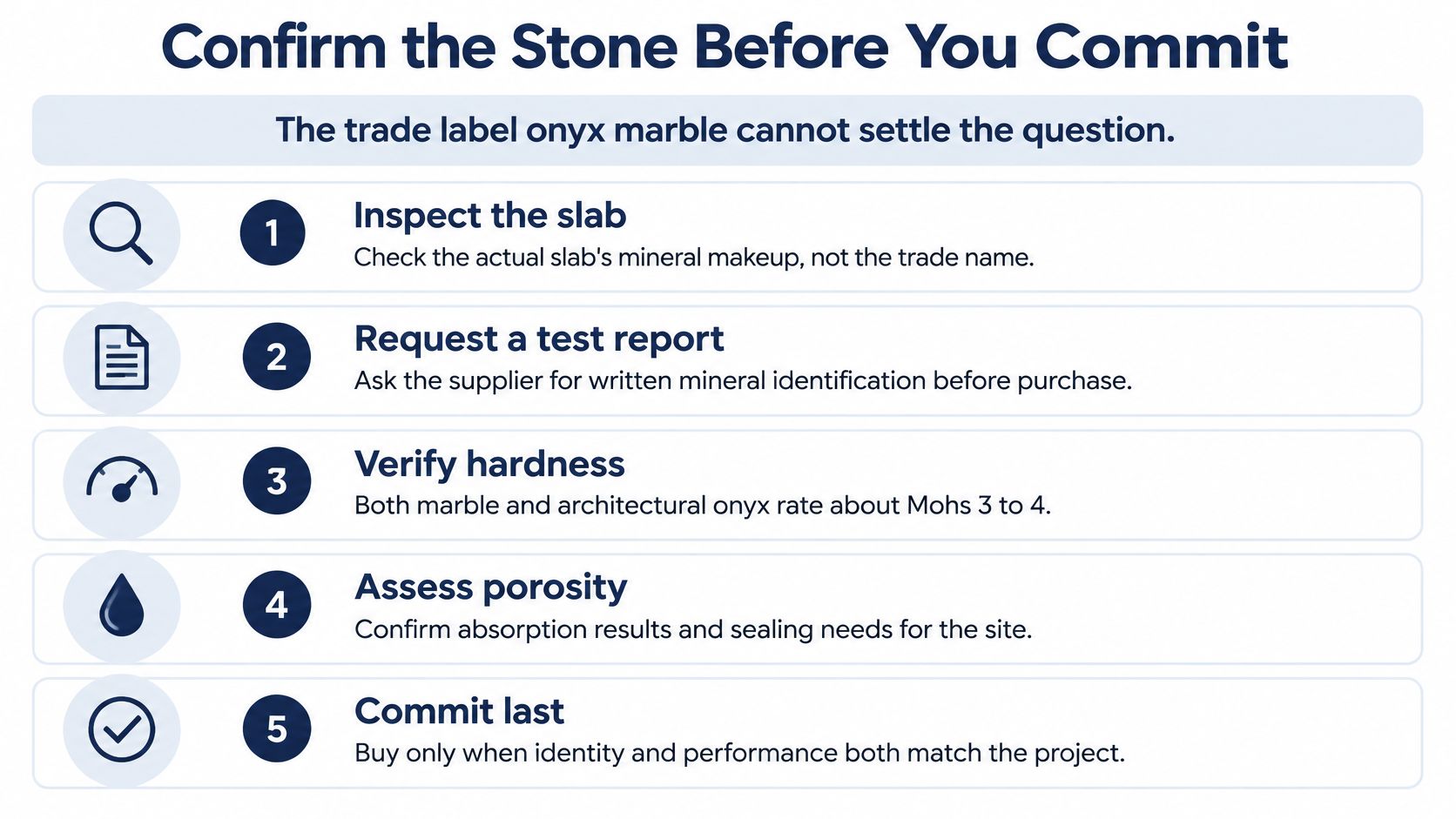
Take this checklist to the showroom
Request relevant test reports. Ask for water absorption, porosity, abrasion and durability evidence, with a clear explanation of how the tested material relates to the slabs offered.
Confirm origin and mineral composition. Get the geological identification in writing. A commercial name alone isn't enough to establish suitability.
View the actual slabs under different lighting. Inspect the face under ordinary room light and the proposed project lighting. Don't approve colour from a phone photograph alone.
Order an application-specific mock-up. For backlighting, include the intended backing and lamps. For a heavily used surface, assess the finish, joints and cleaning method.
Review construction details. Check seams, edge profiles, substrate support, cut-outs and handling arrangements with the fabricator before cutting begins.
Write the care schedule. Use the maintenance standard identified above as a discussion point with the project team, and name the people responsible for cleaning, inspection and resealing.
Budget for the complete assembly. Include lighting, backing, fabrication, installation and maintenance access rather than approving a slab-only figure.
Send this checklist to the supplier before your visit so the relevant documents and slabs can be ready. Bring room photographs, drawings and details of expected use; these make the conversation more useful than a colour preference alone.
There's no universal winner. The right stone is the one whose appearance, measured performance and construction suit the room, the light and the people who'll maintain it.
Varun Marbles offers marble and onyx selection, cut-to-size fabrication, finishing and installation coordination for residential and commercial interiors. Visit Varun Marbles with your drawings and checklist to compare actual slabs and discuss the evidence, lighting and care requirements before you commit.