
8 Types of Surface Finishes for Stone and Quartz
You've chosen a dramatic slab for the kitchen island, and now the fabricator asks whether you want it polished, matte or textured. Meanwhile, the architect wants a quieter living-room floor, and the entrance contractor needs a surface that works when visitors bring monsoon water indoors. Choosing the stone hasn't settled the finish.
A polished Calacatta marble island, a matte quartz worktop and a flamed granite entrance need different fabrication, cleaning and installation decisions. A finish isn't merely decorative. It influences glare, visible wear, cleaning effort, tactile grip, repair options and how the exposed edges should be completed.
Before comparing types of surface finishes, establish where the material will go, how much traffic and moisture it will encounter, and how much maintenance you'll accept. Check the lighting, substrate and available fabrication expertise too. For visual drama, start with polished stone; for softer reflections, consider honed or leathered surfaces; for exposed paving, investigate a suitable textured finish with verified performance.
Table of Contents
- 1. Polished Finish
- 2. Honed (Matte) Finish
- 3. Leathered Finish
- 4. Flamed Finish
- 5. Bush-Hammered Finish
- 6. Tumbled Finish
- 7. Sandblasted Finish
- 8. Natural Cleft (Riven) Finish
- 8 Surface Finish Types Compared
- Make the Finish Work for the Space
1. Polished Finish
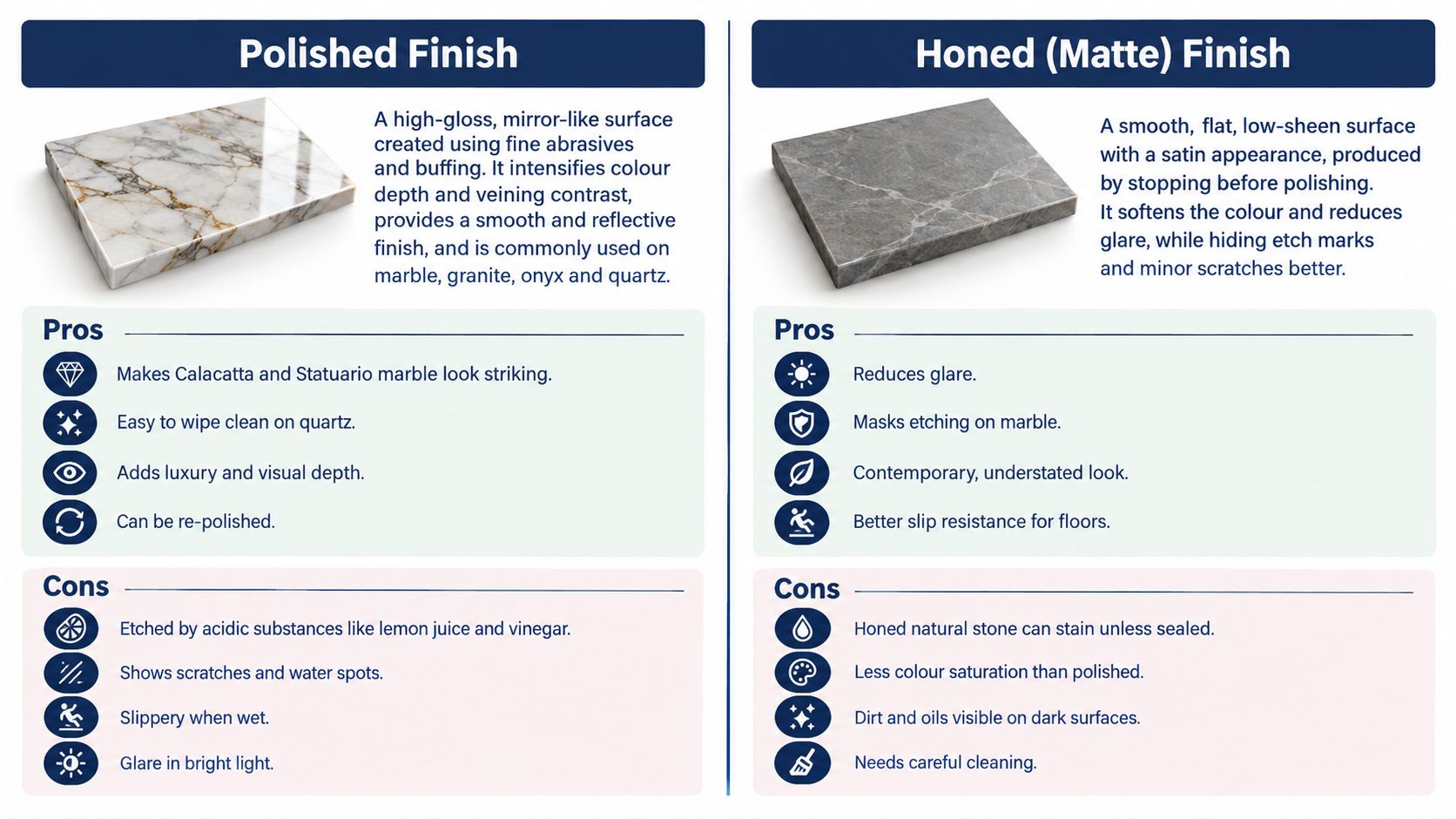
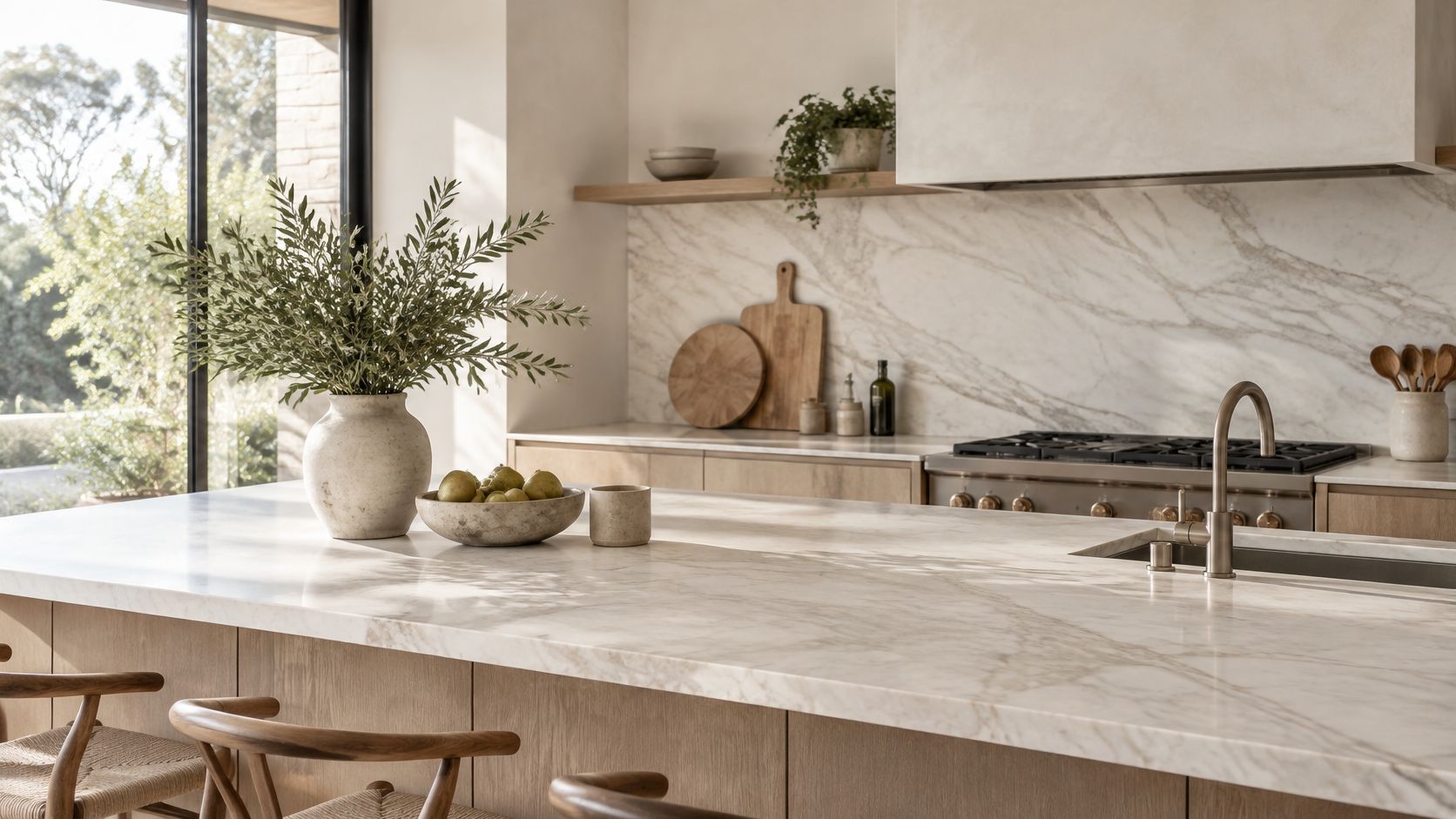
Polished stone is the choice for colour depth and reflected light. Fabricators grind the surface with progressively finer abrasives, then polish it to achieve a glossy appearance. On a strongly veined Calacatta marble island or an onyx feature wall, that reflection becomes part of the design.
Polishing emphasises colour and pattern, but it doesn't establish the stone's underlying quality. The Indian natural-stone specification guide recommends checking absorption, thickness and finish consistency alongside relevant standards, including IS 1124 for absorption testing and IS 14223 for polished building and decorative stone.
Specify the Upkeep, Not Just the Shine
For a kitchen, discuss how the client cooks and cleans before approving polished marble countertops. Marble needs protection from acidic cleaners and spills that can dull its surface. Use a suitable pH-neutral stone cleaner, and agree on a maintenance and restoration approach with the fabricator.
- Review the lighting: Inspect the slab under the proposed pendants and daylight, not just showroom lighting.
- Approve the edges: Ask for an edge sample so its sheen matches the face.
- Separate locations: A glossy backsplash and a wet walking surface shouldn't share a specification just because they share a colour.
Varun Marbles note: Compare polished Italian or Indian marble with polished quartz for worktops, and onyx for decorative walls. For Kalinga Stone, confirm the selected product's available finish and application guidance rather than assuming every collection behaves like natural marble.
2. Honed (Matte) Finish
A living-room floor doesn't always need to reflect every ceiling light. Honed stone offers a smooth, low-sheen alternative, produced by abrasive grinding that stops before a full polish. It suits schemes where the stone should contribute texture and tone without dominating the room.
Honed Makrana marble flooring, a subdued granite worktop or matte quartz cabinetry surfaces are useful design directions. However, a quieter appearance isn't a promise of effortless care: compare honed and polished marble with cleaning habits and expected wear in mind.
Matte Isn't a Slip Certificate
The Indian flooring-finish specification guide describes honed stone as offering somewhat better wet performance than polished stone, while recommending more textured finishes for exposed wet walking areas. Don't approve a bathroom or entrance floor on sheen alone.
For natural stone, agree on a compatible penetrating sealer and maintenance schedule after reviewing the material's absorption and exposure. Sealing isn't a substitute for prompt cleaning or suitable cleaners.
Practical rule: Choose honing because you want a softer surface appearance, then verify its suitability for the actual room separately.
Varun Marbles note: Compare honed marble and granite with factory-produced matte quartz under the project lighting. Keep onyx focused on its intended decorative application, and request the specific Kalinga Stone finish sample rather than treating “matte” as a universal surface specification.
3. Leathered Finish
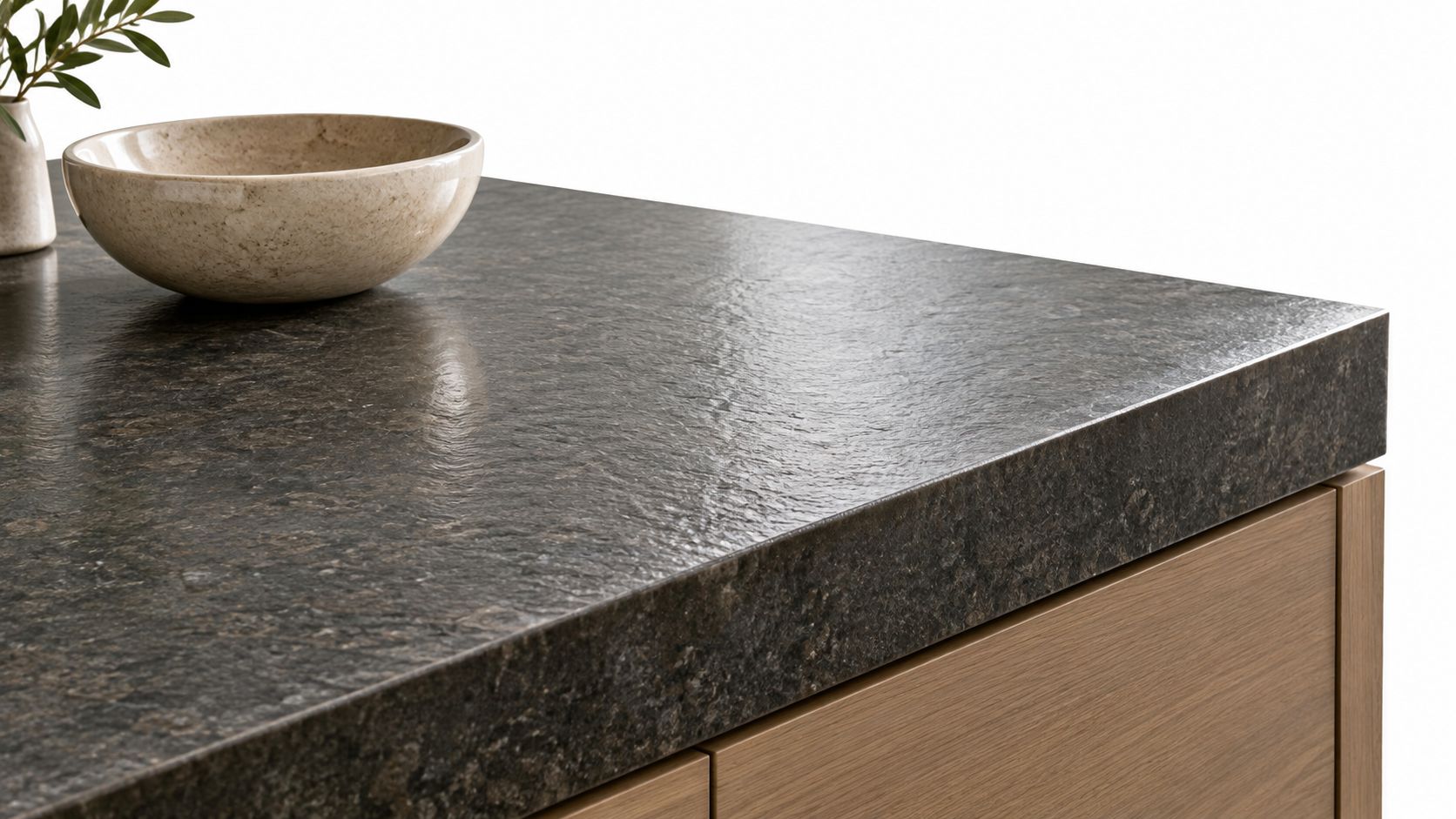
Run your hand across leathered stone before choosing it from a photograph. The attraction is tactile: a low-sheen surface with fine, uneven texture, rather than the flat smoothness of honing.
Fabricators typically develop that texture with abrasive or diamond brushes after preparing the stone surface. The result depends on the material, so a leathered granite sample shouldn't be used to approve the texture of a different granite, marble or engineered quartz product.
Balance Smudge Visibility Against Cleaning
A leathered granite kitchen island is worth considering when a family wants a less reflective worktop. The texture can make minor marks less conspicuous, but it also creates recesses that need proper cleaning. Don't confuse less visible residue with a clean surface.
- Test the routine: Try the proposed cleaner on an offcut and check for residue after drying.
- Inspect the edge: Approve how the texture meets the edge profile, sink cut-out and backsplash.
- Check availability: Confirm the chosen slab can receive the intended treatment before finalising drawings.
For a retail wall, the same tactile character may be desirable without the cleaning demands of a food-preparation surface. For a lobby floor, require relevant slip testing rather than relying on how grippy it feels by hand.
Varun Marbles note: Start with granite or an available leathered quartz option. Confirm marble suitability individually; don't assume onyx or every Kalinga Stone product can accept the same brushing process or achieve the same result.
4. Flamed Finish
For an exposed entrance, begin with wet-use requirements rather than gloss. Flaming uses intense heat on suitable stone to disrupt the surface and create a rough, non-reflective texture. Granite is the principal material to discuss for this treatment.
A flamed granite pathway, exterior step or pool-side paving scheme still needs careful drainage and installation design. Texture alone won't compensate for standing water, poorly resolved thresholds or unsuitable cleaning practices.
The supplied video provides a visual reference for the finish.
Confirm the Material Before Processing
Ask the supplier to approve the particular granite for flaming, then review a processed sample for colour, texture and dimensional consistency. Coordinate finished thickness with bedding and adjoining surfaces, rather than asking the installer to resolve discrepancies at site.
For North Indian procurement, Rajasthan deserves attention: it accounted for roughly 57% of India's granite production in FY2024, according to the CRISIL report on the Indian granite sector. That sourcing context doesn't establish the suitability of an individual slab, which still needs inspection.
Varun Marbles note: Discuss flamed granite separately from interior marble selections. If you're considering red marble flooring, don't transfer the granite finishing specification to it; likewise, onyx, quartz and Kalinga Stone require their own product-specific approval.
Plan access for cleaning debris from the texture, especially around planting beds and entrance drains.
5. Bush-Hammered Finish
A bush-hammered panel has a deliberately worked, rugged character. A multi-point hammer repeatedly strikes the surface, creating a field of small indentations rather than the brushed relief of leathering or the thermal texture of flaming.
Consider it for a granite garden wall, a commercial façade feature or exterior stair treads where the design calls for pronounced texture. Approve the actual texture depth, because an attractive vertical panel may feel too coarse for the adjacent walking surface.
Resolve the Boundary Details
The difficult part is often where the texture stops. A stair tread may need a controlled nosing detail, while a façade panel needs clear decisions about corners, joints and visible returns.
- Approve a sample panel: Review texture consistency across a meaningful area, not just a small chip.
- Coordinate the edges: Show whether borders remain smooth or receive the same treatment.
- Agree on cleaning: Start with a suitable brush and water, and obtain approval before using aggressive cleaning equipment.
A rougher-looking finish isn't automatically the right finish. Approve the texture for the people who'll touch, walk on and maintain it.
For stairs and paving, ask for performance evidence for the finished surface and intended conditions. Avoid presenting bush-hammering as a substitute for drainage or good step geometry.
Varun Marbles note: Explore suitable granite first, and assess other natural stones individually. Don't specify bush-hammering for marble, onyx, engineered quartz or Kalinga Stone without confirming material suitability, processing approval and an acceptable sample.
6. Tumbled Finish
For a rustic kitchen backsplash, perfectly sharp edges may work against the design. Tumbled stone has softened corners and an aged appearance, created by rotating smaller pieces with abrasive media and water.
Marble, travertine and limestone are common directions for this look. A tumbled marble feature wall or travertine backsplash can introduce variation without requiring the strong reflection of polished stone.
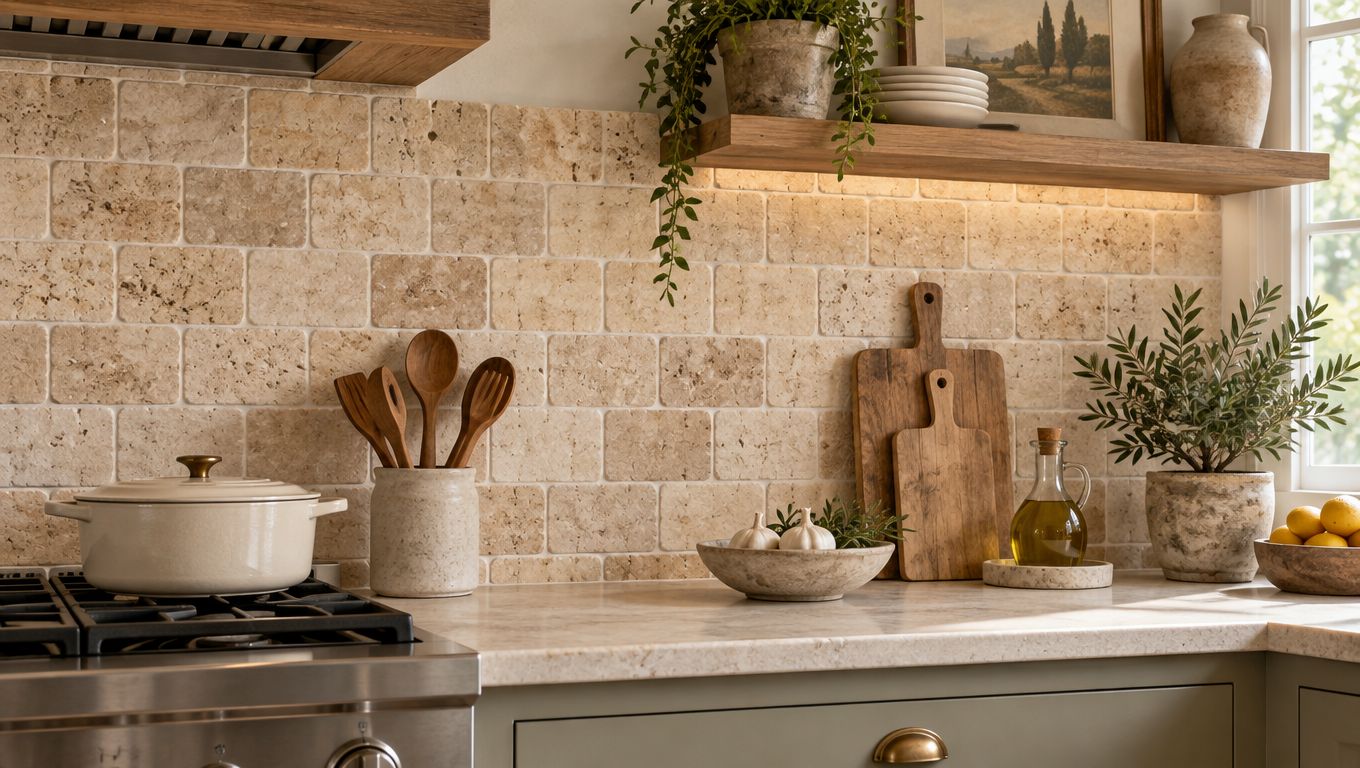
Approve the Grout With the Stone
Lay out a sample with the proposed grout before ordering. Rounded edges and irregular pieces make joint appearance particularly important, and an unsuitable grout colour can overwhelm the intended softness.
Don't demand an unrealistically tight joint to make the installation look more refined. Ask the installer to establish a practical joint width for the actual pieces, and allow for sorting and cutting during procurement.
- Test pre-sealing: Agree on a compatible treatment before grouting where the stone requires it.
- Inspect variation: Approve a spread of pieces for colour, edge wear and surface character.
- Check cleanability: Test cleaning products and grout removal on the sample assembly.
Tumbled surfaces deserve particular thought behind a hob or beside food-preparation areas, where texture and joints add cleaning work.
Varun Marbles note: Discuss tumbled marble as a distinct format, not a finish applied to any full slab. Granite, onyx, quartz and Kalinga Stone shouldn't be substituted without confirming that the required format and treatment are available and suitable.
7. Sandblasted Finish
Sandblasting is useful when the brief calls for a controlled matte texture or patterned detail. The fabricator directs abrasive media at the stone to remove surface material. Masking can define lettering, borders or decorative areas while leaving surrounding sections untreated.
A granite entrance sign, a textured wall panel or a stone feature are practical examples. On a façade, review the sample from the intended viewing distance as well as close up, because fine texture may read differently across a large elevation.
Specify the Process Responsibly
Don't write “sandblasted” and leave the rest to interpretation. Ask the processor to declare the abrasive, dust-control arrangements and proposed method, and approve the result on the actual material before production.
- Control the pattern: Sign off stencil artwork, boundaries and the relationship to joints.
- Inspect the colour: Compare treated and untreated samples before committing to adjacent finishes.
- Confirm protection: Agree on any compatible sealer after processing, based on the stone and exposure.
For paving, request testing for the finished surface rather than assuming that visible roughness proves suitability. For decorative panels, inspect whether the treatment reveals unwanted variation or changes the intended reading of the veins.
Varun Marbles note: Granite is a useful starting point for exterior or signage discussions; selected marble may suit decorative work after sampling. Treat onyx, engineered quartz and Kalinga Stone separately, with written processing approval rather than a blanket instruction to blast every material in the project.
8. Natural Cleft (Riven) Finish
Unlike a polished or blasted surface, natural cleft follows the stone's splitting structure. The resulting face is irregular rather than uniformly machined, with surface and thickness variation that must be considered during installation.
Riven sandstone cladding or slate and quartzite garden paving can suit an outdoor-design scheme. If you want Kota stone or a split-face granite product, ask the supplier to identify the actual surface treatment and format instead of assuming that every rough surface is naturally cleft.
Let the Sample Set Installation Expectations
Request a full-size sample and a representative spread of pieces. A small sample can conceal the variation that the installer will need to accommodate across a courtyard, threshold or wall.
Bedding, substrate preparation and level control should be agreed before delivery. Don't prescribe extra mortar as a universal solution; the installation method needs to suit the stone, support and exposure.
Site check: Inspect the highest ridges and lowest recesses, not just the average appearance. Those are the details occupants and cleaners will encounter.
For walking surfaces, consider trip points, furniture stability, drainage and cleaning access together. Where sealing is appropriate, approve a compatible product on a sample and confirm whether it changes the colour or sheen.
Varun Marbles note: Ask about suitable natural-stone formats and sourcing before fixing the design. Marble, onyx, engineered quartz and Kalinga Stone shouldn't be specified as naturally cleft merely to reproduce a rugged appearance; compare available approved finishes instead.
8 Surface Finish Types Compared
| Stone Finish | 🔄 Implementation Complexity | ⚡ Resources & Maintenance | ⭐ Key Advantages & 📊 Expected Outcome | 💡 Ideal Use Cases |
|---|---|---|---|---|
| Polished | Fine abrasive grinding and buffing; moderate fabrication complexity. | Natural stone may need sealing and periodic re-polishing; use pH-neutral cleaners on marble. | High-gloss, reflective surface enhances colour and veining; easy to wipe on quartz and sealed stone. | Countertops, vanities, feature walls, and low-traffic decorative floors. |
| Honed (Matte) | Ground with fine abrasives; polishing stage is omitted. | Seal porous natural stone; clean carefully to avoid dull patches. | Low glare and understated appearance; conceals etching and minor wear better than polish. | Flooring, worktops, bathrooms, and sunlit or contemporary interiors. |
| Leathered | Honed stone is brushed with abrasive tools to create a textured surface. | Regular cleaning is needed to remove dirt and grease from texture; availability depends on the slab. | Soft sheen and tactile character; hides fingerprints and minor scratches. | Busy kitchens, family homes, counters, and floors where extra grip is useful. |
| Flamed | High-temperature treatment; suitable only for heat-resistant stone, typically granite. | Requires suitable stone and allowance for surface variation; clean textured areas regularly. | Rough, non-reflective surface with strong slip resistance and outdoor durability. | Outdoor paving, pool surrounds, steps, pathways, and exterior cladding. |
| Bush-Hammered | Stone is struck with a studded tool; fabrication can be labour-intensive. | Skilled fabrication and texture-aware cleaning are required; sample panels help confirm consistency. | Rugged, patterned texture offers excellent grip and conceals weathering. | Exterior steps, façades, ramps, garden walls, and architectural features. |
| Tumbled | Small stone pieces are rotated with abrasive media and water; commonly used for tiles. | Seal before grouting; order extra pieces to allow for shape and colour variation. | Softened edges create an aged, rustic look; hides minor chips and wear. | Backsplashes, floor tiles, feature walls, and traditional or farmhouse interiors. |
| Sandblasted | Abrasive media is directed at the stone under controlled conditions; requires skilled operators. | Use non-silica abrasives and dust controls; textured surfaces may need sealing and careful cleaning. | Uniform matte texture provides grip and supports decorative patterns or lettering. | Exterior cladding, signage, decorative panels, and garden features. |
| Natural Cleft (Riven) | Stone is split along natural bedding planes; uneven thickness makes installation more complex. | Allow extra bedding material and levelling time; sealing may be needed, especially for porous stone. | Natural, irregular character with good outdoor slip resistance and minimal processing. | Paving, courtyards, terraces, landscape walls, and rustic cladding. |
Make the Finish Work for the Space
The best choice among these types of surface finishes is the one that matches the room, the material and the maintenance routine. Start with the application, then approve the appearance within those practical limits. Don't let a small, dry showroom sample settle a wet-area flooring decision.
Slip performance needs particular care. The Indian accessible-flooring guidance explains that specifications may need recognised test classifications, including DIN 51130 for shod-foot conditions or DIN 51097 for wet barefoot use, with certificates for the actual finished surface. These classifications relate to defined test conditions, not universal guarantees.
Put the Decision Into the Order
- Identify the application: Distinguish walls, worktops, floors, stairs and exterior paving.
- Map exposure: Record foot traffic, moisture, cleaning products and barefoot or footwear use.
- Approve the sample: Review a full slab or representative finished sample under project lighting.
- Confirm fabrication: Document thickness, cut-outs, edge profiles, joints and finish boundaries.
- Set installation requirements: Resolve substrate preparation, bedding, drainage and thresholds.
- Record aftercare: Include compatible sealing, cleaning and maintenance instructions.
Varun Marbles can support this process from quarry selection and slab inspection through cutting, surface finishing, edge profiling and installation coordination. Its portfolio includes natural marble, granite and onyx, alongside engineered quartz in polished, matte and leathered options. Confirm availability and suitability for the specific selection before finalising the order.
Visit the Sikanderpur Marble Market or HUDA Marble Market showrooms in Gurugram with drawings, lighting references and information about the intended use. Compare Kalinga Stone where its colour and texture range suits floors, walls, façades, bathrooms, countertops, staircases, windows or door frames, subject to the selected product's application requirements. Approve a coordinated material-and-finish specification, not just a colour.
Varun Marbles offers natural stone and engineered quartz selection, surface-finishing guidance, cut-to-size fabrication and installation support. Visit Varun Marbles to arrange an in-person comparison of finishes, and bring your plans so the team can help connect each surface choice to its intended use.