
White Marmara Marble: A Practical Guide for Indian Interiors
You're standing in a Gurugram stone yard with two white slabs in front of you. One is labelled Marmara White, Turkey. The other says Marmara Extra, supplied by a Delhi re-importer. Both have fine grey lines, both look expensive, and the salesperson wants a booking decision before the next buyer takes the lot.
That's where most mistakes begin. The question isn't whether white Marmara marble looks elegant. It does. The question is whether the slab's origin is clear, whether the finish suits the room, and whether natural calcite stone is sensible for the way your family, hotel guests, or restaurant staff will use the surface.
Indian listings commonly present Marmara White as an imported Turkish stone with a white base, fine grey linear veining, polished surfaces, and 18 mm slab availability. Retail and wholesale quotes commonly sit around ₹120–₹230 per square foot, while some Delhi and regional listings reach about ₹354 per square foot (market listing and availability details). That spread is large enough to punish a rushed decision.
Table of Contents
- Walking Into a Gurugram Showroom Looking for White Marmara Marble
- What White Marmara Marble Actually Is
- Where White Marmara Works and Where It Doesn't
- Finishes, Slab Sizes, and Edge Options Worth Asking For
- White Marmara Marble Against Its Real Alternatives
- Keeping White Marmara Looking New in Indian Conditions
- Verifying Provenance and Spotting Look-Alike Stock
- A Short Buyer's Checklist Before You Commit
Walking Into a Gurugram Showroom Looking for White Marmara Marble
The designer picked up a small sample and held it against the larger slab. The sample had calm, parallel veining. The slab on the rack had a warmer ground and a few lines that wandered more than expected. The labels made both sound like the same product, but the quotes were different.
A serious buyer stops there and asks for paperwork, not another sales pitch. Is the block Turkish in origin? Was it processed in Turkey or elsewhere? Does the supplier have a crate number, producer stamp, and invoice trail that matches the material being shown? “Marmara” is used widely in Indian yards for white marble with thin grey lines, so the name alone proves very little.
The room also matters. A polished slab that looks perfect under showroom lights may be a poor choice for a busy kitchen island. A wall panel in a hotel lobby faces a very different workload from flooring at a building entrance. Humidity, hard water, turmeric, coffee, lemon, chair movement, cleaning chemicals, and wet footwear all affect the buying decision.
Practical rule: Don't book a slab until you've approved the origin, finish, application, and actual lot together.
Before payment, inspect several full slabs in daylight or raking light. Check whether the lines run in a direction that works with the room, whether tone changes between slabs, and whether the supplier has enough matching material for the complete installation. The rest of this guide is the groundwork that should happen before the invoice is signed.
What White Marmara Marble Actually Is
In an Indian showroom, “Marmara” should describe more than a pale slab with grey lines. White Marmara marble is associated with Marmara Island and the wider Marmara region of Turkey. It is a natural metamorphic stone formed when limestone recrystallises under heat and pressure. For a buyer, the practical test is its appearance, slab consistency, and suitability for the intended room.
The usual look is a warm white to off-white background with fine grey, silver-grey, or occasional pale gold veining. Its lines are generally narrower and more orderly than the broad movement seen in some Italian marbles. That restrained pattern suits floors, wall cladding, vanities, and feature surfaces where the stone should support the design rather than dominate it.
Read the slab before reading the label
Catalogue photographs hide lot variation. One batch may look nearly uniform, while another shows stronger lines and wider tonal changes. Ask the yard to display multiple slabs together and arrange them in installation order. If the project needs a continuous direction, the cutting plan matters as much as the name on the quotation.
Published technical figures include water absorption of about 0.08%, porosity of about 0.23%, and dry bulk density around 2.715 g/cm³ (technical property listing). Low absorption means the stone takes in less moisture and staining liquid than a more absorbent material. It does not make the surface stain-proof or acid-proof, especially in a kitchen exposed to turmeric, lemon, coffee, or harsh cleaners.
Reported compressive strength is about 88 MPa parallel to foliation and 77 MPa perpendicular to it. That difference gives the fabricator a practical instruction: cutting direction and support deserve attention. The slab should not be handled like an interchangeable ceramic panel.
| Property | Typical Range | What It Means for You |
|---|---|---|
| Water absorption | About 0.08% | Limits moisture ingress, but sealing and prompt cleaning still matter |
| Porosity | About 0.23% | Indicates a relatively dense surface, without preventing stains or etching |
| Dry bulk density | Around 2.715 g/cm³ | Requires proper handling and support during installation |
| Compressive strength | About 88 MPa parallel, 77 MPa perpendicular to foliation | Cutting direction and installation support affect performance |
White Marmara is a dense, visually controlled natural marble. It remains a maintenance material, so a humid NCR kitchen or busy hotel floor may justify quartz or sintered stone instead. The premium should buy the marble's appearance where that appearance can be protected, not a false promise of carefree performance.
Where White Marmara Works and Where It Doesn't
White Marmara earns its place when the surface is seen often but abused rarely. A living room floor in a relatively dry NCR home can suit it, especially where the design benefits from a pale background and fine directional veining. A hotel lobby accent wall is an even safer application because guests see the stone without repeatedly spilling food and acidic drinks onto it.
Master bathroom walls away from direct shower splash are also sensible. The low reported absorption helps, but grout detailing, ventilation, and hard-water management still decide how the installation ages. Use it where the stone's appearance carries the design and where the maintenance burden remains manageable.

The applications I'd reject
I wouldn't specify polished Marmara as the default surface for a crowded family kitchen. Turmeric, coffee, wine, lemon, and acidic cleaners create two different problems. Liquids can stain vulnerable areas, while acids can etch the calcite surface and leave dull marks that no routine wipe will remove.
High-humidity kitchen floors in coastal cities such as Mumbai or Chennai deserve extra caution. Ground-floor floors exposed to dampness, wet footwear, and heavy traffic need a finish and maintenance plan that the household can realistically follow. Outdoor paving is a poor match too. Monsoon water, thermal movement, dirt, and surface wear create a harsher environment than the stone's showroom presentation suggests.
A hotel lobby floor can work, but only with a proper commercial specification. Confirm the finish, slip behaviour, cleaning method, entrance matting, and replacement stock. Don't approve the stone merely because the sample looks impressive under polished lighting.
Use Marmara for visual control and moderate contact. Choose another surface when acid, impact, moisture, and cleaning abuse are unavoidable.
The reported density and low absorption are positives, but they don't answer every site question. Vein direction, slab support, finish, joints, and local maintenance determine whether the material behaves well after installation.
Finishes, Slab Sizes, and Edge Options Worth Asking For
The finish changes the practical character of the stone. Polished Marmara gives the bright, reflective floor associated with premium showrooms, but it also makes etching, hairline scratches, and water marks easier to notice. Honed material has a softer, more architectural appearance and usually disguises everyday scuffing better in a lobby or family living room.
Leathered and brushed finishes add texture and reduce the mirror effect. They can make traffic wear less obvious, but the textured surface needs careful sealing and cleaning because residue can sit in its micro-profile. Don't choose one from a tiny sample alone. View a large finished area or at least a substantial sample under the lighting planned for the project.
| Finish | Look and Feel | Slip Resistance | Upkeep Demands | Best Indian Application |
|---|---|---|---|---|
| Polished | Bright, formal, reflective | Lower when wet | Shows etching and marks readily | Dry interior floors, walls, selected vanities |
| Honed | Soft, satin, understated | Better than polished in many interior settings | Needs regular neutral cleaning | Lobbies, living rooms, bathroom walls |
| Leathered | Textured and tactile | Can offer useful grip depending on profile | Sealing and residue removal need care | Feature counters and selected low-use surfaces |
| Brushed | Aged, directional texture | Depends on depth and treatment | More demanding around spills and grout | Decorative walls and controlled residential areas |
Indian yards commonly show 18 mm polished slabs, and imported stock may also be offered in larger formats. Ask for the exact slab dimensions, usable area, thickness tolerance, and expected wastage rather than accepting a verbal rate. Large slabs reduce visible joints, but they also increase transport, handling, and installation risk.
For book-matching or vein continuation, approve the layout before cutting. Tell the fabricator which edge will remain visible and whether the lines should run with the room, turn at a corner, or mirror across a panel.
Keep edge profiles restrained. An eased edge suits floors and many vanity tops. A pencil edge softens a counter without looking heavy. Demi-bullnose works in traditional residential interiors, while a waterfall edge makes sense only when the slab, support, and vein direction have been planned together. For broader countertop decisions, this practical guide to polished marble countertops is useful before you approve a glossy finish.
White Marmara Marble Against Its Real Alternatives
A Gurugram kitchen, a humid NCR home, and a high-traffic hotel lobby need different answers. White Marmara earns its place when the brief depends on Turkish-origin stone with fine grey veining and natural variation. It is the wrong default for a worktop that will face constant staining, acids, and rushed cleaning. In those cases, quartz usually serves the owner better.
Italian Statuario is the stronger choice for high-contrast luxury veining and a recognisable Italian appearance. Expect a significant premium, and check the pattern against the room before approving it. Bold movement can overpower a restrained interior. Indian Statuario, including Andhi and Indore varieties, offers a similar white-and-grey direction at a more accessible level, but tone, grain, and consistency change from lot to lot. Select from the actual slabs, not a catalogue image.
Vietnamese white marble can look close in photographs. Inspect each slab for its field colour, veining, surface quality, and finish instead of relying on the country label. Engineered quartz is the practical kitchen choice where consistent appearance and easier routine stain management matter. Sintered surfaces suit demanding areas exposed to impact, heat, and intensive cleaning. Their edge fabrication and manufactured visual character differ from natural marble, so approve a physical sample first.
Current Indian listings place Marmara White around ₹120–₹230 per square foot, with some Delhi and regional listings reaching about ₹354 per square foot. Treat those figures as market indications, not a project quote. Finish, grade, slab selection, fabrication, transport, wastage, and installation can change the final cost substantially.
| Material | Origin | Stain/Etch Risk | Approx. 2026 Price Range (₹/sq ft) | Main Edge Over Marmara |
|---|---|---|---|---|
| White Marmara | Commonly marketed as Turkish | Moderate to high for acids and careless use | ₹120–₹230, with some listings around ₹354 | Fine, quiet linear veining |
| Italian Statuario | Italy | Moderate to high | Verify current yard quote | Stronger luxury movement |
| Indian Statuario | India | Moderate to high | Verify current yard quote | Local availability and potentially lower cost |
| Vietnam white marble | Vietnam or mixed market naming | Varies by stone and finish | Verify current yard quote | Can offer a similar pale visual field |
| Engineered quartz | Engineered material | Lower routine stain risk, still follow manufacturer guidance | Verify current yard quote | Easier kitchen maintenance and consistency |
| Sintered surface | Manufactured mineral surface | Generally strong resistance profile | Verify current yard quote | Impact and heat tolerance in demanding areas |
For a kitchen decision, compare the expected cleaning routine, heat exposure, staining risk, repair tolerance, and visual priorities. This guide from SitePro Bathrooms gives a useful marble-versus-quartz comparison. My recommendation is direct: buy Marmara for its particular Turkish appearance and quiet veining, not because it is the most practical worktop material. In a hotel lobby, it can justify its care requirements as a visual surface. In a busy kitchen, quartz is usually the better allocation of the budget.
Keeping White Marmara Looking New in Indian Conditions
Maintenance starts before the first meal is served. Seal the installed stone with a suitable impregnating sealer, confirm that the surface is clean and dry, and ask the installer to explain the product's care instructions. Plan a resealing review before the monsoon season rather than waiting for darkened edges or recurring marks.
Use a neutral-pH stone cleaner and a soft microfiber mop or cloth. Avoid vinegar, lemon-based products, acidic kitchen cleaners, toilet descalers, and aggressive bathroom sprays. These products may remove mineral deposits quickly, but they can also dull a calcite marble surface.

Deal with spills before they become marks
Blot wine, turmeric gravy, coffee, oil, or lemon juice immediately. Don't rub the spill across a larger area, and don't reach for vinegar because the mark looks stubborn. Wipe with a neutral cleaner and clean water, then dry the surface fully.
Use felt pads beneath dining chairs and movable furniture. Put absorbent mats near balconies, entrances, and kitchen sinks, but lift and dry them regularly so trapped moisture doesn't sit against the floor. In bathrooms, remove hard-water droplets routinely. This guide to hard-water stains on marble covers the problem that catches many homeowners after the installation looks complete.
Commercial warning: Oil near banquet kitchens, salt deposits around pool decks, and unsuitable machine polishing can create problems that ordinary mopping won't solve.
A floor machine operator should use a marble-appropriate process. A heavy polish can close the surface and trap moisture in a poorly prepared floor. Check the cleaning contractor's method before approving routine maintenance for a hotel or retail project.
Use this embedded visual reference for the care sequence:
Verifying Provenance and Spotting Look-Alike Stock
A slab labelled “Marmara” is not automatically Turkish Marmara. In Indian yards, the name may describe Turkish-origin stone, locally processed stock, or another white marble with fine grey veining. Trade records show Turkish participation in India's marble supply, including rough blocks from Turkey, and broader trade reporting places Turkey among the important sources of imported raw marble (trade and provenance context).
Ask for the crate number, producer details, invoice, and country-of-origin documents. Match those records to the slab lot in front of you, not to a catalogue image or a verbal promise. If the supplier cannot trace the block, do not pay an imported-stone premium.
Three checks at the slab counter
Start with the underside and the cut edge. Run your fingers across the surface, then use a phone torch to inspect the edge. Genuine material should show a coherent crystalline structure and some translucency at the edge. A look-alike often appears flatter, more opaque, or chalkier.
These are useful counter checks, not laboratory proof. Use them with the paperwork and, for a large project, professional inspection.
A producer stamp on the slab edge carries more weight than a handwritten yard label. Check the declared thickness across several slabs and compare the weights within the lot. An 18 mm slab measuring 2.4 by 1.2 metres should weigh close to 150 kg, so a markedly lighter piece deserves a second look (Indian Marmara product listing).
| Check | Genuine Marmara | Typical Look-Alike |
|---|---|---|
| Origin paperwork | Turkish source and traceable lot details | Vague origin or only a reseller label |
| Veining | Fine, mostly linear grey movement | Similar lines with inconsistent direction or contrast |
| Edge appearance | Coherent crystalline structure with some translucency | Flat, opaque, or chalkier appearance |
| Producer mark | Stamp or identifiable slab information | No producer identification |
| Weight and thickness | Consistent with the declared specification | Unexpectedly light or inconsistent |
Indian showroom names often blur the line between imported stone and domestic alternatives. This guide to Indian marble that looks like Italian stone explains why appearance alone cannot establish origin. Compare the physical slab, documents, and intended use before judging the price. For a humid NCR kitchen or a busy hotel lobby, that verification also helps decide whether the imported stone earns its premium over a more practical surface.
A Short Buyer's Checklist Before You Commit
Take this list to a Kishangarh, Udaipur, or NCR yard and make the salesperson answer each point in writing.
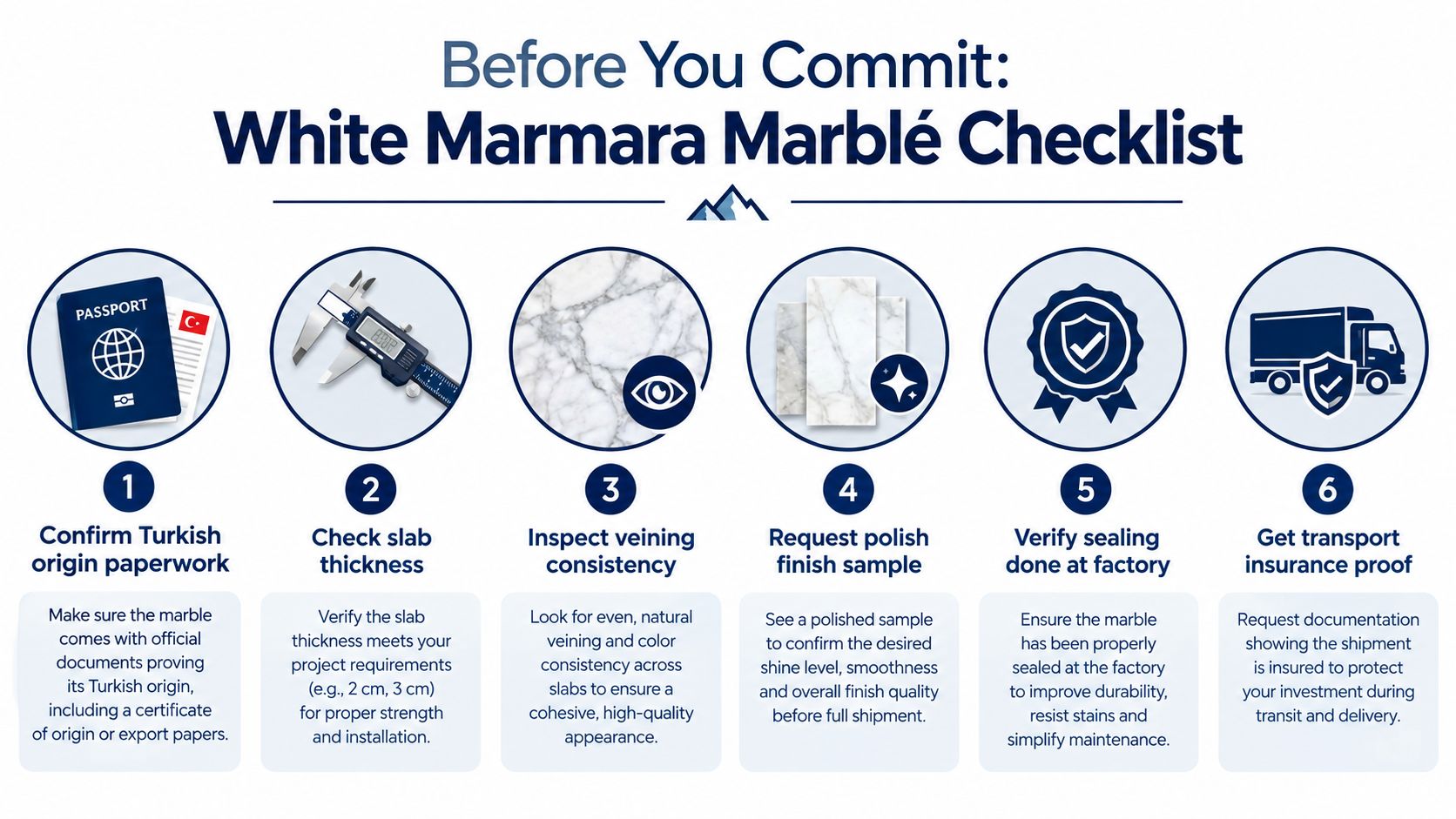
- Confirm Turkish origin: Ask for the country-of-origin paperwork, crate reference, producer identity, and invoice trail.
- Record the specification: Put thickness, finish, slab dimensions, grade, and accepted wastage allowance on the quotation.
- Inspect the full lot: View at least three full slabs in raking light. Look for tone changes, filled fissures, edge damage, and vein direction.
- Test an offcut: Place water on a leftover piece and observe how the surface responds. Use the result as a comparison between lots, not as a substitute for professional testing.
- Approve the finish: Polished and honed surfaces won't age or show marks in the same way. Keep a signed sample with the order.
- Match stone to use: Decide whether the slab is for a wall, bathroom, lobby floor, vanity, or kitchen counter before paying an imported-stone premium.
- Budget for care: Include sealing, neutral-pH cleaner, protective pads, transport, fabrication, and future maintenance in the project decision.
- Reject unclear substitutes: If the slab has no producer stamp and the origin story keeps changing, walk away.
My verdict is straightforward. Buy white Marmara marble when you specifically want Turkish provenance, a warm white field, and quiet grey linear veining. Choose a well-selected Indian white marble when you only want the look, and choose quartz or sintered stone when daily kitchen abuse matters more than natural variation.
Varun Marbles can help you compare Turkish and Indian natural stones with engineered quartz, then support slab selection, edge fabrication, and installation coordination in Gurugram. Visit Varun Marbles with your application, finish, and budget decided, and ask to compare the actual slabs rather than buying from a label alone.