
Indian Marble Look Like Italian: The Complete Guide

The best Indian marble can approximate the Italian look, but it can't perfectly reproduce the same translucency and vein figure. With Indian marble generally priced at ₹80–350 per sq ft versus roughly ₹250–1,500+ for Italian marble, it's usually the smarter choice for durability and cost in NCR projects.
The popular advice is to choose Italian marble whenever a project needs a luxury finish. That advice is too blunt for Gurugram homes, hotels, offices, and retail interiors. The question isn't whether Indian marble can look expensive. It's whether a particular Indian slab has the right base whiteness, vein scale, translucency, slab consistency, and polish response to create the intended visual effect.
In practice, the finest Indian stones can come remarkably close in tone and movement. They usually win on thickness flexibility, fabrication tolerance, everyday serviceability, and budget. They lose when the design depends on the luminous depth, delicate figure, or highly controlled continuity associated with premium Italian white marble.
Table of Contents
- Why the Indian Versus Italian Marble Question Matters
- Visual Criteria That Define the Italian Marble Look
- Indian Marble Compared With Italian Marble
- How to Select Indian Marble That Mimics Italian Styles
- Cost, Availability, and Sourcing Considerations
- Where Indian Marble Outperforms Italian Options
- Decision Pathways for Architects and Homeowners
Why the Indian Versus Italian Marble Question Matters
India's preference for Italian-looking stone didn't develop in isolation. Imported marble has shaped the visual language of premium interiors, from expansive living-room floors to book-matched feature walls and bright kitchen surfaces. In 2023, India imported $318 million of marble, travertine, and alabaster, making it the world's second-largest importer in that category. Italy supplied $57 million, while Turkey led with $182 million, according to the India marble import profile.
That import pattern explains why architects and homeowners in Delhi NCR often use Italian references even when they eventually select a domestic stone. Terms such as Carrara-style, Calacatta-inspired, soft veining, cool white, and high-lustre finish describe an aesthetic standard influenced by imported material. The slab may come from Rajasthan, the fabrication may happen in Gurugram, and the installation may be completed in a local residence, but the visual benchmark is still international.
The search is about appearance and risk
A homeowner searching for “Indian marble look like Italian” usually wants several outcomes at once:
- A bright, premium base: The stone should make rooms feel open rather than yellow or visually heavy.
- Controlled movement: Veins should add character without making the floor or wall look chaotic.
- Luxury under artificial light: The surface should respond well to daylight, concealed lighting, and warm interior fixtures.
- A manageable maintenance burden: Kitchens, entrances, bathrooms, and staircases need more than an attractive sample.
- Predictable project costs: The selected slab should be available in sufficient quantity and suitable for fabrication.
Those requirements expose the weakness of a simple country-of-origin comparison. “Indian marble” and “Italian marble” each cover many different stones, finishes, grades, and visual patterns. A plain Indian white marble may be a poor substitute for a dramatic Calacatta, while a carefully selected Indian slab may be a convincing alternative for a restrained Carrara-inspired interior.
Consultant's rule: Judge the slab in the finished room, not the country printed on the quotation.
The useful comparison therefore has to focus on observable material behaviour. First assess the visual figure. Then assess how the stone will be cut, installed, sealed, cleaned, and lived with. That sequence gives NCR projects a more reliable answer than choosing imported stone just because the brief says “Italian look”.
Visual Criteria That Define the Italian Marble Look
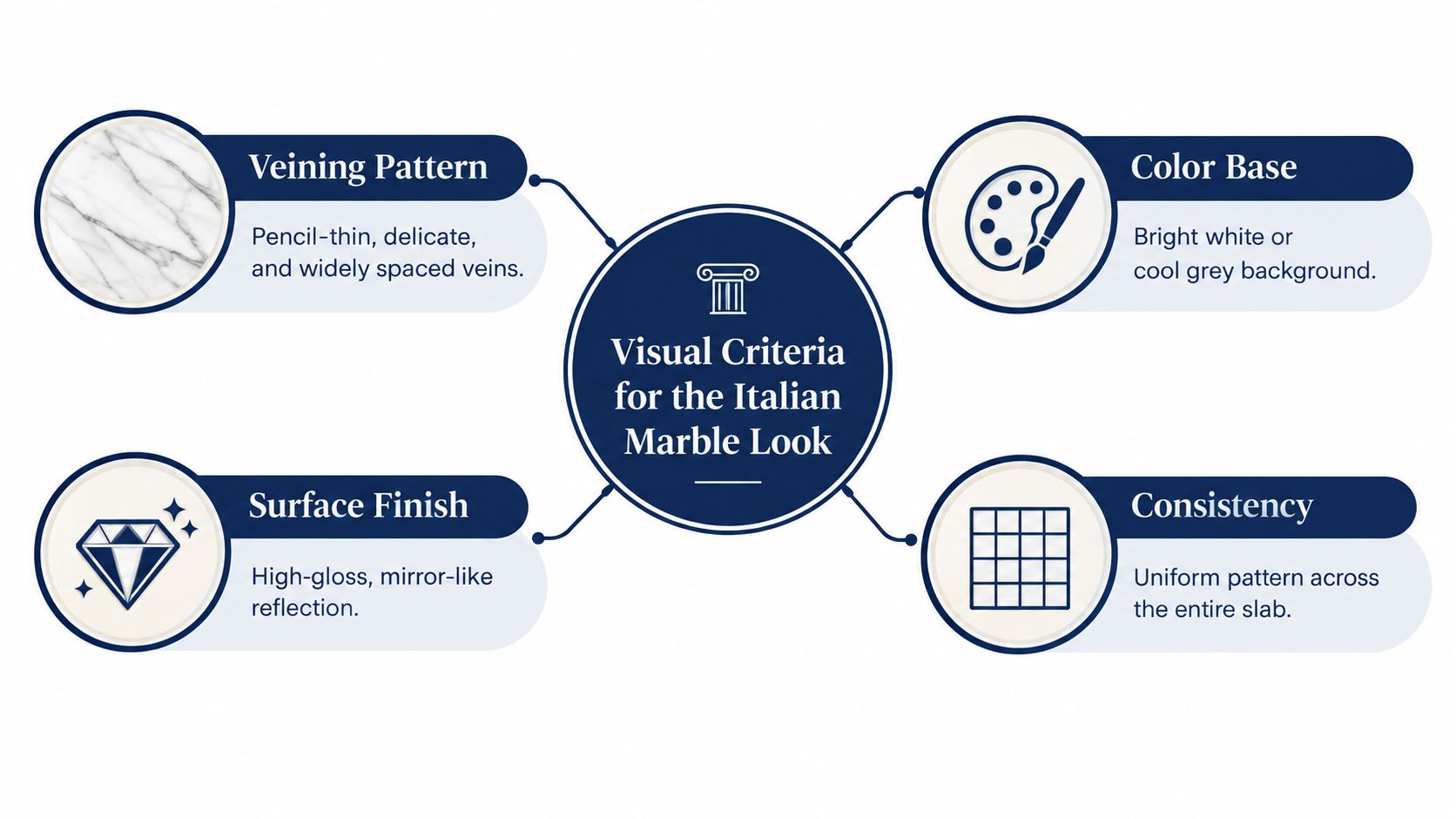
A slab reads as Italian-looking when several visual qualities work together. A polished white surface alone isn't enough. In a high-end NCR interior, the eye notices the relationship between the background colour, the veins, the light passing through the stone, and the way the pattern continues from one slab to the next.
Base whiteness sets the visual temperature
Start with the background, not the vein. A bright, cool white tends to resemble the clean architectural appearance associated with many Italian white marbles. Softer whites, greys, creams, and warmer undertones can still look luxurious, but they create a different atmosphere.
Take the sample into the intended lighting. A slab that appears neutral in a showroom may look warmer beside beige cabinetry or cooler beside charcoal flooring. Compare it with the actual paint, wood, metal, and upholstery selections. Don't approve a stone from a small polished tile when the project depends on a broad, uninterrupted white field.
Vein scale determines whether the stone looks refined or theatrical
The vein must suit the room. Fine, widely spaced lines create a calm Carrara-like impression. Larger grey or gold movement produces a bolder, more decorative result. Neither is automatically superior, but the two styles shouldn't be confused.
For floors, excessive movement can dominate furniture and make room boundaries feel busy. For a reception desk, bar front, fireplace, or statement wall, stronger patterning may be exactly right. The question is whether the vein has a deliberate direction and whether the fabricator can orient the slabs to support it.
Translucency creates depth that photographs can't fully show
Translucency is one of the hardest qualities for a domestic alternative to reproduce. It gives pale marble a sense of depth, especially near edges, windows, and carefully positioned lighting. A slab can have the right white colour and still look flatter because light doesn't travel through it in the same way.
This matters most in thin architectural details, illuminated features, sculptural edges, and close-up applications. It matters less on a busy floor where furniture, rugs, reflections, and foot traffic break up the surface.
Finish response reveals the stone's character
Polish is not a substitute for stone quality. Dense material can produce a crisp, reflective surface, while a more porous or softer stone may require more careful finishing and ongoing care. The final appearance depends on the stone, the polishing process, the edge work, and site installation.
Review the full slab from different angles. Look for cloudy patches, inconsistent reflection, filled fissures, and visible surface variation. For a curated Italian marble collection, use the same inspection standards you'd apply to Indian material. A luxury appearance comes from selection discipline, not a label.
Indian Marble Compared With Italian Marble
Indian marble is the practical choice for many NCR interiors, yet it does not automatically reproduce Italian marble. The substitution succeeds only when the slab matches the brief on vein scale, base whiteness, and translucency. If the design depends on a very specific figure or luminous depth, Italian material still has the advantage.
Indian marble generally comes in a 15–30 mm slab range, while Italian marble is commonly available at 18–20 mm, according to an India-focused comparison of Indian and Italian marble. The broader Indian range suits floors, steps, thresholds, and surfaces requiring a substantial edge. Italian slabs may need more careful handling, reinforcement, and specialised fabrication planning.
| Criterion | Italian Marble | Indian Marble |
|---|---|---|
| Visual character | Refined veining, strong white backgrounds, and greater translucency in premium grades | Can approximate white and veined Italian styles, but vein figure and translucency vary by slab |
| Vein control | Strong choice for a defined Carrara, Calacatta, or Statuario-style appearance | Works when the design accepts natural variation and selection is made slab by slab |
| Typical thickness | Commonly 18–20 mm | Typically 15–30 mm |
| Fabrication | Softer material may require reinforcement and highly skilled handling | Generally more forgiving during cutting and installation |
| Everyday performance | More vulnerable to staining and wear in demanding zones | Harder and denser, with better tolerance for heavy use |
| Indicative price range | Roughly ₹250–1,500+ per sq ft | Roughly ₹80–350 per sq ft |
| Best fit | Feature areas where exact figure and imported provenance justify the premium | High-use floors, broad residential schemes, and budget-controlled premium interiors |
The cited comparison places Italian marble at roughly ₹250–1,500 or more per sq ft, compared with ₹80–350 per sq ft for Indian marble. Treat those figures as slab guidance, not the installed project cost. Selection, wastage, transport, fabrication, finish, installation, and care can materially change the final amount.
Appearance decides whether the substitution works
Indian marble can deliver a convincing Italian look when the slab has a pale, clean base, controlled linear movement, and a polished finish. The result falls short when the client expects very fine branching, a nearly pure white field, strong translucency, or consistent matching across a large room.
The label alone is not enough. “Calacatta” may refer to bold grey veins, warm gold movement, a predominantly white canvas, dramatic book matching, or a luxurious white surface. These are separate visual requirements. Indian marble selections from Varun Marbles' Indian marble collection should therefore be judged by the actual slab, not its trade name.
For high-end Gurugram projects, Varun Marbles' hand-inspected inventory is useful when the design team needs to compare slabs in person and reject inconsistent pieces before fabrication. Approve the material only after reviewing full slabs under the project's lighting, alongside cabinetry, paint, flooring, and metal samples. Vein scale matters as much as colour. Fine movement may suit a calm floor, while broad diagonal veins can dominate a feature wall.
Performance changes the recommendation
India-focused technical comparisons describe Italian marble as softer, more porous, and higher-lustre, while Indian marble is generally harder and denser, with greater resistance to scratching and wear. Italian material may require mesh backing, reinforcement, and more specialised craftsmanship. Indian material usually gives fabricators and installers a wider margin during cutting and site handling.
Indian marble still needs appropriate sealing, cleaning, edge protection, and competent installation. It is not indestructible. It does, however, offer more usable performance where children, pets, outdoor dust, wet footwear, cooking, or high footfall will test the surface daily. Use Indian marble for demanding areas when the slab meets the visual brief. Specify Italian marble for a focal application when exact figure, whiteness, or translucency matters more than easier maintenance.
How to Select Indian Marble That Mimics Italian Styles
A photograph can help you shortlist a style. It can't approve a slab. Indian marble varies naturally, and the difference between a convincing Italian-inspired interior and a disappointing one often comes down to slab-level inspection.
Rajasthan is central to this assessment. It contributes more than 89 percent of India's marble production, and official data records 1,910 mining leases, 3,298.50 hectares under marble mining, and 132.09 lakh tons of production valued at Rs. 1,354.88 crores in 2013–14, as reported in the Indian marble government and geology reference. That deep mining and polishing ecosystem gives buyers a broad domestic field to evaluate, but it also makes selection more important because “Indian marble” is not a single uniform product.
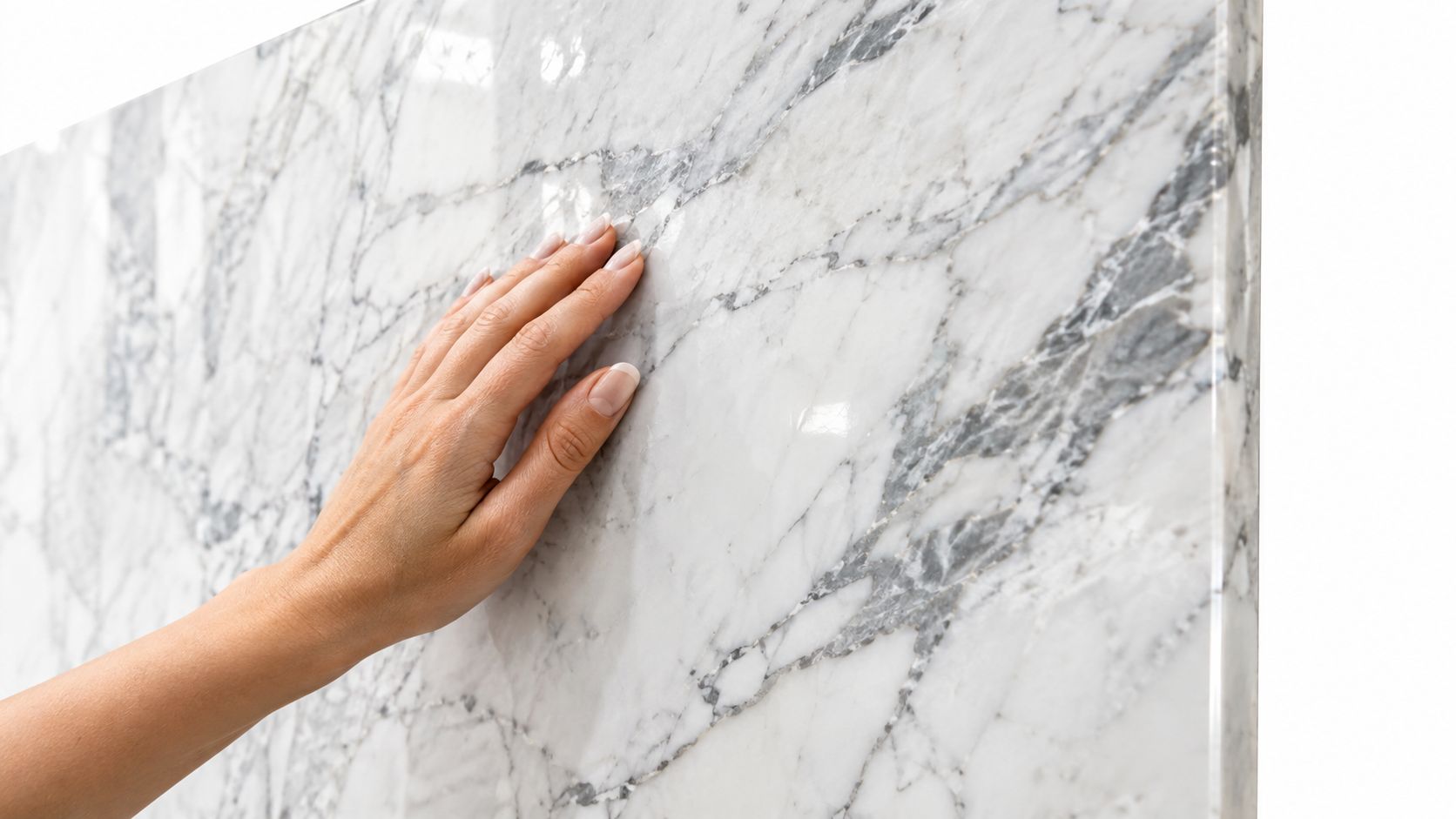
Inspect the slab in this order
Choose the base tone first. Place the slab beside the project's paint, cabinetry, flooring, and metal samples. Reject material that looks too yellow, muddy, or uneven for the design direction.
Read the vein at full scale. Walk along the slab instead of viewing only the centre. Check whether the movement is fine and spaced, broad and dramatic, or broken into distracting patches. Decide whether the direction works for the room's geometry.
Check continuity across the batch. Lay adjacent slabs together where possible. The pattern doesn't need to be identical, but major shifts in background tone or vein density can undermine a continuous floor or wall.
Test the polish under changing light. View the slab vertically and horizontally, in daylight and artificial light. Look for dull areas, cloudy reflections, resin-filled marks, and edge differences.
Examine the back and edges. Ask whether reinforcement is required, whether the slab has visible cracks or repairs, and how much usable material remains after cutting. A beautiful face can still create fabrication problems.
Approve the actual slabs. Don't sign off on a catalogue image when the installation depends on matching. Record slab positions, intended orientation, cut-outs, and the areas where each piece will be used.
Ask questions that expose the real quality
Ask where the block was sourced, whether all slabs come from the same block, how the supplier grades them, and what happens if a slab fails during fabrication. Ask to see the full inventory rather than a single hero piece. Also confirm who controls cutting, edge profiling, polishing, delivery, and installation coordination.
A hand-inspected inventory can reduce mismatched tone and unexpected pattern changes. Varun Marbles states that its selection process inspects slabs for vein, tone, and translucency, with blocks selected at the quarry face before slab production. For a Gurugram project, that type of local, in-person review is more useful than relying on a generic online label.
Selection advice: If the room needs visual continuity, buy the pattern first and the name second.
Cost, Availability, and Sourcing Considerations
The lower price of Indian marble matters, but it isn't the only financial advantage. Domestic sourcing can simplify replacement, inspection, transport coordination, and communication between the architect, supplier, fabricator, and installer. Those practical benefits become valuable when a project has several rooms, complex cut-outs, or a tightly controlled handover.
Italian marble carries an import premium because the buyer is paying for more than the stone itself. Procurement may involve international quarry supply, shipping, handling, breakage risk, customs processes, storage, and the coordination required to protect a thinner premium slab. The final decision should therefore compare the complete installed system, not just the quoted square-foot rate.
Indian marble's indicative range of ₹80–350 per sq ft, compared with roughly ₹250–1,500+ per sq ft for Italian marble, gives domestic material a clear budget advantage in the documented market comparison. That difference can be allocated to better joinery, lighting, hardware, fabrication, or higher-quality installation rather than absorbed entirely by the stone.
Availability only helps when selection is controlled
A domestic slab may be easier to source, but easy availability doesn't guarantee a consistent appearance. Natural stone can vary between blocks and batches. A project manager who orders by a general colour name may receive material that technically matches the description but fails beside the approved sample.
Use a written approval process:
- Approve full slabs: Don't rely on small samples for a large floor or feature wall.
- Reserve the quantity together: Keep the installation tied to a defined batch wherever possible.
- Map the layout: Mark which slab goes to which wall, floor zone, stair, vanity, or counter.
- Confirm fabrication limits: Review cut-outs, joints, mitres, radii, and edge profiles before cutting.
- Protect the finished surface: Coordinate delivery and installation so other trades don't damage the polish.
Technical behaviour also affects the budget. Comparisons describe Italian marble as softer and more porous, while Indian marble is generally harder and denser. Italian stone may need reinforcement and more skilled craftsmanship, whereas Indian marble is usually more forgiving during fabrication. Those requirements can affect waste, labour, installation risk, and post-handover maintenance.
For architects managing specification, procurement, and site execution together, the marble and granite sourcing guidance is relevant because it frames selection as a process rather than a product name. In Gurugram, the supplier's ability to show the actual slabs and coordinate fabrication may be as important as the nominal origin.
Where Indian Marble Outperforms Italian Options
Indian marble is usually the better recommendation for high-traffic residential floors, staircases, family living areas, commercial corridors, and hospitality surfaces that must tolerate repeated use. Its described hardness and density give it a more practical profile where scratching, wear, dust, and frequent cleaning are unavoidable.
Italian marble makes a strong visual statement, but softness and porosity change the maintenance conversation. India-focused comparisons describe it as more vulnerable to stains in wet or heavily used zones, with more frequent sealing often required. Kitchens, entrance halls, bathroom floors, and restaurant areas expose those weaknesses quickly because spills and abrasive particles are part of normal operation.
For a busy home, serviceability is part of luxury. A surface that still looks composed after daily use is more successful than a premium slab that demands constant protection.
Indian marble also gives fabricators more room to work with thickness. The broader 15–30 mm range can support substantial steps, thresholds, ledges, and floor applications without forcing every detail into the thinner premium-slab format described for Italian marble. That doesn't remove the need for structural review, but it can make detailing more straightforward.
The best use cases for Indian stone
Choose Indian marble when the project has:
- Large floor areas: Natural variation can be managed through layout, while the material's practical profile suits regular footfall.
- Family kitchens and utility zones: Select a suitable stone and use disciplined sealing and cleaning, but don't specify a fragile surface solely for its imported identity.
- Staircases and thresholds: Thickness flexibility and fabrication tolerance can simplify detailed finishing.
- Commercial interiors: Durability and replacement practicality often matter more than exact vein replication.
- Budget-sensitive premium homes: Domestic stone can reserve more budget for lighting, carpentry, and installation quality.
Indian marble doesn't outperform Italian marble at every task. If the brief demands a highly specific translucent white, exact vein figure, or dramatic book match, imported material may remain justified. But for most NCR projects, especially those with heavy use, the domestic option offers the more balanced result.
Decision Pathways for Architects and Homeowners
Choose Indian marble when you want a bright, veined, Italian-inspired appearance across floors or broad surfaces and you're prepared to approve slabs in person. Choose Italian marble when a feature wall, sculptural element, or exact vein figure justifies the premium and the project can support more careful handling and maintenance.
For kitchens and baths, engineered quartz deserves a direct comparison rather than an automatic rejection. Its non-porous surface, consistent appearance, and lower upkeep can suit households that want a white-veined luxury effect without accepting the same staining concerns as porous natural stone.
In Gurugram, make the decision from full slabs, with the fabricator and designer involved before approval. Compare the actual material against lighting, cabinetry, usage, budget, and installation details, then specify the stone that serves the room rather than the label.
Varun Marbles offers hand-inspected Indian and Italian marble, engineered quartz, fabrication, and installation coordination for residential and commercial projects in Gurugram. Visit Varun Marbles to compare full slabs in person and discuss which material can deliver your intended Italian-inspired look with the right performance profile.