
Polished Marble Countertops: A Complete Guide
“Seal it regularly” is the most common advice given for polished marble countertops, and it's incomplete. A sealer can slow staining, but it cannot stop acid from etching polished marble. In an Indian kitchen, lemon, vinegar, tomato, curd, turmeric, tea, coffee, ghee and hard-water deposits create different risks, and the glossy surface makes every dull patch easier to see.
Polished marble can be an exceptional design material. It brings depth, movement and reflectivity that engineered surfaces often imitate but don't fully reproduce. My recommendation is direct: specify it by use case, not by default. It belongs in carefully chosen kitchens, vanities, hospitality counters and feature zones, but a heavy-use cooking platform demands an owner who accepts prompt cleaning and periodic restoration.
Table of Contents
- Why Polished Marble Is Not a Default Kitchen Choice
- Understanding Polished Marble as a Material and Finish
- Advantages and Drawbacks of Polished Marble Countertops
- Staining Versus Etching and How Each Damages the Surface
- Specifying Slab Thickness and Sourcing for Countertop Projects
- Where Polished Marble Works Best in Residential and Commercial Spaces
- Maintaining the Polish Over Years of Daily Use
Why Polished Marble Is Not a Default Kitchen Choice
Polished marble isn't a universal kitchen upgrade. It's a high-impact finish with a predictable weakness: the very gloss that makes it luxurious also makes etching highly visible.
Indian cooking creates unusually demanding countertop conditions. Lemon juice, tamarind, vinegar, tomato, curd, turmeric paste, tea, coffee, ghee and oil can reach the surface during ordinary preparation. Near the sink, standing hard water can leave rings and mineral deposits. These aren't rare accidents. They're normal exposures in an active kitchen, and a polished marble surface records them more clearly than a finish that diffuses light.
The practical rule: Choose polished marble because you're prepared to manage its finish, not because someone promised that sealing makes it maintenance-free.
The distinction matters because staining and etching are separate problems. A sealer helps reduce absorption of coloured liquids and oils. It doesn't prevent an acid from reacting with the calcium-carbonate surface. Once that reaction creates a dull, lighter patch, resealing won't restore the gloss. A stone restoration professional must mechanically repolish the affected area.
That doesn't make polished marble a bad material. It makes it a specialised one. It works particularly well for a low-splash island, a lightly used pantry, a bar counter, a vanity or a formal hospitality surface where visual impact matters more than complete resistance to daily abuse. For a high-use cooking zone, honed marble, quartz or another less reactive worktop may be the more intelligent specification. A useful overview of material selection for Indian kitchens is available in this guide to kitchen marble and granite.
The same logic applies to surrounding renovation decisions. If the countertop is being paired with resurfacing your kitchen doors, coordinate the colour, sheen and maintenance expectations instead of treating the worktop as an isolated purchase. A glossy counter beside newly finished cabinetry can look exceptional, but only when the household understands how the surfaces will age together.
Understanding Polished Marble as a Material and Finish
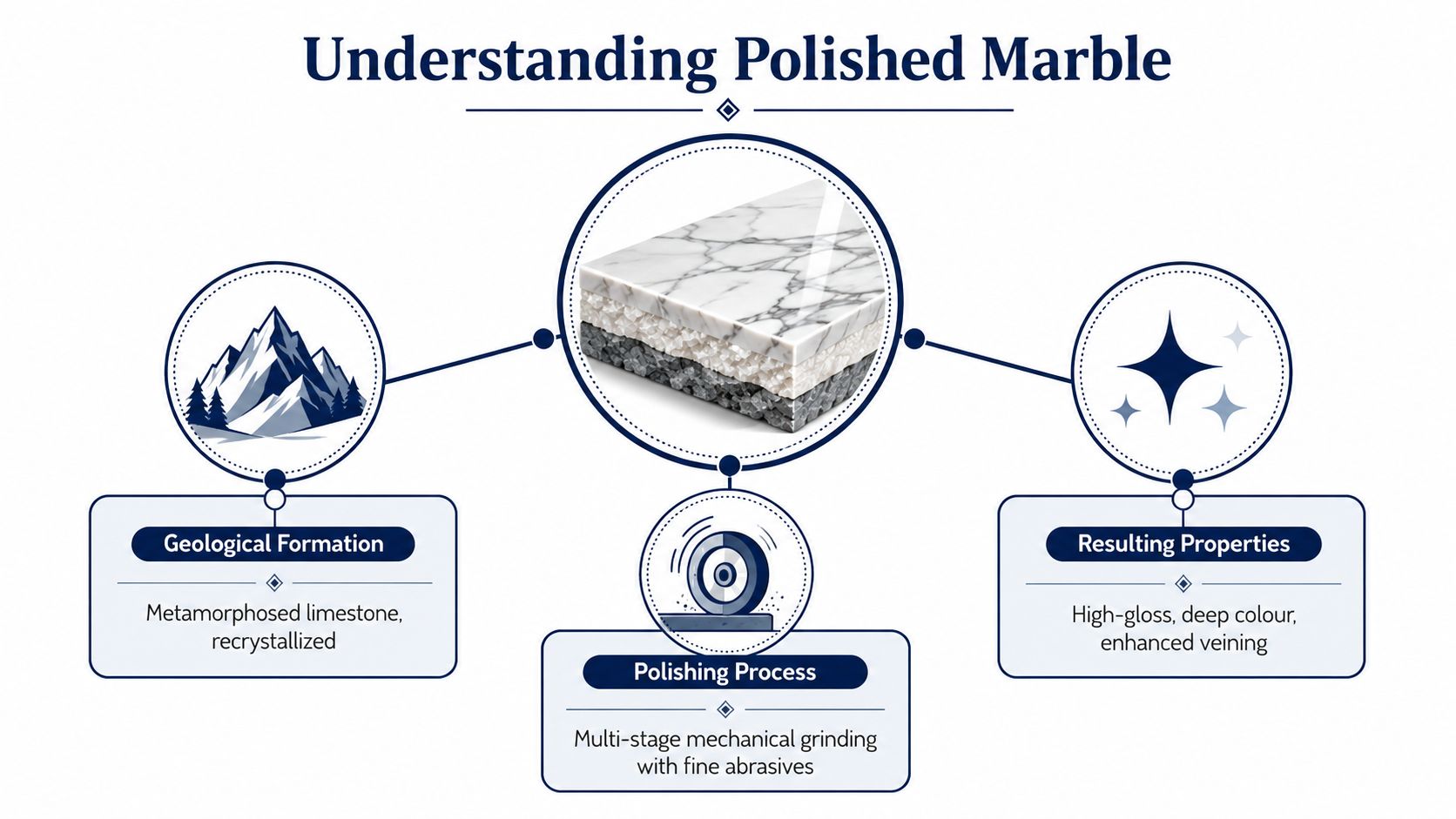
Marble begins as limestone that has been transformed by heat and pressure. Its minerals recrystallise during metamorphism, creating the interlocking structure, colour variation and veining that make each slab different. The calcium-carbonate composition is the critical technical fact for countertop use because acids can react with it.
A polished finish is created mechanically. Fabricators move through progressively finer abrasive stages until the surface becomes microscopically smooth and highly reflective. The process is similar to sanding a piece of wood repeatedly until the grain feels almost glass-like, except the final result is a mineral surface with a much stronger visual reflection.
Why the finish changes what you see
Polishing does more than add shine. It deepens apparent colour, sharpens contrast between the background and veins, and reflects light across the room. A white marble can appear brighter, while a darker stone can develop a richer, more dramatic appearance.
The smooth surface is also straightforward to wipe. Crumbs and liquid sit on top rather than catching in texture, which makes everyday cleaning simple. But that same uninterrupted reflection exposes fingerprints, water spots, fine scratches and etching. A dull mark interrupts the reflection, so the eye notices it immediately.
Honed marble stops the abrasive process earlier, leaving a smooth but matte surface. Leathered finishes introduce texture and are more commonly associated with suitable granites and quartzites. These alternatives don't remove marble's acid sensitivity, but they can make everyday marks less visually prominent.
The finish isn't the same as protection
A polished surface may absorb spills more slowly than a rougher surface, but it remains chemically vulnerable. The finish doesn't turn marble into quartz, granite or a non-reactive engineered material. It only changes the surface appearance and the way light responds to wear.
For architects, the correct specification therefore includes both the stone type and the finish. For homeowners, the correct question isn't whether the slab looks beautiful in a showroom. Ask how it will respond to the liquids, cleaning products and work habits that define the room.
Advantages and Drawbacks of Polished Marble Countertops
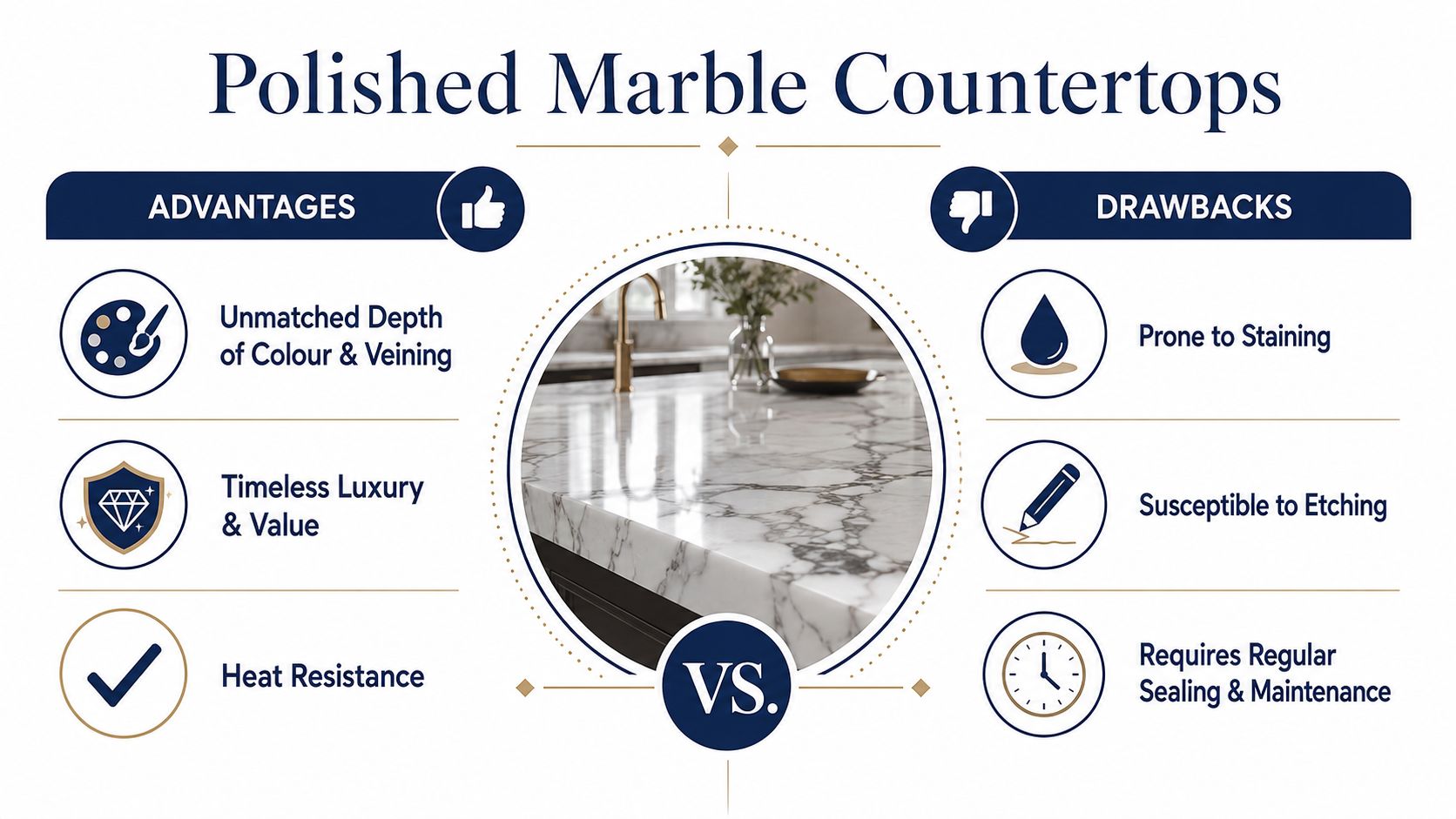
Polished marble earns its place through appearance first. No two slabs display exactly the same movement, and polishing brings that movement forward. Veins look sharper, colour appears deeper and reflected light gives the counter a formal, premium character.
What you gain
- Visual depth: Polishing reveals contrast and veining with exceptional clarity, especially in white, beige and softly veined materials.
- Light reflection: The gloss can make a compact kitchen, bathroom or reception area feel brighter and more open.
- Design authority: In luxury residences, hotels and retail interiors, the surface communicates a crafted, architectural quality.
- Easy surface wiping: The smooth finish doesn't hold crumbs and debris in texture.
- Heat tolerance: Marble is commonly selected for worktop applications where hot cookware may briefly contact the surface, although trivets remain sensible practice.
What you accept
The principal drawback is not general “maintenance”. It's finish visibility. A polished slab makes a small acid mark look like a defect because the surrounding surface reflects light evenly. A honed finish may make the same change less conspicuous, although it still requires care.
Staining is another concern. Turmeric, oil, coffee and coloured sauces can penetrate microscopic pores if they remain on the stone. A suitable impregnating sealer improves resistance, but it doesn't remove the need for quick cleaning.
There's also a lifecycle cost. Polished marble can require cleaning discipline, sealer renewal and professional repolishing when high-use areas lose their uniform gloss. That cost isn't captured by the slab price alone. Fabrication, edge details, sink cutouts, maintenance products and restoration all affect ownership.
My recommendation: Use polished marble when its visual contribution is central to the design. Don't use it merely because it's available or because a showroom sample looks impressive under controlled lighting.
Compared with engineered quartz, polished marble offers more natural variation but demands more tolerance for change. Quartz is often the more practical default for households that want a consistent, lower-maintenance worktop. Marble remains the stronger choice when authenticity, veining and a time-sensitive natural surface matter more than resistance to every kitchen exposure.
Staining Versus Etching and How Each Damages the Surface
The words “stain” and “etch” are often used interchangeably by homeowners. They describe different damage mechanisms, and confusing them leads to the wrong repair.
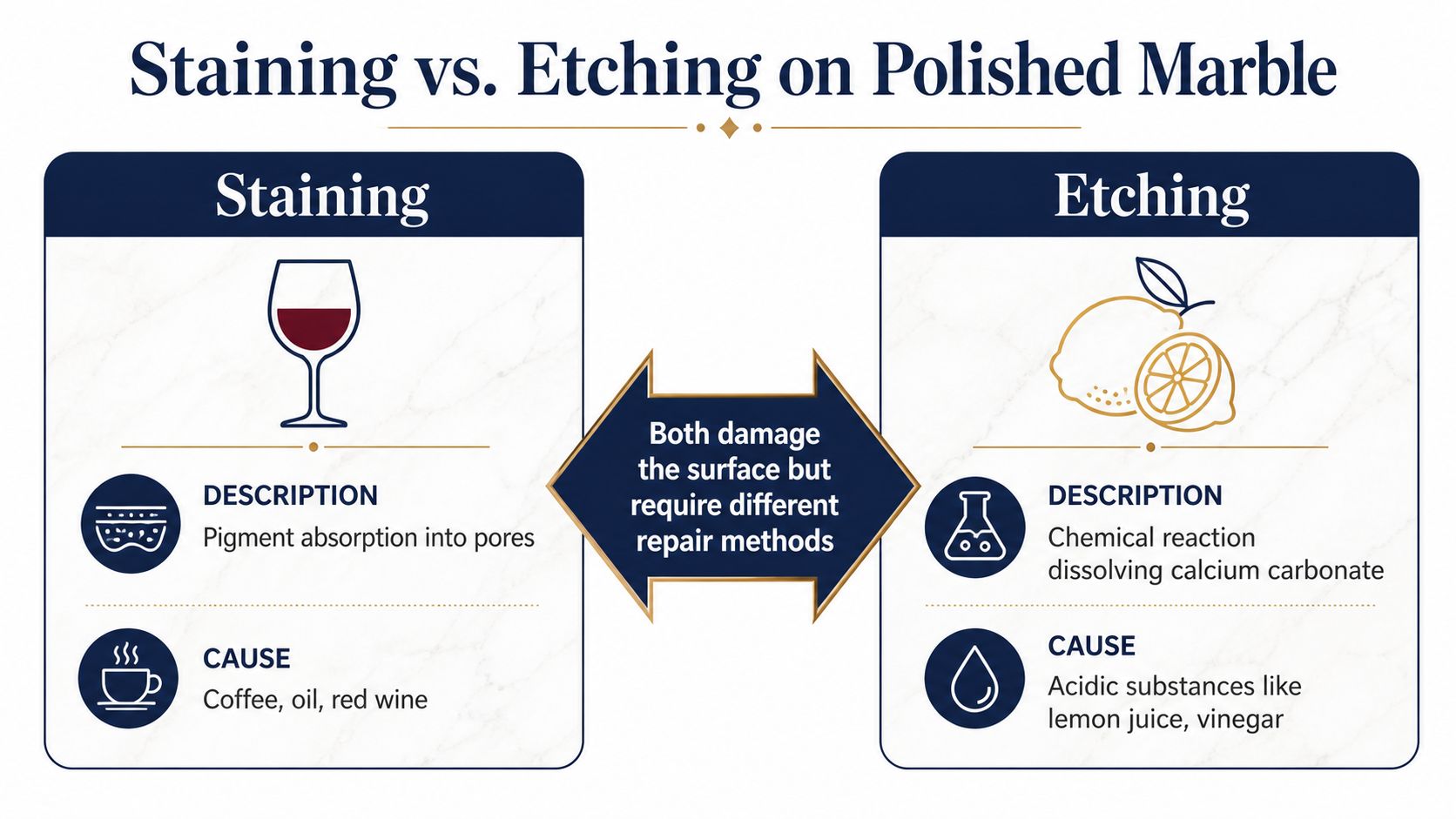
Staining is absorption. A coloured liquid, oil or food residue enters the stone's microscopic pores and leaves a darker or discoloured area. Turmeric paste can create a persistent yellow mark. Coffee and tea can leave brown tones. Ghee and cooking oil may produce a darker patch, particularly if the spill sits near an edge or an unprotected area.
Etching is a chemical reaction. Acid dissolves part of the calcium-carbonate surface and changes its reflectivity. Lemon juice, vinegar, acidic descalers and foods containing acids can leave a dull, pale patch. The stone may not look discoloured, but the polish has been altered.
Why sealing has a limited role
A penetrating sealer works inside the stone to reduce the speed and extent of liquid absorption. That gives you more time to blot a spill before pigment or oil enters the pores. It's useful protection against staining.
It doesn't create an acid-proof barrier. If lemon juice or vinegar reaches the polished surface, the chemical reaction can occur even when the countertop has been sealed. A sealer can't restore a gloss that acid has already removed.
Hard water creates a third visual problem. Mineral deposits near a sink may appear as pale rings or cloudy areas, and aggressive descaling products can worsen the surface by introducing acids. Scrubbing with an abrasive pad can also create a change in sheen that resembles etching.
The right response to common exposures
- Turmeric, tea or coffee: Blot first, then clean with a pH-neutral stone cleaner and a soft cloth. Don't spread the pigment across a wider area.
- Lemon, vinegar or tomato: Wipe immediately with water, then use a suitable neutral cleaner. Don't apply a bathroom descaler or vinegar solution.
- Ghee and oil: Remove the residue promptly and avoid leaving an oily film around the cooking zone.
- Hard-water deposits: Use a marble-safe cleaning method recommended by the fabricator. Don't reach automatically for an acidic limescale remover.
- Existing dull patches: Treat the area as possible etching. Sealing won't repair it, and repeated scrubbing will usually make the sheen less even.
The maintenance priority is simple: remove reactive or pigmented material quickly and clean gently. Product choice matters, but response time matters more than marketing claims on a sealer bottle.
Specifying Slab Thickness and Sourcing for Countertop Projects
A polished marble countertop should be designed as a supported assembly, not treated as a decorative slab placed over cabinetry. Indian technical guidance for countertop applications commonly recommends 30 to 40 mm thickness, with proper substrate support, as described in the Indian Green Marble technical data. The support becomes especially important around sink cutouts, hob openings, projecting edges and unsupported spans.
The slab provides mass and surface finish. The substrate, cabinetry and installation details help manage flexural loading and reduce breakage risk. A thin or poorly supported section can fail even when the marble itself is dense and technically suitable for fabrication.
A practical specification table
| Application | Recommended Thickness | Support Requirements | Finish Risk Level |
|---|---|---|---|
| Low-use vanity top | 30 mm | Continuous cabinet support, reinforced cutouts | Moderate |
| Residential kitchen worktop | 30–40 mm | Full substrate support, strengthened sink and hob zones | High |
| Kitchen island with overhang | 30–40 mm | Engineered support beneath all projecting areas | High |
| Hospitality reception counter | 30–40 mm | Continuous support and protected edges | Moderate |
| Bar or display counter | 30 mm | Firm cabinet or frame support | Moderate |
The table is a starting point, not a substitute for a fabricator's site measurement. The actual edge profile, overhang, cutout geometry and cabinet construction determine the final support requirement.
Source globally, inspect locally
India's polished marble supply is strongly import-linked. Trade data records 2,868 marble shipments from October 2023 to September 2024, sourced from 477 foreign exporters and purchased by 418 Indian buyers, with the category showing a 15% decline against the previous twelve months. The same dataset says India buys marble from more than 142 countries, while India, Turkey and China together account for 69% of total marble imports. Volza's India marble import data illustrates why availability, finish consistency and lead time can depend on international procurement rather than only local quarry output.
Government records also distinguish between polished and rough material. A Parliamentary reply records that polished marble blocks, slabs and tiles were free to import under the then-current Exim Policy, while rough marble blocks and slabs were restricted and required an import licence. The same record includes active polished slab consignments from countries such as Spain and Vietnam, confirming that finished polished material remains part of India's procurement. The Parliamentary document on marble imports provides that regulatory context.
Inspect the actual slab. Check background tone, vein direction, fissures, filled areas, edge integrity and how the polish behaves under changing light. A catalogue image can't show every characteristic that will affect a large island or a book-matched wall. For broader selection considerations, review this guide to signature marble and granite.
Where Polished Marble Works Best in Residential and Commercial Spaces
Polished marble works best where visual impact is high and chemical abuse is controlled. That usually means a hospitality reception counter, a luxury vanity, a bar top, a formal pantry, a low-splash island or a feature counter that isn't used as the household's primary chopping and seasoning station.
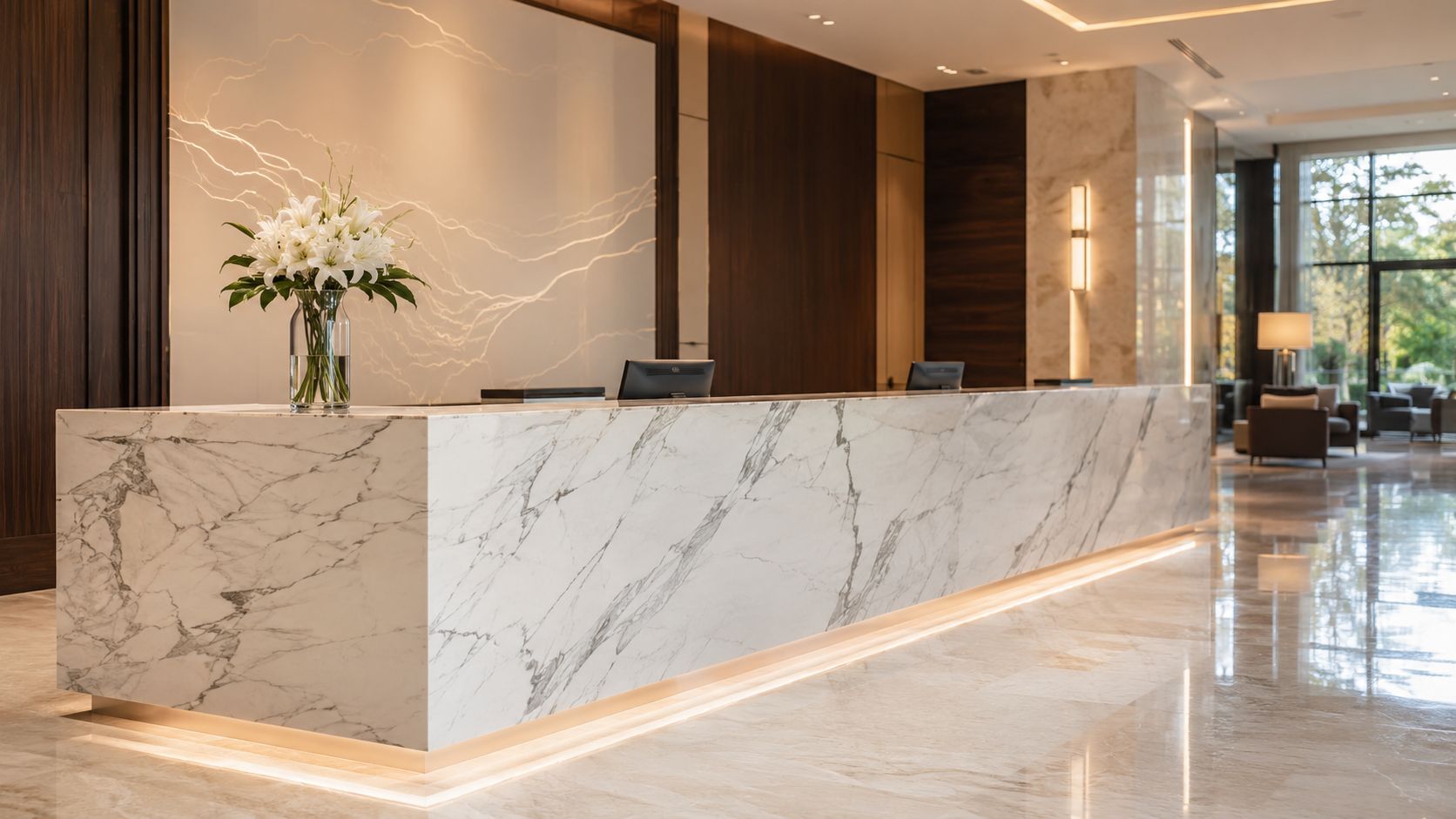
A hotel reception desk is a strong application because the design depends on immediate visual impression, while staff can control cleaning and prevent prolonged exposure to food acids. Bathroom vanities also suit polished marble, provided users don't leave acidic cosmetic products, hard water or wet containers sitting on the surface.
Match the finish to the zone
Luxury kitchen island: Appropriate when the island is primarily for serving, seating and light preparation. If it's the main area for lemon, masala, dough and wet cooking, choose a more forgiving material or finish.
Primary cooking counter: I generally don't recommend polished marble as the default. Consider engineered quartz for a consistent, lower-maintenance surface, or discuss honed marble only if the owner accepts that acid marks can still occur.
Bathroom vanity: A good fit for owners who want brightness and depth. Specify generous splash management and ask the installer to address the sink perimeter carefully.
Bar top: Often suitable because the visual character matters and the use pattern is more controlled. Spilled citrus and alcohol still require quick cleaning.
Reception and retail counters: Strong candidates, especially where the counter is a brand or interior focal point. Protect exposed corners and plan cleaning around the finish rather than using generic commercial chemicals.
Current Indian design coverage points towards beige, soft greys, warm whites and light earthy tones, while natural stone remains in demand. That palette works well with polishing, but a honed surface can give the same stone a quieter, more relaxed character. For a broader material comparison, see marble versus vitrified tiles.
If the project includes a bathroom, a focused guide to bathroom remodeling with marble can help frame the vanity decision around splash, storage and surrounding finishes.
A polished surface also works when the design deliberately accepts patina. Owners who regard minor marks as part of natural stone's character may enjoy it more than owners expecting a permanently showroom-perfect worktop.
Here's a visual reference for the kind of hospitality application where polished marble earns its premium:
Maintaining the Polish Over Years of Daily Use
Maintenance should be planned before installation, not after the first dull mark appears. In an active Indian kitchen, wipe lemon, vinegar, tomato, curd, turmeric, tea, coffee, oil and ghee as soon as they reach the surface. Use a soft microfibre cloth and a pH-neutral stone cleaner, not vinegar, bleach-heavy mixtures, abrasive powders or acidic descalers.
Daily care is simple:
- After cooking: Remove food residue and oily films before they dry.
- Around the sink: Dry standing water and check for rings or cloudy deposits.
- During weekly cleaning: Use a neutral cleaner, clean water and a soft cloth. Rinse away residue instead of allowing cleaner to dry on the slab.
- For spills: Blot rather than scrub. Scrubbing can spread pigment and create uneven sheen.
- For protection: Use cutting boards, trivets and trays beneath bottles, appliances and frequently moved containers.
Sealing remains useful for stain resistance, but it isn't an anti-etching treatment. Ask the fabricator which impregnating product suits the specific stone, and test the surface rather than relying on a calendar alone. If water absorbs quickly instead of remaining on the surface, the protection may need attention.
For an active kitchen, Indian design guidance commonly recommends professional repolishing every 12 to 18 months to retain the finish, as discussed in this Indian kitchen countertop guide. The work addresses worn gloss and local dulling, but it doesn't prevent future exposure. Restoration also adds a recurring ownership cost, and the exact price depends on site access, area, edge details and the condition of the stone, so it should be quoted after inspection rather than guessed in advance.
Hard-water rings and isolated dull patches are manageable. They become expensive when a homeowner attacks them with bathroom chemicals or abrasive pads and turns a local issue into a wider finish problem. Keep the installer's cleaning recommendation, record the slab and sealer details, and arrange restoration before the surface has multiple incompatible sheen levels.
If your household wants the appearance but won't follow this routine, choose quartz or another suitable worktop. If you're willing to wipe promptly, protect the surface and budget for periodic care, polished marble can age with considerable character.
Varun Marbles supplies Italian and Indian marble, granite, engineered quartz and other natural stones, with slab selection, cut-to-size fabrication, edge profiling and installation coordination for residential and commercial projects. Visit Varun Marbles to inspect slabs in person and discuss whether polished marble, honed stone or quartz suits your kitchen's actual use.