
Hard Water Stains on Marble: Safe Removal and Lasting Care
You've just lifted a steel tumbler from your polished marble countertop and found a pale ring underneath. Around the tap, there's a chalky crust. Across the slab, the shine looks cloudy rather than clean. In a Delhi, Jaipur, Ahmedabad, Hyderabad, or Tamil Nadu home, this often starts with mineral-rich tap or borewell water, not a failed marble surface. Indian stone-care guidance links calcium and magnesium in hard water with chalky scale, pale rings, mineral spotting, and gradual hazing on polished marble, especially where droplets are left to evaporate. Tiles Finders explains the connection between hard water and marble maintenance.
The important question is not how to remove hard water stains on marble. First, you must identify whether the white mark is a deposit sitting on top of the stone or acid etching that has altered the polished calcite surface. Use the wrong cleaner and a removable film can become permanent dulling.
Table of Contents
- Why Those White Rings on Your Marble Won't Budge
- Hard Water Stains Versus Acid Etching on Marble
- Safe Step-by-Step Removal for Fresh Hard Water Marks
- Handling Heavier Buildup and Knowing When to Call a Pro
- Prevention Toolkit for Indian Hard-Water Households
- Long-Term Care and Smart Material Choices
Why Those White Rings on Your Marble Won't Budge
A white ring beside the kitchen tap can return after every wipe. In Jaipur, Delhi, and other Indian homes, the pattern is familiar: a droplet spreads over the polish, evaporates, and leaves dissolved calcium and magnesium behind. Repeated splashing turns that faint film into a visible ring or cloudy patch.
Indian water hardness helps explain the stubborn residue. One published Indian study recorded total hardness from 200 to 908 mg/L, described as extremely hard and beyond maximum permissible limits in the sampled area. The Indian study provides the reported hardness range. An India-oriented stone-care guide places dissolved minerals in tap water in Bangalore, Mumbai, Delhi, and Hyderabad at roughly 100–400 mg/L, a range that can leave recurring deposits on polished stone. The maintenance guidance discusses mineral-rich tap water and marble.
Why ordinary wiping fails
A dry cloth lifts loose droplets, not mineral scale that has adhered to the surface. A wet wipe can spread residue into a wider haze. Rough fabric or abrasive pads can add fine scratches to the polished finish.
Marble contains calcium carbonate, so acids are unsafe. Vinegar, lemon, citric cleaners, and many bathroom descalers can react with the stone. They may remove some white residue while leaving a dull etched patch that ordinary cleaning cannot reverse.
The first job is diagnosis, not scrubbing. A deposit sitting on marble calls for careful, neutral cleaning. A chemically altered surface requires polishing or restoration.
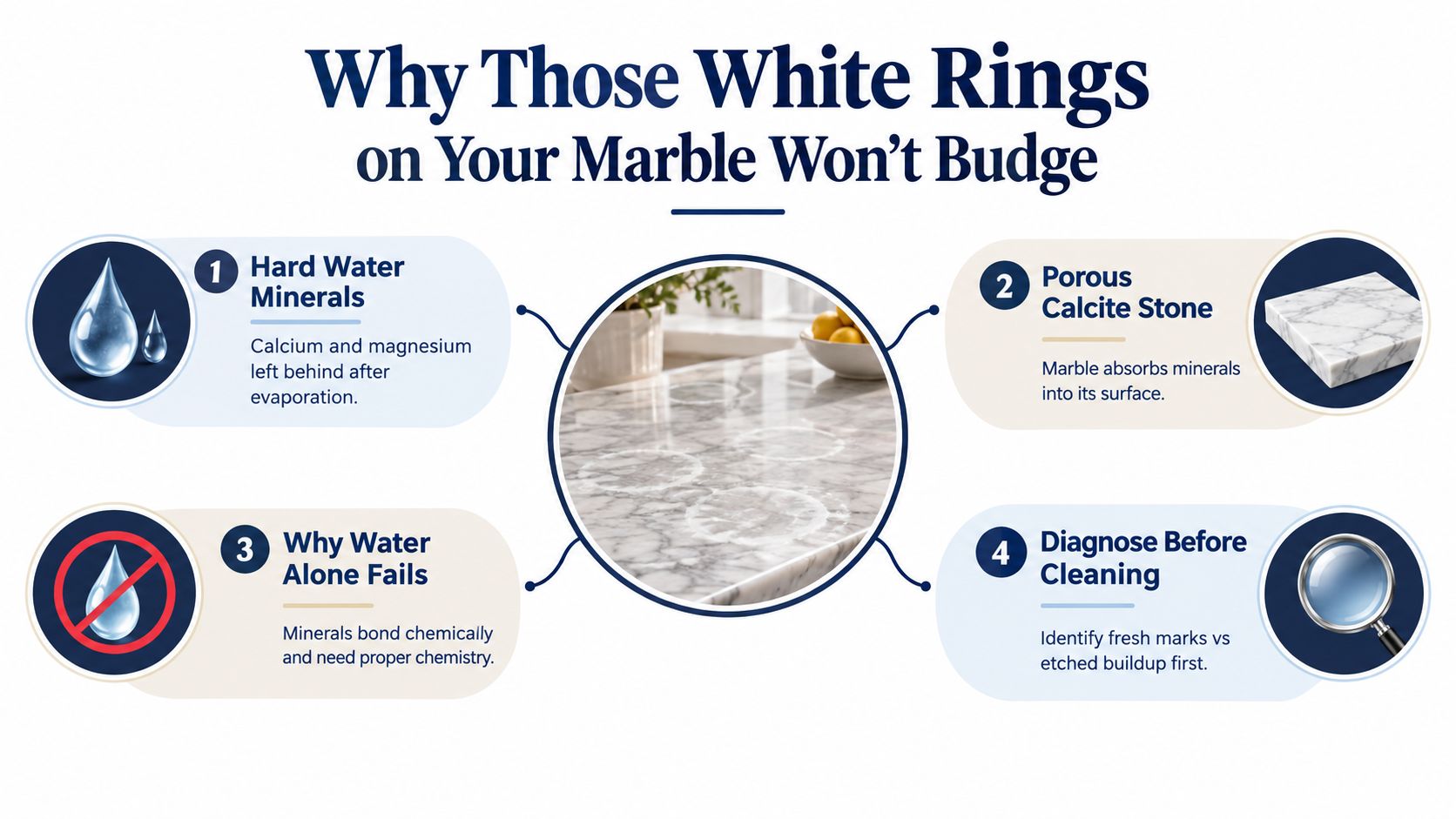
Check the mark under angled light before choosing a cleaner. Chalky, raised, powdery residue near a tap points to mineral scale. A smooth, dull, lighter patch with no removable residue points to etching. Use a neutral stone cleaner for the first type, and never apply acid to either mark.
Hard Water Stains Versus Acid Etching on Marble
Hard-water residue is a mineral deposit left behind after water evaporates. On marble, it commonly appears as a white crust, cloudy film, or pale ring. It may feel slightly gritty or raised because the material is sitting above the polished surface. A suitable pH-neutral stone cleaner can loosen or remove fresh residue without attacking the stone.
Acid etching is different. Vinegar, lemon, citric products, acidic bathroom cleaners, and limescale removers can react with marble's calcite. The result is a change in the surface itself. The affected area often looks dull, flatter, or less reflective than the surrounding polish, and it generally feels smooth rather than gritty. No amount of neutral cleaner will restore the lost shine.
This distinction matters around Indian kitchens and bathrooms because the trigger may not be the water alone. A tap drip can leave scale, while lemon juice on a preparation counter can create etching. Vinegar used during cleaning, tamarind or curd left on a slab, and repeated balcony splashes can produce marks that look similar under ordinary light.
| Feature | Hard Water Stain, Mineral Scale | Acid Etching |
|---|---|---|
| Position | Sits on top of the marble | Changes the marble surface |
| Appearance | White, chalky, cloudy, or crusty | Dull, pale, hazy, or less reflective |
| Feel | May feel gritty, powdery, or raised | Usually smooth and level |
| Neutral cleaner test | May lift or reduce the residue | Won't restore the shine |
| Correct response | Neutral cleaning and complete drying | Specialist polishing or restoration |
| Main household triggers | Tap drips, standing water, mineral-rich splashes | Vinegar, lemon, citric products, acidic descalers |
Before treating a countertop, inspect it under angled light and run a clean finger lightly across the mark. Don't scratch or scrape. Apply a small amount of pH-neutral stone cleaner to a hidden or inconspicuous area first, then use the same method on the mark. If the residue lifts, continue conservatively. If the surface remains dull after the residue is gone, stop cleaning and treat it as possible etching. For material selection and care considerations around polished worktops, see this guide to polished marble countertops.
Safe Step-by-Step Removal for Fresh Hard Water Marks
Fresh marks need a restrained routine. You're not trying to overpower the deposit. You're trying to remove loose minerals without changing the finish beneath them.
Prepare the right tools
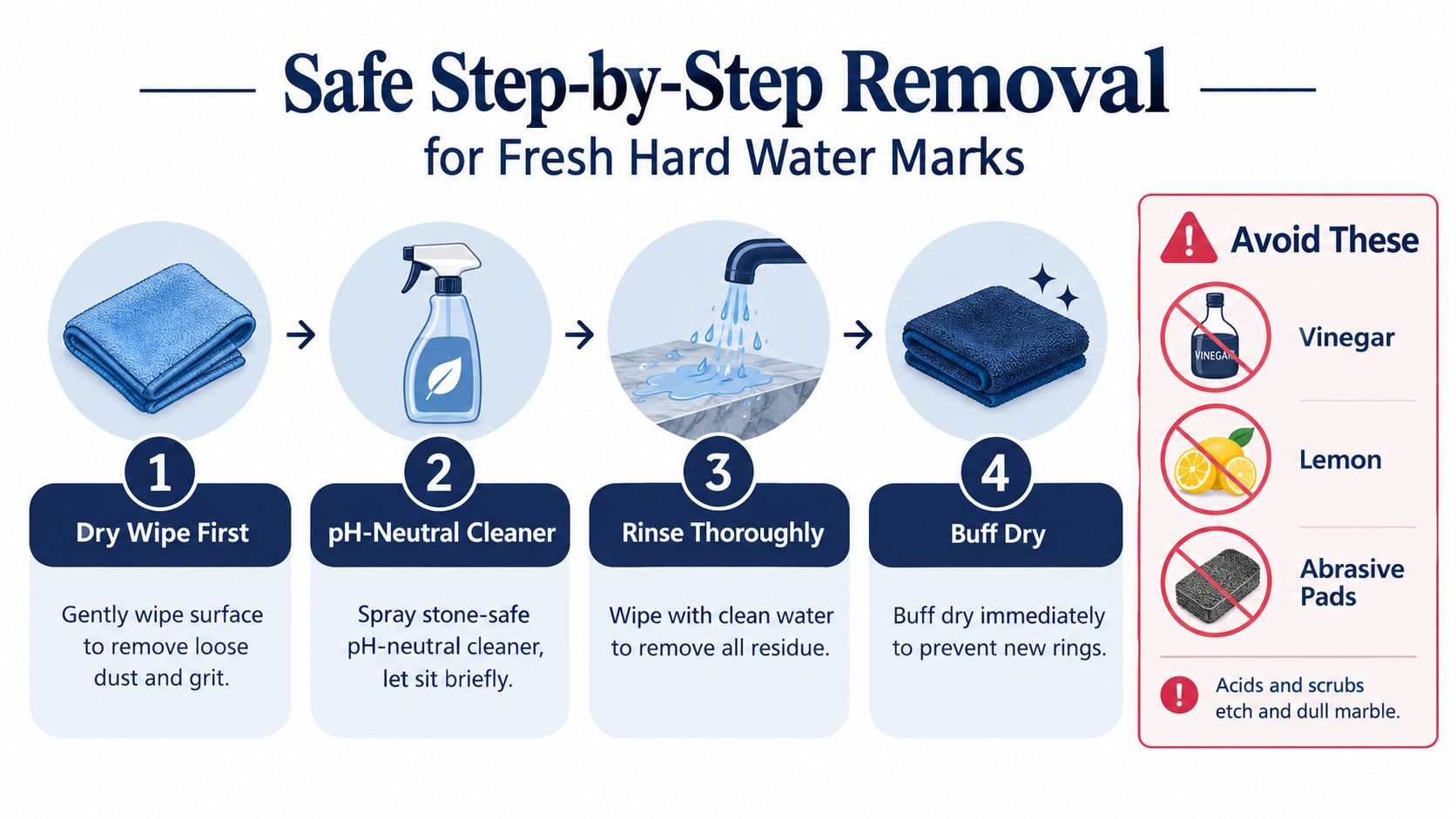
Use a clean microfiber cloth, a soft white nylon pad, two buckets, and a pH-neutral cleaner formulated for natural stone. A diluted glycerin soap can work as a mild option if it's suitable for the surface, while a branded pH-7 marble or stone spray is the more controlled choice.
For the final rinse, use filtered, RO, or distilled water when your household has persistent hard-water buildup. India-focused guidance recommends filtered or distilled final-rinse water because it reduces the minerals left behind during drying. Keep one bucket for the cleaning solution and one for clean rinse water.
Follow the four-stage routine
Dry-wipe first. Use a dry microfiber cloth to remove loose grit and surface moisture. Don't rub aggressively, because trapped grit can scratch the polish.
Apply neutral cleaner. Dampen the cloth or spray the cleaner onto the cloth rather than flooding the countertop. Work in gentle circular movements over a small area and allow a short dwell time of about 30–60 seconds, following the product label.
Rinse immediately. Wipe the area with clean water to remove both the loosened mineral residue and the cleaning solution. Don't allow the cleaner to air-dry on the marble.
Buff completely dry. Use a fresh, dry microfiber cloth until the surface has no visible moisture. Air-drying leaves another opportunity for mineral rings to form.
Keep these products away from marble
- Vinegar and lemon: Their acidity can etch calcite marble rather than safely dissolving the deposit.
- Harpic and acidic bathroom cleaners: Toilet and bathroom formulations may be far too aggressive for a polished stone surface.
- Citric descalers and general limescale removers: Calcium-removal chemistry isn't automatically marble-safe.
- Bleach: It isn't the right treatment for mineral scale and may affect surrounding finishes or sealers.
- Abrasive powders, steel wool, and rough pads: These can scratch or dull the polish even when they remove some residue.
If the white ring becomes visibly lighter or disappears after the neutral-cleaner test, repeat the process gently rather than increasing chemical strength. For broader background on limescale treatment across household surfaces, this guide to how to remove limescale is useful, but marble still requires the stone-specific precautions above.
The pass/fail check is simple. Pass: the deposit lifts and the surrounding polish looks consistent after drying. Fail: the residue remains bonded, the area stays dull, or the mark has a smooth etched feel. If it fails, stop repeating household cleaning and move to professional assessment.
Handling Heavier Buildup and Knowing When to Call a Pro
White rings that survive gentle cleaning usually need diagnosis before stronger treatment. Repeated wetting can bond mineral scale to calcite marble, especially in Indian homes supplied by hard borewell or municipal water. For heavier deposits, choose a stone-safe mildly alkaline cleaner. Guidance on stone maintenance describes these products as commonly around pH 8–9, rather than acidic. The stone-care guidance outlines alkaline options for heavier deposits.
Escalate carefully
Select a product that explicitly approves calcite-based natural stone. A dilute alkaline or hydrogen-peroxide formula made for marble may suit the deposit, but the full label matters more than a familiar chemical name. Patch-test an unseen area first, particularly on dark marble, filled stone, or a recently polished surface.
Apply it with a soft white nylon pad. Avoid steel wool and green Scotch-Brite pads. Work on a small section using light circular pressure, keep the dwell short, and follow the label. Do not let the product dry on the surface. Keep the working time within five minutes, then rinse thoroughly. For a cautious home treatment, rinse twice with clean water and buff completely dry.
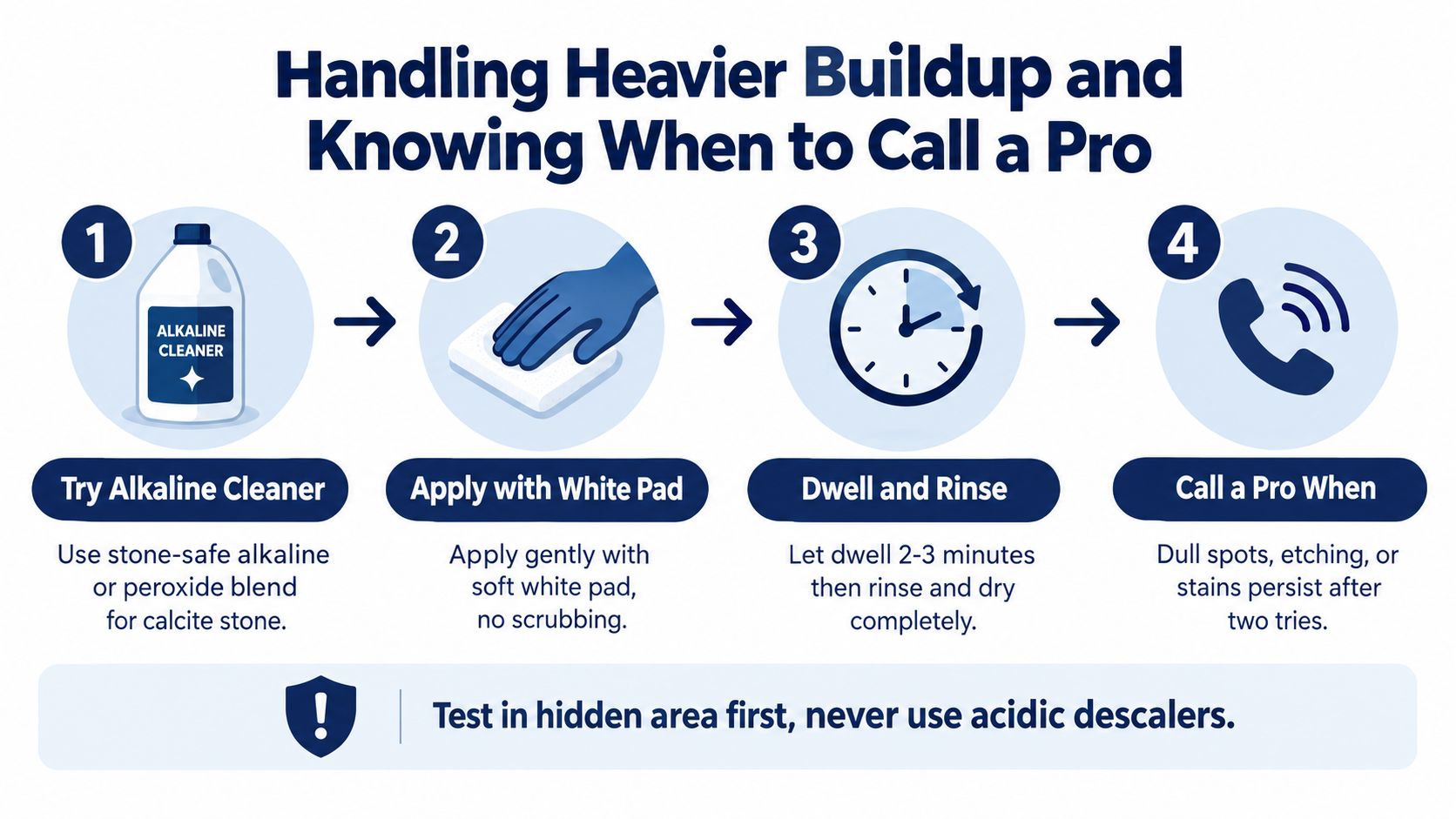
Do not turn a stubborn ring into a chemical experiment. If the deposit resists three passes, stop. A restoration team can select controlled micro-abrasion, diamond honing, or a poultice system after identifying whether the mark is bonded scale, staining, or acid etching.
Use clear stop signals
Call a marble restoration specialist if:
- The surface is pitted: Pits indicate damage to the stone, not just a removable surface film.
- The area is yellowing: Old chemical residue, iron, or another underlying issue may be involved.
- A hazy ring surrounds the mark: The visible deposit may sit inside a wider etched area.
- The stain covers more than one square foot: Large sections are difficult to treat evenly by hand.
- Two careful attempts fail: More scrubbing increases risk without solving the problem.
Use the finish as your decision guide. A crust that feels raised and lifts gradually may be scale. A smooth, dull patch points to etching and needs polishing rather than stronger cleaner. Never reach for vinegar or an acidic bathroom cleaner because the deposit looks hard. Acid can dissolve the mineral crust while permanently dulling the marble underneath. At that point, cleaning is over and re-polishing is usually required.
Prevention Toolkit for Indian Hard-Water Households
Cleaning solves the current ring. Prevention stops the next ring from forming. If your home receives borewell or mineral-rich municipal water, marble care must include drying habits, rinse-water choices, and sensible material placement.
A practical daily protocol is straightforward. Dry-wipe splashes first, use a pH-neutral stone cleaner only when needed, buff with a clean microfiber cloth, and use a squeegee on shower walls. Keep bottles on ceramic or stone-safe trays so water doesn't remain trapped beneath them.
Indian guidance identifies water above 120 mg/L as calcium carbonate as generally hard under BIS-oriented norms, while the cited Indian study recorded hardness from 200 to 908 mg/L in its sampled area. This explanation connects hardness levels with recurring household deposits. If white deposits also appear on taps, shower glass, and fixtures, review these signs of hard water at home as part of a broader diagnosis.
| Method | Effort Level | Approx. Cost, ₹ | Scale Reduction |
|---|---|---|---|
| Dry microfiber after use | Low | Not specified | Reduces evaporation residue |
| Filtered or distilled final rinse | Low to moderate | Not specified | Reduces minerals left during drying |
| Point-of-use water treatment | Moderate | Not specified | Reduces mineral exposure at selected taps |
| Squeegee for wet zones | Low | Not specified | Limits standing water on walls and ledges |
| Marble sealing | Moderate | Not specified | Helps reduce absorption, but doesn't replace drying |
| Quartz in high-splash zones | Project-dependent | Not specified | Avoids many marble-specific wet-zone concerns |
The table deliberately avoids invented prices or performance percentages. Your water chemistry, product choice, installation, and usage determine the cost and result. Sealing can support maintenance, but it won't make marble acid-proof and it won't prevent a mineral film from sitting on the surface.
For a kitchen renovation, material placement matters as much as the cleaning routine. Review the practical differences between kitchen marble and granite, then consider engineered quartz for areas that receive constant splashes. Marble remains a strong choice where its appearance matters and exposure is controlled. It's a poor choice for a surface that stays wet and is routinely cleaned with aggressive products.
Long-Term Care and Smart Material Choices
Long-term marble care is a water-management and specification problem, not a matter of cleaning more often. If the incoming water continually deposits calcium and magnesium, your household will keep fighting the same marks unless you reduce exposure or change the surface used in the wettest zones.
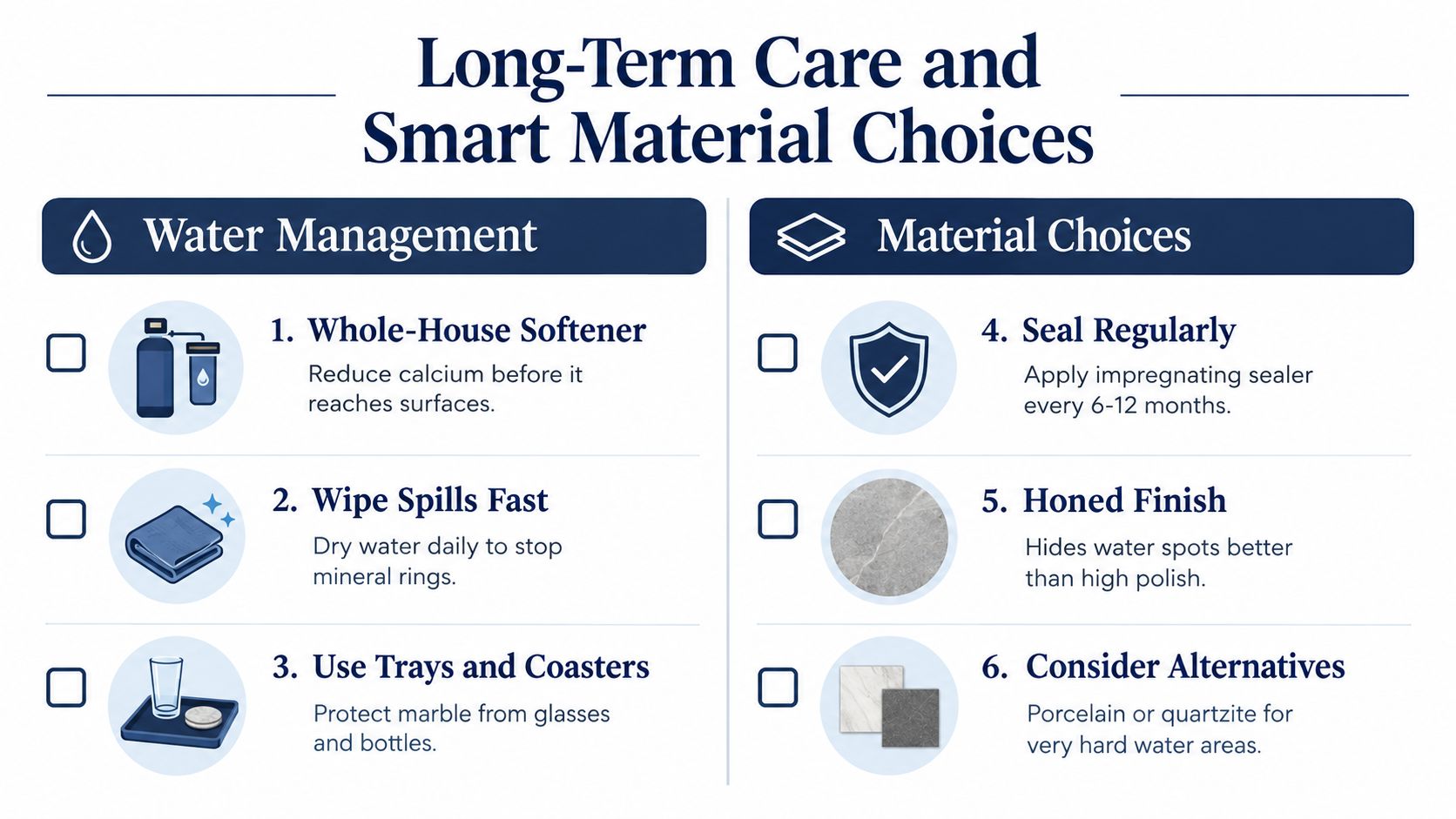
Start at the source. A whole-house softening system can reduce calcium before it reaches taps, shower walls, and counters, while a kitchen-stage RO unit can provide treated water for food preparation and final rinsing. Have the water assessed before choosing equipment. The correct system depends on the water supply, household usage, and whether the issue affects one tap or the whole property.
Match marble to the room
Reserve highly polished marble for lower-exposure applications such as dining tables, console tops, bedroom dressers, and decorative wall elements. These areas still need coasters and prompt spill cleanup, but they don't receive the same repeated wetting as a sink ledge or shower shelf.
For high-splash locations, consider engineered quartz, compact sintered stone, porcelain, or a honed marble finish. Quartz is non-porous and can simplify routine care, while a honed finish can make small water marks less visually prominent than a mirror polish. That doesn't make any material indestructible, so follow the manufacturer's care guidance.
This comparison of honed and polished marble is useful before you approve a finish for a bathroom vanity, kitchen counter, or balcony ledge. The right finish can reduce visual stress, but it can't compensate for standing water and unsuitable chemicals.
Use a simple inspection calendar
Every day, remove standing water from taps, counter edges, shower ledges, and balcony thresholds. Keep a clean microfiber cloth where the splash happens, not in a cupboard across the room. Replace wet cloths with fresh ones so you're not spreading mineral residue across the polish.
Each quarter, inspect the marble under angled light. Check for new rings, dull patches, open chips, and areas where water no longer behaves as it did after sealing. A small water-bead test can help you monitor the sealer, but it doesn't diagnose etching and shouldn't replace professional advice when the surface is damaged.
Review high-use counters annually and reseal according to the stone, sealer, and installer's recommendations. Don't apply a new product because a calendar reminder appears. The correct interval depends on exposure and the particular marble.
Choose based on lifetime care
Material samples should be tested against the way your household works. If family members leave wet bottles beside the basin, choose trays and a surface that tolerates that routine. If staff clean the home with general bathroom products, specify materials and written care instructions that prevent acid exposure.
For a wider comparison of surface options, this Boston countertop materials cost guide can help frame the trade-offs between appearance, maintenance, and material selection, even though local pricing and availability will differ. In the NCR, Varun Marbles supplies natural marble, granite, onyx, and engineered quartz, with slab selection, fabrication, and installation support. Treat that as one sourcing option when you're comparing materials for a hard-water home.
A workable marble-care checklist: manage the water, dry every splash, use only neutral chemistry, inspect the finish, and reserve marble for zones where your household can protect it.
The decision tree is worth keeping near your cleaning supplies:
- White and raised: Dry-wipe, test with pH-neutral cleaner, rinse, and buff dry.
- Smooth and dull: Suspect etching. Don't apply vinegar, lemon, or descaler.
- Persistent after careful cleaning: Stop escalating chemicals and arrange specialist assessment.
- Recurring within days: Investigate the water source and change the drying or material strategy.
- High-splash installation: Consider quartz, porcelain, sintered stone, or a suitable honed finish instead of polished marble.
The safest response to hard water stains on marble is controlled action. Remove fresh deposits gently, diagnose dullness before treating it, and solve recurring marks through water management and smarter material zoning.
If white rings have appeared on your marble, visit Varun Marbles to compare natural marble and engineered quartz options with guidance on slab selection, finishing, fabrication, and installation. Their Gurugram showrooms can help you choose a surface that suits both your design and the hard-water conditions in your home.