
White and Beige Marble for Homes and Projects

You're standing in a marble yard in Gurugram with two slabs in front of you. One is a bright, cool white with fine grey movement. The other is a creamy Indian beige that looks calmer, warmer, and easier to live with. Both look premium under showroom lights. The difficult question is what they'll look like after dust, cooking, hard water, children, guests, and daily cleaning have had their say.
White and beige marble aren't single products. They're broad colour families containing stones with very different base tones, veining, density, fossil content, finishes, and maintenance requirements. A carefully chosen beige can look more refined in a busy family home than an unforgiving mirror-polished white. A well-specified white can still be the right answer for a quiet lobby, powder room, or feature wall.
The decision should start with use, light, and care habits, not with the word “luxury” on a sample label.
Table of Contents
- What White and Beige Marble Really Means
- White Marble Versus Beige Marble at a Glance
- Finishes That Change How the Stone Performs
- Italian and Indian Origins Worth Knowing
- Pairing White and Beige Marble With Other Materials
- How to Inspect a Slab Before You Buy
- Maintenance and Sealing in Indian Conditions
- Choosing the Right Marble for Your Project
What White and Beige Marble Really Means
White marble can range from the cool, bluish-white appearance associated with Carrara and Statuario to the warmer creamy tones found in Indian white stones. Beige marble covers an equally broad spectrum, from pale buff surfaces to deeper cream shades with gold, brown, or grey movement. Two slabs sold under the same colour description can produce completely different results once they're installed across a floor or wall.
Start by identifying the base tone. A cool white reflects daylight with a crisp, architectural quality. A warm white contains cream or ivory, so it sits more comfortably beside timber, brass, and warm paint. Beige usually softens a room because its background absorbs some of the visual contrast between the stone, furniture, and lighting.
Next, study the veining density. Fine, scattered veins create a quiet surface that suits large floors and calm walls. Broad veins create drama, but they also demand careful slab selection and layout planning. If a feature wall has strong movement, the fabricator must align slabs deliberately. Otherwise, the pattern can look accidental rather than bookmatched.
Read the stone beyond its colour name
Look for fossil content, crystalline structure, pits, and cloudy patches. Some Indian white marbles are valued for their crystalline appearance and ability to take a strong polish, while Banswara is described by the Indian Bureau of Mines as a white to off-white dolomitic marble. That distinction matters because a crystalline surface and a softer dolomitic surface won't behave identically under abrasion or at exposed edges.
India's white-marble story also has real architectural depth. Makrana marble is historically associated with the Taj Mahal and other landmark buildings, while the Rajasthan marble guide places white and beige stones within a structured domestic market with distinct grades and uses. Makrana, Morwad, Rajnagar, Banswara, and other regional stones should therefore be judged by the actual slab, not by a broad colour label.
Specification rule: Approve the full slab, not a small tile sample. Colour family tells you the starting point. The slab's pattern, finish, and condition determine the finished room.
White Marble Versus Beige Marble at a Glance
White marble gives a room brightness, contrast, and visual polish. It can make a compact entrance or lobby feel more open because its pale surface reflects available light. It also exposes dust, footprints, water marks, edge wear, and acidic etching more readily, particularly when the surface is highly polished.
Beige marble is more forgiving. Its cream, buff, or soft gold background disguises everyday dust and minor variation better, and it connects naturally with wood, warm metals, linen, and earthy textiles. That doesn't make beige maintenance-free. A porous or softer beige stone can still stain, scratch, or develop marks if the specification and sealing are poor.
Use this comparison as a starting filter rather than a substitute for slab inspection.
| Characteristic | White marble | Beige marble |
|---|---|---|
| Visual effect | Brighter, cooler, and more reflective | Warmer, softer, and visually grounded |
| Dust visibility | Dust and footprints show quickly, especially on polished faces | Everyday marks are generally less conspicuous |
| Veining | Grey, blue, gold, or dark veins can look highly contrasted | Cream, brown, gold, and grey veins usually blend more gently |
| Lighting response | Daylight can make cool whites feel crisp; warm artificial light can reveal cream undertones | Daylight reinforces warmth, while cool artificial light can make beige appear flatter |
| Water and porosity | Must be checked stone by stone; open pores and pale backgrounds make staining more obvious | Porosity still varies, but the warmer background can disguise slight discolouration |
| Etching visibility | Lemon, vinegar, curd, and hard-water marks are often easy to see | Etching can still occur, but low contrast may make minor marks less obvious |
| Typical project fit | Feature walls, formal entrances, powder rooms, quiet living areas, premium hospitality spaces | Family floors, warm living rooms, bedrooms, larger residential areas, practical wall cladding |
| Pattern tolerance | Strong veins create a high-end statement but require disciplined layout | Subtle patterns are easy to coordinate; bold beige movement can anchor a neutral interior |
| Budget position | Imported Italian whites usually carry a premium because of origin, selection, and logistics | Indian beige options often offer a broader local supply route and more accessible choices |
| Care expectation | Best for owners who accept visible marks and regular upkeep | Better for households that want natural variation without constant visual policing |
For kitchens, ask a harder question than “Which colour looks expensive?” Ask whether you'll accept visible etching around the sink and preparation area. For a hotel lobby, a polished white may communicate formality and grandeur. For a family kitchen, a honed beige or a quartz alternative can be the more rational specification.
The relevant performance check is not the colour alone. BIS IS 1130:1969 treats white marble as a distinct category and sets physical-property requirements, including moisture absorption of no more than 0.4% by weight after 24-hour cold-water immersion. Request the applicable test information for the selected stone, then match it to traffic, wet exposure, cleaning behaviour, and your tolerance for visible wear.
Finishes That Change How the Stone Performs
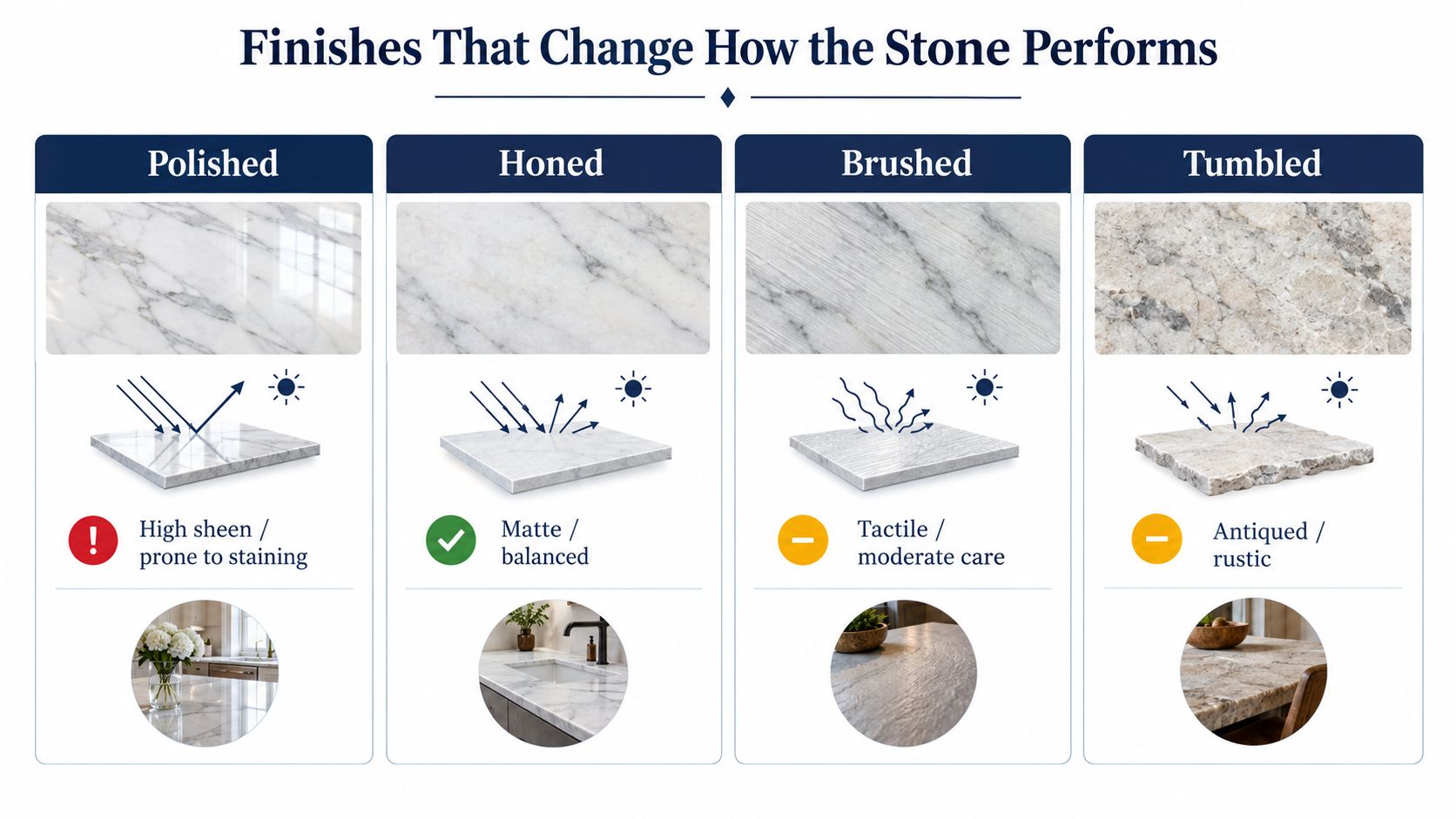
Finish changes the stone's appearance, traction, reflection, and the way it reveals daily use. The same white or beige slab can feel formal and demanding when polished, or quiet and practical when honed.
Polished
A polished surface has a mirror-like sheen that intensifies colour and contrast. It suits decorative walls, formal entrances, low-stain powder rooms, and feature furniture, where reflection is part of the design.
It's a poor choice for a busy kitchen worktop or a high-traffic floor if the owner expects the surface to remain visually perfect. Fingerprints, water spots, footmarks, and micro-etching stand out. Polished marble still needs sealing where the stone requires it, and cleaning must stay gentle and pH-neutral.
Honed
Honed marble has a satin-smooth, low-reflection surface. It softens veining and reduces glare, making it a strong choice for living floors, bathroom walls, and calm contemporary interiors. It can still mark, but small etches usually blend into the softer visual field better than they do on a mirror finish.
Specify honed white or beige where you want refinement without showroom shine. Avoid it only when your design depends on maximum reflection or when the selected stone's open surface needs a different treatment strategy. For a practical explanation of how the two surfaces differ, review this guide to the difference between honed and polished marble.
Matte, brushed, and river-washed surfaces
Matte finishes reduce reflection further and work well in understated bathrooms, pooja rooms, and relaxed residential spaces. Brushed or river-washed textures add tactile variation and can help break up a large beige surface, but the texture collects dust and requires more attentive cleaning.
Use textured finishes carefully near wet areas. They can improve visual grip, but they aren't a substitute for a properly designed floor, drainage, grout system, and slip assessment. Avoid rough surfaces on kitchen counters where crumbs, oils, and residue can settle into the texture.
Leathered
Leathered marble has a textured face with a more tactile depth than honed stone. It's particularly effective on beige, cream, and earthy stones because the surface reinforces their natural character while reducing the visual impact of small marks.
Specify leathered marble for selected kitchen fronts, vanity tops, feature counters, and hospitality surfaces where touch and texture matter. Don't use it automatically across every surface. Strong texture can complicate writing, food preparation, detailed cleaning, and edge finishing. Seal according to the stone and treatment system, then test the completed finish before approving the full installation.
Italian and Indian Origins Worth Knowing
A slab's origin affects more than its label. It influences colour consistency, block selection, available quantities, processing, logistics, and how quickly a replacement can reach site.
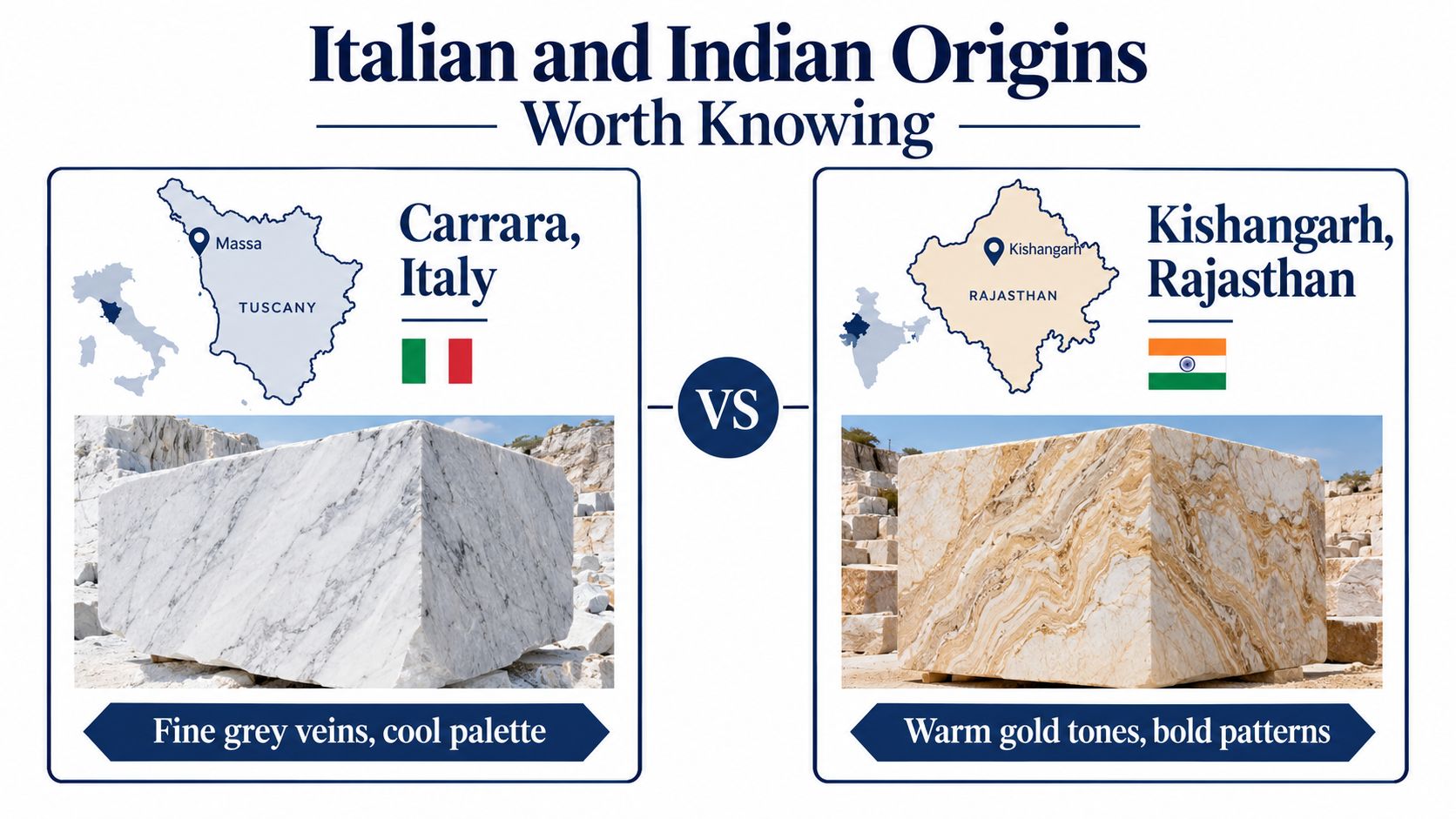
An Italian white often begins as a carefully selected block from a quarry near Carrara. The yard sorts slabs for background tone and vein movement, then fabricators and importers manage packing, transport, customs, and inland delivery before the material reaches an NCR project. That chain can produce a refined, recognisable look, but it also makes lot consistency and replacement planning important.
An Indian beige may travel a much shorter route from a Rajasthan quarry or processing cluster to a Gurugram yard. The material can offer warmer undertones, broader availability, and more practical continuity for a project that needs multiple slabs. Rajasthan is the centre of India's marble supply. The Indian Minerals Yearbook records Rajasthan's marble production at 10,621,000 tonnes in 2019–20 and 16,159,347 tonnes in 2020–21, compared with 347 tonnes from Gujarat in 2020–21. The same government source records Rajasthan's dominant share of national marble output value in earlier years, confirming the long-running importance of its quarrying and processing belt.
What the supply route changes on site
Italian and Indian material can both be excellent. The practical differences often appear in:
- Slab continuity: Imported lots may have a tightly defined appearance, while Indian yards can offer broader selection from local production clusters.
- Calibration: Thickness tolerance and back calibration affect adhesive use, finished levels, and transitions with tiles or timber.
- Resin treatment: Resin-filled pits and fissures can improve the usable face, but the treatment must be declared and inspected under light.
- Packing and handling: Longer transport introduces more handling stages. Crates must be checked for edge damage, corner breaks, and slab-to-slab variation.
- Replacement planning: A locally sourced stone may be easier to match later, while an imported lot may require early purchasing and careful allocation.
Kishangarh is widely described as Asia's largest marble market, and its role matters to NCR buyers because processing, trading, and selection happen close to a major project region. Read this white Volakas marble guide for another example of why a name alone doesn't define the exact surface you'll receive.
Treat origin as a reliability and coordination signal, not a status symbol. The right question is whether the supplier can show the actual slabs, confirm the lot, explain treatment, and support fabrication through installation.
Pairing White and Beige Marble With Other Materials
Good marble combinations rely on temperature, contrast, and visual hierarchy. The easiest way to lose control is to combine several materials that all demand attention.
White marble works well with teak, walnut, brass, blackened steel, warm white paint, and deep blue accents. Cool white with walnut creates a deliberate contrast. Warm white with oak or brass feels quieter. Honed white beside fluted travertine creates texture without forcing two competing patterns to dominate.
Beige marble acts as a neutraliser. It can sit between a busy white marble and a strong timber grain, or soften blackened steel in a living room. A beige floor with warm white walls creates continuity, while beige cladding behind a dark vanity gives the room depth without introducing another aggressive colour.
Use the room as the selection filter
For a living room, consider honed white with walnut furniture and linen upholstery if the space has controlled traffic. For a family dining area, beige with teak and black metal is more forgiving and keeps food, dust, and furniture movement from becoming the visual focus. A bathroom can take polished white on a niche wall, then use a honed or textured surface underfoot for a calmer and safer composition.
The same logic applies to other stones:
- Green marble: Pair it with quiet beige or warm white. Keep the supporting stone low-contrast and use a honed finish if the green already has strong movement.
- Travertine: Combine it with honed white or cream marble. The shared softness keeps the pairing architectural rather than decorative.
- Granite: Use a restrained beige marble beside a visually active granite. Don't place two high-movement stones directly opposite each other.
- Onyx: Let onyx own the feature. Use plain white or beige around it and control lighting so the wall remains intentional.
A useful planning discipline is the 60-30-10 colour rule. Let the dominant surface, such as flooring or wall paint, occupy the visual majority. Use the secondary stone or timber to support it, then reserve the accent share for brass, artwork, upholstery, or a feature stone.
For more ways to assess warm beige movement, compare the beige marble texture options. Before final approval, place full-size samples together under daylight and the actual artificial lighting. Never approve two busy marbles merely because each looks attractive on its own.
How to Inspect a Slab Before You Buy
A showroom sample can hide the issues that become obvious across a full wall or floor. Inspect the slab standing, walking, tilting, and touching it. Don't judge only from a photograph.
Start with the whole slab
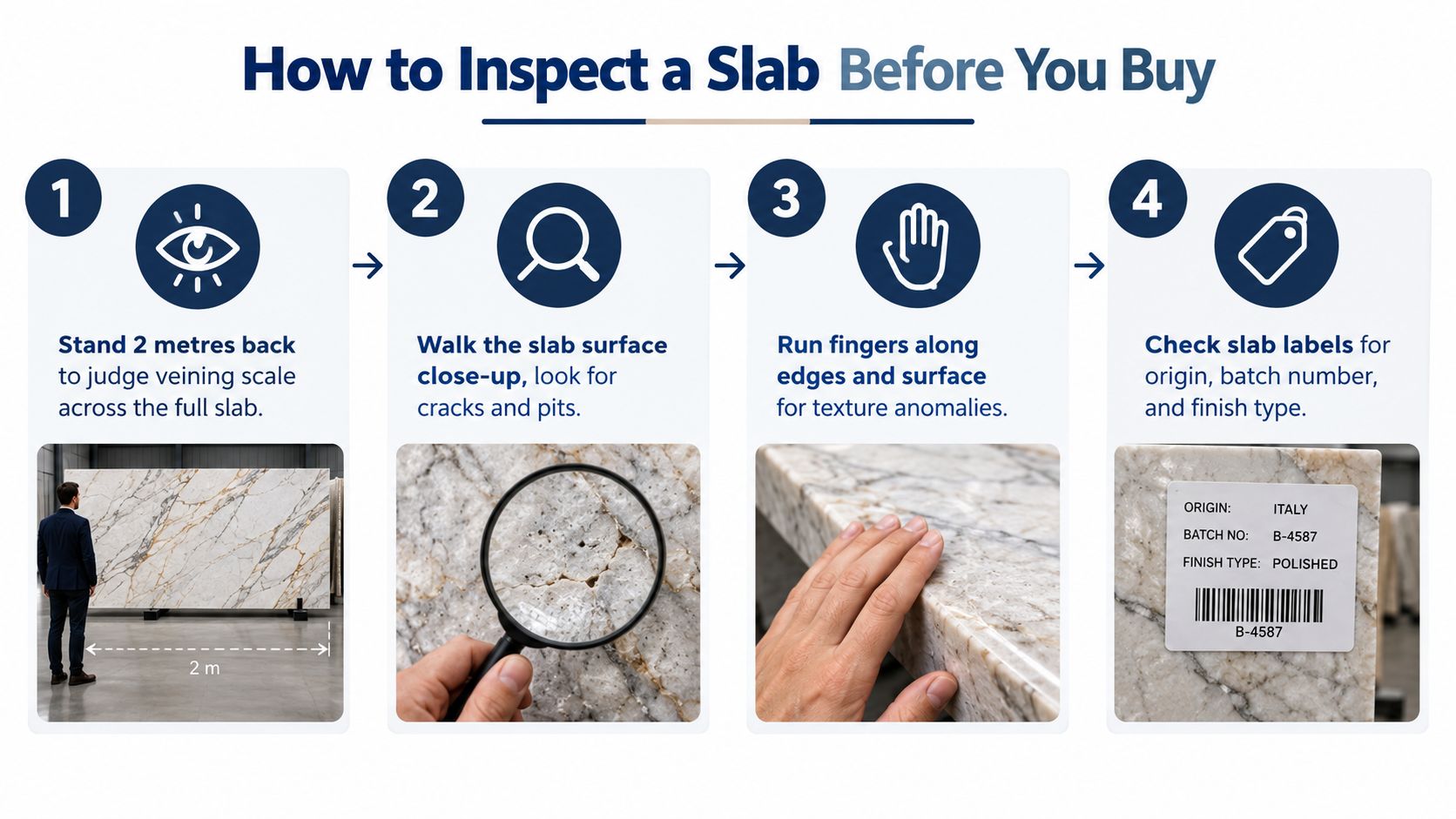
Stand about 2 metres back and assess the overall rhythm of the veins. Ask whether the movement suits the room's scale. A fine pattern can disappear on a large lobby floor, while a broad vein can overwhelm a compact bathroom.
Then move close. Inspect pits, fissures, filled areas, edge chips, resin patches, cloudy zones, and dull spots. Tilt the slab under raking light. Fillers and surface variation often become easier to see when reflected light moves across the face.
Check identity and continuity
Photograph the slab label before approval. Record:
- Origin and stone name: Confirm that the written description matches the selected material.
- Batch or lot number: Keep the number with the purchase documents and site schedule.
- Finish and thickness: A polished slab and a honed slab from the same family can read very differently.
- Crate sequence: Mark the intended order so the installer can maintain a planned flow across walls or floors.
- Visible defects: Photograph each accepted variation and identify whether it's approved, repaired, or excluded.
Ask whether all slabs come from the same block or whether the proposed quantity combines different blocks. Dye-lot drift is more obvious in pale materials, and a mixed supply can create an unwanted patchwork.
Translate tests into daily use
A simple water test on an approved sample can reveal whether the surface darkens quickly at an unsealed edge or exposed area. The test isn't a laboratory result, but it shows why absorption data matters around sinks, shower walls, and wet cleaning zones. A coin test on a honed face can help you discuss surface hardness and scratch sensitivity, but don't treat it as a certified engineering test.
Review the supplier's technical data for moisture absorption, density, and flexural strength. In plain terms, absorption relates to how readily the stone takes in liquid, density helps you understand the material's compactness, and flexural strength helps the project team think about handling, support, and breakage risk. The installer still needs to follow the correct substrate, adhesive, joint, and handling method.
Watch this slab inspection video before your yard visit, then take your own photographs in consistent light. Approval should cover the actual slab, the intended layout, the finish, and the treatment plan.
Maintenance and Sealing in Indian Conditions
Indian interiors bring a demanding mix of dust, humidity, cooking oils, hard water, monsoon moisture, and frequent cleaning. White and beige marble can both perform well, but neither should be specified as if natural stone were maintenance-free.
White marble shows contrast quickly. Dust stands out on a bright polished face, while lemon, vinegar, curd, and other acidic materials can leave visible etching. The safest routine is simple: wipe spills promptly, use a pH-neutral cleaner, avoid abrasive powders, and place heat and stain protection around kitchen work zones.
Beige marble hides some everyday marks better, but it can contain iron-bearing movement that reacts poorly to unsuitable acid cleaners. A yellow or rust-coloured mark near a bathroom or wet edge needs investigation, not aggressive scrubbing. Test any treatment in an inconspicuous area before applying it across the surface.
Choose the treatment for the surface
A penetrating sealer enters the stone and helps reduce liquid absorption without creating a thick film on top. A topical treatment forms a surface layer and may alter sheen, texture, or slip behaviour. The correct choice depends on the stone, finish, location, and manufacturer's system. Don't assume a sealer will prevent etching. Sealing helps with absorption and staining, but acid can still alter the surface.
A polished face highlights marks, while honed and textured finishes visually soften micro-etching. That doesn't mean honed stone never stains. It means the finish can make normal wear less conspicuous and can suit owners who want a less demanding appearance.
| Care factor | White marble | Beige marble |
|---|---|---|
| Daily cleaning | Dust and spills should be removed promptly because contrast is high | Routine wiping remains important, though minor dust is less visible |
| Acid exposure | Etching can be immediately noticeable on polished surfaces | Etching still occurs, but the lower contrast may disguise small marks |
| Kitchen use | Requires disciplined spill control around lemon, vinegar, oils, and sinks | More visually forgiving, but oils and liquids can still penetrate open stone |
| Bathroom use | Hard-water marks and soap residue can show clearly | Iron-bearing veins and unsuitable cleaners may create discolouration |
| Finish choice | Honed can soften the appearance of micro-etching | Honed or leathered surfaces support a relaxed, tactile look |
| Sealing approach | Use a compatible penetrating system where the stone requires it and test first | Confirm absorption and treatment compatibility rather than assuming colour predicts performance |
| Outdoor or monsoon exposure | Avoid treating polished appearance as weather protection | Drainage, moisture, and cleaner selection remain critical |
A sensible maintenance schedule has three layers:
- Daily: Remove dust, standing water, food, oils, and muddy footprints with a soft cloth or mop.
- Weekly: Clean with a stone-safe, pH-neutral product and inspect sink edges, bathroom corners, and traffic paths.
- Periodically: Review the sealer and surface condition with the stone professional. A sealing cycle of two to three years is often discussed for natural stone applications, but the actual interval depends on the stone, finish, traffic, cleaning, and exposure.
For kitchen counters and shower walls, approve a small treated sample before full installation. For lobbies and floors, specify cleaning responsibilities alongside the material. A beautiful stone fails when the housekeeping team uses the wrong chemical.
Choosing the Right Marble for Your Project
Choose tone first by light and lifestyle, then choose pattern and finish. A north-facing or visually cool room may benefit from warm beige. A dim powder room can take a reflective white more easily than a sunlit floor that shows every footprint. A family that cooks frequently and wants relaxed upkeep shouldn't specify polished white for a large kitchen just because it photographs well.
Use this decision framework:
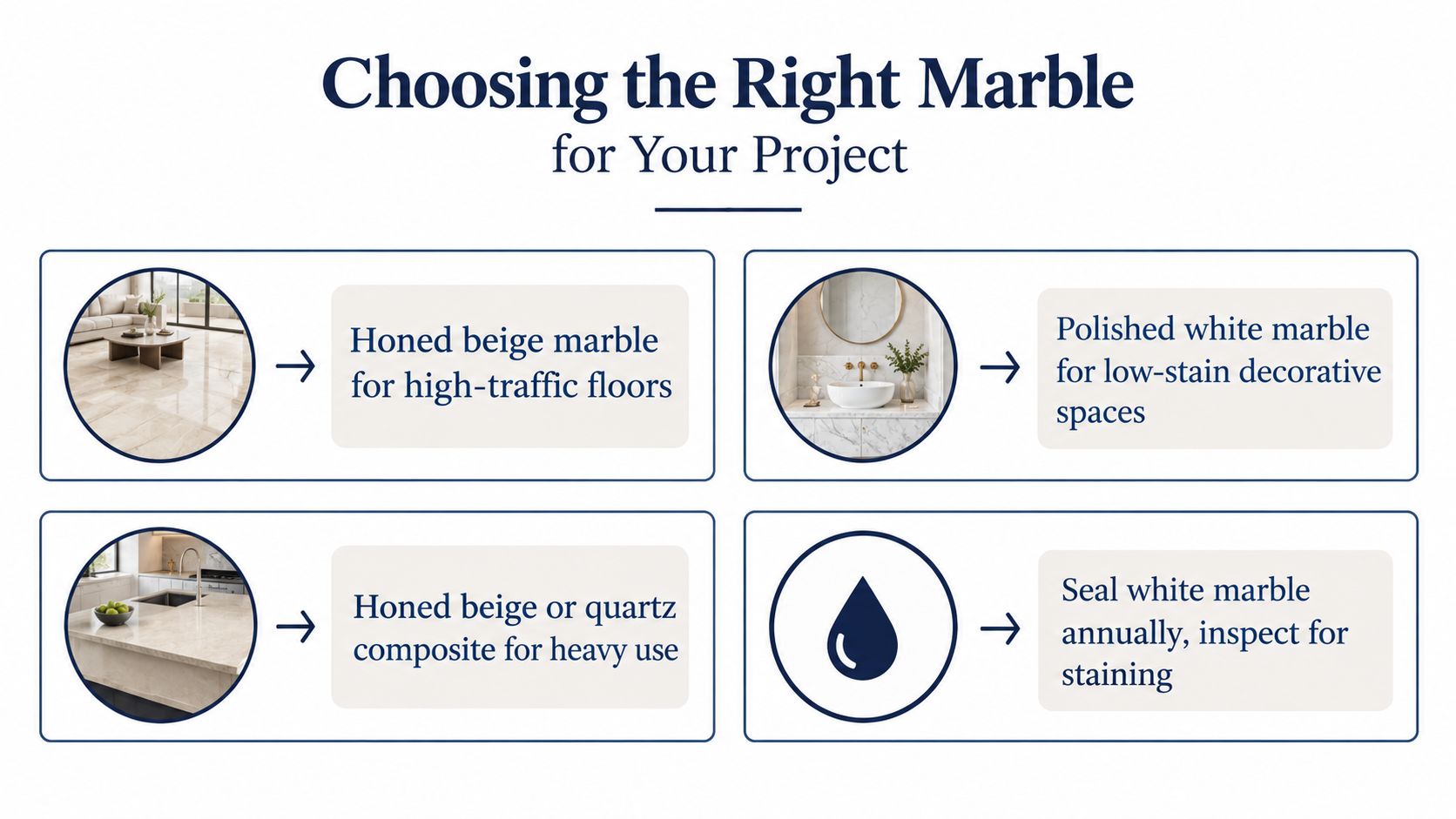
- Match traffic to surface. Honed beige is a strong starting point for busy living floors. Polished white belongs in low-stain decorative zones, formal walls, and carefully managed spaces.
- Match finish to touch. For kitchens and vanities, compare honed beige, leathered cream tones, and engineered quartz. Quartz offers a non-porous alternative when low routine upkeep matters more than natural variation.
- Match pattern to room scale. Fine movement supports continuity across larger areas. Strong veining works better as a controlled feature, with slabs selected and laid in sequence.
- Match maintenance to household habits. If visible dust and etching will cause frustration, choose a warmer tone and softer finish rather than relying on promises that the stone will remain unchanged.
- Approve the actual material. Shortlist two stones, place samples under site lighting, request a sealer demonstration, and inspect the complete slabs before signing off the specification.
Rajasthan remains the core Indian production region for white and beige marble, with Makrana, Rajsamand, Banswara, Rajnagar, and Kishangarh forming important parts of the supply conversation. That local depth gives architects and homeowners meaningful choice, but it also makes inspection essential. Don't buy “white” or “beige” in the abstract. Buy a specific slab, with a specific finish, batch, treatment, layout, and maintenance plan.
Varun Marbles helps architects and homeowners in Gurugram compare Italian and Indian marble, beige and white selections, engineered quartz, and other natural stones through showroom and yard inspection. Visit Varun Marbles to review full slabs, discuss fabrication and finishing, and coordinate installation for your residential, hospitality, or commercial project.