
Difference Between Honed and Polished Marble Guide
Polished marble typically delivers 85+ gloss units, while honed marble sits around 10–20 gloss units. The wet-traction gap matters just as much, with polished marble around 0.3–0.4 wet coefficient of friction versus 0.4–0.5 for honed marble.
You're standing in a Gurugram marble showroom, looking at two slabs cut from the same block. One catches every ceiling light and looks almost liquid. The other has the same veining, but its surface is quiet and satin-like. Both look expensive. Only one may be sensible for your bathroom floor, busy kitchen, or entrance exposed to monsoon water.
That's the difference between honed and polished marble. It isn't a beauty contest. Finish affects grip, glare, visibility of etching, water spotting, cleaning effort, and how the surface will look after years of ordinary use. Indian marble guidance also treats honed and polished as distinct finish categories, not casual showroom descriptions, under IS 1130:1969 (Indian marble specification and finish categories).
My advice is straightforward. Choose polished marble where reflection is part of the design and water exposure is controlled. Choose honed marble where people walk, cook, splash, or track grit. The rest of the decision becomes much easier once you judge the finish by the room it has to survive.
Table of Contents
- Standing in the Showroom Trying to Choose a Finish
- What Honed and Polished Finishes Actually Mean
- Side by Side on the Things Buyers Notice Most
- The Numbers Behind Gloss and Slip Resistance
- Maintenance Realities in Indian Homes
- Matching Finish to Room and Marble Variety
- A Short Buying Checklist Before You Finalise the Slab
Standing in the Showroom Trying to Choose a Finish
A buyer may walk into a Sector 15 marble yard asking for “the shinier one”. That usually happens after seeing polished slabs in photographs, where the reflected light makes white marble look brighter and veining appear deeper. Then the same buyer sees the slab beside a matte sample and starts asking the questions that matter: Will this be slippery near the wash area? Will water marks show? What happens when turmeric, tea, or lemon touches the surface?
The finish should answer those questions before it satisfies the showroom camera.
Start with the room, not the slab
Polished marble is the same natural stone taken through progressively finer mechanical abrasives until it develops a mirror-like surface. Light bounces off that surface, colours look more saturated, and veins become more dramatic. A polished Statuario or Indian white marble can give a formal drawing room the sharp, reflective character many homeowners want.
Honed marble stops the abrasive process earlier. The surface remains smooth, but it has a low-sheen, matte appearance that absorbs rather than throws light across the room. It feels calmer underfoot and is less visually demanding when the surface picks up dust, fine scratches, or small marks.
Practical rule: A finish that looks impressive in a dry showroom can be the wrong finish beside a wet bathroom door.
I've seen polished floors selected for their luxury appearance and then treated like a safety problem once children, older family members, or domestic staff started walking over wet patches. I've also seen honed marble rejected because it looked “flat” under showroom lighting, only for the same finish to work beautifully in a naturally bright home where glare would have been irritating.
Before finalising, view both surfaces under your actual lighting conditions. Compare them with white light, warm light, and light entering from a window. You can also use a visual reference such as these marble floor photos, but don't let an edited image replace an in-person sample.
The consultant's decision order
Use this order when you're unsure:
- Safety first. If the floor will regularly become wet, start with honed or another tested textured finish.
- Maintenance second. If the room sees hard-water droplets, acidic food, dust, or heavy foot traffic, favour the surface that hides daily wear.
- Appearance third. Use polish where reflection improves the room, not because it looks expensive in a yard.
That order prevents the most common buying mistake, choosing a finish for the first impression and paying for the decision during everyday use.
What Honed and Polished Finishes Actually Mean
Honed and polished marble start with the same natural stone. The distinction comes from the finishing work after cutting, not from a different marble variety.
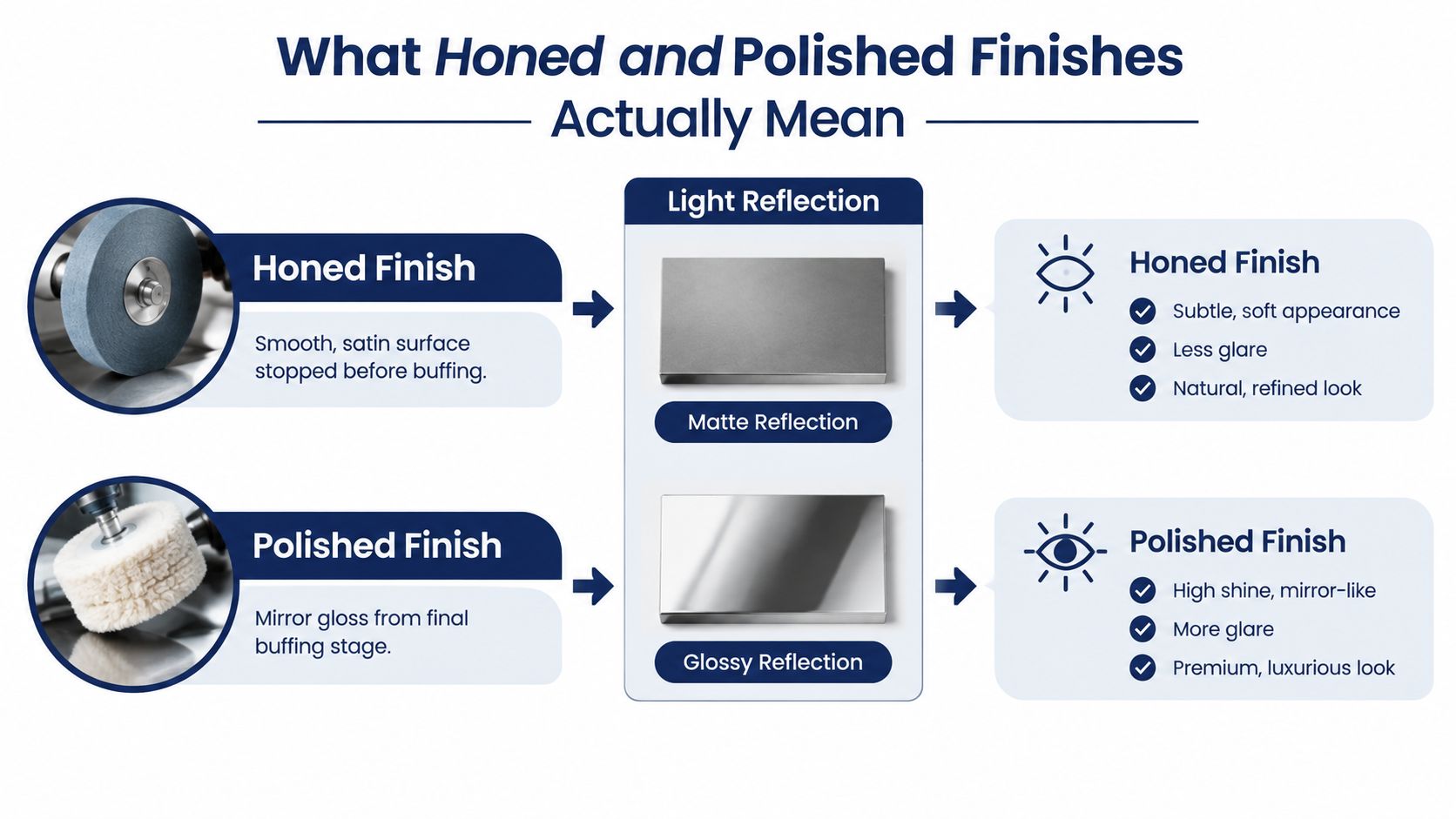
Fabricators create a honed finish by grinding the face with abrasive pads and stopping before the final buffing stages. The result is smooth and level, with a satin or matte appearance. It is comfortable under the hand, but it does not reflect light like a mirror. That lower reflection also gives minor marks and light etching a quieter appearance.
A polished finish uses finer abrasives and polishing compounds until the face becomes highly reflective. The glossy surface sharpens colour, increases visual depth, and reflects nearby lights and objects. In a Gurugram showroom, this is the finish that catches attention first. It is also the finish that exposes water spots, dull patches, and surface damage more clearly.
These are surface treatments, not different stones
The marble's mineral composition stays the same after honing or polishing. The treatment changes how light behaves, how marks show, and how much grip the finished face can provide. Calcite-rich marble remains sensitive to acids in either finish. Polishing does not protect it from lemon, vinegar, or unsuitable cleaning products.
Buyers often ask for a “stronger marble finish” when they want a surface that conceals daily wear. Polishing supplies visual brilliance, not chemical resistance. Honing makes etching less obvious, but it does not remove the need for proper sealing or suitable cleaning.
Ask how the stone and finish are specified
In India, IS 1130:1969 recognises sand or abrasive, hone, and polished finishes for marble blocks, slabs, and tiles (IS 1130:1969 finish definitions). Finish selection is therefore part of supply and specification, not merely a dealer's sales language.
Ask the dealer to identify these separately:
- The marble variety, including origin, colour, veining, and physical characteristics.
- The applied surface finish, such as honed or polished.
Botticino, Statuario, Morwad, and Andhi can all look different under each treatment. Polish may make fine veining appear sharper, while honing gives the same pattern a softer reading. Judge the actual slab or a representative sample. No finish can compensate for poor stone selection, resin repairs, uneven filling, or unsuitable installation.
Side by Side on the Things Buyers Notice Most
The showroom comparison becomes useful when you stop asking which finish is more luxurious and ask which one handles the room better. Polished wins at reflection and visual drama. Honed wins at forgiveness, especially where the surface encounters water, food, grit, and frequent contact.
| Attribute | Honed Marble | Polished Marble |
|---|---|---|
| Appearance | Soft, matte, understated, with a natural dry look | Glossy, reflective, dramatic, with stronger visual depth |
| Light behaviour | Absorbs more light and creates less glare | Reflects light and can brighten a formal interior |
| Wet grip | Usually provides better traction than polished marble | Can become slippery when wet |
| Etch visibility | Light etching and fine scratches blend into the matte face | Etching appears as dull patches or rings against the shine |
| Water marks | Less visually aggressive, though sealing still matters | Droplets and mineral marks can stand out clearly |
| Stain behaviour | May need careful sealing because the surface is more open | The denser finished face can appear less immediately absorbent, but it remains vulnerable to etching |
| Edge appearance | Small chips are less strongly highlighted by reflection | Chips and damaged edges contrast more against the glossy face |
| Best design role | Kitchens, bathrooms, stairs, entries, and relaxed interiors | Formal floors, feature walls, backsplashes, and decorative surfaces |
Where polished takes the lead
Polished marble gives veining a stronger sense of depth. On a dramatic Statuario slab or dark Indian marble, the reflective face can make the stone become the room's focal point. It also works well when you want light to travel across a floor or a wall.
The trade-off is exposure. A polished face shows fingerprints, water marks, fine grinding lines, and dull areas at certain angles. Acidic splashes can create visible rings or cloudy patches because the damaged area no longer reflects light consistently.
Where honed is the sensible choice
Honed marble hides small visual disruptions far better. Dust, minor scratches, and light etching don't announce themselves through a mirror reflection. That makes it more comfortable for a working kitchen, a family bathroom, or an entry that receives outdoor grit.
Honed isn't flawless. Dark honed marble can show oily fingerprints, and an unsealed surface can absorb staining more readily. The finish is forgiving, not maintenance-free.
The winner depends on the trade-off
- For reflection and dramatic veining, polished wins.
- For wet-foot grip, honed wins.
- For hiding etching and everyday scuffs, honed wins.
- For a formal dry drawing room, polished usually wins.
- For a kitchen worktop, honed is the safer visual decision.
- For stair treads and bathroom floors, choose honed unless testing proves another finish suitable.
There's no universal winner. There is only a finish that either suits the room or creates problems the room didn't need.
The Numbers Behind Gloss and Slip Resistance
Gloss and grip are not just showroom impressions. Polished marble is commonly described at 85+ gloss units, while honed marble generally falls around 10–20 gloss units. The polished face therefore reflects far more light, while honed marble gives a quieter surface with less glare. The same India-oriented guidance places polished marble at a wet coefficient of friction of roughly 0.3–0.4, compared with 0.4–0.5 for honed marble (India-oriented marble gloss and grip guidance).
| Metric | Polished Marble | Honed Marble |
|---|---|---|
| Typical gloss | 85+ gloss units | 10–20 gloss units |
| Wet coefficient of friction | 0.3–0.4 | 0.4–0.5 |
| Wet DCOF reference point | Often below the cited benchmark | Nearer to or above the cited benchmark |
| Visual result | Mirror-like and reflective | Matte or satin-like with reduced glare |
Why the 0.42 benchmark matters
India-oriented wet-area guidance often cites a wet DCOF threshold of 0.42 for surfaces expected to be walked on while wet. The published ranges place polished marble below that benchmark in many cases, while honed marble sits nearer to or above it.
Treat that benchmark as a screening point, not a guarantee. Stone type, abrasive sequence, cleaning residue, slope, grout joints, footwear, and installation quality can all change real performance. Ask the supplier to wet-test the actual sample, especially when the slab is intended for a bathroom, balcony, ramp, or staircase.
Wet-zone rule: If people will walk barefoot or in wet footwear, don't approve glossy marble without documented slip testing.
For a dry decorative wall, formal living-room floor, or low-contact feature surface, polished marble is a sensible specification. Wet floors and steps deserve honed marble or another anti-slip finish that passes testing. IS 1130:1969 classifications also matter because Indian marble is sold and specified through recognised stone categories, not finish names alone. Confirm both the marble classification and the tested surface performance before finalising the slab. “It's stone” isn't a safety assessment.
Maintenance Realities in Indian Homes
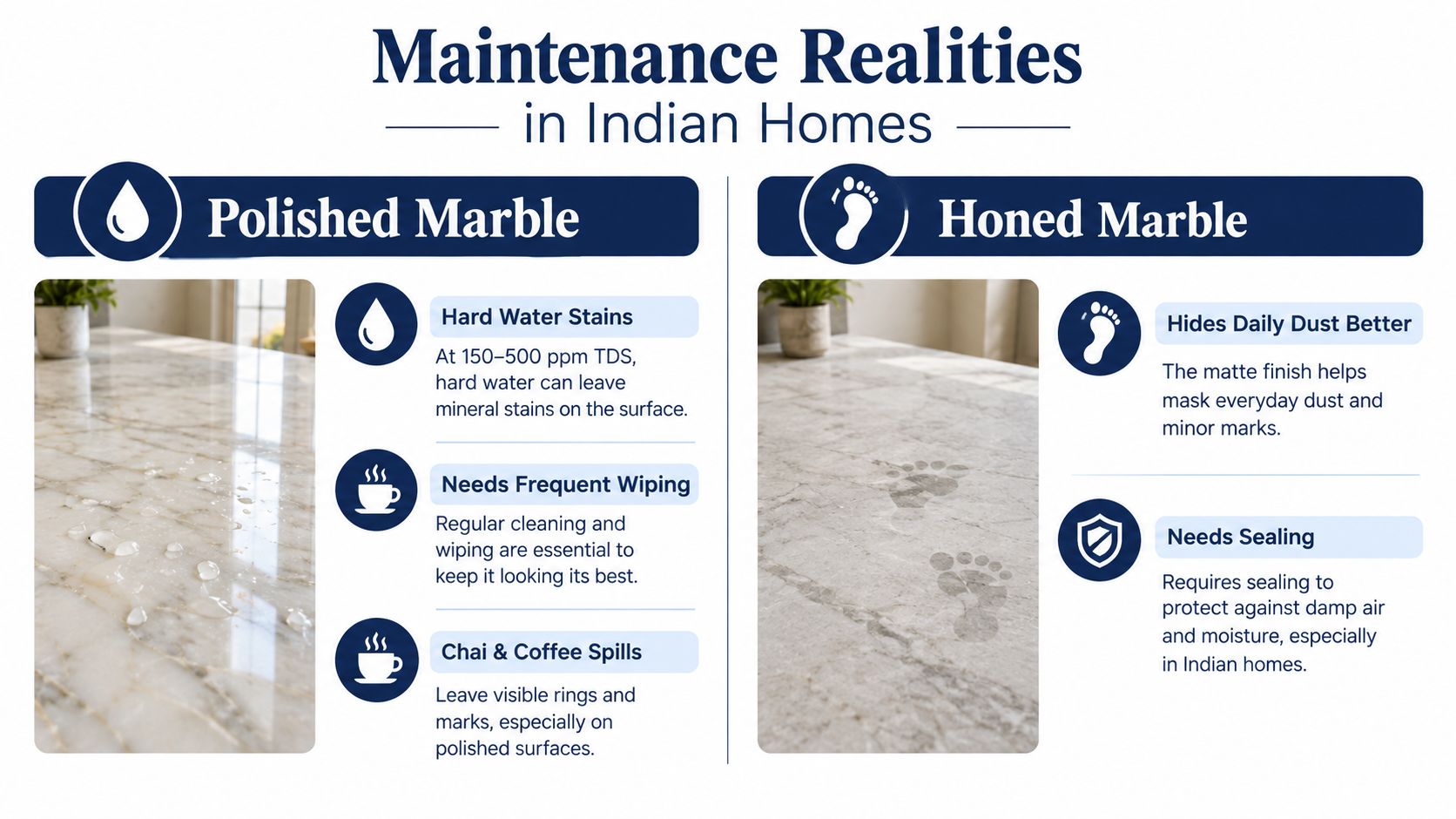
Polished marble is often sold as the easy luxury option because it looks clean when it's freshly installed. In an Indian home, that impression can disappear quickly. Hard-water droplets, tracked grit, tea, coffee, turmeric, and acidic kitchen ingredients interact with a reflective face that displays every change in sheen.
The maintenance problem isn't whether marble is sealed. Acidic cleaners can etch polished surfaces, and periodic repolishing or crystallisation may be required when high-traffic areas lose their uniform shine (India-focused stone maintenance guidance). Sealing helps manage staining risk, but it doesn't turn marble into a chemically resistant worktop.
What hard water does to the decision
Delhi and Jaipur bathrooms commonly expose stone to mineral-heavy water and repeated splashing. I won't give you a false promise that honed marble makes deposits disappear. It makes the visual consequences less aggressive because the surface has no mirror field for each dried droplet to interrupt.
The same logic applies to kitchens. A polished worktop can show a dull ring where an acidic splash has changed the surface. Honed marble may still react, but the change often blends into the surrounding matte plane. That's why honed is usually the more realistic choice for a counter where people prepare food.
Match cleaning chemistry to the finish
Use a pH-neutral stone cleaner and a soft cloth. Avoid vinegar, lemon-based cleaners, abrasive powders, and aggressive bathroom chemicals. Clean spills promptly, especially acidic liquids, and don't assume a glossy finish has become stain-proof just because it looks closed and dense.
A polished surface may reduce the visual depth of some marks, but it demands strict cleaning discipline because etching, scratches, and water spotting catch the light. Honed marble tolerates the visual mess better, but its more open surface makes correct sealing important. The practical answer isn't “honed never needs care”. It's that honed often makes ordinary care less stressful.
For a realistic look at how the finish affects worktop decisions, compare the guidance on polished marble countertops. In my view, a polished kitchen counter is suitable only for a homeowner who accepts immediate wiping and visible patina. If that sounds exhausting, choose honed.
Matching Finish to Room and Marble Variety
The room should decide the finish, and the marble variety should support that decision. Don't start with a named stone and force it into every application. A beautiful slab can still be a poor bathroom floor if the selected face becomes slick when wet or makes every water mark visible.
Floors in living and dining areas
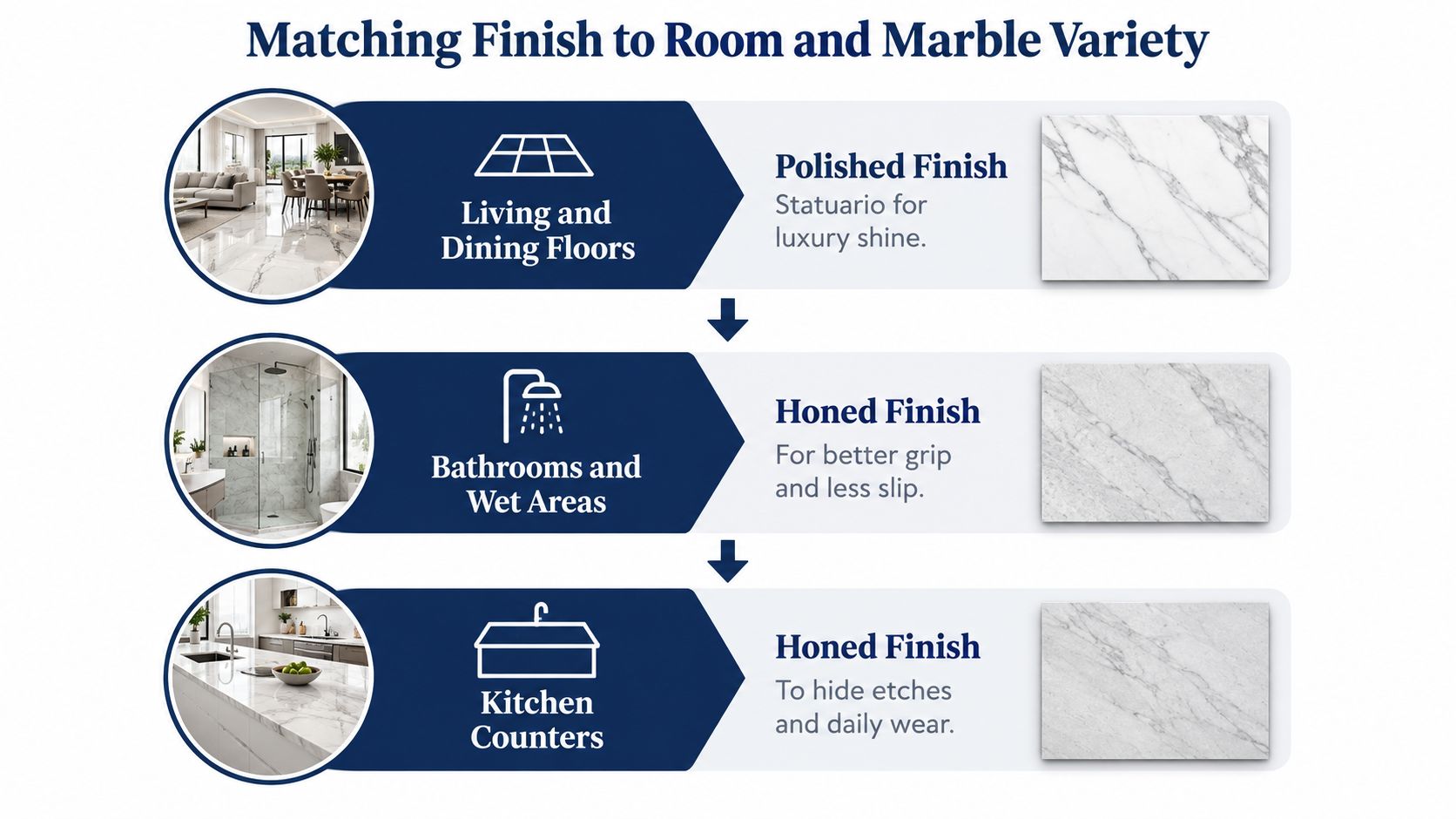
Polished Statuario, Botticino, Ambaji, and Morwad white can work well in formal living and dining rooms where reflection is part of the design. The glossy face lifts the visual energy of the space and gives veining a sharper presence.
Use honed instead when the floor connects directly to a garden, balcony, entrance, or outdoor shoe area. It's also the better starting point for homes with elderly users or anyone who wants less glare under strong lighting. The slab's colour and pattern still matter, but the finish determines how much daily movement the floor visually exposes.
Bathrooms, balconies, and wet areas
For bathroom floors, balcony floors, ramps, and pool-adjacent surfaces, choose honed marble and verify the wet performance of the actual sample. Indian Green, Katni beige, and Italian travertine substitutes can all be attractive in these spaces, but the variety doesn't remove the need for traction.
Anti-slip grooves can support a safe design, but they're not a substitute for choosing an appropriate surface finish. Pay attention to falls, drainage, grout quality, and water accumulation as well.
Kitchens and stairs
For a working kitchen, honed Carrara or Indian rainforest marble is the more forgiving choice. The finish won't prevent etching from lemon or tamarind, but it reduces the harsh contrast between the affected patch and the untouched surface.
Keep polished marble for a backsplash or a decorative island face that doesn't receive chopping, spills, and constant handling. On stairs, use honed marble on treads. Polished marble can be considered for risers or landing strips where people don't place their feet, provided the design doesn't create a confusing visual transition.
Feature walls and named combinations
Polished marble suits feature walls, formal cladding, and backlit onyx where reflection or translucency is central to the effect. Honed Statuario panels work better when you want the veining to remain visible without ceiling lights bouncing across the surface.
Two combinations I'd approve readily are polished Indian Ambaji in a formal drawing room and honed Italian Silver Travertine in a master bathroom. For broader material comparisons, review the distinction between marble and quartzite before selecting a counter or high-use surface. The correct finish can improve a marble installation, but it can't compensate for choosing a stone unsuitable for the room.
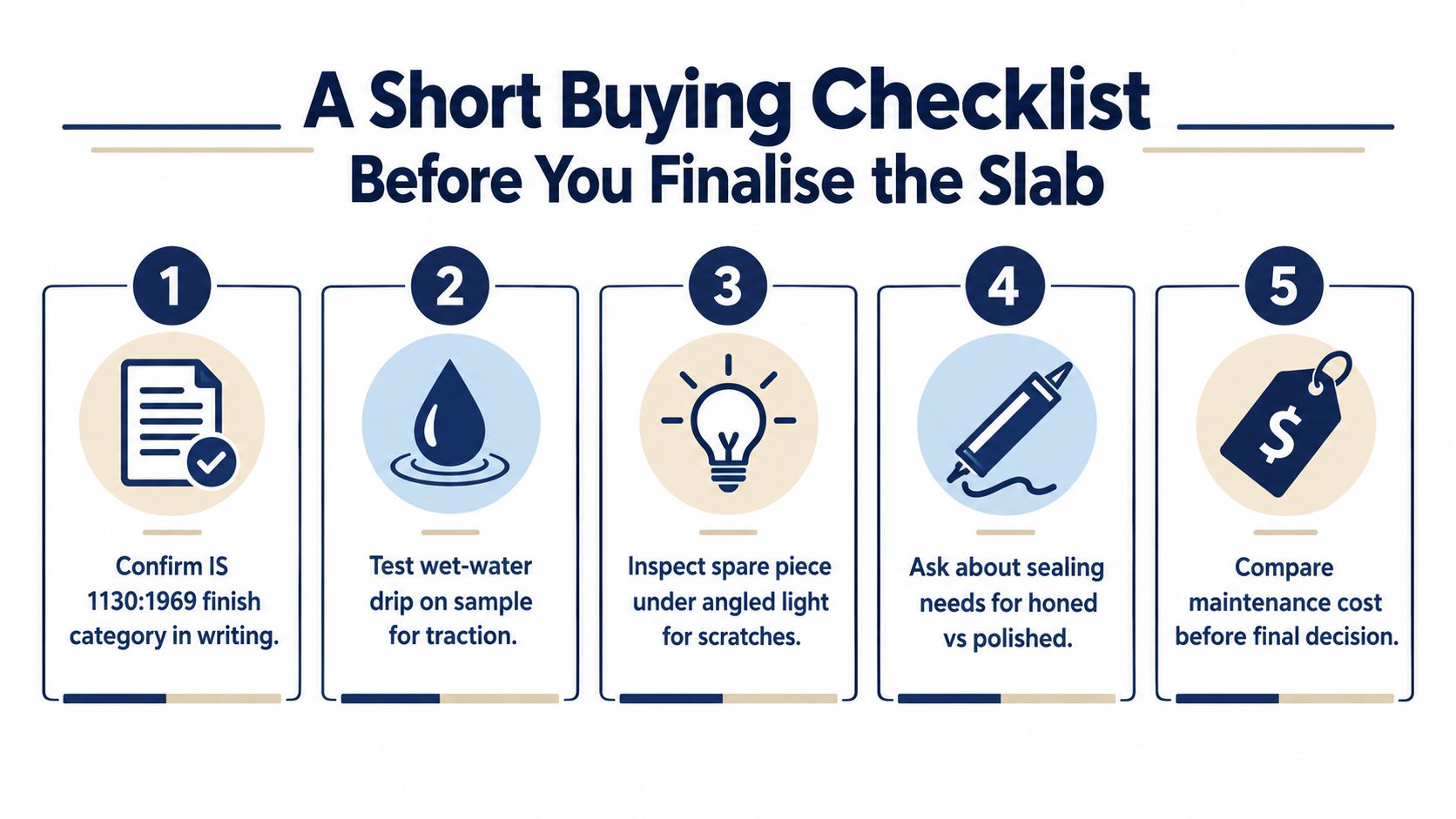
A Short Buying Checklist Before You Finalise the Slab
Showroom lighting hides problems. Before approving a slab, test the finish against the room's water exposure, cleaning routine, and foot traffic.
Get the finish in writing. Ask the dealer to record honed or polished, the marble variety, and the slab identification. IS 1130:1969 treats honed and polished surfaces as separate supply categories, so the invoice and quotation should match the material delivered.
Test the sample wet. Put water on the actual surface and check traction carefully. For Indian Green or Kota in a wet zone, require wet-performance confirmation. “Natural stone” alone does not establish safety.
Inspect under angled light. Check for filler patches, resin repairs, scratches, uneven grinding, and marks that appear only from the side. A polished Statuario for a lobby should remain consistent from the viewing angles that matter on site.
Ask about restoration. Confirm who will handle future honing, diamond polishing, crystallisation, and local repairs. Vague answers usually mean the finish has not been properly specified.
Confirm sealer compatibility. Ask which penetrating sealer suits the marble and finish, how the installer will prepare the surface, and which household cleaners to avoid.
Ask the dealer: “Which finish would you specify for this exact room, given its water exposure, cleaning routine, and foot traffic?” The answer should explain the recommendation, not just favour the shiniest slab.
Varun Marbles helps buyers compare Italian and Indian marble slabs, review honed and polished options, and coordinate cut-to-size fabrication, edge profiling, and installation support. Visit Varun Marbles in Gurugram to inspect samples and choose a finish suited to the room.