
White Volakas Marble Guide for Interior Projects

You're selecting stone for a high-end kitchen, bathroom, or entrance lobby. The sample looks calm and refined under showroom lighting, but the practical decision is harder: will the next slab carry the same white background, will the veins align across a feature wall, and can the shipment reach site before fabrication begins?
White Volakas Marble earns attention because it combines a bright white field with subtle grey or brown veining. It can look luxurious without becoming visually dominant, but it isn't a commodity material that can be ordered casually. In India, the exact slab, import route, stock position, finish, and installation method all affect the result.
This guide focuses on those practical decisions. You'll find the stone's Greek origin, its visual range, suitable applications, care requirements, India-specific sourcing risks, comparisons with Carrara and Makrana, and a quick reference table for site meetings and specifications.
Table of Contents
- Introduction to White Volakas Marble
- Origin and Geological Profile
- Visual Characteristics
- Common Applications
- Care and Maintenance Guidelines
- Availability and Sourcing Strategy
- Comparison with Other White Marbles
- Quick Reference Table
- Glossary of Key Terms
Introduction to White Volakas Marble
A designer may begin with a simple brief: a white surface that feels premium, works with warm timber or neutral cabinetry, and won't make a lobby look flat. White Volakas marble often fits that brief because its clean white background and restrained grey veining add movement without overwhelming the room. The pattern can support a minimalist kitchen, a softly lit bathroom, or a hospitality reception area where the material needs to feel elegant from a distance and interesting up close.
The difficulty appears when the project moves from sample approval to slab selection. A small sample can show the general colour, but it can't reveal how veins will run across a countertop, whether two slabs will book-match, or how much usable material remains after cutting. Imported stone also brings a supply question that local catalogue descriptions often overlook. Availability and consistency must be treated as design inputs, not procurement details.
White Volakas marble is therefore best specified through a combination of appearance, application, and logistics. Confirm the exact slabs, agree on the finish, inspect the substrate and waterproofing plan, and allow time for fabrication decisions before the installation crew arrives.
Origin and Geological Profile
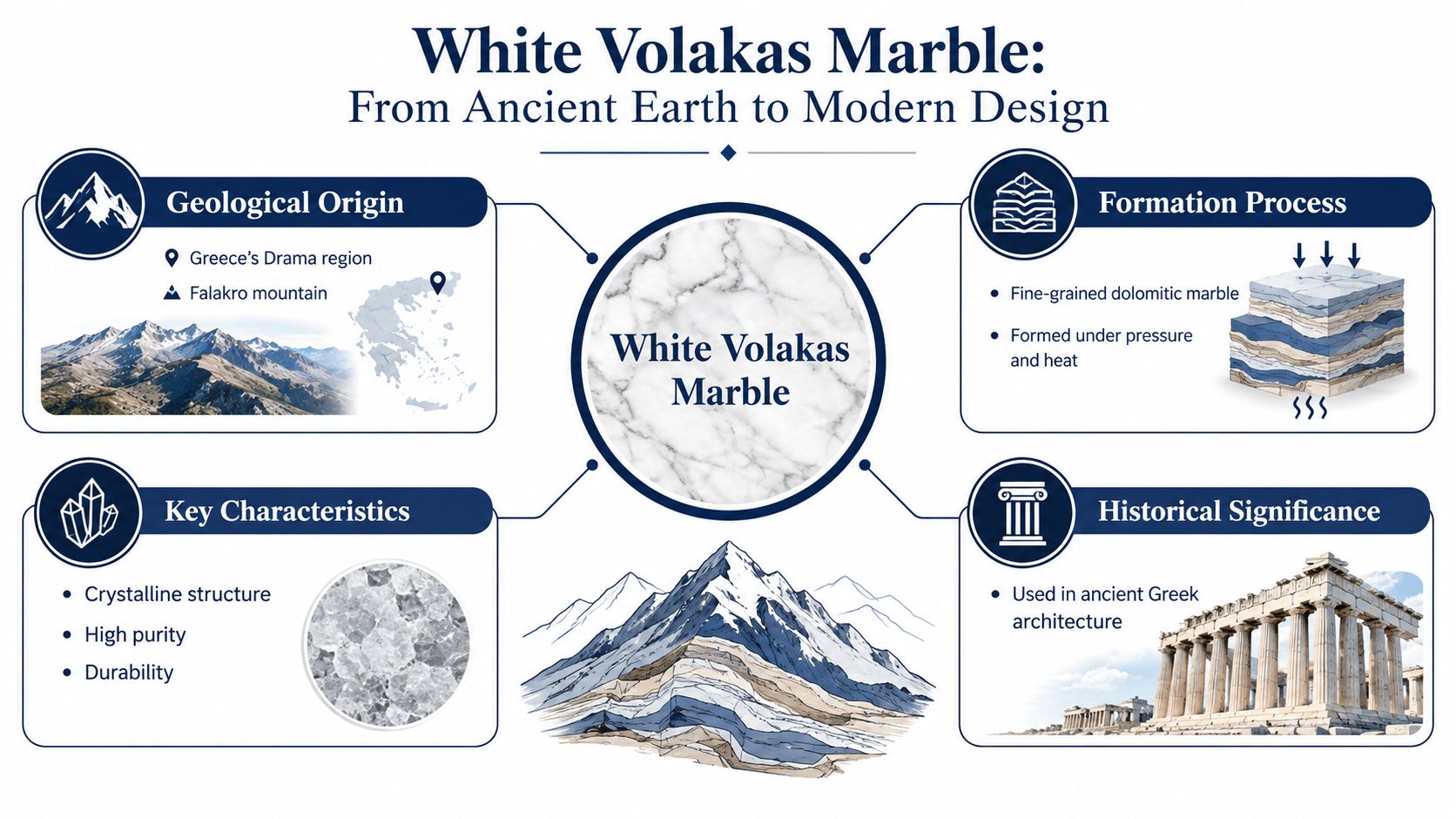
White Volakas marble originates in the Drama region of northern Greece, near Volakas village in the Falakro mountains. Geological records classify it as a fine-grained white dolomitic marble from the Rhodope Massif, among the dolomitic and carbonate marbles of East Macedonia and Thrace. Its Mesozoic age is documented in the European geological reference for Volakas marble.
The trade name “Carrara of Greece” points to its white ground and grey or brown veining. It does not mean the two stones have identical appearance, grading, or supply conditions. For Indian projects, the origin identifies White Volakas as an imported decorative stone, so purchasing plans need to account for shipment timing and the possibility that replacement slabs will not match the approved batch.
Quarry methods and production context
Volakas-area extraction includes open-pit and underground work, including tunnel excavation. Quarry information reports a total quarry area of 81.9 acres, verified exploitable reserves of 536.670 cubic metres, and an exploitation duration of 25 years. These figures describe the operator's stated quarry context, not guaranteed stock for a particular Indian order. Grade, block selection, export scheduling, and local inventory still affect availability and lead times. See the operator's quarry information.
Blocks are cut into slabs, and the finished pattern depends on the block, cutting direction, vein concentration, and surface finish. Indian buyers should therefore approve the actual slab group, confirm its arrival schedule, and reserve extra material for fabrication. A stone name alone cannot guarantee consistent colour or vein placement across a large wall.
Visual Characteristics
White Volakas marble isn't one fixed visual formula. The background may read as crisp white, soft white, or light ivory depending on the selection and the lighting. Grey veining is the defining feature, while some pieces also show brown-toned movement. The veins may appear linear, gently wavy, branching, or feathered, and their density can shift from one slab to the next.
That variation can work in your favour when the design welcomes natural character. It becomes a problem when a specification calls for a nearly uniform white surface across a large elevation. A polished finish usually increases light reflection and makes the relationship between the white field and darker veins more apparent. Honed surfaces diffuse glare and create a softer, quieter reading, while a leathered treatment introduces more tactile texture and can make the stone feel less formal.
How to inspect slabs properly
Review slabs vertically where possible, not only as small samples laid flat. Stand at the expected viewing distance, then examine the material under lighting similar to the finished space.
Use this inspection sequence:
- Check the background: Look for changes from bright white to warmer areas that may affect cabinet, paint, or grout selection.
- Trace the vein direction: Follow major lines from one edge to another and mark where they may interrupt joins, openings, or cut-outs.
- Review the full group: Place slabs together in the proposed order. A single slab can look excellent while the complete elevation feels unbalanced.
- Confirm the finish: Compare polished, honed, or textured samples under the project's lighting, because surface treatment changes both reflection and perceived contrast.
- Approve book-match layouts: For a feature wall or large counter, create the layout before cutting. Symmetry is only useful when the selected slabs support it.
Practical rule: Approve the slab sequence, not merely the marble name. The sequence controls the finished visual composition.
Common Applications
Indian supplier listings commonly specify White Volakas marble in 18 mm thickness, with slab formats around 9 ft × 5 ft and above, for decorative floors, walls, and countertops. The Indian product specification for White Volakas marble supports treating it as a finish stone. Project teams should therefore assess the expected traffic, impact, moisture exposure, support, and maintenance plan before using it in demanding areas.
Where the stone works well
A kitchen countertop can use White Volakas as the principal surface when the owner accepts marble's need for sealing and prompt spill care. Pairing it with matte timber, painted cabinetry, or muted metallic hardware keeps the grey movement legible without making the kitchen feel busy. For cut-outs around sinks and hobs, the fabricator should review vein placement so the most visible lines don't terminate awkwardly at the edge.
Bathrooms are another strong application. Vanity tops, shower walls, niches, and splashbacks can use the same slab family to create continuity, provided waterproofing and substrate isolation are resolved before fixing. For broader bathroom planning, the practical ideas in Task Masters bathroom insights can help coordinate vanity proportions, storage, lighting, and surface selection around the stone.
Wall cladding and reception counters benefit from the material's directional movement. If the design depends on a book-matched panel, reserve the slabs early and approve the elevation drawing before fabrication. Backlit feature work needs an additional translucency test, because a white marble that looks consistent in reflected light may show different density or vein behaviour when illuminated from behind.
Plan the cuts before ordering
A slab around 9 ft × 5 ft can disappear quickly around sink openings, returns, mitres, matching, and edge details. Prepare a cutting diagram and identify visible faces before the purchase order is finalised. The correct order quantity is based on the layout and matching requirements, not only on the net measured area.
Care and Maintenance Guidelines
White Volakas marble has a polished appearance, but polish doesn't make it chemically resistant. Technical data lists a density of 2.69–2.82 g/cm³, water absorption of 0.19–0.43%, and compressive strength of 103–139 MPa in the technical product data. Those properties support many interior uses, while also reinforcing the need for sealing, waterproofing, and substrate isolation.
Acidic liquids such as lemon juice, vinegar, wine, and some bathroom products can etch calcite-rich marble. Etching is a chemical change in the surface, not ordinary dirt, so aggressive scrubbing won't restore the original polish.
A workable care routine
- Clean daily with a pH-neutral product: Use a soft cloth or microfibre mop and remove grit before it can scratch the finish.
- Treat spills immediately: Blot liquids rather than spreading them, especially near kitchen worktops and bathroom vanities.
- Use barriers: Cutting boards, coasters, trays, and soap dishes reduce direct contact with acidic or oily materials.
- Seal after installation: Choose a sealer compatible with the stone, the cement-based substrate, and the intended wet-area system. Follow the product manufacturer's curing and reapplication instructions.
- Inspect joints and grout: Discoloured grout can make a clean white slab look dirty, so include joint inspection in routine facility checks.
Honed marble may hide minor marks better than a highly reflective polished surface, but it still needs the same chemical caution. Dull patches and light scratches should be assessed by a stone-care professional before polishing or refinishing, because a household abrasive can enlarge the affected area.
For more detail on planning and maintaining stone worktops, consult this guide to polished marble countertops. The key installation principle remains simple: isolate the substrate, control moisture, seal appropriately, and keep acidic products away from the surface.
Availability and Sourcing Strategy
Imported marble procurement in India has become a central design consideration, particularly for large NCR interiors. In Q1 2025, India's marble import value rose 69% year on year to $94.5 million, while import quantity rose 80% to 389,678 tons. 97% of imported volume was raw marble blocks and slabs, according to the Q1 2025 India marble import report.
Those figures point to a practical reality. More raw material moving through the market doesn't guarantee that your preferred White Volakas selection will be sitting in a nearby yard. Customs clearance, processing, inventory turnover, block variation, and slab allocation can all affect the date on which the exact material becomes available.
A procurement process that reduces surprises
Start with the design intent. Record the required background tone, acceptable vein intensity, finish, thickness, visible slab faces, and whether book-matching is mandatory. Then ask suppliers for current slab photographs or videos, but use those as a screening tool rather than a substitute for physical inspection.
For a large fit-out, request more slabs than the calculated net requirement where the layout includes matching, mitres, or complex cut-outs. Keep an approved backup selection, and write the acceptance criteria into the purchase order. “White Volakas” alone is too broad to control the final composition.
Varun Marbles operates showrooms in Gurugram, including locations in Sikanderpur Marble Market and HUDA Marble Market Sector 33–34, and provides slab selection, fabrication, finishing, and installation coordination. Its signature marble and granite guidance is relevant when comparing natural stone options alongside local and imported inventory.
Procurement note: Don't release fabrication drawings until the actual slab group has been selected. A late substitution can change the vein layout, cut plan, and visual balance of the entire room.
Comparison with Other White Marbles
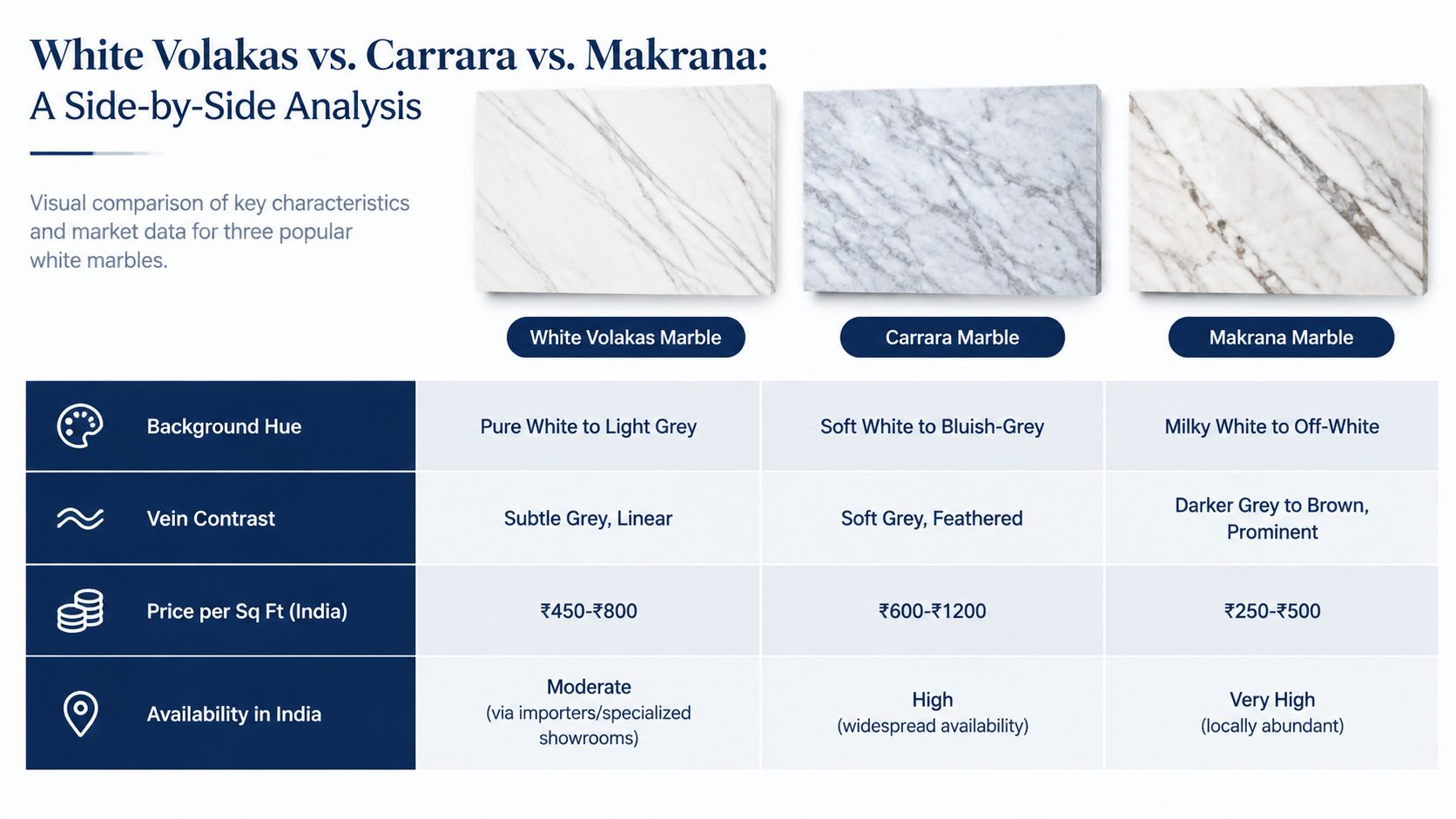
White Volakas, Carrara, and Makrana address different design and procurement needs. Volakas typically presents a cool white background with controlled grey movement. Carrara is associated with softer grey veining and a familiar Italian origin, while Makrana offers warmer white and off-white tones with more accessible domestic supply in India.
Price comparisons require careful qualification. Indian listings vary by supplier, thickness, finish, slab size, and visual selection. Market references place Volakas across a broad range, including approximately INR 200–1000 per square foot, while other Indian sellers quote around INR 300–700 per square foot. Selected thicknesses or finishes may be listed at approximately INR 450–550 per square foot. These figures are indications, not fixed landed prices.
Import conditions also affect the comparison. White Volakas may offer the required Greek appearance, yet imported lots can arrive with different background tones, vein density, and available slab quantities. That variation affects matching, replacements, and lead times in India. Makrana or domestic stock may provide easier replenishment when the schedule allows little room for a new import.
Choosing by priority
| Decision priority | More suitable direction |
|---|---|
| Cool white with subtle architectural veins | White Volakas |
| Soft, familiar grey movement | Carrara |
| Warmer white and easier local sourcing | Makrana |
| Exact imported provenance | White Volakas or Carrara |
| Tighter schedule and local replenishment | Makrana or available domestic stock |
Volakas suits interiors that need a refined imported appearance without the stronger contrast of heavily veined stone. Carrara works well where the scheme calls for softer movement. Makrana becomes more practical when budget, domestic availability, or replacement access matters more than Greek provenance.
Approve the actual slab group under project lighting. For a wider view of white-toned options, Varun Marbles' blue and white marble selection offers a useful visual reference. The final choice should still reflect the selected slabs, application, and sourcing schedule.
Quick Reference Table
Use this table as a specification check before placing an order. Where a value varies by supplier or selection, treat it as a range rather than a promise.
| Attribute | Detail |
|---|---|
| Origin | Drama region, near Volakas, Greece |
| Geological profile | Fine-grained white dolomitic marble from the Rhodope Massif |
| Geological age | Mesozoic |
| Common slab format | Around 9 ft × 5 ft and above |
| Common thickness in India | 18 mm |
| Density | 2.69–2.82 g/cm³, according to technical data for Volakas marble |
| Water absorption | 0.19–0.43%, according to the same technical reference |
| Typical applications | Decorative floors, walls, bathrooms, countertops, and feature surfaces |
| Maintenance | pH-neutral cleaning, spill control, sealing, and substrate moisture protection |
| Indian price indication | Approximately INR 200–1000 per square foot across listed market references, with other sellers quoting around INR 300–700 |
| Main procurement risk | Slab-to-slab variation and import-related timing |
| Approval method | Inspect the exact slab group and approve the cutting layout |
The table should support, not replace, a physical inspection. A suitable technical profile can still produce the wrong visual result if the selected slabs don't match the elevation or fabrication plan.
Glossary of Key Terms
Dolomitic marble: A marble containing a significant dolomite component. In Volakas, the term describes the stone's geological classification and helps distinguish it from other carbonate stones.
Book-matching: Placing adjacent slabs as mirror images so their veining creates a symmetrical opening or continuous visual composition. It requires compatible slabs and an approved layout before cutting.
Water absorption: The amount of water a stone can take into its pore structure under a defined test method. Volakas has measurable absorption, so wet-area detailing and sealing matter.
Compressive strength: The stone's resistance to loads pressing down on it. It helps engineers assess suitability, but it doesn't remove the need for proper support, handling, and installation.
Honed finish: A low-sheen, smooth finish that reflects less light than polished marble. It can create a quieter appearance, but it remains vulnerable to acids and staining.
Waste allowance: Extra material ordered to account for cuts, breakage risk, unusable sections, vein matching, mitres, and edge fabrication. The allowance should come from the cutting plan, not an arbitrary addition.
Substrate isolation: Separating or protecting the marble from movement, moisture, salts, or incompatible backing conditions in the supporting surface. This is particularly important where cement-based systems or wet areas are involved.
Vein consistency: The degree to which background colour, vein direction, and vein intensity remain visually compatible across the slabs assigned to one installation. It's a selection issue, not a characteristic that can be guaranteed by the stone name alone.
For White Volakas marble, Varun Marbles can help you review available slabs, compare finishes, and coordinate fabrication and installation for residential or commercial interiors. Visit Varun Marbles with your drawings or slab schedule so the selection can be checked against the actual project requirements.