
Which Is Better for Flooring Granite or Marble?
A renovation often reaches a difficult point when the flooring samples arrive. The marble looks refined, luminous and distinctive, while the granite appears denser, more practical and easier to trust in a busy home. Both can transform a room, but the sample tells you very little about how the floor will respond to grit, wet footwear, acidic spills, trolley wheels and cleaning routines.
The more useful question isn't just which stone looks better. It's which is better for flooring, granite or marble, in the specific conditions of your project? The answer depends on hardness, water absorption, traffic, spill exposure and finish selection. Once those variables are separated from appearance, the decision becomes far more predictable.
Table of Contents
- What Actually Decides a Flooring Stone Choice
- Understanding the Core Differences Between Granite and Marble
- Durability and Maintenance Performance Comparison
- Best Use Cases for Granite and Marble Flooring
- Cost, Lifespan, and Long-Term Value Analysis
- How to Choose the Right Stone for Your Project
- Frequently Asked Questions About Stone Flooring Choices
What Actually Decides a Flooring Stone Choice
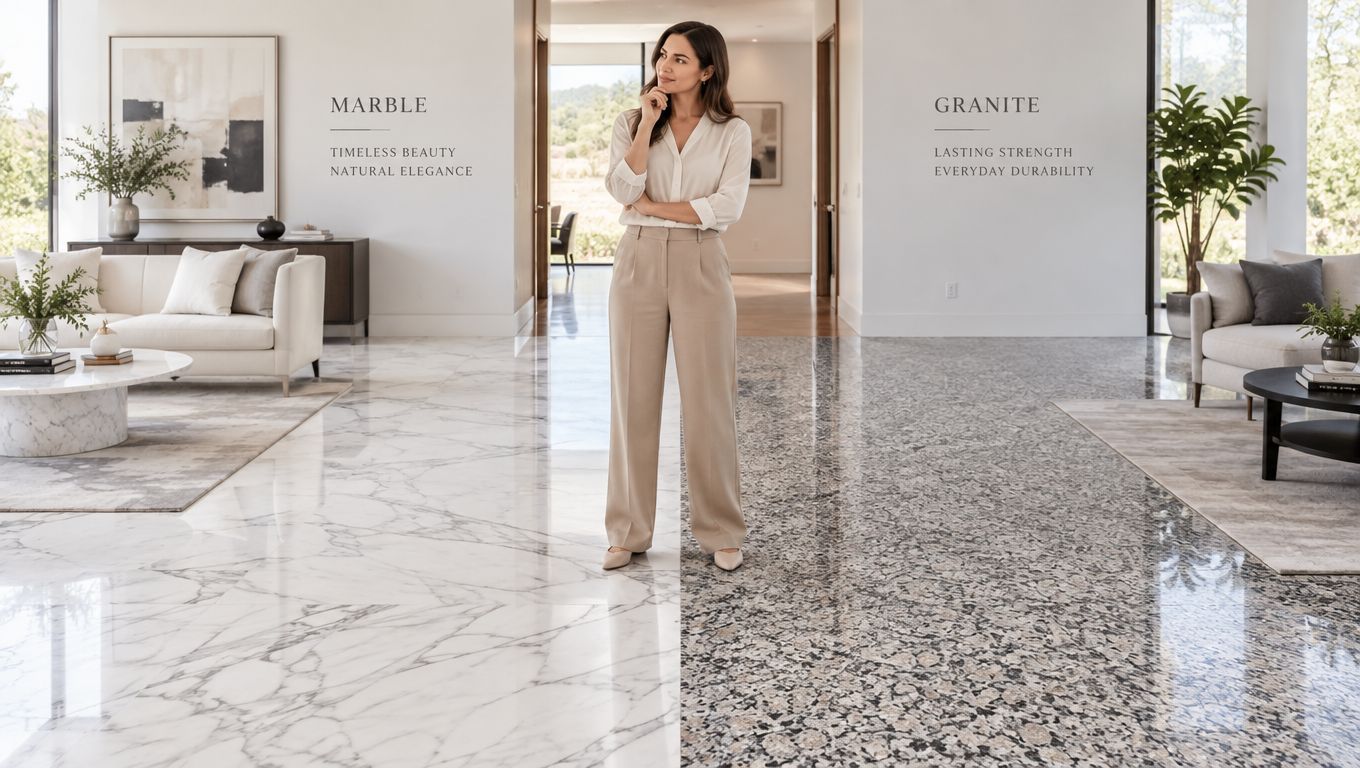
A homeowner in Gurugram may be selecting stone for an open-plan home with a kitchen entrance, staircase and living room used by visitors throughout the week. The marble sample offers elegant veining and an immediate sense of luxury. Granite shows less dramatic movement, yet its denser structure may suit areas exposed to grit, spills and frequent movement.
Taste plays a role, but the decision also hinges on exposure conditions. A polished entrance floor receives dust and abrasive particles from outside. A kitchen floor faces spilled liquids, acidic ingredients and repeated cleaning. In an apartment, one material may run continuously from the living room into circulation areas, while each zone imposes a different performance burden.
| Decision factor | Granite | Marble |
|---|---|---|
| Hardness | About 6–7 on the Mohs scale | Roughly 3–4 on the Mohs scale |
| Water absorption | Commonly about 0.1–0.5% | Commonly about 0.5–2% |
| High-traffic response | Strong resistance to abrasion and point loads | More vulnerable to wear and etching |
| Acid exposure | Generally resistant to routine acidic contact when properly maintained | Can etch with lemon juice, vinegar and similar acids |
| Suitable finish strategy | Polished, honed or flamed, depending on location | Polished or honed, with careful slip and maintenance planning |
| Practical default | Busy circulation zones and kitchens | Aesthetic-first, lower-abrasion interiors |
The comparative figures and performance observations are documented in this India-focused flooring materials guide. The practical distinction is responsibility after installation. Marble can perform well, but its porosity, acid sensitivity and finish require tighter control over sealing, cleaning and spill response.
Why first impressions can mislead
Marble often wins the showroom decision because its veining creates a strong visual identity. Granite may appear more restrained, but its performance becomes more valuable as daily users, cleaning cycles and spill sources increase.
A formal living room with controlled footwear and attentive cleaning offers marble a favourable setting. An entrance lobby, corridor or retail floor creates greater mechanical and chemical stress. Finish selection changes that balance: polished stone presents a refined surface, while honed or flamed finishes may suit locations where slip control matters more.
The floor should be specified for its hardest routine, including grit, moisture and likely spills, rather than its most flattering showroom conditions.
Practical rule: Choose the stone for the hardest routine it will face, not for the easiest day you can imagine.
Understanding the Core Differences Between Granite and Marble
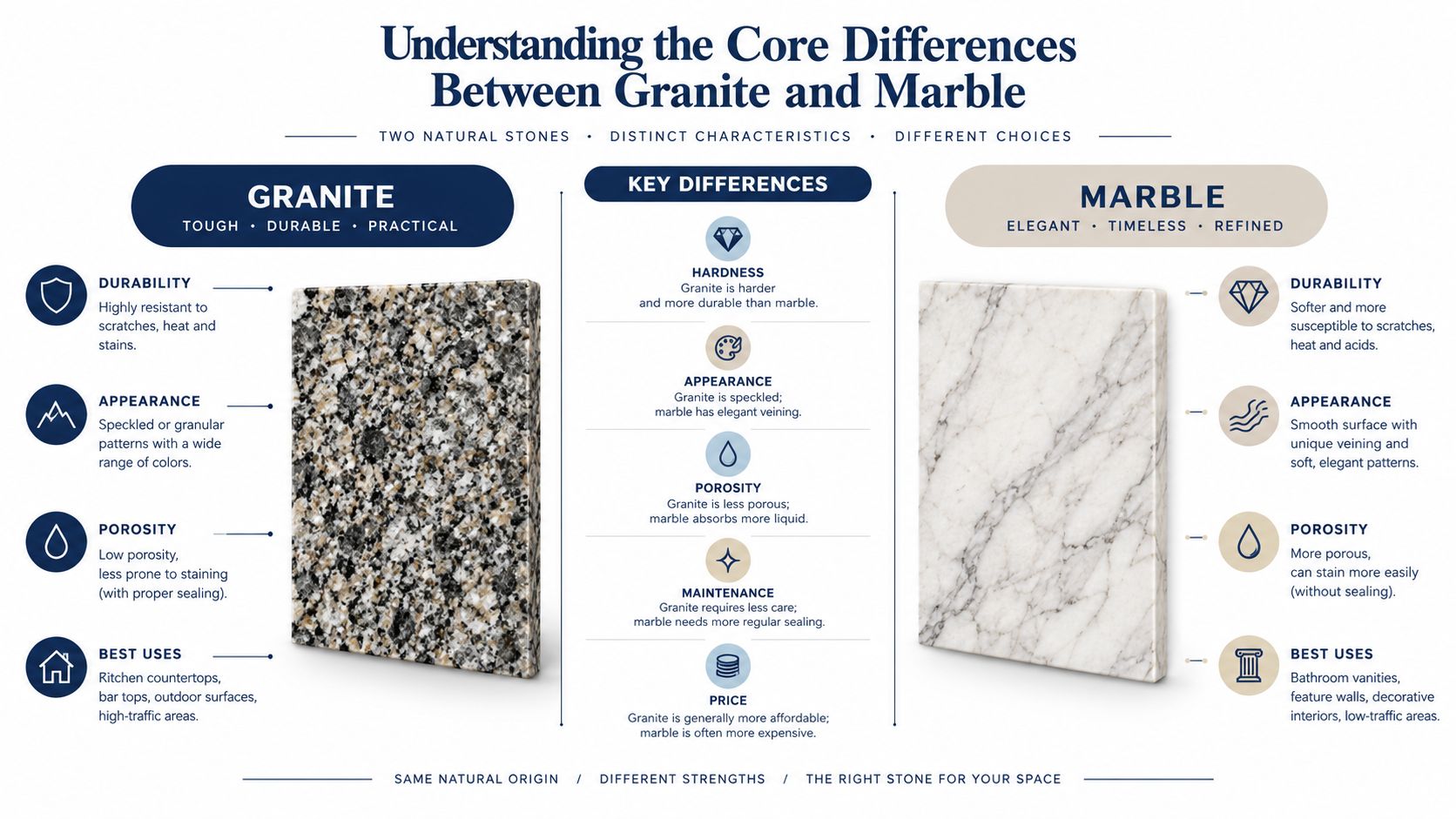
Granite and marble are both natural stones, but they don't behave alike because their structures differ. Granite is a dense, crystalline stone associated with high hardness and resistance to abrasion. Marble is softer and more vulnerable to surface change, particularly when acids contact a polished finish.
That distinction explains why installer skill can't fully compensate for an unsuitable material choice. A precise installation can provide sound support, accurate joints and an even surface, but it can't make a softer stone behave like a harder one. Likewise, good sealing reduces absorption risk, but it doesn't eliminate marble's susceptibility to acid etching.
The classic granite and marble comparison can help readers review the visual differences before assessing technical suitability. For a project team, however, appearance should follow the performance brief rather than replace it.
Hardness, absorption and chemical exposure
Hardness affects how a surface responds to abrasive particles and everyday contact. Granite's Mohs hardness is commonly cited at about 6–7, while marble is roughly 3–4, according to the India-focused flooring reference linked above. That gap matters where sand, grit and frequent movement can gradually dull or scratch a floor.
Porosity adds another layer. Granite's water absorption is commonly cited at about 0.1–0.4%, compared with marble at about 0.5–2%. Lower absorption generally gives granite better resistance to staining from monsoon moisture, spilled liquids and routine cleaning chemicals, although neither material should be treated as maintenance-free.
Acids create a separate problem. Lemon juice and vinegar can etch polished marble, changing the surface rather than merely leaving a removable stain. Granite is generally described as scratch- and heat-resistant, which is why it has a stronger technical case in kitchens, stairs and busy flooring applications.
The difference is cumulative. One spill may not determine a floor's future, but repeated exposure combined with grit, moisture and inconsistent cleaning can make the material's inherent properties visible in everyday use.
Durability and Maintenance Performance Comparison
A stone floor can meet its specification and still age poorly if its porosity, finish and cleaning routine are mismatched. Granite generally gives owners a wider margin for error because its lower absorption and higher hardness make routine grit, traffic and spills less likely to become visible defects. Marble can perform well, but it needs tighter control over exposure and maintenance.
The relevant distinction is the maintenance programme, not a repeated list of basic strength properties. For granite, the programme usually centres on regular dust and grit removal, prompt cleaning of spills, compatible detergents and resealing when the surface begins to lose protection. Granite's water absorption is commonly cited at about 0.1–0.4% in India-focused technical guidance, which helps explain its lower staining risk. It remains vulnerable to staining and wear, so lower maintenance demand does not mean no maintenance.
Marble requires greater attention because two separate mechanisms can change its appearance. Its higher porosity gives liquids more opportunity to penetrate, while acids such as lemon juice and vinegar can etch a polished surface. Sealing can reduce absorption, but it cannot prevent chemical etching or compensate for a cleaner that is too acidic, abrasive or aggressive. Owners should plan for prompt spill removal, pH-neutral products and periodic inspection by a qualified stone-care professional.
The practical risk depends on what reaches the floor. Monsoon water near an entrance may carry soil and dissolved minerals. Tea, oil or coloured liquids can remain visible if they are left on a more absorbent surface. Fine grit can also act as an abrasive under footwear, gradually reducing polish. A maintenance specification should therefore identify likely spills, entry-point contamination and the cleaning standard available after handover, rather than relying only on the stone name.
Hard-water residue is a related concern. Mineral deposits may stand out on polished marble, and an unsuitable acidic or abrasive treatment can add etching or scratches to the original deposit. Guidance on removing hard-water stains from marble helps assess whether the proposed cleaning method is compatible with the finish and the stone.
Finish selection changes maintenance performance
A polished finish improves reflection but makes residue, water film, scratches and etching easier to notice. It can also become slippery when wet. That combination makes drainage, entrance matting and spill response part of the flooring specification, especially where cleaning cannot happen immediately.
A honed finish reduces glare and can make minor scratches or etching less conspicuous. It may suit an interior where a quieter appearance and easier visual control matter more than maximum reflection. A flamed finish produces a rougher texture that can support slip-control requirements, although its texture must remain compatible with mopping and dirt removal.
Marble can also be honed, but the finish changes how damage appears rather than removing the stone's chemical vulnerability. Finish selection can reduce one category of maintenance risk. It cannot erase the underlying difference in porosity and acid response between granite and marble.
Best Use Cases for Granite and Marble Flooring
Room function should determine the default stone. A floor near an entrance, kitchen or commercial lobby experiences a different combination of stress from a formal living room. The strongest specification identifies the likely traffic, the source of moisture, the type of spill and the standard of maintenance available after handover.
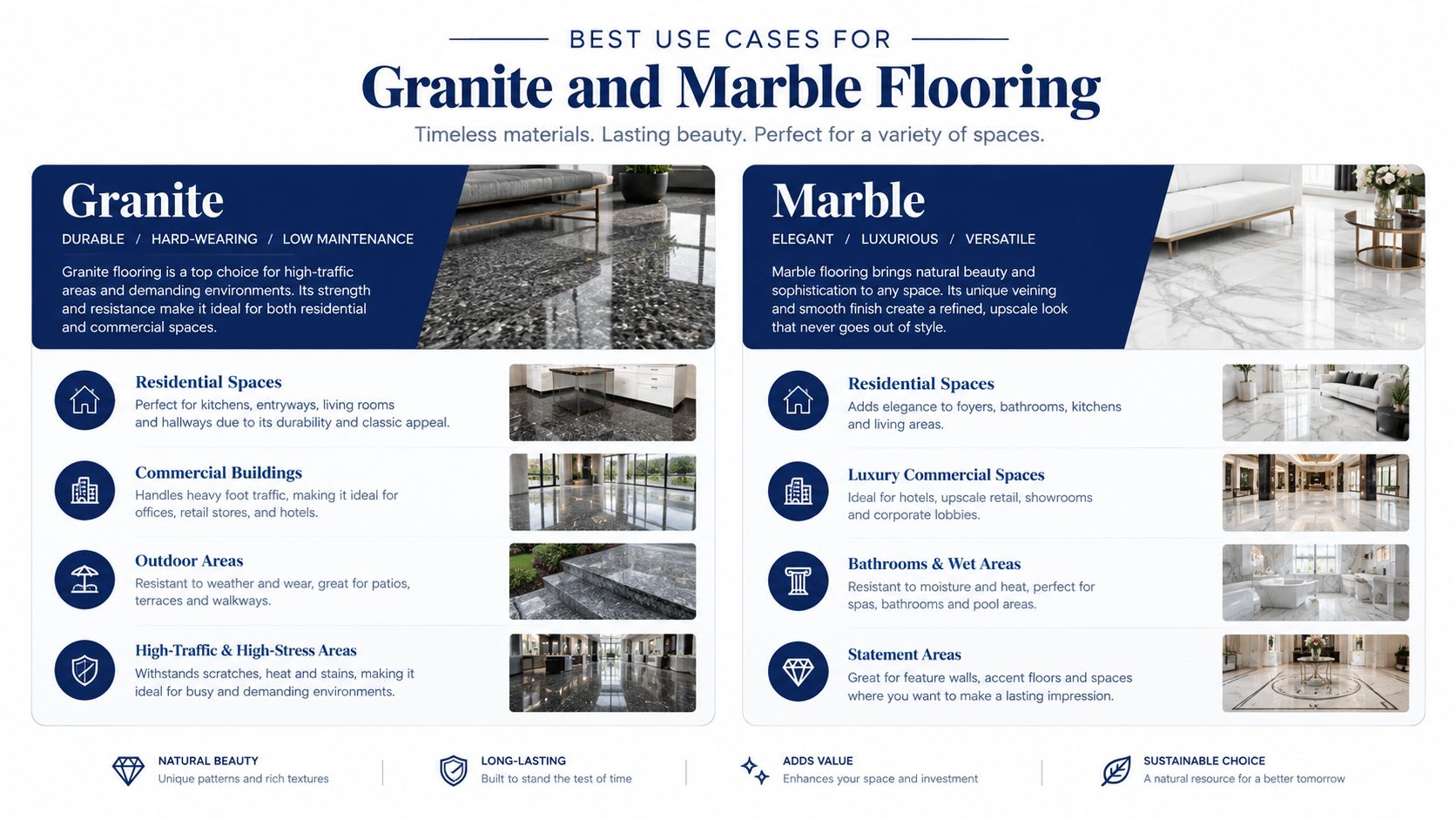
Granite is the more durable choice for high-traffic residential areas, entry lobbies, corridors, retail floors and kitchens. India-focused stone standards describe granite as having very high compressive strength, very low water absorption and superior abrasion resistance compared with marble, supporting better performance under point loads, trolley traffic and grit-induced wear in these spaces (natural stone standards for Indian projects).
Match the material to the room
Entrance zones favour granite, particularly where wet footwear, grit and inconsistent cleaning are likely. A honed or flamed surface can be more appropriate than a mirror-polished finish when the area needs stronger slip-control detailing.
Kitchens also lean towards granite because spills are unavoidable and acids such as lemon juice and vinegar can affect polished marble. Marble isn't impossible in a kitchen, but it requires owners to accept faster intervention and more careful product selection.
Retail floors and commercial lobbies need resistance to concentrated loads, trolley movement and abrasive dirt. Granite's technical profile gives it the clearer specification advantage, especially when the floor must retain a consistent appearance under varied maintenance standards.
Formal living rooms, powder rooms and feature installations can give marble a more favourable setting. These spaces may place greater value on veining and visual depth than on maximum abrasion resistance. Marble works best when the design team can control spill exposure, footwear conditions and cleaning procedures.
For projects where the brief includes other materials or adjacent rooms, a specialist resource covering hardwood and tile services can help with broader flooring coordination. The key is to avoid choosing stone in isolation from thresholds, transitions and the maintenance behaviour of neighbouring finishes.
Bathrooms require a separate assessment of wetness, slope, drainage and underfoot texture. A useful reference on bathroom stone flooring reinforces the need to treat water exposure and finish selection as connected decisions rather than separate design details.
Cost, Lifespan, and Long-Term Value Analysis
The cheapest quotation isn't automatically the lowest-cost floor. Material price, fabrication, installation, sealing, cleaning, polishing and possible repair all contribute to the ownership experience. A stone that needs more supervision can carry a higher practical cost even when its initial purchase appears attractive.
Granite often provides stronger long-term value in demanding zones because its performance allows a wider margin for ordinary use. Routine cleaning and resealing at longer intervals are generally enough when the surface has been correctly selected and installed. That doesn't make granite maintenance-free, but it can reduce the number of situations that require specialist intervention.
Marble's value calculation is different. Its veining and surface character may be central to the design, so the owner may accept regular sealing, careful spill management and periodic re-polishing as part of preserving the intended appearance. The material can be a sound choice when the project budgets for that care and places the stone in a suitable environment.
A lifecycle decision rather than a showroom decision
Ask the project team to assess each option against four cost drivers:
- Routine care: Which stone can the occupants clean correctly without specialist products or complicated procedures?
- Surface restoration: How will the owner respond if the finish becomes dull, etched or visibly worn?
- Operational disruption: Can the space tolerate periodic professional work, or must it remain available with minimal interruption?
- Replacement risk: Would a damaged area be easy to match, or would variation between natural slabs make a repair visually obvious?
These questions are more useful than a simple material-rate comparison because they expose the costs that appear after occupation. Granite usually has the advantage where maintenance discipline varies between residents, staff or tenants. Marble can offer better design value where the owner deliberately funds preservation and controls the environment.

A fair specification therefore records not only the selected stone, but also the finish, sealer, cleaning method, expected traffic and responsibility for ongoing care. That written brief protects the design intent better than a sample approval alone.
How to Choose the Right Stone for Your Project
Start with use, not colour. Walk through the building and identify where footwear, grit, trolleys, moisture and food or cleaning chemicals will reach the floor. The busiest and most exposed area should set the minimum performance requirement.
A practical selection sequence
Classify traffic. Separate bedrooms and formal rooms from entrances, corridors, kitchens, retail areas and shared circulation. If people and equipment move constantly through a space, granite deserves the initial preference because its hardness, absorption and abrasion profile are better suited to demanding use.
Map spill exposure. Mark kitchens, dining areas, beverage stations, bathrooms and entrance thresholds. Lemon juice, vinegar and other acidic substances create a particular concern for polished marble, so the project must either control that exposure or accept the additional care it demands.
Choose the finish after choosing the zone. Polished stone may suit a low-abrasion luxury setting. Honed granite can provide a quieter and more forgiving surface in busy interiors, while a flamed finish may be considered for wet or public circulation where texture and slip control matter.
Test the maintenance plan. Specify the cleaning products, spill response and resealing responsibility before installation. If occupants or facility staff are unlikely to follow a detailed routine, granite is the more resilient default.
Inspect the actual slabs. Natural stone varies in colour, veining and texture. Review full-size pieces where possible, approve the layout and confirm how joints will be positioned before cutting begins.
Architects and contractors also need to document substrate preparation, joint treatment, edge conditions and installation tolerances. A technically appropriate stone can still underperform if the supporting floor, drainage or finish detailing is poorly resolved.
For flooring businesses that need to make their capabilities easier for local project buyers to find, guidance on how to drive flooring leads with SEO offers a useful marketing perspective. For the material decision itself, use a simple conclusion: granite for demanding circulation and spill-prone areas, marble for controlled, aesthetic-first spaces where its care requirements are acceptable.
Frequently Asked Questions About Stone Flooring Choices
Can marble work in a kitchen?
Yes, but it requires a deliberate maintenance plan. Seal the surface appropriately, remove spills promptly and avoid acidic cleaners, lemon juice and vinegar because polished marble can etch. If the kitchen is busy and maintenance discipline is uncertain, granite provides a more forgiving specification.
Does darker granite make a room feel smaller?
It can make a compact room feel visually heavier, particularly when combined with dark cabinetry and limited daylight. Lighter granite, careful joint planning and sufficient lighting can create a more open impression. This is a design response, not a technical limitation of the stone.
Which finish should be used for flooring?
Polished finishes offer strong reflectivity but can be slippery when wet. Honed finishes provide a more subdued surface and can disguise minor marks, while flamed granite may suit wet or public areas where additional texture supports slip-control detailing. The finish should follow the room's exposure and cleaning method.
Is marble suitable for Indian homes?
Marble can work well in low-abrasion, carefully maintained interiors. Indian conditions make moisture, monsoon dirt and common acidic spills practical considerations, particularly near entrances and kitchens. Granite is generally the safer default for busy circulation paths, while marble remains appropriate where appearance takes priority and maintenance is organised.
Is granite always the better material?
No. Granite is usually the stronger technical choice for demanding floors, but marble may be the better design choice for a formal room or feature installation where distinctive veining matters more than maximum resistance to wear. The correct decision balances performance, appearance and the owner's willingness to maintain the surface.
Varun Marbles supplies granite and marble for residential and commercial interiors, with slab selection, cut-to-size fabrication, finishing and installation coordination available for project requirements. Visit Varun Marbles to compare natural stone options and discuss the appropriate finish for your flooring conditions.