
Classic Granite and Marble: A Complete Interior Guide 2026

Photos make classic granite and marble look interchangeable. Daily use quickly proves they aren't. A lemon squeezed on a worktop, turmeric paste left beside the hob, hard-water deposits on a vanity, or a hot pan placed after cooking can reveal more about a slab than its colour and veining ever will.
The popular advice, granite for practical rooms and marble for decorative rooms, is useful but incomplete. The better question is where each stone can tolerate the chemistry, impact, moisture, and cleaning habits of an Indian home. In Gurugram and the wider NCR, that means choosing by zone and behaviour, not by showroom drama alone.
Table of Contents
- Why Stone Choice Matters More Than Style
- The Science Behind Granite and Marble
- Appearance, Durability, and Finish Options
- Sourcing and Selection from Italy and India
- Maintenance and Lifecycle Care Tips
- Where to Use Granite and Where to Choose Marble
Why Stone Choice Matters More Than Style
A homeowner once showed me two slabs for the same kitchen. One had the soft, luminous movement associated with premium marble. The other was a restrained, dark granite with less visual drama. The marble won the first conversation because it made the room look expensive. The granite won the installation plan because the family cooked with lemon, tamarind, tomato, and vinegar almost every day.
That distinction matters. A stone can be visually perfect and functionally wrong for the surface where you intend to use it. A polished marble island may look excellent on handover day, yet repeated acidic spills can leave dull marks that no ordinary wipe or sealer will remove. Granite may appear less delicate, but it usually gives a busy kitchen more tolerance for stains, abrasion, heat, and rushed cleaning.
A slab ages according to its surroundings
A bathroom vanity, kitchen worktop, entrance floor, shower ledge, fireplace surround, and reception counter don't place the same demands on stone. The same marble that performs comfortably as a decorative wall panel may become a source of complaints on a heavily used cooking counter. Likewise, a durable granite selected for a small powder-room vanity may solve a problem that never existed, while sacrificing a particular veined look the client wanted.
Stone selection also affects fabrication and aftercare. Veining must be planned around joints, cut-outs, book-matching, and edge profiles. A finish changes how light moves across the surface and how visible marks become. Installation quality, substrate support, seam placement, and the cleaning products used after handover all influence the result.
Practical rule: Choose the room first, then the stone, finish, slab layout, and maintenance routine.
For designers working across NCR, the useful discussion isn't classic granite and marble as competing categories. It's the relationship between the material and the person using it. A careful cook may accept marble's patina. A family seeking a consistently uniform worktop may not. A hospitality client may prioritise serviceability over a delicate surface effect.
For a visual perspective on how stone changes the character of a wet area, this Melbourne stone wall bathroom guide offers useful design context, although the performance decision still needs to reflect Indian use patterns. Varun Marbles' signature marble and granite collection can also help buyers compare the design language of both materials before they inspect full slabs.
The Science Behind Granite and Marble
Granite and marble don't merely have different colours. They have different mineral structures, and those structures explain most of their practical behaviour.
Granite is an igneous rock, formed as magma cools and crystallises. Its interlocking mineral grains create a dense surface with strong resistance to compression, abrasion, and everyday impact. Marble is a metamorphic stone derived from limestone, and its principal calcium carbonate composition makes it more vulnerable to acids and surface scratching.
Industry and institutional references commonly place granite's bulk density around 2.6 to 2.8 g/cm³, compressive strength around 140 to 210 MPa, Mohs hardness at 6 to 7, and water absorption generally around 0.1% to 0.6%, as outlined in this Indian marble and natural stone reference. Those figures describe why granite suits worktops, lobbies, stairs, and commercial circulation areas where point loads and repeated contact are normal.
Why kitchen acids matter
Marble's calcium carbonate reacts with acidic substances. Lemon juice, vinegar, tamarind, and tomato can attack the surface and create etching, a chemical change that appears as a dull patch, light mark, or loss of polish. This isn't the same as a stain moving into the pores. The reaction occurs at the exposed surface.
That difference creates a common maintenance misunderstanding. A sealer can reduce the movement of staining liquids into porous stone, but it can't prevent marble from etching. If an acidic ingredient sits on polished marble, a sealed surface may still lose its shine. The Indian kitchen countertop discussion is useful because it places this issue in the context of daily cooking chemistry rather than treating acid exposure as an unusual accident.
Granite isn't chemically indestructible, and its exact resistance depends on mineral composition, finish, and the spill. It does, however, provide a more forgiving work surface for routine kitchen use. Its low absorption helps limit stain ingress, while its hardness supports resistance to scratching and repeated polishing.
What sealing can and cannot do
Sealing is a protective treatment, not a material conversion. It helps a suitable natural stone resist the penetration of staining liquids, but it doesn't make marble behave like granite and it doesn't repair an already etched surface.
Use the material data as a guide, not a substitute for slab inspection. Two stones sold under the same broad name can differ in colour, grain, porosity, and response to finishing. Ask the fabricator or supplier about the actual slab, recommended sealer, cleaning method, and likely service requirements before approving the layout.
For a broader material comparison before a renovation, this guide to countertop options for Southwest Michigan homes is a helpful reference point. The final choice, however, should still be made against your own cooking habits and project conditions.
Appearance, Durability, and Finish Options
Granite usually announces its geological origin through granular movement. Black, grey, brown, red, blue, and multicoloured varieties can show crystals, flecks, bands, or broad mineral movement. Marble makes a different promise. Its appeal comes from veining, soft transitions, translucency, and the sense that the pattern is drawn rather than scattered.
Neither description determines quality by itself. A quiet granite can create a disciplined contemporary kitchen, while a strongly veined marble can become the architectural centre of a lobby or bathroom. The decision becomes more precise when appearance is considered alongside touch, light, use, and repair tolerance.
| Feature | Granite | Marble |
|---|---|---|
| Visual character | Granular, crystalline, and available in a broad colour range | Veined, luminous, and often visually softer |
| Scratch resistance | Generally higher because of its greater hardness | More susceptible to scratching and surface wear |
| Acid response | Usually more forgiving in kitchen conditions, although the slab still needs care | Calcium carbonate can etch when exposed to acidic ingredients |
| Stain protection | Sealing can help reduce stain ingress where the stone requires it | Sealing helps with staining but does not stop etching |
| High-use worktops | A rational choice for busy cooking and circulation zones | Suitable when the owner accepts visible ageing and careful use |
| Finish options | Polished, honed, matte, and textured finishes can be specified | Polished, honed, matte, and textured finishes can be specified |
| Best visual role | Durable statement worktops, floors, stairs, and commercial surfaces | Feature surfaces, vanities, wall cladding, and lower-abuse interiors |
Finish changes the risk profile
A polished finish reflects more light and intensifies colour. It can make a dark granite look deeper and help marble veining read with greater clarity. The same reflective quality also makes water marks, fingerprints, scratches, and etching easier to notice.
A honed or matte finish reduces reflection and often gives interiors a calmer, more tactile appearance. Fine scratches may be less obvious, but the open-looking surface can show oil, water, or staining more readily depending on the stone. A leathered finish adds texture and can work well when a designer wants movement without a mirror-like surface. It still needs a cleaning routine that reaches the texture rather than just passing over its high points.
Select for the person, not the brochure
A marble worktop may be entirely appropriate for a baker who uses one section for pastry and accepts gradual patina. It may be a poor fit for a household that leaves wet spice mixes, citrus, and sauces on the counter while managing children and guests. Granite can handle the second lifestyle with less anxiety, but it may not deliver the continuous veining a client wants for a book-matched island.
Inspect the slab under showroom lighting and, where possible, in natural light. Check the edge, corners, veining near cut-outs, and the direction of movement. A finish sample cannot show the full effect of a slab, and a small sample rarely reveals how a strong pattern will behave across an island or long vanity.
Sourcing and Selection from Italy and India
Country of origin narrows the search, but it does not certify quality or suitability. Italian marble is associated with refined veining, pale backgrounds, and carefully selected premium blocks. India offers broad choices in marble and granite, with local stone used for residential floors, façades, and commercial worktops.
Indian Bureau of Mines data, the most recent national assessment, recorded 46,320 million cubic metres of granite dimension-stone resources as of 1 April 2015. The total included 264 million cubic metres classified as reserves and 46,056 million cubic metres classified as resources. More recent state-level surveys have continued to expand these figures, so treat the national assessment as historical supply context rather than a live inventory. The India natural stone market reference reports Karnataka and Rajasthan at about 20% each of those resources, followed by Jharkhand at 19% and Gujarat at 18%. It also records coloured granite at about 92% of total resources and black granite at about 7%.
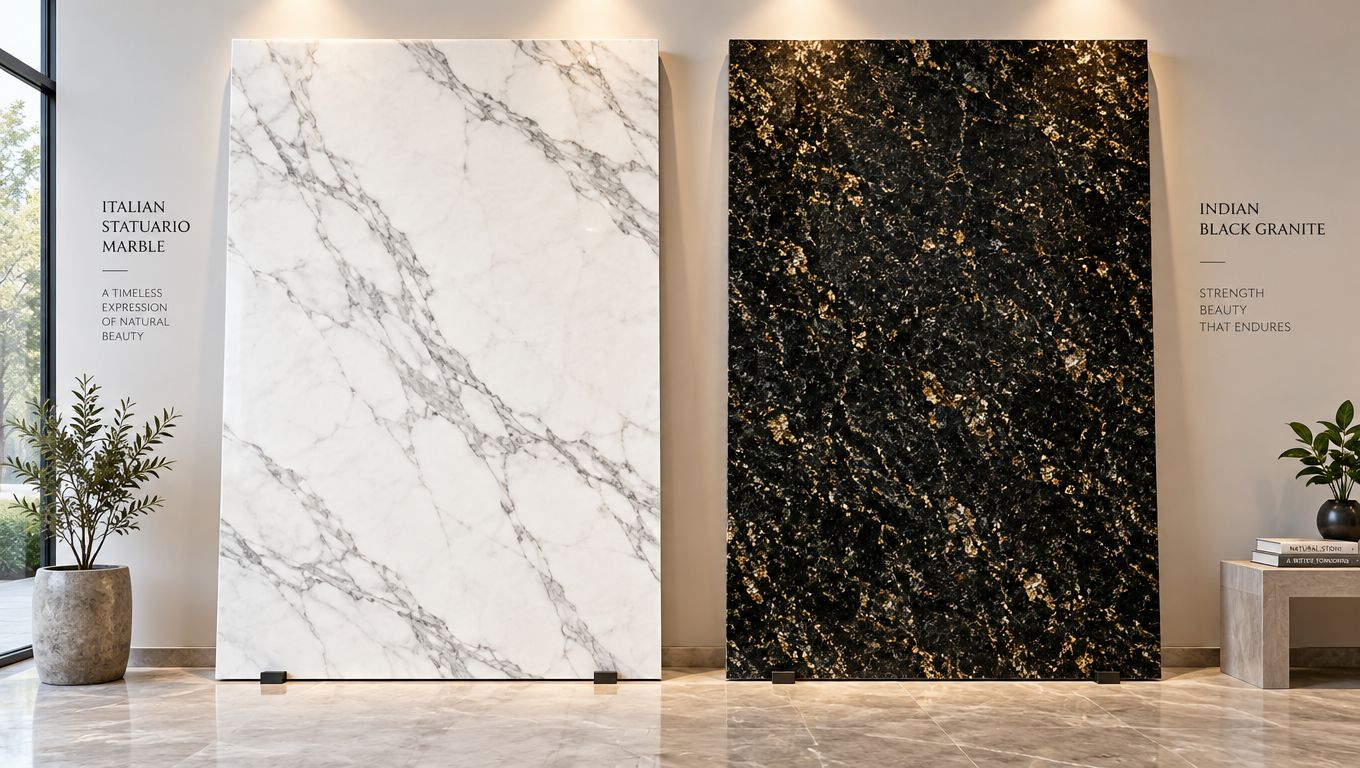
Local abundance and imported character
Rajasthan has long dominated Indian marble production, accounting for nearly 90% of India's marble in historic industry data. Granite production has been concentrated in southern states, including Tamil Nadu, Karnataka, and Andhra Pradesh. Historical references also describe the Indian stone sector employing about 300,000 workers in the late 1990s, with production reaching 3.5 million tons in 1995. This overview of stones of India supplies that historical context. The available block and slab still matter more than an old production ranking when specifying a project.
For NCR homes and commercial interiors, Indian supply can simplify replacement, matching, fabrication coordination, and service. Imported marble may provide a particular background, vein pattern, or translucency that a local alternative cannot reproduce. The trade-offs include lead times, limited slab availability, breakage risk, import handling, and the need to approve the actual material rather than a catalogue photograph.
Kitchen chemistry should be part of the sourcing decision. A striking marble may suit a low-acid area or a client who accepts gradual etching. It is a risky worktop choice where lemon, tamarind, tomato, vinegar, wine, or acidic cleaners regularly contact the surface. Granite is usually the rational selection for busy preparation zones when resistance to daily chemical exposure matters more than continuous veining.
Selection principle: Approve the actual slab, not just the stone name or country of origin.
Inspect before you approve
Check tone across all planned pieces, natural fissures, resin-filled areas, repaired corners, vein direction, and the way the slab responds to the room's lighting. For book-matched marble, agree on the sequence before fabrication. For granite, study mineral movement around sink cut-outs and appliance openings, where a small section can alter the visual balance.
A useful comparison of visual interpretation appears in this guide to making Indian marble look like Italian stone. Colour, finish, layout, lighting, and edge detailing can influence the finished impression as much as the slab's label.
Before handover, confirm the intended use, finish, thickness, edge, joint position, sealing recommendation, approved cleaning products, and responsibility for fabrication and installation. A beautiful slab can still disappoint if its cut plan ignores the stone's movement or the homeowner receives no practical guidance on chemical exposure.
The following visual reference can help clients understand how slab character, finish, and selection affect a completed surface.
Maintenance and Lifecycle Care Tips
Maintenance begins with matching the routine to the stone. Granite generally needs periodic resealing where stain resistance depends on a penetrating treatment. Marble demands faster spill response because wiping away an acidic liquid protects the surface from prolonged contact, but it can't reverse etching that has already occurred.
Start with the simplest daily habit. Use a soft microfibre cloth and a cleaner labelled pH-neutral and suitable for natural stone. Don't reach for vinegar, lemon-based sprays, bathroom descalers, bleach mixtures, abrasive powders, or rough scouring pads unless the stone professional has confirmed compatibility.
A workable routine for granite
Wipe food residue and standing water after use. Blot oil, tea, colour-rich sauces, and spice mixtures instead of spreading them across the surface. Use chopping boards, trivets where appropriate, and soft cloths for routine cleaning.
Granite's lower absorption and higher hardness reduce daily worry, but they don't eliminate maintenance. A sealer can wear unevenly on a frequently used worktop, especially around the sink and preparation zones. Ask for a resealing assessment based on the actual slab, finish, traffic, cleaning practice, and signs of absorption rather than following a blind calendar.
A stricter routine for marble
Treat acidic spills as immediate clean-up events. Lemon, vinegar, tamarind, tomato, wine, and some commercial cleaners can dull polished marble. Coasters, trays, cutting boards, and dedicated preparation areas aren't decorative extras. They create distance between reactive substances and the stone.
A dull patch caused by etching isn't a normal stain. Depending on its size and depth, a stone specialist may need to hone, polish, or refinish the affected area. Repeated local repairs can alter the uniformity of a surface, particularly where the surrounding marble has developed a different sheen.

Plan for service, not just cleaning
A practical handover file should record the stone type, finish, sealer used, recommended cleaner, fabrication details, and installer contact. That information prevents a later contractor from treating marble like ceramic tile or applying a generic descaler to a natural-stone vanity.
Hard-water deposits need particular care in NCR bathrooms. Scraping with metal tools can scratch the surface, while acidic limescale products can attack marble. The guidance on hard-water stains on marble is relevant, but stubborn deposits should be assessed before treatment.
Maintenance reality: Sealing reduces stain risk. It doesn't remove the need to wipe spills, and it doesn't make marble acid-proof.
For a lifecycle discussion, compare the likely service burden before installation. Granite may involve periodic sealing and occasional professional attention. Marble can involve more frequent polishing, honing, or repair when the owner wants to maintain a consistent finish. Imported stone and engineered alternatives can carry different supply and service considerations, so the lowest purchase price isn't automatically the lowest long-run cost.
Where to Use Granite and Where to Choose Marble
The most attractive stone is not always the right stone. In an Indian home, the better specification depends on what each zone must tolerate, how quickly spills are wiped, and whether the owner accepts visible change. Granite is the rational default for hard use and imperfect habits. Marble earns its place where its visual character matters more than resistance to chemical attack.
Choose granite for kitchen worktops, utility counters, busy reception desks, entrance flooring, stair treads, and circulation areas. It suits surfaces exposed to repeated contact, wheeled movement, point loads, grit, and regular cleaning. Its hardness, low absorption, and compressive performance provide more tolerance in these settings, as discussed in this technical natural stone performance reference.
A room-by-room decision
Kitchen worktops: Choose granite for a household that runs a pressure cooker, wet grinder, and tawa on the same counter within an hour, where spills land faster than anyone can wipe them. Choose marble for a carefully managed prep area when the owner accepts etching, patina, and prompt cleanup. Marble can survive daily kitchen use, but it cannot promise a uniform finish after repeated chemical contact.
Baking areas: Marble remains a sensible choice for a dedicated pastry surface. Its smooth feel and cool working character suit dough handling, provided the area is protected from staining liquids, abrasive tools, and careless storage. This is a controlled use case, not proof that marble belongs on every kitchen counter.
Bathrooms: Marble works well on a vanity, wall, ledge, or feature panel when its design value justifies more careful care. It can handle a low-contact vanity zone with suitable cleaning habits. Granite is safer for a heavily used vanity, shower threshold, or surface exposed to aggressive cleaning products.
Living rooms and hospitality spaces: Marble creates a strong statement on a feature wall, fireplace surround, reception backdrop, or low-contact console. Granite is more dependable for floors and routes where shoes, grit, furniture, and wheeled traffic cause continuous abrasion.
Outdoor or semi-exposed areas: Review the specific stone, finish, installation detail, drainage, and local exposure before approval. An indoor marble specification should not move outdoors without checking its suitability.
A broader overview of natural stone surfaces for remodels helps teams compare materials during planning. The final specification should document the zone, expected contact, cleaning products, finish, and owner's tolerance for patina.
Classic interiors work best when each stone has a defined job. Varun Marbles supplies Italian and Indian marble, granite, engineered quartz, and onyx, with slab selection, fabrication, finishing, and installation coordination in Gurugram. Visit Varun Marbles to inspect slabs and discuss the right material for each zone.