
Onyx Marble Texture: Lighting, Patterns, and Installation
Most advice about onyx marble texture starts with colour, veining, and the promise of a luxurious glow. That's the wrong starting point. Onyx isn't a more expensive substitute for ordinary marble. In a well-designed interior, it behaves as a lighting-dependent surface system, where the stone, its layered translucency, the direction of its bands, the backing assembly, and the surrounding finishes must work together.
That distinction matters in NCR projects. A backlit onyx wall can become the visual centre of a residence, hotel lobby, bar, reception desk, or vanity area. The same material can disappoint on a busy counter or floor, where traffic, spills, impact, and maintenance expose its limitations. The most successful specifications treat onyx as a carefully controlled feature, not as a general-purpose worktop.
Table of Contents
- Why Onyx Marble Texture Is More Than a Luxury Finish
- The Geological Structure Behind Onyx Translucency
- Where Onyx Texture Works and Where It Becomes a Liability
- Designing Light and Orientation Around Onyx Slabs
- How Texture, Finish, and Sourcing Shape Project Cost
- From Slab Yard to Finished Interior
- Deciding If Onyx Texture Fits Your Project
Why Onyx Marble Texture Is More Than a Luxury Finish
The popular showroom explanation is simple: onyx looks premium because light passes through it. That description is accurate, but incomplete. Translucency is the reason onyx is visually distinctive, and also the reason it demands more coordination than a conventional opaque stone.
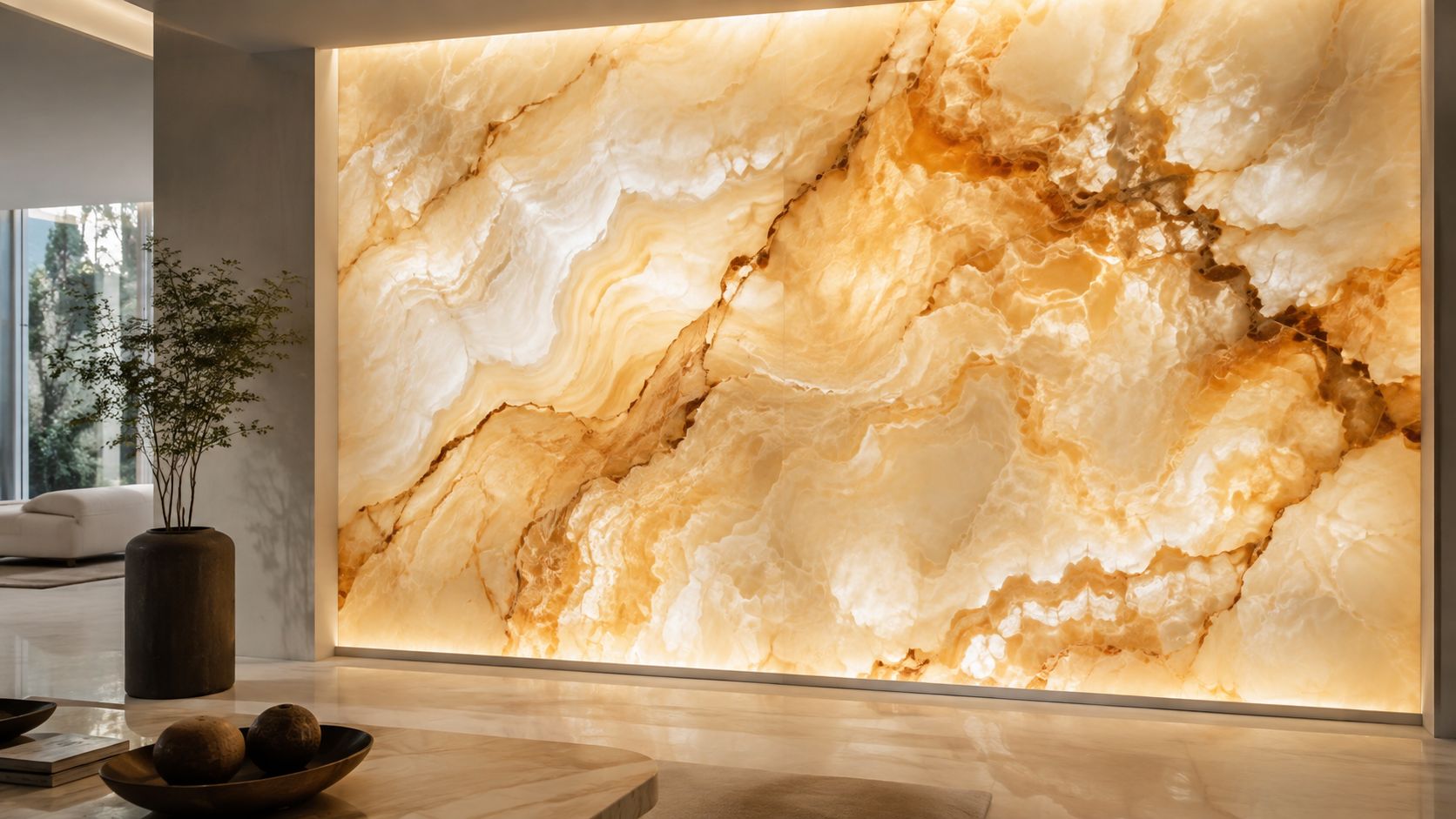
In the Indian Minerals Yearbook, onyx marble is described as a dense crystalline form of lime carbonate deposited from cold-water solutions. The government source also describes it as generally transparent to translucent, with variegated colour layering created by its mode of deposition. The same reference records an Indian occurrence in Kupwara district in Jammu and Kashmir, giving the material a documented domestic geological context rather than treating it as an entirely imported decorative idea (Indian Minerals Yearbook.pdf)).
That geological character explains why architects usually specify onyx in feature walls, reception fronts, bars, vanities, and decorative panels. These applications allow the stone to be seen at close range and, where appropriate, illuminated from behind. They also reduce the amount of abrasive contact and impact the surface receives compared with flooring or a heavily used kitchen worktop.
The surface is only half the specification
A sample viewed under showroom lights can look completely different from the installed slab. A warm concealed light may bring out honey and amber layers, while a cooler or poorly distributed source can flatten the same material or reveal unwanted hot spots. The orientation of the natural bands also changes the visual rhythm of a wall. Vertical movement can make a panel feel taller, while horizontal layering may support a console, bar, or reception counter.
Onyx therefore needs to be judged through four linked questions:
- What will the light do? Will the slab be backlit, lit from the front, or left to respond only to ambient light?
- What will the surface endure? Is it a protected wall, a vanity, a bar, or a high-contact worktop?
- How will the pattern be laid out? Will the slabs be book-matched, sequenced, or deliberately varied?
- Can the fabricator control the result? Slab inspection, cutting, support, finishing, and installation must be coordinated before fabrication begins.
Practical rule: If the design still works without the planned illumination, onyx may be functioning as a stone. If the design depends on the glow, specify it as a stone-and-light assembly from the beginning.
That approach prevents a common error in NCR interiors. A client approves a dramatic slab, but the electrical plan, wall cavity, diffuser, and final orientation are decided later. The stone arrives on site, the light is uneven, and the texture no longer resembles the approved sample. Onyx earns its cost when every part of the installation supports the material's natural structure.
The Geological Structure Behind Onyx Translucency
Onyx texture isn't a printed pattern applied to a uniform surface. It comes from a compact, banded structure made of coloured and transparent layers of calcite and, in some definitions, aragonite. Indian technical literature uses this layered description, and a 2025 academic paper aligns it with the European standard EN 12670:2001 (technical paper on onyx marble structure).
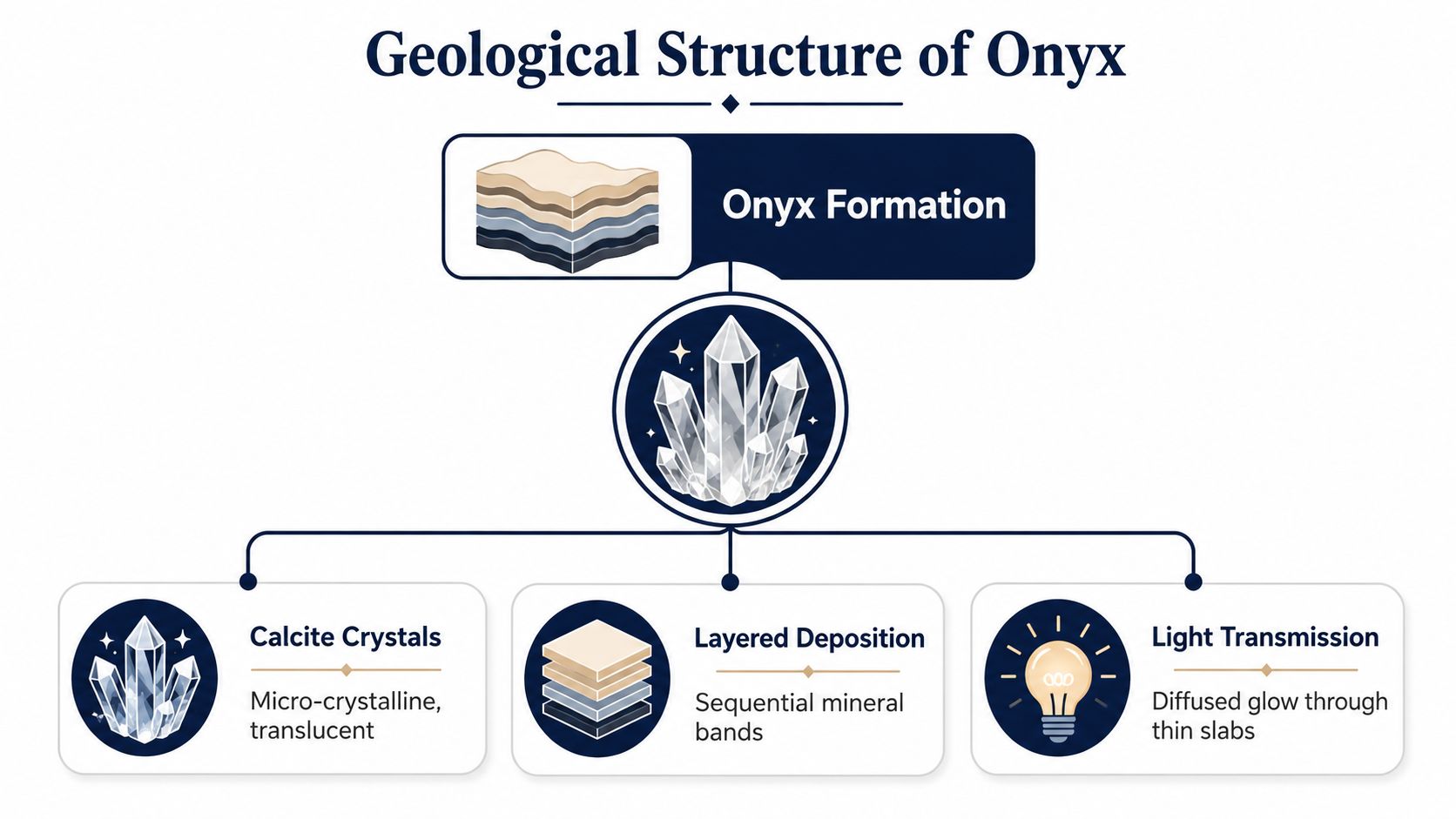
The distinction between layers is critical. Some laminae transmit light, while others block or diffuse it. Under illumination, those alternating zones produce the characteristic depth associated with onyx. You're not merely seeing a dark line against a pale background. You're seeing a stratified mineral fabric responding differently as light travels through the slab.
Why the bands vary from slab to slab
The Indian government description connects the stone's variegated colour layering to deposition. Each slab is therefore a section through a naturally formed sequence, not a repeatable industrial graphic. Even slabs from the same block can show changes in band width, colour concentration, cloudiness, fissures, and translucent areas.
For a fabricator, this means the showroom sample is only a starting reference. The full slab needs to be assessed with the intended use in mind. A broad pale zone may glow beautifully behind a reception desk, but appear visually empty when cut into a narrow vanity. A dense band may create a strong focal line on a wall, yet become an unwanted interruption if it crosses a basin or tap opening.
Light transmission is a fabrication issue
Thickness, backing, orientation, and illumination all influence the finished appearance. Thinner sections generally allow more light through, but the design team still has to balance visual transmission with mechanical support and safe handling. The light source must also be distributed across the back of the slab. Concentrated points can produce bright patches, while poorly planned cavities can create shadowing around supports, joints, or service openings.
The practical sequence should be:
- Inspect the complete slab. Mark transparent zones, opaque bands, dominant veins, and areas that may be lost during cutting.
- Overlay the elevation or template. Place basin cut-outs, sockets, shelves, corners, and joints on the actual pattern.
- Test the intended light. A small mock-up or sample test can reveal whether the selected colour temperature supports the stone.
- Confirm the viewing direction. A slab may look stronger in one orientation because the bands and translucent areas distribute differently.
- Approve the layout before cutting. Book-matching is an aesthetic decision, but it's also a material-use and joint-planning decision.
This is why experienced teams don't select onyx solely from photographs. The geological structure creates the beauty, but it also creates variation. Architects should approve the slab, the cutting diagram, and the lighting concept as one coordinated package.
Where Onyx Texture Works and Where It Becomes a Liability
Onyx should not be specified as a generic luxury marble. It is a lighting-dependent surface system, and its texture-performance trade-off only works when the location allows the pattern and translucency to remain visible without exposing the stone to constant abuse. Protected vertical applications usually deliver that balance. Working surfaces often do not.
| Application | Visual Impact | Traffic Suitability | Maintenance Demand |
|---|---|---|---|
| Backlit feature wall | Very high, especially across broad panels where layered bands remain visible | Excellent for a protected vertical surface | Moderate, focused on cleaning, joints, lighting access, and surface protection |
| Reception front or lobby insert | High, with strong arrival and branding impact | Suitable when shielded from direct impact and heavy contact | Moderate to high, depending on public interaction and cleaning routines |
| Bar front or decorative bar wall | High, particularly with controlled illumination | Suitable for fronts and walls, less forgiving on active work surfaces | Moderate, requiring prompt spill response and appropriate stone care |
| Bathroom vanity or powder-room panel | High, because the stone can remain the focal point in a compact setting | Suitable for considered residential and hospitality use | Moderate, with careful cleaning and protection from harsh products |
| Kitchen worktop | High at installation, but the visual gain brings practical compromises | Limited for demanding daily preparation and impact | High, especially around acids, oils, heat, and abrasion |
| Main flooring | Attractive in selected zones, but movement can make the texture less noticeable | Poor for heavy traffic compared with harder workhorse stones | High, since wear, dirt, and surface dulling become visible over time |
The most reliable placements are feature walls, bar fronts, protected reception faces, vanity surrounds, and decorative inserts. In these positions, people see the banding and glow while the material avoids repeated cutting, dragging, impact, and chemical exposure.
Where the advantage starts to disappear
A kitchen counter has a different workload from a backsplash. It receives cookware, food, spills, cleaning products, and repeated hand contact. Onyx's crystalline, layered structure may look exceptional, but the owner must accept more care and a higher chance of visible change. A protected backsplash or side panel can provide the onyx effect without asking it to perform like granite or engineered quartz.
Flooring creates a similar problem. Constant movement, grit, cleaning, and impact can make delicate variation look tired rather than luminous. Onyx can still work in a controlled inset, lift-lobby feature, or low-traffic decorative zone, but broad high-use flooring needs a stone selected for wear before appearance.
Granite remains the more dependable choice for these demanding areas. Market data places granite at 40.9% of stone-type revenue in India in 2025, reflecting its wider use across flooring and institutional settings (India luxury interior trends and stone context). The comparison is practical, not dismissive. Onyx is a specialist decorative surface. Granite, engineered quartz, or another suitable stone is often the better workhorse.
The specification should follow the viewing pattern of the room. Put onyx where people pause and look, not where they constantly drag, cut, spill, or strike objects.
For NCR homes, appropriate locations may include a drawing-room media wall, powder-room vanity face, or bar backdrop. In commercial interiors, a reception feature, lift-lobby insert, or hospitality wall can give the slab a controlled role. Where reliability matters more than illumination and pattern movement, choose a material designed for that workload.
Designing Light and Orientation Around Onyx Slabs
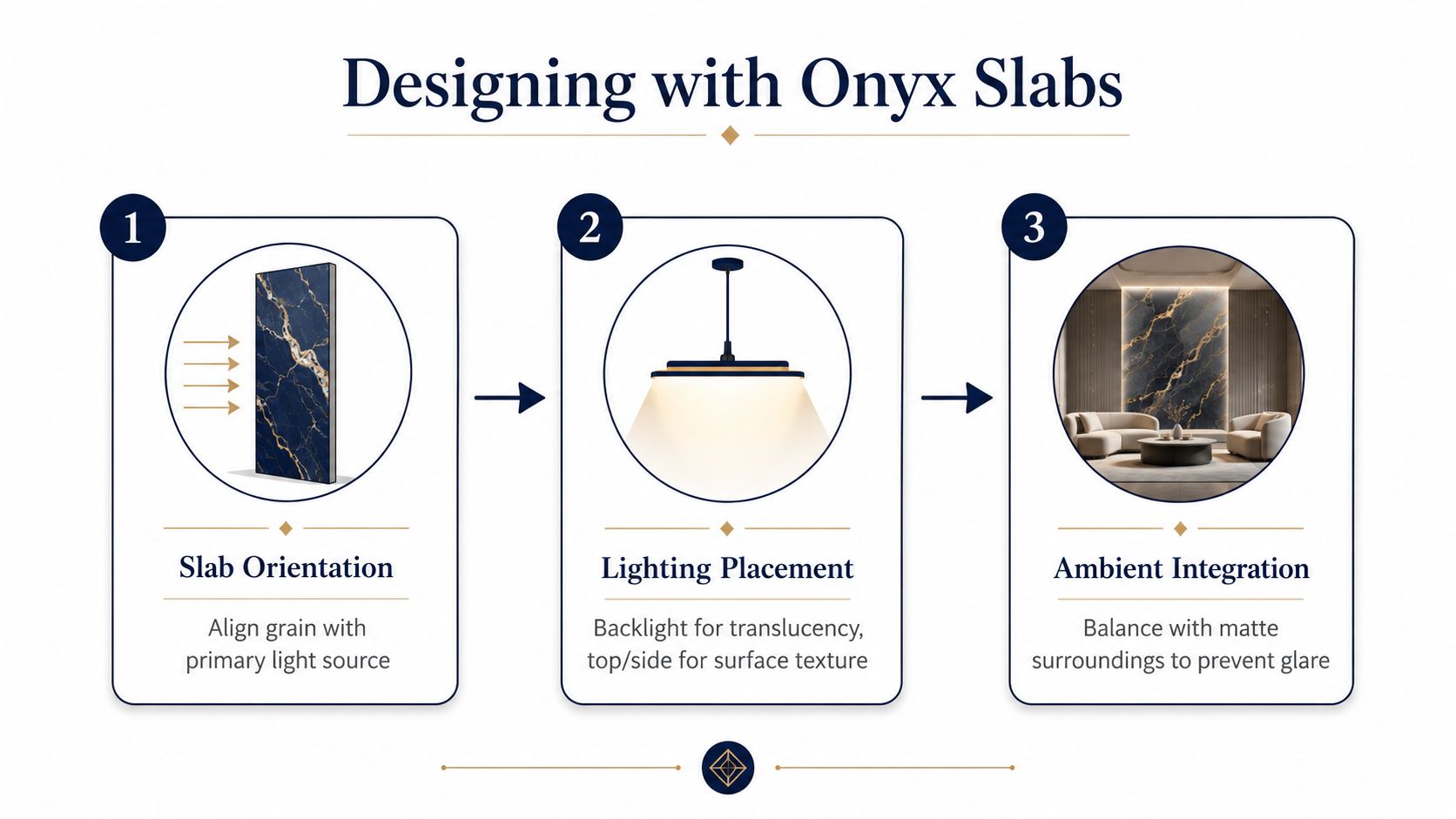
Onyx should enter the electrical and interior coordination process before the slab is cut. The stone's band direction, translucent zones, slab build-up, backing, and light distribution determine whether the final installation looks softly luminous or visibly patchy.
Start with the elevation, not the cut list
Lay the selected slab against the actual elevation and identify the visual priority. Is the main vein intended to rise behind a console? Should the softest translucent field sit behind a reception logo? Will a book-matched pair create a central mirror, or will the design look stronger with sequential slabs that continue the natural movement?
A fabricator should mark:
- Primary band direction, whether vertical, horizontal, or deliberately angled.
- High-transmission zones, which may become the brightest areas under backlighting.
- Opaque or dense bands, which can provide visual framing but may interrupt an opening.
- Cut-outs and joints, so plumbing, sockets, corners, and shelves don't destroy the composition.
The best layout isn't always the one with the least waste. With onyx, pattern continuity and light balance can matter more than using every available section of the slab.
Make the light even before making it bright
A bright light source won't correct an unsuitable backing system. It can exaggerate irregularities instead. Concealed LED panels, diffusers, and a planned cavity help spread illumination across the slab, while isolated point sources can create hot spots that make the texture look artificial.
The lighting designer and stone contractor should agree on:
- Light position, whether the source is behind the slab or directed across its face.
- Diffusion method, especially where the slab has broad translucent fields.
- Colour character, so the light supports the selected honey, white, green, pink, or other tonal range.
- Access for maintenance, because a concealed system still needs service access.
- Dimming and switching, particularly in hospitality, bedroom, lounge, or reception settings where the wall may need more than one mood.
For general coordination on recessed fixtures, the adding recessed lighting guide offers useful background before the electrician finalises the lighting layout.
The following video can help clients and design teams visualise how light placement changes the reading of a stone surface:
Control the room around the slab
Onyx already carries movement, reflection, and colour variation. Glossy flooring, mirrored furniture, and multiple competing light sources can make the room feel unsettled. Matte paint, timber, brushed metal, quiet upholstery, and controlled ambient light usually give the slab more authority.
Book-matching can be dramatic, but it needs a full-slab approval. If the material's bands don't mirror naturally, forcing symmetry may look less convincing than a carefully sequenced installation. The finished effect depends on restraint as much as illumination.
How Texture, Finish, and Sourcing Shape Project Cost
Onyx cost is not controlled by colour alone. Texture is part of the specification, and a demanding texture can increase selection time, layout work, fabrication coordination, and lighting requirements. A slab that looks exceptional in a yard may cost more because fewer panels can deliver the same visual continuity.
In the Indian market, honey onyx is generally more accessible, while rare pastel, white, and green varieties attract a premium. Imported material also carries shipping and duty costs, although Indian processing quality continues to improve. Treat these as procurement factors, not merely as a premium for appearance.
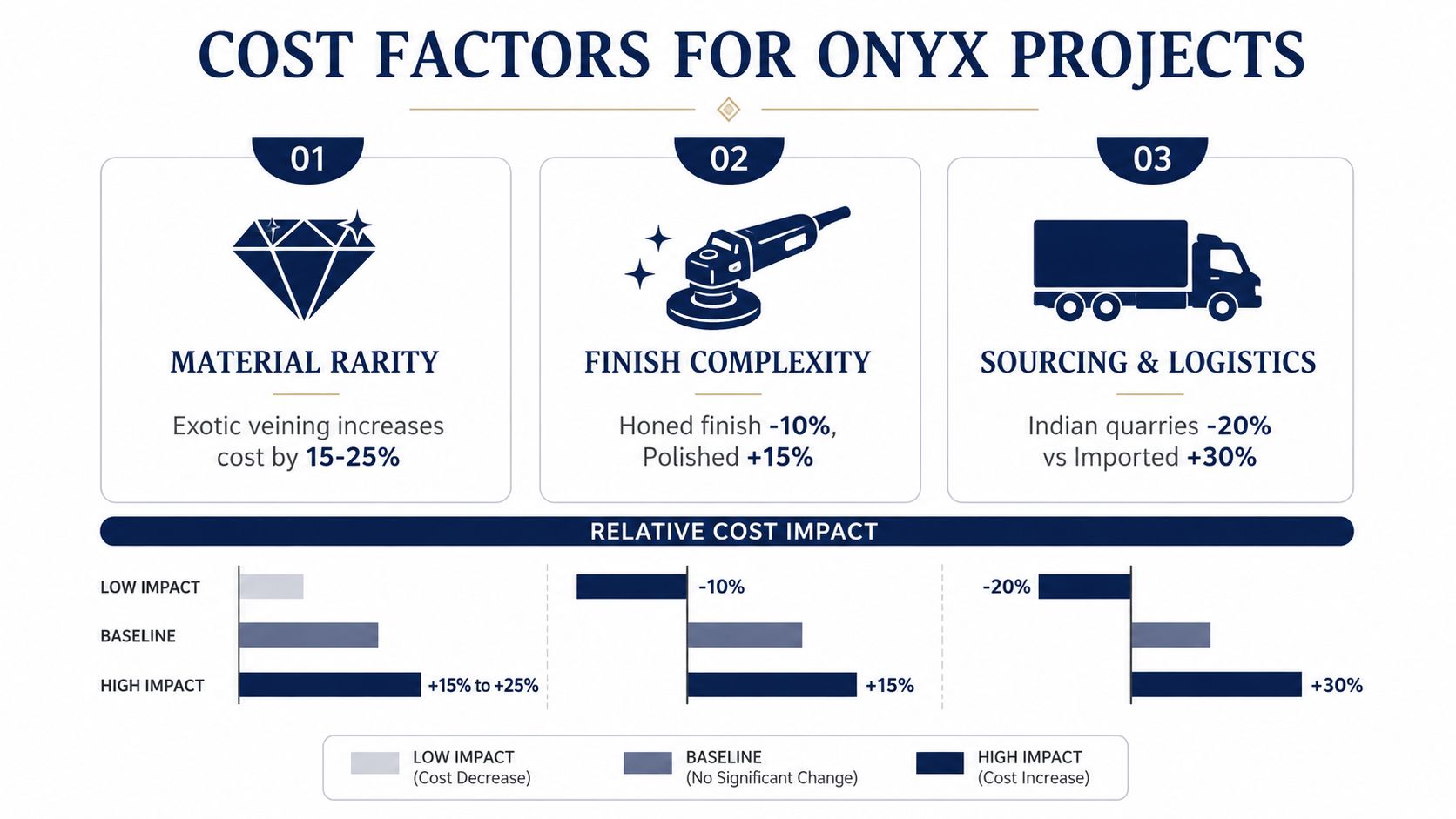
A visually rare slab can affect the budget in several ways. Strong colour, even translucency, and well-formed banding may reduce the number of acceptable slabs available in a yard. Book-matching adds another constraint because the paired slabs must work together in tone, movement, and illuminated appearance. A large uninterrupted wall may also require a slab size or sequence that standard stock cannot provide.
Cost is created after the slab is chosen
The stone invoice covers only one part of an onyx installation. Ask the fabricator to itemise:
- Slab selection and reserve, including whether the approved slab will be held until the layout is signed off.
- Cutting and edge work, including openings, returns, corners, and edge profiles.
- Surface finish, because polished, honed, and textured surfaces change both the visual result and fabrication effort.
- Backing and illumination, including the support frame, diffuser, LED system, wiring, controls, and service access.
- Installation risk, particularly for large panels, narrow returns, stair access, and complex joints.
- Replacement exposure, if a damaged or mismatched panel would be difficult to source later.
The imported onyx collection can help buyers review available material, but a small sample should not be the final approval. Inspect the actual slab, especially if the finished surface will be backlit.
An illuminated onyx wall should be compared with another complete finished system, not only with the square-metre price of opaque marble. The fair comparison includes the light box, electrical work, diffuser, support, access, and added fabrication complexity. These components determine whether the texture performs as intended after installation.
Choose the texture you can actually repeat
A dramatic slab may suit a private powder room and remain impractical for a large commercial elevation if matching material is unavailable. Hospitality and retail projects should define the panel sequence early, including acceptable variation in colour, band direction, and translucency. In a residence, one carefully selected slab can create the focal point without spreading procurement risk across the entire interior.
Forecasts for India's stone sector indicate continued growth, including projected growth rates of 15.90% in 2025 and 16.14% in 2026 in one cited forecast (India stone market forecast). That projection does not make every onyx texture easier to source. It reinforces the need for organised procurement when a project depends on a particular colour, band direction, or translucent field.
From Slab Yard to Finished Interior
The safest onyx projects begin in the slab yard, not at the installation site. A client or architect should see the actual material under neutral conditions, then review it again with the proposed lighting approach. Photographs can help with initial selection, but they don't show the full relationship between veining, translucency, thickness, and cut-outs.
Selection has to follow the elevation
For a residential bar wall, the fabricator may place the slab against a drawing showing the counter, shelves, bottle display, and lighting cavity. The team can then decide whether a dense band should frame the bar or whether it will interfere with the shelving. For a hotel reception, the same process may involve logo placement, desk height, corner returns, service openings, and the viewing angle from the entrance.
The slab should be checked for:
- Tone, including whether the base colour remains consistent across the planned panels.
- Vein and band movement, especially at corners and book-matched joints.
- Translucency, including areas that may become brighter than the rest under backlighting.
- Visible natural features, which may be acceptable, concealed, or unsuitable for a particular cut.
- Panel sequence, so the installer knows the intended order rather than making decisions on site.
Varun Marbles' natural onyx collection is one example of a supplier route where clients can review natural onyx options before coordinating fabrication and installation.
Fabrication protects the visual intent
Once the layout is approved, cut-to-size work translates the raw slab into panels, vanity tops, counter fronts, or decorative inserts. Edge profiling must suit the application, and openings should be positioned away from fragile visual zones where possible. The support method also matters. Large panels need stable handling, accurate backing, and installation planning that prevents stress from being concentrated at corners or cut-outs.
A useful comparison is a traditional stone feature wall. Even when the project doesn't use translucent material, the same discipline applies when you build an attractive retaining wall, where substrate, alignment, support, and installation sequence affect the final result. Onyx adds lighting and translucency to that coordination burden.
At site, protect the finished face from construction dust, impact, abrasive tools, and unsuitable cleaners. The electrician should test the illumination before final closure, while the stone team checks joints, edges, and pattern continuity from the normal viewing distance. A successful installation is not just a slab fixed to a wall. It's the approved geological pattern, cut accurately, supported correctly, and lit evenly.
Deciding If Onyx Texture Fits Your Project
Onyx earns its place when the project has a clear focal point, controlled lighting, limited physical abuse, and a client willing to maintain the surface thoughtfully. It becomes a poor fit for carefree worktops, high-traffic floors, or large areas that require consistent, easily replaceable material.
Use this filter before approving a slab:
- Location: Start with feature walls, protected reception fronts, bars, vanities, and decorative panels. Treat demanding work surfaces cautiously.
- Lighting: Confirm space for even illumination, service access, and electrical coordination. Without those provisions, the texture and translucency lose much of their effect.
- Pattern: Approve the complete slab and mark the cut plan. A small sample cannot show the final band direction, colour variation, or light balance.
- Maintenance: Account for spills, cleaning routines, public contact, and the level of care the space can support.
- Procurement: Check whether matching slabs, the selected colour, and the required finish are available at the project's scale.
- Alternatives: If durability and low upkeep lead the brief, compare granite or engineered quartz instead of forcing onyx into the wrong application.
The useful comparison is between a fully coordinated illuminated onyx assembly and a stone surface chosen for dependable daily performance. For a wider material comparison, the marble and granite selection guide can help structure the discussion around natural and engineered options.
Onyx works best when its visual role justifies the lighting, fabrication, and maintenance demands. Use it for a wall, bar, lobby, or vanity, and settle the lighting plan before cutting the slab. If the space needs an easy-care workhorse, select a material that can handle daily use without constant caution.
Varun Marbles helps architects and homeowners in NCR review natural onyx, imported onyx, marble, granite, and engineered quartz, with slab selection, cut-to-size fabrication, finishing, and installation coordination. Visit Varun Marbles to inspect suitable slabs in Gurugram and discuss whether the texture, lighting plan, and application suit the project.