
Marble and Quartzite Surfaces Compared for Indian Homes
You're standing in a Gurugram stone yard with two slabs shortlisted for the same kitchen. One has the marble look you've wanted for years, with sweeping veins and a soft, architectural surface. The other is quartzite, harder, denser, and usually more expensive. The decision feels simple until you remember how often your family cooks, how quickly spills get cleaned, and how difficult it can be to match a replacement slab later.
That's where marble and quartzite need to be judged differently in the NCR. The right choice isn't the stone that looks better under showroom lighting. It's the material that delivers the right balance of appearance, maintenance, fabrication, sourcing reliability, and replacement risk for the room.
Table of Contents
- Introduction That Helps You Choose With Confidence
- Understanding Marble and Quartzite at a Glance
- How Hardness Porosity and Density Really Compare
- Finishes Fabrication and Installation Insights
- Where Each Stone Performs Best in Real Projects
- Maintenance Sealing and Long Term Care Trade Offs
- Making the Right Choice for Your Space and Budget
Introduction That Helps You Choose With Confidence
A Gurugram kitchen used by a busy family exposes the difference quickly. Marble delivers stronger visual impact, but citrus, vinegar, wine, tomato and daily abrasion can etch or mark its surface despite sealing. Quartzite tolerates demanding use more comfortably, yet its higher purchase and fabrication cost earns its place only when the room benefits from that added durability.
The wrong choice usually begins with a lifestyle mismatch. A slab is approved for its showroom appearance, then faces hurried breakfasts, wet hands, children, caterers or frequent cleaning in a commercial washroom. Architects and contractors carry another risk: the next shipment may differ in tone or veining, while a fabricator may underestimate quartzite's tooling, handling and edge requirements.
Use a clear rule. Choose marble for visual impact where use and maintenance are controlled. Choose quartzite where traffic, scratching, moisture and replacement risk justify a higher initial spend. Neither material suits every project.
Lifecycle cost matters more than the slab price. A cheaper marble selection can demand more careful cleaning, earlier refinishing or replacement in a heavily used kitchen. Quartzite can repay its premium when fewer surface failures, lower disruption and better resistance to daily wear matter over the life of the installation. In humid Indian homes, neither stone should be installed without a stone-specific sealing plan. Poor sealing, standing moisture and rushed fabrication can erase the practical advantage of either material.
Sourcing adds a distinct NCR risk. India's marble market has long been concentrated in Rajasthan, which accounted for about 89% of the country's marble output value in 2014–15, while Gujarat contributed about 10%, according to the Indian Minerals Yearbook marble data.pdf). North Indian projects therefore depend on domestic quarry networks as well as imported material. Approve the complete slab lot, record its identification, and confirm that future replacement pieces can be sourced before fabrication begins.
The guide compares geology, technical performance, finishes, fabrication, installation, applications and long-term care. It focuses on practical approval decisions, including which rooms justify quartzite's premium and where marble remains the smarter specification.
| Decision factor | Marble | Quartzite |
|---|---|---|
| Visual character | Strong veining, translucency and broad colour variation | Mineral movement, linear patterns and a stone-like depth |
| Scratch resistance | Lower, with a minimum hardness of 3 on the Mohs scale under Indian specifications | Mohs hardness of 7 |
| Water and stain exposure | Needs careful sealing and prompt spill management | Lower typical porosity, but still requires stone-specific sealing |
| Best fit | Feature walls, controlled-use kitchens, luxury bathrooms and floors with managed traffic | Busy kitchens, stairs, high-traffic floors, wet areas and demanding commercial interiors |
| Main risk | Etching, staining, edge wear and inconsistent maintenance | Higher upfront cost, difficult fabrication and inconsistent identification or lots |
Understanding Marble and Quartzite at a Glance
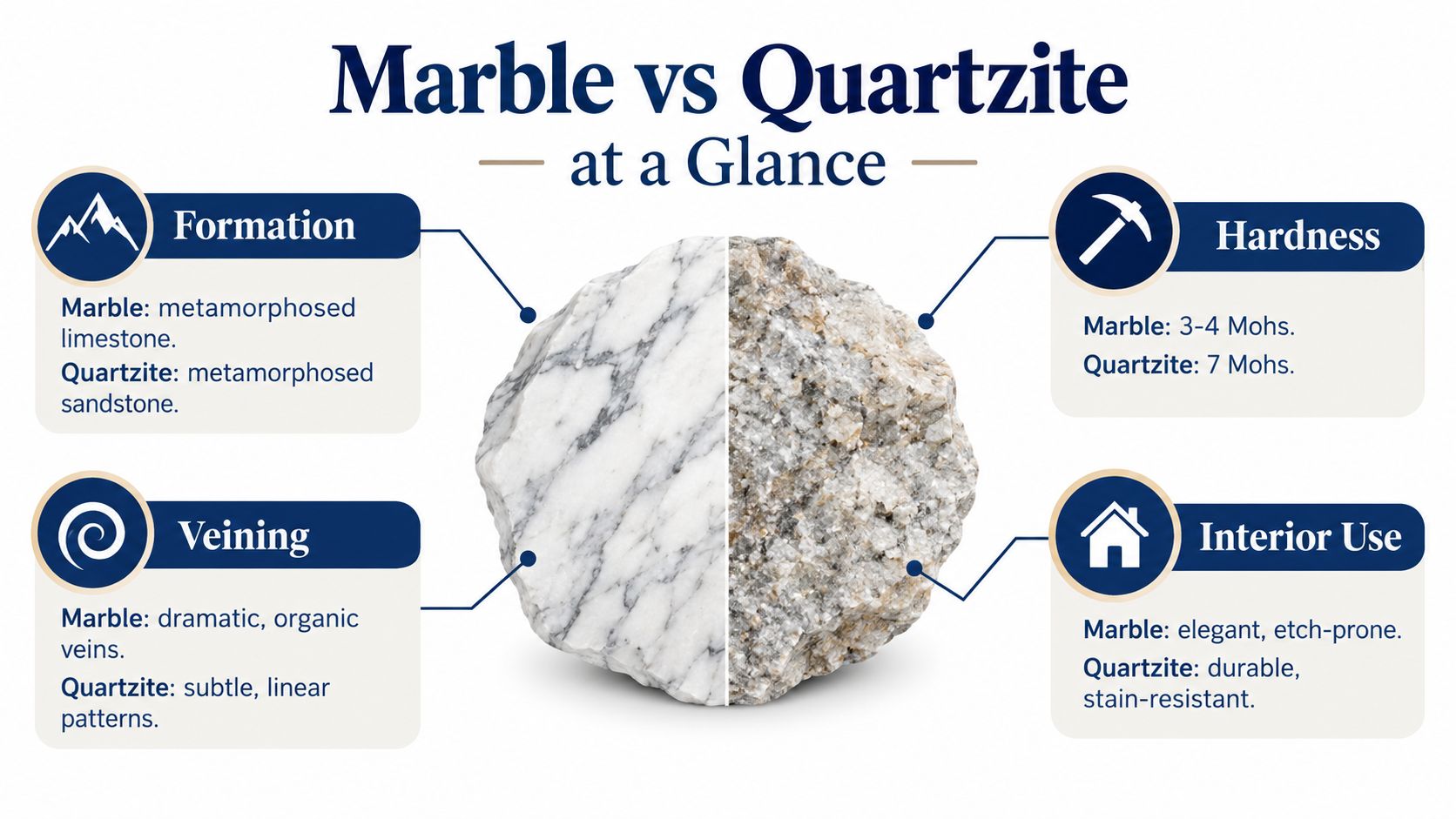
For an NCR kitchen, the wrong stone choice shows up later as etching, replacement delays, or a failed sealer. Marble starts as limestone. Heat and pressure recrystallise its minerals, creating the veining, translucency and colour movement that give each slab its identity. Mineral content changes the result, from restrained white backgrounds to dramatic directional patterns in Italian marble, while Indian marble offers a wide range of familiar and contemporary tones.
Quartzite starts as sandstone. Heat and pressure fuse its quartz-rich grains into a denser metamorphic rock. That formation gives quartzite its characteristic strength and helps explain its resemblance to marble, especially where pale backgrounds carry flowing mineral bands. The higher purchase cost makes sense on busy counters, stairs and floors only when the material is correctly identified, fabricated and sealed.
Appearance alone cannot confirm the stone. A slab sold as quartzite may be marble or another similar-looking material. Ask the supplier for the stone identification, complete lot details and recommended sealer before approval. Test the actual slab when the project involves a kitchen, wet area or humid Indian home. A convincing sample can still behave poorly at the counter edge or around the sink.
Appearance follows the geology
Marble's strength is its variation. Veins may be soft and cloudy, sharply linear, or layered with visible depth. That makes it effective for book-matched walls, vanity fronts, fireplace surrounds and statement floors. It also makes full-slab approval necessary. A small sample cannot show how the main vein will cross an island or meet a seam.
Quartzite provides a related premium look with a harder mineral structure. Patterns may be granular, linear or crystalline, but pattern alone cannot establish classification. In hospitality and façade work, quartzite suits surfaces expected to retain a refined natural-stone appearance under heavier use.
For Indian and imported choices, Varun Marbles' Indian marble collection shows why selection must begin with the available slab, not merely the category. The individual slab, finish, thickness, fabrication plan and installation quality can affect lifecycle cost as much as the invoice label.
India's trade connects NCR interiors to domestic and international supply. In 2015–16, marble imports rose by 11% to 8,58,061 tonnes, with 83% dressed marble, while Italy supplied 49% and Turkey 30% of dressed-marble imports, according to the Indian Minerals Yearbook. Approve the full lot and confirm replacement availability before fabrication. That step reduces mismatched colour, inconsistent veining and sourcing risk later.
How Hardness Porosity and Density Really Compare
The technical difference between marble and quartzite becomes practical at the counter edge, beside the sink and across a busy floor. Hardness measures resistance to scratching, not immunity from damage. Porosity influences how quickly a stone can absorb liquid. Density helps indicate how tightly the material is structured.
Indian Bureau of Standards specifications for marble blocks, slabs and tiles set maximum moisture absorption at 0.4% by weight after 24 hours of cold-water immersion, with minimum hardness of 3 on the Mohs scale and minimum specific gravity of 2.5, as stated in the BIS marble product manual. Those figures don't make marble unsuitable. They explain why marble performs best when the design controls exposure and the maintenance plan is followed.
Quartzite's published technical guidance lists Mohs hardness of 7, compressive strength of 100–200 MPa, porosity of 0.5–3%, and specific gravity of 2.6–2.7 g/cm³ in the quartzite material guidance from InHeritage Foundation. The exact response still varies by slab, mineral content, finish and installation, but the direction is clear: quartzite is substantially better suited to hard-wearing applications.
| Property | Marble | Quartzite |
|---|---|---|
| Mohs hardness | Minimum 3 under BIS specifications | 7 in technical guidance |
| Moisture behaviour | Maximum absorption specified at 0.4% by weight after 24 hours of cold-water immersion under the BIS reference | Typical porosity listed at 0.5–3% |
| Specific gravity | Minimum 2.5 under BIS specifications | Typically 2.6–2.7 g/cm³ |
| Compressive strength | Not stated in the cited BIS data | Typically 100–200 MPa |
| Practical implication | Softer surface, greater sensitivity to scratching, staining and etching | Strong scratch resistance and lower typical water uptake |
What the numbers mean on site
A marble vanity in a guest bathroom may perform beautifully because traffic is limited and spills are easier to manage. A marble floor in a reception lobby faces a different problem. Repeated foot traffic can gradually alter the sheen along walking paths, and repairs or polishing may become part of the building's upkeep.
Quartzite's hardness is especially valuable for kitchen counters, stair steps, hallways and wall cladding. It won't remove the need for a cutting board, a proper sink installation or a competent fabricator. It does, however, give the surface a stronger margin against daily abrasion and edge wear.
For a busy kitchen, hardness is the decisive differentiator. Marble rewards careful use. Quartzite tolerates demanding use more confidently, provided the slab is genuine, the sealer is appropriate and the fabrication team has the right tooling.
Stone selection should also be compared with other surface categories rather than treated as a two-material decision. If you're evaluating ceramic or porcelain alternatives for a specific room, this explanation of porcelain tile is useful because porcelain brings a different balance of manufacturing consistency, water resistance and design flexibility. The right answer may be natural stone in one room and a manufactured surface in another.
Finishes Fabrication and Installation Insights
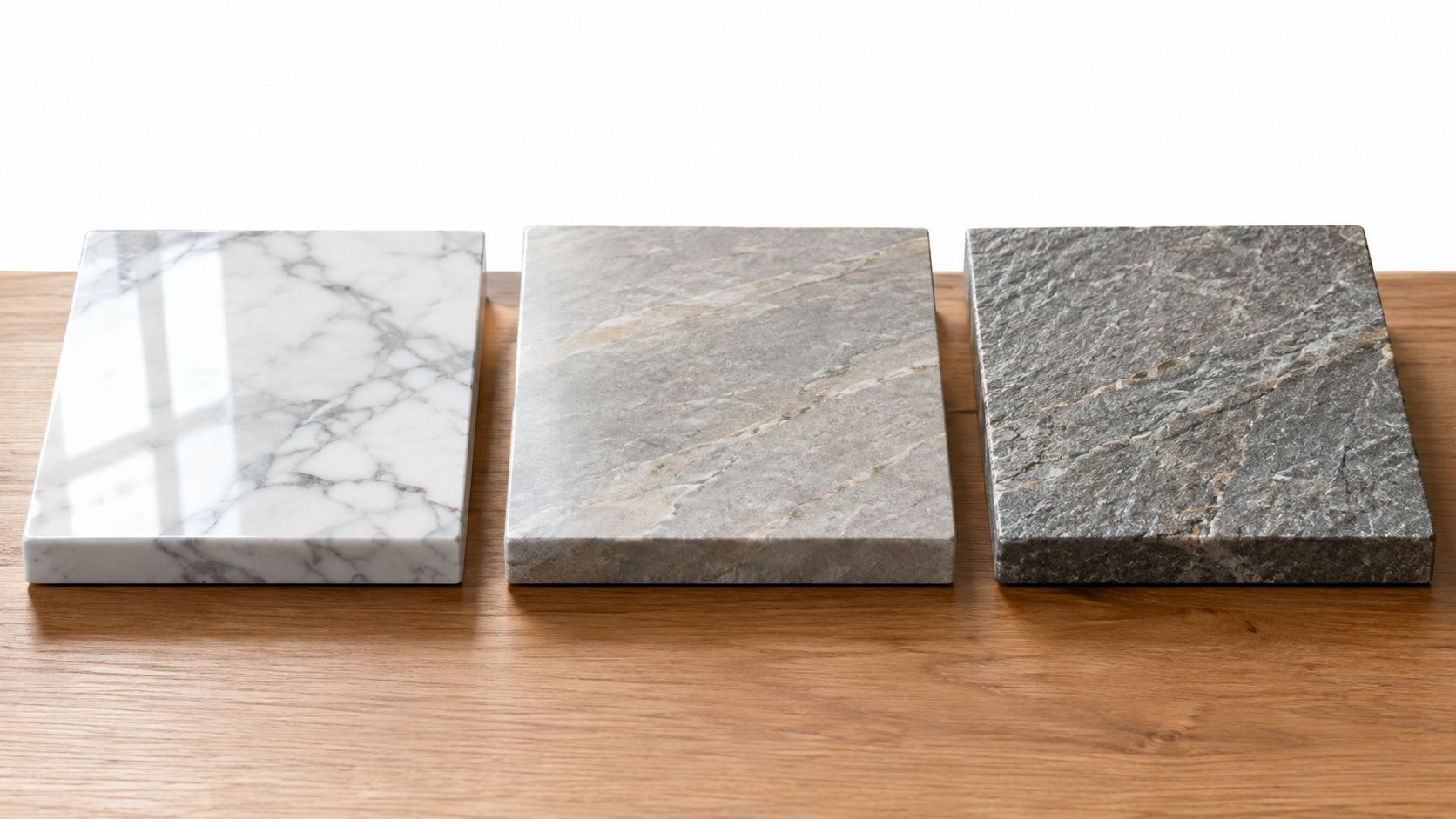
The finish changes how a slab looks and how it behaves. Polished marble gives the strongest reflection and can intensify colour and veining, but it also makes dull areas and surface marks easier to notice. Honed marble has a softer, matte appearance that can disguise minor wear, although the reduced sheen doesn't make the stone harder. Leathered finishes add texture and visual depth, helping mask fingerprints and small variations while requiring careful cleaning around the textured surface.
Quartzite can also be polished, honed or leathered. The choice should follow the room, not fashion. A polished finish suits a formal vanity or feature wall. A matte or leathered finish can be more forgiving in a high-use kitchen, corridor or hospitality area where reflections, water marks and frequent contact would otherwise dominate the appearance.
Fabrication deserves approval before purchase
Fabrication determines whether the finished surface looks intentional or improvised. Review the cutting layout before the slab is cut, particularly for a waterfall island, full-height backsplash, book-matched wall or long vanity. Mark sink cut-outs, cooktop openings, joints and visible edge profiles on the approved slab photograph.
Quartzite needs more disciplined fabrication because its hardness places greater demands on diamond tooling, polishing and handling. Marble is easier to shape, but its softer edges can chip if the team uses poor support, rushed transport or an unsuitable edge profile. Both materials need accurate site measurements, solid substrate preparation and an installation sequence that protects finished faces from other trades.
Varun Marbles describes a quarry-to-showroom process that includes block selection, slab inspection, cut-to-size work, edge profiling, finishing and installation coordination. Its guidance on quartz slabs for modern kitchens is also relevant when a project compares natural stone with engineered options, especially where consistent patterning and lower routine upkeep are priorities.
A useful fabrication review should cover:
- Slab identity: Confirm the exact slab, lot and orientation, not just the commercial name.
- Vein control: Decide where the principal vein will land before approving sink and hob cut-outs.
- Edge treatment: Match the profile to the stone's hardness, thickness and expected contact.
- Joint position: Keep seams away from high-stress corners and visually disruptive areas.
- Site protection: Cover completed surfaces while carpenters, painters and electricians finish their work.
Watch the fabrication process before you finalise a complex design. This video provides a visual reference for the way stone surfaces are handled and finished.
A beautiful slab can't compensate for a poor joint, an unsupported overhang or a sealer applied to a dusty surface. Treat fabrication and installation as part of material selection, not as a separate afterthought.
Where Each Stone Performs Best in Real Projects
In Gurugram and the wider NCR, choose the stone by use, replacement risk and supply consistency, not colour alone. A slab that performs well in a showroom can become an expensive problem if the lot varies, the fabricator cannot match panels, or humid conditions expose weak sealing.
Kitchens and food preparation areas
For a family kitchen that cooks daily, quartzite is my recommendation. Its hardness gives better protection against scratches, while its lower typical water uptake provides more tolerance around sinks and wet hands. The higher purchase and fabrication cost earns its keep when the counter will face years of frequent cooking, cleaning and contact.
Marble suits a low-traffic kitchen when the owner accepts patina and responds quickly to spills. For an NCR project, approve the exact slab before fabrication and record its lot, because a later replacement may not match the original veining. Use marble on a feature island when visual impact matters more than keeping the surface unchanged.
Bathrooms and washrooms
Marble works well for a luxury vanity, wall panel or shower surround when the design controls water exposure and the client accepts natural variation. Specify matching slabs for adjoining panels, especially on a book-matched wall. Check that the supplier can hold the selected lot until fabrication is complete, rather than relying on a commercial name alone.
Quartzite is the stronger choice for a heavily used family vanity, hotel washroom or wet-area wall exposed to frequent cleaning. In humid Indian homes, inspect sink edges, joints and wall penetrations during handover. A sound slab still fails as a system when water reaches poorly prepared or incompletely sealed details.
Floors, stairs and commercial interiors
Use marble flooring selectively in a low-to-moderate traffic residence, boutique foyer or decorative inlay. It is a poor default for busy corridors, school entrances, retail areas and commercial staircases. Quartzite handles abrasion better, making it more suitable for hallways and stair treads.
Quartzite stair work also carries a fabrication cost delta. Confirm tread thickness, nosing detail, support and the number of slabs required before comparing quotations. A cheaper rate can disappear through wastage, extra joints or a replacement slab from a different lot.
India-focused market coverage reports growing quartzite visibility in premium façades and hospitality work. It records Indian quartzite export volume rising from 102 KT in FY2022 to 126 KT in FY2025, while reporting supplier concentration and intense price competition in the blocks and slabs trade, as discussed in the India construction ornamental stone market overview. For NCR commercial work, verify quarry or distributor continuity, slab identity and replacement availability before approval.
Feature walls and statement surfaces
Marble usually wins for reception backdrops, bar fronts and book-matched panels because its veining carries the design. Before cutting, dry-lay every panel, confirm orientation and approve the joint map. This prevents a visually important wall from depending on a mismatched replacement.
Quartzite earns the premium when the statement surface also faces moisture, impact, exterior exposure or repeated cleaning. Do not pay for its hardness where the wall is protected and rarely touched. Use it when lifecycle risk, not appearance alone, justifies the higher upfront cost.
Maintenance Sealing and Long Term Care Trade Offs
Maintenance begins before installation. Ask what sealer will be applied, whether the product is penetrating or topical, how the stone was tested, and what the fabricator recommends for the specific slab. A generic promise that the stone is “sealed” isn't enough. Poor surface preparation, an unsuitable product or incomplete coverage can create the appearance of a material problem when the failure occurred during installation.
Marble needs stricter daily discipline. Keep citrus, vinegar, wine, strong bathroom chemicals and abrasive powders away from the surface. Sealing can reduce absorption, but it won't stop acid from etching the calcite-rich face. Wipe spills quickly with a soft cloth and pH-neutral cleaner, and don't use a rough scrub pad to chase a mark.
Quartzite needs less supervision, not zero supervision. Some slabs still absorb moisture through the stone or along edges and joints, so the fabricator should test the actual material rather than apply a universal interval. A sealed quartzite counter should still be cleaned with mild products, protected from harsh chemicals and inspected around sink cut-outs, seams and exposed edges.
A practical care routine
- Clean without experimenting: Use a soft cloth and a stone-safe, pH-neutral cleaner for marble. Use mild cleaner and water for quartzite unless the supplier specifies otherwise.
- Treat edges as vulnerable zones: Sink rims, hob cut-outs and exposed corners receive repeated contact and should be checked during routine cleaning.
- Test before resealing: Ask the installer to perform a water-absorption check on an inconspicuous area. Resealing should respond to the stone and use conditions, not a blindly repeated calendar.
- Control the room, not just the slab: Wet bathrooms need properly detailed joints, ventilation and falls. A sealer can't correct standing water or failed waterproofing.
- Keep the replacement record: Photograph the approved slab, retain the batch details and store the supplier's care instructions. Matching a natural stone later is difficult when the original lot is unknown.
Polished marble countertops can show the difference between visual luxury and maintenance tolerance particularly clearly. Polishing amplifies colour and reflection, but it also makes etching and worn pathways more visible than a honed finish would.
Cost planning must include more than the slab. India's marble and travertine block pricing has been volatile, with a reported LTM proxy average of US$372 per tonne and four monthly records above the previous 48-month peak, according to FIGSI's natural stone market outlook. The same source reports that GST on marble and travertine blocks and granite blocks was cut from 12% to 5% effective September 22, 2025. Tax changes can alter procurement budgets, but they don't eliminate fabrication, sealing, wastage, maintenance or replacement risk from the lifecycle calculation.
Making the Right Choice for Your Space and Budget
For NCR projects, compare stones by lifecycle cost, not slab price alone. A lower initial quote can become expensive after resealing, repairs, replacement and project disruption.
| Project condition | Recommendation | Cost logic |
|---|---|---|
| Feature wall where veining drives the design | Marble | Spend on appearance when wear is controlled |
| Gurugram kitchen with constant family use | Quartzite | Higher upfront cost can offset repeated care and surface repairs |
| High-traffic floor, stair or commercial washroom | Quartzite | Hard wear creates greater value for the more durable option |
| Controlled bathroom with an attentive owner | Marble | Works when sealing, cleaning and spill control are planned |
| Tight budget with limited maintenance capacity | Reconsider the application | The cheaper slab may create higher ownership cost |
Quartzite earns its premium when replacement would interrupt daily life or a commercial operation. In a humid Gurugram kitchen, marble may require more frequent attention to staining, etching and worn work zones. If resealing and eventual repair become recurring costs, quartzite's higher purchase price can pay back through fewer interventions. That calculation should include fabrication, installation, downtime and wastage, not just the material invoice.
Marble remains the right purchase when its veining is the primary design feature and the client accepts patina, careful cleaning and a documented care plan. Do not specify it for a hard-working surface merely because the first quote is lower.
Sourcing risk can erase the expected savings from either stone. Inspect the complete slab in daylight and verify that all pieces come from the same lot. Approve the cutting layout against the actual vein direction. For quartzite, request a small sample test when the trade name is unclear, then confirm water absorption and sealer compatibility before fabrication. This check helps prevent inconsistent lots and sealing failures in humid Indian homes. Keep the approved slab photographs, batch details and care instructions for future repairs.
For a Gurugram home, visit the yard before signing the order. Carry cabinet samples, paint colours and drawings that show sinks, joints and edge details. Varun Marbles provides natural and engineered slabs, in-person slab selection, cut-to-size fabrication, edge profiling and installation coordination through its Gurugram showrooms. Use an integrated supplier process, whether you choose Varun Marbles or another qualified fabricator, and confirm who will cut, seal and install the stone.
Visit Varun Marbles in Gurugram to compare full marble and quartzite slabs, review finishes, and discuss fabrication and installation for your kitchen, bathroom or commercial project. Bring drawings and room-use requirements, then select for appearance and lifecycle performance.