
Travertine Marble Price in India: What You Actually Pay

Standard commercial travertine in India costs roughly ₹200–₹500 per sq. ft. for stone only, with ordinary beige, Noche or silver selections at about ₹250–₹350 per sq. ft., and GST, freight, cutting and installation are extra. Most buying advice tells you to chase the lowest headline rate. That's the mistake. The cheapest quote often buys thinner stock, weaker selection or a bill that excludes fabrication, handling and care.
Table of Contents
- What Travertine Costs per Square Foot in India
- The Seven Variables That Move Travertine Prices
- How Import Origin Shapes Travertine Quotes
- How to Calculate the True Price per Usable Square Foot
- Maintenance and Lifecycle Cost by Application
- Where Travertine Is Worth Paying For
- Request a Written Quote Before You Commit
What Travertine Costs per Square Foot in India
The catalogue rate is only a starting point. A travertine quote becomes useful when it identifies the stone, the chargeable area and the work included. The cited Indian listings span roughly ₹220–₹700 per sq. ft. across origins and finishes, according to broader Indian listings spanning different origins and finishes. That range is a reference, not a single market rate.
Stone-only quotes need clear categories. These bands separate ordinary stock from more selective material without treating overlapping grades as distinct price brackets.
Stone-only travertine rates by grade band, India
| Grade band | Stone-only rate (₹ per sq. ft.) | Typical use | What pushes the rate up |
|---|---|---|---|
| Ordinary beige, Noche or silver | ₹250–₹350 | Everyday residential floors and walls | Limited veining consistency |
| Consistent veining or premium finish | Above ₹350–₹500 | Feature floors, premium bathrooms | Selection, finish, lot matching |
| Unusual colour or high-selection imported premium | Above ₹500 | Statement walls, special projects | Rarity, origin, shipping |
| Full listing range across origins | ₹220–₹700 | Listings with varied specifications | Origin, thickness, finish |
The bands are guides, not grade labels guaranteed by every seller. A quote at the boundary needs a specification: thickness, finish, cut, filling and the actual lot. Without those details, two rates cannot be compared on price alone.
What Stone Only Means
Treat each table rate as the cost of stone, not the installed floor. GST, freight, unloading, cutting, edge profiling, sealing, installation and wastage can all change the final bill. The usable area matters too: a slab's quoted area does not account for pieces lost to cuts, defects or matching.
For example, a seller quoting ₹280 per sq. ft. with delivery and fabrication included may cost less overall than a seller quoting ₹240 per sq. ft. ex-yard. Ask for the quote basis and exclusions in writing, then compare the total cost against the area that can be installed.
The Customs Reality Check
Import figures help describe the raw-material market, but they do not set a retail rate. India imported about 1.4 million tonnes of marble and travertine blocks and slabs in 2023, valued at about US$318 million, according to IndexBox data on Indian marble and travertine block prices. The same source reports an average import price of US$226 per tonne, down 4.1% from 2022. Its longer-term series puts the average at about US$375 per tonne in 2015, with prices generally below that peak through 2023.
Those per-tonne figures cannot be converted directly into a rupee-per-square-foot quote. Between imported blocks and installed stone are transport, duties, processing, polishing, wastage, fabrication and seller margin. Customs values describe imports at a different stage of the supply chain; they do not establish a minimum shop price.
Reading rule: A quote well below comparable rates warrants checks on thickness, grade and excluded charges. A high quote should come with a specific reason, such as unusual colour or intensive selection.
Use the bands to identify what needs explaining, then compare quotes by specification and usable installed area.
The Seven Variables That Move Travertine Prices
A catalogue rate is only a starting point. The cost of travertine depends on how much usable stone arrives, what processing it needs, and how difficult it is to install well. Two beige slabs can therefore carry very different costs despite sharing a colour name.
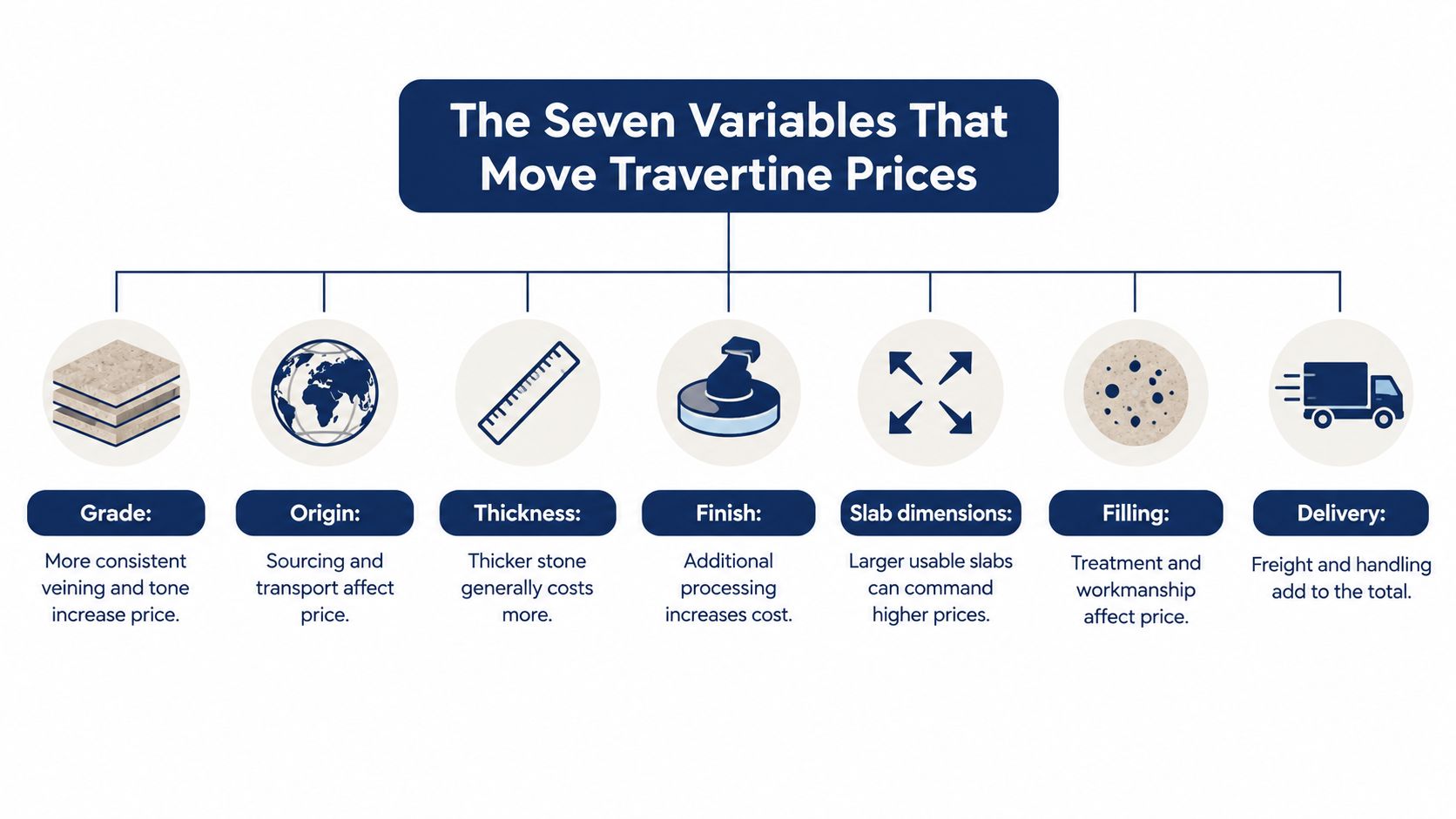
- Grade affects usable yield. More consistent veining and tone often require stricter selection, leaving fewer slabs suitable for a matching installation. The buyer pays for the selected pieces and the rejected material behind that selection.
- Cut affects appearance and selection. Vein-cut slabs show linear grain suited to bookmatching and feature work, where matching pieces can take more time to source. Cross-cut slabs have a more uniform, cloudy pattern.
- Finish adds processing and changes use. Polished, honed and textured surfaces involve different work and behave differently underfoot. Compare the types of surface finishes and what each involves before comparing rates.
- Fill and repair add labour. Pores may remain open for a natural look or be filled and polished. Filled material needs careful inspection, particularly for wet areas.
- Origin changes the cost base. Quarry, freight and currency costs vary by country.
- Format changes cost per square foot. Tiles need piece-by-piece cutting and edging. Slabs reduce joints across large areas but require more handling and fabrication.
- Installation complexity raises labour cost. Stairs, curves, large formats and pattern matching demand more careful fitting.
Why Listings Can't Be Compared Directly
Trade listings show how seller terms and product specifications vary, not a dependable rate card for the standard ₹200–₹500 per sq. ft. band. The Indian travertine listings with differing thickness and seller terms do not establish whether prices cover stone only, delivery or installation. Treat them as leads to verify, not as comparable quotes.
A rate well below the standard band may reflect a different product, thickness, grade or set of included costs. Without a clear basis, the listed number cannot be reconciled with a like-for-like purchase price. Ask the seller to specify thickness, finish, grade, quantity, delivery terms and whether installation is included. Compare the resulting landed cost against the usable area, not just the advertised rate.
Performance specifications also need context. A red travertine listing gives water absorption of about 0.5% and density of 2,426 kg/m³. These figures describe material properties, but do not establish its appearance, installation quality or suitability for a particular room. Evaluate them alongside the finish, filling and intended use.
How Import Origin Shapes Travertine Quotes
The quoted rate per square foot is only a starting point. Import origin affects the cost of getting a lot into India, while selection quality, usable area, fabrication and installation determine what the buyer ultimately pays. India relies heavily on imported stone: OEC records about US$318 million in 2023 imports of marble, travertine and alabaster, and ranks the country as the world's second-largest importer in this category (OEC trade data for India's marble, travertine and alabaster imports).
India's marble and travertine imports by supplier country, 2023
| Supplier country | 2023 import value (US$ million) | Share of India's imports | What it means for a quote |
|---|---|---|---|
| Turkey | 182 | About 57% | Largest source, so Turkish quarry and freight costs affect many quotes |
| Italy | 57 | About 18% | Major source for premium marble and travertine lots |
| Vietnam | 22 | About 7% | Smaller supplier, with prices exposed to its freight routes |
| Portugal | 11.5 | About 4% | Smaller supplier, so confirm lot consistency |
| Greece | 10.5 | About 3% | Smaller supplier, so confirm origin on the quote |
| All origins | 318 | 100% | India ranked as the second-largest importer in the category |
Vietnam, Portugal and Greece account for about 7%, 4% and 3%, respectively, calculated from the stated US$318 million total.
What Concentration Means for Your Rupee Price
Turkey accounts for about 57% of the import value. Turkish quarry costs, freight and currency movements can therefore affect many Indian yard quotes. Italian lots draw on a different quarry market and shipping route, so their costs can move differently. A rupee quote alone does not show which of those exposures is built into the price.
Italian material is often used as a premium comparison in showrooms. Buyers weighing an Italian slab against travertine can compare it with current Italian marble pricing in India, while checking that grade, thickness and finish match.
Policy Has Moved This Market Before
India has treated rough marble and travertine as a regulated import category. The specific floor price and import cap previously cited are omitted here because they are not supported by a source in this section. The broader point remains: policy can affect raw blocks differently from imported slabs and finished interiors, so an import value alone cannot explain a retail quote.
Ask for the origin in writing on every quote, and compare it alongside grade and thickness, never instead of them.
A supplier that identifies each lot's origin gives you a detail you can verify. Without it, the import-related part of the price is difficult to assess.
How to Calculate the True Price per Usable Square Foot
A catalogue rate is only a starting point. Compare travertine by the cost of the area you can install, after delivery, fabrication and site work.
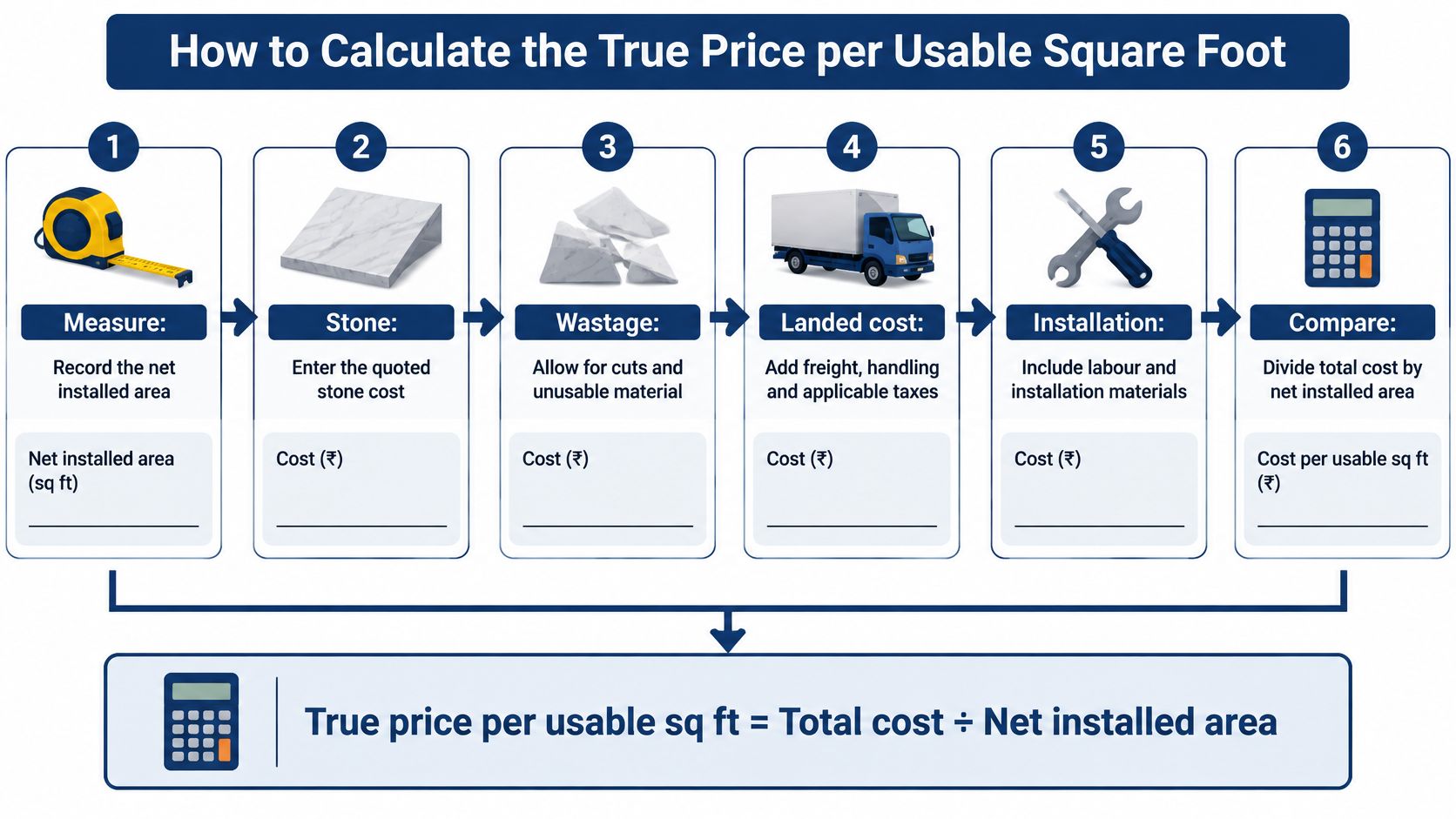
- Measure net installed area. Measure the floors, walls or counters to be covered, not the room footprint.
- Set a waste allowance. Agree on the quantity with your fabricator. Patterned layouts and cuts around corners or fixtures may require more material. Include this in the order quantity.
- Price the selected slab lot. A catalogue category does not specify the slab you will receive. Pores, voids, vein continuity and shade variation affect matching and usable yield.
- Add freight, insurance, customs and GST. Confirm the delivery basis. An ex-yard price and a delivered-to-site price are not comparable.
- Include fabrication. Cutting, edge profiling and surface finishing can carry separate charges.
- Include filling and sealing. Cost any pore filling or repair treatment the selected lot needs before installation.
- Add transport, unloading and installation. Check whether site handling is included. If fabrication or handling is absent from a quote, ask for it in writing before comparing totals.
- Divide the total by net installed area. True price per usable sq. ft. = total cost ÷ net installed area. Use this figure to compare sellers on the same basis.
A Worked Example
For a 500 sq. ft. net area, a 12% cutting allowance means buying about 560 sq. ft. At an example rate of ₹300 per sq. ft., the stone costs ₹1,68,000. Add the actual freight, fabrication, sealing and installation charges, then divide the complete total by 500, not 560. The resulting cost per usable square foot exceeds ₹300 before those additional charges.
For outdoor work, patio pricing from R E and Sons separates material from labour and preparation, a useful format for checking a quote. For interior floors, compare your worksheet with marble floor pricing per square foot.
Why Two Quotes for the Same Stone Differ
The previously cited 2023 import figure, US$226 per tonne, describes a broad import average, not the price of a particular slab at an Indian yard. It cannot show what a buyer will pay for a selected grade, thickness or bundle, or whether delivery is included. The slab quote depends on those details, so the tonne-level figure is context, not a retail benchmark.
At quote level, vein-cut or cross-cut selection, filled or unfilled pores, thickness, bundle yield and breakage risk all affect the area you can use. Ask each seller to specify these terms, along with the delivery basis, then compare the total cost against net installed area.
Maintenance and Lifecycle Cost by Application
A low per-square-foot rate can hide a high upkeep bill. For travertine, the application and installation determine whether that headline price holds up over time.
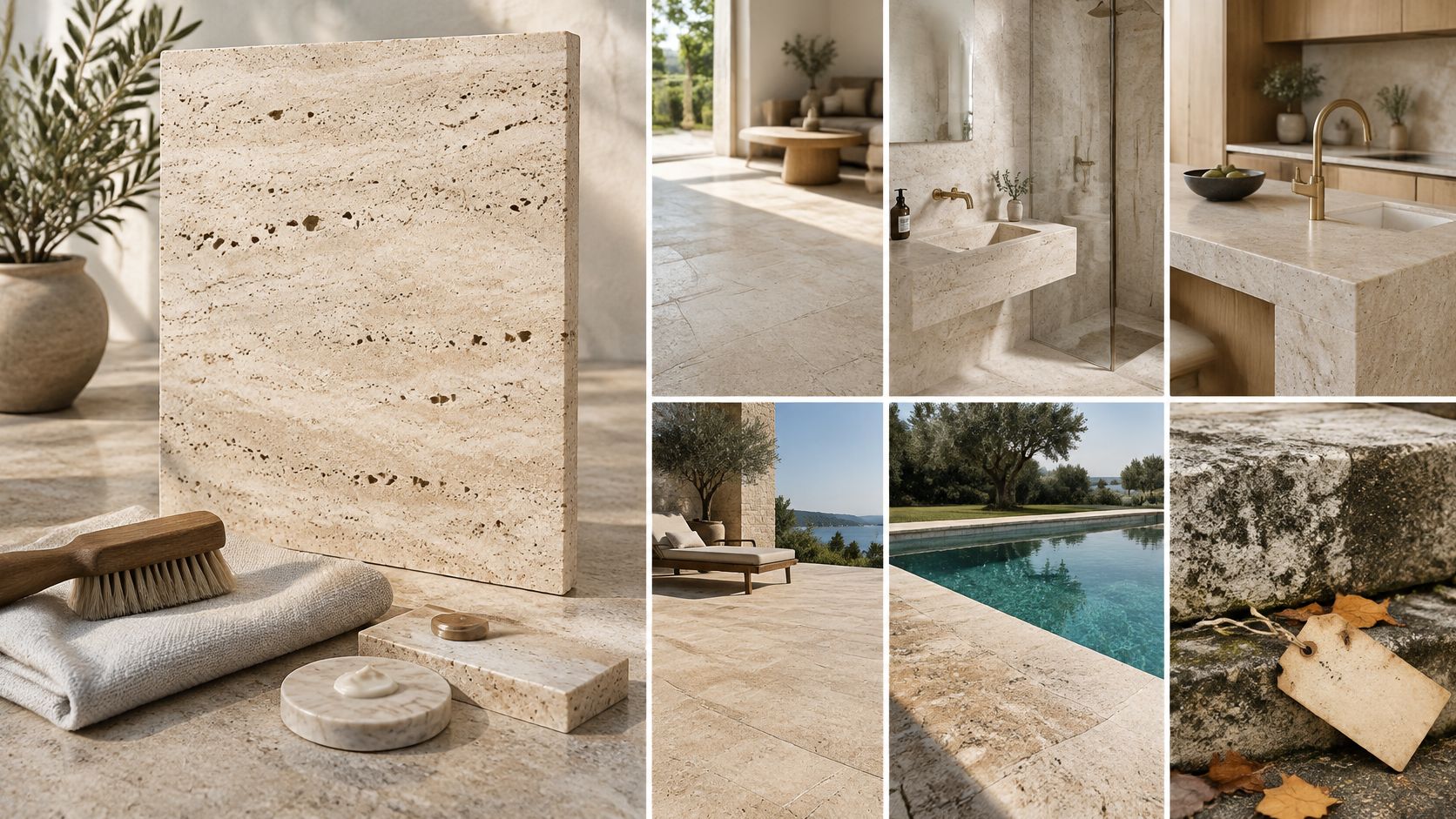
Travertine is porous, so exposure matters. In India, monsoon moisture, humidity, intense UV, heat and wet-dry cycles can increase the risk of moisture absorption, staining and biological growth on unsealed exterior stone. Climate-focused guidance on travertine care in India outlines these conditions. Sealing belongs in the upkeep budget, not just the initial purchase.
Travertine maintenance by application and exposure
| Application | Exposure | Care and sealing | Cost implication |
|---|---|---|---|
| Indoor living room or bedroom floor | Dry, foot traffic | pH-neutral cleaning, periodic sealing | Lower upkeep; include cleaning and resealing in the maintenance allowance |
| Bathroom floor and shower walls | Wet, humid, soap film | Seal at installation, reseal periodically, check slope and drainage | Higher upkeep; include sealing and drainage-related work |
| Kitchen backsplash or counter | Oils, acids, hot pans | Seal, wipe spills promptly | Allow for resealing and prompt cleaning; compare with non-porous quartz |
| Balcony or open terrace | Monsoon rain, UV, heat | Exterior-grade sealer, drainage, expansion joints | Budget for exterior sealing and joint upkeep |
| Façade or pool surround | Wet-dry cycling, UV, growth on unsealed stone | Exterior sealing, substrate preparation, scheduled resealing | Higher lifecycle cost; get separate quotes for sealing and substrate work |
Installation Quality Decides More Than Origin
The slab's origin cannot compensate for poor site work. Substrate preparation, drainage, expansion joints and adhesive choice affect whether stone cracks, lifts or stains. A well-laid ordinary slab can outlast a premium slab installed over a poor substrate without adequate drainage fall.
The video below shows travertine in real installations, including how its surface and joints meet site conditions. Use it to assess whether the finish and detailing suit a wet-area specification.
Resealing costs depend on the sealer type, the area to be treated and the surface preparation required. How often it is needed depends on exposure and use, so an exposed terrace or pool surround may require a different schedule from a dry interior floor. Substrate repairs, drainage corrections and joint work add separate costs. Ask installers to quote these items individually, then compare them with the stone and installation cost rather than treating maintenance as an unspecified future expense.
The Case for Paying More Upfront
A carefully selected slab, proper filling and finishing, sound substrate preparation and suitable sealing can reduce lifecycle costs compared with a cheaper slab installed without those controls. The difference matters most in bathrooms, balconies, façades and pool surrounds, where water can expose weak detailing.
Put maintenance on the worksheet from the start. Request the sealer specification, expected resealing schedule for the application, and separate prices for the work. Routine cleaning and joint care also matter, as reflected in patio care advice for Dublin homeowners. If the required upkeep does not fit the budget or routine, choose another material rather than assuming cheaper travertine will solve the problem.
Where Travertine Is Worth Paying For
Travertine pays off when the look is the reason for the purchase and the exposure is controlled.
Feature walls in living rooms and lobbies justify the price first. The warm, layered pattern carries the design, foot traffic is zero, and water exposure is minimal. You're buying appearance where appearance is the whole job.
Interior living and dining floors work with moderate foot traffic and a sealing routine you'll stick to. Hospitality reception areas and retail fit-outs also make sense, since they get a premium stone look without paying for the most expensive marble. Interior bathrooms justify travertine only when slope, drainage and sealing are detailed properly from the start.
Where does a cheaper route win? A budget-first rental flat is usually better served by vitrified tile, which asks little of tenants. An exposed façade or pool surround with no drainage detailing rarely justifies the cheapest travertine, because you'll pay the difference later in resealing and repair. Anyone budgeting for a custom stone patio faces the same trade-off between material price and the detailing that keeps it sound.
Think of travertine as a wool coat. Beautiful, textured, and it needs care in wet weather. Buy it for the look you want, and budget the care without resentment.
Match the slab grade to how the room will be used, not how it photographs in a showroom.
Request a Written Quote Before You Commit
A verbal rate protects the seller, not you. Request a written quote that states the terms that affect the travertine marble price you'll pay.
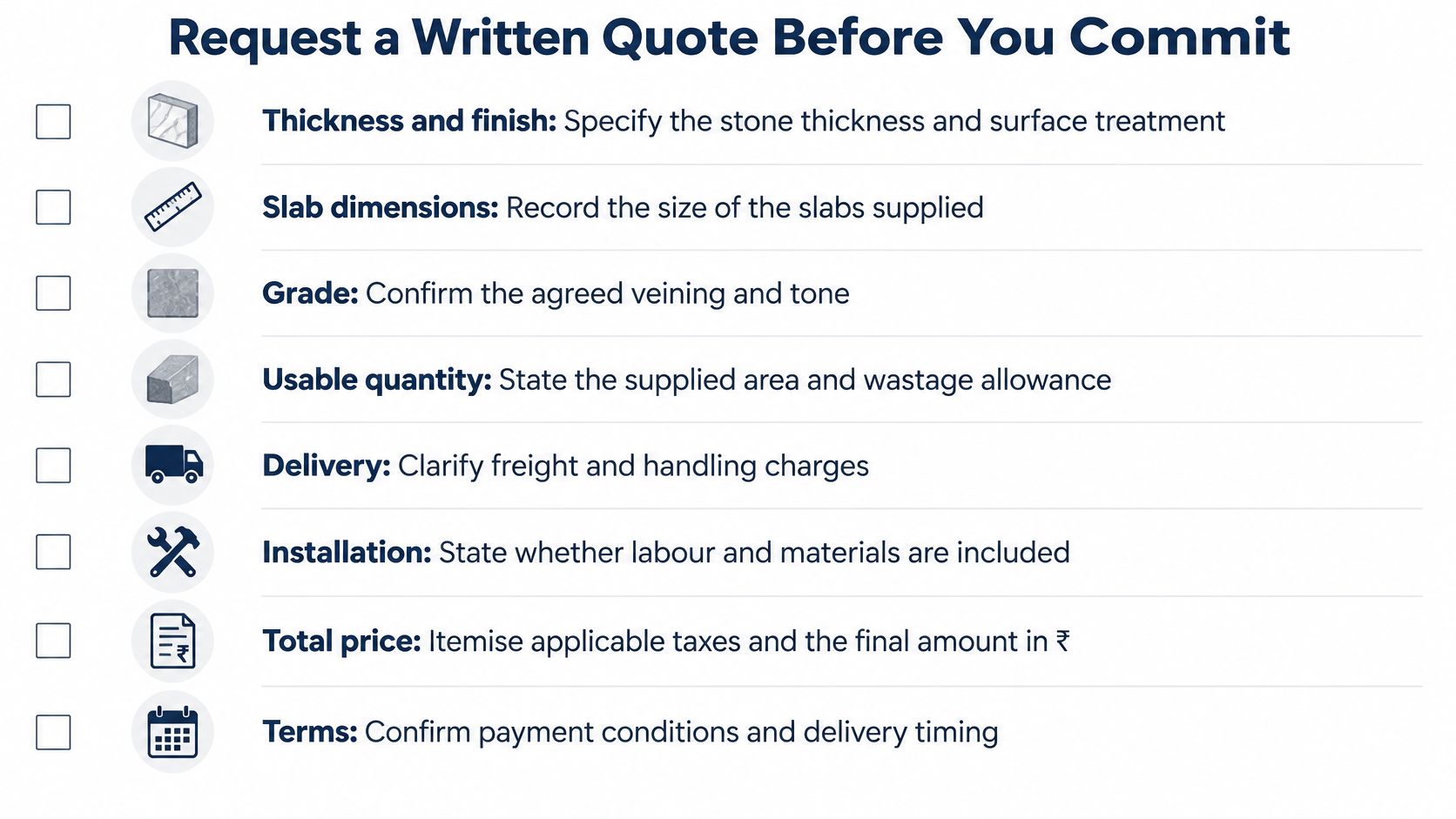
- Thickness and finish: The two specifications that most change both price and performance.
- Slab dimensions: Size decides yield, joints and how much cutting you'll pay for.
- Absorption data where available: Relevant for bathrooms, kitchens and any wet area.
- Origin: The cost exposure behind the rupee figure.
- Batch or lot consistency: Whether your whole area comes from matching slabs.
- Filling or repair treatment: What's been done to the pores, and to what standard.
- Breakage responsibility: Who carries the loss if a slab cracks in transit or handling.
- GST and delivery basis: A missing delivery basis hides freight until the final bill.
- Quantity and delivery location: Both change freight and handling charges.
- Intended application: A bathroom slab and a bedroom slab shouldn't be specified identically.
Each missing item is a cost that surfaces later. A missing breakage clause leaves you carrying cracked slabs. A missing lot statement leaves you with mismatched shade across a floor.
You can judge slabs in person at Varun Marbles, which has Gurugram showrooms at Sikanderpur Marble Market and HUDA Marble Market Sector 33–34 and supports cutting, finishing and installation from yard to site.
Send your application, net area, finish and delivery location with your enquiry. Then run every reply through the landed-cost worksheet and compare cost per usable square foot before you choose a slab.
Bring your room measurements, intended application and preferred finish to Varun Marbles and ask for a written, itemised quote on the specific lot you select, with origin, thickness, delivery basis and breakage terms stated. You'll leave with a cost per usable square foot you can defend, and a slab you've inspected yourself rather than a headline rate you have to take on trust.