
Italian Marble Price Guide 2026: Cost & Selection
Italian marble in India typically costs ₹250 to ₹1,500+ per sq ft for material alone, while premium Statuario, Calacatta and highly selected slabs can exceed that range. The final installed cost is significantly higher once GST, fabrication, wastage, transport and site logistics are added.
You've probably seen two very different quotes for what appears to be the same Italian marble. One supplier may quote a low slab rate, while another gives a much higher project figure that includes delivery, cutting and installation. Both prices can be genuine, but they may describe different stages of the purchase.
For a homeowner in Gurugram, Delhi or the wider NCR region, the useful question isn't just, “What's the Italian marble price per square foot?” It's, “What will each usable square foot cost after the stone reaches my site and becomes a finished surface?” That shift from headline slab price to landed-to-installed cost prevents most budget surprises.
Table of Contents
- Understanding Italian Marble Price Ranges in India
- Key Factors Driving Cost Variability
- The Complete Cost Breakdown from Quarry to Installation
- Smart Budgeting and Sourcing Strategies
- Evaluating Italian Marble vs. Alternative Materials
- Final Thoughts on Achieving Design Value
Understanding Italian Marble Price Ranges in India
A homeowner comparing two Italian marble quotes may see one slab rate and one project total. The first may describe selected material at the supplier's premises. The second may include the costs required to bring that stone to the site and turn it into a finished floor. Both figures can be accurate because they represent different points in the buying process.
The broad material-only range for imported Italian marble is roughly ₹250 to ₹1,500+ per sq ft, with premium Statuario, Calacatta and comparable high-selection grades exceeding it. Use this as an indicative planning range, not a fixed retail tariff. Variety, slab quality, thickness, finish, selection, stock position and project requirements all affect the quotation. For a practical comparison, see a detailed breakdown of marble floor pricing in India and this India-focused Italian marble flooring cost guide.
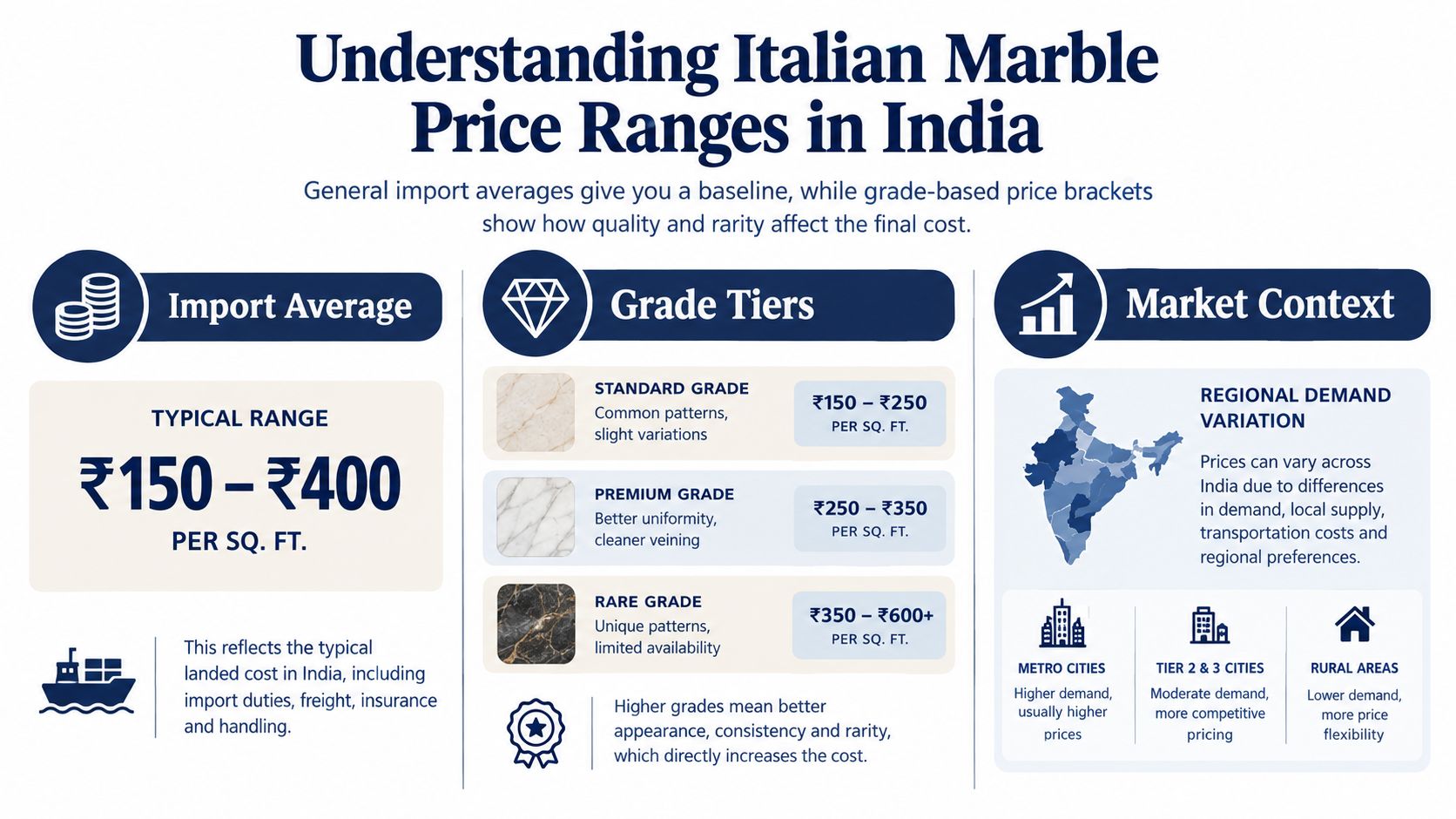
An import benchmark is not the same as the price of a finished retail slab. In 2024, India's average import price for marble and travertine blocks and slabs was approximately US$229 per metric ton, up 1.6% from 2023, according to India marble import market data. That figure combines different blocks, slabs, thicknesses, qualities and origins. It cannot be read as the quotation for a polished, selected, 2-cm Calacatta slab in an NCR showroom.
Italy remains an important high-value source. Italy supplied approximately US$43 million of India's imports in this category in 2024, representing 17% of total import value and placing Italy second among suppliers, according to the same market source. In 2023, Italy contributed about US$57 million to India's imports of marble, travertine and alabaster, or roughly 18% of the total value in that product group, as reported in India's marble building stone market analysis.
Why grade changes the starting point
Standard Carrara selections often provide a more accessible entry into Italian marble. Their background, vein movement and availability vary, but they commonly serve as a reference for light stone with restrained grey movement.
Calacatta and Statuario occupy a higher selection bracket. Whiter backgrounds, dramatic veining, rarity, quarry provenance, book-matching potential and face approval can raise the price substantially. One November 2024 shipment of polished Calacatta slabs, totalling 996.34 square metres and weighing 55,794 kilograms, was valued at approximately US$214,974.69, equivalent to about US$3,086 per metric ton. It shows why a rare, processed and carefully selected slab should not be compared directly with a broad import average.
Practical rule: Use the import average as a customs-value indicator. Treat the supplier's slab quotation as the starting point for a landed-to-installed project calculation.
Regional demand, currency movement, freight conditions and stock availability also affect the visible price. Ask for the actual slab, its thickness, selection details and the costs beyond the stone itself before approving a quote.
Key Factors Driving Cost Variability
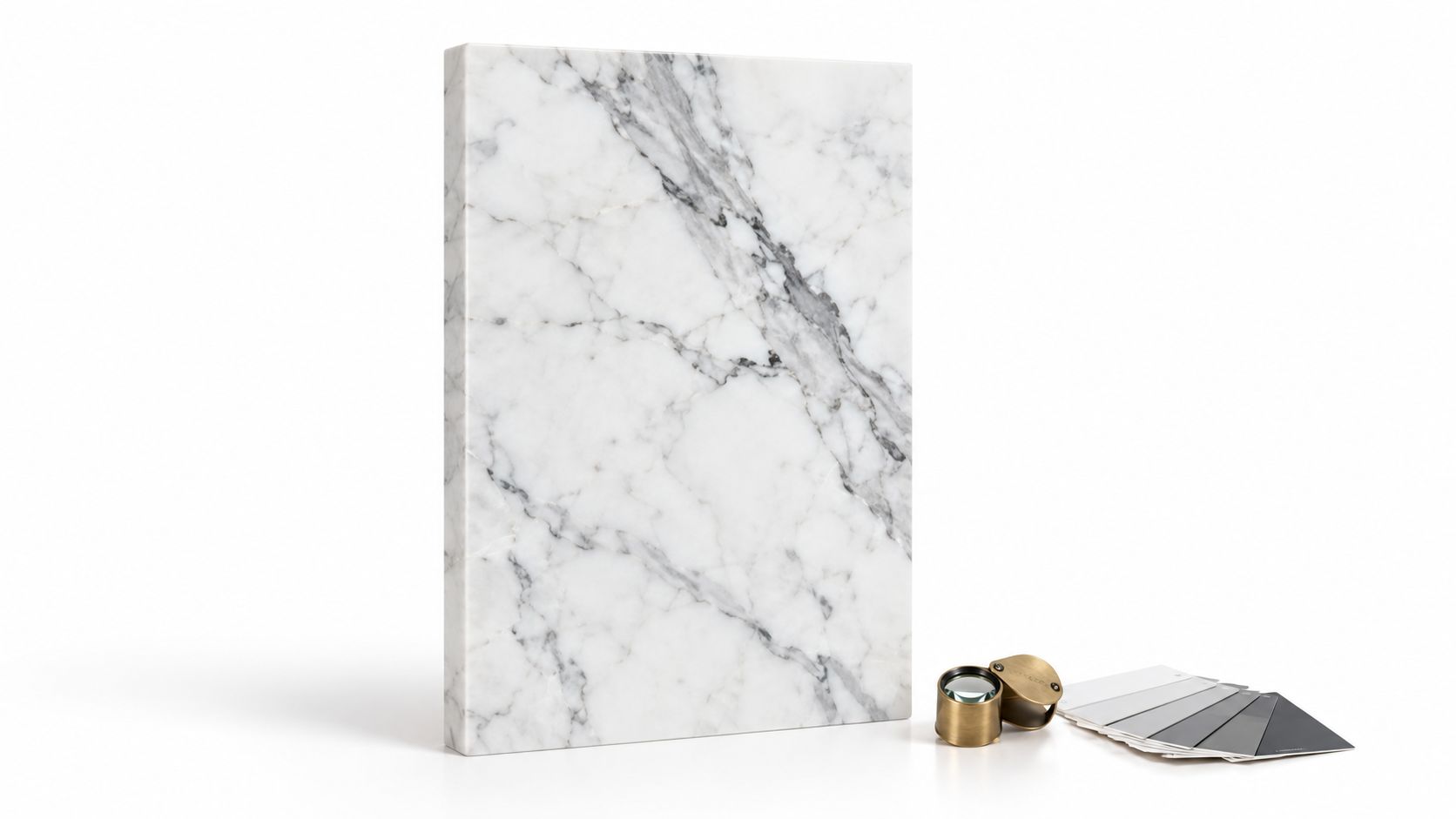
Two slabs carrying the same commercial name can have noticeably different values. Natural stone is judged by more than colour. Buyers and designers also assess the background tone, vein direction, fissures, repairs, translucency, usable area and how well the slab suits the intended design.
Start with origin and selection quality
Quarry origin affects the visual character and commercial positioning of a stone, but origin alone doesn't guarantee a particular price. A relatively common grade from a recognised region may cost less than a rare lot with a cleaner background and more expressive movement.
Selection quality matters because the visible face determines the design result. For a large floor, a consistent background may be more valuable than dramatic veins. For a feature wall, the opposite may be true. A designer may deliberately pay more for movement that creates a focal point, while a homeowner covering a broad area may prefer quieter slabs that produce a more coherent layout.
Varun Marbles hand-inspects every slab for vein, tone and translucency, accepting fewer than one in ten slabs into its gallery, according to the company's published information. That type of curation can reduce the chance that the selected material looks materially different from the approved face, although the buyer should still approve the actual slabs and layout.
Thickness, finish and fabrication potential
Thickness changes both material value and handling requirements. It can also influence the fabrication method, edge details, reinforcement and installation planning. Confirm whether the quoted rate refers to the actual thickness you need, rather than assuming that two visually similar slabs have identical specifications.
Surface finish changes the appearance and practical behaviour of the stone. A polished finish highlights colour and veining, while honed or matte finishes create a softer visual effect. The finish may also change the fabrication and maintenance discussion, particularly for floors, kitchens and high-contact surfaces.
Strong veining affects yield. A slab may technically contain enough area for a project, but the design may require the fabricator to discard sections that interrupt the pattern, contain unwanted flaws or cannot be aligned with adjacent pieces.
Before accepting a rate, confirm:
- Commercial variety: Record the stated variety, origin and selection grade.
- Physical specification: Check slab dimensions, thickness, finish and usable area.
- Design intent: Decide whether the layout needs vein matching, book-matching or directional placement.
- Fabrication detail: List cut-outs, edge profiles, mitred joints, grooves, reinforcement and polishing.
- Approval process: Ask to view full slab faces and approve the proposed layout before cutting.
The lowest nominal rate can become expensive if the slab creates excessive offcuts or demands complex matching. The right comparison is therefore not only price per purchased square foot, but price per usable square foot after the design has been laid out.
The Complete Cost Breakdown from Quarry to Installation
A Gurugram homeowner may receive an attractive Italian marble slab rate, then discover that the installed floor costs much more. The difference comes from the journey between quarry and finished surface. Freight, insurance, customs, domestic delivery, fabrication, labour, taxes and site handling can all sit outside the headline figure.
The landed-to-installed framework makes the quotation easier to read. Treat the slab rate as the starting point, not the project total. The cost usually moves through these stages:
- Quarry or block value: This is the value of the stone before cutting, selection and later logistics. It does not represent the price of the usable, installed surface.
- Landed slab cost: Overseas freight, insurance, customs-related charges, port handling and importer costs bring the material into the Indian supply chain.
- Selection and wastage: The buyer pays for the purchased slab or lot, while the design uses only the sections that fit the required layout.
- Fabrication: Cutting, edge profiling, sink or hob cut-outs, reinforcement, polishing and book-matching add workshop time and material handling.
- Installation: The site team prepares the laying bed, carries the stone, sets each piece, aligns joints and completes the specified finishing.
- Project extras: Unloading, stairs, crane or manual handling, skirting and other site-specific work may be excluded from the basic rate.
| Cost Component | Description | Estimated Impact |
|---|---|---|
| Material or slab | Selected Italian marble, quoted by area, slab or lot | The visible starting price, not the completed project cost |
| GST | Tax applied to the material value | An indicative 18% GST may be added to the material value, according to Indian landed-cost guidance |
| Freight and import handling | Overseas freight, insurance, customs, port charges and importer costs | Converts the international stone value into landed inventory |
| Domestic transport | Delivery from the yard or showroom to the project | Depends on distance, vehicle access and handling |
| Wastage and layout | Cut-outs, defects, directional placement and pattern matching | Increases when the design requires continuous veining |
| Fabrication | Cutting, edges, cut-outs, reinforcement and finishing | Rises with precision, detail and the number of pieces |
| Laying and labour | Bedding, carrying, setting and alignment | The cited guidance indicates approximately ₹40–₹90 per sq ft for laying bed and labour |
| Grinding and polishing | Diamond grinding and mirror polishing after installation | Approximately ₹30–₹80 per sq ft where specialist finishing is required |
| Access and unloading | Crane work, manual carrying, stairs and upper-floor movement | Varies by site and can remain substantial even when the stone rate is unchanged |
The labour figures and wider cost structure are indicative. As noted earlier in the price ranges section, the actual quotation depends on the material specification, site conditions and included services. A supplier may show some items separately, while another may combine them into a higher-looking rate.
That difference makes like-for-like comparison important. Ask each supplier to price the same drawings, finish, thickness, layout and access conditions. Use this guide on comparing price quotes step by step to place competing quotations into matching categories.
The most reliable comparison is completed installed cost per usable square foot, not the supplier's nominal slab rate.
For an NCR project, the quotation should state whether it includes transport from the yard, unloading, wastage, book-matching, edge work, skirting, laying, polishing and GST. Mark every missing item as an allowance. Otherwise, an apparently cheaper offer may be leaving part of the landed-to-installed cost for later.
Smart Budgeting and Sourcing Strategies
Start with the finished design, not the showroom rate. Measure the areas that will be covered, identify visible edges and transitions, and decide where the veins must align. A floor, vanity, staircase and feature wall may all use the same stone, but their fabrication and wastage assumptions won't be identical.
Then request an itemised quotation with separate lines for the following:
- Stone: Variety, origin, thickness, finish, slab or lot identification and material rate.
- Tax: GST shown separately from the base material.
- Logistics: Delivery point, transport, unloading, carrying and difficult access.
- Wastage: Purchased area, expected usable area and the assumptions behind the allowance.
- Fabrication: Cut-to-size work, edges, cut-outs, reinforcement, polishing and book-matching.
- Installation: Laying bed, labour, joints, site protection, grinding and final polishing.
- Exclusions: Skirting, removal, plumbing adjustments, structural work and any other site extras.
Inspect the actual stone
Digital photographs help with initial screening, but they can't fully communicate scale, translucency, surface reflection or the relationship between a vein and the finished room. Visit a showroom or yard with the floor plan, elevations and joinery drawings. Ask the supplier to place the slabs in a proposed sequence where continuity matters.
The supplier should also explain whether the quotation covers a full slab, a selected bundle or only an area-based allocation. Those are different commercial arrangements. Keep photographs of the approved slab faces with the quotation so the material specification remains clear during fabrication.
Varun Marbles provides integrated support for cutting, finishing and installation through its Gurugram showrooms, and its published selection process includes hand inspection for vein, tone and translucency. Its Italian marble collection gives buyers a starting point for reviewing available material, but the final decision should still be based on the actual slab and project layout.
A disciplined approval process is especially important for premium grades. If one slab contains the exact movement you want, confirm whether adjacent areas require matching slabs and whether the supplier has enough compatible material. Paying for a dramatic face without planning the cuts can create expensive offcuts or an inconsistent installation.
Use this video as a visual reference while assessing how marble selection, fabrication and installation connect:
Finally, compare suppliers on completed scope and accountability. A coordinated supplier can simplify communication between slab selection, cutting, polishing and site installation. That doesn't automatically make the quote cheaper, but it can make the cost easier to verify and the responsibility for errors clearer.
Evaluating Italian Marble vs. Alternative Materials
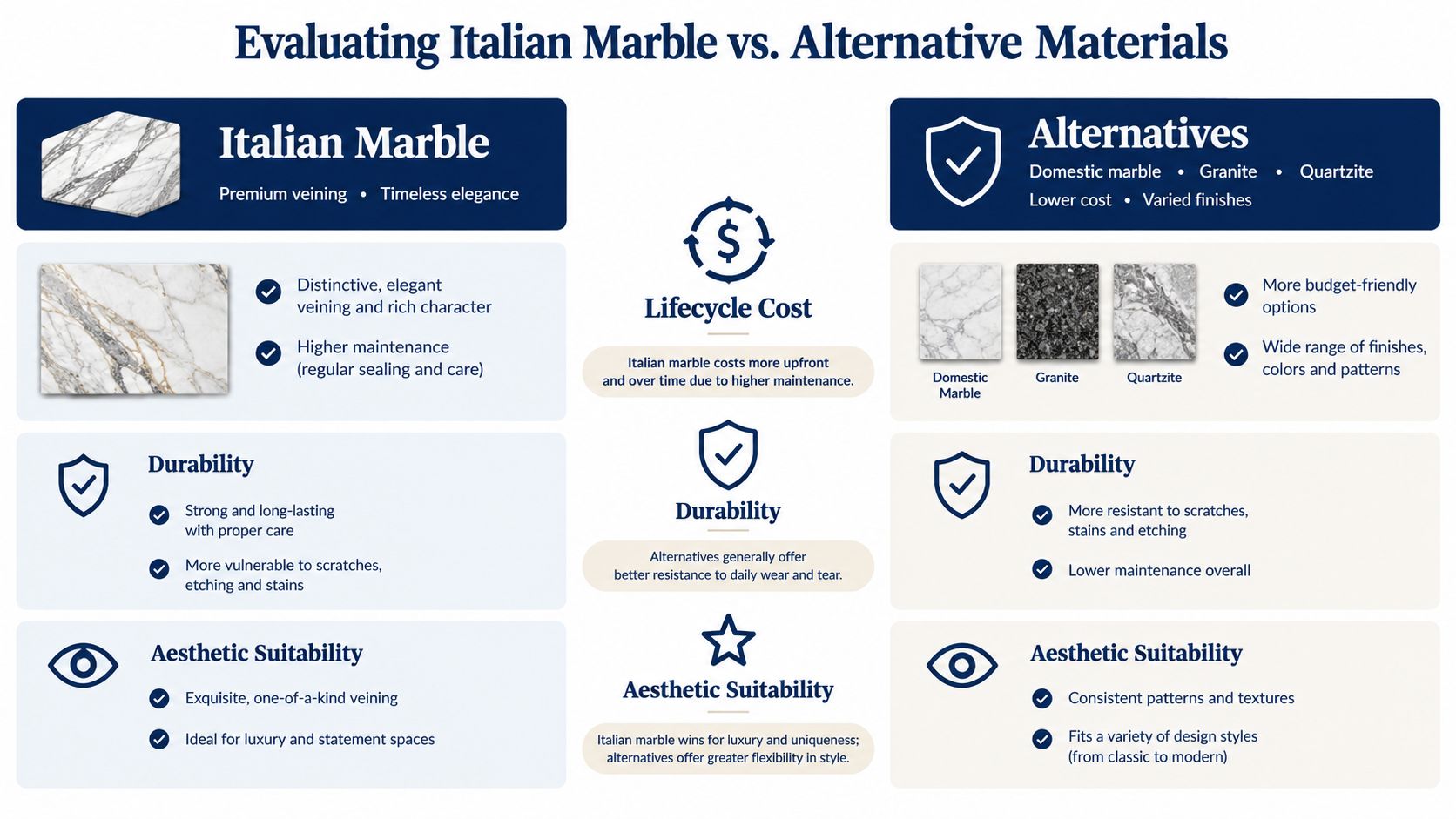
Italian marble earns its premium when the natural pattern, translucency and quarry character are central to the design. It isn't automatically the most economical surface for every room. A large, heavily used floor, busy kitchen or commercial circulation area may justify a different material after maintenance, repair and replacement are considered.
India's construction ornamental-stone market was estimated at US$5.20 billion in 2025 and is projected to reach US$7.62 billion by 2031, with flooring representing 60.4% of 2025 market value and residential projects representing 64.1%, according to market research on India's ornamental-stone sector. Those figures reinforce a practical point: material suitability matters across large floor areas, not just appearance at the showroom.
Match the surface to the application
Italian marble can be a strong design choice for a feature wall, entrance, lobby, vanity or low-traffic luxury area where a distinctive natural face carries real design value. The material may have greater impact when used selectively rather than spread across every surface.
Indian marble can provide a more accessible route to a natural stone floor, while granite, quartzite and engineered quartz may offer different balances of consistency, maintenance and performance. Quartz, for example, is manufactured and can provide a more controlled visual result, while natural alternatives preserve the variation that some designers actively want.
For each material, assess:
- Appearance: Does the colour and pattern support the room's design?
- Maintenance: Can the owner accept sealing, care and possible etching or staining?
- Repairability: How visible will a repair be, and can a matching replacement be sourced?
- Usage: Will the surface face moisture, food acids, heavy traffic or repeated abrasion?
- Wastage: Does the selected pattern require costly matching or large offcuts?
- Lifecycle value: What will ownership involve over the intended service period?
The relevant comparison is not just Italian marble versus a cheaper material at purchase. It's natural visual value versus long-term practical cost. A rare marble may be financially sensible on a small focal surface, while a consistent and lower-maintenance alternative may be more suitable across a large kitchen or high-use commercial floor.
For a design-led project where the Italian appearance matters but the budget is constrained, compare the actual stone with alternatives that reproduce a similar visual direction. This guide to Indian marble with an Italian look can support that early comparison, although the material properties and natural variation still need separate evaluation.
Final Thoughts on Achieving Design Value
A homeowner may begin with a sample labelled Calacatta, receive a rate per square foot and assume the budget is nearly complete. The more reliable journey starts differently. The buyer approves the actual slab faces, checks the layout against the drawings, confirms the purchased and usable areas, and asks the supplier to separate material, GST, logistics, fabrication and installation.
The designer then decides where the stone deserves visual priority. A dramatic slab may be reserved for a wall or vanity, while a more consistent material is selected for a larger floor. That decision can protect the design language without forcing every square foot to carry the highest possible material cost.
The final approval should record:
- The stone identity: Variety, origin, thickness, finish and selected slab faces.
- The cost scope: Material, GST, delivery, unloading, wastage, fabrication and installation.
- The design assumptions: Vein direction, book-matching, edges, joints and cut-outs.
- The ownership expectation: Cleaning, sealing, maintenance and future replacement considerations.
Italian marble price becomes easier to understand once you stop treating it as one number. The strongest design value comes from matching the selected stone to the application, controlling the landed-to-installed cost and approving the work before cutting begins.
Visit Varun Marbles to inspect curated Italian and Indian marble selections in Gurugram and discuss cutting, finishing and installation requirements. Take your drawings and ask for an itemised quotation that shows the true usable-square-foot cost of your project.