
Marble Floor Price Per Square Foot: 2026 Guide
Domestic marble flooring in India typically lands between ₹250 and ₹700 per sq ft installed, while premium Italian marble can range from ₹1,000 to ₹2,500 or more per sq ft. The figure on a slab quote is only the starting point, because cutting, polishing, wastage, delivery, sealing, and labour can change the final budget substantially.
You may be standing in a showroom with two quotes in hand. One supplier has shown an attractive material rate, while another has quoted a figure that seems far higher for what appears to be the same floor. The difference usually becomes clear only when you compare the complete scope of work rather than the stone price alone.
A marble floor is a finished installation, not a stack of slabs. The right way to assess the marble floor price per square foot is to ask what the quoted rate includes, how much stone the layout will consume, and whether fabrication and site finishing are built into the number.
Table of Contents
- Why Marble Flooring Costs Vary So Much
- Breaking Down the Actual Cost Per Square Foot
- Comparing Domestic and Imported Marble Options
- Understanding Fabrication and Finishing Needs
- Real-World Budgeting Examples for Your Home
- Smart Strategies to Optimise Your Flooring Budget
- Finalising Your Marble Flooring Investment Plan
Why Marble Flooring Costs Vary So Much
A homeowner often starts with a slab price because it is the easiest figure to compare. A vendor may show an Indian marble at a low material rate, and the quote initially looks comfortably within budget. Later, the contractor adds cutting, laying, grinding, polishing, skirting, sealing, transport, wastage, and tax. The final invoice no longer resembles the showroom number.
That isn't necessarily a sign that the contractor has inflated the price. The slab still has to become a floor. A large piece may need to be cut around columns, doorways, drains, stair edges, or awkward corners. The installer must also prepare the base, align the pieces, manage joints, and correct level differences before the surface receives its final polish.

The difference between material and finished flooring
A 2026 India-focused pricing guide places basic Indian marble at about ₹35 to ₹150 per sq ft, with installed Indian marble flooring commonly ranging from ₹35 to ₹250 per sq ft before labour, while Italian marble is listed at roughly ₹200 to ₹6,000 per sq ft before labour, depending on the material. Installation can add a further ₹100 to ₹200 per sq ft. These figures illustrate why a slab-only quote cannot serve as a reliable project budget. The India marble flooring cost guide also explains that cutting, polishing, wastage, and labour can make the completed rate several times higher than the raw stone price.
The range is wide because “marble” describes a broad family of stones rather than one uniform product. Origin, grade, colour, vein movement, thickness, surface finish, and availability all affect the material rate. A calm, consistent domestic stone and a heavily veined imported slab serve different design objectives and carry different handling requirements.
What a low quote may leave out
Ask whether the following items are included before comparing offers:
- Fabrication: Cutting, edge treatment, shaping, and preparation for the planned layout.
- Site installation: Labour for bedding, levelling, joint alignment, and laying.
- Surface finishing: Grinding, polishing, honing, or other treatment carried out after installation.
- Wastage: Extra material needed because the room layout cannot use every part of every slab.
- Ancillary work: Skirting, thresholds, repairs to the base, sealing, delivery, and applicable taxes.
Practical rule: Compare two complete scopes of work, not two material rates. A higher slab price can still produce the more predictable project if the quote clearly includes fabrication and finishing.
The most dependable budget therefore begins with the finished square footage and a written list of inclusions. If a supplier gives only a stone rate, treat it as a product price. If the quote includes preparation, execution, and handover, you're looking at a flooring rate.
Breaking Down the Actual Cost Per Square Foot
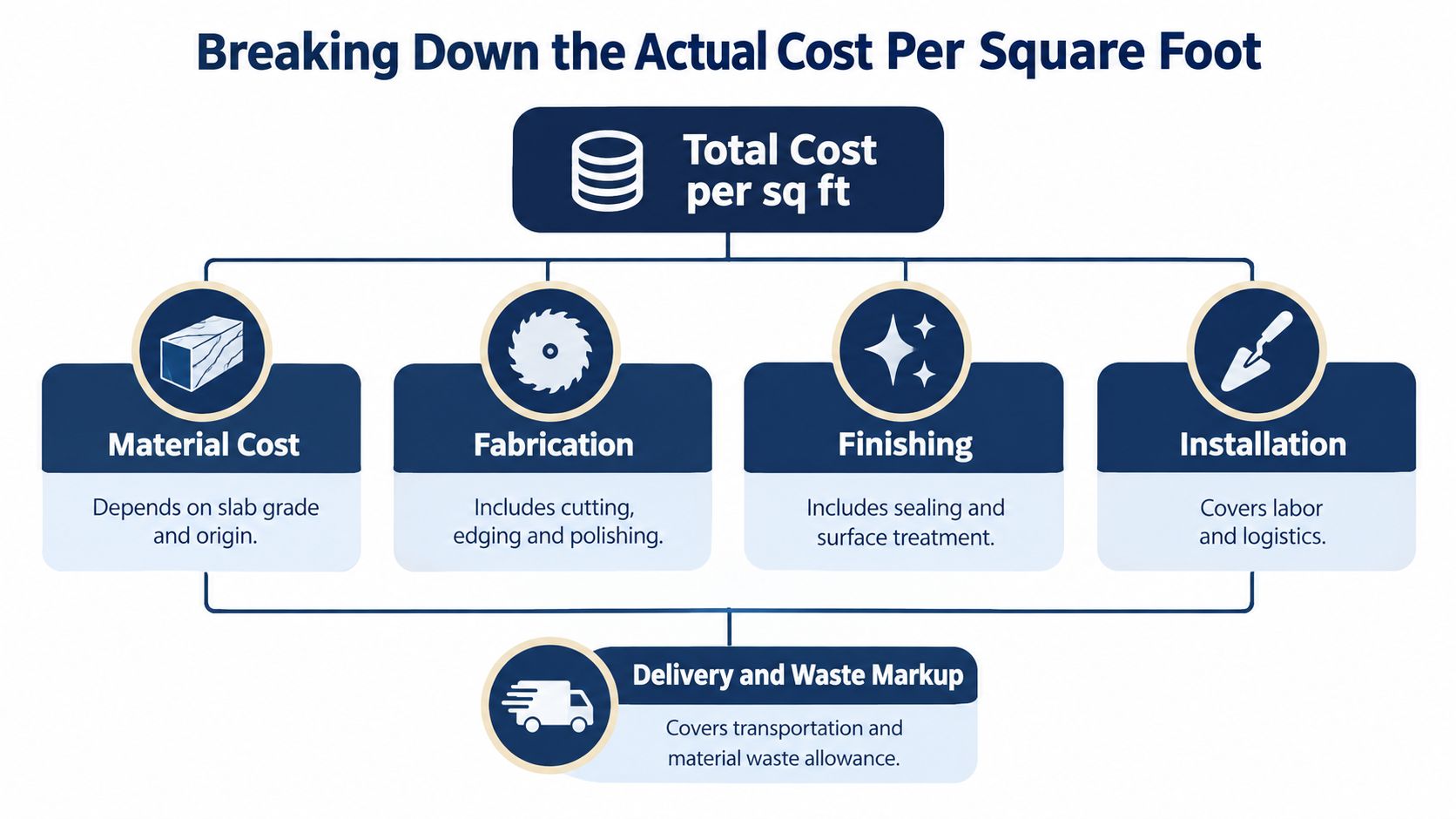
The installed rate becomes easier to understand when the quote is separated into working parts. Each part answers a different question. The material line tells you what stone you're buying. Fabrication shows how the slabs will be prepared. Finishing describes the surface treatment, while installation covers the work required to turn prepared pieces into a usable floor.
Material cost
The stone itself is influenced by origin, grade, visual consistency, and the amount of selection involved. Domestic marble may offer a broader range of accessible options, while imported stone can command a premium because of quarry origin, selection, transport, and distinctive appearance.
Material selection also affects how much of a slab can be used efficiently. A quiet stone may allow a straightforward layout, whereas a heavily veined material may need careful matching to preserve continuity. A supplier who helps reserve slabs for a planned sequence is solving a practical design problem, not merely selling surface area.
Fabrication and preparation
Fabrication includes the physical work required before the marble is laid. It can involve cutting pieces to room dimensions, creating openings, preparing thresholds, producing skirting, and shaping edges where the floor meets another material.
Complex layouts generate more cutting and more handling. A straight installation with sensible slab planning is easier to execute than a design with multiple borders, diagonals, medallions, or small pieces. The quote should state whether the fabricator is working from an approved cutting plan and whether additional site changes will be charged separately.
For readers comparing natural stone with engineered surfaces, a related reference on quartz slab pricing in India can help clarify why material selection and fabrication scope should be assessed together.
Finishing and installation
Installation is more than placing marble on a prepared floor. The team has to check the substrate, establish levels, position pieces in the intended sequence, maintain alignment, and protect the surface while adjacent work continues. After laying, the floor may require grinding or polishing to create a consistent finish across joints and individual pieces.
The installation line can also include logistics that homeowners overlook. Marble is heavy, vulnerable at corners, and difficult to move through a finished property without careful protection. Delivery access, floor-to-floor movement, temporary storage, and coordination with carpenters or painters can all affect execution.
A quote that separates labour from logistics is easier to audit. A quote that combines everything into one unexplained figure may still be valid, but you'll have less control if the scope changes.
Delivery and wastage
Wastage is not automatically avoidable waste. Some offcuts cannot fit another part of the design, and some pieces must be rejected because their pattern does not work in the approved layout. A good fabricator reduces this loss through nesting, orientation planning, and early approval of the vein direction.
It helps to request a slab layout before production. That drawing can show which pieces come from each slab and where the remaining offcuts might be used. Small leftover sections may work for skirting or thresholds, but you shouldn't assume every offcut has useful value.
For a broader explanation of non-material project expenses, the soft construction costs guide is useful because it places planning, coordination, and related project overheads in context. These costs aren't the marble itself, but they can influence the amount you ultimately spend to complete the room.
Comparing Domestic and Imported Marble Options
Domestic and imported marble should be compared by design intent as well as price. Indian marble can provide strong visual character and practical value for a full floor, particularly when the priority is to cover a larger area without making the stone the entire project budget. Italian marble is often selected when the veining, background colour, or exclusivity of the material is central to the design.
The lower-cost choice isn't automatically the sensible choice, and the premium choice isn't automatically wasteful. The correct selection depends on whether the room needs a quiet continuous surface, a dramatic focal point, or a material that coordinates with counters, walls, stairs, and furniture.
Domestic marble and practical value
Indian marble offers considerable variety in tone and pattern. It can suit entrance halls, living areas, staircases, bathrooms, and commercial interiors, provided the selected finish and maintenance expectations match the use of the room.
A domestic stone can also simplify sourcing and replacement. If a future repair requires a matching piece, local availability may make the search more manageable than finding an imported selection from a particular block or shipment. That doesn't guarantee an exact match, because natural stone varies, but it can improve practical access to comparable material.
The better question isn't just, “Which marble is cheaper?” Ask whether the stone's appearance will remain appropriate across the full area, whether the supplier can show enough slabs for selection, and whether the proposed finish suits the room's traffic and moisture conditions.
Italian marble and design impact
Imported Italian marble is commonly chosen for its refined background, distinctive movement, and premium visual effect. It can work particularly well where the floor is intended to act as a major architectural element. The cost rises when the project demands careful slab selection, bookmatching, continuity of veins, custom fabrication, or a high level of finish control.
That premium can make sense in a feature area, but using an expensive stone everywhere may not produce the best allocation of money. A designer might reserve the imported material for a foyer, formal living area, staircase, or selected wall and use a coordinated domestic marble elsewhere.
A useful design reference on achieving an Italian-inspired appearance with Indian material is this guide to Indian marble that looks like Italian marble. It reinforces an important selection principle: colour family, vein pattern, slab arrangement, and finish can influence the final impression as much as the country of origin.
Choosing between the two
Use domestic marble when the project needs broad coverage, controlled spending, accessible sourcing, or a more flexible replacement path. Choose imported marble when the specific stone character is central to the design and the budget allows for more demanding selection and execution.
Request physical slab viewing whenever possible. Small samples can hide variation in background tone and veining, while a complete slab shows how the material will read across a room. Also ask the installer to confirm whether the proposed layout is realistic before you approve a stone based only on a photograph.
Understanding Fabrication and Finishing Needs
Raw marble doesn't arrive looking like the smooth, continuous floor shown in a finished interior. The quality of the result depends on how the fabricator and installer handle the stone from slab selection through final polishing.

Start with selection and cutting
The first step is to inspect the slabs for colour, veins, fissures, edge condition, and visible variation. The fabricator then prepares a cutting plan that reflects the room dimensions and the desired direction of the pattern.
This plan matters because every cut affects both appearance and material consumption. Doorways, columns, floor outlets, steps, and changes in flooring need to be marked before production. Cutting first and solving the layout later can create unnecessary joints, awkward fragments, or a pattern that looks unbalanced.
Prepare the edges and joints
Edges may need profiling where marble meets a threshold, stair, skirting, or another finish. The fabricator can also prepare pieces for borders or special transitions. Even when the floor uses a simple field layout, the edges at walls and openings need accurate measurement.
The installer then checks the base and establishes a consistent level. A polished stone surface can make uneven joints particularly noticeable, so levelling and alignment shouldn't be treated as minor details. The closer the pieces are set to the intended plane, the more uniform the final surface will appear after finishing.
This guide to honed and polished marble is useful when deciding whether the surface should prioritise reflection or a softer, less glossy appearance.
Finish the installed surface
After installation, grinding can help address small level differences between adjoining pieces. Polishing then develops the desired sheen, while honing creates a more muted surface. Sealing may be specified according to the stone, finish, and location, but the contractor should explain what product is being used and how the surface should be maintained.
The finish also affects how the floor behaves visually and practically. A glossy surface reflects more light and highlights the stone's movement, while a honed surface can give a quieter appearance and may be more appropriate where glare or a softer feel is preferred. The right choice depends on the room, not just the showroom sample.
The following video provides visual context for the type of workshop process involved in marble surface preparation:
Ask for a sample showing the proposed finish before the full floor is processed. A small approved sample gives the homeowner and installer a shared reference for colour, sheen, joint treatment, and final expectations.
Real-World Budgeting Examples for Your Home
A practical budget starts with the room's measurable floor area, then adds the scope that turns material into a finished surface. Don't multiply a showroom slab rate by the room area and assume the answer is your renovation cost. That calculation ignores the work that happens after purchase.
For a domestic marble room, begin with the material selection and then ask for a separate installed rate. The supplier should identify whether that figure includes cutting, laying, grinding, polishing, sealing, skirting, delivery, wastage, and GST. If any item is excluded, write it into the working budget before approving the stone.
Example one with a controlled domestic selection
Suppose a homeowner is renovating a living area and chooses a readily available Indian marble with a straightforward layout. The planning priority is a consistent field, limited special cutting, and a finish that suits everyday use.
The budget should be organised under these headings:
- Stone selection: The agreed domestic marble and the quantity required for the approved layout.
- Fabrication: Cutting, edge preparation, skirting, and thresholds.
- Site work: Laying, alignment, surface correction, and final polishing.
- Completion items: Sealing, delivery, protection, wastage, and taxes where applicable.
Historical India consumer guidance cited by Livspace places Indian marble at around ₹250 per sq ft including inlay, labour, cutting, and polishing, while imported Italian marble can reach roughly ₹650 to ₹1,000 per sq ft installed. These figures are useful as market context, but the actual quote still depends on the selected stone and the exact scope. Livspace's marble flooring cost guidance also shows why a homeowner should ask whether a quoted rate includes execution rather than treating it as a slab price.
Example two with a premium imported selection
For a formal living room or entrance, a homeowner may select imported marble because the slab pattern is the main design feature. The budget then needs to allow for more deliberate slab selection, pattern orientation, careful handling, and a finish that displays the material without distracting joints.
The room may still be manageable if the imported stone is limited to a feature zone. A coordinated domestic marble can serve adjoining spaces, while the premium selection remains concentrated where visitors see it most. This approach protects the visual intention without forcing the highest material cost across every room.
A quote-checking worksheet
Before committing, ask the contractor to provide:
- The material name, origin, grade, finish, and approved slab references.
- The net floor area and the quantity allowed for the planned layout.
- A fabrication description, including special cuts and edge work.
- The installation and polishing scope.
- A list of exclusions, such as base repairs, skirting, delivery, or taxes.
- The process for approving additional work before it starts.
This structure lets you compare suppliers on the same basis. It also gives you a record to use if the layout changes or the site reveals a preparation issue.
Smart Strategies to Optimise Your Flooring Budget
Cost control works best before the slabs are cut. Once the material has been ordered and fabrication has started, design changes can create avoidable offcuts, delays, and rework. A good budget strategy protects the visible result while removing waste from the process rather than asking the installer to reduce labour.

Choose the stone for the room
A premium grade isn't necessary for every application. Select a material whose colour variation, finish, and performance suit the room, then reserve highly distinctive slabs for areas where their visual impact justifies the additional outlay.
Approve the layout early
Ask the fabricator to show how the slabs will be divided before cutting begins. Fewer unnecessary cuts and better nesting can reduce unusable offcuts. A layout plan also helps you spot an awkward joint or an unwanted change in vein direction while there's still time to adjust it.
Negotiate the complete scope
A supplier may have more flexibility when the discussion covers material, fabrication, and installation together. Don't focus only on obtaining a lower slab rate. Ask whether the team can offer a clearer package, reduce duplicated transport, or use suitable offcuts for skirting and thresholds.
Schedule with coordination in mind
An installer who arrives before the base is ready may need to return, while a finished floor exposed to ongoing construction can require extra protection and cleaning. Coordinate the stone work with plastering, painting, cabinetry, and electrical finishing so the installation team can complete the surface efficiently.
Spend on preparation and maintenance
Poor levelling or rushed polishing can undermine an expensive stone. Put the budget towards accurate cutting, skilled installation, proper surface finishing, and a clear care routine. Saving on preparation often creates visible defects that cost more to correct than the original saving.
A written quote should show these choices clearly. If one contractor offers a cheaper total, check whether the difference comes from a more efficient layout or from missing work.
Finalising Your Marble Flooring Investment Plan
A reliable marble flooring plan has three layers. First, choose the stone according to the room, design, and available budget. Next, confirm the fabrication and installation scope, including the work required to turn slabs into a level, finished surface. Finally, protect the budget with an approved layout, written exclusions, and a process for authorising changes.
The most useful question for any supplier is simple: “What exactly is included in your installed rate?” Ask for the answer in writing, then compare it with other quotes line by line. This approach makes the marble floor price per square foot meaningful because it reflects a completed floor rather than an isolated material figure.
Don't approve a stone before viewing the slab or an accurate selection reference. Don't assume that every offcut has value, that polishing is included, or that site preparation is automatically part of laying. A clear quote and an agreed finish sample will prevent many disputes before work begins.
Varun Marbles supplies Indian and Italian marble along with other natural stones, and supports projects with slab selection, cut-to-size fabrication, edge profiling, finishing, and installation coordination. Visit Varun Marbles to review suitable stone options and request a flooring quote based on your material choice and complete installation scope.