
Titanium Black Granite: Looks, Specs and Care

The most common advice you'll hear about Titanium Black Granite is also the most misleading. You're told it's dark, dense and practically maintenance-free, so you can pick it from a catalogue photograph, install it and forget about it. That advice treats the name as if it were a grade.
It isn't. Titanium Black is a commercial colour label, not a promise that every slab sold under that name will absorb water at the same rate, carry the same load or show the same pattern. Two slabs can share the label and still behave differently in your kitchen, on your stairs or at a seam beside a sink.
That doesn't make the stone a risky choice. It makes the order of decisions important. Don't start with the name and work backwards. Start with the specific lot, check its test values, look at the actual slabs, then decide on finish, fabrication and sealing by zone.
If that sounds like extra work, it's mostly a short paper trail and a few minutes of looking properly. You'll ask for a batch certificate, approve a control sample, mark slab direction before cutting, and test water on the installed surface instead of following a blanket resealing calendar. Those steps replace guesswork with evidence, and they're what separate a dark granite that performs well for years from one that surprises you after installation.
Table of Contents
- Titanium Black Granite at a Glance
- What the Name Covers and How to Confirm the Lot
- Finishes and What Each One Does to the Look
- Where It Works and What Fabrication Demands
- Care and Sealing by Zone in the Kitchen
- Placing the Order Against the Approved Lot
Titanium Black Granite at a Glance
Start with the benchmarks, because they turn a sales conversation into a pass or fail decision. The table below puts the official minimums beside the wider ranges you'll see in trade listings, so you can see why one number from a brochure isn't enough.
Titanium Black Granite properties and benchmarks
| Property | Benchmark or typical value | What it tells you |
|---|---|---|
| Compressive strength, minimum | 98 MPa (1,000 kg/cm²) under IS 1121 Part 1 | Load resistance for counters and stairs |
| Compressive strength, listing range | 120 to 250 MPa | Wide spread, so each lot needs its own test |
| Water absorption, maximum | 0.50% under IS 1124 | Staining and moisture risk |
| Water absorption, listing range | 0.05 to 0.40% | Some lots sit close to the limit |
| Flexural strength, listing range | 10 to 25 MPa | Edge and thin-section chipping risk |
| Dry density, commercial classes | 2.60 to 2.68 g/cm³ | Typical density of commercial granite |
What Each Benchmark Actually Means
The Indian Bureau of Mines granite guidance specifies a minimum compressive strength of 1,000 kg/cm², approximately 98.1 MPa, under IS 1121 Part 1 and maximum water absorption of 0.50% under IS 1124. That same guidance gives published Indian granite ranges of compressive strength of roughly 1,300 to 2,200 kg/cm² and dry density of 2.60 to 2.68 g/cm³ for certain commercial classes. Converted, that strength band is about 127 to 216 MPa, narrower than the 120 to 250 MPa listing range in the table, which is why you should always ask which source a figure comes from.
Compressive strength tells you how much crushing load the stone can take. It matters most for stairs, flooring and counters that carry heavy appliances. Flexural strength is different. It tells you how the stone copes with bending, which is why it matters at thin edges, long overhangs and narrow strips beside cutouts.
Water absorption is the figure most buyers should check first. A lot at 0.05% and a lot at 0.40% both sit under the 0.50% maximum, but they won't behave the same beside a sink. The higher figure leaves less margin for oil, coloured liquids and standing water, even though both lots technically pass.
A minimum is a pass line, not a performance promise. Where your lot sits within the range matters as much as whether it passes.
Three Checks You Can Make Today
Low absorption reduces staining and moisture damage, but it doesn't make a dark polished surface immune to etching, hard-water marks, fingerprints or fabrication swirl marks. Numbers and visual inspection have to work together.
- Ask for the batch test certificate: Request a quarry or batch-specific certificate, not a generic product sheet for the trade name.
- Compare absorption with the limit: Confirm the figure is at or below 0.50%, and note how close it is to that line.
- Confirm strength before approval: Check compressive strength is at least 98 MPa before you approve a counter, staircase or high-traffic floor.
Add two physical checks to that paper screen. Verify uniform thickness across the slab, and look for open fissures or heavy resin filling where sink and hob cutouts will go. For exterior or wet use, don't treat absorption as a standalone guarantee. Pair it with freeze-thaw, slip-resistance and site weathering checks that suit the actual location.
What the Name Covers and How to Confirm the Lot
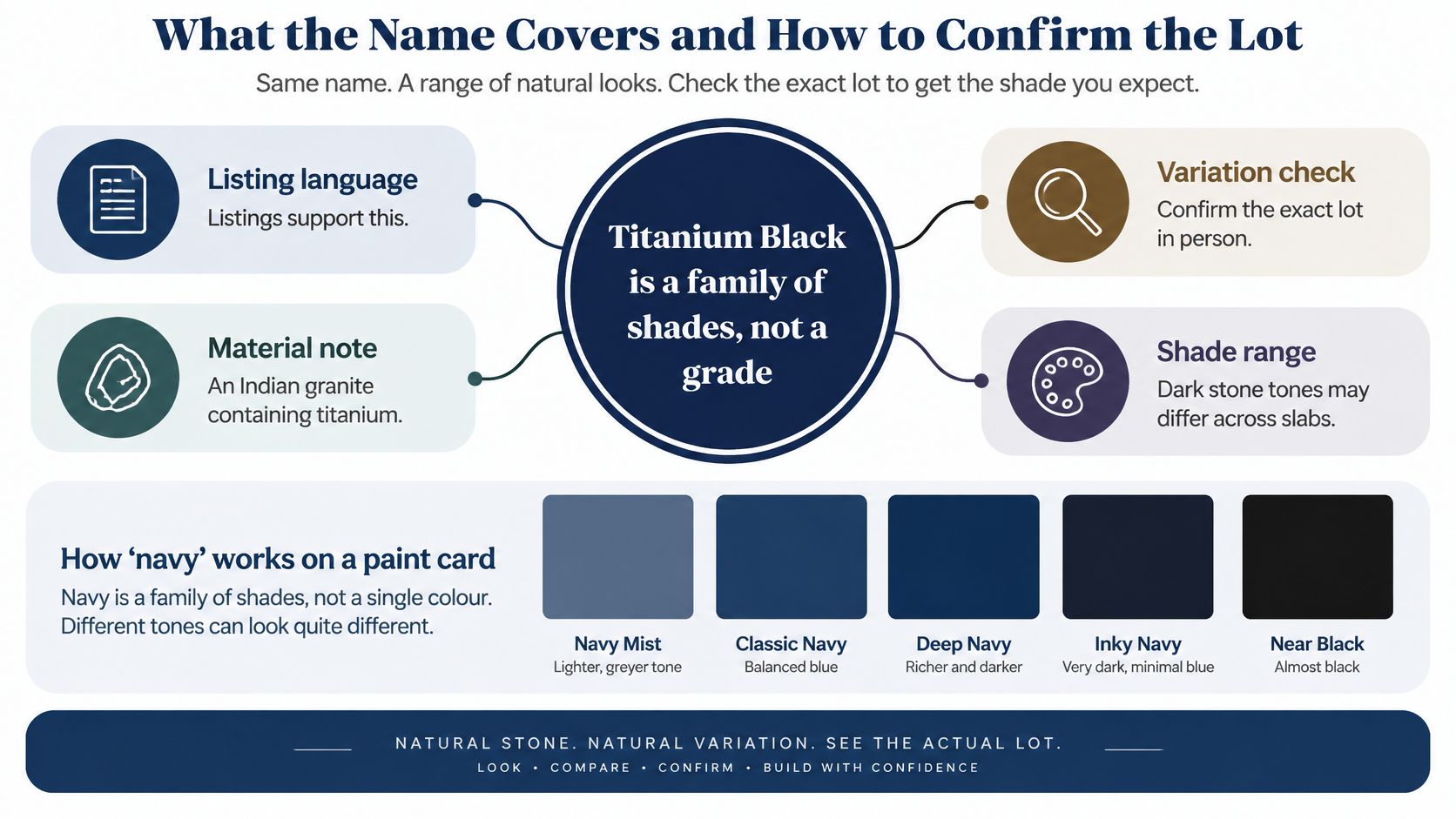
Think of Titanium Black the way you'd think of navy on a paint card. Navy describes a family of dark blue shades. It doesn't tell you the exact tone on your wall, and two tins labelled navy from different ranges won't necessarily match. Titanium Black works the same way.
Listings show the problem clearly. The Vardman Industries Titanium Black listing sits within a market where one description calls it an Indian granite containing titanium, aluminium and magnesium oxides, while another publishes colours including black, gold, red, blue, green, brown and multicolour rather than one tightly defined appearance. That listing also reports water absorption from 0.05% to 0.40%, compressive strength from 120 to 250 MPa and flexural strength from 10 to 25 MPa, which shows why a single word like durable can't describe every lot.
The visual below summarises why the name should start your search, not finish it.
Why Slabs With the Same Label Differ
Granite is cut from natural blocks, so background tone, dark mineral distribution, feldspar-quartz texture, veining and titanium-like streaking can shift across one block and change more sharply between blocks. A sample chip can't show you that movement. It also can't tell you whether the delivered slab will fabricate cleanly at a narrow sink rail.
Supply follows quarry geography, not a single national grade. The Indian Bureau of Mines National Mineral Inventory estimated India's total granite dimension-stone resources at 46,320 million cubic metres as of 1 April 2015, with black granite representing approximately 7% and coloured granite accounting for about 92%. It identifies Rajasthan and Karnataka each contributing roughly 20%, followed by Jharkhand at 19% and Gujarat at 18%. Black stone is therefore a smaller, distinct segment, and availability depends on region and block selection.
That context explains a common frustration. You approve a deep black sample with fine streaking, then the delivered lot arrives warmer, busier or more heavily veined. Nothing has necessarily gone wrong in transport. You've bought from a different part of the natural variation that the label allows.
A Six-Step Sourcing Sequence
Judge the slab, not the label. Work through these steps in order, before any cutting starts.
- Request origin documentation: Ask for quarry or origin details with the block number and extraction date recorded.
- Obtain the batch certificate: Get test values for absorption and compressive strength for that lot, plus thickness and finish.
- View photographs under neutral light: Ask for exact slab photographs, then inspect in person under lighting close to your site conditions.
- Approve a control sample: Number the approved block or slab set, keep a control piece, and view slabs dry and wet because water deepens colour temporarily.
- Confirm on delivery: Recheck thickness, finish, resin or mesh backing, edge integrity and visible fissures against the approved set.
- Reorder from the same block: If you need more stone later, go back to the recorded block first, because a new block can shade-mismatch once installed.
Practical rule: For several kitchen or vanity tops, batch consistency and seam placement matter more than finding the exact trade name again.
Say you're ordering an island and two perimeter counters. Your priority isn't three pieces all called Titanium Black. It's three pieces from a consistent set, laid out so streaking runs intentionally and seams don't cut through the strongest pattern. That decision is made at the yard, with full slabs in front of you, not from a thumbnail image.
Finishes and What Each One Does to the Look
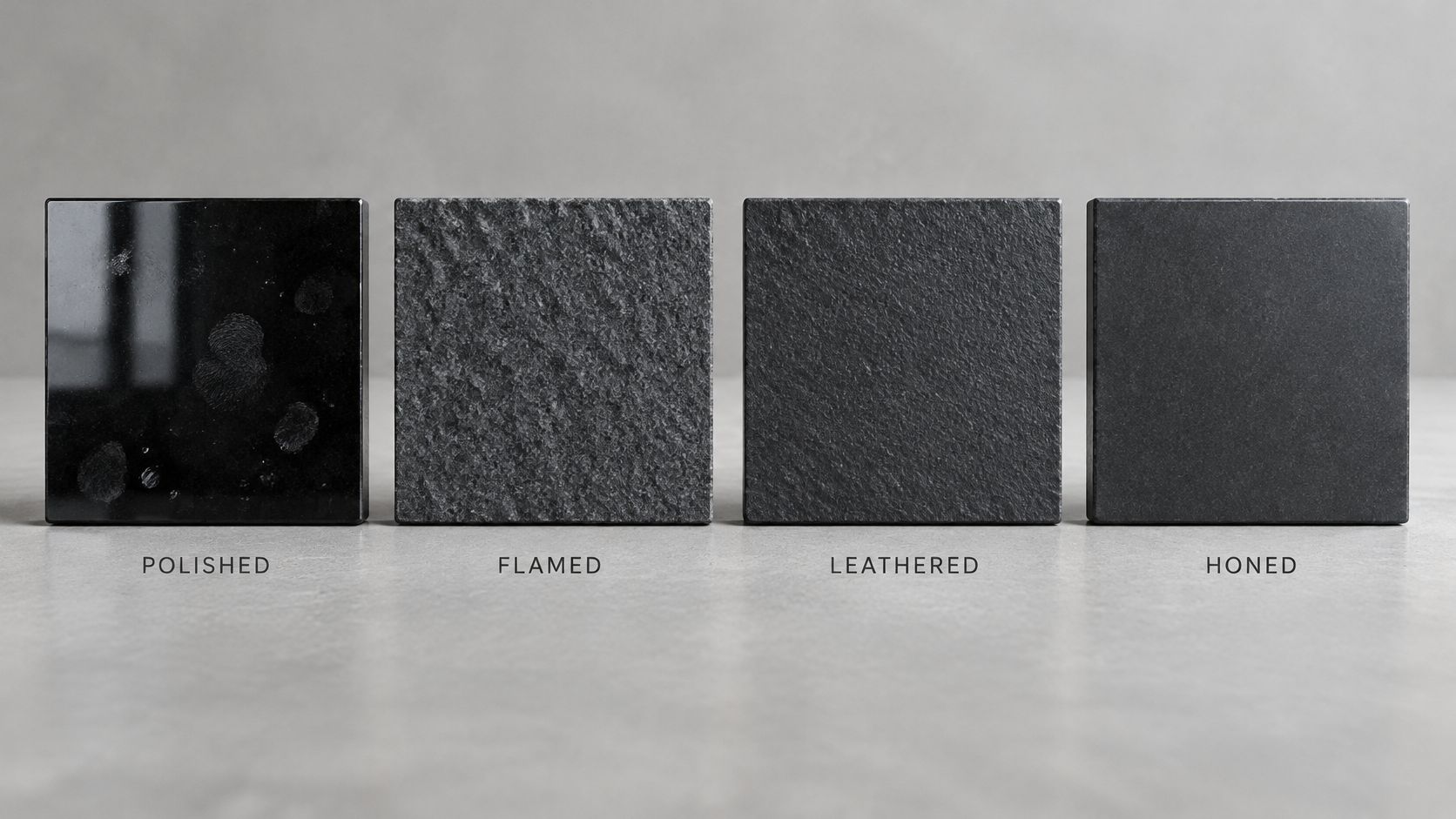
Finish changes how dark the stone looks, how much it reflects, and how clearly it shows daily marks. It doesn't alter the mineral pattern or the absorption figure underneath, so choose finish after you've accepted the lot, not instead of testing it.
The samples below show the four finishes side by side.
Titanium Black Granite finishes compared
| Finish | Look and feel | Best used for | Maintenance effect |
|---|---|---|---|
| Polished | Glossy, deepest black, sharp reflection | Counters, vanities, wall panels | Shows fingerprints, water spots and etching fastest |
| Flamed | Textured, matte-like, uneven sheen | Outdoor paving, steps, exterior cladding | Hides marks, but texture is harder to wipe clean |
| Leathered | Soft, low-sheen, subtle texture | Kitchen counters, high-traffic floors | Hides wear well, sealing still follows the lot test |
| Honed | Smooth, even matte face | Floors, bathroom surfaces | Hides marks, check sealing after fabrication |
How to Choose Without Overcomplicating It
Polished gives you the deepest black because the smooth surface reflects light cleanly and saturates colour. It's the right choice for wall panels and low-traffic counters where reflection is part of the design. It's also the least forgiving. Fingerprints, hard-water spots and fine swirl marks show quickly, especially under downlights.
Flamed stone is heated so the surface lifts into a rough, textured face. You'll lose the sharp reflection and the colour will read lighter and flatter, but you'll gain grip and a surface that hides outdoor dirt. That makes it practical for paving, external steps and cladding. Don't choose it for a worktop you need to wipe perfectly clean, because crumbs and spills sit in the texture.
Leathered sits between the two. It has a soft, low-sheen texture that keeps some depth of colour while hiding wear better than polish. Honed is smoother and evenly matte, so it suits floors and bathroom surfaces where glare would be a problem. If you want to compare these textures in more detail, our guide to types of surface finishes explains how each finish is produced.
The video below is useful for seeing sheen change as light moves across a surface.
Use one simple rule. Choose polished for vertical and low-traffic surfaces, leathered or honed for busy floors and counters, and flamed outdoors. Always view your chosen finish on your actual slab, because the same stone can look near-black polished and charcoal-grey honed.
Where It Works and What Fabrication Demands
Titanium Black Granite works in several settings, but each setting stresses the stone differently. Match the application to the check that matters most, rather than assuming a good counter slab is automatically a good stair tread.
The checklist below groups the main uses with their key checks.
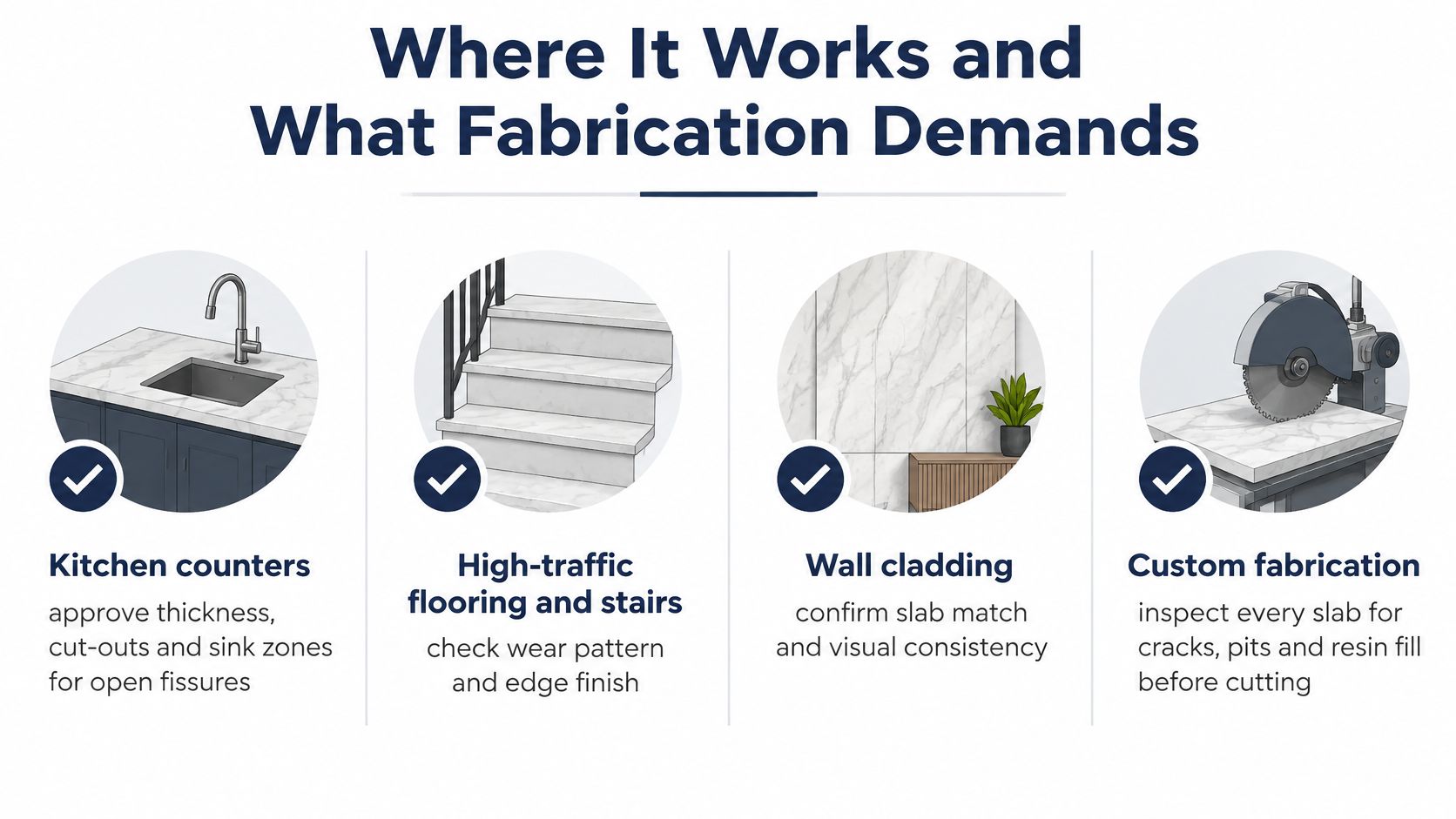
- Kitchen counters: Approve thickness and inspect sink and hob cutout zones for open fissures, because narrow rails beside cutouts are the weakest points.
- Flooring and stairs: Verify edge integrity and slip-resistance for the chosen finish, and check tread nosings for chips before fixing.
- Feature walls and cladding: Align slab direction across panels and plan book-matching at the yard, not on site after cutting.
- Vanities and bathroom surfaces: View the slab wet, because colour deepens when damp and a panel that matches dry can look darker beside a shower.
Fabrication Decisions to Lock Before Cutting
Good fabrication starts with layout. Ask the fabricator to mark slab direction on every piece with chalk or tape arrows, so streaking runs in one intentional direction across islands and wall panels. Plan seams away from sinks and hobs, where water, heat and movement put joints under the most stress. Our notes on granite slab measurements will help you check sizes and allowances before you sign off the layout.
Next, inspect resin filling along veins and natural fissures. Resin isn't automatically a defect. It stabilises the surface and is common on polished slabs. Problems start when heavy filling sits exactly where a cutout or edge profile will remove support. Move the layout, choose another part of the slab, or choose another slab.
Thickness needs the same attention. Measure at several points with calipers, not just at one corner, because uneven thickness shows up as lippage at seams and uneven support under long counters. Confirm the edge profile on a sample offcut from your lot, since dark edges reveal poor polishing faster than pale stone does.
Ask for a final polish check under raking light, with a torch held low across the surface. Swirl marks and dull patches that disappear under overhead light show up immediately at that angle.
On-Site Checklist
Carry this short list when pieces arrive, before adhesive goes down.
- Thickness and size: Measure each piece and compare it with the approved layout.
- Microcracks and resin: Run your hand over veins, check cutout corners, and look for open fissures.
- Edges and direction: Confirm no edge chips, check polish under raking light, and verify direction marks before fixing.
If a piece fails one of these checks, it's far easier to recut or replace it at delivery stage than after plumbing and cabinetry are connected around it.
Care and Sealing by Zone in the Kitchen
Dark granite isn't stain-proof, and it isn't automatically maintenance-free. Dark colour can hide a stain visually while liquid still enters the surface, so a counter that looks clean may still be absorbing. Sealing should follow how your installed slab behaves, zone by zone.
The Baaft Decor kitchen countertop materials guide notes that dense dark granites may need little or no sealing, while other granites can require several coats, and it gives a practical test of placing water on a clean surface for roughly 10 to 20 minutes to check whether the stone darkens. That test is more useful than a calendar reminder to reseal everything every year.
Run the Test Properly
Clean the area with a neutral pH cleaner, rinse and let it dry fully. Place a small puddle of water on the surface, note the time, and check after 10 to 20 minutes. If the stone underneath has darkened, water has entered and that zone needs sealing.
Repeat the same idea beside the hob with a few drops of cooking oil on an inconspicuous spot or an offcut. Oil, turmeric, hot pan splashes and acidic cleaners are the main stressors in Indian kitchens, and the hob zone often needs attention before a dry preparation area does. Test each zone separately and write down the dwell time and result.
Sealing decisions by kitchen zone
| Zone | Risk | Test | Action |
|---|---|---|---|
| Next to the sink | Water, hard-water deposits, cleaners | Water test, 10 to 20 minutes | Reseal if the stone darkens |
| Cooking hob | Oil, turmeric, heat, splashes | Oil-drop test, 10 to 20 minutes | Seal and wipe spills promptly |
| Dry counter zone | Light use, coffee, fingerprints | Water test, 10 to 20 minutes | Often needs little or no sealing if it stays dry |
| Floor or stairs | Grit, traffic, wet feet | Water test plus slip check | Seal per test result, verify slip-resistance |
| Exterior | Weather, freeze-thaw, UV | Water test plus site weathering review | Pair absorption data with site checks, do not rely on sealing alone |
Daily Care That Protects the Seal
Sealant choice, curing time before use, edge treatment and cleaning chemicals matter as much as the granite itself. Follow the sealant maker's curing instructions and don't flood the counter with water the same evening. Pay attention to edges and the stone around sink cutouts, because those areas are handled and wetted most.
Use neutral pH cleaners and a soft cloth for routine wiping. Keep acidic descalers, vinegar-based sprays and harsh bathroom cleaners off polished zones, and wipe turmeric and oil promptly rather than leaving them overnight. If you're planning cabinet colours around a dark top, our guide to granite countertops with white cabinets covers contrast and lighting. For wider wet-area planning beyond stone alone, the Flacks Flooring kitchen and bathroom guide is a useful resource on matching floor surfaces to moisture exposure.
Retest the wet zone after the first month of real cooking, and again whenever a spill no longer wipes away cleanly or a dull patch appears. Reseal only the zones that darken. You may find the sink run needs attention while the dry counter passes easily, and that's a perfectly sensible outcome.
Placing the Order Against the Approved Lot
A catalogue name will not tell the fabricator what to cut. The approved lot will. By this stage the application, finish, block and test results are settled, and the order sheet binds them together so the workshop cuts only what was approved.
Write the application and finish on the order itself. A polished kitchen counter, a leathered floor and flamed external steps place different demands on the same stone. A slab accepted for a wall panel can end up on a stair tread when that use is left unwritten, so record it before anything moves to fabrication.
What Belongs on the Order Sheet
- Lot identity: Block number, slab numbers, control-sample number and origin documentation attached to the purchase record.
- Test screen: Batch certificate confirming the lot meets your absorption and strength requirements, with uniform thickness and no open fissures in cutout zones.
- Layout instructions: Direction marking for each piece, seam positions away from sinks and hobs, and any book-matching agreed at the yard.
- Fabrication details: Edge profile, resin treatment, cutout positions and finish confirmed in writing before cutting begins.
Keep that sheet with the invoice. Photographs of the approved slabs under neutral light belong in the same file. Memory fades. A later request for a matching splashback or an extra vanity top is far easier to trace to a specific block number than to reconstruct from a colour description.
We supply South India granite in Polished, Flamed and Leathered finishes, with fabrication and installation support, and buyers in the NCR can view slabs in person at our showrooms at Sikanderpur Marble Market and HUDA Marble Market Sector 33-34, Gurugram, before approving a lot. That in-person step is where shade, streaking and finish stop being descriptions. They become decisions you can stand behind.
Decision rule: Approve the lot, not the name.
That rule protects the whole job. It leaves you with a certificate to check, a control sample for comparison, direction marks for fabrication and a sealing plan matched to the test results after installation. Titanium Black then functions as it should, a striking dark stone chosen on evidence, rather than a label you hope will behave consistently.
If a supplier cannot produce lot documentation or will not let you approve the actual slabs, treat that refusal as information. Asking for verification is standard practice for a variable natural material, and a good supplier will expect those questions.
Visit our Gurugram showrooms at Sikanderpur Marble Market or HUDA Marble Market Sector 33-34 to view granite slabs in person, and ask our team about fabrication and installation support before you place an order.