
Taj Mahal Quartzite: Origin, Performance and Buying Tips

The most common advice about Taj Mahal quartzite is to choose it for marble-like looks without marble-like worries. That's an incomplete buying rule. A trade name doesn't prove what a slab is, and a hard mineral structure doesn't guarantee a trouble-free countertop. Start with the actual slab, its origin documents and a matching test offcut, not a showroom label.
Table of Contents
- Taj Mahal Quartzite at a Glance
- Why Taj Mahal Quartzite Is Not an Indian Stone
- Colour, Veining and Translucency to Expect
- How It Performs Against Quartz, Granite and Marble
- Best Uses for Countertops, Feature Walls and Floors
- How to Verify Origin and Test a Sample Before Fabrication
- Sealing, Cleaning and Daily Care
- Confirm Your Slab Before You Cut
Taj Mahal Quartzite at a Glance
Taj Mahal quartzite is a natural metamorphic stone, formed when quartz-rich sandstone underwent intense heat and pressure, recrystallising into a dense, interlocking structure. It's natural stone rather than an engineered surface, so specification means selecting an individual slab, not choosing a colour code.
| Attribute | Taj Mahal quartzite | Note |
|---|---|---|
| Origin | Brazil, particularly Espírito Santo | Commercial origin, not India |
| Rock type | Metamorphic quartzite | Formed from quartz-rich sandstone |
| Geological age | Precambrian | Deposit description, not a slab-quality grade |
| Hardness | Quartz-rich, scratch-resistant stone | Confirm performance on the selected offcut |
| Gangsaw slab | Large-format slab | Published dimensions below |
| Cutter slab | Narrower-format slab | Published dimensions below |
| Finishes | Request the actual polished or textured finish sample | Confirm per slab with the supplier |
Petrosstone's 2025 product listing states that gangsaw slabs are available at 280 × 180 cm or larger, while cutter slabs are available at 180 × 60 cm or larger. These are reported supply formats, not a promise that every slab in a yard has those dimensions.
Read the specification as a starting point
Finish, thickness and veining change between blocks and supplied slabs. A polished display sample doesn't establish the appearance of a textured slab, and a nominal slab dimension doesn't tell the fabricator how much usable stone remains after trimming.
Ask for the slab's measured outline, thickness and photographs showing its edges. Mark fissures, filled areas and any portion that shouldn't fall beside a sink cut-out or exposed edge.
- Identify the format: Confirm whether the quotation describes a gangsaw slab or cutter slab before comparing dimensions.
- Separate gross size from usable size: The cutting layout must accommodate trimming, defects and vein direction.
- Specify the finish: Record the approved surface treatment rather than relying on a photograph's shine.
- Keep the identity attached: Carry the slab reference through the quotation, approval sheet and cutting drawing.
A large slab isn't automatically the better purchase. The useful slab is the one that accommodates your layout with acceptable seams and the appearance you've approved.
Why Taj Mahal Quartzite Is Not an Indian Stone
The name suggests India, but the commercially recognised stone comes from Brazil. Artistic Stone's technical overview identifies Brazil, particularly Espírito Santo, as its origin and describes the deposit as Precambrian, more than 550 million years old.
Taj Mahal is a visual and marketing reference to the monument's white marble appearance, not evidence of a quarry connection to Agra. The monument was constructed primarily from marble over a sandstone foundation; its cultural and material history belongs to a different discussion, explored in the GIA account of the Taj Mahal and Mughal craftsmanship.
Heritage association isn't provenance
India has its own quartzite resources and a documented history of using quartzite in architecture. That doesn't make an imported slab sold under the Taj Mahal name Indian stone.
Say a showroom label reads Taj Mahal beside a cream-coloured slab. That label identifies the commercial selection, but it doesn't establish the exporting country, quarry or block.
Buying rule: Treat Taj Mahal as a trade name. Establish geological identity and provenance through documents tied to the material you're buying.
For an Indian project, specify imported Brazilian natural stone and require country-of-origin information, block identity and slab continuity. Don't let an India-associated name become an unsupported origin statement on the purchase order.
Colour, Veining and Translucency to Expect
Expect a white to pale grey base, often warmed by ivory or cream undertones, with grey, gold or beige veining. Some slabs have restrained lines; others show stronger movement that becomes the main feature of the room.
The slab below illustrates why the full pattern matters more than a small colour chip.
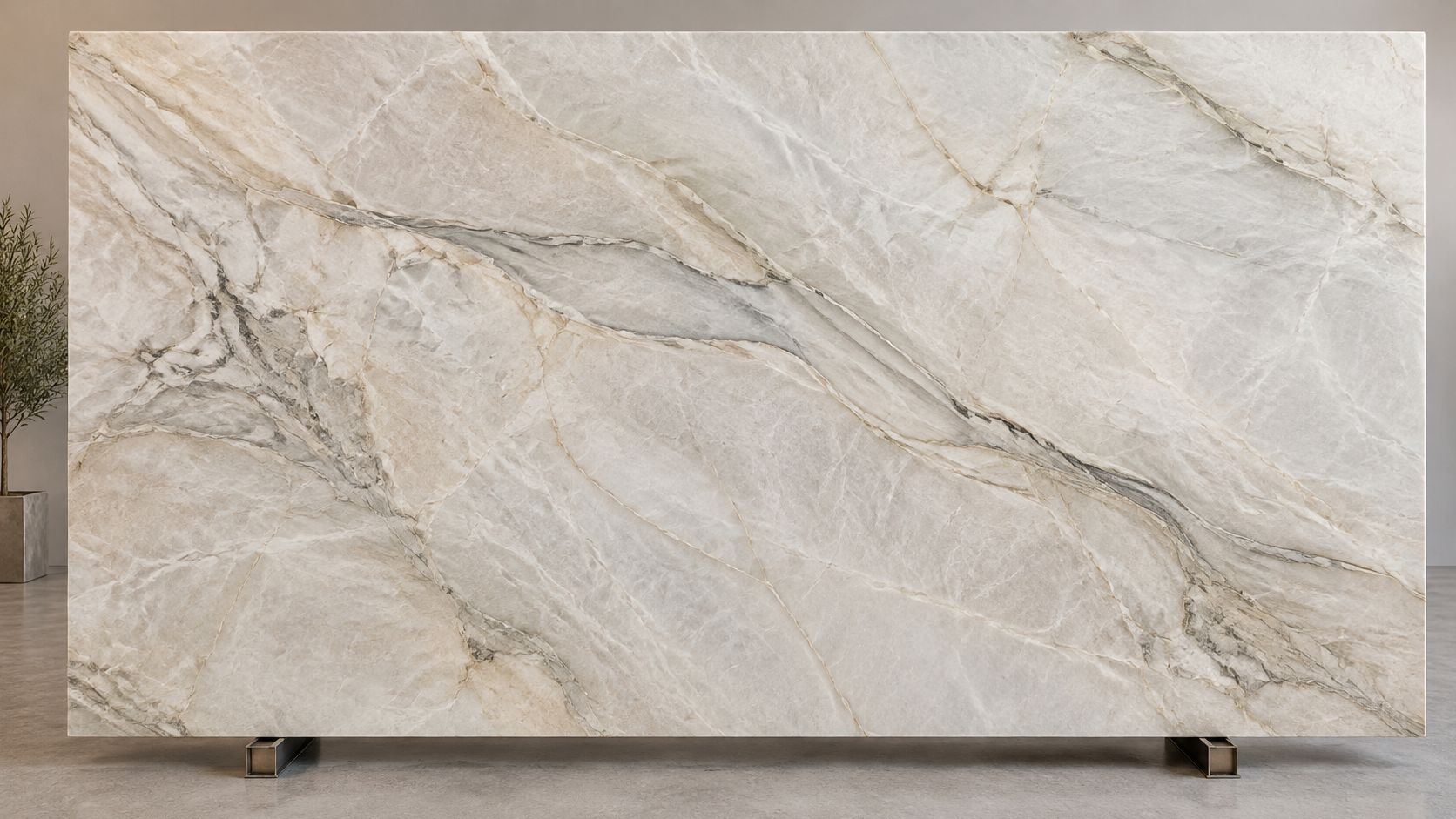
Direct light can reveal a crystalline sparkle rather than the softer, clouded appearance associated with classic marble. Translucency can also change across the slab, so don't approve backlighting from an attractive translucent corner alone.
Read slabs like pages in a book
Consecutive slabs are like consecutive pages cut from a block. Their patterns relate, but they aren't identical. A book-matched pair can mirror movement across a joint, provided the slab faces, polishing arrangement and cutting layout support that effect.
A seam still interrupts the surface. Ask the fabricator to show the proposed joint on photographs rather than promising an invisible continuation.
For coordinating the stone with cabinetry, flooring and paint, Vizcraft's guide to connecting design samples to staged interiors offers a useful way to organise material comparisons. Use that approach with a photograph of your selected slab, not a generic product image.
- View the whole slab: Stand back to judge the overall movement, then inspect filled areas and abrupt tonal changes.
- Bring room samples: Compare cabinet, paint and metal finishes under lighting close to the intended room lighting.
- Approve the orientation: Decide where the strongest vein belongs before anyone cuts the island or wall panels.
Use the video as a visual reference, then make the final decision against the physical material.
A suitable slab has the base colour and flowing movement you want without an unapproved colour shift. Natural variation isn't automatically a defect, but it must be a variation you knowingly accept.
How It Performs Against Quartz, Granite and Marble
Quartzite and granite generally tolerate heat well; engineered quartz requires more caution because it contains resin. The George Furnishings surface comparison also makes the important distinction between the stone's performance and the complete installation, including sealers, seams and adhesives.
| Surface | Heat tolerance | Staining and sealing | Scratch hardness assessment |
|---|---|---|---|
| Taj Mahal quartzite | Good; use trivets | Assess absorption and specify sealing | Quartz-rich stone; test the actual offcut |
| Engineered quartz | Vulnerable to high heat because of resin | Low porosity; generally no routine sealing | Use the manufacturer's product specification |
| Granite | Good; protect joints and surrounding materials | Assess the selected stone's sealing needs | Mineral composition affects scratch behaviour |
| Marble | Heat isn't its only concern; acids can etch | Sealing helps with absorption, not acid etching | More vulnerable to scratching than quartz-rich stone |
A Mohs figure alone would be a poor buying decision. It describes scratch resistance, not resistance to staining, edge chipping, thermal stress or failure around a badly positioned cut-out.
Choose the risk you're prepared to manage
For Taj Mahal quartzite, the attraction is the combination of natural veining and a durable working surface. The trade-off is slab-specific variation in absorption, filling, finish and fabrication requirements.
Engineered quartz offers more predictable tone and lower routine sealing demands. That predictability can be useful when matching a replacement piece or keeping a long counter visually uniform, but it doesn't make hot cookware safe on the surface.
Granite remains worth considering when you want natural stone without making flowing, marble-like veining the priority. Marble suits buyers who accept a surface that can acquire scratches and acid marks rather than remaining visually unchanged.
For a closer material distinction, our guide to marble and quartzite helps separate appearance from geological identity. When budgeting alternatives, Studio Contour's countertop cost comparison is useful for identifying the scope questions to put into a quotation, rather than assuming every quote includes the same work.
Test against your kitchen, not a sales description
Indian kitchen use involves turmeric, cooking oil, tea, coffee and hot pressure cookers. Ask how the proposed surface will be protected during those activities, including at joints and beside appliances.
- For staining concerns: Test representative spills on an approved offcut using the proposed sealer.
- For heat concerns: Plan a trivet location that's convenient enough to use during cooking.
- For replacement concerns: Retain labelled material rather than assuming another block will match.
- For fabrication concerns: Agree seam positions, edge profiles and cut-out details before approval.
Heat tolerance belongs to the stone. Heat protection must cover the whole countertop assembly.
Choose Taj Mahal quartzite when natural movement and heat-adjacent use are priorities. Choose engineered quartz when consistent appearance and reduced sealing work matter more. Neither choice compensates for poor support, careless installation or unsuitable cleaning.
Best Uses for Countertops, Feature Walls and Floors
Kitchen islands and working counters are the strongest starting point for Taj Mahal quartzite. They give you room to appreciate the veining while making practical use of the stone's durable mineral structure.
Match the application to its detailing requirements, not just its appearance.
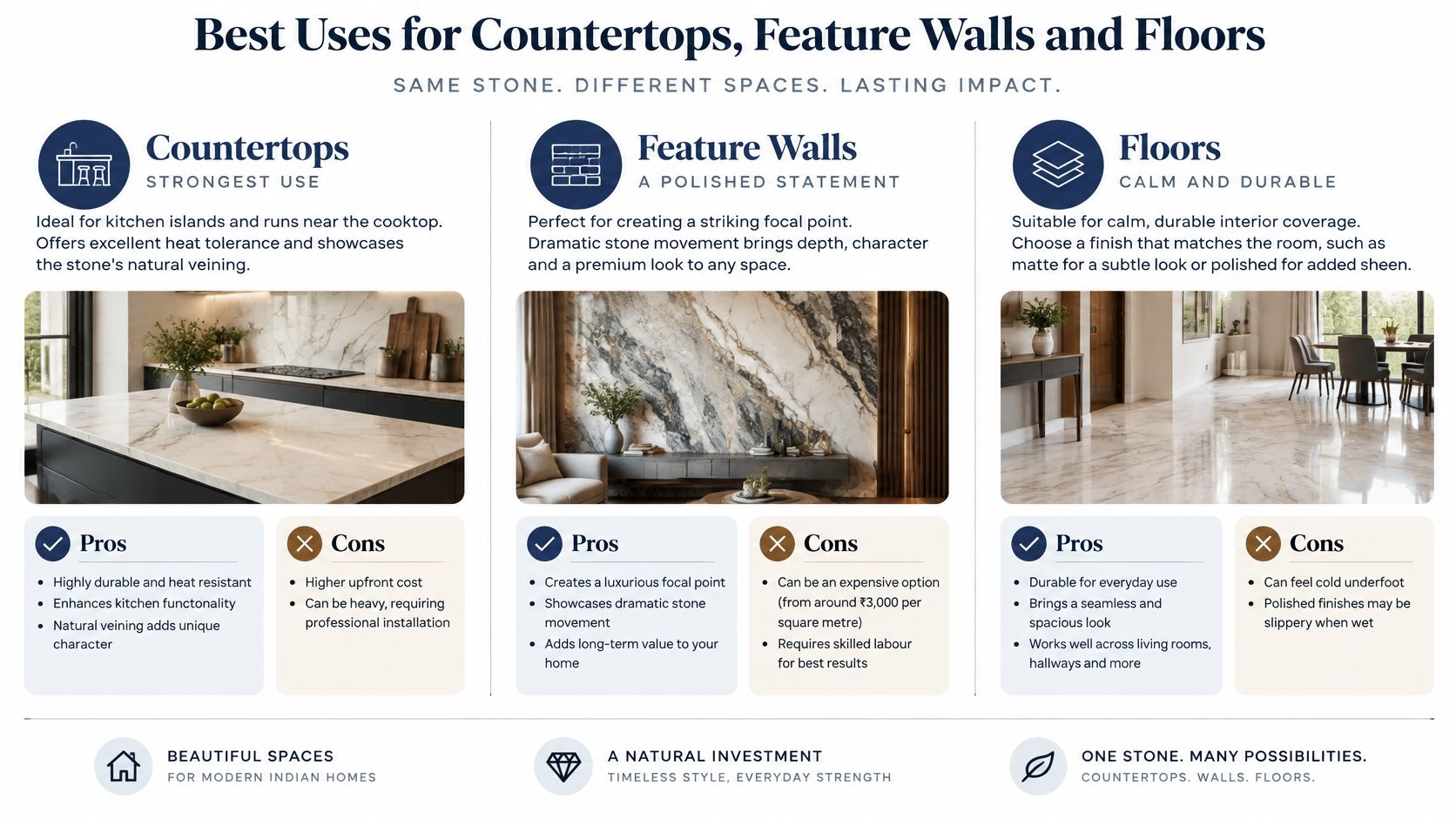
Countertops and islands
Set thickness and support requirements with the cabinet designer and fabricator. An eased edge gives a restrained outline; bevelled or ogee profiles change the visual weight and need careful positioning around veins and filled areas.
- Pros: Broad surfaces display natural movement, and a coordinated splashback can continue the material palette.
- Cons: Sink openings, hob cut-outs and unsupported projections need proper fabrication and support. A dramatic vein isn't a reason to accept an awkward seam.
For waterfall ends, approve both the top and vertical pieces together. A convincing corner depends on the cutting arrangement, not just on ordering slabs from the same block.
Feature walls and floors
A feature wall can show stronger movement without the visual interruption of appliances or sinks. Book-matched panels suit a living-room focal point or hospitality reception, but the installer must resolve panel support, joint alignment and access before fixing begins.
- Wall advantages: Large panels create a clear focal surface and allow deliberate vein placement.
- Wall limitations: Weight, substrate preparation and fixing design need professional coordination.
- Floor advantages: The neutral palette can provide continuous interior coverage without a busy pattern.
- Floor limitations: Choose the finish for grip, cleaning and visible wear. Don't approve a glossy floor solely because the showroom slab looks attractive.
For busy circulation routes, assess a finished sample under raking light and discuss maintenance expectations. Lower-traffic interiors offer more freedom to prioritise appearance.
Bathrooms and exposed settings
Vanity tops and shower walls can work when waterproofing, joints and drainage are properly designed. Sealer isn't waterproofing, and stone cladding doesn't replace the concealed wet-area system.
Outdoor kitchens require a separate approval of the stone treatment, adhesive, substrate and weather exposure. Don't transfer an indoor specification outside without reviewing those components.
Constantly wet surfaces, aggressive cleaning routines and inaccessible joints are poor conditions for a low-effort installation. Resolve those conditions first rather than expecting the stone to compensate for them.
How to Verify Origin and Test a Sample Before Fabrication
Authenticity is necessary, but it isn't enough. The StoneTrades sourcing guide highlights why a commercial label can't replace documented provenance, slab identification and testing of the actual material.
Use a sacrificial offcut for testing. Never scratch or apply acid to the saleable face.
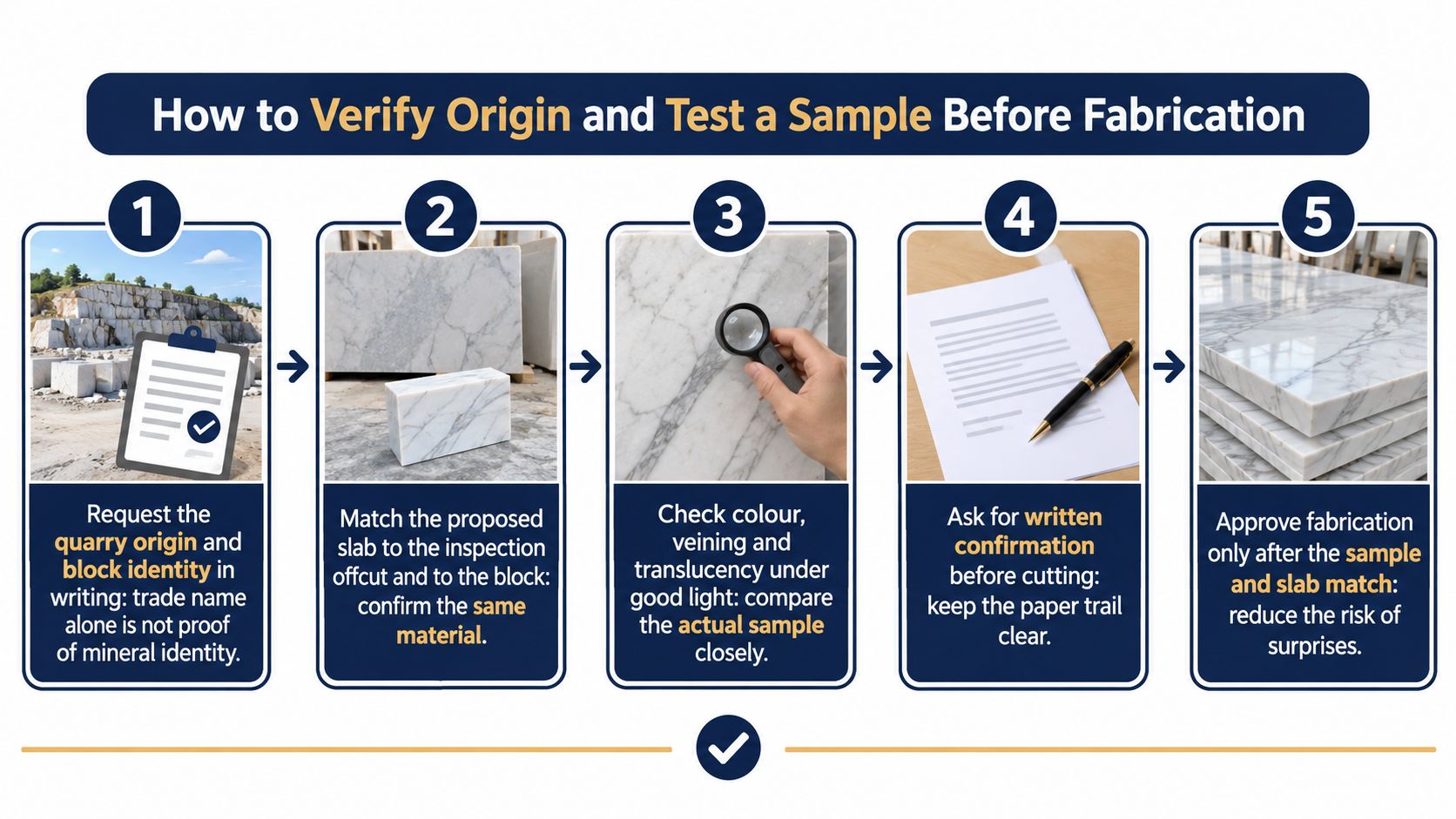
Build a traceable approval record
Request written origin and block identity. Obtain the country of origin, available quarry information and block/slab references. A product name printed on an invoice doesn't establish mineral identity.
Match the inspection offcut. Compare its tone, grain and veining with the proposed slab and block photographs. Label the offcut immediately so it can't be confused with another selection.
Approve continuity and cutting. Request full-slab photographs and a seam drawing showing each finished piece. Mark resin-filled areas, fissures and any feature that shouldn't land at an exposed corner.
Screen the offcut carefully
Try a controlled scratch test. On an inconspicuous part of the offcut, draw a steel point lightly across the surface, then clean away residue. A metal streak isn't necessarily a scratch; inspect whether the stone itself has a groove. Treat the result as screening, not a laboratory identification.
Compare water absorption. Place water drops on a clean, dry area and record whether the stone darkens and how quickly. Allow it to dry fully, apply the proposed sealer correctly, then repeat under comparable conditions. This helps assess the treatment, not just the untreated stone.
Check acid response. Put dilute vinegar on a separate test area, then rinse and inspect. Calcite-bearing material may fizz or develop a dull patch; quartz-rich stone shouldn't show the same response. A lack of visible fizz doesn't conclusively establish quartzite, especially where coatings or resin affect the surface.
Record the decision before cutting. Attach photographs, test observations, the sealer specification and the approved layout to the order. Keep a labelled repair offcut, or discuss spare material where future matching matters.
If the results conflict with the description, pause fabrication and seek professional mineral identification. Don't try to settle an ambiguous result by applying stronger chemicals.
Our green quartzite selection guide is another useful reference when comparing natural-stone options, but each selection still needs its own approval record.
A test sample is useful only when you can demonstrate that it came from the slab being fabricated.
Sealing, Cleaning and Daily Care
A good care routine protects the stone, its finish and the surrounding installation. Don't treat a sealer as a coating that makes every spill harmless or every cleaner suitable.
Keep the routine simple enough that everyone using the kitchen can follow it.
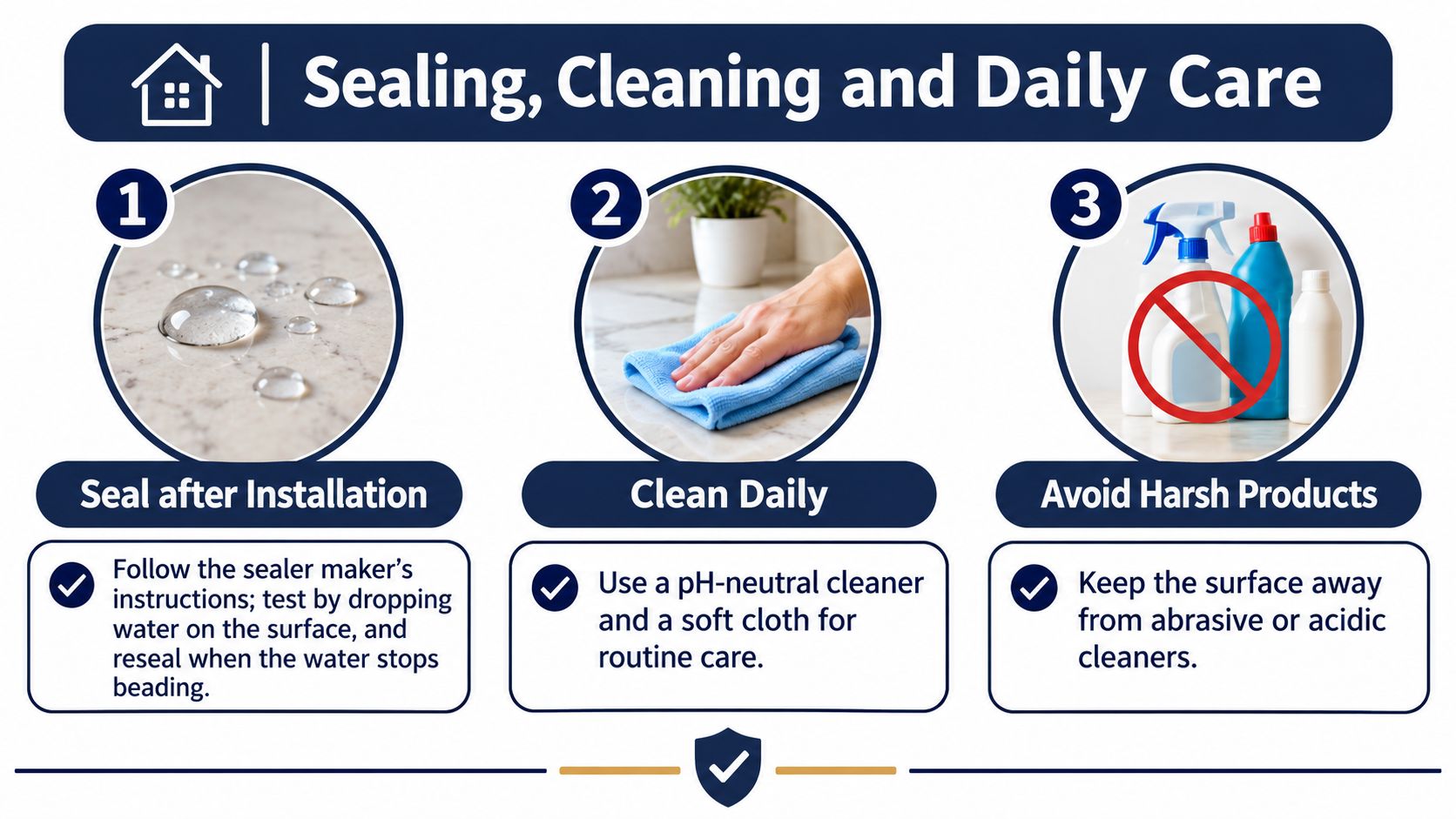
Protect the finish without over-treating it
- Agree the sealing sequence: Confirm whether the material has already been treated and whether further sealing is needed after installation. Use a compatible penetrating stone sealer, respect its curing instructions and remove excess before it dries on the face.
- Check absorption, not shine: Water beading can be informative, but darkening is the more useful warning of absorption. Compare the surface with its recorded baseline before deciding to reseal.
- Clean with a neutral product: Use a pH-neutral stone cleaner, a soft microfibre cloth and clean water as appropriate. Dry the surface to avoid leaving cleaner residue or water marks.
- Keep acids out of routine cleaning: Don't use vinegar, lemon-based cleaners or bathroom descalers on the countertop. Even where the quartz-rich stone resists acid, treatments and adjacent materials may not.
- Lift spills promptly: Blot turmeric, oil, tea and coffee rather than spreading them across the surface. Textured finishes deserve particular attention because residue can remain in the texture.
Protect joints and review changes
Use trivets under pans and pressure cookers, and keep concentrated heat away from seams and edges. Use a chopping board too, rather than treating scratch resistance as permission to cut directly on the counter.
Schedule a regular absorption check, with closer attention in heavily used kitchens. Reseal according to observed absorption and the chosen product's requirements, not an arbitrary calendar promise.
Advice for another material shouldn't become your stone-care specification. For example, Concrete Resurfacing Products cleaning advice concerns stamped concrete; its relevance is the need to match cleaning methods to the surface, not to transfer concrete products onto quartzite.
If a mark persists, identify whether it's residue, absorbed staining or surface damage before treating it. Abrasive pads and improvised chemicals can turn a local mark into a larger repair.
Confirm Your Slab Before You Cut
Approve a documented slab that matches its inspection offcut and has an agreed fabrication and sealing plan. Don't authorise cutting while the material identity, layout or surface treatment is still unresolved.
We select blocks at the quarry face across Italy, Brazil, Turkey and India, before they become slabs. We also guide stone from our yard through cutting, finishing and installation, so the enquiry should address the finished application rather than availability alone.
Prepare a useful enquiry
- Bring room dimensions: Include the counter runs, island outline or wall area.
- Bring the layout: Mark the cooktop, sink, cabinet supports and intended exposed edges.
- Bring approval questions: Ask about origin documents, block identity, available slab formats, seam planning and offcut comparison.
Our quartzite slab purchasing guide can help you frame the scope of the enquiry without assuming that nominal slab size equals usable coverage.
Use the relevant stone collection page's enquiry button to request current availability and slab-format details. Make the next decision an inspection appointment or document review, not an irreversible cutting instruction.
Varun Marbles offers stone selection guidance and support through cutting, finishing and installation. Visit Varun Marbles and use the relevant collection's enquiry option to discuss Taj Mahal quartzite availability, origin documentation and slab formats for your layout. Bring your drawings and request a matching inspection offcut before approving fabrication.