
Green Quartzite Stone: A Practical Buyer Guide
Green quartzite stone is a hard, quartz-rich metamorphic rock whose green colour comes from accessory minerals, not from one mineral species, and that colour alone does not prove low porosity or fitness for wet areas. That's the opposite of the most popular advice you'll hear in a showroom, where a deep green polish is sold as proof that a slab will behave like granite in a kitchen. It might. It might also be a softer green stone under a quartzite label, or a true quartzite with a weak plane running exactly where you want a sink cut-out.
Don't start with the photograph. Start with what the rock is, what makes it green, and what papers travel with the actual block you're buying.
Table of Contents
- What Green Quartzite Is and Why Its Colour Varies
- How Green Quartzite Compares with Similar Stones
- Rooms and Finishes That Suit the Stone
- Tests That Matter More Than Hardness
- How to Check a Slab Before You Buy
- Where Indian Supply Sits for Buyers
- Care and Upkeep After Installation
- Confirm the Slab Before Fabrication Starts
What Green Quartzite Is and Why Its Colour Varies
Green quartzite is easier to name than to define. Loose sand buried, heated and squeezed until the grains lock gives you the formation model. The Indian Bureau of Mines quartz overview defines quartzite as a granulose metamorphic rock formed when sandstone is cemented and recrystallised by silica, and notes that impurities can produce green, blue, yellow, orange or brown colours while quartz content gives the rock approximately Mohs 7 hardness.
In a yard, buyers usually expect a sage, mint or deep emerald ground, white or gold veins, and a slight glassy sparkle where quartz crystals catch light. That look is real, but it is a quarry signature more than a definition. A sticker name describes a commercial look, and Indian statistics classify quartzite by geology rather than by colour names sold in showrooms.
Three stones that get mixed up with it
Green marble is carbonate stone. It is softer, it etches when lemon or vinegar sits on it, and it needs different care. Serpentinite can also be green and dramatically veined, and it is often sold in the marble family, which still leaves its quartz content unproven.
Engineered quartz is a manufactured, resin-bound slab. Its heat, seam and repair behaviour follow the resin and the factory recipe, so a green engineered slab and a green metamorphic slab should never be specified by the same visual test.
If those three sit beside a true green quartzite under showroom lights, colour alone will not sort them. Mineral identity will.
Where the green actually comes from
The green usually lives in the accessory minerals, while quartz grains do most of the work for hardness. Thin sheets of mica and other minerals threaded through the rock supply colour, banding and, sometimes, a preferred direction of split.
A woven-cloth comparison helps: hard warp threads carry the load, coloured threads make the pattern, and the same coloured threads can show where the fabric bends most easily. Fuchsite, a chromium-bearing mica, is a common source of pale green in quartzite. When flat minerals such as micas line up, the stone gains foliation: visible bands for the eye, and a plane the slab may follow when it is cut, lifted or loaded.
Green colour alone should never be used as a proxy for low porosity, uniform strength or suitability for exterior exposure.
Keep that sentence in your pocket in the yard. Two slabs with the same trade name can come from different layers in one quarry. One layer may be tight and even. The next may carry more mica, stronger banding and a different response at the edge of a hob cut-out.
A Brazilian exotic name, an Indian quarry name or a polished sample chip tells you where to start looking. For a large panel, a stair tread or a heavily loaded worktop, ask for petrographic confirmation, meaning a laboratory description of which minerals are present and how they are arranged. Then inspect slab by slab, because the report describes the lot while your eyes check whether the slab in front of you matches it.
How Green Quartzite Compares with Similar Stones
Choose the stone family first, then argue about the exact slab. This table puts green quartzite beside the materials it's most often mistaken for.
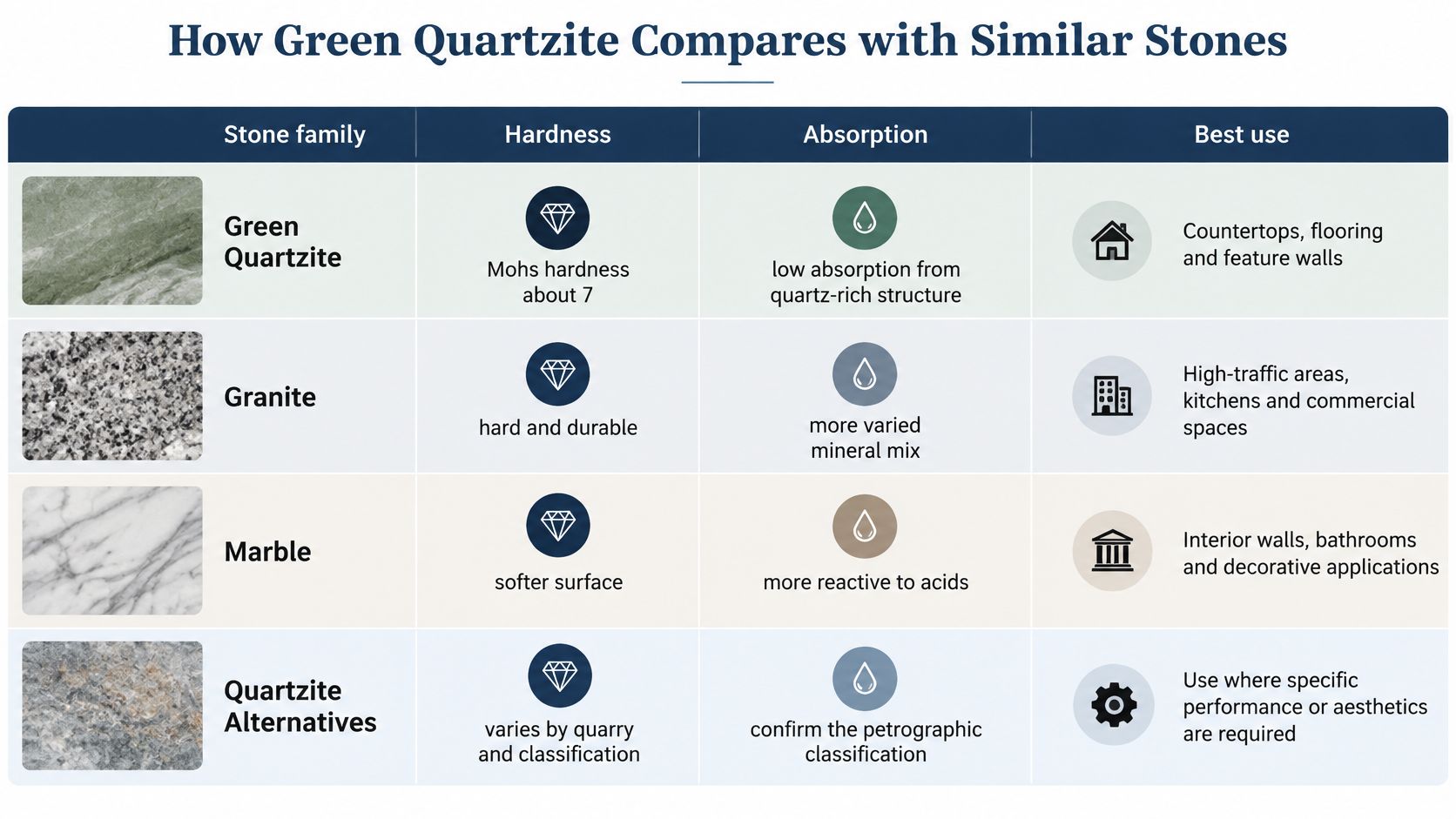
| Stone | Hardness | Absorption or porosity | Heat and acids | Best interior role | Main risk |
|---|---|---|---|---|---|
| Green quartzite | About Mohs 7 | Often low; samples 0.32–0.90%, published ranges 1.0–2.0% | Heat-tolerant; acids usually safe if truly quartz-rich | Worktops, floors, wall panels | Foliation, joints, mislabelling |
| Green marble | About Mohs 3–4 | Higher; sealing usually needed | Etches with acids; heat can mark it | Feature walls, light-use surfaces | Etch, scratch, stain |
| Granite | About Mohs 6–7 | Generally low | Resists heat, knives and traffic | Floors and worktops | Natural pattern swing |
| Engineered quartz | High surface hardness, resin-bound | Non-porous; no sealing | Resin can scorch; not a natural stone repair | Matched worktops and vanities | Heat and different fabrication |
| Serpentinite or green marble sold as quartzite | Often softer than quartzite | Variable by lot; test before wet use | May etch or scratch | Decorative cladding only after tests | Label does not prove quartz |
Reading the rows in order
Green quartzite earns its kitchen reputation when it's quartz-rich. A quartz-rich surface doesn't etch in the way calcite does, and it tolerates hot pans better than a resin-bound slab. The absorption figures in the table are tested aggregate-sample data and published ranges, not a guarantee for your finished slab. Your lot certificate replaces them.
Verdict for green quartzite: specify it for busy worktops only after the lot passes absorption and strength checks.
Green marble gives you depth and veining that many people fall for first. At about Mohs 3–4 in the table, it scratches more readily, and lemon, vinegar and many cleaners can leave a dull etch mark that sealing won't prevent. Sealing slows staining. It doesn't stop acid reaction.
Verdict for green marble: use it where you can admire it, not where you'll chop lemons on it every day. If you want to see how veining reads at full slab scale before you commit, marble gallery video inspiration from Nim is a useful visual check alongside an in-person visit.
Granite sits close to quartzite for hardness, at about Mohs 6–7, but it's an igneous rock with a different mineral mix. It handles heat and traffic well and doesn't etch like marble. Its pattern can swing from slab to slab, so you still approve the actual pieces.
Verdict for granite: it's the low-drama alternative when you want natural stone and heavy use without a green quartzite premium. Our guide to marble and quartzite choices for interiors sets out that family decision in more detail.
Engineered quartz is non-porous and consistent because it's manufactured. You don't seal it, and colour matching across many slabs is easier. The trade-off is resin. A very hot pan can scorch or discolour it, and a chip isn't repaired like natural stone.
Verdict for engineered quartz: choose it when repeatability matters more than geological character.
Serpentinite or green marble sold as quartzite is the row that causes disputes. A hard-looking polish and bold green veins don't prove quartz. If the seller can't name the quarry and classification, treat the slab as decorative until tests say otherwise.
Verdict for mislabelled greens: don't put an untested green slab in a shower or on a kitchen worktop on trust.
Rooms and Finishes That Suit the Stone
A kitchen that cooks every night asks more of a slab than a kitchen built for photographs. Keep that menu in mind as you look at this room.
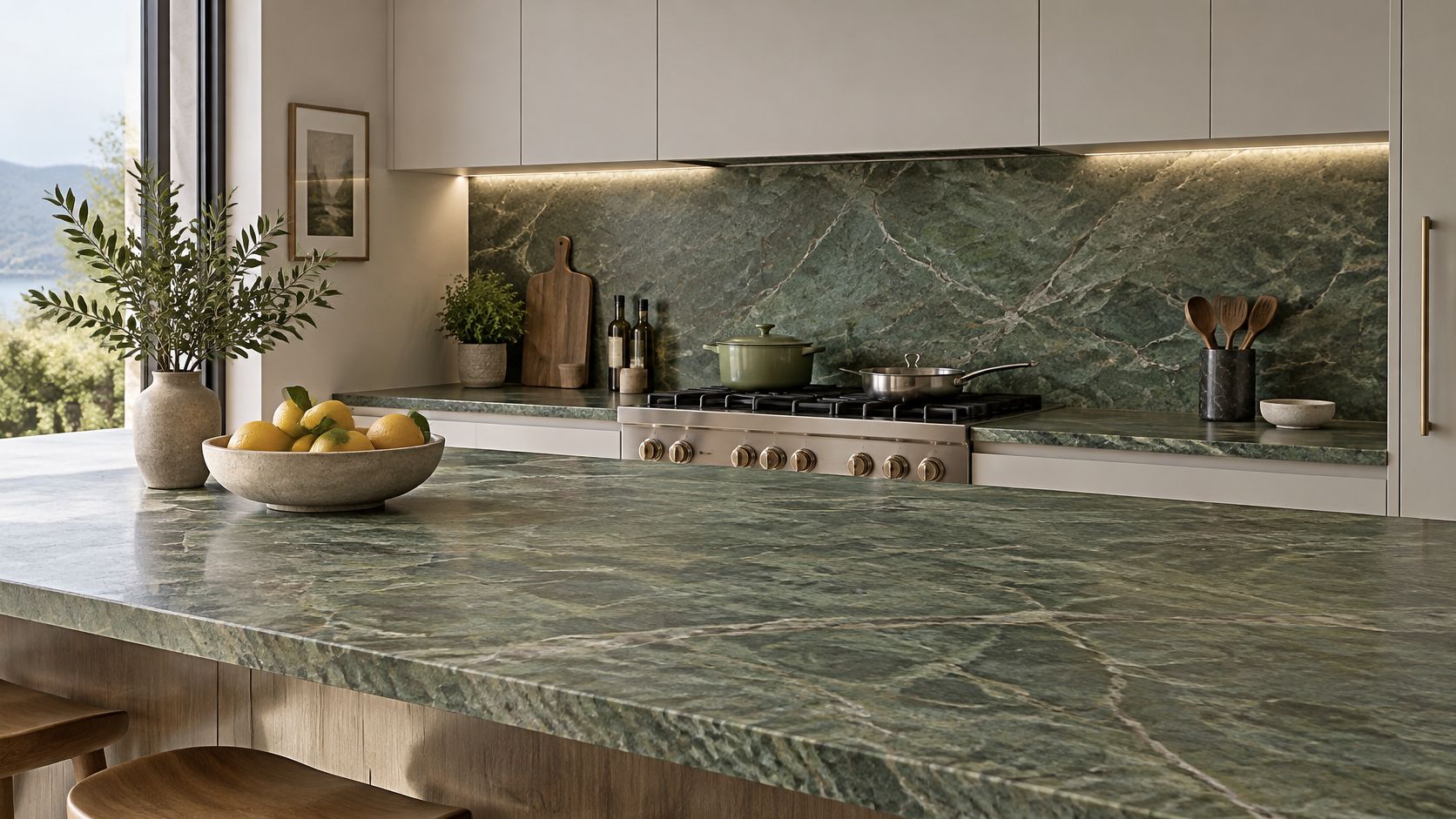
Kitchens, bathrooms and floors
In a kitchen, a confirmed quartz-rich green quartzite worktop can handle pans and citrus better than marble. Finish changes daily life, though. A polished face deepens colour and wipes down easily. A honed face softens reflection and hides faint marks, but oils can show more readily and need prompt wiping. A leathered face adds texture and calms glare in a sunny room, while its small undulations hold crumbs and turmeric dust more than a flat polish does.
Agree the finish against real cooking, not against a sample under a spotlight. Our overview of types of surface finishes for stone helps you compare sheen and grip before you stand in front of full slabs.
In a bathroom, put tighter, crack-free material on vanities and wet walls. Book-matched panels behind a basin carry the green as a feature without forcing a fissured slab to work as a shower floor. On floors and stairs, abrasion resistance and cut direction matter more than shade. Don't let a visible foliation plane become the nose of a step, where shoes strike it every day.
This short film shows how light moves across finished stone, which is exactly what changes between polished, honed and leathered faces.
Walls, fireplaces and lobbies
Feature walls and fireplace surrounds are where dramatic movement earns its cost. The stone isn't carrying pans or foot traffic, so you can favour pattern, book-matching and, where the fabric allows it, thinner lit panels. You still check the back and edges, because a large panel must survive transport and fixing.
In a commercial lobby, repeatability is the problem. Reserve slabs from one block so adjacent panels don't jump from mint to olive across a lift wall. Photograph the sequence in the yard, number the slabs, and keep that sequence through cutting.
Watch edges closely. A thick mitred waterfall end looks dramatic on an island, and it also exposes the cut face. If a resin-filled fissure runs through that face, you'll see it every day and the mitre may be weaker there. Inspect the cut face before anyone glues the mitre.
Practical rule: the busier the traffic and the wetter the room, the more the certificate outranks the photograph.
Tests That Matter More Than Hardness
A slab rarely fails because quartz wasn't hard enough. It fails at a hairline joint hidden by polish, at an edge where the saw crossed a mica band, or on a forklift when a weak plane gave way. Hardness tells you about scratching. It doesn't tell you about those three moments.
The Indian Geological Society study of fuchsite-bearing quartzite records deformation bands, sutured quartz-grain boundaries, compositional layering, and interlayering with amphibolite, gabbro and gneiss, while quartzites in the Kharbar–Parsad area are described as commonly fractured, with two joint sets and bedding and cleavage planes. The same source reports water absorption of 0.32–0.90% for tested samples, but also cites published quartzite ranges of 1.0–2.0%.
Translate those geological words into yard language. A joint is a crack system in the rock. Foliation is a lined-up mineral fabric. Compositional layering means one band isn't identical to the next. Any of them can drink water along a line, chip at an edge, or shorten the safe span of a worktop.
The five papers to request
| Property | Reported range | Why it matters | Specification use |
|---|---|---|---|
| Water absorption | 0.32–0.90% in tested samples; 1.0–2.0% in other published quartzite | Shows how readily the stone takes stains and moisture | Prefer the low end for wet areas |
| Petrographic description | Example: 10–20% fuchsite, quartz grains 0.3–0.8 mm | Confirms quartzite rather than marble or serpentinite and maps weak planes | Required for large panels and loaded tops |
| Bulk density | Lot certificate value for the actual block | Flags weathered or porous stone versus a tight quartz mass | Compare slabs from the same lot |
| Flexural strength | Lot certificate value for the actual block | Predicts breakage on spans, stairs and thin edges | Limit unsupported spans across foliation |
| Abrasion resistance | Lot certificate value for the actual block | Predicts wear on floors and stair treads | Do not assume countertop hardness equals floor life |
Water absorption decides how cautious you must be in wet rooms and how you think about sealing. Lower is generally safer for showers, bathroom floors and any exterior exposure. Don't accept a brochure average when the range above shows deposits differ.
Petrographic description answers the identity question. It confirms the rock is quartzite, names accessory minerals, and describes grain size and fabric. That's the paper that separates a green quartzite from a green marble with confidence.
Bulk density helps you compare slabs from one lot. A noticeably lighter, more porous piece in an otherwise tight lot deserves a second look for weathering. Flexural strength is about bending and breaking, so it governs long spans, cantilevered breakfast ledges, stair treads and thin edges. Abrasion resistance governs floors, where grit under shoes does slow damage that a worktop never sees.
What doesn't count as a test
Scratching the polished face with a knife in the showroom proves very little. A polished skin, surface resin and a hard quartz grain at that exact spot can mislead you about the body of the slab. It also tells you nothing about absorption along a joint ten centimetres away.
Write the five tests into your material schedule before the block is sawn. Ask for certificates from the actual quarry batch, not generic quartzite values. Then design from the results. Keep long unsupported spans off visible foliation, reserve crack-free low-absorption slabs for wet work, and let a weaker but beautiful slab become a wall panel instead of a stair tread.
How to Check a Slab Before You Buy
Imports make this protocol more important, not less. The GTAIC report on India's quartzite block-and-slab imports puts imports at 197,212.81 tonnes in the latest November 2024–October 2025 period, up 103.34% year over year, so a Delhi-region yard may hold domestic and imported greens side by side. Origin doesn't settle quality. Documentation and inspection do.
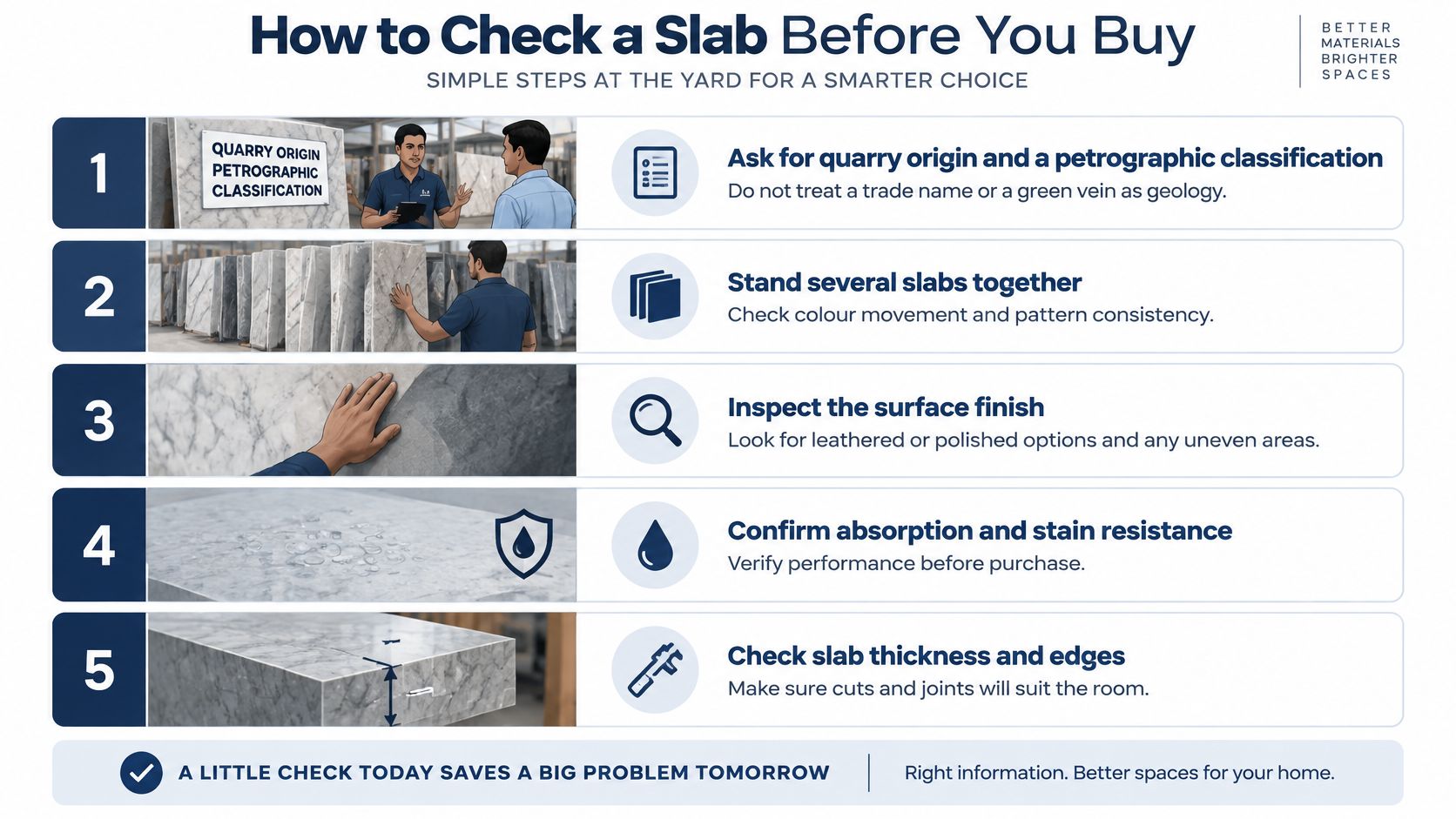
Seven checks in yard order
- Ask for quarry origin and petrographic classification. A trade name or green vein isn't geology, and visual colour isn't a reliable identifier.
- Stand several slabs from the same block together. You'll see whether colour and movement stay within what your design can absorb, or jump so far that seams will shout.
- Inspect the cut edge and the back. Look for resin fills, open pores, mesh, patches and colour that seems to sit only on the polished face.
- Wet a discreet area with permission. Water that sheets off behaves differently from water that darkens a streak along a joint or soaks into a dull patch.
- Sight along the slab in raking light. Low-angle light reveals hairline cracks, pits and waves that a top-down phone photo hides.
- Mark foliation and fracture traces before templating. Decide cut direction now, so a sink, hob or stair nose doesn't land on the weakest line.
- Send high-value or high-risk lots for independent testing. Request the batch certificate named in the testing table, covering absorption, density, strength, abrasion and petrography for that lot.
Each step catches a different lie a polished face can tell. Step 1 catches a wrong name. Steps 2 and 5 catch pattern and surface problems. Steps 3 and 4 catch treatment and thirsty lines. Step 6 turns geology into a cutting plan. Step 7 replaces opinion with numbers when the job is expensive, wet, exterior or heavily spanned.
A dense-looking green slab can still hide inclusions, microfractures, resin treatment and uneven absorption.
That's the contrarian case worth remembering. A slab can feel hard under your palm and still chip where the saw crosses a mica-rich band. It can look dry and still darken along a joint in a shower.
Keep engineered quartz separate in your mind during this visit. It's manufactured to be non-porous and consistent, which removes some natural-stone checks and adds others, especially heat at seams and around hobs. Don't judge a natural green quartzite by engineered quartz rules, and don't expect engineered quartz to repair like natural stone.
A showroom label, a mirror polish and a pretty vein can't replace steps 1 and 7. If a seller resists origin papers for a premium green slab, treat that resistance as information and choose a different lot.
Where Indian Supply Sits for Buyers
India's quartzite base is large, but large tonnes don't mean a green slab is waiting in the right size this week.
| State or total | Million tonnes | Share of reported bulk |
|---|---|---|
| Haryana | 884.18 | 53% |
| Bihar | 277.82 | 17% |
| Odisha | 140.55 | 8.47% |
| Maharashtra | 90.70 | 5.46% |
| Punjab | 81.91 | about 5% |
| Jharkhand | 40.70 | 2.45% |
| India reserves only | 83.47 | about 5% of 1,658.80 |
| India reserves plus remaining resources | 1,658.80 | 100% of reported total |
The Indian Bureau of Mines National Mineral Inventory figures, compiled under the UNFC system as of 1 April 2015, reported 1,658.80 million tonnes of quartzite reserves and resources. Of that, 83.47 million tonnes (about 5%) were classified as reserves and 1,575.32 million tonnes (about 95%) as remaining resources, with Haryana alone holding approximately 884.18 million tonnes, or 53%, of the reported bulk.
Read the two India rows at the bottom of the table as a signal about certainty. The reserves figure is the slice assessed as economically extractable. The remaining resources figure is a geological estimate of material in the ground, which is a very different thing from slabs on a yard rack. Most of India's reported quartzite sits in that second, looser category.
What this means in the NCR
Haryana being the largest reported holder is convenient for Gurugram buyers because short distance affects logistics and makes yard visits practical. It doesn't mean Haryana material is automatically green, slab-grade or colour-consistent. The inventory doesn't identify which deposits carry green, and colour follows specific quarries rather than state totals. Geological resources are also not the same as commercially usable blocks.
Production statistics do confirm one useful thing: quartzite is an established, routinely reported mineral category in India. The official categories group all colours together, though. A counted tonne of quartzite could be grey, pink, white or green, and much of it ends up in uses far from decorative slabs.
Imports run in parallel, so the slab in front of you may be domestic or brought in. Either way, the three availability questions stay the same. Is the colour in stock at full slab size? Is the block identity known, so matching pieces can be reserved? Are batch test results attached to that block?
Price follows those answers more than national tonnage, which is why our explainer on the price of a quartzite slab reads best once you've confirmed identity and lot.
Care and Upkeep After Installation
Care isn't a generic stone routine. It follows the papers you collected before fabrication, especially the absorption result and the confirmed stone family.
- Clean daily with a pH-neutral cleaner. Until a lot is confirmed as quartzite, keep acidic cleaners off any green surface, because a mislabelled marble or serpentinite can etch.
- Wipe oils and dyes promptly. Honed and leathered faces show oil, turmeric and wine more clearly than a mirror polish, so speed matters more than scrubbing.
- Decide sealing from the lot absorption result. A low-absorption lot may need little or no sealer. A higher-absorption lot needs a penetrating sealer applied exactly as its supplier specifies, with reapplication based on water behaviour, not a calendar guess.
- Use trivets and cutting boards. True quartzite tolerates heat and knives better than many stones, but boards protect edges and finishes, and they're essential discipline if any adjacent surface is resin-bound engineered quartz.
- Inspect seams and fissure lines every few months. A line that darkens when wet, holds dirt or starts to feel rough is an early sign of a weak plane or failing fill.
- Plan repairs by material. Natural quartzite can often be re-honed or polished by a stone specialist. A resin-filled fissure or a chipped mitre needs that specialist too, while engineered quartz follows its manufacturer's repair rules.
Keep the batch papers with your house documents. When a future fabricator asks whether the green worktop can be re-polished, extended or matched, those papers answer faster than memory.
Confirm the Slab Before Fabrication Starts
Don't let a template turn an untested assumption into a cut slab. Lock three things first. The stone family is quartzite, or you've consciously chosen an alternative. The finish suits the room's light, traffic and cooking. The batch papers match the wetness, span and wear the job will impose.
Do that comparison in person if you can. At Varun Marbles in Gurugram, we've worked since 1996 and we sell quartz slabs, marble, granite and onyx, so you can stand a green natural stone beside Italian or Indian marble, South Indian or imported granite, and a non-porous engineered quartz slab. That side-by-side view makes the differences in this guide visible in a way a chip never will.
Our quartz slabs are available in Polished, Matte and Leathered finishes. They're manufactured quartz, not quartzite, but those three faces give you a useful reference for how much sheen you want on a green surface before you choose the natural slab's finish.
Our showrooms at Sikanderpur Marble Market and HUDA Marble Market, Sector 33–34, let you evaluate slab characteristics and finishes in person. Bring room measurements, photographs of the light in the room, and the test list from this guide. Approve the actual slab, edge profile, seam positions and finish before cutting begins.
We guide each stone from our yard to your space, and the stone is cut, finished and installed in a coordinated sequence. That continuity matters with green quartzite, because the person marking foliation in the yard and the person cutting the sink opening need to be working from the same decision.
Bring your measurements and test list to Varun Marbles, compare green quartzite stone beside marble, granite and engineered quartz in Gurugram, and approve the exact slab, finish and edge before fabrication starts.