
Price of Quartzite Slab in India: Costs Per Sq Ft 2026

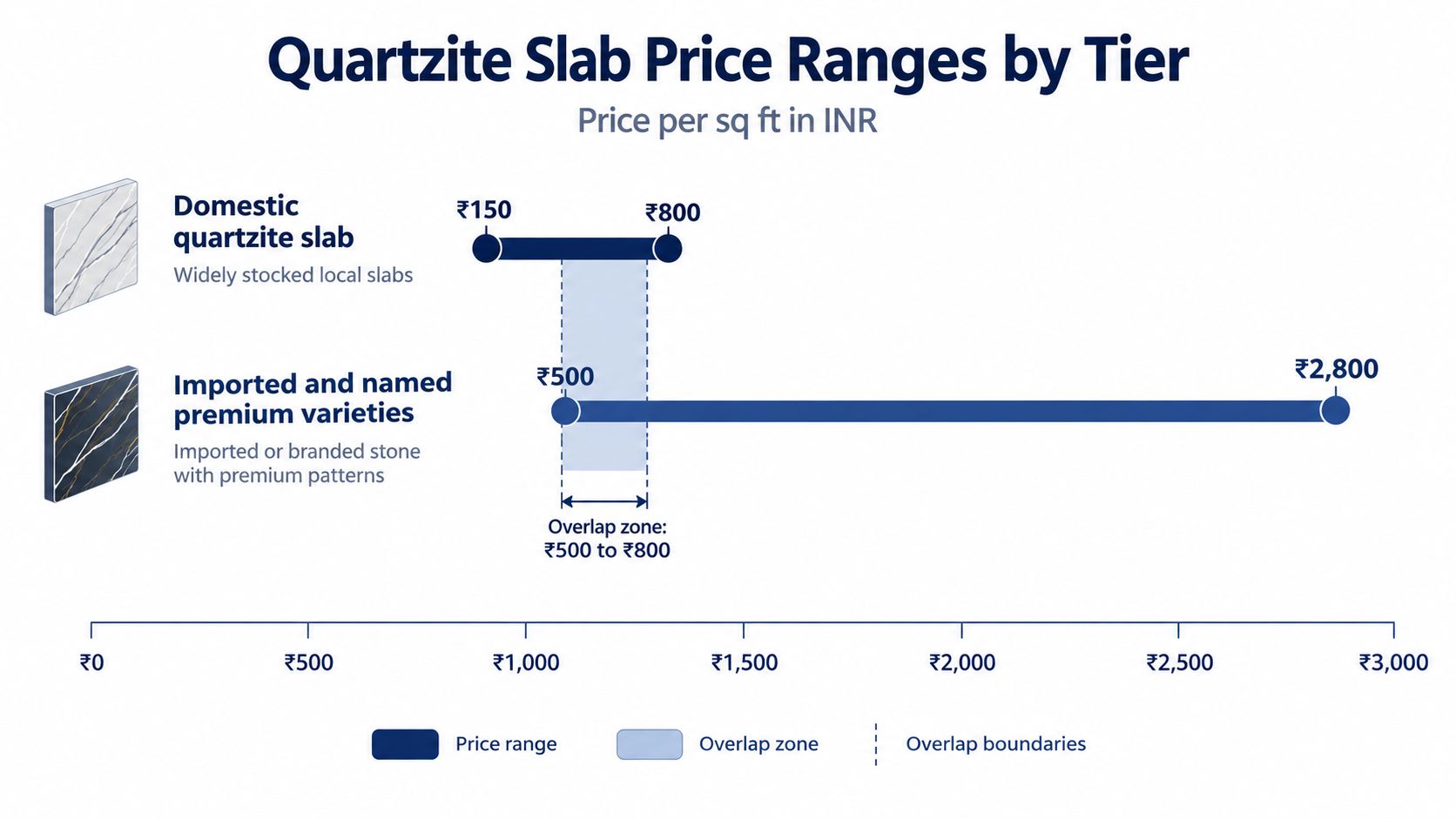
Domestic quartzite slabs ask about ₹150–₹800 per sq ft, while imported and named premium varieties range from ₹500–₹2,800 per sq ft, before fabrication and installation. For an illustrative 55 sq ft slab, those bands translate to ₹8,250–₹44,000 and ₹27,500–₹1,54,000 respectively, for material alone.
The more useful question for an NCR project is how much finished surface that purchase will deliver. A slab with an attractive yard rate can become an expensive countertop if the cut layout leaves substantial offcuts, the selected pattern requires extra material, or the quotation excludes site handling.
The price of quartzite slab material is therefore a starting input, not a completed budget. The analysis below separates published asking rates from project-specific costs and uses an explicitly assumed calculation to show how buyers can compare quotations fairly.
Table of Contents
- Quartzite Slab Price Ranges by Tier
- Named Quartzite Varieties and Their Listed Prices
- Origin, Thickness and Finish as Price Levers
- Turning Slab Price into Installed Cost per Usable Sq Ft
- Natural Quartzite or Engineered Quartz for Your Budget
- What to Specify When Requesting a Quote
- Quote Mistakes That Change the Final Bill
- Confirm Your Budget Before You Order
Quartzite Slab Price Ranges by Tier
Published asking rates range from ₹95 per sq ft for an Udaipur example of 18 mm Kandla Grey to ₹2,800 for a named premium listing. The lower listings make a ₹150 starting point too high for a budget tier, so the table uses ₹95 as its floor. That rate is an individual example, not a guarantee of current stock or a typical offer.
| Tier | Typical varieties | Asking price per sq ft | Approx. per 3200 × 1600 mm slab, using 55 sq ft |
|---|---|---|---|
| Budget domestic | White and grey quartzite | ₹95–₹500 | ₹5,225–₹27,500 |
| Mid domestic | Silver shine and ocean blue | ₹200–₹800 | ₹11,000–₹44,000 |
| Imported mid-range | Brazilian Fantasy and Macaubas | ₹500–₹1,800 | ₹27,500–₹99,000 |
| Premium imported | Taj Mahal quartzite | ₹1,000–₹2,500 | ₹55,000–₹1,37,500 |
| Named premium | Green Canyon, Bitcoin Grey, Blue Roma | ₹1,600–₹2,800 | ₹88,000–₹1,54,000 |
The domestic and imported bands consolidate published categories in the India quartzite price table. Named-premium rates come from individual marketplace listings, not a separate market index. Full-slab amounts are arithmetic illustrations based on an assumed 55 sq ft area. They are not supplier quotations or confirmation that slabs of these dimensions are available.
Read the tiers as shortlisting bands
A category range helps define a search, while a specific slab offer depends on its own specifications. White and grey quartzite may sit in the budget tier, but the category does not make every slab equivalent in quality, thickness or finish.
The ₹95 Kandla Grey example and ₹125 white polished listing sit below the original ₹150 floor. Their lower asking prices widen the budget end of the range, but they do not establish comparable products or confirm the same commercial terms. A buyer should compare the actual slab and quotation before treating either rate as a project benchmark.
Brazilian Fantasy and Macaubas also occupy different published bands. Grouping them supports an initial budget, not a direct substitution without inspection. The Taj Mahal row identifies one variety, while the named-premium row combines separate products. Overlapping price bands show that origin alone cannot predict the asking rate, and that domestic material should be assessed by its exact product and specification.
Separate a buying envelope from a quotation
These figures define a buying envelope for material, not a delivered or installed rate for Gurugram. They do not confirm stock, taxes, fabrication, site handling or installation. Listed prices are asking prices, not final project costs.
The 55 sq ft slab area is only a calculation basis. Confirm the supplier's actual slab dimensions and billable area, then check how much the fabricator's layout can use. Offcuts can reduce the usable surface, so the lowest listed rate may still produce a higher cost per usable square foot.
Keep material and completion as separate budget entries. Use the tier to narrow the search, then multiply its rate by the supplier-confirmed purchase area. Price the layout and completion scope separately before comparing NCR project totals.
Budgeting rule: Confirm the material tier and purchase area, then compare quotations by usable area and completion scope.
Named Quartzite Varieties and Their Listed Prices
| Variety | Finish or form | Thickness listed | Asking price per sq ft |
|---|---|---|---|
| Generic quartzite slab | Slab, finish not specified | 18 mm | ₹525 |
| Green Canyon | Slab, finish to confirm | Not established in this listing summary | ₹1,600 |
| Bitcoin Grey | Slab, finish to confirm | Not specified in cited example | ₹1,800 |
| Blue Roma | Slab, finish to confirm | Not specified in cited example | ₹2,800 |
These named asking prices come from Indian quartzite supplier listings. They span a wide range, but the listings do not establish matching grades, thicknesses, finishes or commercial terms. The table therefore compares offers, not like-for-like material costs.
The ₹125 white polished listing has been excluded. It falls below the article's stated domestic range of ₹150–₹800 per sq ft, and the cited example does not provide enough detail to reconcile the difference. Treating it as representative would understate a reasonable material budget.
A variety name doesn't identify the purchase
For buying purposes, a variety name is a starting identifier, not a complete specification. The exact lot matters: colour, pattern, provenance, grade and availability can all affect the offer.
This is especially relevant when a design depends on a recognisable vein pattern. A name or small reference image does not confirm which slab will be cut. Ask the supplier to identify the offered material with a full-slab photograph and lot reference.
The listed rates support a comparison of named offers, but they do not establish a standard origin, finish or grade for every product sold as Green Canyon, Bitcoin Grey or Blue Roma. Nor do they explain why one listing costs more than another. A buyer may choose to pay a premium for a particular appearance, but that decision should be based on the actual slab rather than an assumed ranking of variety names.
Resolve missing information before negotiating
Missing specifications can change what the price represents. Ask the supplier to complete them before negotiating; otherwise, a lower rate may refer to a different material or condition.
- Confirm identity: Request the material description, declared origin and lot reference.
- Record condition: Specify finish and thickness, and ask about visible repairs or features that need review.
- Approve the selection: Confirm whether the photograph shows the exact available slab or a representative example.
For darker designs, the guide to black quartzite stone offers a selection reference. A lot-specific quotation and inspection are still needed to establish what the supplier is offering.
The listed slab rate is only a starting point for a project estimate. For an NCR order, compare the confirmed material and usable area against fabrication, transport and installation costs. A cheaper listing can cost more per usable square foot if the selected slab yields less usable material or requires more work. The relevant premium is the amount paid for an approved result, not the variety name alone.
Origin, Thickness and Finish as Price Levers
Origin, thickness, finish and visual selection should be treated as separate quotation variables. If several change at once, a price difference can't reliably be assigned to any single one.
Origin and thickness need controlled comparisons
The imported categories in the tier table provide an initial reference, but origin still needs documentation on the individual offer. Ask whether the quotation is ex-yard or delivered to site, and which transport and commercial charges remain outside the stated rate.
Thickness requires even more care. The Udaipur quartzite marketplace examples include 18 mm Kandla Grey at ₹95 per sq ft and 20 mm Brown Emerald at ₹900 per sq ft, alongside 18 mm Green Canyon at ₹1,600 and 20 mm Avocado at ₹1,700.
Those examples mix varieties as well as thicknesses. They do not establish a thickness premium. A valid comparison would hold the variety, grade, finish and commercial scope constant, then ask the supplier to quote the thickness alternatives available.
The fabricator should also confirm the proposed support arrangement and whether reinforcement or edge construction changes with the selected specification. Don't assume that the cheapest available thickness is suitable for the intended span or detail.
Finish and pattern need explicit approval
A rate for polished material shouldn't be carried into a honed or leathered specification without confirmation. Ask whether the requested finish is already present on the offered slab or requires further processing, then identify any associated work separately.
The overview of types of surface finishes can help establish the vocabulary for that discussion. The purchase document should still identify the selected finish rather than relying on a general description such as contemporary or natural.
Pattern introduces a different decision. For a statement island, the buyer may value a particular vein arrangement more than visual uniformity; for repeated counters, a predictable appearance may matter more.
Before cutting, inspect the full slab for thickness consistency, flatness, visible cracks, fissures, pits, pores and colour variation. Document what the buyer and fabricator accept, and identify features that must be excluded from the cut layout.
Ask for a price at the exact thickness and finish the project will use. A loosely specified reference rate isn't a substitute for that offer.
Turning Slab Price into Installed Cost per Usable Sq Ft
Consider an illustrative calculation, not a market quotation: a 55 sq ft slab purchased at an assumed ₹400 per sq ft costs ₹22,000. If an assumed 30% becomes unavailable through defects, cut-outs and offcuts, the remaining usable area is 38.5 sq ft, making material alone approximately ₹571 per usable sq ft.
These assumptions are chosen to demonstrate the arithmetic. They aren't a claim about normal quartzite wastage, a recommended allowance or a likely outcome for a particular kitchen.
The distinction matters because marketplace quartz-stone offers cover differing product specifications and commercial conditions. A headline rate doesn't establish the purchased quantity, usable yield or completed installation scope.
| Line item | Amount | Note |
|---|---|---|
| Illustrative slab purchase | ₹22,000 | Assumed area multiplied by assumed rate |
| Usable area after assumed 30% loss to defects, cut-outs and offcuts | 38.5 sq ft | Illustrative yield, confirm through the cut layout |
| Effective material cost per usable sq ft | Approximately ₹571 | Purchase cost divided by assumed usable area |
| Fabrication, edge profile and sink cut-out | Awaiting quotation | Quote from fabricator |
| Delivery to Gurugram site and handling | Awaiting quotation | Confirm distance, load and access |
| Installation and sealing | Awaiting quotation | Quote per job with scope stated |
| Total installed cost | Not yet established | Sum after every applicable charge is confirmed |
Use a defined denominator
Installed cost per usable sq ft = total agreed project cost ÷ accepted finished surface area.
Define “usable” before comparing quotations. For this purpose, it means the finished surface the project receives, not every remaining piece of stone that might theoretically be reused.
Also distinguish an offcut from an additional purchase requirement. A layout can leave spare material yet still require another slab because the necessary piece won't fit, or because the approved pattern orientation prevents a different arrangement.
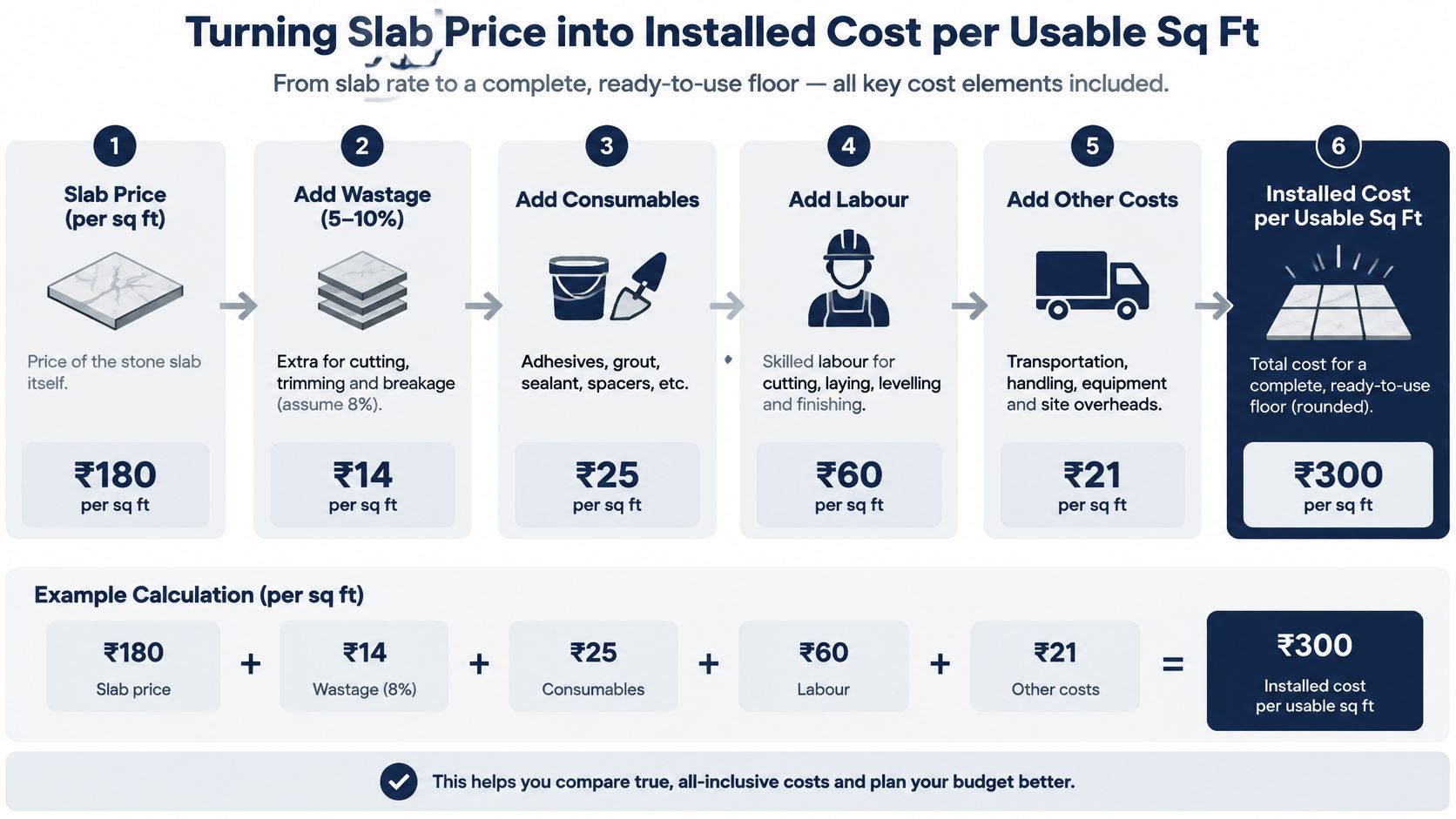
Repeat the calculation for each offer
Measure and draw the layout. Give the fabricator measured drawings showing the required pieces, openings and joints. Room area alone isn't enough to establish the stone purchase.
Confirm the slab count. Place the required pieces on the actual offered slabs, accounting for the approved vein direction and any pattern-matching requirement.
Establish the usable yield. Exclude rejected areas and distinguish unavoidable offcuts from material that can serve another specified surface. Don't apply the illustrative loss assumption automatically.
Price fabrication separately. Identify cutting, edge profiling, polishing and sink or appliance openings so that complex details aren't hidden inside a general labour line.
Add delivery and handling. For a Gurugram project, specify the destination and site access. Agree who handles unloading and movement to the installation location.
Complete the installation scope. Obtain a written price for installation and any specified sealing, with responsibilities clearly allocated.
Reconcile tax treatment. Confirm whether GST is included or additional on each applicable quotation, then compare totals on the same basis.
The cheapest listing can produce the highest project cost when its usable yield is poor or its completion requirements are expensive. That conclusion follows from the denominator: a lower purchase rate doesn't guarantee a lower cost for each finished square foot.
Don't add a second wastage charge if the quotation already bills the full slabs required by the agreed layout. Ask the fabricator to show how the purchased quantity and finished area reconcile.
Natural Quartzite or Engineered Quartz for Your Budget
For an NCR project, compare the slab asking price with the cost of the finished area you can use. Natural quartzite is quarried stone, so its price and usable yield depend on the individual slab, its veining, thickness and the cuts your layout requires. Engineered quartz combines mineral material with resin, making product consistency and the manufacturer's specifications central to the comparison. Neither listing price is an installed cost.
The available article prices should anchor the per-square-foot comparison: use the quartzite ranges and named-variety prices already established above, then compare them with a specific engineered-quartz quotation. The engineered quartz countertop cost guide offers a separate reference, but check that its product and scope match your proposed project. The quartz-stone marketplace catalogue is a place to locate offers, not evidence that products labelled “quartz” share the same composition or performance.
Compare the material, not just the label
| Budget factor | Natural quartzite | Engineered quartz |
|---|---|---|
| What drives the purchase price | Slab selection, appearance, thickness and how much of the slab the layout can use | Product specification, design and the quoted product range |
| What affects usable area | Veining and slab characteristics may constrain cuts or matching | Consistency may simplify matching, but confirm the offered product and dimensions |
| Care to confirm | Ask whether sealing is required for the selected stone and what maintenance is specified | Confirm resin-related care instructions and limits, including heat exposure |
For a statement island, a premium natural slab may make sense if its veining is the design feature. Its higher asking price only buys that value if the approved layout preserves the pattern and yields enough finished area. For repeated counters, engineered quartz may suit a preference for consistent appearance, while natural quartzite may require more careful slab selection.
In wet areas, confirm the selected quartzite's sealing needs rather than assuming every stone requires the same treatment. For engineered quartz, check the manufacturer's care and heat guidance for that exact product. Ask about repair options for either material, since remedies depend on the product and the fabricator's terms.
Convert both offers to a comparable installed cost per usable sq ft: account for the slab quantity needed by the layout, fabrication, delivery, installation and any specified sealing. A low natural-quartzite asking price can lose its advantage if the usable yield is poor; an engineered-quartz offer can also look cheaper because its scope leaves work out. Compare written, like-for-like totals, not material names alone.
What to Specify When Requesting a Quote
A useful quotation request defines the product and the work before asking for a total. Give every supplier the same document, drawings and scope, so a cheaper response doesn't merely reflect an omitted service.
Define the material and purchase quantity
Species and exact slab reference. State the requested material identity and attach a photograph or lot reference, because a variety name alone doesn't identify the visual selection being purchased.
Thickness and tolerance. Request the thickness in millimetres and the acceptable variation, with the fabricator confirming suitability for the proposed application.
Finish. Specify polished, matte, honed or leathered as applicable, and ask whether any additional finishing work is included in the offer.
Measured quantity and allowance. Provide drawings and distinguish finished area from purchase area, with the proposed wastage allowance or slab count clearly stated.
Edge profile and fabrication. Identify the edge detail, openings, sink work and polishing requirements so suppliers price the same finished geometry.
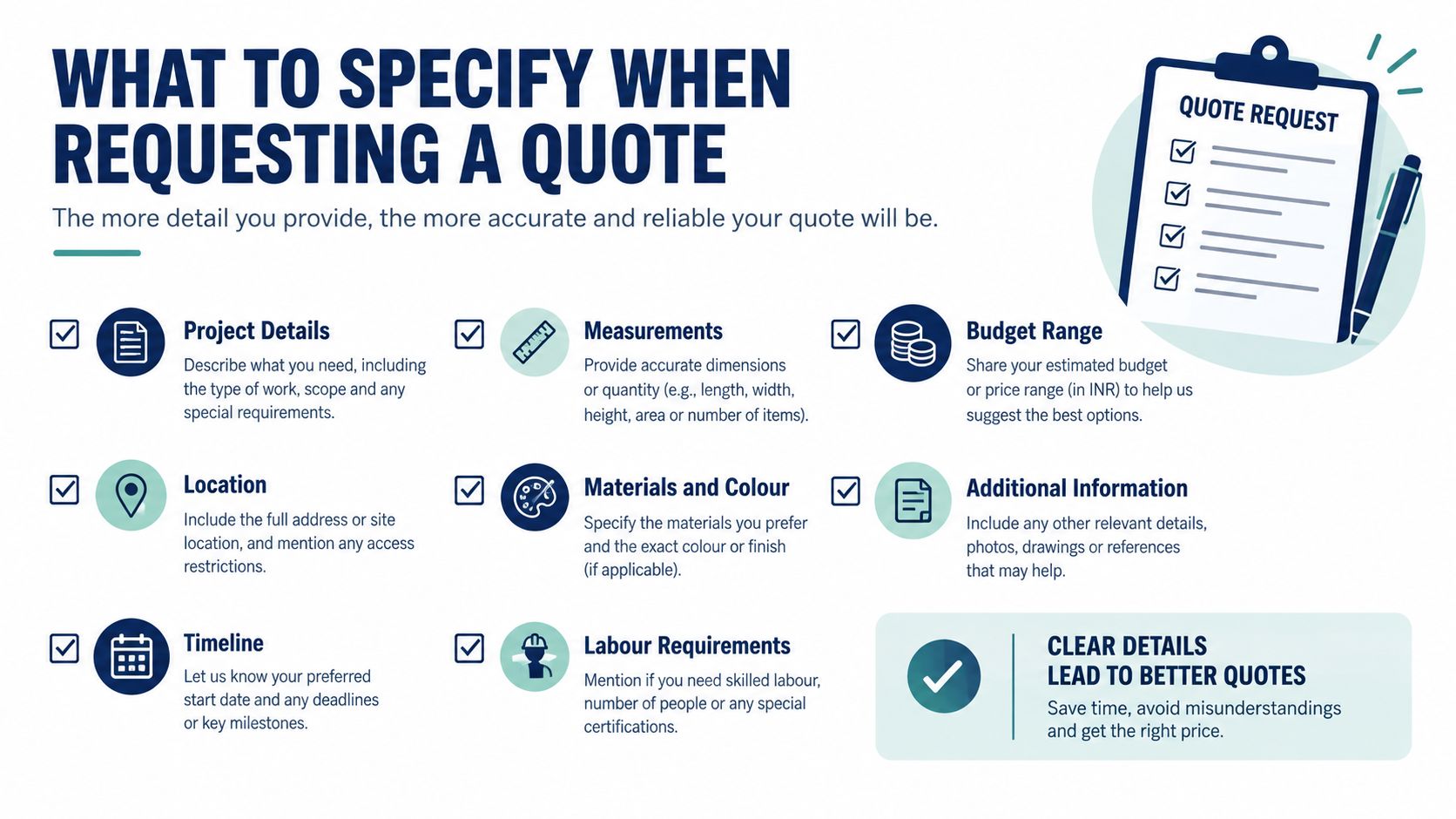
Define delivery and commercial responsibility
Delivery, handling and transit damage. Give the site location and access conditions, then name the party responsible for unloading, movement and breakage during transport.
Installation and sealing. Describe the installation scope and any specified sealing, including who supplies materials and who signs off the finished work.
GST and freight treatment. Ask the supplier to label inclusions and exclusions explicitly rather than leaving taxes or transport to be resolved after approval.
Quote validity and escalation. Request a validity period and any conditions that allow a price change, especially if slab approval and installation won't occur together.
Minimum quantity and small-lot terms. Confirm whether the offer applies to your actual requirement or depends on purchasing a larger quantity.
These are purchasing instructions, not assumptions about what every supplier includes. If a supplier can't price an item, record it as unresolved instead of treating it as free without saying so.
For the area, fabrication, delivery and installation entries, use the installed-cost routine above to reconcile the total. The quotation should make it possible to trace the finished surface back to the purchased slabs without guessing which costs have already been included.
Send the same specification to every supplier. Only then can differences between offers be interpreted as price differences rather than differences in scope, material or responsibility.
Quote Mistakes That Change the Final Bill
Comparing a raw-yard slab rate with a finished countertop price is a major budgeting error because the offers describe different purchases. One buys material; the other may include a sequence of fabrication and site services.
A low figure isn't necessarily misleading, but the buyer must establish what it buys. The same applies to a higher figure: it isn't automatically complete merely because it appears more expensive.
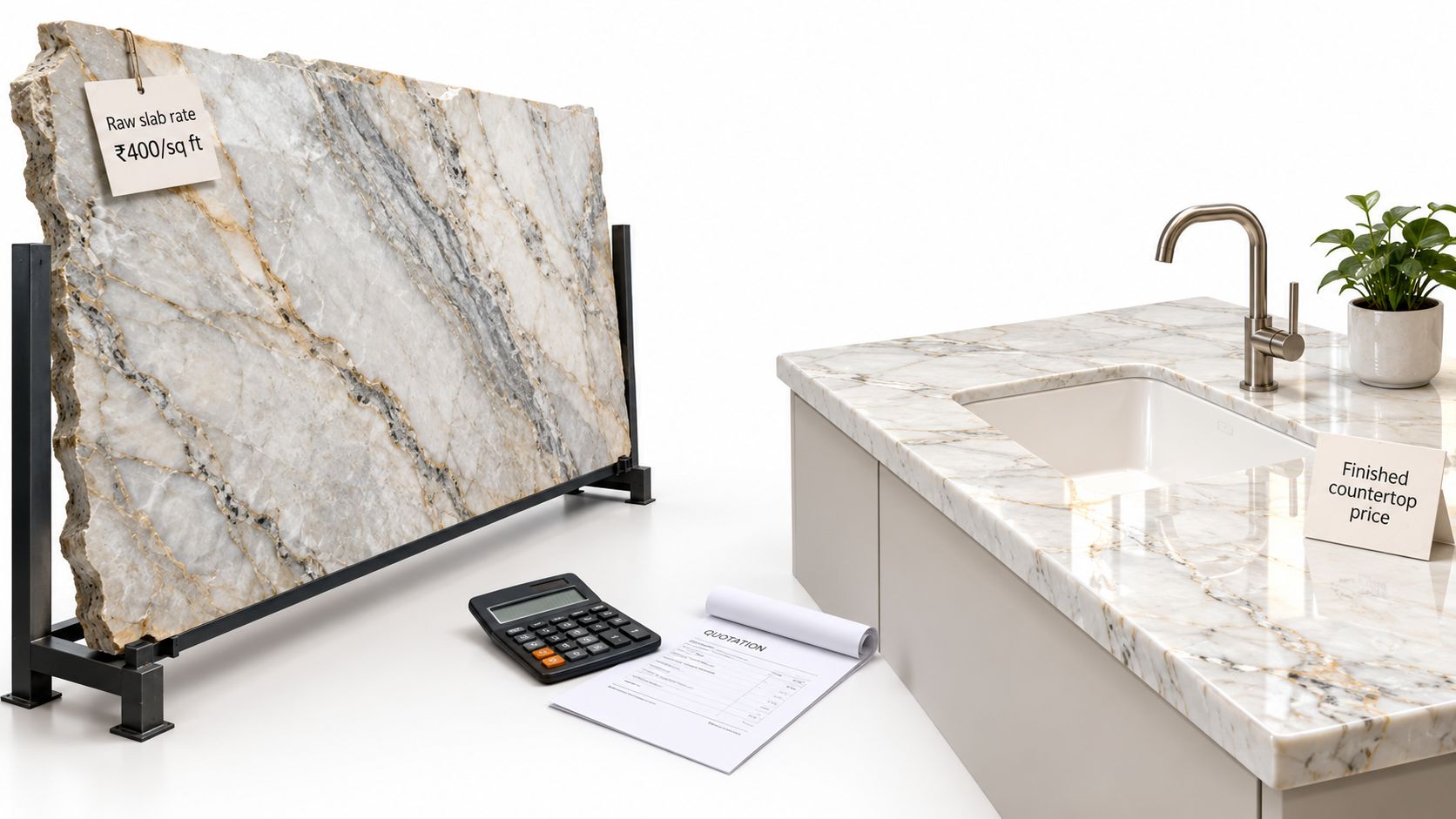
| Mistake | Effect on the final bill | Fix before ordering |
|---|---|---|
| Comparing a raw-yard slab rate with a finished countertop price | Budget misses fabrication and installation | Ask each quote to state its scope in writing |
| Using a marketplace listing as the quotation | Thickness, grade and minimum quantity may not match | Quote against a named lot, thickness and finish |
| Ignoring yield on a figured or veined slab | Usable area falls below slab area, raising cost per sq ft | Approve a cut layout and purchase allowance |
| Omitting delivery and transit breakage | Freight and damage costs remain unresolved | Record delivery, handling and damage responsibility |
| Accepting a bulk-only offer for a small job | Required purchase may exceed project needs | Confirm minimum quantity and small-lot terms |
| Cutting before inspecting the slab | Rejected areas may require rework or replacement | Inspect thickness, flatness and surface before cutting |
Approval timing matters
Inspection should take place before the approved slab is transformed into project pieces. If a buyer raises an objection only after cutting, the parties may disagree about whether the feature was visible beforehand, whether it was accepted, and who should pay for replacement.
That doesn't mean every fissure or variation is a defect. It means the buyer and fabricator need a documented decision about the offered material, using the inspection criteria identified earlier.
A similar problem arises when the buyer approves appearance without approving the layout. The selected stone may be acceptable while the proposed joint placement or vein direction isn't.
An incomplete price isn't yet comparable
Don't try to repair an incomplete quotation by adding informal assumptions from a conversation. Ask the supplier to revise the written offer, particularly where an omission affects responsibility for a failed delivery or rejected piece.
The installed-cost calculation helps expose missing charges, but it can't resolve an unidentified lot or an unapproved specification. Arithmetic becomes useful only after the purchase is defined.
Apply this final test: if scope, lot, thickness, finish, yield and transit terms aren't recorded in writing, the price isn't ready for a like-for-like comparison.
Confirm Your Budget Before You Order
A usable project budget depends on three inputs: the chosen slab, the area that can be installed, and the work required to complete it. Treat marketplace prices as asking prices, not as installed costs.
Decision checklist
Set a material range. Refer to the tier table under “Quartzite Slab Price Ranges by Tier” to identify a shortlist. Use the supplier-confirmed purchase area, not just the room's floor or counter dimensions.
Define the specification. Record the selected variety, thickness and finish, along with the measured area and intended layout. This makes it possible to compare offers for the same material and scope.
Convert offers to usable-area cost. Compare itemised quotations by installed cost per usable sq ft. Account for how much of the purchased slab becomes finished work, and keep fabrication, finishing and installation coordination visible as separate cost lines. A low listing can lead to a higher project cost if the slab's usable yield is poor or additional work is excluded.
Check the budget against the defined scope. Confirm that the total covers the specified material and planned work before approving the order. If an offer leaves a cost line unclear, request a revised quotation so the comparison does not depend on assumptions.
Before requesting quotes, gather three documents: measured drawings, a written material specification, and an itemised checklist of required work. Together, these give suppliers a consistent basis for pricing and make differences between offers easier to trace.
Varun Marbles supplies engineered quartz and natural stone, with support for cut-to-size fabrication, edge profiling, surface finishing and installation coordination. Visit Varun Marbles to arrange an in-person review in Gurugram, bringing the drawings and specification so material selection and completion costs can be discussed separately.