
Regal Beige Marble: A Complete Buyer's Guide for 2026

You're standing in a Gurugram stone showroom with a cabinet sample in one hand and a flooring plan in the other. A polished beige slab looks like the answer: warm enough for the living room, quiet enough for the kitchen, and easy to carry through the bathrooms. Before you reserve it, there's a less glamorous question to settle: will this particular lot perform where you intend to install it?
Table of Contents
- The Beige Marble That Looks Perfect Until It Doesn't
- What Regal Beige Marble Actually Is
- Reading Appearance, Veining, and Finish Options
- Technical Standards That Actually Matter
- Matching the Stone to the Right Application
- Sourcing, Slab Selection, and Supply in the NCR
- Installation and Maintenance for Long-Term Performance
- Your Pre-Purchase Checklist Before You Sign for the Slab
The Beige Marble That Looks Perfect Until It Doesn't
Consider a plausible renovation decision, rather than a documented project. A homeowner chooses Regal Beige marble for an open kitchen because the polished surface complements the joinery beautifully. The same finish goes into the adjoining washroom to keep the interior coordinated.
After handover, lemon residue leaves a dull patch on the worktop. A wet bathroom floor feels less secure underfoot, and a darkened area near the basin raises questions about moisture uptake. These are different problems, not evidence of a single defective stone.
The mistake was treating visual coordination as technical approval. A slab can be attractive and structurally usable yet still demand more care, or a different finish, than the household expected.
What showroom approval leaves unanswered
Showroom lighting tells you little about how a surface will behave around cooking acids, wet feet or tracked-in grit. A small sample also doesn't establish the condition of the slabs that will be cut.
Before approving the material, separate the decisions:
- Appearance: Does the full slab suit the room, including its movement and shade variation?
- Lot quality: Can the supplier connect the physical test report to the reserved material?
- Application: Has someone assessed the selected finish under the conditions the surface will face?
- Ownership: Will the household or housekeeping team follow the required care routine?
Practical rule: Approve the stone, the finish and the intended use together. A beautiful slab isn't an approval for every room.
Not every downstream problem can be predicted from a certificate. Test results won't reveal a poorly supported cut-out, an unsuitable cleaning product or an installation team's workmanship. They do, however, remove guesswork from important material properties.
The sound buying order is measure first, approve the application next, then commit to the appearance. If the stone requires a level of care you don't want, choosing another surface before cutting is better than trying to manage disappointment after installation.
What Regal Beige Marble Actually Is
Regal Beige is a commercial stone name, not a standardised Indian geological variety. Available Regal Beige product information associates it principally with Turkish supply, describes a warm beige appearance with relatively subtle movement, and lists common slab thicknesses of 12, 15 and 18 millimetres.
Read that name as a starting point for selection, not a performance specification. It identifies the material being marketed, but it doesn't establish that every supplier's stock comes from an identical deposit or carries an identical grade.
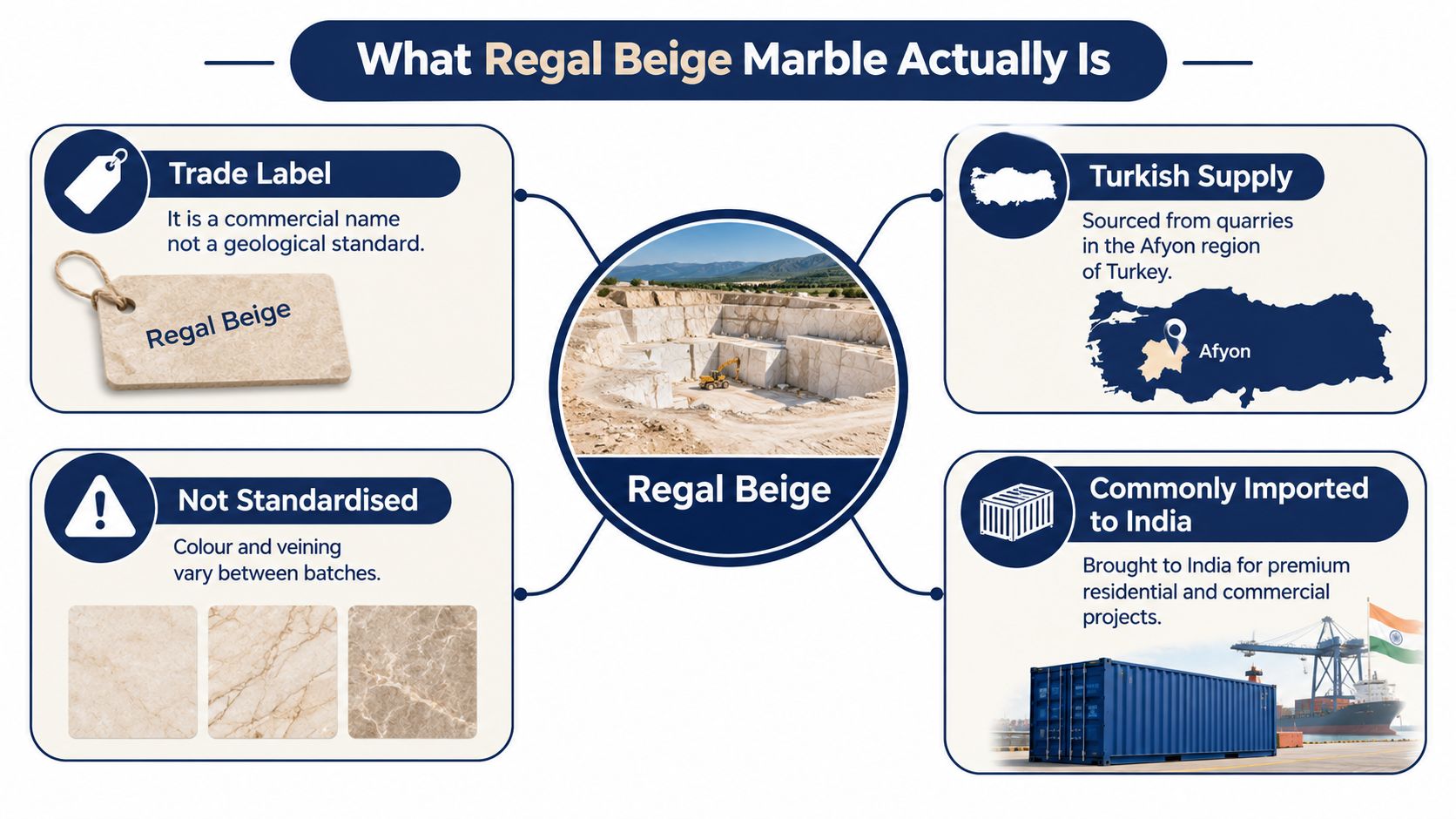
Read the invoice beyond the name
Ask the supplier to record the country of origin, slab identification, declared thickness and agreed finish against your reservation. Where quarry documentation is available, retain it with the purchase file rather than relying on a verbal description.
There isn't a useful universal slab dimension to assume from the trade name. Request the actual usable dimensions of the reserved pieces, allowing the fabricator to identify damaged margins, unsuitable veins and areas that won't enter the cutting layout.
| Description offered | What the buyer should establish |
|---|---|
| Regal Beige | Which physical slabs carry that description? |
| Turkish origin | What documentation supports the origin declaration? |
| Selected quality | What defects and variations are acceptable? |
| Matching material | Which slabs belong to the approved batch? |
| Finished slab | What finish and thickness will be delivered? |
An Indian beige alternative should be evaluated through the same process. Similar colour doesn't establish equivalent absorption, hardness, filling or fabrication behaviour, and Turkish origin doesn't automatically make a slab superior to an Indian one.
The practical distinction is between a commercial promise and an inspectable specification. A careful invoice connects the name to identifiable material; a vague invoice leaves room for substitution.
Keep offcuts from the approved lot where practical. They provide a physical reference for later finish discussions and repair trials, although they can't guarantee that replacement stock will match.
Reading Appearance, Veining, and Finish Options
Put neighbouring slabs beside each other before judging either one. Warm beige can look beautifully uniform in isolation, yet an adjacent piece may reveal a shift towards a cooler background or stronger movement.
Think of fabric dye lots: the label stays the same, but the relationship between adjoining pieces matters. For flooring, evaluate the proposed grouping. For a vanity or island, evaluate the particular portion that the cutting plan will expose.
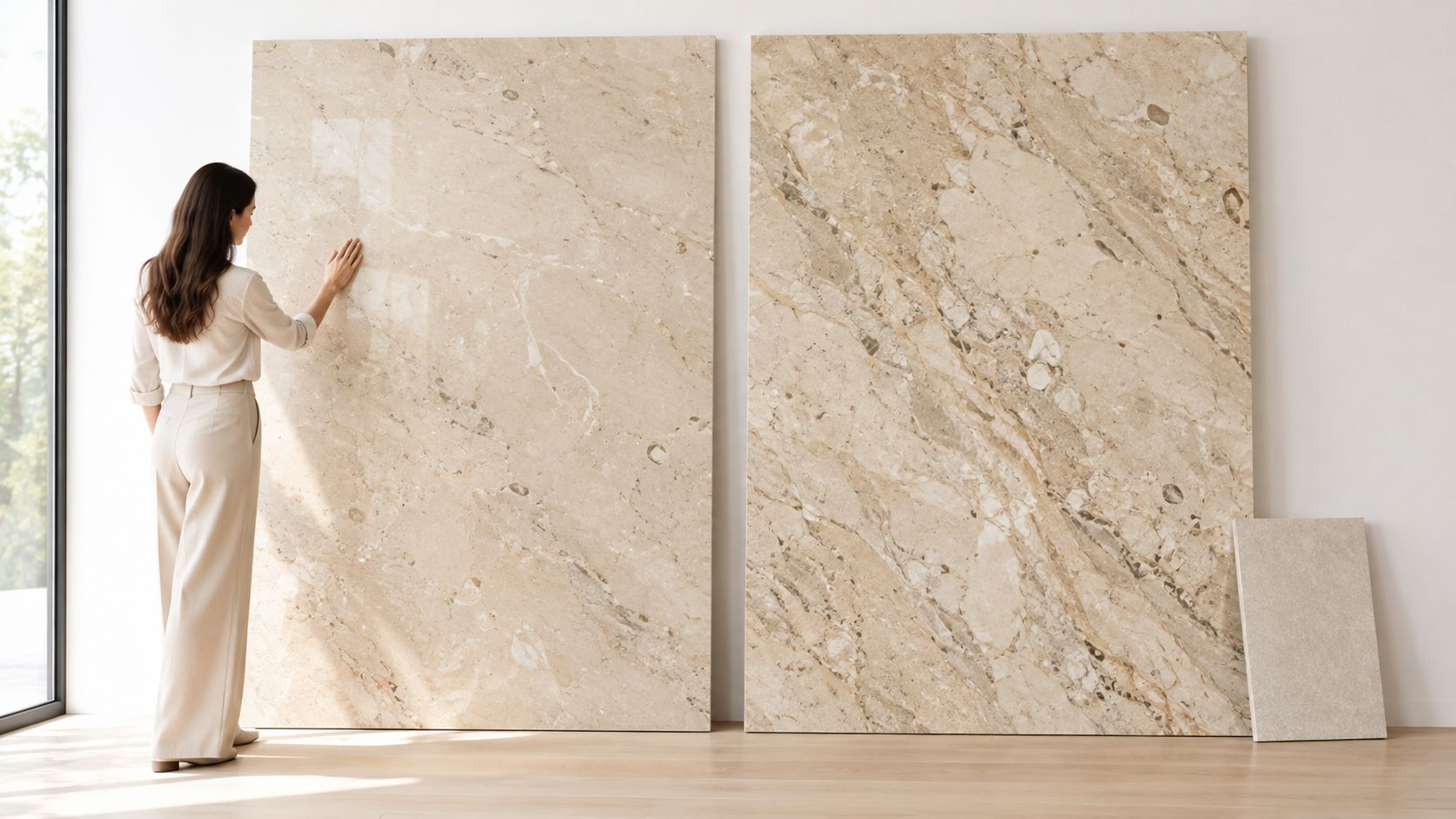
Compare the finish on actual material
Polished Regal Beige gives a reflective presentation. It suits a design that welcomes shine, but reflections can complicate your assessment of subtle surface irregularities. Look across the slab from different angles rather than inspecting it only head-on.
Honed material offers a lower-sheen presentation. Ask for a finished sample from the proposed lot so you can judge whether the quieter appearance works with your lighting and furniture.
Leathered is a textured finishing option, not a complete technical specification. Request a sample showing the proposed texture, and discuss how the fabricator will finish edges, corners and adjoining pieces.
| Visual question | Useful yard check |
|---|---|
| Is the background consistent? | Compare slabs together under the same light |
| Will the movement look deliberate? | Mark the intended orientation on the cutting layout |
| Are surface interruptions acceptable? | Inspect visible filling and changes in sheen closely |
| Does the finish suit the room? | View a physical sample beside joinery and lighting samples |
A photograph is useful for recording selection, but it shouldn't replace inspection. Reflections, camera exposure and a phone screen can alter your impression of the stone.
The beige marble texture guide is a useful companion when developing a visual brief. Convert that brief into plain instructions such as a quiet background, restrained movement or a deliberately varied floor.
Avoid requesting completely identical natural slabs without defining what variation you will accept. Specify inspected slabs, their orientation and their finish, then agree how neighbouring pieces will be arranged before fabrication begins.
Technical Standards That Actually Matter
A supplier's brochure and a delivered-lot test certificate serve different purposes. The brochure describes a product; the certificate should establish the properties of material traceable to your purchase.
The IS 1130 marble requirements summary gives the relevant benchmarks: maximum water absorption of 0.4% by weight after 24 hours of cold-water immersion, minimum Mohs hardness of 3, and minimum specific gravity of 2.5. IS 1124 supports testing for absorption, apparent specific gravity and porosity.
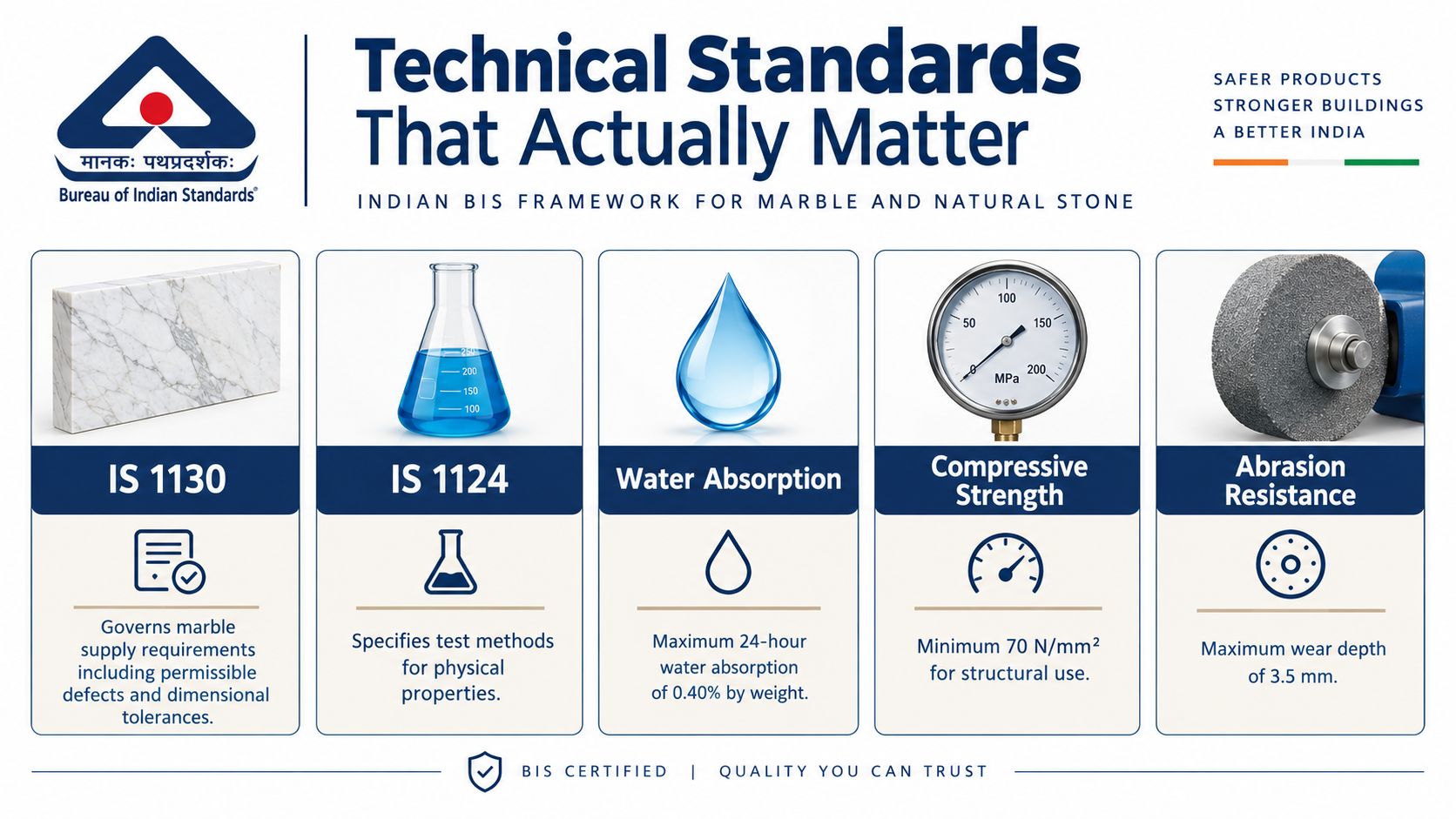
Treat the graphic as an orientation aid, not the project's acceptance schedule. IS 1130 doesn't prescribe an abrasion-resistance or slip-resistance limit; those requirements need separate project-specific assessment, as the linked standards summary explains.
Translate the report into buying questions
- Absorption: Ask whether the report uses the relevant test method and whether the tested sample represents the reserved lot. Lower uptake can reduce the likelihood of rapid moisture darkening and staining, but it doesn't establish stain-proof performance.
- Hardness: Request confirmation against the marble benchmark. A compliant result isn't permission to drag abrasive objects across the surface.
- Specific gravity: Look for the reported result, rather than accepting a description such as dense premium stone.
- Traceability: Check sample identification, test date, laboratory details and the supplier's connection between the sample and your slab reservation.
- Exceptions: Ask for a written response to results outside the acceptance criteria, unexplained inconsistencies or missing tests.
A convincing report still needs physical inspection. Open fissures, problematic filling and edge defects deserve attention before the fabricator commits to cutting.
Add the tests your application needs
For floors, request finish-specific slip and wear assessment. Don't accept a result for a different finish as evidence for the one being installed, particularly where the surface will become wet.
Thickness tolerance also needs a written agreement. Have the fabricator explain the acceptable variation for the proposed installation and verify delivered material with a caliper; the trade description alone isn't enough.
A certificate is useful only when it can be connected to the material being delivered and the conditions being specified.
If the supplier can't establish that connection, pause the order. Re-testing costs less disruption than discovering an unresolved material question after the slabs have been fabricated.
Matching the Stone to the Right Application
Regal Beige marble isn't automatically suitable for every surface in a coordinated interior. The BIS building-materials guidance identifies properties such as absorption, porosity, abrasion, weathering, durability and capillary water transmission as relevant to stone assessment.
The following matrix is a practical selection judgement, not a product certification. Every conditional approval depends on the actual lot, installation design and intended maintenance.
Regal Beige Marble Application Suitability Matrix
| Application | Recommended Finish | Suitability | Key Caveat |
|---|---|---|---|
| Living-room flooring | Polished or honed | Recommended for assessed dry interiors | Agree wear expectations and cleaning routine |
| Feature walls | Polished, honed or sampled texture | Recommended | Confirm support, fixing and cutting layout |
| Kitchen islands used mainly for serving | Honed or polished by preference | Acceptable with conditions | Owner must accept surface-care demands |
| Active kitchen countertops | Finish selected after a care discussion | Caution | Choose another material if appearance must remain effortless |
| Vanity tops | Honed or polished | Acceptable with conditions | Check basin detailing and likely product exposure |
| Bathroom floors | Honed or leathered candidate finish | Conditional, not automatic approval | Require wet-use slip assessment |
| Shower walls | Finish approved through a mock-up | Acceptable with conditions | Resolve waterproofing, joints and cleaning access |
| Staircases | Assessed lower-sheen or textured finish | Acceptable with conditions | Verify slip performance and tread detailing |
| Hospitality entrances | Project-tested finish | Caution | Require wear and slip evidence |
| Balcony floors | No default recommendation | Avoid without project-specific approval | Assess outdoor exposure and wet-use safety |
| Exterior cladding | Engineer-approved finish and assembly | Conditional specialist use | Require weathering and fixing assessment |
Honed or leathered finishes may be better candidates than mirror polish in wet or busy areas, but texture isn't a substitute for testing. Don't describe a floor as safe solely because it looks matte.
Thickness should follow the support conditions, cut-outs, edge design and fixing system. There's no responsible universal thickness recommendation covering both a supported vanity and exterior cladding.
For a kitchen comparison, Home Pro's Remodeling & Repairs' discussion of the durability of quartz vs granite offers another decision resource. The marble and quartzite guide can also help you frame questions about alternatives without assuming that visually similar stones behave alike.
Choose something else when the intended use conflicts with the care you're prepared to provide.
Sourcing, Slab Selection, and Supply in the NCR
Quarry origin is only part of a reliable purchase. An NCR project also depends on who inspects the slabs, prepares the cutting layout, carries out fabrication and takes responsibility when delivered material differs from the reservation.
Historical Indian Minerals Yearbook reporting on marble placed Rajasthan at about 89% of India's marble output value in 2014–15, with roughly 95% of marble-processing capacity and slab-production capacity of around 1,000 million square feet per year. These historical figures explain why Indian processing infrastructure remains relevant even when the chosen stone is imported.

Use the supply-chain diagram as a general orientation, not evidence of the route taken by a particular consignment. Ask your supplier for the documentation and handling arrangements that apply to your reserved stock.
A yard inspection worth supervising
Start far enough back to judge the overall relationship between slabs. Then move close to inspect the surface and exposed edges.
- Record the reservation: Photograph slab identifiers and have them entered on the selection sheet.
- Examine veins and margins: Ask the fabricator to identify open fissures, hairline cracks and portions they propose to exclude.
- Inspect filling: Discuss visible resin or filled areas, especially where a cut-out, corner or narrow strip is planned.
- Measure the material: Use a caliper at accessible locations and compare the readings with the agreed thickness tolerance.
- Approve the cutting map: Mark orientation, joins and the pieces intended for each room before cutting starts.
Hand inspection has more value when the same findings reach the fabricator and installer. A showroom conversation that never enters the production file won't protect the final layout.
Before dispatch: Compare the finished pieces with the approved cutting map, not merely with the invoice total.
Ask who handles packing, transport damage, unloading and site access. Agree when responsibility changes hands and how discrepancies will be documented.
A supplier offering quarry selection, local inspection and coordinated fabrication should be able to show how those services connect. The useful test isn't the breadth of the sales presentation; it's whether someone can trace your chosen material from reservation through finished-piece delivery.
Installation and Maintenance for Long-Term Performance
The installer should approve the substrate and assembly before the stone arrives. Ask for a written plan covering substrate preparation, adhesive compatibility, joint layout, edge profiles and the manufacturer's curing instructions.
For wet areas, require the project team to resolve waterproofing, falls and penetrations independently of the decorative stone selection. A quality slab doesn't compensate for an unsuitable installation detail.
Agree the handover routine
Specify a compatible penetrating sealer after fabrication, with application and curing carried out according to the product instructions. Agree who applies it and how the work will be recorded.
The Indian natural-stone standards and care guidance identifies marble's vulnerability to scratching and acid etching and recommends pH-neutral cleaning. Acid reaction can dull the polished carbonate surface, producing an etch rather than an absorbed stain.
That distinction matters when someone tries to repair a mark. More sealer won't restore polish lost to etching, and an aggressive stain-removal attempt can introduce another problem.
| Task | Written instruction for housekeeping |
|---|---|
| Routine cleaning | Use the approved pH-neutral stone cleaner |
| Food spills | Remove lemon, vinegar and tomato residue promptly |
| Bathroom cleaning | Keep acidic bathroom products off the marble |
| Installation residue | Ask the stone specialist to approve removal methods |
| New marks | Record the location and exposure before attempting treatment |
| Sealer review | Follow the product guidance and assess actual use conditions |
Don't set a universal resealing interval just because it sounds reassuring. Establish a review routine based on the sealer manufacturer's instructions, surface exposure and the condition of the installed material.
Keep unsuitable cleaners out of the cupboard
Hard-water deposits need particular care because a household descaler may contain ingredients unsuitable for marble. The hard-water stains on marble guide is a useful starting point before selecting a treatment.
Treat the surface like a valued wooden dining table: prevention is easier to organise than repeated restoration. Leave the approved cleaner on site, label it clearly, and give the household or facility manager the written routine.
A maintenance specification only works if the person cleaning the stone can follow it.
Your Pre-Purchase Checklist Before You Sign for the Slab
Signing should confirm decisions already made, not start another round of assumptions. Bring the floor plan, joinery samples and intended-use notes to the yard, then leave with a reservation sheet that the fabricator can use.
Carry this into the showroom
- Confirm the material identity. Record the origin declaration and the identifiers of the reserved slabs.
- Check usable dimensions and thickness. Obtain measured information, not just nominal catalogue descriptions.
- Approve the visual grouping. Record shade relationships, vein orientation and any agreed variation between rooms.
- Resolve visible defects. Mark filling, fissures and excluded areas on the slab photographs or cutting map.
- Request the lot-linked test report. Check it against the acceptance benchmarks established earlier, including the absorption requirement.
- Match evidence to the application. Obtain the relevant finish-specific slip, wear or exposure assessment where needed.
- Agree fabrication details. Confirm edges, joints, cut-outs, supports and the process for approving changes.
- Document sealing and care. Name the approved products and assign responsibility for application and handover.
- Set delivery responsibilities. Confirm inspection, damage reporting and the treatment of substituted or rejected pieces.
For readers comparing tile-based projects as well as slab installations, Melbourne Tiling Services P/L's marble tiles Melbourne guide provides an additional planning resource. Keep the local project specification and tested material central to your own approval.
Recognise the reassuring claims that aren't enough
Sealed doesn't mean stain-proof. Equally, marble isn't automatically unsuitable for every floor; finish, exposure and verified performance determine the decision.
All beige stones don't behave alike, and an imported label isn't a substitute for inspection. The strongest purchase combines an identifiable lot, an appropriate application and an installation team working from the same written decisions.
If a question remains unresolved, keep the slab uncut. A curator-style supplier should help you decide whether to proceed, change the finish or select a different material, rather than treating every application as an easy yes.
Varun Marbles offers natural-stone selection, cut-to-size fabrication, edge profiling and installation support for residential and commercial interiors in Gurugram. Visit Varun Marbles with your plans and finish samples to discuss Regal Beige marble, inspect available slabs and agree the verification needed before cutting.