
Engineered Quartz Countertops Cost Guide

A client in Gurugram often starts with a simple question: “What's the engineered quartz countertops cost per square foot?” They find an attractive slab rate, multiply it by the visible counter area, and set the figure aside. The surprise comes later, when cutting, polishing, sink and hob openings, transport, lifting, joints, and installation appear on the final invoice.
That gap exists because a raw slab price and a completed countertop price are different things. For an NCR kitchen, the useful budget is the cost of the finished surface at site, not the lowest number printed beside a slab. Material grade matters, but so do the shape of the counter, access to the property, fabrication method, and the quality of the installation team.
Table of Contents
- Finished Surface Pricing Versus the Headline Slab Rate
- Material Tiers and Market Price Bands
- Design Variables That Drive Fabrication Costs
- Ancillary Site and Installation Expenses
- Sample Budget for a Standard Kitchen Layout
- Fabrication Safety and Occupational Health
- Lifecycle Value Compared to Natural Stone
- Securing an Accurate Quotation
- Streamlining Your Project with Varun Marbles
Finished Surface Pricing Versus the Headline Slab Rate
A slab rate can look precise while leaving the finished budget unclear. It covers the material, not the yield from each slab, the number of cut-outs, the edge treatment, or the fabrication work needed before the countertop reaches an NCR site.
Indian pricing guidance places standard quartz material at approximately ₹250–₹400 per square foot. Premium quartz with marble-look patterns, stronger veining, or high-end finishes commonly reaches ₹800–₹1,200 per square foot for material alone, as outlined in this India quartz and granite countertop pricing guide. Treat these as indicative bands, rather than fixed quotations for every Delhi or Gurugram project.
Why the headline rate changes
The finished-surface budget must account for work that a slab-only quote may leave out:
- Fabrication: Cutting, polishing, edge shaping, joint preparation, and template work.
- Openings: Sink and hob cut-outs need accurate measurements and additional finishing.
- Logistics: Transport, lifting, restricted access, and careful handling can change the amount.
- Wastage: The visible counter area may not match the slab area purchased, particularly with directional patterns or awkward layouts.
- Installation: Levelling, jointing, adhesive work, and final placement form part of the installed surface.
- Site modifications: Weak cabinetry, uneven walls, or structural changes can create work outside the slab rate.
A 25–35-square-foot kitchen may cost roughly ₹15,000–₹45,000 installed for standard quartz and ₹40,000–₹1,50,000 for premium quartz, according to the same India-focused pricing reference. The wide range reflects differences in grade, layout, edge profiles, access, and fabrication requirements.
Practical rule: Request the finished installed rate and the slab-only rate as separate figures. A low material rate does not make quotations comparable if one excludes fabrication, lifting, seams, or site work.
For architects and homeowners, approve the colour and slab before fabrication, then issue a measured template with a line-item quotation. A lower slab price can still produce a higher finished cost after a complicated edge, additional seams, difficult lifting, or responsible off-site fabrication and installation are included. The relevant comparison is the completed surface at site, with every required operation visible in the budget.
Material Tiers and Market Price Bands
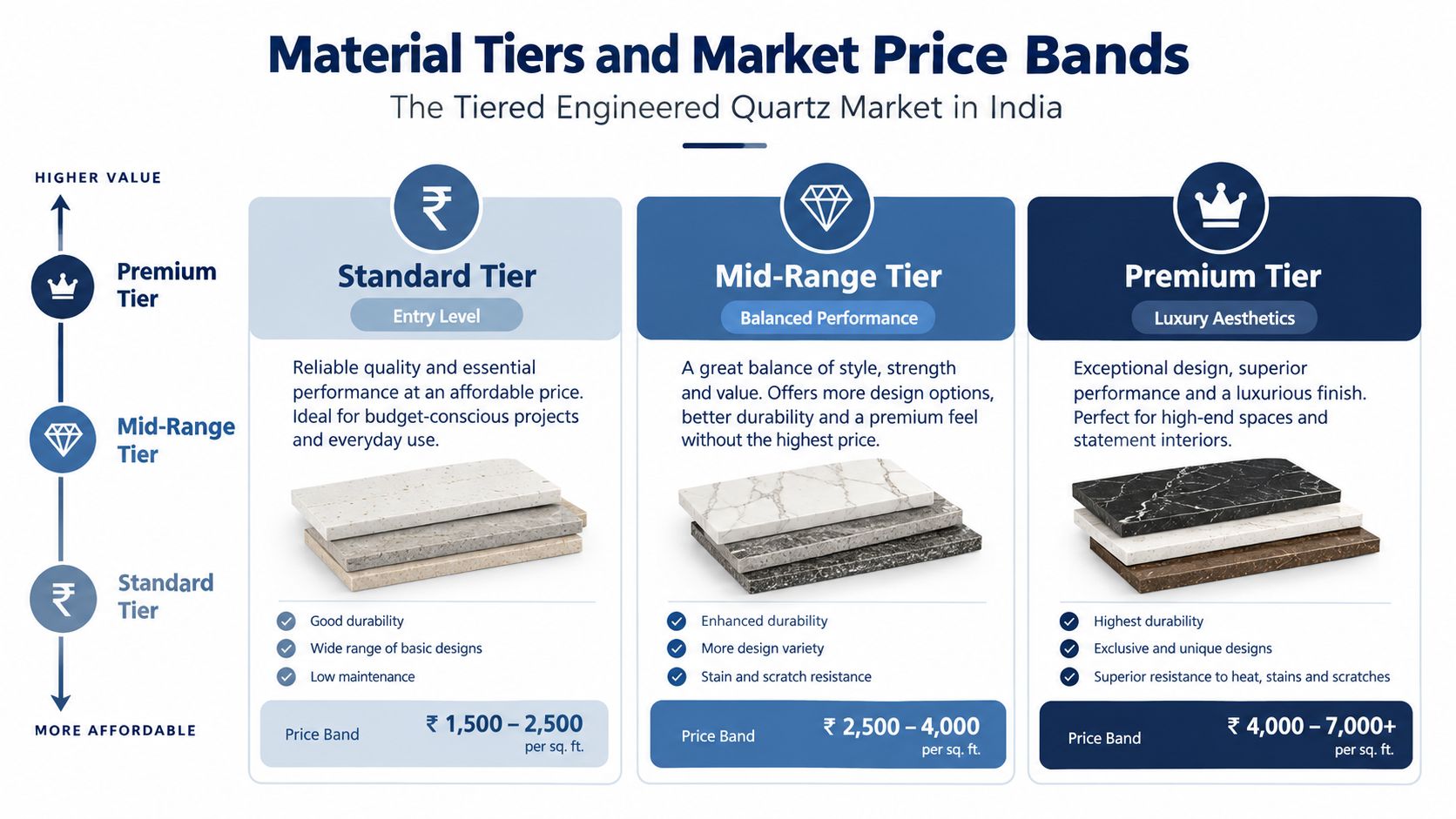
Engineered quartz in India is a tiered market, so a single per-square-foot rate rarely describes the finished surface. Two slabs sold as quartz can differ in pattern control, finish, thickness, brand positioning, stock availability, and suitability for fabrication.
Use the following material-only bands as a starting point for NCR discussions. They are not a quotation. Colour selection, slab dimensions, availability, layout, and fabrication requirements can change the final offer.
Standard tier
Standard quartz generally falls around ₹250–₹400 per square foot for material only, an indicative market range for straightforward residential work. These products suit simple kitchen runs, utility counters, rental upgrades, and projects where a consistent surface matters more than a pronounced stone imitation.
Pattern movement is usually more uniform, with simpler colour variation and fewer strong veins. A standard 20-millimetre slab is a common practical specification for ordinary residential work, subject to the chosen brand, colour, and available stock.
Mid-range tier
Mid-range quartz typically sits around ₹400–₹700 per square foot for material, based on supplier quotations commonly seen in the market. This bracket can provide more controlled patterning, greater visual depth, and a wider colour range for islands or coordinated kitchen and bathroom surfaces.
For many NCR projects, it offers a sensible balance between appearance and budget. The slab may look more distinctive without placing the complete installation in a luxury material category.
Premium tier
Premium quartz commonly reaches ₹700–₹1,200 per square foot, while Calacatta or Carrara-style products may rise to ₹2,000–₹5,000 or more per square foot, according to this engineered-quartz budgeting calculator. Strong veining, controlled marble-look movement, specialised matte or leathered finishes, imported designs, and luxury brand positioning can all increase the material rate.
Review full quartz slabs for kitchen and interior surfaces before approving a design. Full-slab viewing helps confirm vein direction, bookmatching potential, colour consistency, and how the pattern will appear across a prominent island. The material tier sets the starting point, while the selected slab and its fabrication suitability determine whether the finished surface stays within budget.
Design Variables That Drive Fabrication Costs
A straight counter with one polished edge has a different fabrication brief from an island with a waterfall return, undermount sink, hob opening, wall upstand, and several visible joints. Once the quartz grade is selected, these design decisions often determine the finished-surface cost.
Start with the edge profile. A standard straight edge usually costs less because it needs less shaping and polishing. Bevelled, bullnose, waterfall, and ogee profiles require extra machine work and hand finishing. Across the India market, these profiles may add roughly ₹100–₹500 per running foot, depending on the shape and finish required.
The details that change the fabrication brief
- Edge profile: Confirm the profile drawing, exposed edge length, corner radius, and whether polishing covers every visible side.
- Thickness: A thicker-looking edge may need a laminated build-up instead of a single thicker slab. That adds material, adhesive, alignment, and polishing work.
- Sink opening: An undermount sink requires an accurately finished opening and adequate support around the cut-out. Keep the final sink model available before templating.
- Hob opening: Use the appliance manufacturer's dimensions rather than a rough cabinet opening. The design should account for heat clearance and support.
- Waterfall sides: A waterfall panel uses extra quartz and makes mitres, vein direction, corner alignment, and seam visibility more demanding.
- Joints: Long runs, L-shaped counters, and multi-slab layouts need planned seams. Their locations affect appearance, slab usage, and labour.
Accurate measurements protect the budget. The principles in this guide to granite slab measurements and layout planning also apply to quartz templating, since both materials require reliable site dimensions before cutting.
For NCR homes and architectural projects, calculate horizontal surfaces, exposed vertical panels, edge length, openings, joints, and expected slab consumption as separate quantities. A per-square-foot allowance based only on the countertop footprint can miss the fabrication work that makes the finished installation expensive. Confirm mitre details, vein matching, cut-out tolerances, and polishing requirements before approving the quotation.
Ancillary Site and Installation Expenses
A quotation that lists only “quartz at ₹X per square foot” is incomplete. The material still has to move from the supplier's yard to the property, reach the kitchen safely, fit against the walls, and sit level on prepared cabinetry.
For Indian countertop projects, fabrication and installation commonly add ₹150–₹400 per square foot, depending on edge profiles, cut-outs, and city conditions, according to this countertop material and installation cost guide. That allowance is separate from the slab rate and may still exclude unusual access or structural work.
What sits outside the slab price
Transport is affected by distance, vehicle access, loading conditions, and whether the slab must be handled through a narrow entrance. Lifting to an upper floor can require additional labour or equipment, particularly when the slab can't travel safely through the lift or stairwell.
Fabricators also need a stable base. If the carcass is uneven, under-supported, or not ready on the agreed date, the installation team may need to return, re-level, or modify the support. Those changes aren't material costs, but they affect the project budget and programme.
Jointing deserves specific attention. A seam isn't merely a line where two pieces meet. The fabricator must align the pieces, prepare the edges, apply suitable adhesive, clamp or position the sections, and finish the joint so it remains as discreet as practical.
The cheapest quote often excludes the work that makes the surface look finished.
Plumbing coordination matters too. The countertop team needs confirmed sink dimensions, tap locations, and appliance positions before cutting. For general context on coordinating service rough-ins and final connections during construction, this resource on rough-in and final plumbing San Antonio provides a useful example of why trade sequencing matters, even though the project location and local practices differ.
Sample Budget for a Standard Kitchen Layout
A 32-square-foot conventional kitchen counter can show why a slab rate is an incomplete budget. Using a mid-range quartz allowance, the material may be priced at ₹550 per square foot, while edge work, openings, handling, and fitting determine the amount the client ultimately pays.
| Cost Component | Indicative Rate | Total Estimate |
|---|---|---|
| Quartz material | ₹550 per sq ft | ₹17,600 |
| Edge polishing | Project allowance | ₹1,900 |
| Sink cut-out | Project allowance | ₹1,000 |
| Hob cut-out | Project allowance | ₹800 |
| Transport and lifting | Project allowance | ₹2,000 |
| Installation and jointing | Project allowance | ₹2,500 |
| Completed project total | Effective rate about ₹806 per sq ft | ₹25,800 |
The finished total is ₹25,800, or about ₹806 per square foot, compared with the material-only rate of ₹550 per square foot. This is an illustrative India-market scenario, not a fixed quotation. Fabrication complexity, access, quartz grade, and the contractor's scope can change each allowance.
The calculation also works out to approximately ₹1,613 per running foot for the stated layout. That rate should not be copied to another kitchen. Running-foot pricing changes with counter depth, shape, exposed edges, openings, and the method used to calculate slab consumption.
The practical lesson is simple: price the completed surface, not only the slab. Polishing, cut-outs, lifting, transport, installation, and jointing produce the usable counter and should appear as separate lines in the quotation.
For a Gurugram or wider NCR estimate, ask whether the fabricator has priced net installed area, full slab consumption, or running feet. Confirm the measurement with a site template before ordering, particularly where the design includes a sink, hob, return, or peninsula.
A fabrication drawing should record:
- slab direction and visible pattern;
- seam positions;
- edge geometry;
- sink and hob dimensions;
- joint colour and adhesive;
- support requirements around openings;
- finished wall and cabinet tolerances.
Line-by-line pricing gives the homeowner and architect a budget they can test before fabrication starts. It also exposes whether a low per-square-foot rate leaves edge finishing, cut-outs, or responsible installation outside the quoted scope.
Fabrication Safety and Occupational Health
The finished counter is only part of the fabrication decision. Cutting and grinding engineered quartz can release respirable crystalline silica, so workshop controls affect both occupational health and the credibility of the quotation. The British Safety Council India on artificial stone and silicosis describes serious silicosis risks associated with quartz worktop fabrication and the material's high silica content.
For NCR projects, ask where each operation will occur. A low labour allowance may reflect efficient workshop production, or it may exclude proper dust control, rely on dry cutting, or shift uncontrolled work to the installation site. The rate alone does not reveal the difference.

What to verify before approving the quote
Ask the fabricator to describe the cutting route, dust controls, and site method in practical terms. Wet processing, local exhaust ventilation, and on-tool extraction can limit airborne dust. Workers still require suitable respiratory, eye, hearing, and skin protection.
Include these checks in the supplier comparison:
- Workshop cutting: Is cutting completed with water control instead of uncontrolled dry cutting?
- Extraction: Is dust captured at the cutting and grinding point through local exhaust or on-tool extraction?
- Site exposure: Can cut-outs and edge work be completed off site, reducing dust in occupied homes?
- Training and protection: Are workers trained and equipped for the tasks they perform?
- Slurry and housekeeping: How are slurry and dust collected, contained, and removed without spreading through the workshop?
- Method statement: Will the contractor document fabrication controls, lifting arrangements, installation steps, and cleanup?
For broader guidance on exposure controls and occupational-health considerations, review Facility Management Insights on silica.
Responsible fabrication can cost more than the lowest labour quote. Treat that allowance as part of the finished-surface budget, alongside edge work, cut-outs, transport, and installation. A properly priced countertop should not reduce the project cost by transferring avoidable health risks to the people who fabricate it.
Lifecycle Value Compared to Natural Stone
For NCR projects, the finished-surface budget should reflect years of use, not only the slab rate. Engineered quartz offers a non-porous surface, consistent appearance, and comparatively simple routine care. Natural stone brings geological variation, which may be the main reason a client selects it.
Quartz typically does not require sealing, reducing the recurring maintenance associated with porous stones. Its controlled pattern can also simplify slab matching when several pieces are needed for a kitchen, or when the same palette extends into bathrooms. That benefit comes with a design trade-off: natural granite and marble provide variation that manufactured patterns cannot fully reproduce.
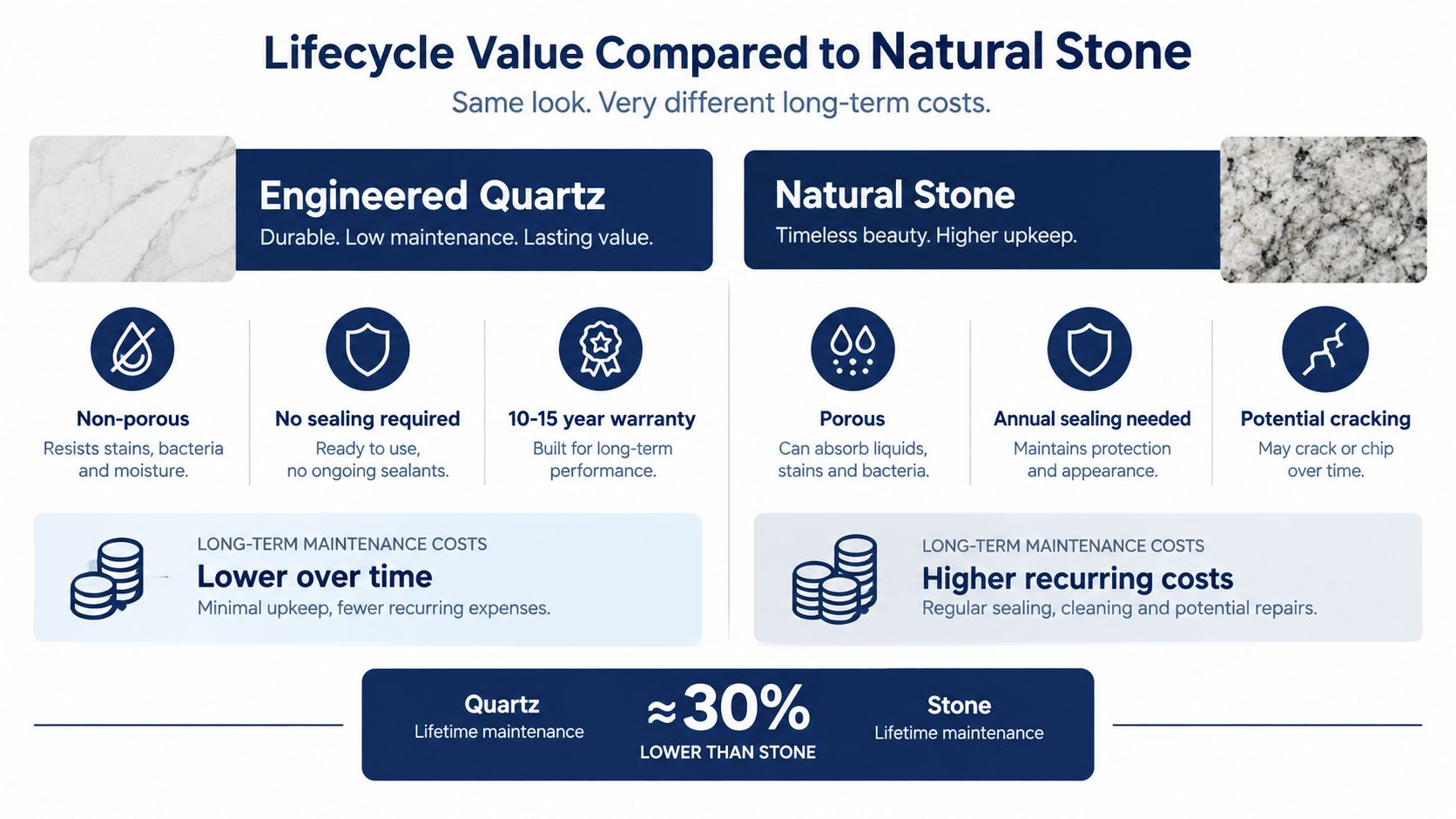
Granite suits briefs that call for natural movement, hard-wearing stone character, and a different heat-performance profile. Marble offers depth and tactile variation, but its appearance may require more careful use and maintenance. Quartz suits clients who value consistent colour, stain resistance, and predictable indoor performance.
The material choice should follow the room, maintenance expectations, and design intent:
- Choose engineered quartz for consistent patterning, low routine maintenance, and controlled indoor applications.
- Choose granite where natural variation and stone character matter alongside durable everyday use.
- Choose marble when its visual and tactile qualities justify greater care.
- Specify the complete installation for every material. Edge profiles, cut-outs, joints, support, transport, and fitting affect the finished result as much as slab selection.
Lifecycle value also depends on fabrication quality. A lower initial quote can lose its advantage if poor cutting, unsuitable support, or avoidable replacement work creates later costs. Confirm the fabricator's care guidance before handover, particularly for heat, chemicals, support conditions, and any proposed outdoor use.
For practical design context, review why quartz slabs suit modern kitchens.
Securing an Accurate Quotation
A professional quotation should let you reconstruct the finished price without guessing what has been excluded. If a supplier provides only a slab rate, request a revised document that connects the approved drawing to every chargeable operation.
Require these line items:
- Slab area and product identification: Record the brand, colour, finish, thickness, slab dimensions, and selected batch where relevant.
- Wastage and slab consumption: Confirm whether the calculation uses net counter area or the full slab needed for the cutting layout.
- Edge length and profile: State the running length, profile type, corner treatment, and whether polishing is included.
- Cut-outs: List each sink, hob, tap, dispenser, socket, and other opening separately.
- Jointing: Identify the number and location of joints, adhesive colour, and finishing method.
- Transport and lifting: Confirm delivery conditions, access assumptions, floor handling, and any excluded lifting.
- Installation: Include levelling, placement, joint finishing, sealing of adjoining interfaces where applicable, and site clean-up.
- Taxes and commercial terms: State GST, payment stages, measurement conditions, lead time, and the process for approved changes.
Use the quotation to compare finished-surface costs, not advertised slab rates. Edge work, cut-outs, joints, lifting, and installation can materially change the budget, so each operation needs a clear price or stated inclusion.
Use the quotation as a technical document
Attach the approved plan, appliance specifications, sink model, edge drawing, and slab photographs or selection notes. If the design includes a prominent vein, record its intended orientation and seam locations before fabrication begins.
Ask what “installation included” covers. Placement may be included while lifting, jointing, support modifications, on-site polishing, or return visits caused by incomplete cabinetry remain chargeable.
The quotation should also identify who approves site measurements and who carries responsibility for discrepancies between the drawing, cabinetry, and final template. Keep revisions dated, especially when an appliance, sink, edge profile, or slab selection changes.
The lowest total is not automatically the best budget. Choose the document that makes scope, assumptions, exclusions, and responsibility visible before the slab is cut.
Streamlining Your Project with Varun Marbles
NCR projects become easier to control when the material supplier, fabricator, and installation coordinator work from the same approved information. An integrated yard-to-site process reduces the hand-offs where colour selection, slab availability, measurements, edge details, and site instructions can become disconnected.
Varun Marbles supplies engineered quartz and natural stones for residential and commercial interiors, with showrooms at Sikanderpur Marble Market and HUDA Marble Market Sector 33–34 in Gurugram. The company is an authorised dealer of Kalinga Stone and AGL Quartz in Gurgaon, and its service scope includes cut-to-size fabrication, edge profiling, surface finishing, and installation coordination.
What to verify in person
A showroom visit is useful when the project depends on pattern, finish, and slab consistency. Small samples can hide movement, tonal changes, or vein direction that become prominent across a full island or long counter.
Varun Marbles states that it sources from quarries in Italy, Brazil, Turkey, and India, inspects slabs for vein, tone, and translucency, and accepts fewer than one in ten slabs into its gallery. Those selection standards are relevant to projects where the visual result must be approved before fabrication rather than judged after installation.
For a Gurugram kitchen, the process should still remain practical and documented:
- approve the exact slab or product code;
- confirm thickness, finish, and edge profile;
- complete a site measurement and cutting template;
- agree seam placement and opening dimensions;
- separate slab, fabrication, logistics, installation, and GST;
- confirm the safety controls used during fabrication;
- record the care instructions at handover.
This model doesn't remove every project variable. It gives the architect, homeowner, contractor, and supplier a shared basis for managing them. The result is a more realistic engineered quartz countertops cost, with fewer surprises caused by missing fabrication or site allowances.
For a measured NCR quotation, visit Varun Marbles to compare engineered quartz slabs, finishes, and natural stone alternatives in person. Share your layout and appliance details so the team can help separate material, fabrication, transport, and installation costs before production begins.