
Black Quartzite Stone: The Ultimate Guide for NCR Interiors

You've selected a dramatic black slab for a Gurugram kitchen, approved the sample under showroom lighting, and scheduled fabrication. Then the delivered lot arrives with a different grain direction, softer grey movement, or edge damage that wasn't visible in the small sample. The problem usually isn't the colour name. It's the gap between the “black quartzite” label and the actual quarry, grade, slab lot, finish, and fabrication method.
For NCR projects, black quartzite stone should be treated as a procurement decision rather than a black-colour selection. Quarry continuity, regional production, batch matching, surface treatment, and installation quality all influence the finished result. A sound specification therefore needs more than a product photograph. It needs traceability and inspection at every stage.
Table of Contents
- What Is Black Quartzite Stone
- Hardness Durability and Performance Data
- Black Quartzite vs Granite and Engineered Quartz
- Sourcing and Slab Inspection Criteria
- Fabrication and Installation Considerations
- Where to Use Black Quartzite Stone
What Is Black Quartzite Stone
A designer may approve a black slab for a Gurugram residence, then receive a bundle with stronger grey movement, a different grain direction, or visible fissures. The variation may come from a different quarry bench, processing lot, finish, or export market, even when the supplier uses the same commercial name. The specification fails when “black quartzite” is treated as a fixed product rather than a category requiring verification.
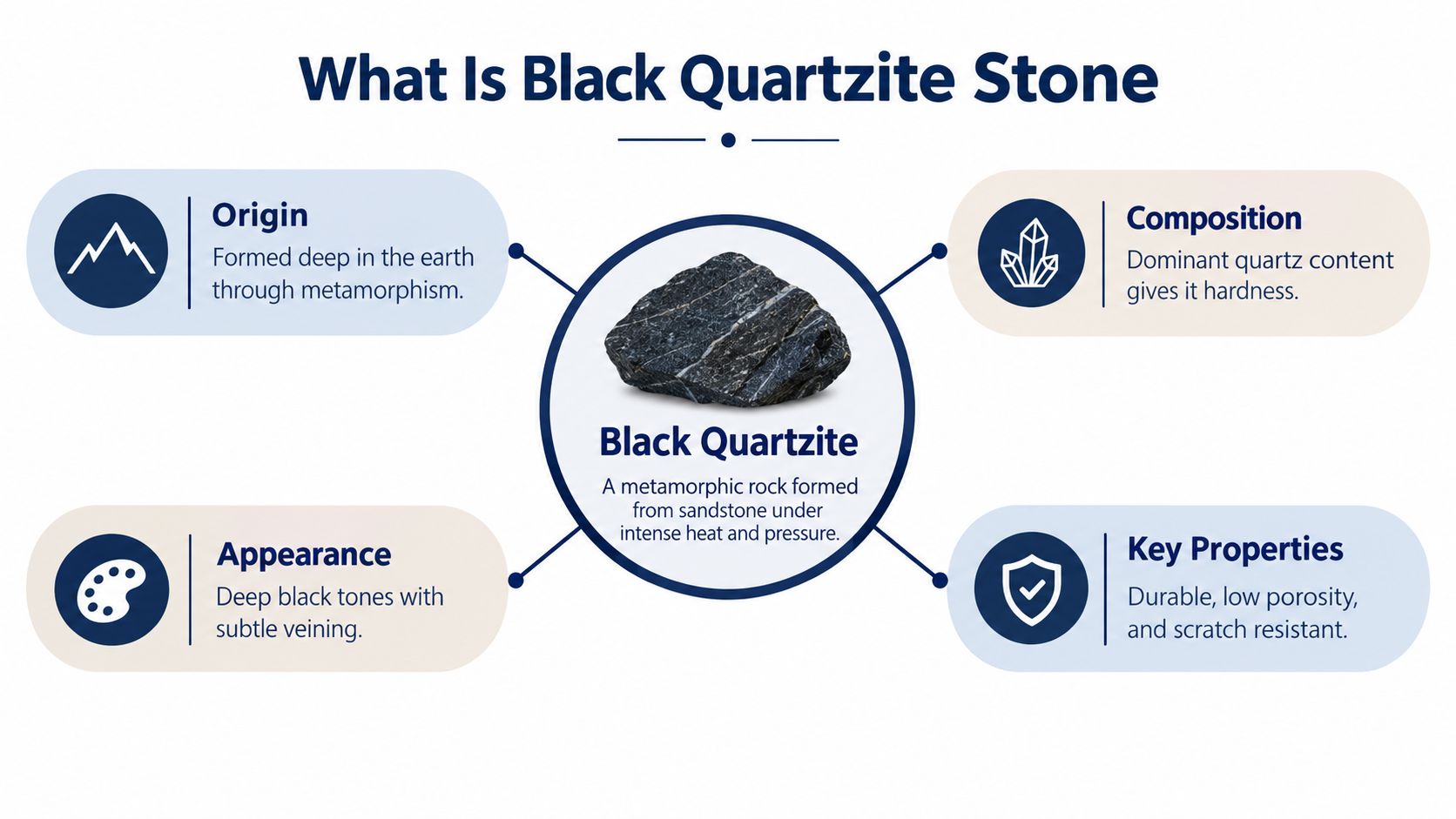
Black quartzite is a natural metamorphic rock, generally formed when sandstone is altered by intense geological heat and pressure. The original grains become tightly interlocked, and its quartz-rich composition gives the stone a hard, dense structure. Other minerals determine the depth of the black tone, veining, movement, and occasional translucency.
Natural stone is not the same as engineered quartz
Natural black quartzite and engineered quartz may appear similar under showroom lighting, especially when both have a dark base and restrained veining. Their supply and grading realities differ. Natural quartzite is quarried as a block and sliced into slabs. Each slab reflects its source geology, so tone, grain, fissures, veining, and translucency can change across a bundle.
Engineered quartz is manufactured from processed mineral content and binding materials, which supports more controlled visual consistency. That predictability helps when a project needs matching colour across a long counter or several apartments. A one-off island may justify accepting natural movement, provided the client approves the actual slab and understands that adjacent slabs will not be identical.
The label also covers products that may be slate-like, quartz-rich, or sold under decorative trade names with limited mineral information. Request the technical specification and inspect the slab face, cut edge, and underside where possible. Polishing can reduce the visibility of texture, hairline fissures, and mineral variation that become clearer after cutting or honing.
Procurement rule: Approve the actual slab or a clearly identified lot, not only a catalogue image or a small loose sample.
Why the label needs qualification
India's official mineral data recorded 1,658.80 million tonnes of total quartzite resources as of 1 April 2015, including 83.47 million tonnes of reserves and 1,575.32 million tonnes of remaining resources, according to the Indian Bureau of Mines quartzite resource data. The reserve classification represented only about 5% of the identified base at that time.
A large national resource figure does not guarantee reliable access to a particular black variety. Quarry geology, bench selection, extraction losses, block size, slab processing, surface treatment, and demand from export markets can all affect what reaches an NCR project. One named colour may therefore vary in availability, thickness, finish, and visual character between suppliers or consignments.
For specification purposes, black quartzite means a natural, quartz-rich metamorphic stone whose appearance and technical suitability must be verified at slab level. The commercial name identifies a starting category. Quarry origin, lot records, inspection, and agreed acceptance criteria complete the specification.
Hardness Durability and Performance Data
The most useful way to assess black quartzite is to separate stone-body performance from fabrication performance. The rock itself may resist crushing, scratching, and water movement well, yet a poorly supported overhang or badly placed cut-out can still fail. Buyers often blame the material for problems created at the edge, joint, or installation stage.
One Indian technical source reports uniaxial compressive strength of 1,500 to 3,000 kg/cm² and porosity of only 0.1% to 0.5% for black quartzite-related material data. Those figures indicate a dense stone with strong resistance to crushing and limited pore space for capillary water movement, as documented in the Indian technical material reference for quartzite.
What the benchmarks mean on site
Low porosity is valuable in flooring, cladding, paving, and worktops because the stone body has fewer connected spaces through which moisture can travel. It doesn't make the complete installation waterproof. Water can still enter through unsealed joints, cut-outs, fissures, adhesive failures, or the junction between the slab and supporting substrate.
A separate quarry-linked commercial specification lists density of 2.3 to 2.4 kg/cm³, water absorption of 1.0% to 1.2%, Mohs hardness of 6.5 to 7, compressive strength of 90 to 140 N/mm², and modulus of rupture of 16 to 40 N/mm². These values are reported in the black quartzite technical specification. Because the figures come from a commercial specification for a particular material, they shouldn't be treated as a universal certificate for every black slab sold in India.
The hardness range explains why a sound slab can perform well against ordinary scratching and wear. The modulus of rupture is equally important because it shows that bending strength remains finite. Stone can be very hard and still break when a long unsupported section receives a concentrated load.
The weak points are usually designed into the slab
For a kitchen, the fabricator should review sink cut-outs, hob openings, narrow strips, inside corners, waterfall edges, and unsupported breakfast-bar projections before cutting. A large overhang may look effortless in a render, but its success depends on support, geometry, slab condition, and the location of natural fissures.
Use these checks before approval:
- Review the cut plan: Confirm that cut-outs won't sit across visible fissures or unusually narrow sections.
- Support projecting areas: Use suitable brackets, rails, or structural support where the design creates a cantilever.
- Inspect edges after profiling: Look for chips, resin-filled fissures, and weak corners before installation.
- Test the finish sample: Polished, honed, and leathered surfaces can show different responses to fingerprints, water, and light.
- Confirm the actual technical sheet: Treat generic online specifications as a guide, not a substitute for the selected quarry lot.
The low porosity of the stone body shifts attention toward joints, cuts, edges, adhesive selection, and support. That's why a technically strong slab can still produce a poor result when a fabricator rushes the template or treats every black stone as interchangeable.
Black Quartzite vs Granite and Engineered Quartz
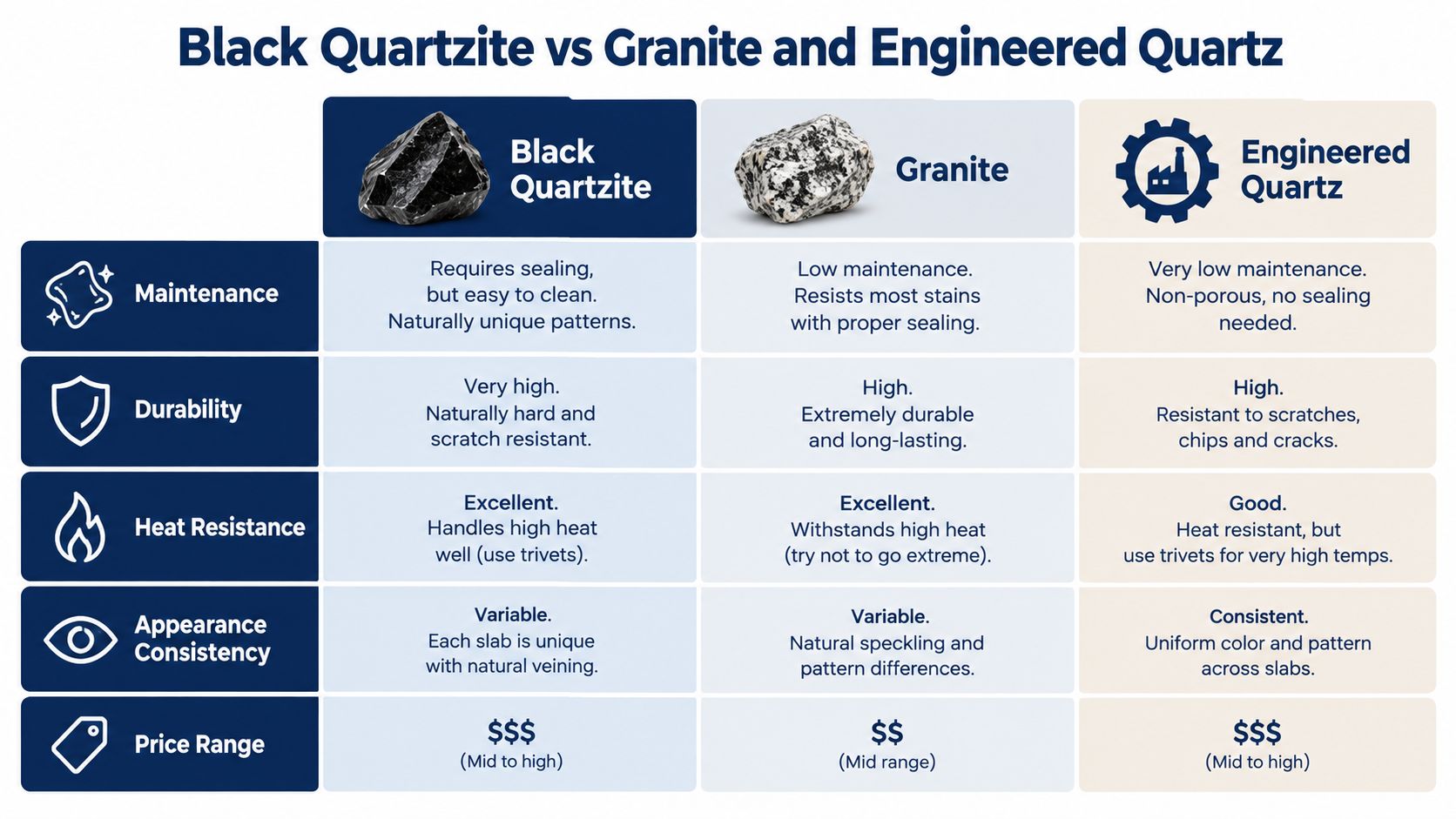
The right comparison depends on the job. A natural stone island, an exterior facade, and a rental apartment worktop don't have the same priorities. Black quartzite can offer geological depth and strong heat performance, but granite may provide easier procurement for a particular design, while engineered quartz may win where uniformity and routine convenience matter most.
| Criterion | Black quartzite | Granite | Engineered quartz |
|---|---|---|---|
| Maintenance | Usually needs appropriate sealing and sensible cleaning | Often straightforward, with sealing determined by the specific stone | Generally low routine maintenance and no natural-stone sealing requirement |
| Durability | Hard, dense, and suitable for demanding surfaces when detailed correctly | Strong option for worktops, flooring, and many high-use areas | Resistant to ordinary wear, with application limits determined by the manufactured composition |
| Heat exposure | Natural stone performance makes it suitable for high-heat contexts, subject to supplier guidance | Performs well in many hot-use applications | Heat protection remains important because manufactured binding materials can be vulnerable to extreme heat |
| Appearance consistency | Natural variation, movement, and lot-to-lot differences | Natural variation, usually with a different mineral character | More controlled and repeatable visual appearance |
| NCR price context | Recent listings place black quartzite around ₹150 to ₹700 per square foot | Varies by variety, grade, finish, and source | Recent listings commonly place black engineered quartz around ₹350 to ₹750 per square foot |
The NCR price ranges above come from recent black quartzite and engineered quartz market listings. They're useful for initial budgeting, not a quotation. Thickness, edge work, wastage, transport, installation, finish, and the selected slab can change the delivered cost.
Where each material makes sense
Black quartzite suits projects that need natural movement, heat tolerance, and a premium geological appearance. It's especially compelling for a feature island, statement wall, reception counter, or exterior application where a manufactured uniform surface would feel too regular. The trade-off is that the design team must accept variation and manage sealing, inspection, and fabrication carefully.
Granite remains a practical alternative where the project needs a naturally hard surface and a broader choice of familiar commercial grades. It may be easier to match across a larger project, depending on the selected variety and current inventory. Its appearance tends to have its own crystal and mineral character rather than the layered or veined effect associated with many black quartzites.
Engineered quartz works well where repeatability is the priority. It can simplify selection across multiple rooms or units and offers a controlled visual language. It isn't automatically the right choice for every high-heat or exterior situation, so the manufacturer's application guidance should govern the specification.
For a broader discussion of natural and engineered materials, the marble and quartzite comparison guide can sit alongside the technical review. The final choice should follow the exposure, support conditions, maintenance expectations, and required appearance, not the showroom label alone.
Sourcing and Slab Inspection Criteria
A black quartzite slab can look consistent under showroom lights and still vary significantly across a delivered lot. Before approving it for an NCR project, record where the slab came from and how the lot was controlled. India's quartzite production has been concentrated in a small number of states. In one official reporting year, Andhra Pradesh accounted for about 78% of output, Maharashtra contributed about 10%, Odisha 4%, Chhattisgarh 3%, and Karnataka 2%, with the balance spread across Rajasthan, Bihar, and West Bengal. These figures are reported in the Indian Minerals Yearbook quartzite production tables.
That concentration affects freight, availability, and the chance of replacing a damaged slab with a visually compatible one. Quarry output also shifts between reporting periods. Official yearbook data record quartzite production of 365 thousand tonnes in 2012–13, a 34% rise over the previous year, with all output coming from private-sector mines. The same source records five principal producers accounting for about 57% of production. Later tables show Andhra Pradesh output moving from 2,871,070 tonnes in 2019–20 to 1,402,110 tonnes in 2020–21, while Rajasthan output moved from 1,329,000 tonnes to 1,306,802 tonnes, then 1,948,690 tonnes in 2021–22. A label such as “black quartzite” therefore does not guarantee identical supply, grading, or replacement availability.
A practical inspection sequence
Record the source and lot. Ask for the quarry or region, supplier lot, slab identification, thickness, finish, and arrival date. Without lot identification, later matching becomes difficult.
View full slabs in neutral light. Small samples conceal movement and cannot show how veining will run through an island, backsplash, or facade panel. Photograph the face and mark the selected slabs before fabrication.
Check tone and pattern together. Place slabs side by side. Compare black intensity, grey patches, vein density, mineral clusters, and directional movement. “Black” alone is not an adequate colour specification.
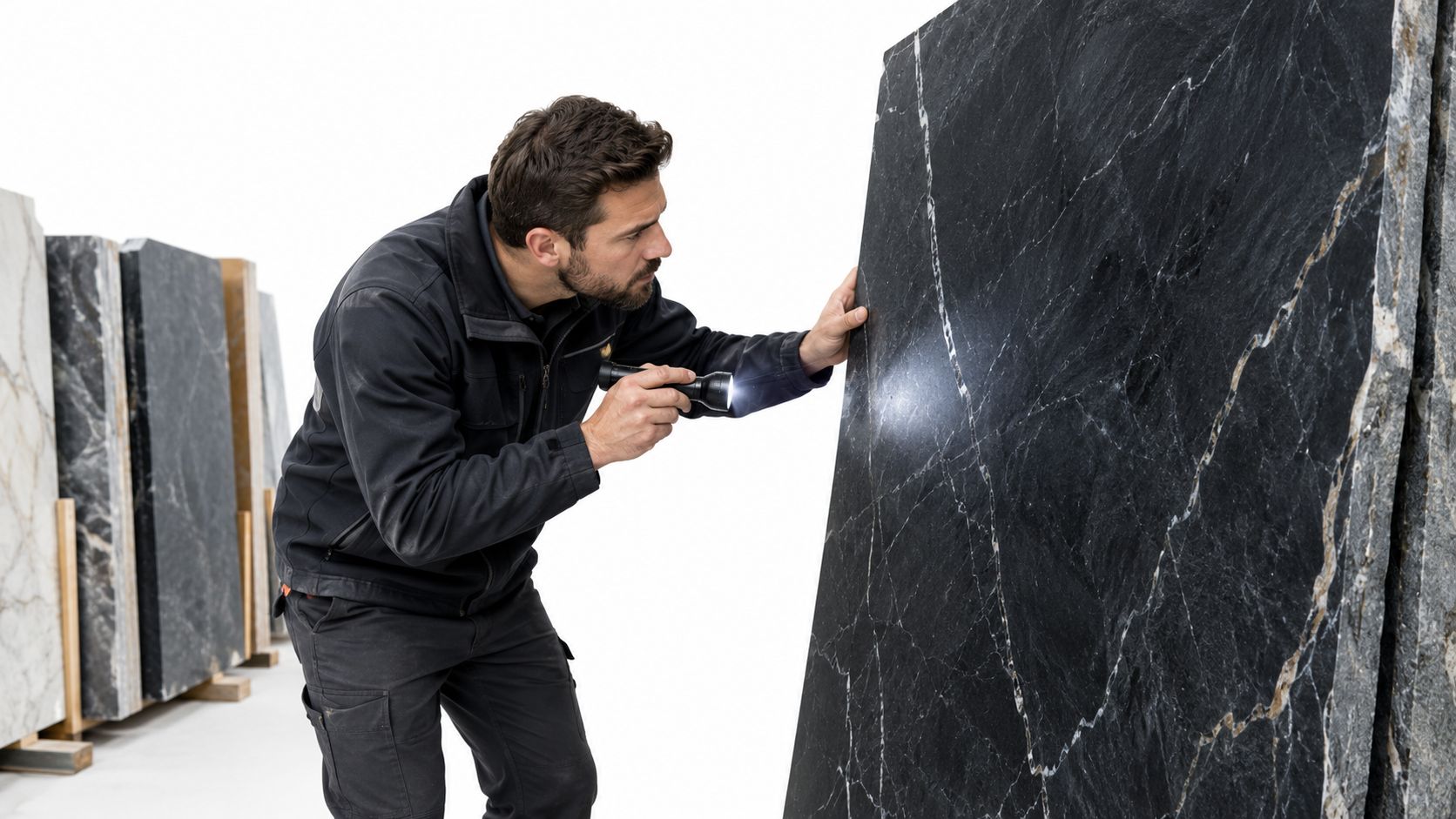
Use angled light to reveal surface issues. A bright flashlight can expose hairline fissures, resin-filled areas, uneven polishing, pits, and patches hidden by flat showroom lighting.
Inspect the reverse and cut edge. The underside may reveal open fissures or layered structure that is unclear on the polished face. The cut edge also helps the fabricator assess suitability for a honed or leathered finish.
Approve a cutting layout. Mark the sink, hob, joins, and waterfall returns on the selected slab drawing. Yield should not dictate a layout that weakens the design's visual centre.
A commercial quote should separate slab cost from cutting, edge profiling, transport, installation, sealing, and wastage. For budgeting context, compare the specification with this quartz slab price guide for India, then confirm the final figure against the actual black quartzite lot.
Site advice: If a replacement slab would visibly change the project, reserve compatible slabs before fabrication begins instead of relying on future stock.
Fabrication and Installation Considerations
Black quartzite rewards disciplined fabrication, not improvisation. Its dense body can tolerate demanding use, but the slab still has finite bending strength, and dark surfaces make chips, uneven joins, adhesive marks, and inconsistent polishing easy to notice.
The first decision is the fabrication drawing. It should show slab orientation, vein direction, sink and hob cut-outs, joints, edge profiles, splashback interfaces, support points, and any book-matched intention. A fabricator who receives only a room measurement may make a technically efficient layout that ignores the design's visual centre.
Details that deserve approval before cutting
- Edge profile: A small eased edge may reduce visible fragility, while a complex profile requires clean execution at corners and returns.
- Cut-out geometry: Avoid placing sharp internal corners across fissures or areas with limited stone around the opening.
- Overhang support: A projecting breakfast ledge or waterfall transition needs support designed into the cabinetry or structure.
- Finish selection: Polished surfaces emphasise depth and reflection, honed surfaces soften glare, and leathered finishes change tactile response and the way marks read.
- Thickness coordination: Marketed thicknesses can vary by product and supplier. Confirm the actual slab thickness, edge build-up, appliance clearance, and join detail before production.
Low porosity reduces the amount of water that can move through the stone body, but it doesn't repair a badly sealed joint. Sealant, adhesive, substrate preparation, and movement at interfaces require their own specification. In wet areas, the installer should explain how the stone, grout, silicone, and surrounding construction will work together.
NCR installation needs site control
Gurugram sites often combine tight lift access, unfinished joinery, dust, changing moisture conditions, and compressed handover schedules. Protect the slabs from other trades, inspect the substrate before delivery, and keep the final installation date aligned with cabinet readiness. A finished slab shouldn't be used as a workbench for painting, drilling, or heavy material storage.
For measurement discipline, use a documented template and reconcile it with the granite slab measurement guide. The same habit applies to quartzite. Measure the actual site, not only the design drawing.
The best outcome comes from treating selection, cutting, finishing, transport, and installation as one chain. A beautiful slab can't compensate for a weak joint, unsupported projection, or late-stage site damage.
Where to Use Black Quartzite Stone
Black quartzite stone works best when its natural variation becomes part of the design rather than a defect the project tries to hide. A kitchen island can use the strongest movement as a focal point. A reception desk can benefit from depth under controlled lighting. A facade or feature wall can use the material's dense character, provided the fixing system, anchoring, joint design, and local exposure are properly engineered.
Strong applications
Kitchen worktops and islands are suitable when the selected slab has been checked around sink and hob cut-outs, the projection is supported, and the household understands that natural stone needs appropriate care. Black surfaces show dust, fingerprints, dried water, and edge marks more readily than many mid-tone materials, so lighting and maintenance expectations should be discussed before approval.
Feature walls and reception counters allow the designer to position the most expressive part of the slab where it will be seen. Large-format planning matters here. A visually quiet replacement slab may be structurally acceptable but fail the original design intent.
Exterior cladding and paving can benefit from the stone's density and wear resistance, but the specification cannot stop at the face finish. Anchoring, drainage, substrate movement, slip requirements, freeze-thaw exposure where relevant, and local installation standards need review by the project team. A stone suitable for a worktop isn't automatically suitable for every exterior assembly.
Bathrooms and vanity tops can work well with correct joint treatment and sealing. Avoid assuming that low porosity eliminates all moisture detailing. Open edges, penetrations, grout lines, and wall interfaces remain installation points that need attention.
Where another material may be wiser
Black quartzite is not the automatic answer for a project that needs perfectly repeated tone across many units. Engineered quartz may be more efficient when consistency, simple selection, and low routine maintenance outweigh natural movement. Granite may be a more practical choice when a familiar black grade is available in the required quantity and the design doesn't need quartzite's particular veining.
A polished finish may be unsuitable for a surface where glare or slip is a concern. A dramatic fissured slab may be a poor choice for a heavily cut worktop, even if its face looks exceptional. For designers comparing visual alternatives, this stone look flooring guide offers useful context on achieving a stone aesthetic through other flooring approaches when slab performance or maintenance isn't the right fit.
The specification should therefore include:
- A named material and lot, not just “black stone”.
- Full-slab approval, including tone, movement, and visible fissures.
- A fabrication drawing showing every cut and support point.
- A finish and maintenance decision suited to the room.
- A responsibility trail from supplier inspection to site handover.
Varun Marbles offers in-person slab selection, cut-to-size fabrication, edge profiling, and installation coordination through its Gurugram showrooms, which can help keep the material decision connected to execution. For an NCR project, that joined-up process is more valuable than choosing a dramatic image online and hoping the delivered slabs behave the same way.
Varun Marbles can help you compare natural quartzite, granite, marble, and engineered quartz, then coordinate slab selection, fabrication, edge finishing, and installation for your NCR project. Visit Varun Marbles to review available materials and discuss the right black quartzite specification for your kitchen, commercial interior, facade, or feature surface.