
Panda White Marble Specs, Uses and Care

The popular advice sounds simple. Pick Panda White Marble if you want drama, seal it, and it'll look after itself. That's the part to challenge. The black veins don't make this stone maintenance-free, and a glossy photo doesn't guarantee the slab, the finish, or the room will suit each other. In humid, hard-water NCR homes, Panda White works best when you treat it as a performance specification, not just a colour choice.
Table of Contents
- What Panda White Marble Looks Like
- Specs Prices and What They Leave Out
- Rooms Where Panda White Earns Its Place
- Polished Honed and Brushed Faces
- Care in Humid and Hard Water Homes
- Panda White Against Other White Marbles
- Approve the Slab Before You Order
What Panda White Marble Looks Like
Think of ink pulled across wet paper. One slab carries a few fine, broken lines. The next, cut from the same block, can carry a wide black band that runs corner to corner and changes the whole room. That swing is the appeal, and it's also why a single catalogue photograph can't promise your layout.
Panda White Marble is traded in India as a Rajasthan stone, with a white ground cut by black or dark-grey linear veining. The ExportersIndia Jaipur marble slab listings describe slab thicknesses from approximately 18 to 30 millimetres, a density of about 2.7 g/cm³, and hardness of roughly 3 to 4 on the Mohs scale. Those listings identify Kishangarh, Ajmer, Rajsamand, and the wider regional processing network as the commercial hub for extraction, slab production, finishing, and distribution.
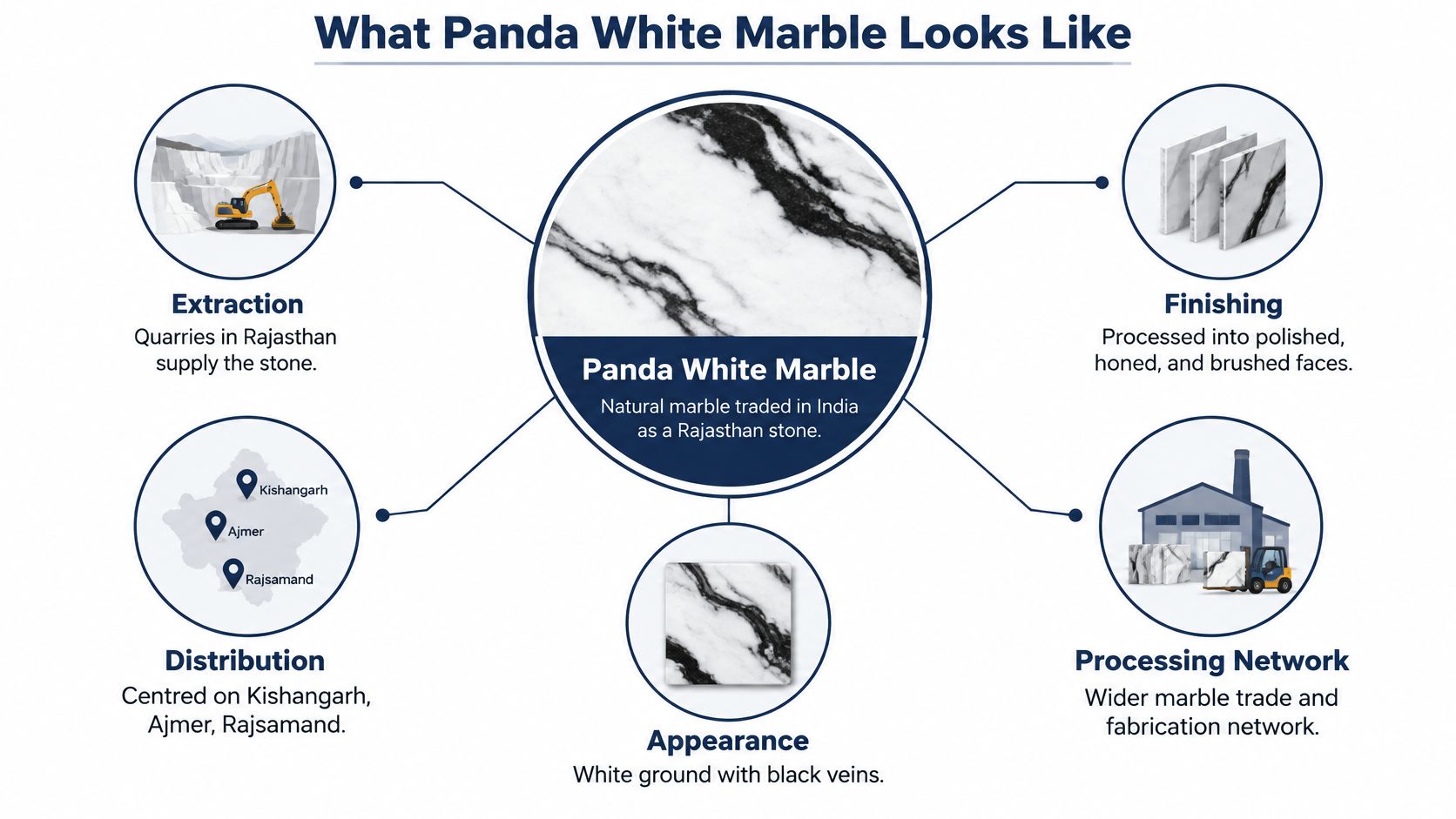
Why One Photo Isn't a Layout
The veins run in a direction. Turn a slab ninety degrees and a calm wall can become a busy one. Mix slabs at random on a long floor and the rhythm breaks, so your eye reads patches instead of movement. Book-matching solves this by mirroring two consecutive slabs, so the strokes meet and continue. It only works if you sequence the actual slabs in the yard, in order, before anyone cuts.
Treat the vein as handwriting. You're choosing the sentence, not just the ink.
Polished faces are the standard trade offer, and sellers commonly name flooring, wall cladding, countertops, bathrooms, and feature surfaces. That list tells you where the stone is sold, not where it'll stay happiest. A moderate hardness figure describes a workable interior marble that can be cut and finished cleanly. It doesn't describe a surface that ignores grit, acid, or standing water.
Shortlist on full slabs, not chips. Stand back far enough to read the whole movement, then check it under light close to your room's own. Cool white LEDs can push the ground towards grey, while warmer evening light softens the contrast. If the boldest band would land across a basin cut-out or a door swing, reselect now. It's far cheaper to move a slab in the yard than to live with a vein that fights the room.
Specs Prices and What They Leave Out
Start with the numbers side by side, then read what each one can't do.
| Benchmark | Figure | How to read it |
|---|---|---|
| Kishangarh polished slab | About ₹60 per sq ft | 2 cm; listing rate only |
| Ajmer–Kishangarh polished slab | About ₹70 per sq ft | 15–20 mm; stated delivery 5–7 days |
| Unit-based supplier record | ₹170 per unit | Not comparable with sq ft rates; 5,000 units a month claimed |
| Wider Rajasthan marble quotes | About ₹50–₹300 per sq ft | Moves with size, grade, finish, wastage and selection |
| Listed water absorption | About 0.25–0.35% | Inside a common white-marble band of 0.2–0.6% |
| Listed compressive strength | 1200–1400 kg/cm² | About 118–137 MPa; broader band about 70–140 MPa |
| What the slab rate omits | Inspection, cut, edges, breakage, freight, tax, fixing | NCR installed cost can sit well above the advert |
A TradeIndia Panda White Marble listing from Kishangarh reports ₹60 per square foot for a polished slab with a 2-centimetre thickness, while another Ajmer to Kishangarh listing gives ₹70 per square foot at 15 to 20 millimetres with a stated delivery window of 5 to 7 days. The same marketplace picture includes a record at ₹170 per unit claiming supply capacity of 5,000 units per month, and a broader Rajasthan range of ₹50 to ₹300 per square foot. Because the unit record doesn't state an equivalent measurement basis, you shouldn't compare it directly with square-foot rates.
What a Low Rate Doesn't Price
These are historical marketplace benchmarks, not an official national price index. For an NCR project, the slab rate is only the first line. Inspection, cutting, edge work, breakage allowance, freight from Rajasthan, taxes, and fixing all move the final bill, often by a lot. A cheap slab with poor usable yield can cost more per finished square foot than a dearer slab that cuts cleanly.
Compare quotes like for like. Ask each supplier to price the same thickness, finish, slab size, and usable yield, and to state what's included. If one quote assumes you accept the next slab off the stack and another lets you sequence matched slabs, they're not the same product, whatever the rate says.
What Strength Figures Don't Guarantee
One listing in Petros Stone's Indian white marble price guide reports approximately 0.25 to 0.35% absorption and 1200 to 1400 kg/cm² compressive strength, roughly 118 to 137 MPa, against common white marble bands of 0.2 to 0.6% absorption and 70 to 140 MPa. Lower absorption usually slows uptake of oil and bathroom water. Higher compressive strength helps under spread-out load.
Neither figure predicts the failures that happen on site. A crack at a thin span, a hob cut-out with a sharp internal corner, or a natural fissure crossing a vein won't be saved by a good compressive number. Marble also varies by quarry zone, mineral fabric, and testing direction, so a published range is a screen for preliminary selection, not a certificate for your block.
Practical rule: use listed figures to shortlist, then ask for a block-specific test report that names the method, specimen orientation, conditioning, and batch.
Rooms Where Panda White Earns Its Place
Sort rooms by exposure, not by whether they're indoors. Product guidance summarised in Grand View Research's India natural stone market outlook describes Panda White as suitable for indoor and semi-covered applications, recommends sealing, and warns that direct outdoor exposure can reduce polish retention. That's a starting point. The deciding exposures in most NCR homes are turmeric, oil, lemon, hard water, grit, and water left standing.
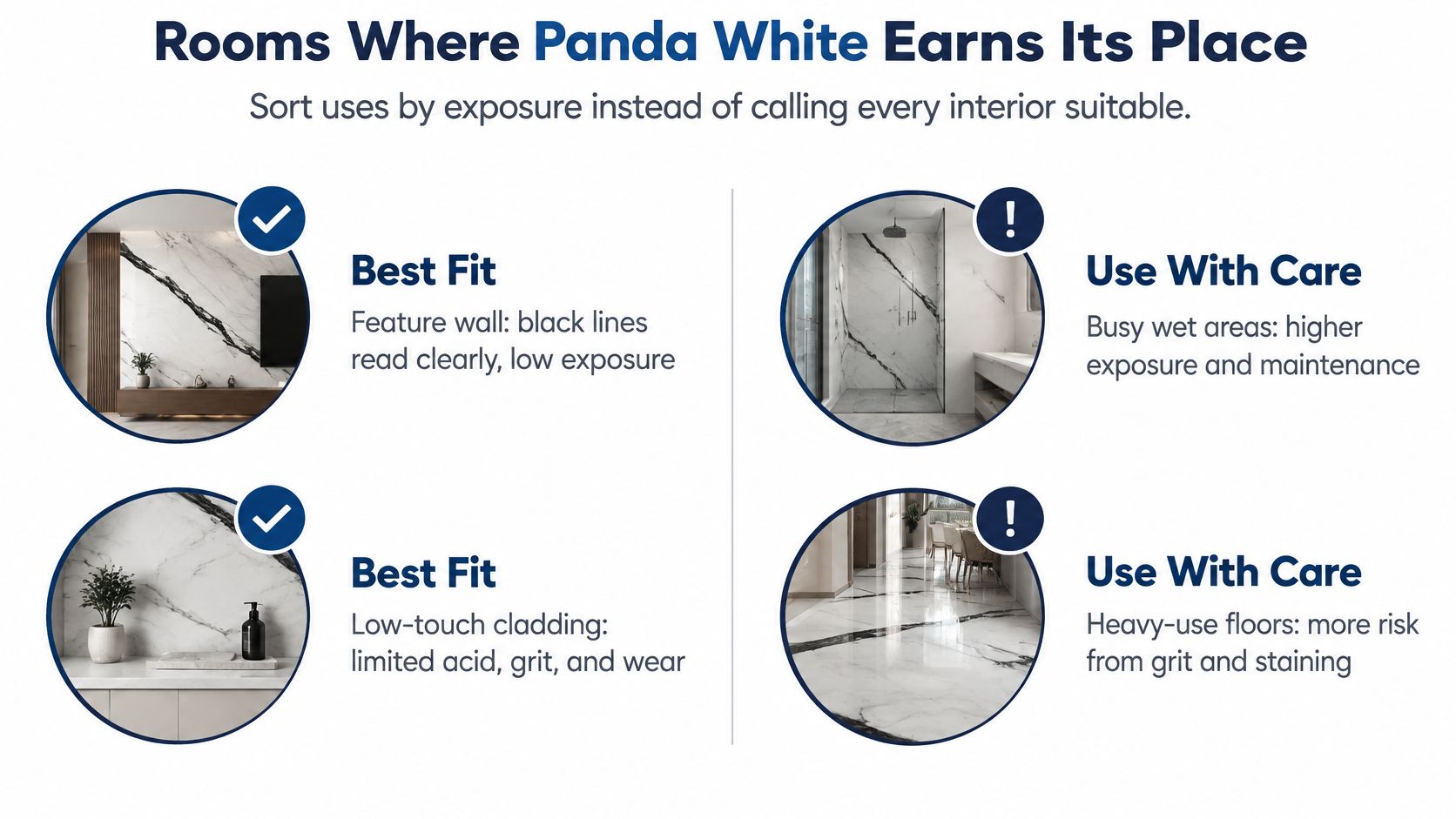
| Room | Verdict | Deciding exposure |
|---|---|---|
| Feature wall or low-touch cladding | Yes | Black lines read clearly; little acid, grit or standing water |
| Bathroom vanity top | Yes, if sealed and supported | Standing water and toiletries; wipe, do not let puddle |
| Kitchen worktop | Conditional | Turmeric, oil and lemon etch; granite or quartz where daily frying dominates |
| Low-to-moderate floor | Conditional | Grit control; thickness and substrate suited to span |
| Busy commercial lobby | Conditional, harder than a bedroom | Heavy grit and wear |
| Shower wall | Conditional | Fall, sound waterproofing build-up, no trapped water at joints |
| Semi-covered area | Conditional | Rain and sun limited |
| Fully exposed facade | No | Polish and pale colour suffer outdoors |
A Worked Example in Gurugram
Say an apartment has a living room that needs one strong gesture, a guest bathroom used a few times a day, and a kitchen where frying and turmeric happen daily. A book-matched living-room wall is the easiest win, because the stone is seen more than touched. A sealed guest-bath vanity can work well if the basin is fully supported and toiletries don't sit in puddles. The main kitchen worktop is the honest compromise. The white ground will magnify oil, turmeric, grout shadow, and etch marks, so granite or quartz often earns that job while Panda White takes the splashback or a breakfast ledge.
Floors sit in the middle. A bedroom or formal living floor can succeed when grit is controlled at the door and the substrate is flat and sound. A busy lobby brings far more abrasive traffic, so expect faster dulling and a stricter cleaning regime. Shower walls need correct falls, a sound waterproofing build-up behind the stone, and joints that don't trap water. Don't use a shower to test an unsealed polish.
Polished Honed and Brushed Faces
Finish changes how damage shows, not just how light reflects. The three faces below are the ones you'll most often be offered, starting with the showroom standard.
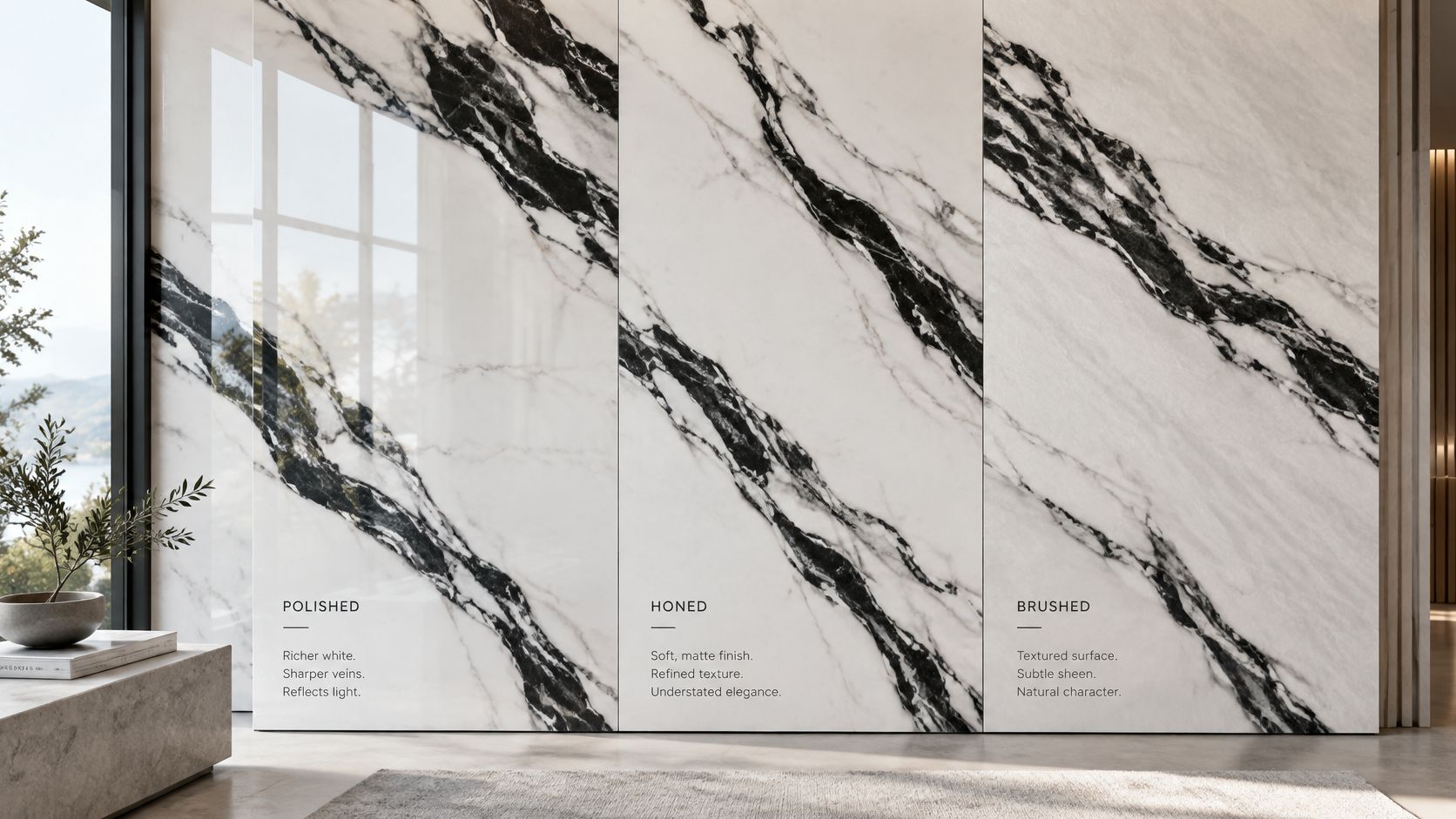
Polished deepens the white and makes black veins look sharp. On a feature wall, that reflection is the point. On a worktop or floor, the same mirror betrays you. Acid etch appears as a dull spot because it breaks the reflection, and fine scratches read as pale ticks. If you'd like the detail behind that trade-off, our guide to the difference between honed and polished marble walks through sheen, grip, and upkeep.
Honed takes the shine down to a soft matte. Etch is less obvious because there's less reflection to lose, veins look calmer, and a dry floor feels less slippery. The trade-off is that a very open hone can hold soap film or kitchen grease if the sealer coat is thin or tired.
Where Each Face Belongs
Brushed or leathered faces add light texture. They hide small marks better than polish and soften the graphic veins, which suits floors where a wet look would feel wrong. They're harder to wipe perfectly smooth, and the surface can darken slightly when damp, so test with a wet cloth before you commit.
The short video below is useful for judging sheen in motion, because a still photo flattens the difference between matte and gloss.
Edge profile follows the same logic. A sharp square arris chips more visibly on white stone than a small round or chamfer, especially on vanity corners and stair nosings. Ask to see the finish on a full slab in daylight and again at night. Don't let anyone promise that a hone makes marble acid-proof. It only makes the evidence quieter.
Pair polish with walls and careful vanities, hone or brush with busier floors, and write the finish on the order for every piece. Yards default to gloss when the instruction is vague.
Care in Humid and Hard Water Homes
The bold veining gives Panda White a reputation it has not earned: homeowners assume a surface this graphic must hide everyday mess. Marks still land on a bright white field, and in NCR homes the two biggest sources are hard water and steamy, slow-drying bathrooms. Turmeric on a spoon rest, oil beside the hob, lemon on a drinks ledge, coloured cleaner pooled around a tap. Each one reads clearly. Blot spills instead of wiping them, so you lift the liquid rather than spread it, then clean with a pH-neutral stone soap and a soft cloth.
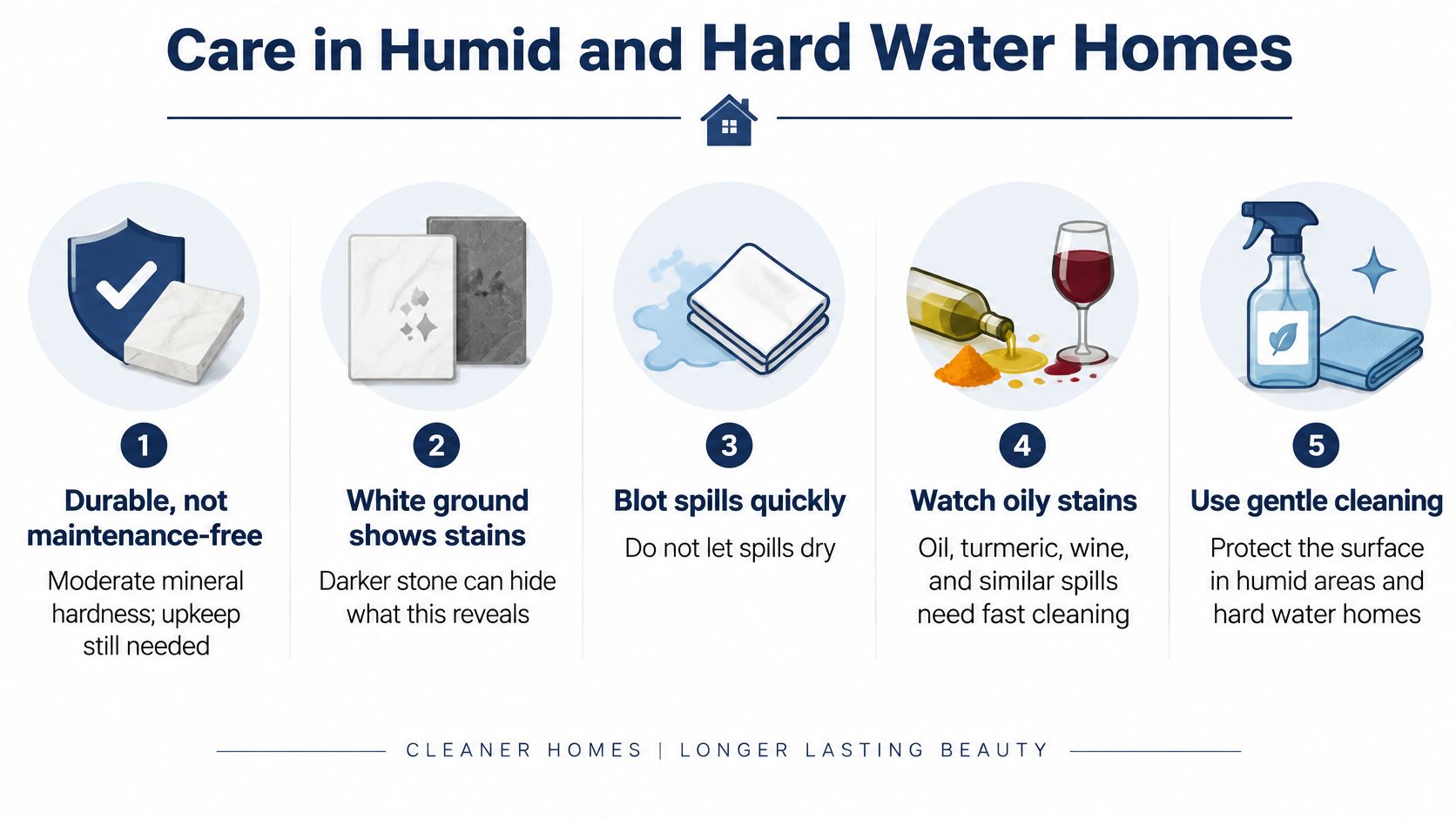
Vinegar, lemon juice, generic bath acid and scouring powder attack the surface itself. Hard water does something slower: it works like limescale inside a kettle, leaving a pale mineral crust on polished rims and around fittings every time water evaporates. A dedicated stone cleaner plus a quick dry-off after use beats any aggressive descaler, and our guide to hard water stains on marble explains how to lift deposits without dulling the face.
Humidity lengthens the exposure window. Through the monsoon, a damp vanity stays damp for hours, so water that would evaporate in a dry climate instead sits in joints and beside fittings. That is why the dry-off steps below matter more in an NCR bathroom than the cleaning products do.
| Room | Routine | Sealer and checks | Avoid |
|---|---|---|---|
| Kitchen worktop | Blot spills at once; neutral wipe daily | Sealer review yearly | Vinegar, lemon, scouring powder |
| Bathroom vanity and rim | Dry off after use; stone cleaner for hard-water crust | Sealer test yearly | Aggressive descalers, generic bath acid |
| Floor | Damp mop weekly with stone soap; felt under furniture | Check sealer on a discreet patch | Muddy mop left to sit |
| Shower wall and seat | Dry down after each use; check joints | Seasonal sealer check | Trapped water at joints |
| Feature wall | Light dust and wipe | Sealer review less often | Abrasive pads |
| Exterior or semi-covered | Rinse; limit rain and sun | Not for full exposure | Acid cleaners |
A Simple Weekly Rhythm
- Daily on worktops: blot spills and finish with a neutral wipe.
- Weekly on floors: damp mop with stone soap, after sweeping grit from entrances.
- After every shower or wash: dry vanities, seats and rims so water doesn't sit.
- Seasonally: drop a little water on a discreet patch. If it darkens the stone quickly, plan a fresh coat of compatible penetrating sealer.
Test sealer on a hidden patch first, because an over-heavy coat can look patchy on white. When a mark survives cleaning, work out which of two problems you have. Etch is polish lost to acid: the surface stays smooth, but the shine is gone. A stain is colour sitting inside the stone. They need different fixes, and repolishing a whole top for a stain wastes effort. If grout, joints or surrounding tiles are failing alongside the stone, the problem has moved past a cloth and cleaner, so read up on when tile care needs professional help before harder scrubbing does more harm.
No cleaner fixes a crack. Continuous support under sinks and hobs, movement joints, and radiused internal corners do that work at installation. Panda White is not fragile, but it is honest: small, consistent habits keep the white field white, and neglect shows just as clearly.
Panda White Against Other White Marbles
One visual difference separates Panda White from the rest of the white family. Its lines are black, directional, and graphic. Most alternatives soften that contrast, warm the ground, or quieten the pattern almost to nothing. Choosing between them is mostly a mood decision, and it's easier when you stop treating pale stones as interchangeable.
| Marble | Ground and vein | Mood in a room | Choose it when |
|---|---|---|---|
| Panda White | White with black or dark-grey linear veins | Crisp, graphic, directional | You want contrast and will sequence slabs |
| Statuario | Bright white with grey strokes | Dramatic but softer than black | Veins should read grey, not ink-black |
| Calacatta type | Ivory with bold gold-grey veins | Warm and luxurious | The interior needs warmth more than stark contrast |
| Makrana White | Luminous white with light figuring | Quiet and classical | Pattern should stay in the background |
| Botticino type | Cream-beige with soft grey-gold | Pale, not white | A beige floor is acceptable and white was never the brief |
Statuario is bright white with dramatic grey strokes. It gives you movement without the ink-black edge, so it feels cooler and less graphic beside stainless steel or pale oak. Calacatta Vagli carries bold gold-grey veining on ivory, which warms a north-facing room that Panda White would make feel stark. If you're also weighing engineered options for a worktop, a clear summary of granite and quartz countertop differences helps you separate stain behaviour from appearance before you fall for a vein.
When to Switch Stone Instead
Makrana White is a pure, luminous white from Rajasthan with light figuring. Choose it when architecture, artwork, or joinery should lead and the stone should almost disappear. A Botticino type stone isn't a white substitute at all. It reads cream-beige, and specifying it because it's pale will disappoint anyone who asked for white with black lines. For a softer European white with gentle grey movement, compare slabs against white Volakas marble in the same light.
Use the table as a mood filter, not a quality ranking. None of these names guarantees a single pattern.
Edge cases matter. A very bold Panda White slab can overpower a small powder room, where you're always standing close to the wall. A sparse slab can look plain if the client fell in love with a dramatic Calacatta photograph. For example, for graphic, modern, and high contrast, stay with Panda White and spend your effort on sequencing. For soft, classical, or warm, switch stone rather than hunting for an unusually quiet Panda White slab and hoping the next one matches. Decide on full slabs, side by side, under one light source.
Approve the Slab Before You Order
Panda White has black brushstroke veins on white, but that description isn't an order. Turn your choices into instructions a fabricator can build from, in this order.
- Write the basics on the enquiry: room, thickness, finish, and edge profile, so a wall slab isn't priced or cut as a kitchen top.
- Put test results on the purchase order: ask for water absorption tested to the same IS 1124 procedure for every selected lot, because veining, micro-fractures, resin filling, and finish cause lot-to-lot variation.
- Inspect under raking light: check vein intersections, edges, resin patches, and open fissures. Reject any fissure you couldn't live with once it's filled and lit.
- Sequence before cutting: lay out book-matched or running slabs in the yard, number them, and photograph the layout.
- Approve a sealed sample panel: view it under your project's own lighting, wet and dry.
- Specify the detailing: continuous support at sink and hob cut-outs, a radius on internal corners, and movement joints where runs change direction or meet another material.
The acceptance screen to write into step two comes from IS 1130:1969, the Bureau of Indian Standards marble specification, which limits moisture absorption after 24 hours of cold-water immersion to 0.4% by weight and requires a minimum Mohs hardness of 3 and specific gravity of 2.5. Low absorption points to a denser microstructure with slower uptake of oils and bathroom water. It doesn't make the stone stain-proof.
Treat that screen as compliance, not permission. It doesn't authorise unsupported cantilevers, exterior exposure, or acid cleaning. Flexural strength, thickness, span, substrate flatness, and fixing details still control cracking risk. We guide each stone from our yard to the customer's space, and the stone is cut, finished and installed, so bring your written list for an in-person slab check before the block is cut. Leave with three things fixed on paper: the slab numbers, the finish and edge for each piece, and the IS screen on the purchase order.
If you're choosing Panda White for a Gurugram or wider NCR interior, come and judge full slabs in person, check the finish under real light, and agree the sequence before cutting starts. We'll help you match slab, thickness, and detailing to the room it'll live in, then cut, finish, and install it as one joined-up job. Start your shortlist at Varun Marbles and bring your room measurements and finish notes with you.