
Marble Table Top Price in India: A Practical Cost Guide

Marketplace listings in India show indicative asking prices of about ₹1,200 per sq ft for plain or standard marble tops and ₹3,000–₹5,000 per sq ft for decorative inlay tops. Specialised mosaic and multicolour inlay work can be listed at higher rates, as shown in marble inlay tabletop listings. These figures are comparisons, not a national price index, and listings may cover different products and services.
A finished table's price is usually higher than a stone-only rate once fabrication, support and installation are included, but only if the listing covers the stone alone. Check the quotation line by line: stone grade and selection set the material charge; slab yield determines how much stone you must buy; cutting, edge work and polishing add fabrication costs. Support, sealing, packing, freight and site access can add further charges.
For homeowners, architects and contractors in Gurugram and NCR, thickness and design affect both material use and fabrication. Ask whether the quoted rate covers a complete table or only the stone top, and confirm dimensions, finish, taxes, delivery and installation before comparing offers. A low per-square-foot figure can leave significant costs outside the quote.
Table of Contents
- Why Marble Table Top Prices Vary So Widely
- What Stone Grade and Origin Add to the Price
- How Slab Size and Yield Shape Your Quote
- Fabrication Costs from Cutting to Polishing
- Support, Sealing, and Installation Charges
- Worked Cost Breakdowns for Common Tables
- How to Lower Risk and Choose the Right Supplier
- Your Next Step Toward an Accurate Quote
Why Marble Table Top Prices Vary So Widely
A per-square-foot rate is only one line in the final bill. The cited listings for marble inlay tabletops show prices around ₹3,000–₹5,000 per sq ft, with higher-end examples at ₹6,500–₹7,000 per sq ft. Plain or standard marble may start at about ₹1,200 per sq ft, while marketplace listings elsewhere in the article span roughly ₹1,500–₹8,850 per sq ft. These are different listing ranges, not a single market-wide price index. Listed marble inlay tabletop prices
A low listing may cover only a cut stone top. A higher one may include inlay, a different thickness, or a base. Check the dimensions, finish, taxes, freight and installation scope before comparing offers. Asking prices can describe very different products.
For a finished table, trace the quotation from slab to installation:
- Stone: The selected slab sets the raw material cost.
- Yield: The slab area purchased can exceed the finished top area, leaving offcuts that may not suit another job.
- Fabrication: Cutting, cut-outs, edge profiling and polishing add labour and tooling.
- Completion: Support, sealing, packing, transport and installation prepare the top for use.
Minimum charges also matter. A small tabletop can still require setup, cutting and polishing, so its fabrication cost may not fall in proportion to its area. Ask the supplier to show any minimum charge separately.
Request a line-by-line quote and confirm whether it covers the complete table or only the stone. Compare offers for the same dimensions, thickness, finish and installation scope. A thinner top may reduce material weight and cost, but the support must suit the stone and intended use. Include usable yield and offcuts in the decision: paying for stone that cannot be reused affects both the total price and the amount of waste.
What Stone Grade and Origin Add to the Price
A slab's price reflects what the stone looks like and how much selection it takes to find the right piece. Colour consistency, vein character, visible defects and origin all affect the rate. Italian marble can cost more than a domestic option, but the material name alone does not establish value. Compare the actual slab, its grade and the quoted scope.
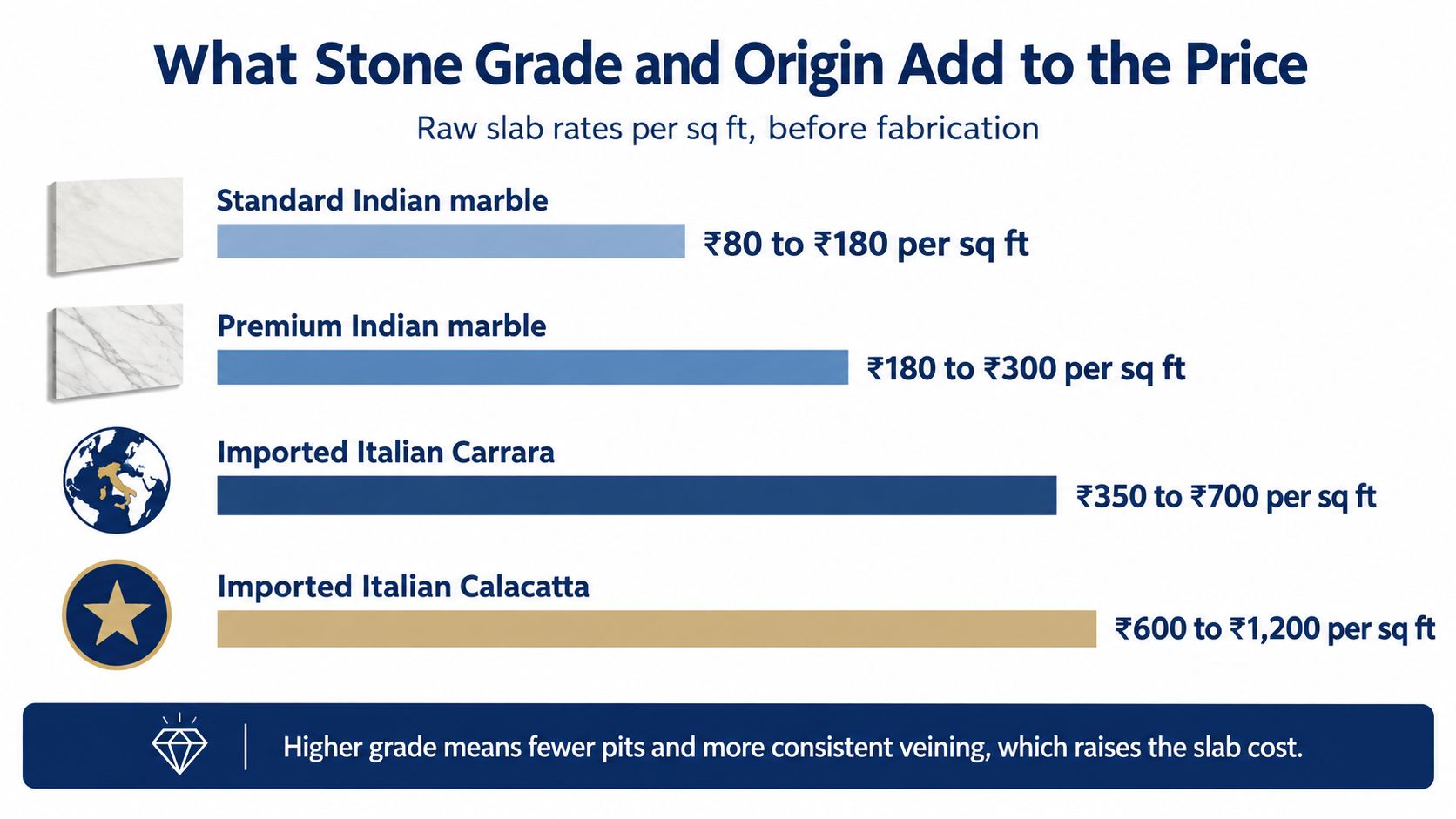
A standard slab and a carefully selected block are different purchases. A lower-priced stone may show more variation or visible defects. A slab with a consistent background or a particular vein pattern may cost more because fewer pieces meet those requirements. The extra charge is for selection and appearance, not merely for a foreign origin.
For a useful comparison, ask suppliers to quote the same table dimensions, thickness and finish using clearly identified materials. The article's quoted ranges for standard and premium tops provide a more practical benchmark than a broad claim about national market size. Check whether the higher stone rate buys a visual feature you value, such as a more even background, or whether a lower-cost slab meets the design brief.
If you are considering Italian marble, compare the actual slab and grade rather than relying on the material name. This guide to Italian marble pricing can help frame that comparison. The written quotation should still identify the specific stone being offered.
Ask the supplier to record stone name, origin, grade and slab selection in writing, and request photographs of the actual slab rather than a catalogue image. That documentation lets you check what the raw material charge covers and judge whether the appearance justifies the difference in price. The Indian Bureau of Mines' marble assessment offers broader context on marble, but the slab and quotation are what determine the choice for your table.
How Slab Size and Yield Shape Your Quote
Think of a slab like a cake. You pay for the whole cake, but only some slices may be suitable for serving. A slab has usable areas and less suitable areas; cracks, colour shifts, pronounced veins or the direction of the saw cut can make part of it unsuitable for a particular tabletop.
That's why a table's finished dimensions don't automatically tell you how much stone you'll need to buy. A fabricator may have to position the template around a flaw or align a prominent vein, leaving offcuts that can't be used for your piece. Ask for the planned layout and the wastage allowance before cutting starts. Usable area, lot consistency, fabrication and delivery all affect the final budget, as described in this Katni marble pricing and availability guide.
Check the layout before approving the cut
Ask the supplier to mark your tabletop outline on a photograph of the selected slab. Review the intended vein direction, tone and any visible defects near the edges. For a patterned slab, the layout is part of the design decision, not just a workshop detail.
A small side table creates a different cost problem. Handling and fabrication charges don't shrink in proportion to the top's area, and the job may still require material from a larger slab. As a result, the effective installed price per square foot can rise sharply on a small piece.
Practical rule: Compare the price of the finished piece, not just the advertised square-foot rate.
When reviewing dimensions, make sure everyone is using the same convention: finished top size, thickness, edge detail and any allowance for overhang. A slab measurement guide can help you prepare dimensions for a supplier discussion.
Then ask the supplier to show the slab rate, estimated yield, wastage allowance and minimum handling or fabrication charges as separate items. That makes the cost of an inefficient layout visible and gives you a fair basis for comparing quotations.
Fabrication Costs from Cutting to Polishing
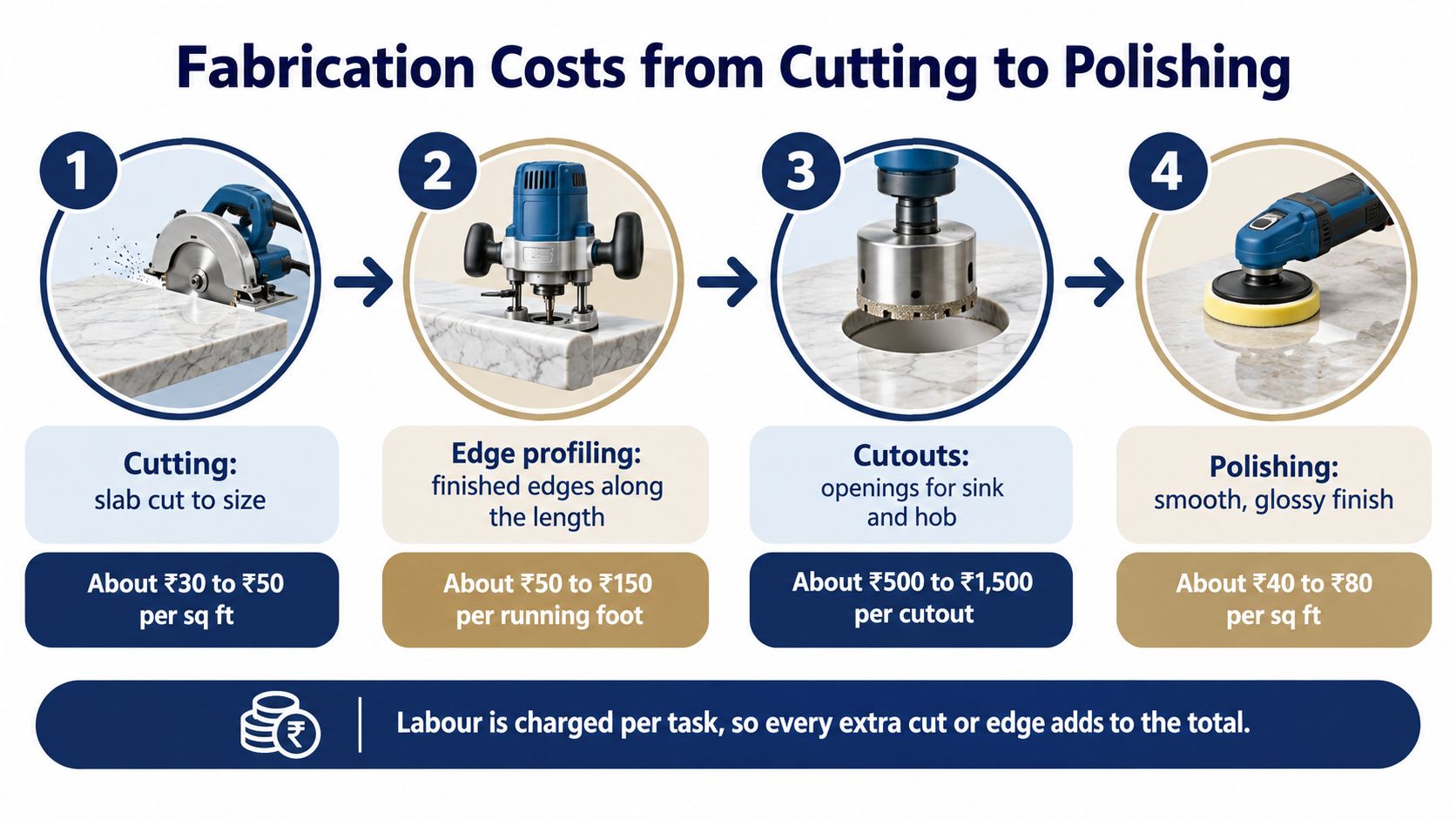
The fabrication line of a quote should show how the slab becomes a finished tabletop. Shops may charge per square foot for general fabrication, per cut, per metre of finished edge, or per cut-out. Ask which basis applies to each item, and whether minimum charges apply. A low slab rate can produce a higher finished price if the shape, edgework or openings require more labour.
Follow the work in quotation order
- Cutting: Straight cuts are generally simpler than curved or CNC-shaped outlines. Confirm whether the dimensions in the quote refer to the finished top or the cut dimensions.
- Cut-outs: Openings for fittings or hardware add layout and cutting work. Put their size and position on the drawing before fabrication.
- Edge profiling: A plain edge costs differently from a shaped profile, and charges can depend on the length of edge being finished. Specify which edges are exposed and which will be concealed or left raw.
- Polishing: State the required surface and edge finish, and confirm what the polishing charge covers. Samples can look different from the finished top, so include the chosen finish in the order. This guide to polished marble countertops explains common finish considerations.
Thickness affects both material use and workshop handling. A thicker top weighs more and takes greater care to cut, finish, pack and move. Confirm the finished thickness after polishing, since the nominal slab thickness does not guarantee the final measurement.
Agree in writing with the fabricator on permitted slab and finished-thickness tolerances. Variation can affect the edge appearance, alignment at joints and the work needed for a consistent polished edge. The BIS marble specification provides a reference for marble specifications; have the supplier confirm which tolerances apply to the slab and finished piece in your quotation.
Before approving the work, have the drawing or quote record:
- Finished thickness after polishing and agreed dimensional tolerances
- Edge profile, finished-edge lengths and any minimum charge
- Cut-out dimensions and positions, with charges stated per opening if applicable
- Surface finish and what polishing includes
These details show where fabrication costs arise and make it easier to compare quotes on the same scope.
Support, Sealing, and Installation Charges
A marble top needs suitable support and careful handling. Treating those items as optional extras can save money on the quote while increasing the risk of cracks, damage or a difficult installation. The support must suit the table's dimensions, weight and intended use, whether it's a pedestal, timber carcass, metal frame or reinforced underside.
Unsupported spans deserve particular attention. Stone doesn't flex like a wood panel, so a poorly supported top can be vulnerable to stress during use or movement. Ask the fabricator and furniture maker to agree on the support plan before the slab is cut. For a heavier or thicker top, confirm that the base and fixing method are designed for that load.
Specify protection and finish
Sealing and surface finish should also be explicit. Natural marble can absorb staining substances, and appropriate care helps protect the surface. Polished, honed and leathered finishes have different appearances and maintenance considerations, so choose based on how the table will be used, not just how a sample looks in the showroom.
An engineered quartz alternative may suit buyers who prioritise a consistent look and lower routine upkeep. Varun Marbles supplies natural marble and engineered quartz, among other stones, so a buyer can compare those material options against the intended use without assuming they behave the same way.
Price delivery as part of the job
The finished top still has to reach the room intact. Packing, transport weight, site access, carrying route, levelling and fixing all affect the installation plan. In Gurugram and NCR, mention access restrictions and the actual placement location when requesting the quote. A top delivered to the building entrance isn't the same service as one carried in, levelled and secured on its base.
Ask the installer: Is packing included? Who handles the top during delivery? Does the quote include carrying, levelling and fixing? What support is required? Is sealing included, and what finish will be supplied? Who is responsible if the stone is chipped in transit or during installation?
Those aren't minor administrative questions. A clear scope protects the material and helps prevent a low initial quote from turning into repair work or replacement.
Worked Cost Breakdowns for Common Tables
A per-square-foot rate covers only part of the bill. The examples below show how stone, yield, fabrication, support and installation can turn a raw-material rate into an installed estimate. These figures are illustrative assumptions, not supplier quotes. Confirm each charge against the chosen slab and the actual site scope.
Small side table, 24 × 24 inches
At an assumed stone rate of ₹2,000 per sq ft, the finished top covers 4 sq ft, so the material allowance is ₹8,000. If the shop must charge for a 6 sq ft minimum or slab allocation, stone becomes ₹12,000. Add ₹1,500 for cutting and polishing, ₹1,200 for a finished edge, ₹2,500 for a suitable support, and ₹1,500 for packing, delivery and fitting. The illustrative installed total is ₹18,700.
The minimum charge matters more than the top's small area. Ask whether the remaining stone can be used elsewhere or credited, and confirm the quoted support suits the top and base.
Dining table, 72 × 36 inches
This top has an area of 18 sq ft. At an assumed rate of ₹2,000 per sq ft, the stone allowance is ₹36,000. Allow 20% for layout and cutting yield, bringing the material line to ₹43,200. Add ₹6,000 for cutting and polishing, ₹3,000 for edge work, ₹8,000 for support, and ₹5,000 for packing, delivery and installation. The illustrative installed total is ₹65,200.
A larger top spreads fixed charges over more area, but the slab layout and base support still affect the quote. Confirm whether the stated yield includes the supplier's expected offcuts and whether the edge price covers the full finished perimeter.
Marketplace listings use different pricing units, including per-square-foot and per-piece prices. Compare the unit, dimensions, stone, finish and included work before treating an advertised figure as a comparable quote. Marble top marketplace listings show why a listing price should not be read as an installed-cost schedule.
For a separate perspective on the material's practical trade-offs, read these marble tabletop pros and cons. For any table size, the useful comparison is the final scope: stone quantity after yield, fabrication and edges, support, and delivery through placement. Ask suppliers to price those lines against the same dimensions and specifications.
How to Lower Risk and Choose the Right Supplier
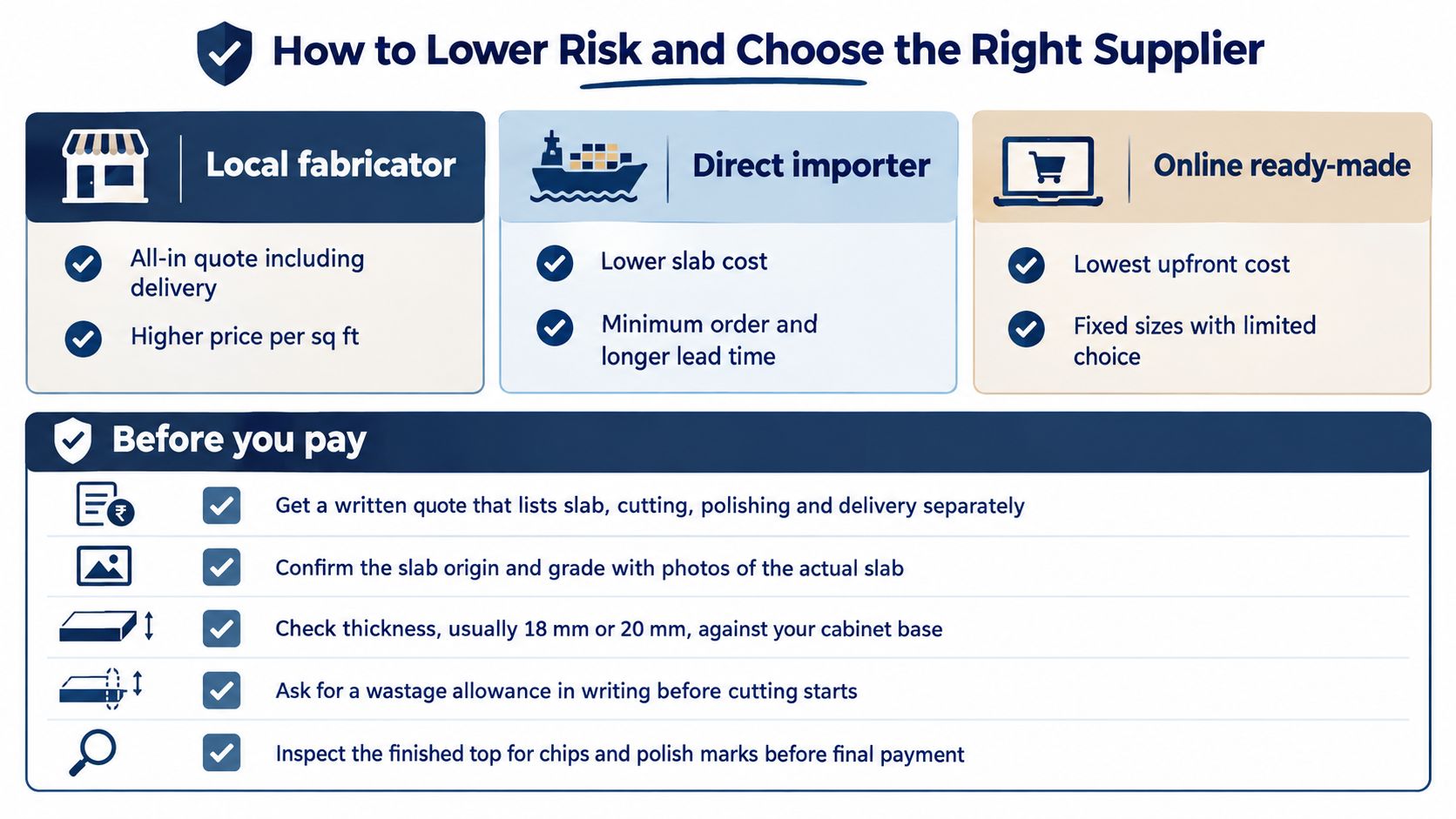
A supplier's reliability shows in how they handle stone selection, damage and inspection, not just in the quoted rate. Choose among three buying routes based on the table's size, appearance and expected use.
A remnant or offcut can suit a small top when its dimensions, pattern and condition match the design. It may reduce unused stone, but confirm that the piece has enough sound material for the finished shape. Ask whether a comparable piece could be sourced if the top later needs replacement.
A standard full slab offers more flexibility in layout and can help when coordinating a matching set. A premium selected slab suits buyers who want a particular vein, background or consistent appearance, with the added selection reflected in the price. In either case, ask the supplier to identify the slab being reserved and confirm that the finished top will be cut from it.
Check the stone and the supplier's process
Before approving a cut, inspect the actual slab in good light. Check its tone, vein direction and visible flaws against the table design. Ask how the supplier records your approval and what happens if the slab cracks or a defect appears during fabrication. If replacement stone is unavailable or may differ in appearance, establish that before committing.
Confirm who is responsible for checking the finished top and what you can inspect before payment. Look for chips, uneven edges and polishing marks, and make sure the agreed thickness and finish match the approved sample. Clarify how damage in transit or during installation is handled, and who arranges a repair or replacement. These answers reveal more about the supplier's working process than a low headline rate does.
Varun Marbles is one option for buyers who want to view stone in person at its Gurugram showrooms. As with any supplier, assess the actual slab and confirm the agreed scope and remedies in writing before authorising fabrication.
For a compact checklist of supplier questions and inspection points, use this stone-supplier infographic. A clear record of the selected stone, approval and responsibility for damage helps reduce disputes and makes the purchase easier to assess over the table's useful life.
Your Next Step Toward an Accurate Quote
An accurate marble table top price comes from the whole job, not the stone rate alone. The quote should account for stone grade and origin, usable yield, fabrication, support, sealing, delivery and installation, based on the actual dimensions and site conditions.
Start by measuring the intended finished size and noting the thickness and edge profile you want. Then record how the top will be supported and any access constraints on the route into the room. Bring a drawing or clear dimensions when you ask for an estimate, and request separate prices for the slab, wastage, fabrication, packing, transport and installation.
You can view slabs in person at Varun Marbles' Sikanderpur Marble Market or HUDA Marble Market Sector 33–34 showrooms in Gurugram. The company coordinates cutting, edge profiling, polishing and installation for completed fit-outs, so you can discuss the material and execution together. For project enquiries, visit Varun Marbles.
Bring your table drawing or dimensions to Varun Marbles and compare the actual slab, finish and support requirements before approving a cut. Visit a Gurugram showroom to request an itemised quote that covers fabrication and installation, not just the stone rate.