
Quartz Slab Price in India: A Practical 2026 Guide

You've asked for three quartz slab quotes for the same kitchen, and the numbers don't line up. One supplier says ₹350 per sq ft, another says ₹550, and a showroom recommends a slab at ₹900. The colour looks similar in the photographs, so it's natural to wonder whether someone is overcharging you.
Usually, the gap isn't automatically a scam. Each quote may be using a different thickness, brand tier, finish, slab size, wastage policy, tax treatment, or fabrication scope. A slab-only rate can look attractive until cutting, edge profiling, transport, installation, and GST appear on the final invoice.
This guide separates the quartz slab price in India from the cost of a finished countertop. The aim is simple: help you read the layers underneath the headline number and decide whether a higher quote buys better material or merely better presentation.
Table of Contents
- Why Quartz Slab Quotes in India Feel So Confusing
- What Engineered Quartz Actually Is and Why It Costs What It Costs
- The Five Drivers Behind Every Quartz Slab Price in India
- How Thickness and Finish Change the Per Square Foot Number
- The Hidden Cost Stack Between Slab Quote and Installed Countertop
- Common Tricks and Misconceptions in Quartz Slab Pricing
- How to Read, Compare, and Negotiate a Quartz Slab Quote
- Matching Your Budget to the Right Quartz Choice
Why Quartz Slab Quotes in India Feel So Confusing
The quartz industry doesn't price a kitchen by one universal square-foot number. It prices a stack of materials and services, then compresses that stack into a number that often appears simpler than it really is.
The quote may not describe the same product
One vendor may quote a 2 cm slab-only rate. Another may quote a 3 cm slab with basic cutting. A third may include transport, sink cutouts, polished edges, installation, and GST. Comparing those figures directly is like comparing the price of a car body with the price of a road-ready vehicle.
Thickness is the first check. In India, a market price guide places typical 2 cm engineered quartz slabs at ₹240–₹550 per sq ft, while 3 cm slabs sit at ₹350–₹650 per sq ft (India-market engineered quartz price guide). Premium patterns and custom designs can reach ₹450–₹850 per sq ft at the slab level, so design complexity alone can create a substantial difference.
Brand and supply chain change the baseline
A domestic production line, an imported slab, and a designer collection don't carry the same factory, freight, dealer, or inventory costs. India's quartz market was valued at US$415.40 million in 2024 and is projected to reach US$1,117.61 million by 2033, implying a 12.18% CAGR for 2025–2033 (India engineered quartz market data). That expansion means suppliers are still managing changing manufacturing capacity, design ranges, and distribution margins.
For a first-time buyer, the practical rule is straightforward:
- Ask what the rate includes.
- Confirm thickness and finish.
- Record the brand, collection, and batch.
- Separate material, fabrication, installation, transport, and GST.
- Compare the final installed figure, not the first headline.
Practical rule: A cheap slab quote is useful only when you know exactly what has been left out.
By the end of the buying process, the higher quote should be explainable line by line. If the supplier can't show where the difference comes from, don't pay it.
What Engineered Quartz Actually Is and Why It Costs What It Costs
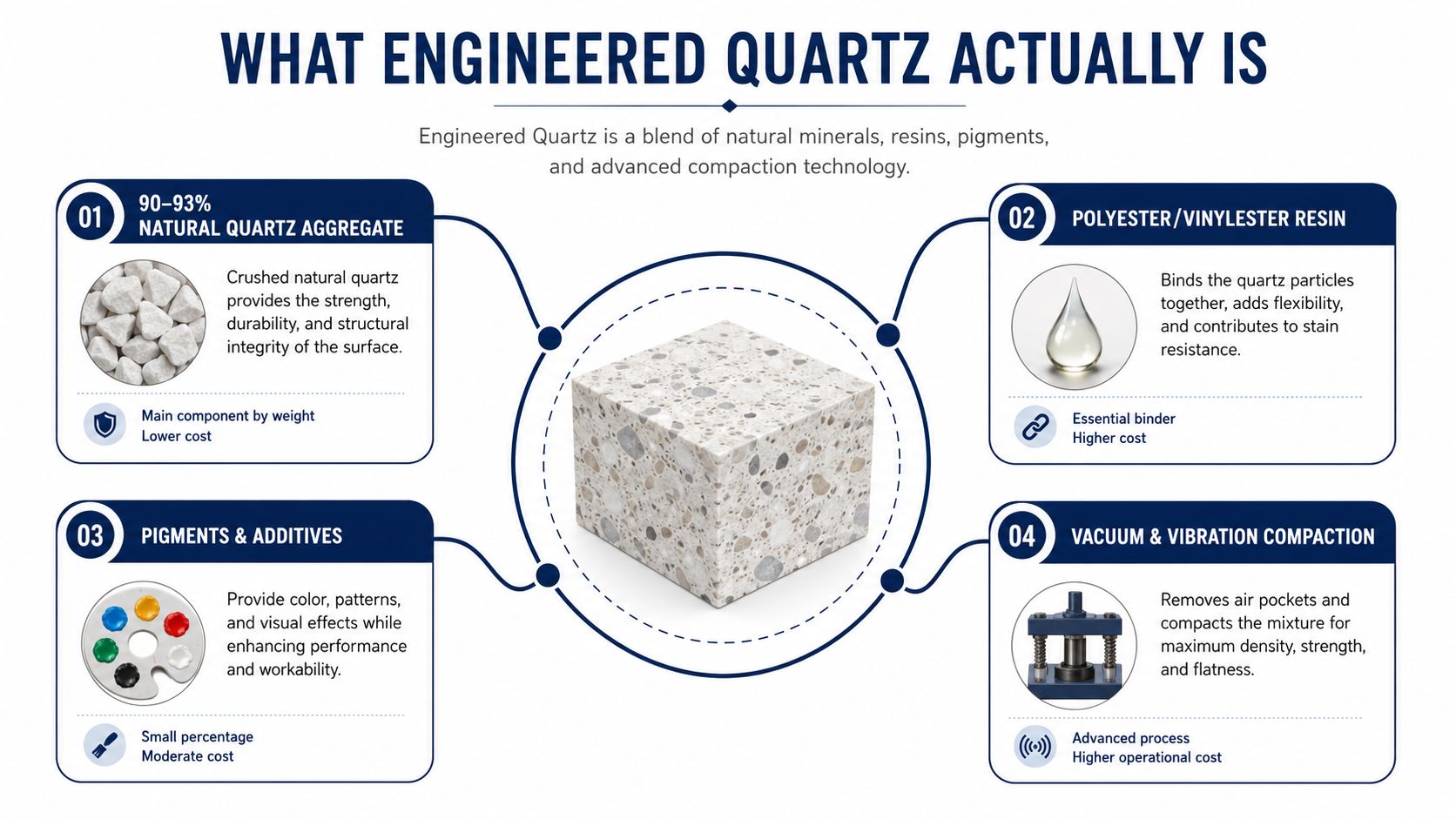
Engineered quartz is a factory-made surface formed from crushed natural quartz aggregate, resin binders, pigments, and additives. A commonly cited composition is approximately 90–93% natural quartz aggregate, with the balance made up of resin and colour-forming ingredients (engineered quartz composition and process overview).
Manufacturers select and grind quartz particles, combine them with resin and pigments, compact the mixture under vacuum and vibration, cure it, and then cut and finish the slab. The factory controls the colour, density, pattern, and surface treatment more tightly than a quarry can control a natural block.
Why the mixture affects the rate
The raw quartz isn't identical across every collection. Purity, particle size, and colour influence the appearance and manufacturing result. Resin quality affects bonding and curing consistency, while pigments determine whether a slab is a simple solid colour or a more complex decorative surface.
A plain polished slab is easier to produce and usually easier to match. Veined designs demand more control. The pattern may need directional alignment during fabrication, and careless cutting can make the finished counter look disjointed. That is why a marble-look slab can cost considerably more than a basic solid colour, even when both are sold under the same broad category of quartz.
For designers comparing materials visually, a tool such as Interior Design Material Swap can help communicate how a quartz surface changes the look of a room before the client commits to a slab.
Quartz is predictable, dense, and low-maintenance, but it isn't a natural quarry product. That factory control explains its premium over ordinary granite in many finishes. At the same time, domestic production and local distribution can keep it below the price of highly exclusive imported collections. For kitchen planning, this comparison of why quartz slabs suit modern kitchens is useful, but the purchase decision still depends on the exact slab and fabrication brief.
The Five Drivers Behind Every Quartz Slab Price in India
The quartz slab price in India is governed by five variables. If two suppliers quote different rates, start with these before accusing either one of inflating the price.
Brand tier
Brand positioning creates the widest visible gap. Budget Indian brands generally compete around ₹250–₹450 per sq ft slab-only, while mid-tier Indian and entry-level imported products commonly sit around ₹450–₹800. Premium imported lines can begin around ₹800 and move above ₹1,800 per sq ft, depending on design and availability.
These figures are slab-only working bands, not installed prices. A premium logo doesn't automatically guarantee that the slab suits your kitchen. Ask what quality control, warranty support, colour consistency, and design specificity you're receiving.
Thickness
Thickness affects both material consumption and handling. The market guide cited earlier places 2 cm slabs at ₹240–₹550 per sq ft and 3 cm slabs at ₹350–₹650 per sq ft (India quartz thickness pricing). A thicker slab can make sense for a visually substantial island or exposed edge, but it's wasteful to specify it everywhere without a design reason.
Finish
Polished is usually the reference finish. Matte, honed, leathered, suede, and concrete-inspired surfaces require different processing and may carry a higher rate. The finish also changes how fingerprints, water marks, and cooking residue appear, so choose it under the lighting conditions of the actual kitchen rather than relying on a showroom spotlight.
Origin
Imported material carries more than a factory price. Freight, customs handling, currency movement, storage, and dealer margin all influence the final number. Trade data records engineered quartz imports from five countries in 2024, with Vietnam, the United States, and China accounting for 98% of total imports (India engineered quartz import data).
Slab size and yield
A larger slab can reduce seams and improve cutting efficiency, especially on islands or long counters. Its per-slab ticket may look higher, but the relevant question is how much usable finished surface remains after cutouts and pattern matching.
| Driver | Budget | Mid-Tier | Premium |
|---|---|---|---|
| Brand | ₹250–₹450/sq ft | ₹450–₹800/sq ft | ₹800–₹1,800+/sq ft |
| Thickness | Lower-cost 2 cm options | 2 cm or 3 cm standard ranges | Design-led 3 cm options |
| Finish | Basic polished | Matte or selected textured finishes | Speciality finishes and complex surfaces |
| Origin | Domestic | Domestic or entry imported | Imported designer collections |
| Slab yield | Standard formats | Larger format where available | Jumbo or pattern-critical formats |
If you want an organised comparison of project documents and commercial details, you can also view plan pricing, but don't let any planning tool replace a written slab quotation. The same five variables will appear in every serious supplier discussion.
How Thickness and Finish Change the Per Square Foot Number
Thickness is not a quality grade by itself. It's a specification choice that affects material volume, weight, transport, fabrication, and the visual treatment of exposed edges.
The India-market guide places 2 cm slabs at ₹240–₹550 per sq ft and 3 cm slabs at ₹350–₹650 per sq ft (quartz slab thickness price ranges). A 2 cm slab is often sensible for standard counters, wall applications, and projects where the fabricator creates a thicker-looking edge through detailing. A 3 cm slab gives a heavier visual profile and can simplify some edge treatments, but it increases the material commitment.
Compare the finish, not only the thickness
Polished surfaces remain the easiest baseline to compare because most suppliers can quote them clearly. Matte or honed finishes produce a quieter appearance, though they can show handling marks or residue differently from a glossy surface. Leathered and textured finishes add tactile character, but they also need a fabricator who understands the particular slab and its finishing limits.
| Option | Typical Price Range (₹/sq ft) | Price Step-Up vs Baseline | Best Use |
|---|---|---|---|
| 2 cm polished | ₹240–₹550 | Baseline for typical 2 cm material | Standard counters and cost-controlled kitchens |
| 3 cm polished | ₹350–₹650 | Higher than typical 2 cm pricing | Islands, substantial profiles, premium residential work |
| Premium custom pattern | ₹450–₹850 | Above standard slab bands | Statement counters and design-led applications |
| Matte or honed | Confirm with supplier | Usually above comparable polished material | Soft contemporary kitchens |
| Leathered or textured | Confirm with supplier | Usually above baseline finish | Feature counters and tactile interiors |
The finish premium is worthwhile when it supports the room's design and the supplier can show the exact surface under practical lighting. It isn't worthwhile when the showroom display is doing all the selling and the final kitchen has no visual benefit from the upgrade.
Choose thickness for structure and edge design. Choose finish for the room, not for the sample board.
The Hidden Cost Stack Between Slab Quote and Installed Countertop
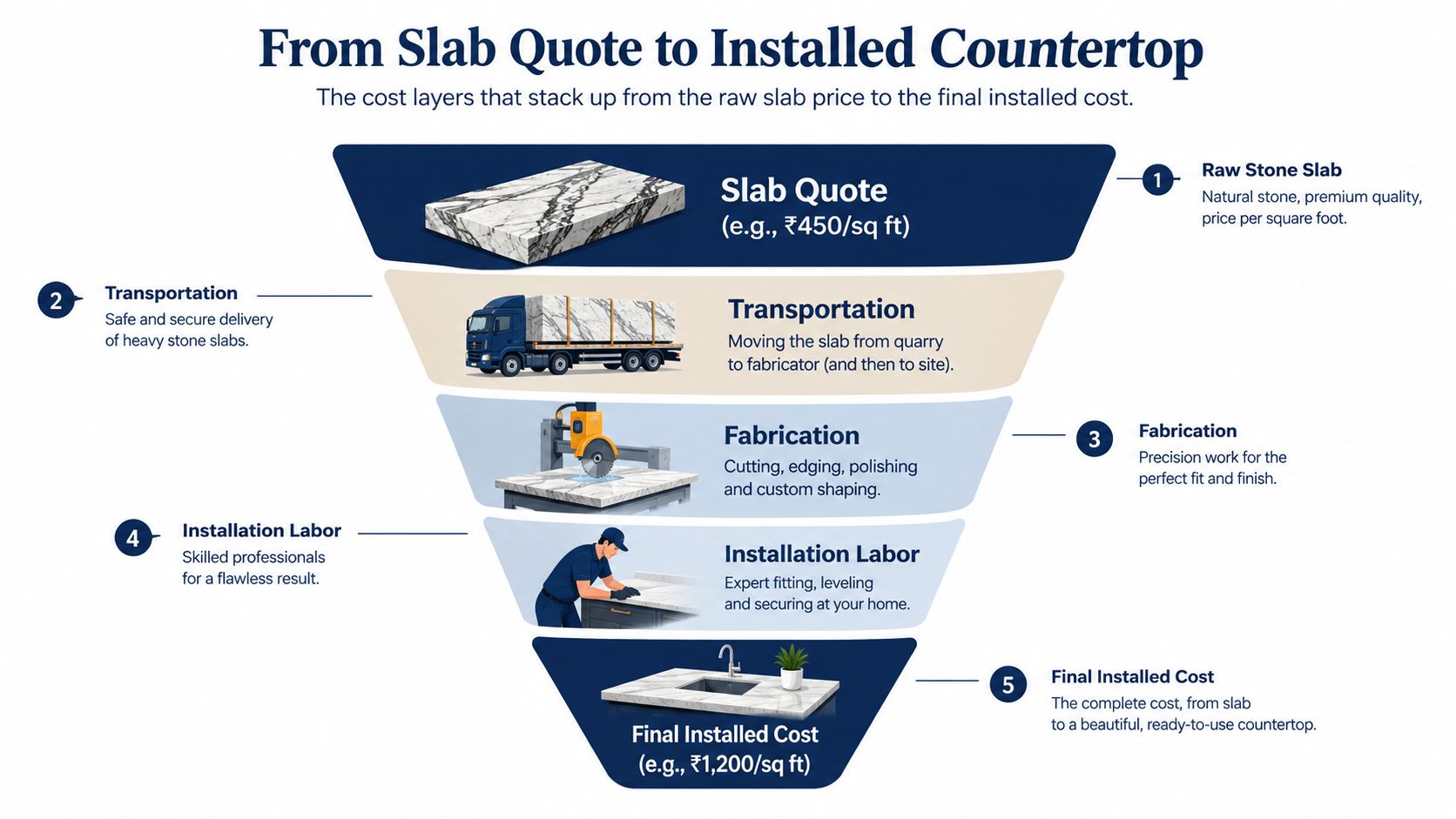
A slab quote is only the starting point. The finished counter requires measurement, transport, cutting, cutouts, edge work, site handling, support, installation, and tax treatment.
The layers suppliers often leave out
Fabrication covers cutting the slab to the approved template. Sink and hob openings are separate decisions, especially when the cutout shape, sink type, or hob geometry requires extra care. Edge profiling adds another fabrication layer, and a simple square edge shouldn't be compared with a decorative profile or a built-up edge.
Measurement and templating protect both the buyer and the fabricator. A site visit identifies wall irregularities, cabinet alignment, appliance clearances, joints, and support requirements. If the supplier skips this step and cuts from rough measurements, the buyer carries the risk.
Transport and crating matter because full slabs are heavy and vulnerable at corners and cutout zones. NCR projects can also involve movement between a yard, a fabricator, and the final site. Ask whether the quote includes loading, delivery, unloading, and carrying into the building.
Wastage is not automatically suspicious. Quartz is cut from fixed slab formats, so the layout may leave unusable pieces. The supplier should show the cutting plan and state the wastage policy in writing rather than adding an unexplained “cutting loss” charge after approval.
Tax and installation need separate lines
For quartz or quartzite blocks and slabs classified under HSN 2506, GST is 5% (GST classification and local quartz market listings). The invoice should identify the material classification and distinguish goods from fabrication or installation services. Don't accept a single tax-inclusive total without understanding what it covers.
A supplier may quote ₹450 per sq ft for the slab and still produce a much higher installed rate after all layers are added. That isn't a contradiction. It's the difference between buying raw material and commissioning a finished countertop.
Watch this visual explanation of how the work moves from slab selection to completed installation:
Use one worksheet for every vendor. Record material rate, usable area, cutouts, edge profile, transport, installation, wastage, and GST. Only then can you tell whether a lower headline quote is cheaper.
Common Tricks and Misconceptions in Quartz Slab Pricing
The most common pricing problem isn't always an inflated rate. It's an incomplete rate.
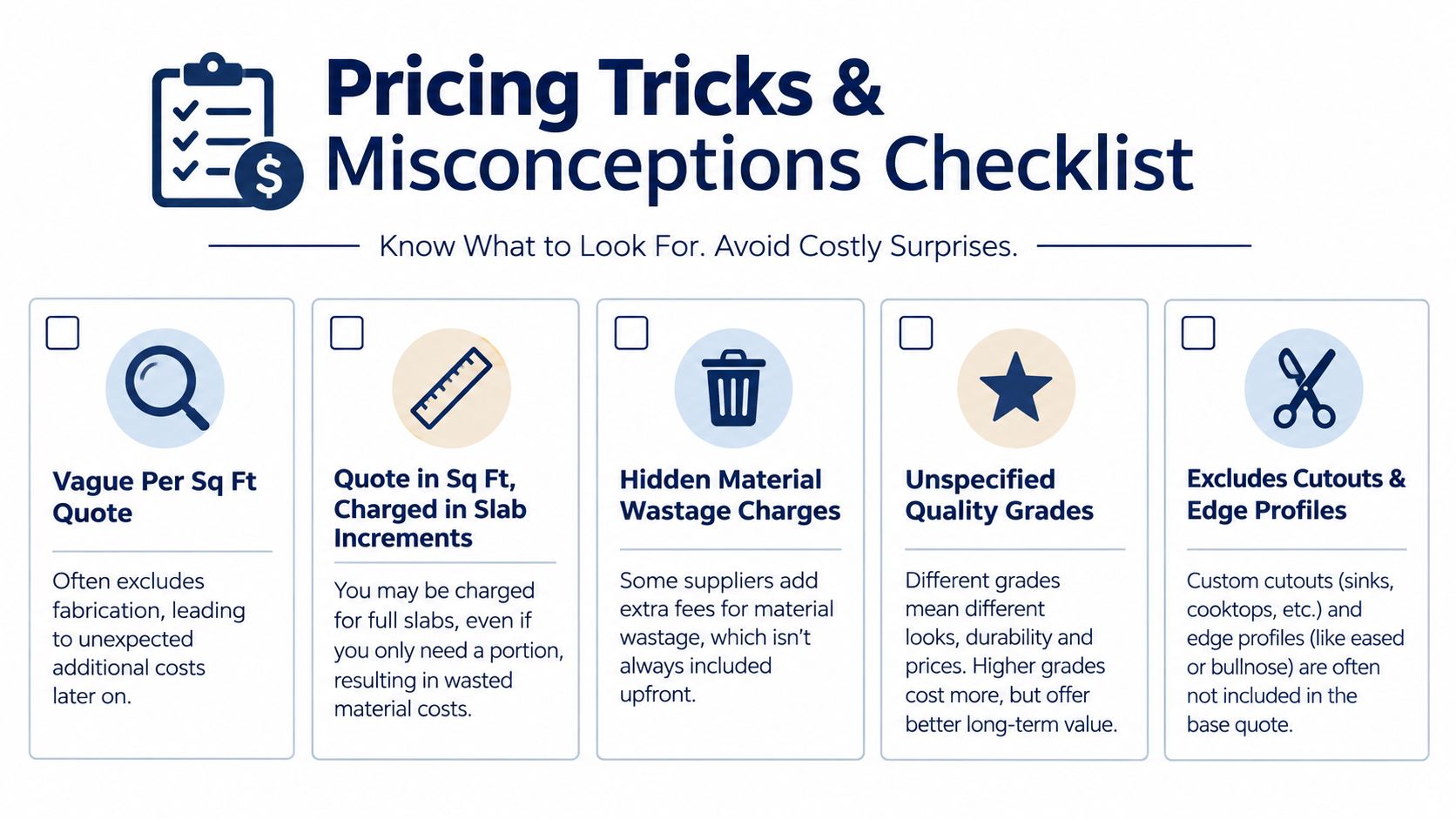
A supplier says “₹500 per sq ft” without stating whether the figure covers the slab, cutting, polishing, installation, or GST. Another calculates the quote using your countertop area but charges for slab-sized purchases, leaving the waste policy unclear. Both methods can produce an unpleasant final invoice.
What buyers should challenge
- Vague per-square-foot rates: Ask whether the number refers to a raw slab or a finished installed surface.
- Slab-increment billing: Request the slab dimensions and cutting layout, especially when the kitchen has an island, return, or long run.
- Unexplained wastage: Require the supplier to state how unused material is treated and whether the buyer pays for it.
- Unspecified grade: Record the manufacturer, collection, finish, thickness, and batch before paying an advance.
- Excluded cutouts: Confirm sink, hob, tap, socket, drainboard, and edge-profile charges in the written quote.
Imported doesn't mean automatically better
Imported material can offer distinctive patterns, surface treatments, or tighter availability in a particular collection. It also carries a more exposed supply chain, as the import data shows, so the higher price may partly reflect freight and distribution rather than a dramatic performance difference.
Thickness isn't a substitute for quality control either. A thicker slab can suit a visual or structural brief, but it won't correct poor cabinet support, careless cutting, or a mismatched batch. Buyers comparing natural alternatives may find this overview of marble and quartzite helpful, but the same rule applies: judge the exact material and execution, not the category label.
Demand the batch number, slab dimensions, finish, thickness, tax split, fabrication scope, and installation scope before you approve the order.
How to Read, Compare, and Negotiate a Quartz Slab Quote
Don't compare supplier quotes by scanning the bold total. Convert every offer into the same format first.
Step one, force the quote into line items
Ask for these entries in writing:
- Slab brand, collection, colour, thickness, finish, and batch.
- Slab rate and chargeable quantity.
- Cutting and fabrication.
- Sink and hob cutouts, listed separately.
- Edge profile and any built-up or mitred work.
- Templating and site measurement.
- Transport, loading, unloading, and site carrying.
- Wastage policy and cutting layout.
- GST classification and tax amount.
- Installation, support, sealing, and handover responsibilities.
If a supplier refuses to separate those items, you're not comparing a transparent quote. Move to another supplier.
Step two, inspect the actual slab
A small sample can't show the full behaviour of a veined pattern across a long counter. Ask to see the exact reserved slab, inspect colour continuity, look for visible resin pooling, check edges for damage, and confirm that the finish matches the approved sample.
For complex patterns, mark the sink, hob, joins, and waterfall panels on the slab before fabrication. The fabricator should explain where the veins will run and where the joints will fall. A beautiful slab can still produce a poor result when the cutting plan ignores its pattern.
Step three, negotiate the controllable items
Material pricing may have limited flexibility, particularly for imported or batch-specific stock. Fabrication bundling, transport, edge work, and installation coordination are usually more practical negotiation points.
Ask whether the supplier can reserve the selected batch against an advance, combine fabrication into the material quotation, or absorb a transport charge when several surfaces are delivered together. Get every concession written into the revised quote, not just agreed verbally in the showroom.
Before delivery, verify the slab identity and inspect corners. Before fabrication begins, sign off the template and cutout positions. That short approval process prevents the most expensive kind of dispute, a dispute after the slab has already been cut.
Matching Your Budget to the Right Quartz Choice
The right quartz choice depends less on chasing the lowest rate and more on deciding where appearance, edge detail, and consistency matter.
A budget-focused buyer should start with a domestic mid-tier slab, a 2 cm thickness, and a polished finish. This suits rental properties, builder-grade homes, and kitchens where a clean, durable surface matters more than a dramatic vein or elaborate edge.
A balanced buyer, which includes most homeowners, can select a mid-premium Indian or entry imported collection. Use 2 cm where the design allows it, or 3 cm where the island and edge need more visual weight. Spend on the visible edge and pattern continuity rather than upgrading every hidden section.
A premium buyer may justify a 3 cm imported slab, a directional marble-look design, mitred edges, or waterfall panels. The extra spend only makes sense when the fabrication team can execute the details properly and the exact slab is reserved before cutting.
| Buyer Tier | Recommended Spec | Installed Cost Range (₹/sq ft) | Main Trade-Off |
|---|---|---|---|
| Budget-focused | Domestic mid-tier, 2 cm, polished | Confirm after full quotation | Fewer premium patterns and simpler edge work |
| Balanced | Mid-premium Indian or entry imported, 2 cm or 3 cm | Confirm after fabrication and installation scope | Better appearance without every luxury detail |
| Premium | Imported 3 cm, directional pattern, mitred or waterfall detailing | Confirm after exact design and fabrication plan | Higher material and execution risk if poorly coordinated |
Marketplace listings in Delhi and Rajkot show active quotes of roughly ₹300–₹785 per sq ft for 20 mm products, before the complete project stack is assessed (local engineered quartz listings). Treat that as a market reference, not a final installed budget.
Order early enough for the selected batch to be available before fabrication. Record the batch number and approve the cutting layout before anyone touches the slab. Buyers comparing available collections can review Varun Marbles' quartz slabs alongside other local suppliers, then request a fully itemised NCR quotation.
Varun Marbles supplies engineered quartz slabs and natural stone, with slab selection, cut-to-size fabrication, edge profiling, and installation coordination available through its Gurugram operations. Visit Varun Marbles with your kitchen drawing and ask for a written slab-to-installation quote that separates material, wastage, fabrication, transport, GST, and labour.