
Luxury Italian Marble Flooring: A Practical Guide
You're standing in a Gurugram showroom with two slabs in front of you. One has the quiet, familiar character of Rajasthan marble. The other has a dramatic Italian vein that makes the entire room feel designed around it. The Italian slab looks exceptional, but the decision isn't whether it photographs better. It's whether your household, contractor, cleaning routine, and installation team can protect that finish for years.
Luxury Italian marble flooring rewards disciplined selection and disciplined living. The purchase price is only one part of ownership. Quarry provenance, slab acceptance, cutting, substrate preparation, finish, sealing, spill response, and wet-area safety all shape the result. This guide takes the view of a senior stone consultant advising an NCR project, where monsoon moisture, dust, grit, acidic cleaners, intensive air-conditioning, and demanding interior briefs all affect natural stone.
Table of Contents
- Why Italian Marble Still Dominates Luxury Flooring in India
- What Makes Italian Marble Different from Domestic Stone
- Italian Marble Varieties Worth Knowing for Flooring
- Choosing the Right Finish for Each Room
- Sourcing, Specification, and the Quarry-to-Slab Journey
- Living With Italian Marble, The Real Maintenance Reality
- Is Italian Marble Worth the Premium for Your Space
- Planning Your Italian Marble Flooring Project
Why Italian Marble Still Dominates Luxury Flooring in India
In a Gurugram showroom, the decision becomes practical once the first impression fades. A homeowner may want Statuario's luminous white, while the architect wants controlled veining across a large living room. The contractor needs slabs that can be selected, cut, installed, and handed over without avoidable surprises. Domestic marble can offer easier availability and a familiar maintenance routine, yet Italian stone remains the stronger choice when the floor must define the room's identity.
That choice exists within a substantial Indian stone economy. The Indian Bureau of Mines marble report recorded Rajasthan at approximately 89% of India's marble output value in 2014–15, Gujarat at about 10%, and other states at approximately 1%. Italian marble does not replace this domestic supply. It serves a smaller, design-led segment in which the client is paying for a specific visual result and a controlled specification.
The distinction matters for the budget. Italian marble is commonly selected for rarity, vein movement, colour control, finish quality, and design recognition, not only because it is marble. Buyers should compare it with Rajasthan stone across appearance, performance, availability, wastage, installation, and future care. A domestic alternative may deliver the required result at a lower ownership cost. If it cannot deliver the required pattern or sense of space, the imported slab may justify its premium.
The showroom decision is bigger than the slab
India's established stone-processing network makes imported marble workable for NCR projects. Blocks and slabs can be cut, polished, finished, fabricated, and distributed through trades that already understand natural stone. That infrastructure helps only when the supplier controls selection and installation. A showroom that sells a name without managing the material leaves the client with the risk.
Ask four questions before approving the order:
- What are you buying? Confirm the named variety, block reference, slab selection, thickness, and any visually similar substitute.
- Where will it be installed? A dry formal room has different demands from a bathroom entrance, kitchen threshold, or commercial lobby.
- Who will protect the finish? Sealing, suitable cleaning products, entrance mats, and rapid spill response form part of ownership.
- What happens after handover? Require inspection, care instructions, and a plan for occasional honing or restoration.
Italian marble earns its luxury position when the design brief needs a natural focal point and the project team can protect that result. It becomes an expensive mistake when the client expects a maintenance-free floor, accepts poor layout, or treats installation as a final-day task. Total ownership discipline, not the purchase price alone, determines whether the material performs like a luxury finish.
What Makes Italian Marble Different from Domestic Stone
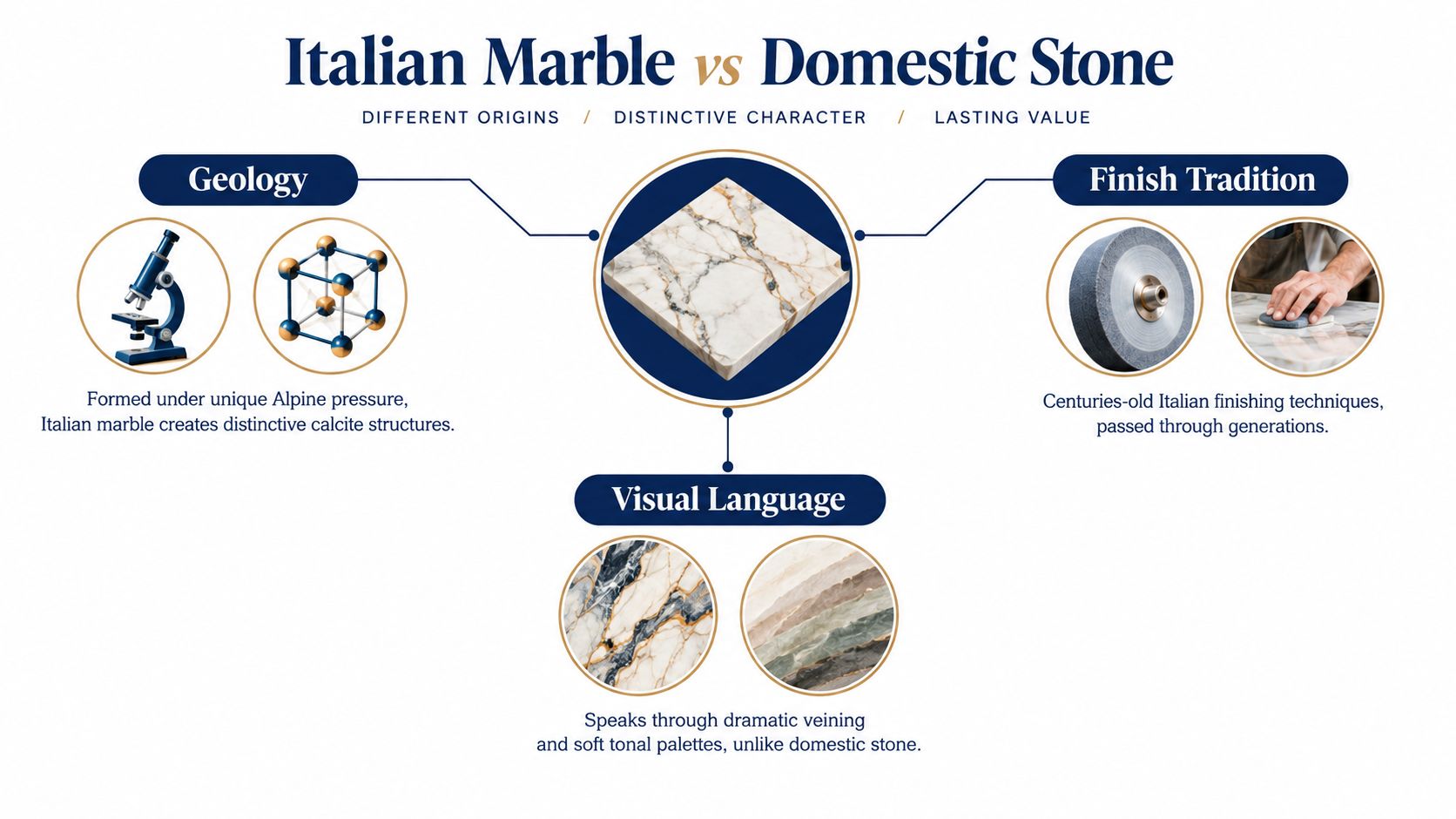
A Gurugram client choosing between an imported slab and a Rajasthan marble is not choosing a passport. The decision is whether the stone delivers the required visual control, fabrication quality, and long-term performance. Italian marble is different in geological character, visual language, and finishing tradition. It earns its premium only when those differences serve the design.
Italian varieties often offer luminous backgrounds, layered calcite structure, and veins that either flow or create a strong focal point. Carrara can establish a restrained white-and-grey field. Calacatta and Statuario can give a room sharper movement and a more deliberate centre of attention. Indian marbles cover a broad range of colours and patterns, and a well-selected domestic stone can perform beautifully when its grade, finish, and installation are properly controlled.
Start with design intent, not nationality
Use three tests before approving samples.
- Read the geology through the pattern. Natural marble contains mineral variation, fissures, crystals, and shifts in tone. A strong vein may make a slab worth selecting, but it also requires disciplined layout, matching, and waste planning.
- Assess the finishing standard. A polished surface can appear flat when slab preparation, resin work, calibration, or polishing is poorly executed. Italian origin cannot correct careless processing.
- Set the floor's visual authority. A quiet Botticino can support furniture and artwork. A dramatic Calacatta may become the room's main architectural element and dictate the rest of the palette.
Indian stone deserves a direct comparison because it comes from a mature domestic market with broad availability and established fabrication skills. Italian marble should therefore be specified as a premium design material, not as an automatic replacement for local stone. The useful question is what the imported slab contributes after freight, selection, cutting, installation, sealing, and future care are included.
Consultant's rule: If you cannot explain what the imported slab contributes beyond prestige, specify the domestic option and put the difference into better installation.
For a Gurugram home, the strongest case usually combines controlled colour, distinctive veining, and a finish that supports the architecture. Foreign stone is not automatically harder, safer, or easier to maintain. Total ownership discipline decides whether Italian marble performs like a luxury floor.
Italian Marble Varieties Worth Knowing for Flooring
A showroom list can overwhelm buyers with names. Narrow the choice by visual personality, room use, and tolerance for variation. Your shortlist should normally contain two or three varieties that support the brief, not every attractive slab in the yard.
Compare the main personalities
| Variety | Visual Character | Best-Fit Application |
|---|---|---|
| Statuario | Bright background with pronounced grey veining and a high-contrast, sculptural feel | Formal living rooms, entrance floors, feature zones, and carefully planned bookmatching |
| Calacatta | Luminous base with bold, expressive veins that can move from grey towards warmer tones | Statement foyers, luxury reception areas, dining rooms, and feature flooring |
| Carrara | Softer white or grey background with restrained, flowing veining | Bedrooms, corridors, understated living spaces, and larger areas where calm continuity matters |
| Botticino | Warm beige or cream character with gentler movement | Indian homes seeking a softer palette, broad flooring fields, and rooms with warm wood |
| Travertine | Earthier, porous visual language with natural linear movement and a more architectural texture | Rustic-modern interiors, selected dry zones, wall applications, and designs that favour tactile depth |
| Onyx accents | Translucent, highly decorative patterning rather than a conventional flooring workhorse | Borders, inlays, backlit panels, niches, and limited feature areas |
Statuario and Calacatta create impact, but their movement can expose poor layout planning. Ask the fabricator to dry-lay the slabs and mark the intended sequence before cutting. If the design depends on a continuous vein, approve the actual slabs, not a catalogue photograph.
Carrara is usually easier to integrate because its softer pattern doesn't compete with every piece of furniture. Botticino works well in NCR interiors that already use timber, brass, beige upholstery, or warm lighting. Travertine needs a clear decision about filled or more textured treatment, especially where dust and cleaning routines matter.
Choose for the room, not the showroom light
A master suite can tolerate a quieter stone with subtle movement. A formal foyer can justify a dramatic centrepiece because guests encounter it briefly and the layout can be controlled. A busy family kitchen floor needs more attention to spill response, grit, and finish than to the excitement of a single vein.
For darker, grey-led interiors, review Grigio Armani marble as a design reference, then compare the actual slab's tone and movement under your project lighting. A dark floor can be elegant, but it may show dust, water marks, and scratches more readily than a moderately varied light stone.
The practical selection process is simple: view full slabs, inspect them in neutral light, identify filled fissures and natural openings, then map each slab to a room. Never finalise a variety from a small sample alone.
Choosing the Right Finish for Each Room
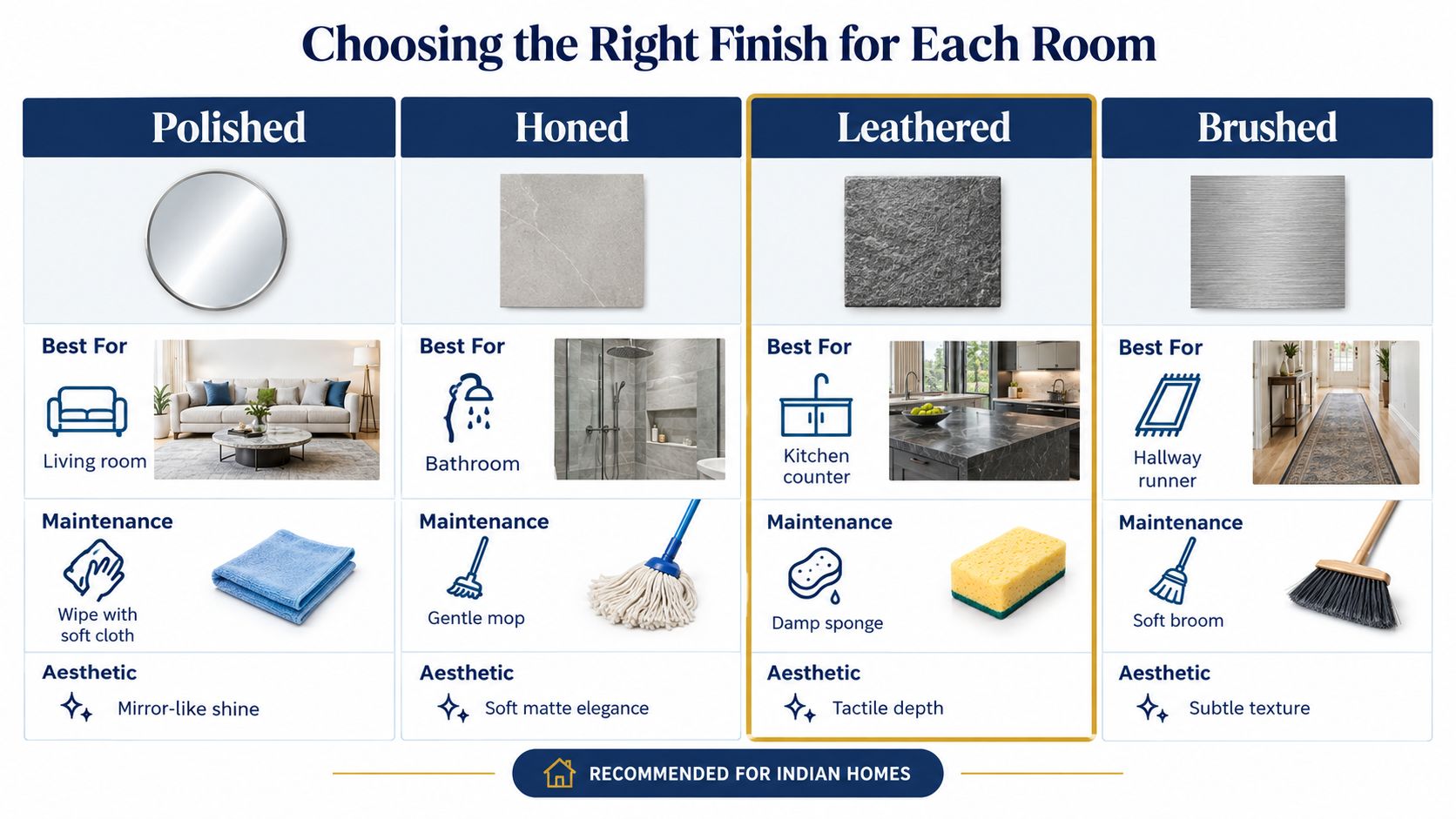
The finish is where many luxury Italian marble flooring projects succeed or fail. A polished surface creates reflection and formal elegance, but the same low-texture surface can become hazardous when wet. Honed, leathered, and brushed treatments reduce visual glare and change the way the floor behaves under feet, furniture, cleaning, and light.
Match surface behaviour to room conditions
Polished marble gives the strongest reflection and makes veining look crisp. Use it in dry, controlled spaces such as formal living rooms, bedrooms, private dining rooms, and low-moisture corridors. It's a poor default for bathroom approaches, pool-adjacent areas, ramps, or commercial floors that are frequently mopped.
Honed marble has a soft matte appearance and usually disguises light surface marks better than a mirror finish. It suits bathrooms, entrance transitions, casual living areas, and spaces where glare is undesirable. The surface still needs sealing and prompt spill care.
Leathered finishes add tactile depth and can make a stone feel less formal. They work best where the design benefits from texture, but they require careful cleaning because depressions and surface variation can hold dust or residue.
Brushed finishes create subtle texture and a less manufactured appearance. Use them selectively in transitional zones, rustic-modern interiors, or areas where a softer grip and visual character matter more than maximum reflection.
Treat slip resistance as an engineering decision
Indian flooring guidance identifies DIN 51130 R10 or higher as a useful target for wet interior areas, with R11 to R12 more appropriate for wetter or exposed zones. Barefoot applications may also require testing under DIN 51097, as outlined in Indian flooring standards guidance. These are screening references, not a substitute for testing the exact finish, slope, contamination, and installation condition.
The cause is simple. Water or cleaning solution forms a lubricating film, while polishing reduces microscopic texture that helps evacuate liquid and generate friction. Keep grout and movement joints flush, provide positive drainage, use entrance mats, and avoid abrupt level changes.
Read the practical difference between honed and polished marble before approving the finish. Then insist on a site mock-up tested both dry and wet. A generic test result for a marble family doesn't tell you how your selected polish will perform under actual cleaning conditions.
Sourcing, Specification, and the Quarry-to-Slab Journey
A serious Italian marble purchase begins before the slab reaches the showroom. The quarry block determines the likely vein direction, background, fissures, translucency, and usable yield. Once the block is sliced, the supplier must inspect the full sequence and decide which slabs suit the intended project.

Look for a supplier who can show the actual slabs and explain their relationship to the block. A casual trader may identify a colour name and quote a rate. A disciplined supplier records the variety, studies the slab sequence, checks resin-filled areas, and helps the design team plan cuts around the stone's movement.
The paperwork your order should carry
For flooring in India, specify and verify compliance with IS 1130:1969, which covers marble blocks, slabs, and tiles for flooring, stairs, facing, dados, and skirtings. The Bureau of Indian Standards category listing identifies key screening thresholds including:
- Water absorption: maximum 0.4% by weight after 24-hour cold-water immersion.
- Mohs hardness: minimum 3.
- Specific gravity: minimum 2.5.
Request representative testing from the delivered lot, not only from a perfect display piece. Record the variety, quarry or block reference where available, slab thickness, batch identification, absorption result, visible fissures, resin filling, and final finish.
The visual standard matters just as much. Inspect slabs for shade continuity, open fissures, resin repair, edge weakness, and areas where polishing changes across the surface. A vein that looks dramatic in one slab may become awkward when repeated across a corridor without a proper layout drawing.
The video below is useful for understanding the inspection mindset, but your approval should still depend on the actual delivered material and project mock-up.
Before installation, approve the adhesive or mortar, joint width, sealer, polish, edge treatment, and sample layout together. This single mock-up can reveal lippage, shade variation, staining, joint visibility, and wet-slip concerns before the project commits to full fabrication.
Living With Italian Marble, The Real Maintenance Reality
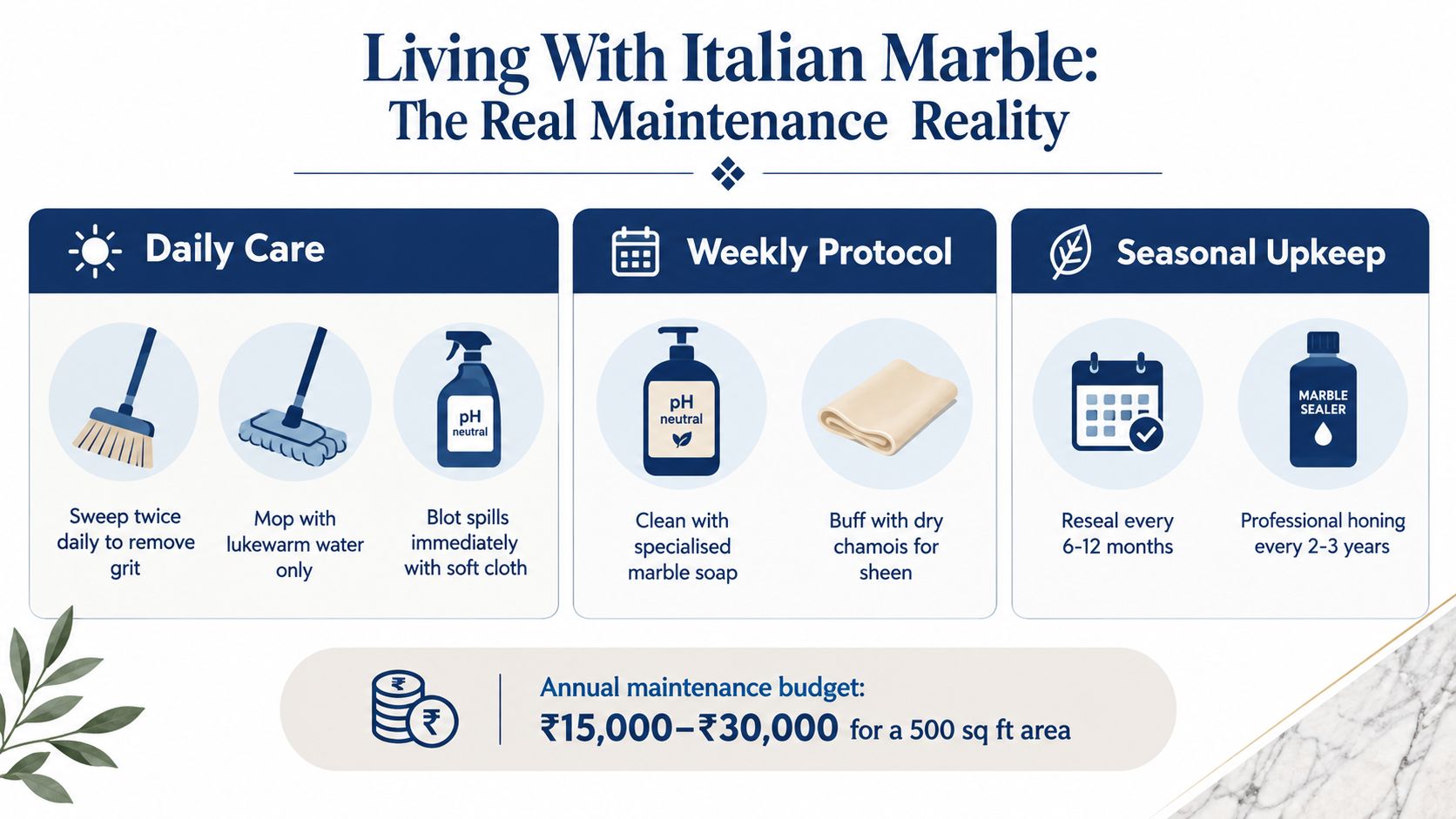
Italian marble isn't maintenance-free because it is expensive. The lifecycle cost depends more on household behaviour than on the invoice. Lemon, vinegar, and acidic cleaners can etch the surface, while oil, turmeric, beetroot, ink, wine, and standing water can stain inadequately protected stone, as explained in Indian marble flooring maintenance guidance.
Use a room-by-room protocol
Kitchens need immediate response. Keep a soft cloth available and blot wine, oil, turmeric, and acidic food residue as soon as possible. Use a pH-neutral marble cleaner, never a bathroom descaler or vinegar solution. Sealing reduces absorption risk, but it won't stop acid etching or repair a dull patch.
Foyers need grit control. NCR dust and outdoor grit can scratch a polished surface under repeated foot traffic. Use entrance mats, sweep regularly with a soft tool, and don't drag planters, furniture, or metal-edged objects across the floor.
Bathrooms need finish discipline. Use honed or textured marble at shower approaches and other wet transitions. Keep drainage positive, remove standing water, and don't assume a sealer makes a polished floor safe.
Restaurants and lobbies need inspection records. Frequent mopping, tracked grit, spills, and cleaning chemicals create a different operating environment from a residence. Assign responsibility for cleaning product approval, spill response, and periodic condition checks instead of leaving care to informal housekeeping habits.
Budget for behaviour and restoration
Resealing doesn't follow a universal annual rule. High-traffic areas may need protection every 18 to 36 months, depending on exposure and performance, while other guidance recommends inspection before automatic recoating. Arrange a pre-monsoon water-absorption check in vulnerable zones, then decide whether the correct intervention is sealing, honing, polishing, or replacement.
Use a simple decision sequence:
- Liquid darkens the surface quickly: inspect the sealer and absorption behaviour.
- A dull mark remains after cleaning: assess acid etching rather than applying more sealer.
- Fine scratches appear near entrances: improve grit control before repolishing.
- Uneven gloss develops across a lobby: review cleaning chemistry and traffic patterns.
If your project team also creates visual property content, a practical guide to making a listing reel can help document the finished floor without relying on static showroom photographs. Good documentation should show the actual stone, finish, light, and room context.
Is Italian Marble Worth the Premium for Your Space
My answer is yes for the right brief, and no for the wrong operating model. Luxury Italian marble flooring is worth specifying when the project needs a distinctive natural surface, controlled visual identity, and a finish that contributes materially to the architecture. It isn't worth the premium when the client wants a floor that can absorb careless cleaning, wet traffic, grit, and delayed spill response without consequence.
Italy has held strong commercial relevance in India's imported natural-stone market. Between 2012 and 2016, India imported roughly ₹1,400 crore of natural marble per year, with imports reaching nearly ₹2,000 crore in 2015. Italy supplied slightly more than half of annual natural-marble imports during that period, according to the trade analysis of Indian marble imports. More recent data in the same source records India importing $318 million of marble, travertine, and alabaster in 2023, with Italy supplying $57 million and ranking second among the listed suppliers.
That commercial presence doesn't prove that Italian marble performs better in every room. It shows that buyers continue to value its provenance, selection, and visual identity within a diversified import market.
Use this decision rule
Choose Italian marble for formal living rooms, statement foyers, hospitality entrances, private suites, and feature-led interiors where the owner accepts disciplined care. Choose granite for areas that face heavier abuse, engineered quartz where low routine upkeep and consistent patterning matter, and quality domestic marble where the design can be achieved locally without sacrificing the brief.
Review the material and installed-cost considerations in Italian marble pricing guidance, but don't make a decision from a rate sheet alone. The correct comparison includes slab selection, wastage, fabrication, edge work, installation quality, sealing, cleaning products, future restoration, and the cost of living with visible damage.
Italian marble earns its premium through design control. If your project won't provide maintenance control, specify a more forgiving material.
Planning Your Italian Marble Flooring Project
Take this checklist to your next showroom visit. It keeps the decision grounded in the actual building rather than the most attractive slab under display lighting.
Set the brief before choosing the name
Write down the rooms, expected traffic, wet transitions, natural light, furniture palette, and cleaning routine. Decide whether the floor should disappear into the architecture or command attention. A dramatic Calacatta may be perfect for a formal entrance and excessive in every bedroom.
Then shortlist varieties by full slab, not sample. Mark vein direction, bookmatch opportunities, fissures, resin-filled areas, tone shifts, and the slabs reserved for visible zones. Ask the supplier to produce a layout that shows where every selected slab will land.
Approve performance before fabrication
Specify the finish separately for every zone. Polished may suit a dry living room, while honed or textured stone belongs at wet transitions and areas where traction controls risk. Require the selected material to be assessed against IS 1130:1969, including representative absorption, hardness, and specific-gravity checks.
Use this supplier question list:
- Provenance: What variety is this, and can you provide a quarry or block reference?
- Batch control: Which slabs belong to this order, and how will shade and sequence be recorded?
- Testing: Can you provide representative absorption and relevant finish or slip-test information?
- Fabrication: Where will cutting, edge profiling, polishing, and sealing take place?
- Mock-up: Will the adhesive, joint, finish, sealer, and layout be approved before full installation?
- Maintenance: What cleaning product, inspection process, and resealing decision will you recommend?
For a wider renovation process, a practical guide to whole-home remodelling can help coordinate flooring with lighting, cabinetry, plumbing, and sequencing. Marble should not be selected in isolation when other trades can damage or stain it before handover.
Varun Marbles supplies Italian and Indian marble, granite, engineered quartz, and onyx, with slab selection, cut-to-size fabrication, finishing, and installation coordination through its Gurugram showrooms. For an NCR project, use that kind of integrated process to compare actual slabs, approve the finish, and plan maintenance before the first tile is laid.
Visit Varun Marbles in Gurugram with your room plans, lighting references, and maintenance expectations, not just a Pinterest image. Ask the team to compare full Italian marble slabs, suitable finishes, fabrication requirements, and installation support so your luxury flooring decision works in daily Indian conditions as well as it looks in the showroom.