
Grigio Armani Marble: A Complete Guide for Interiors

You're probably looking at a few slab photos on your phone, seeing a handsome grey marble called Grigio Armani, and wondering whether it will still look that balanced once it reaches your floor, shower wall, or lobby panel. That's the right question. With this stone, the decision isn't just whether you like the colour. It's whether you know how to read the slab, choose the finish, and specify it in a way that avoids disappointment on site.
Small samples rarely tell the truth with grey marbles. A hand sample can make Grigio Armani seem flat, too dark, too brown, or too busy, depending on the cut and the light. The full slab is where the stone reveals its structure, movement, and tone range. If you're selecting for an Indian interior, that matters even more because lighting conditions, maintenance habits, and fabrication practices all affect the final result.
Table of Contents
- What Is Grigio Armani Marble and Where It Comes From
- Reading the Slab - Colour, Veining and Tone Variation
- Finish Options and How They Change the Stone
- Best Applications in Residential and Commercial Interiors
- Sizing, Formats and What They Mean for Fabrication
- Care, Maintenance and Long-Term Performance
- Choosing and Specifying Grigio Armani Marble With Confidence
What Is Grigio Armani Marble and Where It Comes From
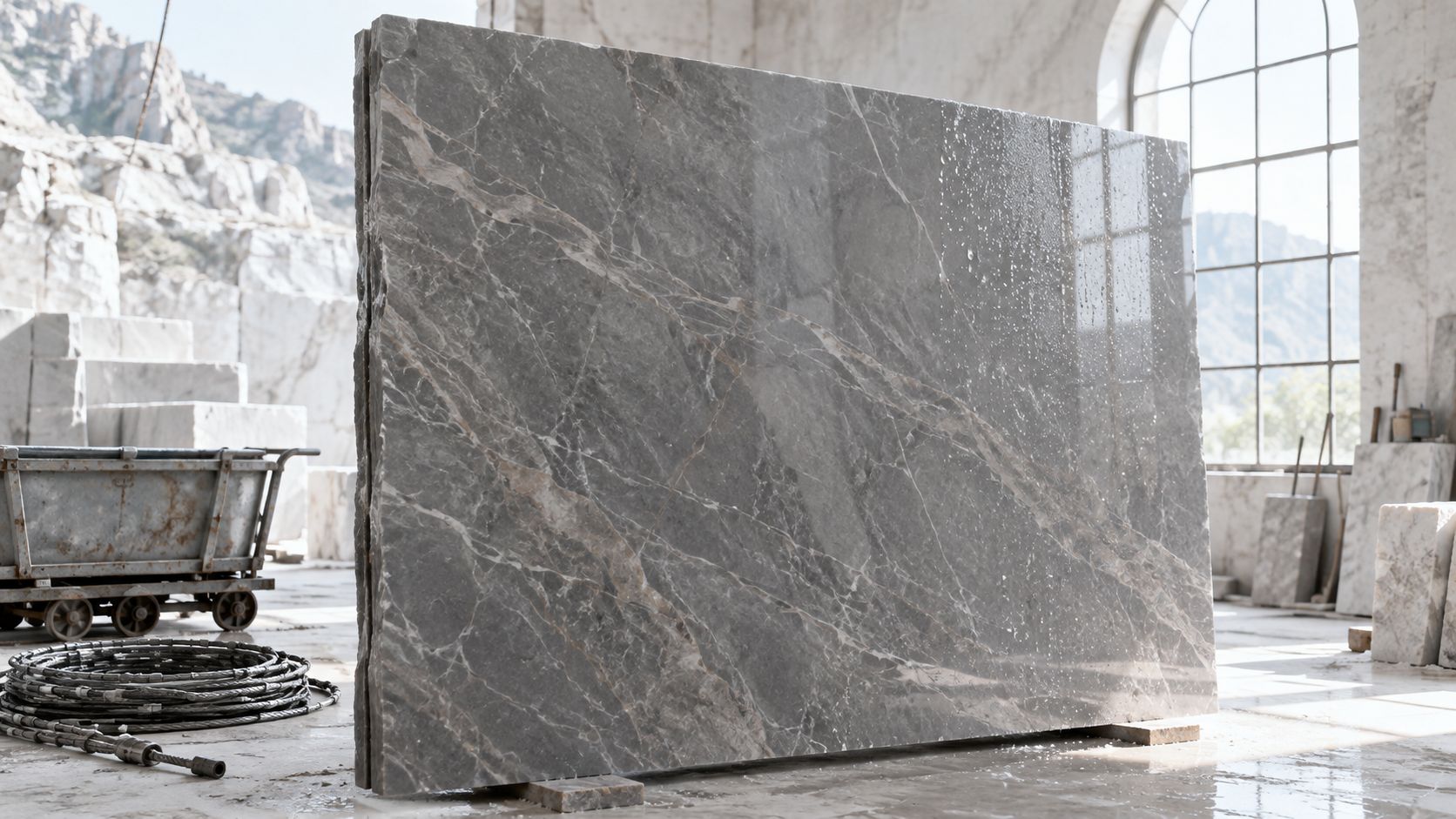
Grigio Armani Marble is a premium imported grey natural stone sold in India for high-end interiors. In the Indian market, it is commonly offered for floors, walls, lobbies, staircases, bathrooms, and commercial spaces, and retail pricing is widely reported around ₹220 to ₹300 per sq ft for 18 mm slabs, while another imported grey marble listing shows a broader range of ₹300 to ₹1,200 per sq ft depending on source, thickness, and finish, as noted by Indian imported coloured marble listings. That spread tells you something useful. Buyers aren't only paying for a colour name. They're paying for origin, slab quality, finish, and availability.
Trade name versus stone identity
One point confuses many first-time buyers. Grigio Armani is a trade-grade name, not a strict scientific classification. In practice, that means two slabs sold under the same name can share the same design language without being visually identical.
Most examples show a grey field with lighter veining and soft movement rather than harsh contrast. Compared with some other grey marbles in the market, Grigio Armani usually reads as calmer and more architectural when the slab selection is done carefully.
Practical rule: Treat the yard name as a starting point, not the full specification. The actual slab is the product.
Why quarry selection matters
Natural marble forms with variation. That variation begins at block level, long before a slab reaches a showroom. If the quarry block has tighter grain and quieter movement, the cut slabs will feel restrained. If the block carries stronger mineral activity, the finished slabs may show bolder veining, patches, or tonal shifts.
That's why clients planning large rooms, lift lobbies, or continuous bathroom cladding should ask to see more than one slab from the same lot. Continuity comes from block selection, not from the trade name alone.
For architects interested in how stone and timber can be balanced without visual overload, this stone and wood building project is a useful design reference because it shows how quieter natural materials can support one another instead of competing.
What to verify before you buy
If you're importing or procuring for a sizable project, ask for clear origin and batch documentation. The paperwork doesn't need to be theatrical. It just needs to be traceable and consistent with the material shown in the yard.
Check these basics:
- Origin records: Ensure the supplier identifies the stone consistently across invoice, lot marking, and transport documents.
- Batch continuity: Confirm whether your approved slabs come from one lot or from mixed arrivals.
- Finish confirmation: Don't assume the same stone will look the same in every finish.
- Showroom match: If you're browsing Italian marble slab collections, compare the gallery image with the in-yard slab, not with a cropped online sample.
Reading the Slab - Colour, Veining and Tone Variation
A printed swatch can't teach you how Grigio Armani behaves. A full slab can. When you stand in front of it, don't ask only, “Do I like this?” Ask four better questions. What is the base tone, how active is the veining, does the movement travel in one direction, and how does this slab sit beside the next one?
Start with base tone
Grigio Armani usually falls somewhere within warm grey, cool grey, or smoke grey. That sounds simple, but many projects go off track. A warm grey slab can work beautifully with walnut veneer, brass, and soft lighting. The same slab may feel muddy beside bright white laminate and blue-toned LED light.
Use this short reading method in the yard:
- Stand back first: View from a distance before inspecting details.
- Ignore the veins for a moment: Read the background field by itself.
- Compare two or three slabs side by side: Your eye notices undertone differences faster in a group.
- Check under actual project lighting if possible: Grey changes quickly under warm and cool lamps.
Then read the movement
The veining may appear linear, cloud-like, or more broken and brecciated. Each pattern gives a different effect in the room. Linear slabs suit long walls and floor runs because the eye follows the movement. Cloud-like slabs feel softer and less directional. Broken patterning can become dramatic on feature walls but may look busy in compact bathrooms.
Here's a simple working scale many designers use in conversation, even if it never appears in formal paperwork:
| Grigio Armani Slab Reading at a Glance | Base Tone | Vein Intensity | Best Use |
|---|---|---|---|
| Quiet slab | Soft or smoke grey | Low | Calm flooring, wall cladding, large visual fields |
| Balanced slab | Warm or neutral grey | Medium | Vanities, fireplace surrounds, hotel-style bathrooms |
| Statement slab | Cool or deep grey | High | Feature walls, book-matched panels, focal counters |
Three checks that reveal the truth
These are the checks I'd insist on before approval.
- Side lighting: Ask the yard team to let light rake across the slab face. This helps you see filled lines, surface irregularities, and whether the movement is crisp or muddy.
- Wet versus dry view: A lightly wetted section often shows how the stone may deepen in colour after sealing and regular use.
- Multiple slab layout: Never approve one slab in isolation for a multi-slab wall.
Bookmatching only works when the adjoining slabs have compatible tone and movement. A mirrored pattern with mismatched depth looks accidental, not luxurious.
For dispatch planning, some suppliers sort slabs for tone consistency before release. If you're buying through a curated yard such as Varun Marbles, ask how the slabs are grouped before loading so the fabricator isn't surprised when the bundle reaches site.
Finish Options and How They Change the Stone
You approve a Grigio Armani slab under bright yard lights, then see it installed at home and wonder why it feels darker, flatter, or more active than you expected. In many cases, the slab did not change. The finish changed how the stone handles light, how sharply the veining reads, and how the surface behaves in daily use.
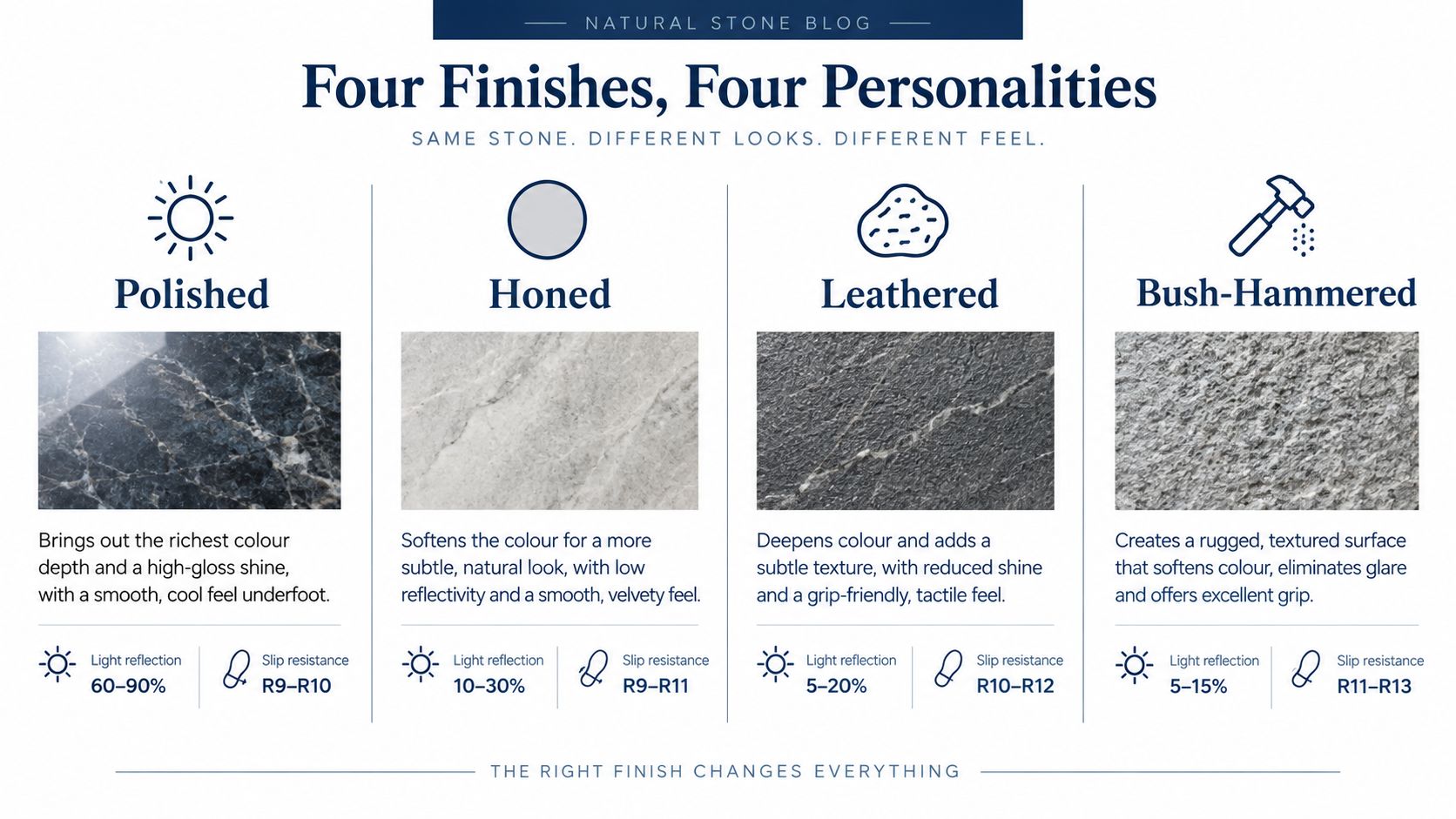
A good way to judge finish is to treat it like fabric choice in tailoring. The colour may stay in the same family, but a crisp silk, a brushed cotton, and a textured wool all present that colour differently. Marble behaves in much the same way. With Grigio Armani, finish affects three things you can see immediately on the slab face: reflectivity, contrast, and texture.
Polished and honed
A polished finish gives you the clearest, most reflective reading of the stone. Grey tones usually look deeper, and pale veining becomes more defined because the surface throws light back at you. That is why polished Grigio Armani often suits entrance foyers, formal powder rooms, and feature vanities where you want the pattern to register from a distance.
A honed finish lowers the glare and calms the contrast. Clients sometimes hear "honed" and expect a flat, lifeless surface. That is not what you see on a well-selected slab. You still get movement and depth, but the visual effect is softer and more architectural, which often works better in bedrooms, bathrooms, and quiet hospitality settings.
If you want a practical comparison before finalising samples, this guide to honed and polished marble differences explains how each finish looks and wears in everyday interiors.
Leathered and bush-hammered
A leathered finish adds a low-relief texture that can make Grigio Armani feel warmer and less formal. The veins usually read with softer edges because the surface is no longer uniformly reflective. This finish can work well on wall cladding, counters with lower glare requirements, or touchpoints where tactility matters.
Texture does not make marble carefree. It only changes what your eye notices first.
A bush-hammered finish is a more deliberate specification. It creates a strongly textured surface with better grip and a rougher visual expression, so the veining becomes secondary to the surface character. In Indian interiors, this is usually reserved for selective use, such as transition areas, spa zones, or an accent panel where slip resistance or material contrast matters more than a smooth luxury look.
How finish changes specification on site
The common mistake is specifying finish by preference instead of by location. A polished sample may look beautiful in isolation, but under strong west light or in a bathroom with many spot reflections, it can feel too sharp. A honed sample may feel understated in the yard, then look exactly right once timber, brass, and warm lighting are added around it.
This matters even more in Indian homes, where daylight intensity, dust visibility, and wet-area use often shape performance as much as appearance. For example, a polished powder bathroom wall and a honed bathroom floor can sit together comfortably because each surface is doing a different job. Using mixed finishes across one continuous plane, however, often creates an accidental patchwork effect.
Use these checks before signing off:
- View the same finish on a full sample, not a chip: Small pieces hide how reflection spreads across a larger face.
- Judge under project-like lighting: Daylight, warm LEDs, and side lighting can make one finish look calm and another look restless.
- Write the finish with the location in the order: "Grigio Armani, honed, floor lobby" is clear. "Grey marble" is not.
- Confirm edge treatment and finish together: A polished top with a honed fascia can look like a mismatch unless that contrast is intentional.
For bathroom mood references, this Dublin bathroom design inspiration is helpful because it shows how surface reflection changes the overall calm or brightness of a room.
Best Applications in Residential and Commercial Interiors
Grigio Armani Marble works best when you use it where its strengths are visible and its vulnerabilities are manageable. It isn't a one-stone-for-everywhere material. That's not a weakness. It's how marble should be treated.
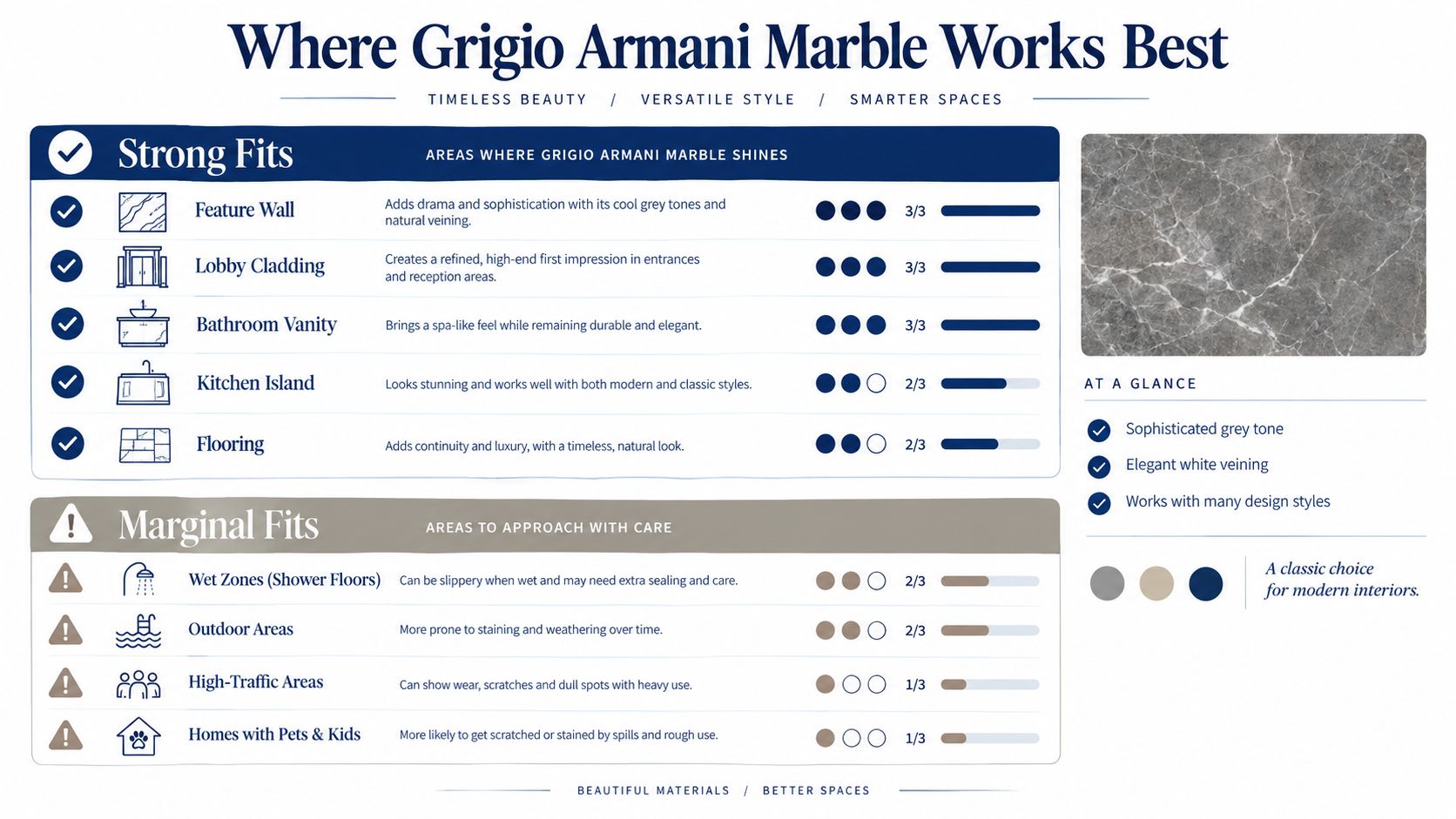
Strong fits
On feature walls, Grigio Armani often looks composed rather than noisy. If the slab has directional veining, a full-height panel can create movement without overwhelming the room. Bookmatched pairs can be especially effective behind a bed, in a dining niche, or in a shower back wall.
In lobby cladding, the stone gives weight and calm. It tends to support lighting, metal trims, and timber joinery rather than compete with them. That makes it suitable for reception zones where the material should feel premium but not theatrical.
Bathroom vanities are another natural fit. Mid-grey tones often read more forgivingly than stark white marbles when splashes dry on the surface. The stone can also ground mirrors, wall lights, and brushed fittings without turning the vanity into a dark visual block.
Good but conditional uses
Kitchen islands can work well when the island functions more as a presentation or social piece than as a heavy prep counter. If daily cooking involves frequent acidic spills, you need to accept that marble will develop use marks.
Flooring is strongest in low-to-medium traffic private interiors where the owner wants stone character underfoot. In a calm apartment living area or master suite passage, Grigio Armani can feel elegant and settled. In aggressive commercial traffic, that same floor may show wear patterns that some clients won't enjoy.
Fireplace surrounds, bar counters, and staircase risers are all good candidates because they showcase the colour and movement without asking the stone to endure the harshest form of abuse.
Marginal or unsuitable placements
Some placements sound appealing on paper but deserve caution.
- Heavy commercial flooring: Large public atriums and intensely trafficked circulation areas usually demand a tougher wear strategy.
- Outdoor paving in harsh exposure: Marble isn't the first choice where weathering and grip dominate the brief.
- Daily acid-prep worktops: Serious cooking zones punish marble quickly.
A stone can be beautiful and still be the wrong answer for one part of the project.
For edges and joints, use the application to guide the detail. Slim eased edges suit modern vanities and wall trims. Mitred edges create visual thickness on islands and counters. Tighter vein-matched joints matter more on feature walls than on small service areas.
The main takeaway is simple. Grigio Armani performs best where visual continuity, controlled lighting, and moderate use come together.
Sizing, Formats and What They Mean for Fabrication
You approve a beautiful slab in the yard, then the finished installation looks busier, more chopped up, or darker than expected. In many projects, the problem is not the stone itself. It is the gap between slab size, cut size, and fabrication planning.
With Grigio Armani, size affects how the eye reads the material. A large panel can show the stone as one quiet field with controlled movement. The same material, cut into smaller modules, can look more fragmented because joints interrupt the flow and each piece may catch a slightly different part of the pattern.
Slab format versus cutter format
Full slabs are usually the right starting point when continuity matters. Use them for vanity backsplashes, shower walls, feature panels, island cladding, and larger floor zones where you want fewer breaks. They also give the fabricator more choice while templating, which matters if one end of the slab is cleaner, darker, or more linear than the other.
Cutter pieces suit projects that do not depend on a long visual run. They are practical for smaller wall sections, framed bathroom areas, skirting, and modular floor layouts where repeatability matters more than a single uninterrupted composition.
A simple way to read this in person is to ask one question: are you buying a picture or a material? If the design intent depends on one continuous visual statement, start from slabs. If the stone is supporting the room more, cut sizes may be enough.
| Common Grigio Armani Marble Formats and Their Uses | Typical Size | Thickness | Best For |
|---|---|---|---|
| Full slab | Large-format slab supply, size varies by lot | Often around 18 mm, but confirm stock | Feature walls, vanities, islands, broader floor layouts |
| Block-derived slab production | Multiple slabs cut from selected blocks | Varies by production | Projects that need several slabs with reasonably consistent tone |
| Cutter slab or cut-to-size pieces | Smaller modular pieces | Confirm with supplier and fabricator | Smaller wall areas, trims, modular layouts |
What to check before fabrication starts
Three decisions shape the final result more than many first-time buyers expect.
First, set the direction of movement. If the stone has a linear grain or soft banding, decide whether it should run horizontally, vertically, or continue across adjacent faces. This should be marked on the slab before cutting, not discussed after templates are approved.
Second, define the visible edge condition. A 40 mm looking island edge may be an 18 or 20 mm slab with a mitred build-up. That is normal, but the joint line, vein alignment, and corner return need to be studied on the slab. A careless mitre can make a calm stone look patched.
Third, check access early. In Indian apartments and urban homes, lift size, landing turns, staircase width, and site protection often decide the maximum finished piece size. A shower wall panel that works perfectly on paper may still need to be split if it cannot reach the bathroom safely.
Why specification details matter
This is also the stage where clear documentation saves money. Your drawing or purchase note should record thickness, finish, edge profile, orientation, and whether bookmatching or vein matching is expected. If you want a low-variation look across multiple rooms, say that directly. If natural shade shift is acceptable, state that too.
Fabricators work best when the instruction is visual and exact. “Grey marble wall” is vague. “Honed Grigio Armani, vertical grain, slabs selected for low contrast, tight vein-matched joints, mitred niche returns” is specific enough to produce a predictable result.
For teams reviewing site preparation and laying sequence, this guide on how to install marble tile is a useful practical reference. It shows how substrate accuracy and installation planning affect what the finished stone will look like.
Care, Maintenance and Long-Term Performance
Grigio Armani Marble doesn't need panic-level maintenance. It needs consistent, sensible care. Owners get into trouble when they treat marble as either ultra-fragile or completely indestructible. It's neither.
The first days matter
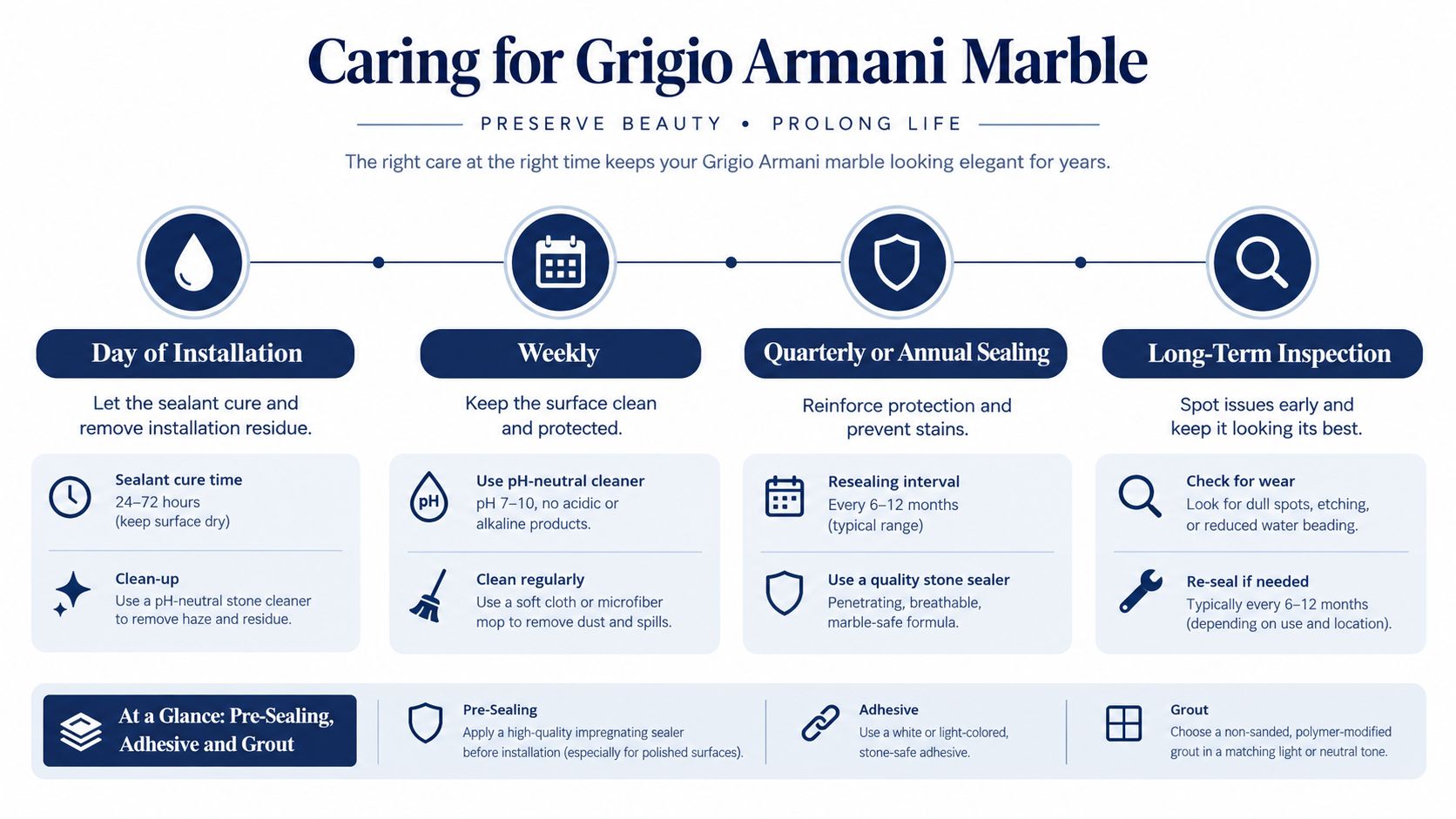
Installation day decisions affect years of performance. The fabricator and installer should agree on suitable adhesive, clean joints properly, and avoid leaving residue to harden on the face of the stone. If sealing is part of the installation strategy, it should be done methodically rather than as an afterthought after grouting dust has already settled into the surface.
The first clean should be gentle. No harsh acidic products, no rough abrasive pads, and no “bathroom cleaner” used casually just because the room is wet.
Simple routine care
For everyday ownership, the routine is straightforward:
- Use pH-neutral cleaners: Marble doesn't like acidic products.
- Dry standing water when practical: This is especially helpful on vanity tops and bathroom ledges.
- Protect from kitchen acids: Citrus, vinegar, and similar substances can etch the surface.
- Avoid abrasive powders and bleach-heavy habits: These often do more harm than the original mark.
Honed surfaces usually disguise light wear more gracefully than polished ones. Polished surfaces, on the other hand, reward careful upkeep with stronger visual depth.
Marble ages well when the owner accepts patina as part of the material, not as proof of failure.
Etching, staining, and resealing
Etching deserves honesty. If acidic substances contact marble, surface change can happen. Grigio Armani's mid-tone background may show these changes less starkly than pale white marble, but that doesn't make it immune.
For stains, cleaning depends on the type of mark. Organic residue and oil-based discolouration don't behave the same way, so treatment should be matched to the problem rather than guessed. If hard water is part of your site condition, this article on hard water stains on marble gives useful context before you choose a cleaning routine.
Long-term performance is mostly about expectation. In lived-in spaces, marble develops a history. On floors, that may appear as traffic softening in the main route. On counters, it may appear as small usage marks where hands and objects repeatedly land. Professional refinishing can often restore the surface when appearance matters more than preserving that lived-in character.
A realistic decade-long view
Think in these terms:
- If you want zero change, don't choose marble.
- If you want depth, variation, and age with character, marble remains compelling.
- If the room sees daily hard use, select the finish and placement with that reality in mind.
Choosing and Specifying Grigio Armani Marble With Confidence
Good results with Grigio Armani Marble rarely come from taste alone. They come from a disciplined approval process. If you specify carefully, the stone usually behaves exactly as expected. If you approve casually, site disputes begin with phrases like “we thought it would be more uniform” or “this doesn't look like the sample”.
Build the brief before you reserve the slab
Start with the application, not the name. A shower feature wall, a lobby floor, and a vanity top need different slab qualities. Once the use is clear, define the minimum visible piece sizes required after cutting. That immediately tells you whether you need large-format slab selection or whether smaller cut pieces will do.
Then request current lot photographs under consistent lighting. Mixed photos from different dates and different wetness conditions are a common source of confusion. If the project is sensitive to tone, approve in person whenever possible.
Write what you actually need
Architectural specifications often fail because they stay too vague. “Grigio Armani Marble” is not enough for procurement or fabrication.
Your specification should identify:
- Intended finish: polished, honed, leathered, or another approved finish
- Thickness required: match this to the actual fabrication detail
- Application: floor, wall, vanity, stair riser, island cladding
- Visual expectation: quiet, balanced, or statement movement
- Lot continuity requirement: especially important for multi-slab walls or large floors
- Approval basis: slab photos, physical selection, or both
Unnamed substitutes are a recurring risk in the stone trade. If a supplier says “same look” without showing the actual replacement slab in proper light, pause the process.
Warning signs worth taking seriously
Be cautious if you notice any of the following:
- Mixed-lot deliveries without prior approval
- Inconsistent finish across slabs
- No clear slab markings linking approved photos to delivered material
- Pressure to approve from small hand samples only
For project teams that want batch-marked slab photos, source traceability, and pre-shipment checks tied to the approved selection, some curated stone yards in India offer that workflow as part of supply coordination. That kind of process matters more than marketing language because it reduces mismatch between what was signed off and what arrives on site.
The confident way to buy Grigio Armani isn't complicated. See the slab in full, decide the finish for the actual room, write the specification with precision, and insist that the delivered material matches the approved lot.
If you're selecting Grigio Armani Marble for a home, hospitality fit-out, or commercial interior, Varun Marbles can help you review slab tone, finish options, and suitable formats before fabrication begins. Their team works with Italian marble slabs and cut-to-size requirements for real site conditions in India, which makes the selection process far more practical than choosing from a small sample. You can explore current materials and speak with the team at Varun Marbles.