
Light Brown Marble: Design, Sourcing and Care

Light brown marble is often sold as the sensible neutral. That advice is incomplete. Its earthy tone can make dust and minor wear less obvious than they appear on stark white or deep black stone, but colour does not protect marble from lemon juice, vinegar, harsh cleaners, or standing moisture. A warm surface can still etch, stain, become dull, and demand professional attention.
For Indian homes and commercial interiors, the right question is not only whether light brown marble looks beautiful. Ask where it will be installed, how often it will get wet, what substances will touch it, and whether the owner will accept a maintenance routine. Used selectively, it brings depth and natural variation that engineered materials struggle to reproduce. Used indiscriminately, it can turn a low purchase price into a demanding long-term surface.
Table of Contents
- The Reality of Light Brown Marble in Modern Interiors
- Geological Origins and Technical Standards
- Room by Room Placement and Material Alternatives
- Sourcing Standards and Slab Selection
- Finishes, Edge Profiles and Styling Palettes
- Lifecycle Maintenance and Long-Term Value
- Executing Your Natural Stone Project
The Reality of Light Brown Marble in Modern Interiors
Light brown marble works because it adds warmth without overwhelming a room. It sits comfortably beside cream cabinetry, walnut furniture, terracotta accents, brushed brass, and soft natural light. In a large foyer or a feature wall, that warmth can prevent an interior from feeling cold or overly polished.
The problem starts when buyers confuse visual forgiveness with physical durability. A mid-tone surface may disguise a fine layer of dust or a small scuff, but it remains chemically vulnerable. Marble reacts with acids because the surface contains calcium-based minerals. Lemon juice, vinegar, wine, bathroom products, and acidic cleaning agents can leave dull marks that ordinary wiping won't remove.
Practical rule: Choose light brown marble for the way it performs in a specific location, not because its colour appears easy to live with.
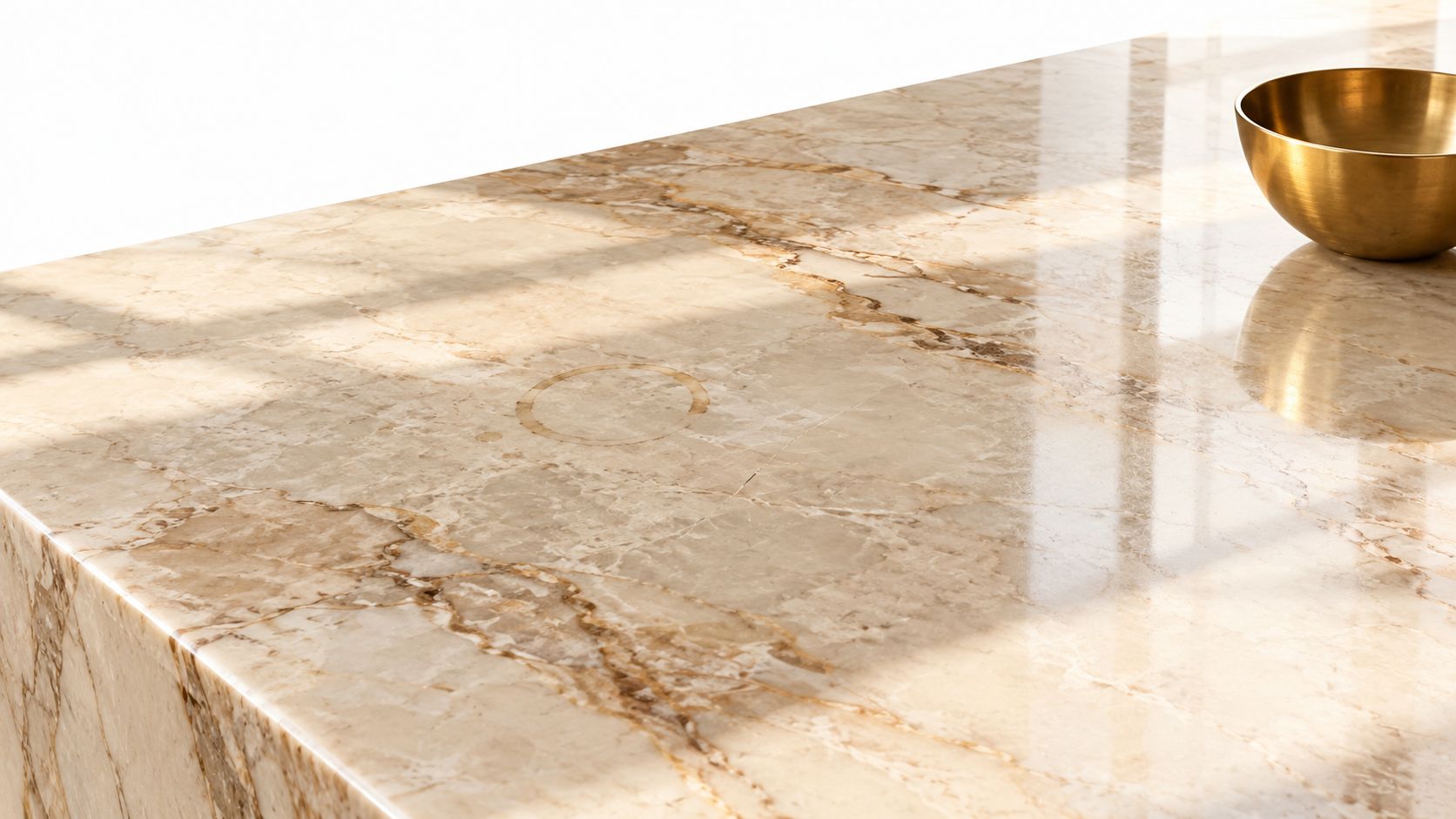
Appearance and vulnerability are separate decisions
Polished marble magnifies colour, depth, and veining. It also makes smudges, water marks, and etching more visible under directional lighting. A ring from a wet glass might look minor on a sample kept in a showroom, but repeated exposure around a kitchen sink or wash basin creates a different maintenance pattern.
The stone also absorbs moisture through its pores. A sealer can reduce absorption, but it can't make marble stain-proof or acid-proof. That distinction matters in Gurugram and the wider NCR, where dust, monsoon humidity, wet footwear, and busy family use place different demands on the same surface.
Where its warmth earns its place
Use light brown marble confidently for decorative wall cladding, fireplace surrounds, vanity fronts, low-traffic floors, stair detailing, and carefully managed reception areas. These applications show the material's pattern without exposing it constantly to acidic food, abrasive grit, or standing water.
Be more cautious with kitchen worktops, shower floors, outdoor paving, and entrances that receive heavy traffic. Polished marble can become slippery when wet, and its tone doesn't change that physical risk. If a project requires a worktop that tolerates neglect, granite or engineered quartz is usually the more rational choice.
Geological Origins and Technical Standards
India's marble supply is heavily concentrated in Rajasthan. The Indian Bureau of Mines marble classification.pdf) records Rajasthan as holding about 63% of India's total marble resources, while the national estimate across all grades is 1,945 million tonnes. The same classification records about 4.5 million tonnes, or 0.23%, as reserves, with the balance listed as remaining resources.
Those figures matter to buyers because geological abundance doesn't mean every slab has identical performance. Rajasthan has marble deposits in 20 of its 33 districts, so colour, grain, density, veining, and mineral composition can vary substantially between producing areas and even between blocks from a similar region. A light brown slab is therefore not a single standardised product. The name describes a visual family, not a guaranteed technical specification.
Calcite marble in the official classification can range from grey and white to figurative light brown and pink. Light brown is a recognised natural variation within India's marble spectrum, but the colour itself doesn't confirm hardness, absorption, or suitability for a wet application.
Read the test values before admiring the veining
For marble sold as blocks, slabs, and tiles in India, IS 1130:1969 provides useful technical benchmarks. The Indian Standard specification for marble sets a maximum moisture absorption of 0.4% by weight after 24 hours of cold-water immersion, a minimum Mohs hardness of 3, and a minimum specific gravity of 2.5.
These are not decorative details. Lower moisture absorption generally means less capillary uptake, while adequate specific gravity helps a buyer assess whether the material is within the required physical range. In a kitchen, bath, or commercial floor, those properties influence the likelihood of moisture-related staining and dimensional instability.
The standard should guide evaluation, not replace it. Ask for the relevant test documentation, confirm the slab identity, and make sure the supplied material corresponds to the approved sample. A beautiful display slab that differs from the delivered batch creates both design and performance risk.
What a technical inspection should establish
- Absorption: Confirm that the product meets the applicable maximum rather than relying on a salesperson's description such as “dense” or “premium”.
- Hardness: Use the standard's minimum Mohs benchmark as part of a broader suitability assessment, especially for flooring.
- Specific gravity: Check that the material meets the stated minimum and that the documentation relates to the selected stone.
- Visual consistency: Compare several slabs because one light brown surface may show a very different balance of cream, grey, brown, or pink.

An architect should specify the application first and the colour second. A homeowner should do the same. Technical compliance won't prevent a lemon etch on a countertop, but it can prevent a buyer from approving a slab that is unsuitable for the moisture conditions expected on site.
Room by Room Placement and Material Alternatives
A room determines whether light brown marble is a pleasure or a liability. The same slab can be a sensible vanity top and a frustrating kitchen worktop because the exposure profile changes. Kitchens combine acidic food, oils, hot cookware, water, and frequent wiping. Bathrooms introduce moisture and personal-care products. Floors face grit, footwear, and repeated abrasion.
The comparison below is deliberately practical. It doesn't treat one material as universally superior.
| Room / Application | Light Brown Marble | Granite | Engineered Quartz |
|---|---|---|---|
| Kitchen worktop | Visually rich, but acid-sensitive and needs disciplined spill control | Strong practical choice for heavy use, with natural variation | Low-maintenance option with consistent appearance and low routine upkeep |
| Bathroom vanity | Suitable when sealed and cleaned with pH-neutral products | Durable and forgiving, though the visual effect may be heavier | Suitable for owners prioritising easy cleaning and predictable patterning |
| Shower wall or decorative cladding | Effective as a feature surface, provided joints, sealing, and cleaning are managed | Durable wall alternative with a different grain and visual character | Works where a controlled, uniform finish is preferred |
| Wet-area floor | Use cautiously because polished marble can be slippery when wet | Generally more practical for demanding floors, subject to finish and texture | Product and finish suitability must be confirmed, but it avoids marble's acid sensitivity |
| Low-traffic living room floor | Strong aesthetic application, especially with a honed or carefully selected polished finish | Durable alternative with a more mineral, harder-wearing appearance | Consistent and easy to maintain, but lacks the same natural variation |
| Entrance or high-traffic commercial floor | Requires careful finish selection and cleaning discipline; grit can dull the surface | Usually the safer natural-stone choice for heavy traffic | Practical where the product is approved for flooring and a uniform design is wanted |
Kitchens deserve a firm recommendation
For a kitchen island or worktop, choose light brown marble only if the household accepts visible ageing and immediate spill cleanup. Use chopping boards, coasters, and trivets. Keep lemon, vinegar, descaling products, and harsh bathroom cleaners away from the surface.
If the client wants a worktop that can be ignored between clean-ups, specify granite or engineered quartz instead. Quartz offers a controlled appearance and low routine maintenance, while granite is generally a more forgiving natural stone for demanding work surfaces. Neither alternative should be selected without checking the exact product and installation requirements, but both reduce the particular acid-etching concern associated with marble.
Bathrooms need surface-specific thinking
A light brown marble vanity can work well because it creates warmth and typically receives more controlled exposure than a kitchen worktop. A shower wall is a design decision, not an automatic approval for every marble product. The installer must manage water, joints, falls, ventilation, and sealing as a complete system.
Avoid treating polished marble as the default for a wet floor. A honed or textured finish may provide a more appropriate visual and practical direction, but the surface still needs to be assessed for slip risk. The neutral guidance on natural stone placement in Indian interiors is useful here because it separates decorative cladding, low-traffic flooring, and wet-area use rather than reducing every decision to colour.
Outdoors and family-use zones
Outdoor applications need especially careful review. Weather exposure, dirt, water, and maintenance access can create a harsher environment than an interior feature wall. For a family home, reserve light brown marble for locations where users can reasonably follow care instructions. If that discipline is unrealistic, use granite or a suitable engineered surface in the highest-use areas and keep marble for the spaces where its character can be appreciated without constant compromise.
Sourcing Standards and Slab Selection
A light brown marble project can fail before fabrication begins. The mistake usually isn't a dramatic defect. It's a mismatch between the approved slab, the delivered slab, and the way the installer has planned the cuts.
Start by defining the visual brief. Decide whether the room needs a quiet beige-brown field, strong movement, visible veining, a cloudy pattern, or a near-uniform background. “Light brown” is too broad for a purchase order. Record the accepted slab, its finish, intended orientation, and the areas where the most prominent pattern should appear.
Inspect the full slab, not a sample corner
A small showroom sample can't reveal how a vein will cross an island, continue across a backsplash, or disappear into a sink cut-out. Stand back from the full slab, then inspect it close up under different angles of light. Look for:
- Tone consistency: Compare the base colour from one end to the other and across the slabs allocated to the same room.
- Vein direction: Mark the preferred orientation before cutting, especially for long counters, stair risers, or bookmatched wall panels.
- Open areas and mineral changes: Decide whether natural variation is a feature or a defect for this particular design.
- Edge zones: Check the material near the proposed cut lines because a beautiful centre area may not be available after fabrication.
- Surface condition: Look for resin fills, hairline cracks, pits, scratches, and areas that may respond differently to polishing.
Ask the supplier to lay out the slabs in sequence. For a large floor or a feature wall, the installation team needs a cutting plan that respects the natural pattern rather than treating every slab as interchangeable stock.
Verify provenance and documentation
The quarry origin helps with traceability, but origin alone doesn't guarantee uniformity. Request the product name, source information where available, test documentation, and the exact slab identification. Keep photographs of the approved slabs in the project file. This creates a reference for the fabricator and reduces disputes when the material reaches site.
A physical showroom remains valuable because a screen can't reproduce translucency, polish, veining depth, or the relationship between a surface and the project's lighting. For architects, this is also where the design team can evaluate adjacent materials, grout, cabinetry, metal samples, and paint instead of approving the stone in isolation.
Selection discipline: Approve the slab and the cutting layout together. A slab can be excellent in isolation and still be wrong for the room once the sink, hob, joints, and dominant veins are marked.
For a related visual reference, compare the tonal behaviour of light emperador marble before finalising a brown-led palette. The point isn't to substitute one product automatically. It's to make the colour decision against real stone references rather than a generic digital swatch.
Finally, specify the finish before the quotation is accepted. Polishing, honing, edge work, sealing, cut-outs, transport, and installation all affect the final result. A low slab price isn't a low project cost if the material later needs corrective fabrication or a replacement panel.
Finishes, Edge Profiles and Styling Palettes
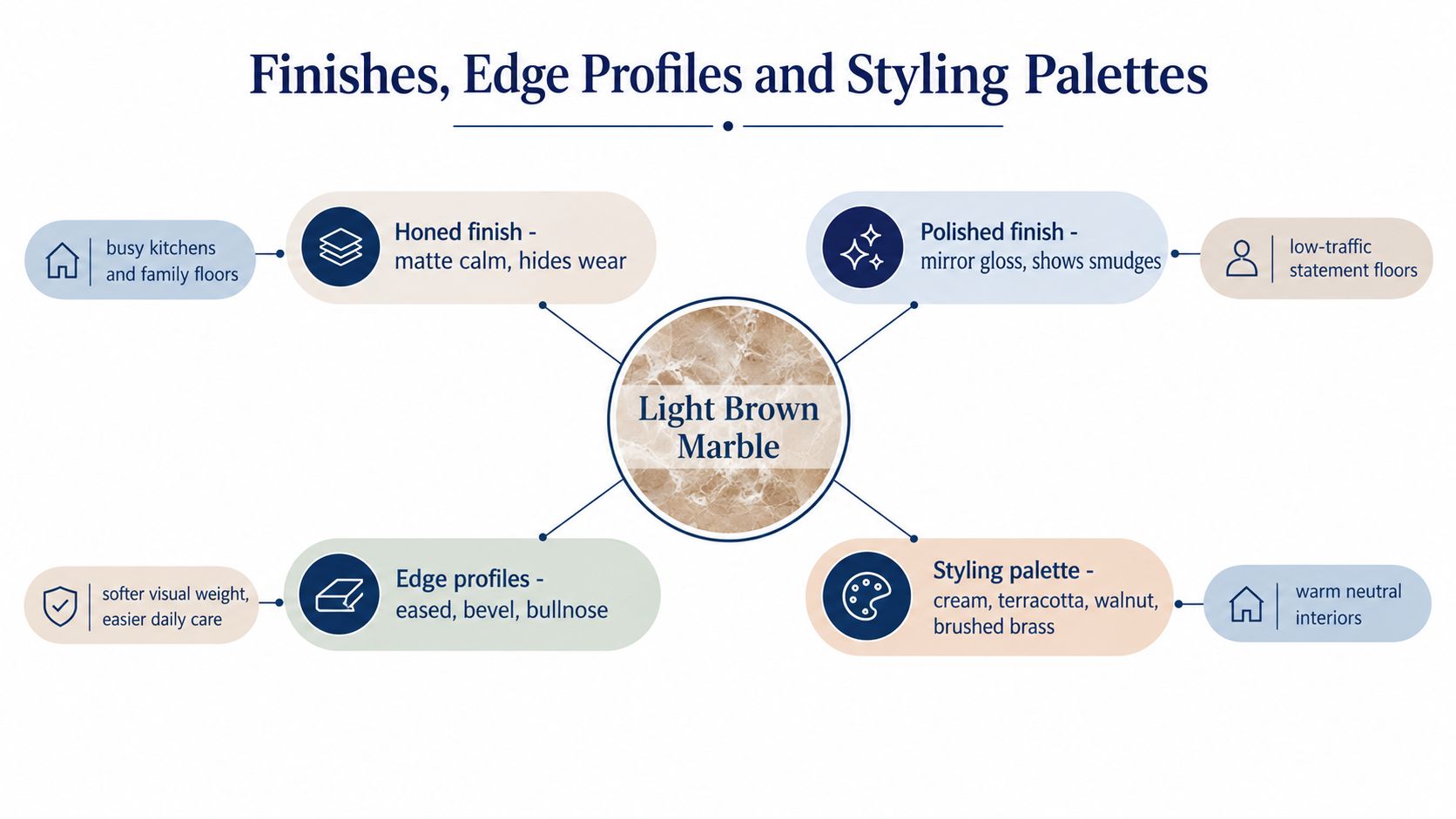
Finish changes both the appearance and the way light brown marble ages. Polished stone gives the deepest reflection and makes a room feel formal, but it also highlights fingerprints, water marks, and dull etches. Honed marble has a softer, matte character that often suits family floors and relaxed kitchens, while leathered surfaces add tactile variation and can make minor wear less conspicuous.
No finish makes marble maintenance-free. The finish only changes what the eye notices and how the surface responds to daily use.
Match the finish to the room
A polished finish is appropriate for a low-traffic statement floor, a reception wall, a fireplace surround, or a carefully managed vanity. It reflects lighting and brings out subtle movement in the stone. Don't specify it for a wet floor just because it looks more luxurious in the showroom.
A honed finish reduces visual glare and gives light brown marble a calmer, more architectural quality. It can make small etch marks less obvious than they are on a mirror-like surface, although the chemical reaction still occurs. It suits family floors, quieter kitchens, and interiors where the designer wants texture rather than shine.
A leathered finish emphasises touch and natural variation. It can be a strong choice for a feature counter or bar where a tactile surface matters, but the texture may require more attention around spills and dirt. Specify a sample large enough to judge how the finish behaves across the actual pattern.
Use edges to control visual weight
An eased edge is restrained and contemporary. A small bevel catches light and gives a crisp transition without making the counter look heavy. A bullnose softens the profile and can suit traditional interiors, rounded furniture, or spaces where a gentler edge is preferred.
Edge selection also affects cleaning. Complicated profiles create more small surfaces and transitions where dust or residue can collect. Keep the profile easy to wipe if the material is going into a busy kitchen, wash area, or commercial setting.
Build the palette around the stone
Light brown marble pairs naturally with cream, terracotta, walnut, muted olive, brushed brass, and warm white. Avoid adding too many competing patterns. If the slab has active veining, keep the cabinetry quieter and let the stone carry the movement.
Lighting deserves a physical test. Warm artificial light may deepen the brown and cream notes, while cool daylight can expose grey or pink undertones. Photographing samples under the project's actual lighting can help, and the resource from Jimmy Clemmons Photographer offers useful context on how light and texture influence interior imagery. For a close tonal comparison, review beige marble texture alongside the selected slab rather than relying on a colour name alone.
Lifecycle Maintenance and Long-Term Value
The purchase decision should include the care plan. Light brown marble can remain attractive for years, but it needs a maintenance system, not occasional panic cleaning after a stain appears. The marble installation and maintenance guidance notes that marble is porous enough to require sealing, that resealing depends on use, and that repolishing may be needed to address etch marks and traffic dulling.
A sensible routine begins with prevention:
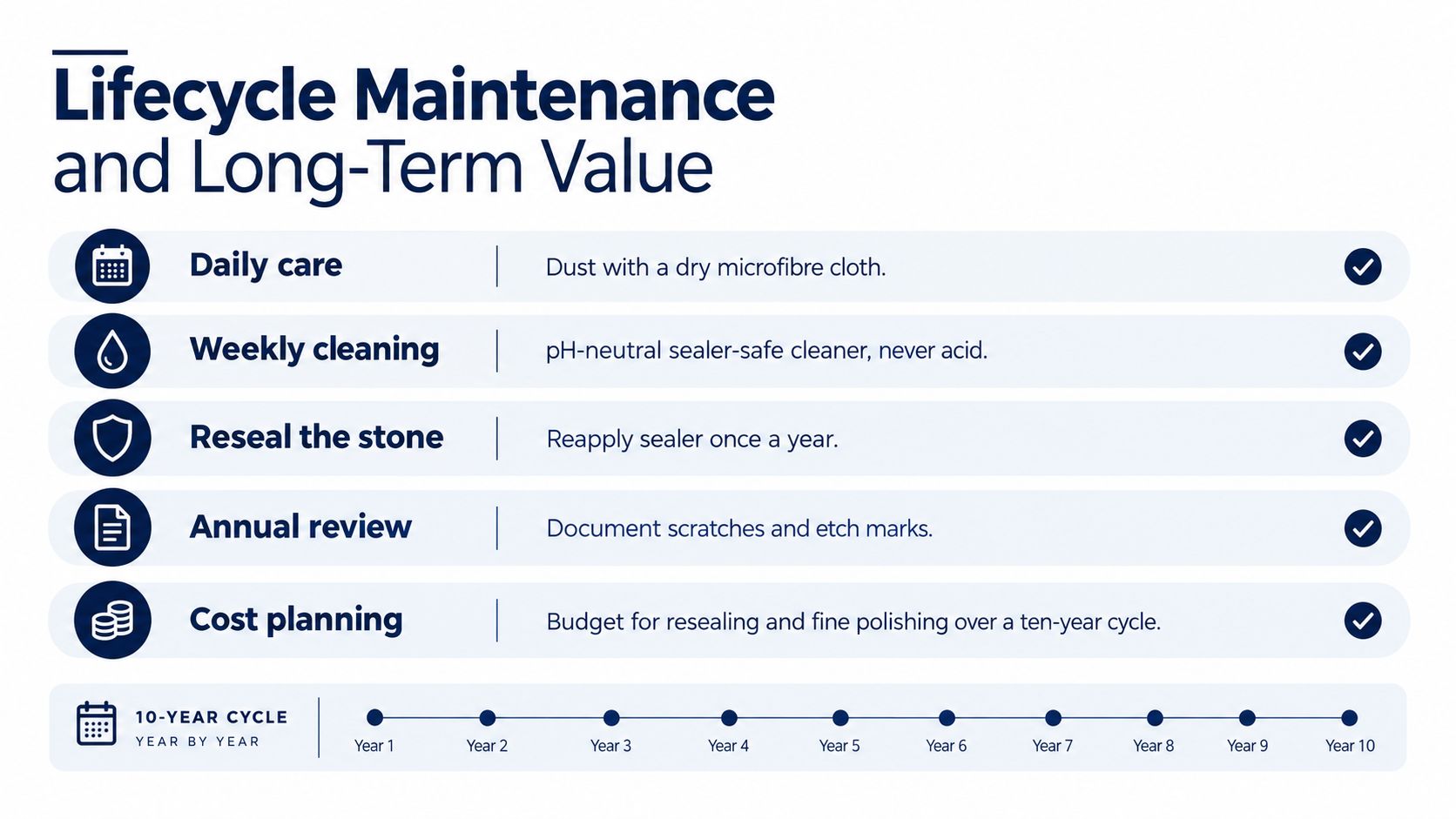
- Everyday care: Remove dust and grit with a dry microfibre cloth, then wipe spills promptly.
- Routine cleaning: Use a pH-neutral, stone-safe cleaner. Avoid lemon, vinegar, bleach-based mixtures, abrasive powders, and harsh descalers.
- Water checks: Watch how the stone responds to moisture. If water darkens the surface quickly instead of beading, ask a stone professional to assess the sealer.
- Stain diagnosis: A darker patch may be an absorbed stain, while a dull or lighter patch may be an etch. They need different treatments.
- Professional correction: Arrange repolishing when traffic has dulled the finish or etching has become visually disruptive.
Resealing is a use-based decision
A yearly review is a practical planning point, not a universal promise that every surface must be resealed on the same date. A lightly used wall and a heavily used kitchen counter experience different exposure. Commercial floors, family kitchens, and bathroom surfaces should be inspected more frequently than decorative cladding.
Sealer reduces absorption. It doesn't stop acid from etching the surface and it doesn't guarantee that oil, pigments, or standing water cannot create a mark. The owner should budget for resealing, occasional stain remediation, and fine polishing rather than treating these as unexpected failures.
Use the accompanying video as a visual introduction to marble care, then confirm the treatment with the fabricator or stone-care professional responsible for the installed material.
Calculate value across ownership
The actual value of light brown marble depends on whether the owner wants natural variation and accepts its patina. A buyer who expects the surface to remain identical to the showroom sample without regular care will probably feel disappointed. A buyer who sees maintenance as part of owning a natural material may find the ageing attractive, provided the stone was placed correctly.
For a deeper look at the practical decisions behind polished marble countertops, compare the finish, usage pattern, and cleaning routine before approving a kitchen specification. The cheapest material at purchase isn't necessarily the cheapest surface to own.
Executing Your Natural Stone Project
A successful light brown marble installation follows a controlled sequence. The architect and homeowner first approve a full slab, then map the veins against the room, appliance cut-outs, joints, and exposed edges. The fabricator converts that layout into cut-to-size pieces, profiles the edges, finishes the surfaces, and labels each piece before delivery.
Site coordination matters just as much. Confirm substrate readiness, access routes, plumbing positions, cabinetry levels, joint locations, and protection after installation. The installer should know which faces are exposed, where the dominant pattern must continue, and what cleaning products are permitted immediately after fitting.
A practical project file should contain the approved slab photographs, technical documentation, fabrication drawings, finish sample, edge profile, sealer information, and care instructions. That record connects the quarry selection to the finished room and gives the owner a clear reference for future repairs or additions.
Light brown marble is a commitment to curation and care, not just a colour preference. Specify it for spaces where its warmth justifies its sensitivity, and choose granite or engineered quartz where low maintenance carries greater value.
Varun Marbles supplies Indian and Italian marble, granite, engineered quartz, and onyx, with slab selection, cut-to-size fabrication, edge profiling, finishing, and installation coordination for residential and commercial interiors. Visit Varun Marbles to discuss a light brown marble project and assess suitable alternatives for your kitchen, bathroom, flooring, or feature wall.