
Light Emperador Marble: A Practical Reference Guide

Light Emperador marble is generally an imported Turkish stone, with BIS checks requiring maximum water absorption of 0.4%, minimum Mohs hardness of 3, and minimum specific gravity of 2.5. It suits warm, decorative Indian interiors, but it isn't the right default for every kitchen, bathroom, or high-use floor.
You're probably looking at a beige-brown slab in a Delhi NCR yard, comparing a polished sample with quartz, granite, or vitrified tile while a contractor insists the material will work everywhere. Light Emperador marble is a warm beige to light brown stone with fine darker veining, imported Turkish material widely re-sold across India. The important question isn't whether it looks expensive. It's whether the slab's provenance, test results, finish, application, and maintenance demands justify the cost.
Indian suppliers position it for floors, walls, countertops, bathroom cladding, and feature surfaces, with commonly listed slab formats around 8×4 feet or 280×180 cm and finishes including polished and honed options (Kohinoor Floors' Light Emperador listing). That range makes the stone flexible, but flexibility can encourage poor specification. A polished kitchen worktop and a honed living-room floor are not equivalent decisions.
For an NCR project, treat the stone as an imported natural material first and a colour choice second. Confirm what you're buying, test the lot, inspect the actual slabs, and match the finish to the abuse the surface will receive.
Table of Contents
- What Light Emperador Marble Actually Is
- Colour, Veining, and Tonal Variants
- Light Emperador Against Dark Emperador and Indian Alternatives
- Procurement Checks Using BIS Marble Standards
- Finishes and How to Choose Between Them
- Applications That Work in Indian Interiors
- Where Light Emperador Is a Poor Fit for Kitchens and Bathrooms
- Sealing, Cleaning, and Stain Prevention Routine
- Indian Market Realities Pricing and Availability
- Quick Reference Checklist Before You Order
What Light Emperador Marble Actually Is
Light Emperador is commonly described in India as an imported Turkish marble quarried in Bursa, although Indian yards and listings may use inconsistent origin labels. The stone normally has a warm beige, caramel, or light-brown base with darker brown veining. It belongs to the calcite-rich marble family, so it has the visual softness and acid sensitivity associated with marble rather than the chemical resistance of engineered quartz.
That distinction matters because “Emperador” is a commercial family name, not a guarantee that every slab came from the same quarry or geological formation. Dark Emperador is the deeper brown counterpart, while Botticino and Crema Marfil are separate beige marble categories associated with Italian and Spanish supply traditions. Don't approve a material from a small sample alone. The yard label, block, finish, and batch should all be recorded.
Why Indian procurement needs more care
Indian listings commonly show 16–18 mm or 18–20 mm slab thicknesses, and standard formats need to be checked against the project's cutting plan (RK Marbles' Light Emperador product information). A designer specifying 600×600 mm or 800×800 mm tiles should ask whether the slabs can be cut efficiently or whether the layout will create excessive offcuts. Re-cutting economics can change the apparent material price more than the showroom rate suggests.
The stone is imported, so availability depends on quarry output, freight, currency movement, and the inventory held by Indian distributors. A current supplier listing gives a starting position of around ₹230–₹250 per square foot and a minimum order quantity of 2,000 square feet, useful as a market anchor rather than a universal quote (RK Marbles).
Procurement rule: Ask who imported the block, who processed it, and who is repacking or relabelling the slabs in the Indian yard. The name on the sample card isn't enough.
Colour, Veining, and Tonal Variants
Light Emperador works because its colour sits between beige and brown. Pale caramel and latte-toned lots make compact rooms feel warmer without the visual heaviness of dark marble. Cappuccino and almond tones carry more depth, while mid-brown material can read closer to a restrained taupe under neutral lighting.
Veins usually range from soft umber streaks to stronger mocha ribbons. Some slabs have a relatively even field, others show directional lines, and some contain broken or brecciated movement. The distinction is practical:
- Uniform field: Easier to tile and better for calm floors, but small tone differences between slabs can become visible across a large room.
- Veined field: More expressive for wall panels and bookmatching, although cutting around strong lines can increase wastage.
- Brecciated movement: Suitable for a focal panel, not a large repetitive floor where irregular fragments may look accidental.
Indian yards may use labels such as Light Classic, Light Extra, and Light Vein Cut, but these labels aren't a substitute for viewing the slabs. One supplier's “Extra” may prioritise a pale base, while another may use the term for stronger veining or fewer visible defects. Confirm the actual selection criteria in writing.
Match the stone to the design brief
| Variant Label | Base Tone | Vein Character | Best Fit Brief |
|---|---|---|---|
| Light Classic | Warm beige to caramel | Moderate brown movement | Living-room floors and coordinated wall bands |
| Light Extra | Pale latte or almond | Relatively controlled veining | Calm contemporary interiors and large floor fields |
| Light Vein Cut | Beige-brown | Directional mocha ribbons | Feature walls, lift lobbies, and bookmatched panels |
Lighting can change the approval decision. Warm 2700K LEDs deepen brown tones, while 4000K neutral white can flatten the warmth and make the stone appear less dimensional. Inspect a physical sample, or preferably the selected slab, under the lighting planned for the room. A showroom sample viewed under warm spotlights isn't a reliable site mock-up.
Light Emperador Against Dark Emperador and Indian Alternatives
Light Emperador is the more forgiving visual choice when a room needs warmth without losing brightness. Dark Emperador creates weight and drama, but it can dominate a small apartment or narrow corridor. For a Mumbai flat with limited daylight, I'd choose light emperador over dark emperador unless the brief specifically asks for a dark, hotel-like atmosphere.
Dark emperador wins in a large lobby, bar, reception desk, or hospitality space where the surface needs visual authority. Indian green marble can win in a cost-sensitive heritage-inspired floor because it's a domestic option, while both Turkish emperador varieties depend on imported supply. Botticino suits a buyer seeking a more restrained premium beige language, but the stone should still be evaluated by actual slab and test certificate, not nationality alone.
| Stone | Origin | Tone | Typical Use | Maintenance | Price Band (INR/sq ft, polished) |
|---|---|---|---|---|---|
| Light Emperador | Commonly imported from Turkey | Warm beige to light brown | Residential floors, feature walls, lobbies | Requires sealing and acid-conscious care | Ask for a current yard quote |
| Dark Emperador | Commonly associated with imported Spanish supply | Deep brown with lighter movement | Hotel lobbies, bars, dramatic feature walls | Shows dust, scratches, and etching clearly | Ask for a current yard quote |
| Indian green marble | Indian supply | Green with varied movement | Heritage-style floors and budget-conscious interiors | Still needs stone care, but avoids imported provenance risk | Ask for a current domestic quote |
| Italian Botticino | Italy | Cream and soft beige | Premium residential and hospitality interiors | Needs marble maintenance | Ask for a current imported quote |
| Quartz | Engineered product | Consistent beige or patterned designs | Kitchens, vanities, worktops | Low routine porosity risk, but follow manufacturer guidance | Ask for a current fabricator quote |
| Beige granite | Natural stone, often available through Indian supply | Beige with granular patterning | Worktops, floors, high-use zones | More tolerant of acids and heavy use than marble | Ask for a current yard quote |
The table deliberately avoids invented price bands. Indian listings vary by origin claim, thickness, finish, and batch, so a responsible quote must come from the actual stock. The decision is simple: choose light emperador for warmth and natural movement, not because a vendor claims every imported beige marble performs the same way.
Procurement Checks Using BIS Marble Standards
Use BIS IS 1130:1969 to assess the shipment on arrival, not merely as a decorative specification reference. The standard covers water absorption, Mohs hardness, and specific gravity, with testing based on a random subsample from each lot. That gives the contractor a documented basis for accepting or challenging the material (BIS standard review for IS 1130:1969).
| Parameter | Acceptable Range | Reject If |
|---|---|---|
| Water absorption | Maximum 0.4% by weight after 24-hour cold-water immersion | The tested lot exceeds the BIS maximum |
| Mohs hardness | Minimum 3 | The result falls below the minimum |
| Specific gravity | Minimum 2.5 | The result falls below the minimum |
Turn the certificate into a site decision
Ask for a recent certificate naming the material, lot, test method, and tested sample. Vague paperwork requires independent testing before installation. A quarry brochure does not replace a lot-specific report.
Inspect every slab for open fissures, sugary patches, resin-filled cracks, damaged edges, and abrupt tonal changes. Compare several slabs with the approved sample, then dry-lay the proposed sequence for a prominent floor or feature wall. Record dimensional consistency separately from BIS acceptance. A slab can meet the chemical requirements and still cause installation problems when cutting or calibration varies.
For projects comparing marble with granite or other signature materials, this stone-selection guide provides a useful framework for reviewing origin, appearance, and intended use. Approve the shipment only after the certificate and physical inspection agree. That discipline matters in India, where imported batches can vary in tone and condition, and replacement stock may not match the approved sample.
Finishes and How to Choose Between Them
Polished light emperador gives the reflective, high-contrast appearance most buyers first notice. It's appropriate for vertical wall cladding, lift lobbies, TV panels, and low-traffic decorative zones where spills and abrasion are limited. It isn't my default for a busy Indian floor or kitchen work surface.
Honed is the safer general specification for flooring. Its matte surface softens glare and makes minor scratches less conspicuous, although it doesn't make marble acid-proof or stain-proof. For a detailed overview of how surface treatment changes stone performance and appearance, Flacks Flooring's natural stone selection guide is a useful complementary reference.
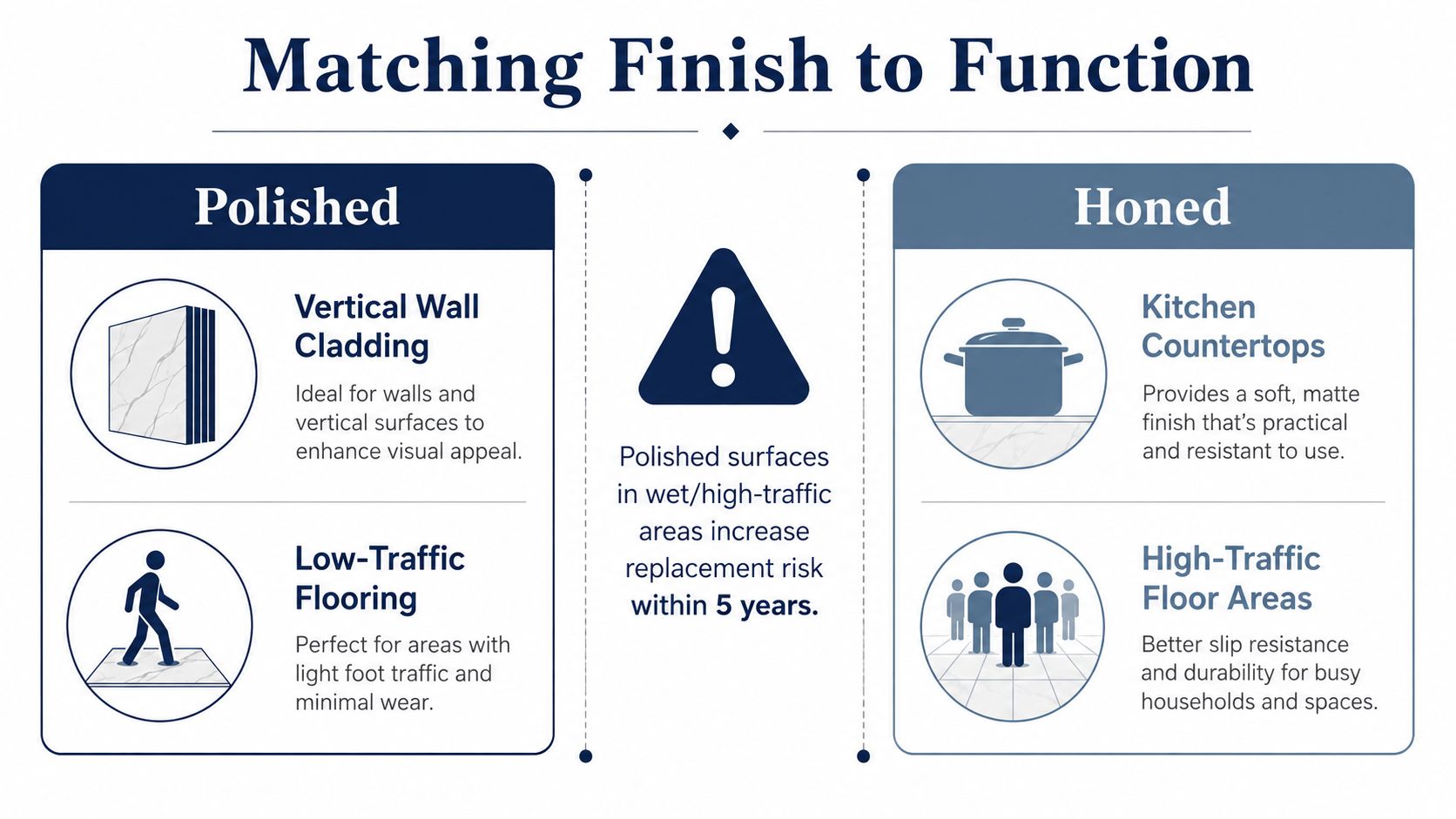
Specify the finish by location
- Polished: Feature walls, bedroom headboards, low-traffic living areas, and decorative panels.
- Honed: Living and dining floors, corridors with controlled traffic, bathroom wall cladding, and vanity surrounds.
- Leathered: Feature walls and powder-room surfaces where tactile depth matters. Clean the texture carefully because it can hold dust.
- Brushed: Decorative vertical surfaces and selected rustic interiors. Approve a physical sample because brushing changes how veins read.
- Flamed or bush-hammered: Use only after a technical review for exterior paving or high-grip steps. These finishes need suitable stone selection and proper drainage.
A polished kitchen floor is an over-specification. Regular mopping, grit, oil, and acidic residues can dull the surface quickly, creating an expensive maintenance problem. For countertop-specific decisions, compare the application guidance in this polished marble countertop reference, then decide whether the household accepts patina.
Applications That Work in Indian Interiors
Light emperador earns its cost when the design allows its colour and veining to remain visible. Use it in rooms where the stone contributes atmosphere, proportion, or a deliberate focal point. Don't spend imported-marble money on a surface that will be covered by rugs, appliances, or constant kitchen clutter.
For living and dining areas, a honed 18–20 mm floor can work well with warm timber, off-white walls, bronze hardware, and restrained artificial lighting. The beige base lifts a room without the starkness of a very pale stone. Keep the tile layout organised, and approve the complete batch before installation so tonal changes don't create an unintended patchwork.
Recommended applications
- Feature walls and TV panels: Polished slabs are appropriate because the material is read vertically and receives limited abrasion.
- Lift lobbies: Use polished material when the project wants a formal arrival sequence. Protect corners and coordinate slab joints with door frames.
- Master-bedroom headboards: Bookmatched slabs can create a strong focal plane, but the fabricator must sequence the slabs before cutting.
- Double-height foyers: Large-format flooring or a selected feature wall can give the stone enough visual scale to justify its movement.
- Bathroom wall cladding and window sills: Honed or polished surfaces can work when edges, joints, and water exposure are controlled.
- Staircases: Specify only after reviewing slip, edge, nosing, and maintenance requirements. A decorative finish isn't automatically a safe tread.
- Kitchen worktops: Treat as an exception, not a standard recommendation. The next section explains why.
Before finalising a floor material, compare the maintenance and installation implications with this marble versus vitrified tiles guide. The finish, thickness, substrate, joints, and edge treatment should be written into the purchase order, not left to the installer's judgement on delivery day.
Where Light Emperador Is a Poor Fit for Kitchens and Bathrooms
Light emperador is a poor default for an active kitchen countertop. Marble reacts to acids, and everyday Indian ingredients such as lemon, vinegar, tomato, tamarind, turmeric, coffee, and oils can stain or etch the surface. A polished slab may develop dull marks after a short contact period, while a honed surface hides some visual change but doesn't stop the chemical reaction.
Use it on a kitchen island only when the owner accepts visible patina and will wipe spills immediately. I wouldn't specify it beside a hob in a home where cooking is frequent, messy, or shared by a busy household. Quartz offers a more consistent, lower-maintenance worktop option, while granite is the more practical natural stone where hardness and acid tolerance matter more than a soft beige vein.
Bathrooms present a different risk. Hard water, soap residue, body oils, hair dye, toothpaste, and fairness creams can darken unsealed pores around basins, drains, and corners. Shower floors are particularly poor locations because standing water and cleaning residues combine with slip and staining concerns.
| Use Case | Light Emperador | Quartz | Granite |
|---|---|---|---|
| Busy kitchen worktop | Visually attractive, but acid-sensitive and maintenance-heavy | Strong practical choice for consistency and routine care | Strong natural-stone choice for hard use |
| Kitchen island beside hob | Accept only with patina-conscious owners | Generally more forgiving for daily use | Usually more suitable than marble |
| Bathroom vanity | Works with sealing and prompt cleaning | Low-maintenance alternative | Durable natural option |
| Shower wall | Possible with careful detailing and cleaning | Suitable where the product is approved for the application | Suitable with correct installation |
| Shower floor | I don't recommend it as a default | Application-specific | Often more practical, subject to slip selection |
| Living-room floor | Good choice with the right finish | Consistent alternative | Durable alternative with different visual character |
Independent care guidance also highlights marble's vulnerability to acidic foods and staining materials, including lemon, tomato, vinegar, turmeric, coffee, and oils (Architectural Digest's marble countertop care guidance). Light emperador wins in living spaces, lobbies, bedrooms, and feature walls, where it's admired rather than repeatedly assaulted.
Sealing, Cleaning, and Stain Prevention Routine
Seal the stone after installation with a penetrating fluoropolymer or silane-based sealer, not a waxy topical coating that can alter the surface and trap residue. Confirm compatibility with the selected finish and ask the installer to record the product, application date, and recommended review interval. Test a discreet area first, because sealers can slightly change colour or sheen.
Daily cleaning should be simple. Use warm water with a small amount of mild dishwashing liquid and a clean microfibre cloth or mop. Avoid vinegar, lemon-based cleaners, abrasive powders, and strong phenyl products. For broader natural-stone cleaning principles, this stone countertop care guide offers useful background, although Indian kitchens need extra attention to turmeric, oil, and spice residues.
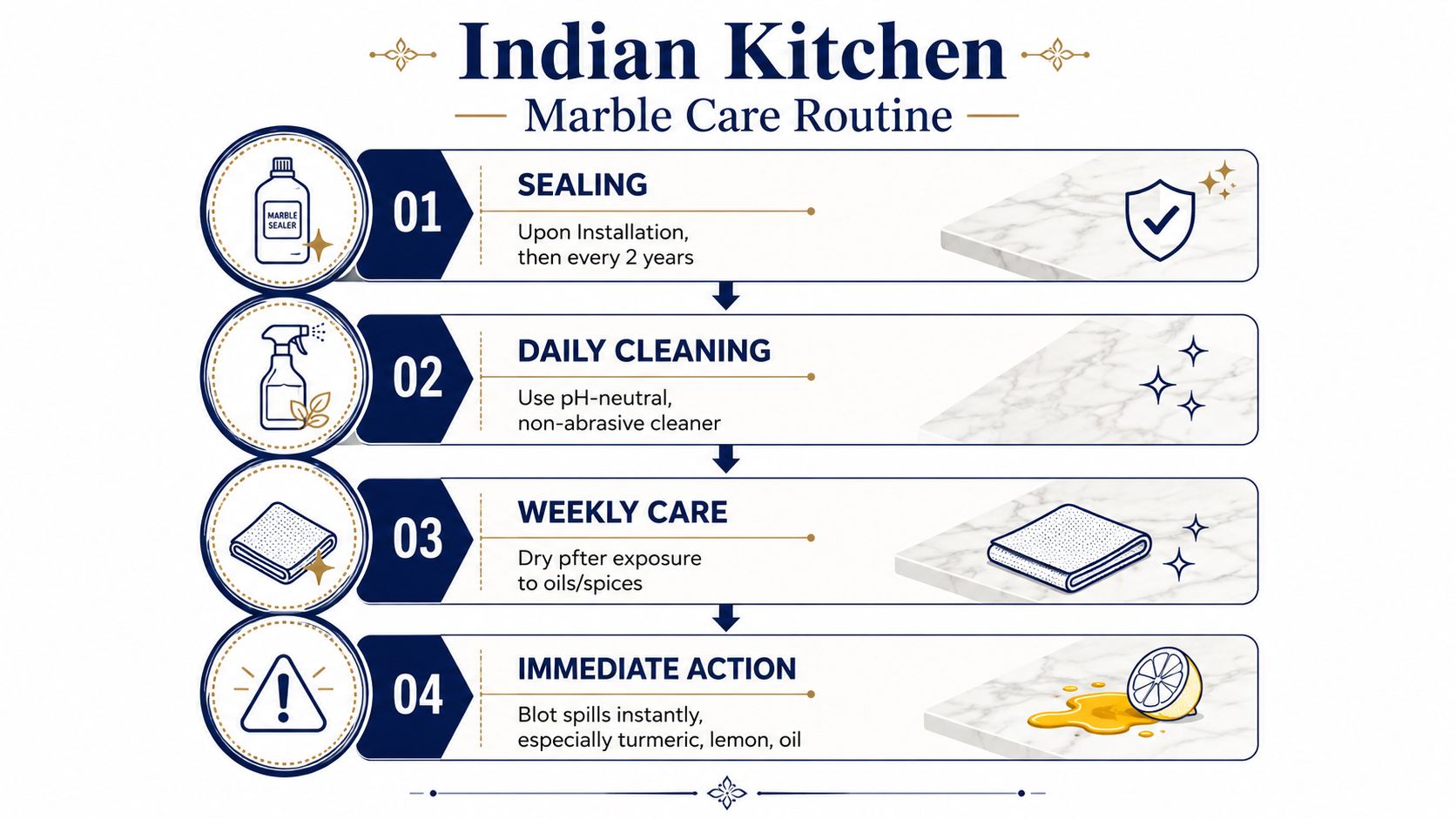
The routine that protects the surface
- Blot spills: Lift turmeric, oil, wine, coffee, or curry residue rather than spreading it with a cloth.
- Use a poultice carefully: Baking soda and water may help with oily staining. Hydrogen peroxide can be considered for some organic staining, but test first and follow a stone-care professional's advice.
- Control bathroom moisture: Squeegee wall cladding after showers, dry floor edges near drains, and remove toothpaste or cosmetic splashes promptly.
- Inspect concealed areas: Check joints, sink cut-outs, corners, and drain zones for water pooling or failed sealant.
A fortnightly deep clean with a compatible alkaline marble cleaner can remove accumulated residue. Treat the schedule as a maintenance plan, not a guarantee against etching. The stone's vulnerability remains part of the ownership decision.
Indian Market Realities Pricing and Availability
Indian suppliers may list light emperador as readily available, yet stock varies by importer, batch, thickness, and finish. Treat the trade name as a starting point, not a specification. One Indian listing shows standard slab thicknesses of 16–18 mm or 18–20 mm, while Kohinoor Floors lists polished, honed, leathered, flamed, and brushed finishes. Request photographs and measurements of the actual slabs before approving the material.
The stone is commonly sold in India as imported Turkish marble, often associated with Bursa. That description still needs verification on the invoice and material documentation. Independent trade reporting recorded India's marble import value at $94.5 million in Q1 2025, up 69% year on year, with quantity at 389,678 tons, up 80% in the same comparison (StoneNews.eu's Q1 2025 India marble import report). Import conditions can therefore affect replenishment, lead times, and batch matching.
| Parameter | Typical Range |
|---|---|
| Common Indian listing origin | Imported Turkish stone, often associated with Bursa |
| Common listed slab thickness | 16–18 mm or 18–20 mm |
| Common listed slab format | Around 8×4 feet or 280×180 cm |
| Example starting market position | Around ₹230–₹250 per square foot |
| Example minimum order | 2,000 square feet |
| Available finishes in Indian channels | Polished, honed, leathered, flamed, brushed |
Use the listed price only as a discussion point. The final rate depends on grade, finish, fabrication, transport, wastage, and batch consistency. Get written stock confirmation, inspect the selected slabs, and match delivery to the project schedule before paying a deposit. For a premium interior, continuity matters more than a low opening quote.
Quick Reference Checklist Before You Order
Use this checklist at the yard in Gurugram, Jaipur, Kishangarh, or another stone market. If the supplier cannot answer clearly, pause the order and verify the material before paying.
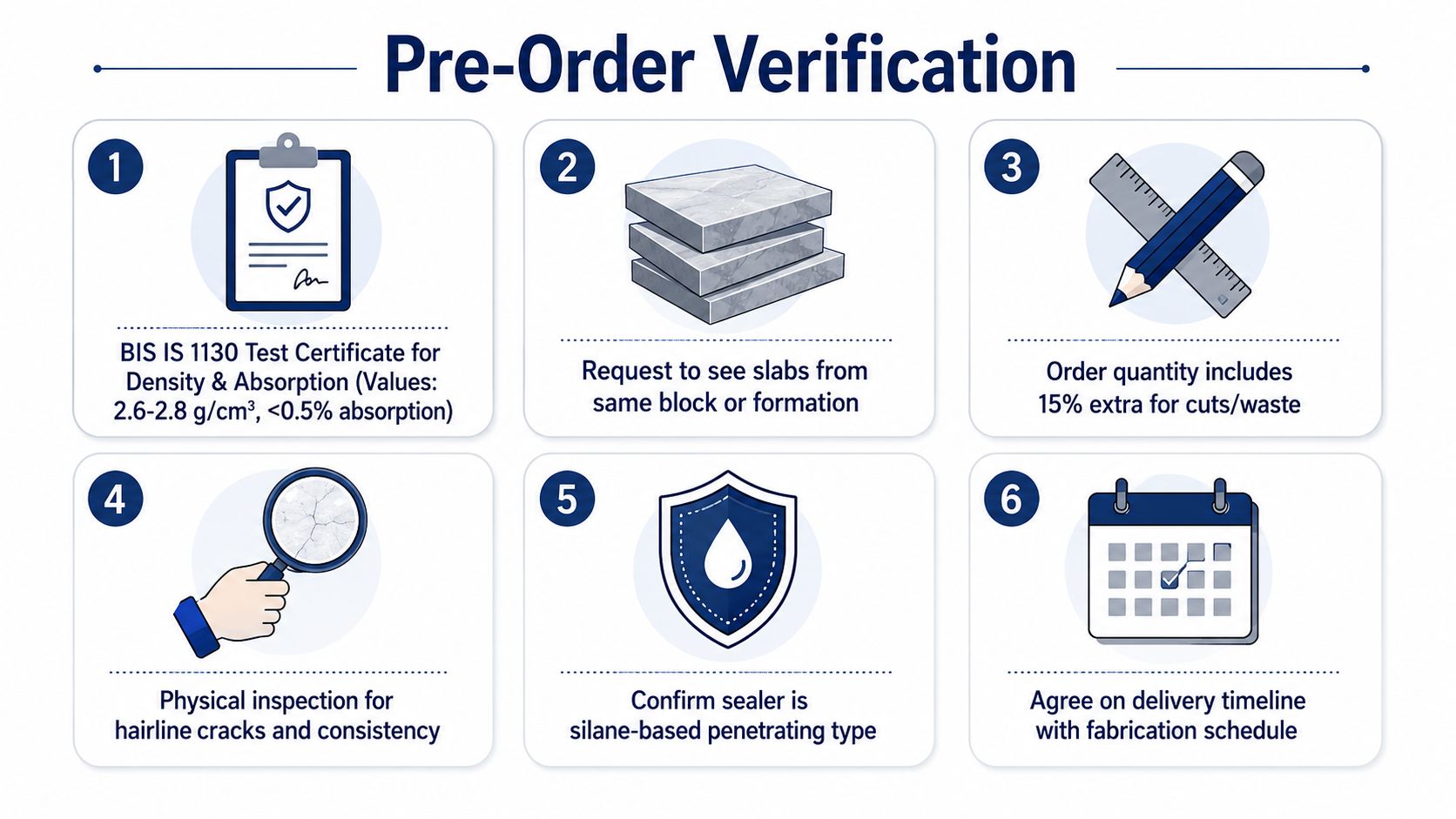
- Verify the BIS certificate: Request test results for water absorption, Mohs hardness, and specific gravity against IS 1130:1969. Check the stated limits: maximum 0.4% water absorption, minimum Mohs hardness of 3, and minimum specific gravity of 2.5. The BIS review cited earlier provides the relevant standard reference.
- Inspect the actual slabs: View at least two or three slabs together. Compare tone, vein direction, fissures, filled areas, and edge condition under consistent light.
- Record the specification: Write down finish, thickness, dimensions, edge profile, tile size, and surface treatment. Do not rely on a verbal quotation.
- Approve the layout: Mark bookmatch direction, visible joints, cut-outs, and likely offcuts before fabrication. Confirm which slab will serve each prominent surface.
- Agree the care plan: Confirm sealer type, application timing, cleaning instructions, and responsibility for post-installation sealing. Light Emperador needs a defined maintenance routine, especially in Indian kitchens and bathrooms.
- Confirm delivery: Obtain written stock confirmation, dispatch timing, fabrication sequence, transport arrangements, and site-access requirements.
- Separate the costs: Request separate amounts for stone, cutting, polishing, edge work, packing, transport, installation, and applicable taxes.
- Reject the wrong application: If the design places polished Light Emperador beside a hob, on a shower floor, or across an uncontrolled high-traffic zone, change the finish or choose granite, quartz, or another more suitable material before ordering.
Varun Marbles can compare imported Light Emperador with Indian marble, granite, and engineered quartz, then coordinate slab selection, fabrication, finishing, and installation support in the NCR. Visit Varun Marbles with the room dimensions, intended finish, and maintenance expectations ready for review.