
Is Quartzite Better Than Granite? a Practical Guide
Quartzite is not automatically better than granite, and the honest answer is that the right choice depends on the tested slab and the zone of use. The stone name tells you less than the absorption figure and the heat exposure beside your hob. Buyers who skip slab-by-slab data and pick whichever stone sounds more premium often pay more and still get the wrong surface for an Indian kitchen.
The comparison is closer than most showroom advice admits. Both are natural stones, both tolerate heat better than engineered quartz, and both resist the acids that etch marble. The differences that matter show up in porosity, fabrication difficulty, and how each slab behaves when a hot tawa lands beside the sink. This guide breaks those trade-offs down so you can compare quartzite and granite the way a stone specifier would, through test data, heat-zone planning, and installed cost rather than marketing names.
Table of Contents
- Quartzite and Granite at a Glance
- Stain Risk and Maintenance by Slab
- Lab Benchmarks to Request for Any Slab
- Heat Tolerance Near Hobs and Cookware
- Fabrication, Supply and Cost Trade-offs
- Choose Quartzite or Granite for Your Project
Quartzite and Granite at a Glance
Quartzite starts life as sandstone. Heat and pressure deep underground fuse the quartz grains into a dense, interlocked mass, which gives the stone its very high scratch and abrasion resistance. Granite forms differently, as slowly cooled magma, and its mineral mix of quartz, feldspar and mica produces the familiar speckled grain.
The table below compares the two stone families on the criteria that drive real decisions. Read it as a starting point, not a verdict, because natural-stone performance varies by quarry and mineral structure. Where a row's value shifts with the tested lot, the lot data overrides the family-level generalisation.
| Criterion | Quartzite | Granite |
|---|---|---|
| Composition | Metamorphosed sandstone, dominated by quartz | Igneous rock of quartz, feldspar and mica |
| Hardness and scratch resistance | Very high, excellent abrasion resistance | High; shifts with the quartz, feldspar and mica balance in the slab |
| Heat tolerance | Depends on the slab's finish, thickness and lot; confirm the tested limit on the data sheet before hot cookware goes down | High at the rock level; slabs are widely used beside hobs |
| Stain and absorption | Low in dense, well-finished lots; fissures and open veins raise it | Low in dense grades; porous or fractured lots absorb more |
| Fabrication | Needs diamond tooling and controlled cooling | Standard tooling; more predictable |
| Aesthetics | Veining and colour range from quiet to dramatic, set by the quarry and block | Speckled grain; grain size and colour set by the quarry |
| Cost | Set by slab size, veining rarity and the harder fabrication the stone demands | Set by grade, origin, finish and slab size |
| Typical applications | Worktops, feature walls, premium flooring | Worktops, flooring, high-traffic commercial surfaces |
What the table can't show
The heat row illustrates the pattern. Quartzite tolerates heat well at the rock level, but its practical limit depends on the specific slab, finish and thickness, so the data sheet for the exact lot must be checked before hot cookware is placed on it. Granite's reputation for heat resistance is a family-level description carrying the same caveat: the tested figure for the lot, not the stone name, sets the safe limit.
The cost row works the same way. Quartzite's price reflects the diamond tooling and slower cutting it demands, while granite's tracks grade, finish and origin. Neither column gives a fixed figure because neither stone sells to one.
A dense, well-finished granite often performs as well as quartzite in everyday kitchens, while a heavily fissured quartzite can underperform beside a sink. The family column tells you what the rock is. The tested lot tells you what the slab does.
Practical rule: Judge the tested slab and the zone of use first, then the stone name second.
Stain Risk and Maintenance by Slab
Hardness and porosity are not the same thing. Quartzite's tightly interlocked quartz grains make it scratch-resistant, but that does not guarantee low absorption. Granite's feldspar and mica respond differently to the turmeric, oil, lemon and tomato that sit on Indian countertops daily. Three factors govern any slab's stain behaviour: mineral content, density, and the fissures or open veins that let liquid penetrate.
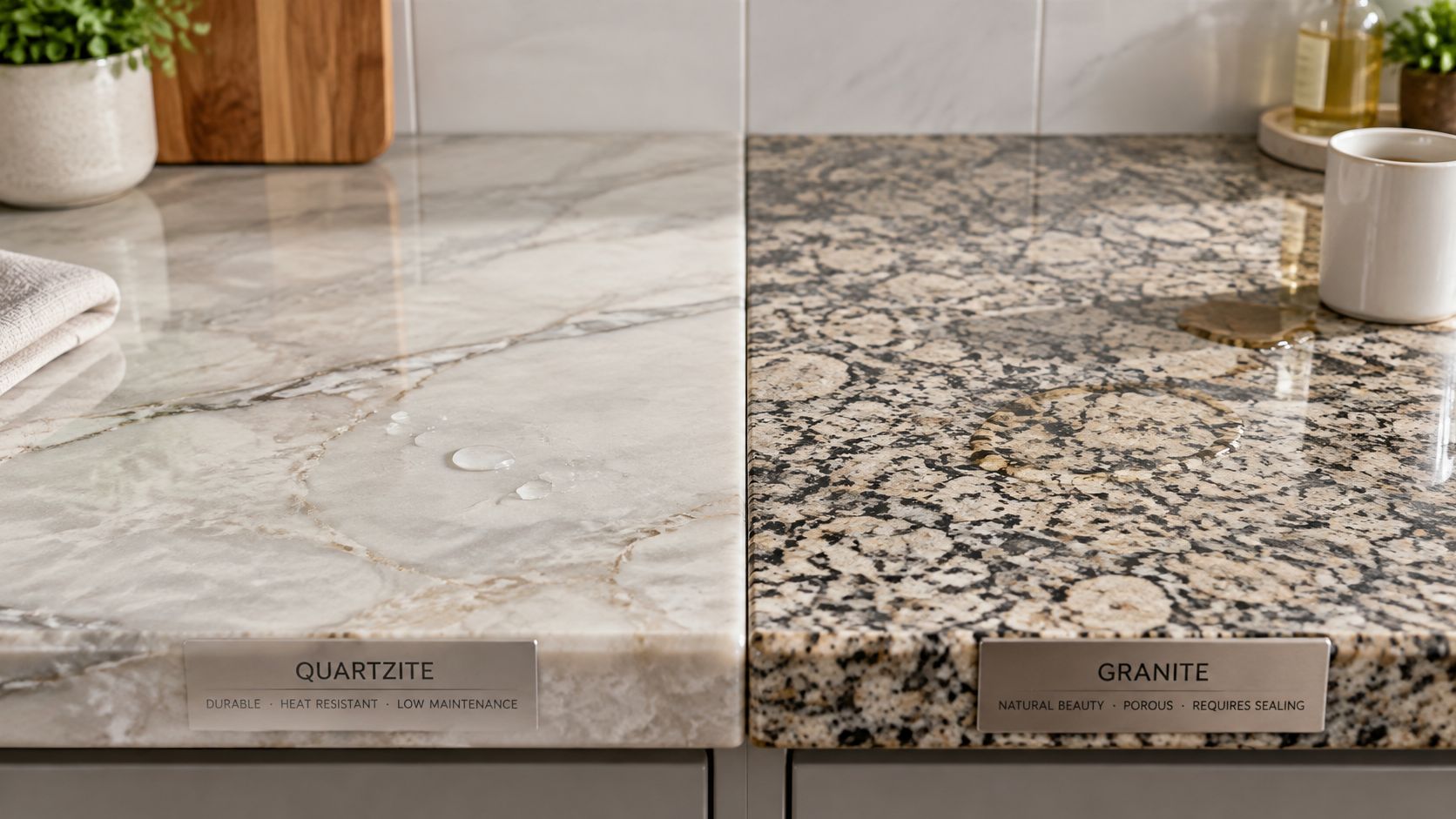
Say two slabs are sold under the same stone name, perhaps two pieces of quartzite from different quarries. One is dense and well finished; the other has a network of pale veins and micro-fissures. Beside a sink where turmeric paste and lemon juice sit for twenty minutes, the fissured slab stains at a visibly faster rate. The stone name predicted nothing useful.
Why a fixed sealing calendar fails
Indian comparison content often presents granite as the maintenance-heavy option and quartzite as similarly porous, but the useful decision variable is each slab's water absorption and capillary behaviour. India-oriented guidance cites BIS standard IS 14223 Part 1 for polished granite, with a maximum water-absorption value of 0.50% for the applicable classification, and notes that sealing intervals should depend on porosity and a simple water test rather than a universal calendar, as the Interiors by Dex stone guide explains. Two slabs carrying the same name can behave completely differently around cooking stains.
The water-drop test is the cheapest reliable method:
- Prepare the surface: Clean the slab completely and let it dry.
- Place the drops: Put several drops of water near the sink, beside the cooktop, and in an open field area.
- Wait and watch: Leave the drops for about ten minutes, then wipe them away.
- Read the result: If a spot darkens or the water soaks in, the slab needs sealing before use.
- Seal correctly: Confirm the sealer suits the stone and allow the full cure time before exposing the surface to water.
- Record the schedule: Write an aftercare plan tied to actual use, not to a calendar date.
Quartzite is not automatically lower-maintenance than granite, and granite is not automatically stain-prone. A dense, properly finished granite can outperform a more absorbent quartzite in everyday use. Before deciding, examine the slab under good light for pits, pale veins and cracks, because those visual clues predict staining better than the stone's name.
Lab Benchmarks to Request for Any Slab
The stone name does not prove performance. Two slabs from the same family can differ sharply in absorption and strength, which is why the tested lot, not the marketing label, should drive the decision. India's Bureau of Indian Standards offers a directly applicable testing framework, and the IS 1124 standard document sets out the method for water absorption, apparent specific gravity and porosity after a 24-hour immersion and oven-drying cycle.
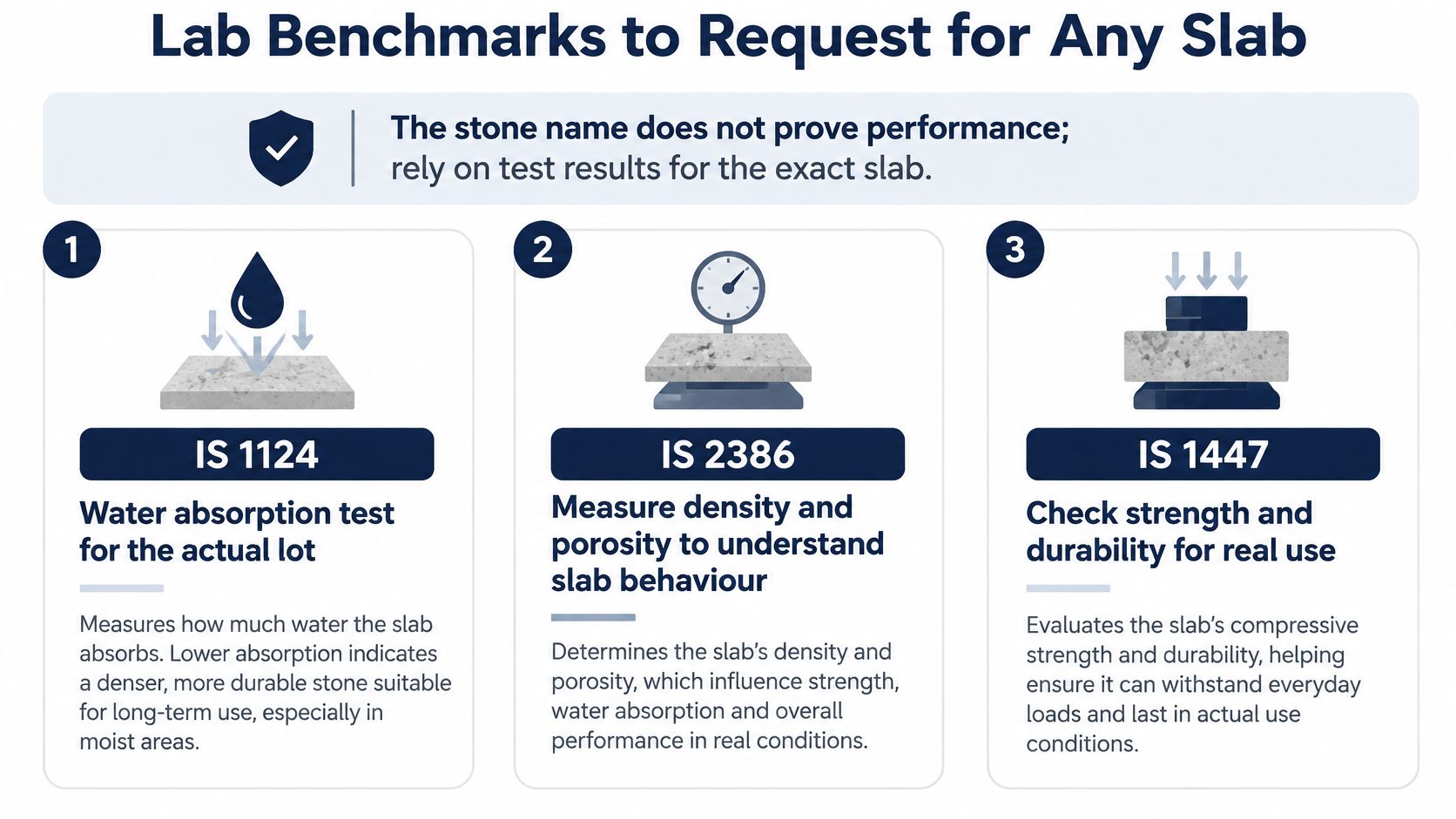
Structural granite has its own compliance benchmark: IS 3316 requires compressive strength of at least 1,000 kg/cm² (approximately 98 MPa), specific gravity of at least 2.6, and water absorption no greater than 0.50%. For quartzite, the same protocol gives a fair comparison even though the standard was written for granite. A heavily fissured quartzite may fail where a dense, well-tested granite passes comfortably.
| Test or benchmark | What it measures | Value to request |
|---|---|---|
| IS 1124 | Water absorption, apparent specific gravity and porosity after 24-hour immersion and oven drying | Absorption at or below 0.50% for wet areas |
| IS 3316 structural granite benchmark | Compressive strength, specific gravity and water absorption | At least 1,000 kg/cm² (about 98 MPa), specific gravity at least 2.6, absorption no greater than 0.50% |
| IS 1121 | Compressive and transverse-shear strength | Result suited to the intended span |
Questions to put to the supplier
When you ask for stone, ask for evidence in this order:
- Slab or block identification for the selected lot, so the test report matches the physical piece you will cut.
- An accredited laboratory report for that lot, not a family-level claim or a printed brochure.
- Absorption at or below 0.50% for kitchen counters, vanities and wet-area applications in Gurugram/NCR.
- Strength figures suited to the intended span, because a long overhang needs different numbers than a fully supported worktop.
- A visual inspection record for fissures, resin-filled cracks and open veins before any cutting begins.
A slab-by-slab report is more reliable than any general statement about either stone. For buyers comparing a specific granite like titanium black granite, the same request list applies, and the tested figures decide whether the lot suits a kitchen or a feature wall.
Heat Tolerance Near Hobs and Cookware
The harder stone is not automatically the safer kitchen surface. This is the point most "quartzite versus granite" comparisons skip. The more useful distinction sits between natural stone and engineered quartz: quartzite and granite are mineral-based stones, while engineered quartz contains resin. India-focused guidance from Studio Matrx reports that resin may soften around 150°C and discolour above roughly 180°C, whereas granite is commonly described as tolerating temperatures around 300°C or more.
Separate the prep zone from the hob zone
In NCR homes and hospitality kitchens, tawas, kadhais, pressure cookers and pans move directly from gas burners or induction zones onto the counter. That use pattern changes the answer. Granite is the safer choice beside active hob runs. Quartzite can be suitable only after confirming the specific slab, finish, thickness and installation details on the technical data sheet.
A designer may specify quartzite for visual continuity across a kitchen. If the client routinely puts hot vessels straight onto the counter, that expectation must be documented before fabrication, not treated later as a generic durability question.
The practical steps are straightforward. Request a technical data sheet for the exact slab. Use trivets regardless of stone. Keep hot vessels away from seams and edges, where thermal stress concentrates. Document the heat-zone decision before the slab is cut, so everyone agrees which stone sits beside the hob and which one runs through the prep area.
Fabrication, Supply and Cost Trade-offs
Quartzite's hardness is a performance advantage on the counter and a processing constraint on the saw. Hard, silica-rich material calls for diamond tooling, controlled feed rates and steady cooling, and a poor setup shows up as tool wear, edge chipping and a higher fabrication bill. Granite stays the predictable benchmark for commercial interiors partly because India's IS 3316 regulates structural granite directly: the IS 3316 standard document sets maximum water absorption of 0.50% and minimum compressive strength of approximately 98 MPa. Quartzite has no equivalent named standard, so a quartzite slab must be tested to the same protocol before any like-for-like comparison holds.
| Factor | Quartzite | Granite |
|---|---|---|
| Hardness and tooling | Very hard; needs diamond tooling | Hard; more predictable with standard tooling |
| Cutting and feed rate | Controlled feed rates and cooling; slower | Routine cutting; more predictable |
| Edge chipping risk | Higher if tooling or setup is unsuited | Lower in routine fabrication |
| Standards coverage | Test to the same IS protocol for a fair comparison | IS 3316 regulates structural granite |
| Availability | Lot- and source-dependent; confirm stock before design sign-off | Broad availability |
| Fabrication cost | Often higher where tooling is difficult | Usually more controlled |
What actually drives the quote
Fixed rupee figures mislead here; relative cost bands are the useful unit. The final number depends on slab tier, veining premium, thickness, edge profile, seam count, cut-outs and fabrication time. A dramatic quartzite with heavy veining costs more per slab than a common granite, and the slower feed rates that hard material demands add labour on top. Each extra hob cut-out or seam means more machine time and more handling risk on a brittle edge. Compare installed cost on the same drawing and the same slab test data, never slab price alone.
Before committing to a very hard quartzite, confirm the fabricator's tooling capability and specify reinforcement around sink and hob openings. Readers treating the worktop as one line item inside a wider renovation can weigh stone spend against cabinetry, appliances and labour with these kitchen budgeting tips for Orange County homeowners. For current quartzite pricing in the NCR market, the price of quartzite slab guide sets out the factors that move quotes.
Where does that leave the choice? Quartzite earns its premium when scratch resistance, natural veining and long-term surface retention lead the brief. Granite earns its place when predictable fabrication, standards compliance, broad availability and a controlled installed cost matter more. The stone name sets the expectation; the tested slab and the shop that cuts it decide the result.
Choose Quartzite or Granite for Your Project
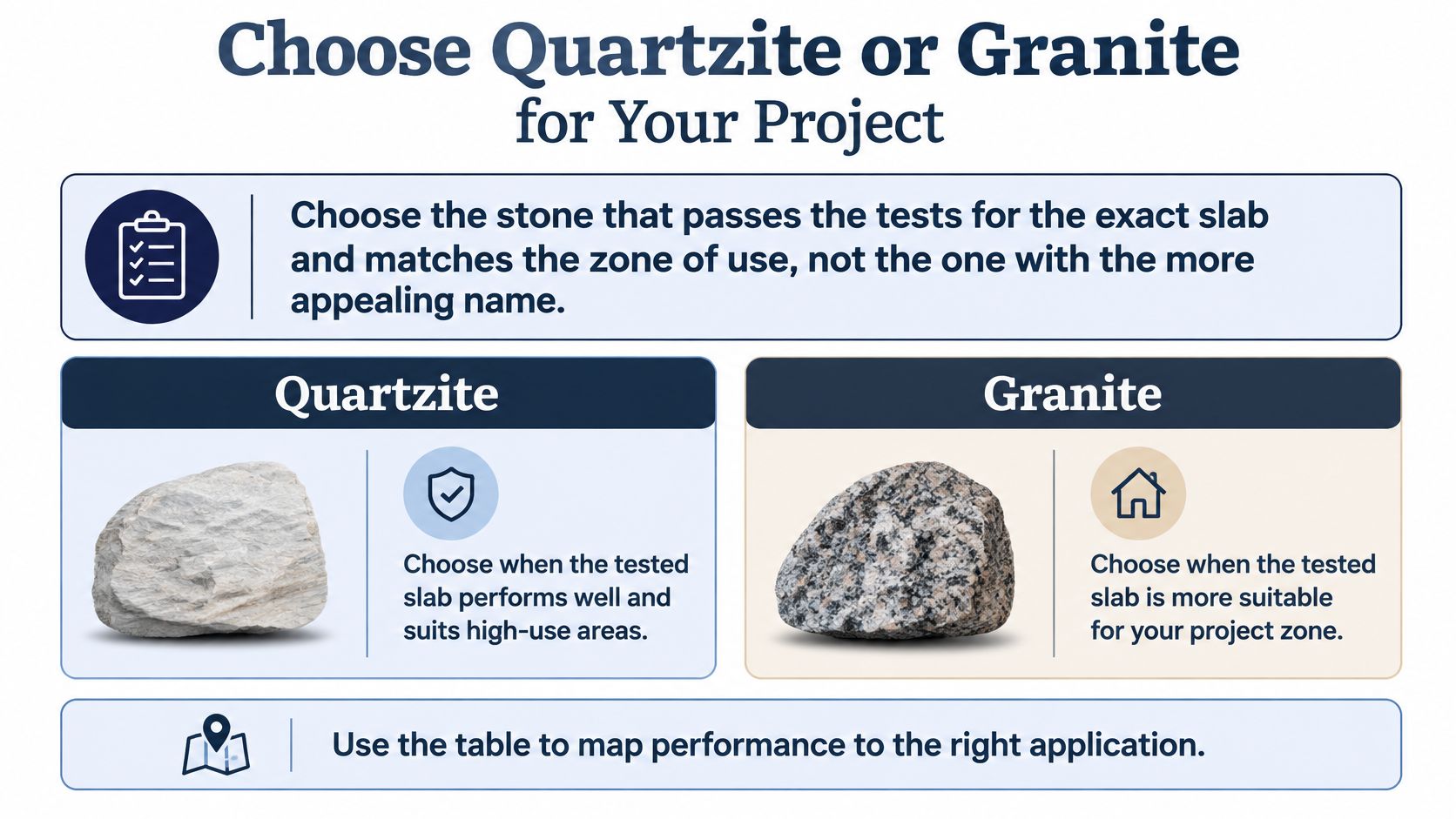
The decision rule is simple: choose the stone that passes the tests for the exact slab and matches the zone of use, not the one with the more appealing name. The table below maps common project types to the lean that usually works, with the condition that decides it.
| Project type | Lean toward | Deciding condition |
|---|---|---|
| Residential kitchen worktop with daily hob use | Granite | Hob zone needs proven heat tolerance |
| Residential prep zone or vanity | Quartzite or granite | Slab passes absorption and wet-area test |
| Feature wall or low-traffic surface | Quartzite | Visual character matters more than daily wear |
| Commercial high-traffic flooring | Granite | Predictable fabrication, standards compliance and availability |
| Hospitality or commercial kitchen | Granite | Heavy cookware and daily heat exposure |
| Large-format slab with long unsupported overhang | Granite | Predictable fabrication and structural compliance |
The four-step path to a decision
Homeowners often value visual character and can accept quartzite in prep zones once it passes testing. Commercial builders and hospitality fit-outs usually need predictable fabrication, compliance paperwork and broad availability, which favours granite. South Indian granites resist heat, knives and decades of traffic, which makes them a practical default for demanding floors and worktops. Quartz slabs are non-porous and scratch-resistant and need no sealing, but they do not answer the quartzite-versus-granite question for buyers who want natural mineral stone.
- Confirm the zone of use for each surface, separating the hob run from the prep area and the vanity.
- Request lab data for two or three candidate slabs, including absorption and strength figures from the actual lot.
- Compare installed cost on the same drawing, with the same edge profile, cut-outs and seams.
- See the slabs in person before committing, and check the vein pattern, fissures and finish under good light.
For a specific quartzite like Taj Mahal quartzite, the showroom slab and its test report tell you more than any generic description. Buyers can view candidate slabs at our Sikanderpur Marble Market and HUDA Marble Market Sector 33–34 showrooms in Gurugram, where the team guides each stone from yard to site, with cutting, finishing and installation handled as one process.
At Varun Marbles, we help you compare quartzite and granite on the numbers that matter: absorption, strength, heat zone and installed cost. Visit our showrooms in Gurugram to inspect slabs in person and request lot-specific test data before you commit. Explore the full stone range and plan your project at Varun Marbles.