
Golden Yellow Marble: A Complete Guide to Luxury Interiors

You enter a room where the walls seem to hold their own sunlight. A golden surface catches the morning, warms beneath evening lamps, and gives even a restrained interior a sense of ceremony. That immediate appeal explains why golden yellow marble remains a compelling choice for floors, counters, feature walls, and architectural details.
The difficulty begins when a showroom label reduces every yellow stone to the same colour name. Golden yellow marble isn't a single, uniform material. It can describe stones with different geological origins, textures, porosity, polish behaviour, and installation requirements. Jaisalmer Yellow, for example, is strongly associated with Rajasthan, while other commercially labelled yellow marbles may be limestone or another stone selected for its ability to take a smooth finish.
A discerning selection therefore starts with two questions. What visual effect do you want, and what material will reliably deliver it in the location you've chosen? A rich surface may suit a foyer beautifully but demand more care in a wet area or busy kitchen. The luxury lies not only in the colour, but in understanding the stone well enough to specify it without unpleasant surprises.
Table of Contents
- Understanding Visual Characteristics
- Origin and Material Distinctions
- Recommended Design Applications
- Sourcing, Matching, and Care
- Conclusion and Key Takeaways
Understanding Visual Characteristics
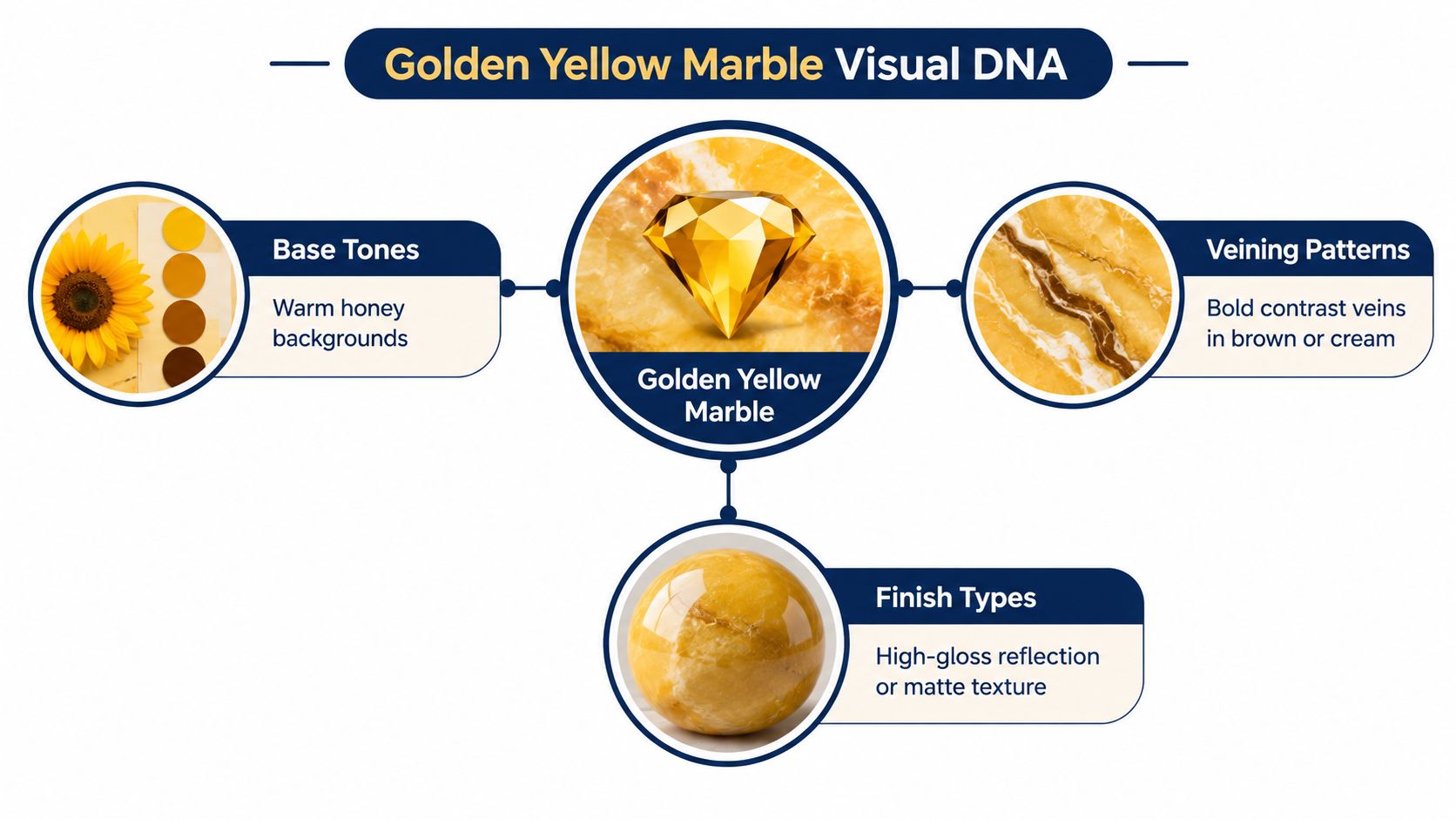
The phrase “golden yellow” covers a broad visual family. Some slabs read as pale cream with a soft honey cast. Others carry stronger amber, ochre, or sunflower tones, while brown, cream, rust, and subdued grey markings add depth. These differences aren't cosmetic details. They influence whether a room feels calm and architectural, richly traditional, or visibly dramatic.
Start by assessing the background tone, then study the markings over it. A quiet base with fine movement can support a large floor or a broad wall without overwhelming adjoining finishes. A slab with assertive veins may work better as a kitchen island, fireplace surround, reception desk, or framed feature where the pattern becomes the focal point.
Read the slab, not just the label
Digital photographs flatten scale and can shift warmth depending on the screen. In person, stand far enough away to judge the overall rhythm, then move close to inspect open pores, filled areas, hairline fissures, and the direction of the veining. Ask the supplier to show several slabs from the same block where possible, because a sample may represent only a small part of the finished composition.
Light changes the material's character. Direct daylight reveals the true balance between yellow, cream, and brown. Warm artificial lighting can intensify amber notes, while cooler lighting may make the same slab appear more restrained. Place a sample beside the proposed cabinet, paint, flooring, and metal finishes before approving the palette.
Understand translucency and finish
Translucency is different from brightness. A polished surface reflects light from its face, while a translucent stone allows some light to travel through the material. That distinction matters for backlit panels, where the slab's internal structure can create a gentle glow or reveal uneven density.
Finish also changes perception. Polishing deepens colour and sharpens reflection, whereas honing creates a quieter, tactile appearance that can soften visual contrast. Neither finish automatically makes a stone suitable for every use. The correct choice depends on the stone's absorption, the expected traffic, the cleaning routine, and the design effect you want to preserve.
Selection rule: Approve the actual slab, under the actual lighting conditions, beside the actual materials. A colour name can't predict the whole surface.
Origin and Material Distinctions
A stone can be sold as marble without being marble in the strict geological sense. In commercial practice, names often reflect appearance, polishability, regional tradition, or market familiarity. That isn't necessarily deceptive, but it does create a specification risk if the buyer assumes that every yellow stone has the same composition and performance.
Jaisalmer provides the clearest example. Indian Bureau of Mines material identifies “Golden-yellow Marble of Jaisalmer” as a distinct variety, while government material also describes the regional product as yellow marble from Jaisalmer. Geological research places the yellow limestone and sandstone in the Jurassic-age Jaisalmer Formation, with prominent outcrops at Bada Bag, Hamira, and Baisakhi. The material is described as hard, compact, low-porosity, and smooth, and it's widely traded and polished for flooring tiles, wall claddings, countertops, and ornamental stone. You can review the Indian Bureau of Mines classification and geological background when a supplier's terminology needs checking.
Commercial name versus material class
True marble forms through the metamorphism of limestone or related carbonate rock. Limestone remains a sedimentary stone, even though a dense, polishable limestone may look remarkably similar after fabrication. Onyx introduces another set of characteristics, especially where translucency and layered patterning are central to the design.
Ask for the stone's geological description, not only its trade name. Then request technical information relevant to the application, such as absorption, recommended finish, sealing requirements, and suitability for the intended traffic or moisture exposure. A showroom should also clarify whether the colour is natural, whether resin or filler has been used, and whether slabs from different blocks may vary.
Jaisalmer's significance extends beyond a sales label. Its golden-yellow stone is tied to the city's Golden City identity and to heritage architecture built from local material. Jaisalmer Fort, known locally as Sonar Qila or Golden Fort, was built from limestone and sandstone, and government material links that stone directly to the city's famous golden appearance. Geological literature describes microfacies including oolitic to bioclastic grainstone, wackestone, mudstone, and packstone, which helps explain its long-standing value as a durable ornamental building material. For a broader visual study of stone, minerals, and geological form, you can explore our geology art collection.
A practical comparison
| Material question | Why it matters |
|---|---|
| Is the stone true marble, limestone, or another material? | Composition affects maintenance and performance expectations. |
| Is the surface polished, honed, or otherwise finished? | Finish changes reflection, texture, and the visibility of wear. |
| Does the slab contain fills or resin? | Filled areas may age differently from the surrounding stone. |
| Is the proposed use flooring, a wall, or a worktop? | The same appearance may suit one application better than another. |
If you're comparing yellow-toned Indian stones, the guide to Yellow Katni marble can help you frame better questions about origin and naming. The point isn't to reject a commercially named material. It's to buy the performance profile you need rather than assuming the word “marble” guarantees it.
Recommended Design Applications
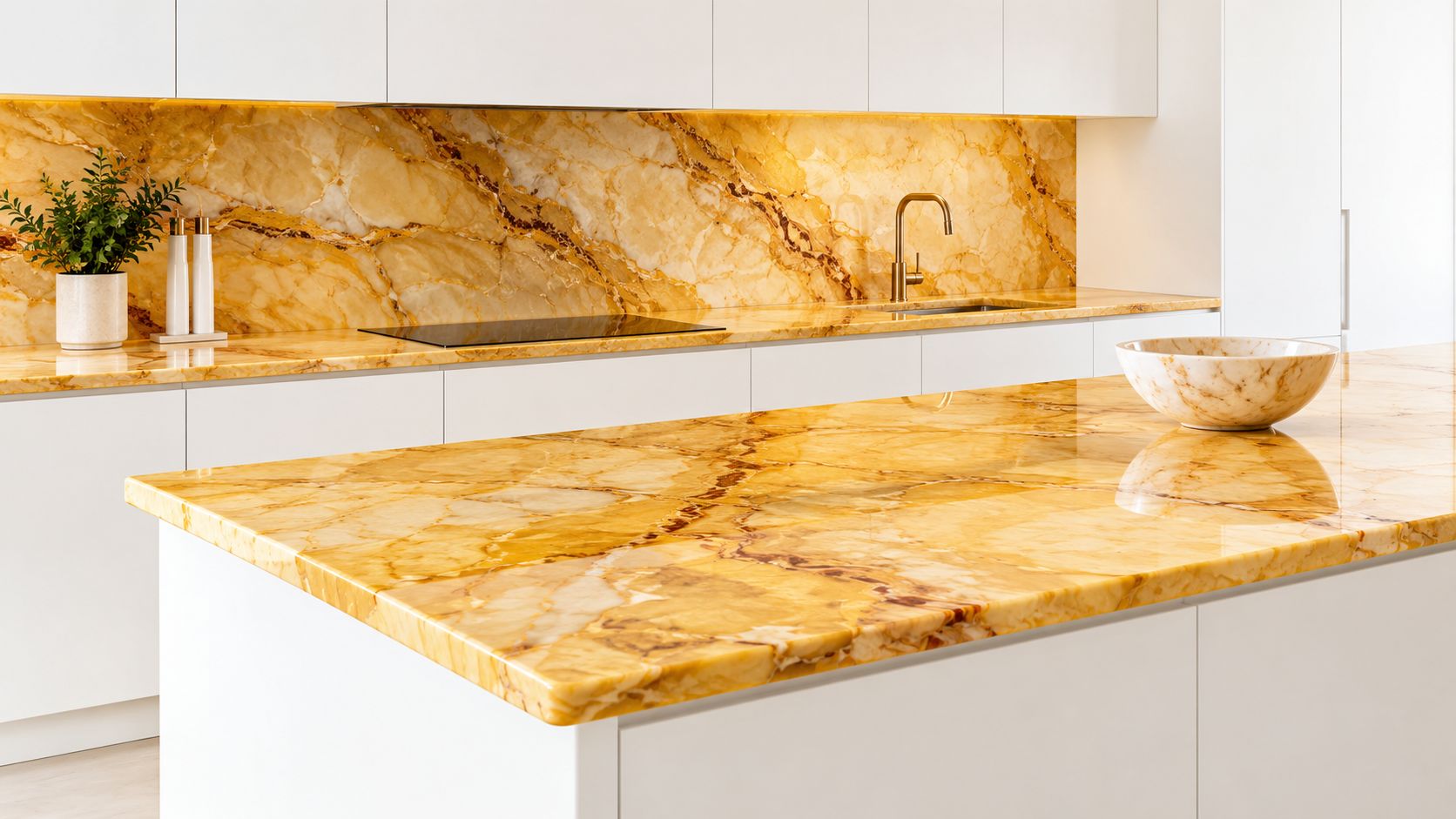
Golden yellow marble works best when its warmth has a clear architectural role. In a contemporary kitchen, it can turn an island into the room's centre of gravity, especially when white cabinetry and restrained hardware leave enough space for the stone's movement to speak. In a traditional setting, the same material can reinforce timber, antique brass, plaster, and patterned textiles without feeling artificially matched.
Give the strongest slab a focused job
A feature wall is often safer than covering every surface. A bookmatched panel behind a reception desk, bedhead, fireplace, or dining console lets you compose the veining deliberately. Large-format installation can reduce visual interruption, but the fabricator must plan joints, corners, openings, and pattern alignment before cutting.
Flooring calls for a more measured selection. A heavily marked slab can become visually tiring across a large area, while a quieter golden field can establish warmth without competing with furniture. Review flooring options for listings when the project involves a property where broad appeal and practical specification need to work together.
Countertops deserve closer scrutiny because spills, cleaning, utensils, and repeated contact test the surface in ways a decorative wall doesn't. Confirm that the selected stone is appropriate for the use, specify the edge profile carefully, and coordinate cut-outs so the most attractive portion of the slab remains visible. For a related look with softer neutral movement, compare the beige marble texture guide.
Use light as part of the design
Backlighting can make a translucent yellow stone appear luminous, but it shouldn't be treated as a shortcut to luxury. The stone needs suitable translucency, even light distribution, adequate support, and carefully concealed electrical and access details. Uneven density can create bright and dark areas, so the fabricator should test a representative piece before committing to a large installation.
A bathroom wall, spa reception, bar front, or hospitality counter may benefit from this effect. A busy shower floor usually deserves a different conversation, one based on absorption, slip considerations, drainage, and maintenance rather than visual drama alone.
The most successful schemes repeat the stone selectively. Pick up one of its quieter tones in cabinetry, paint, or upholstery, then allow the yellow to remain the feature rather than turning the entire room into a single colour statement.
Sourcing, Matching, and Care
Selection begins before the slab reaches the showroom. Confirm the origin, material class, finish, thickness, available quantity, and expected variation. If the project needs several surfaces, ask whether the slabs come from the same block or whether the supplier is combining visually related material from different sources.
India's terminology makes this especially important. Golden yellow marble may refer to multiple stones with different geology and performance profiles, and Rajasthan remains a major centre of marble production. The Indian Business Portal reports Rajasthan output at 16,159,347 tonnes in 2020–21 in its marble overview, but a large production base doesn't remove the need to inspect the exact material being offered. Review the Indian marble market overview for context, then return to the slab itself for the final decision.
A disciplined approval process
- Inspect the full slab. Check tone, movement, open areas, filled sections, edge quality, and any visible repair.
- Map the installation. Mark sinks, hobs, sockets, doors, joints, and bookmatch lines before cutting.
- Test the finish. Compare polished and honed samples under the project's lighting, not only in the showroom.
- Record the approval. Photograph the selected slabs and note their positions so fabrication and installation follow the agreed layout.
Colour matching works best when you match undertones rather than trying to find an identical yellow. Cream cabinetry can calm a strong golden field. Deep brown or walnut can echo darker veins. Matte black introduces contrast, while brushed brass reinforces warmth. Keep grout and adjacent stone quiet if the slab already carries prominent movement.
Natural stone needs a care plan from the start. Use a cleaner recommended for the material and finish, remove spills promptly, and ask the installer whether an impregnating sealer is appropriate. Avoid assuming that a glossy surface is maintenance-free. For a clearer comparison of surface character and upkeep, consult this guide to the difference between honed and polished marble.
Conclusion and Key Takeaways
Golden yellow marble earns attention because it does more than add colour. It brings warmth, geological variation, reflected light, and a connection to a long architectural tradition. Jaisalmer's golden stone is especially significant because the material contributes to the identity of the Golden City and to the appearance of heritage architecture such as Sonar Qila.
The central lesson is simple: golden yellow is a visual description, not a complete specification. Before approving a slab, establish its origin and material class. A stone marketed as yellow marble may be true marble, limestone, or another material chosen for its appearance and polishability. Those distinctions influence porosity, finish retention, cleaning, sealing, and the suitability of a surface for floors, counters, walls, or decorative work.
Your visual review should be equally deliberate. Look at the base tone, vein direction, pattern scale, translucency, and finish in the lighting that will exist after installation. A sample can suggest the character, but the full slab determines the composition. Mark the cuts before fabrication so the strongest movement appears where it will be appreciated.
Use the material selectively when its pattern is assertive. A feature wall, island, fireplace, reception counter, or carefully chosen floor can give the stone authority without making the room feel crowded. If backlighting is part of the design, verify translucency and test the lighting system rather than relying on a catalogue photograph.
Finally, treat care as part of the purchase. Confirm the recommended cleaner and sealer, plan for prompt spill removal, and understand how the selected finish will age. A beautiful stone becomes a regrettable choice only when its behaviour was never discussed. Informed selection is the lasting luxury.
Varun Marbles supplies Indian and Italian marble, granite, onyx, engineered quartz, and fabrication support for residential and commercial interiors. Visit Varun Marbles to review suitable yellow-toned stones, inspect slabs in person, and discuss cutting, finishing, and installation for your project.