
Yellow Katni Marble: Complete Guide for Indian Projects
You approve a yellow Katni marble sample in a Gurugram showroom, expecting the same warm yellow tone across a living room, staircase, and kitchen counter. The delivery arrives with slabs that shift towards beige, cream, or pink, while the thickness varies enough to affect the finished edge and stair nosing. The stone may still look attractive, but the project no longer matches the approved design.
The specification challenge with yellow Katni marble is considerable. Its appeal is easy to understand, but the purchase can't be treated like a uniform manufactured surface. Colour naming, quarry origin, slab thickness, finish, sealing, and inspection at dispatch all affect the result. The guide below approaches the material as a stone specifier would, with particular attention to the risks supplier listings often leave out.
Table of Contents
- Why Yellow Katni Marble Demands Careful Specification
- Geological Origin and Reserve Scale of Katni Marble
- Colour Variants and Naming Inconsistencies in the Market
- Technical Properties and What They Mean for Your Project
- Slab Thickness Standards and Tolerance Checks
- Is Yellow Katni Marble Suitable for Indian Kitchens and Bathrooms
- Procurement Checklist for Batch Matching and Quality Verification
- Finish Selection and Sealing Strategy by Application
- Quick Reference Guide for Common Project Types
- Related Stones and Sourcing Support from Varun Marbles
Why Yellow Katni Marble Demands Careful Specification
A homeowner may select a small sample marked “yellow Katni” and assume the name defines a precise colour. On a larger order, however, the delivered slabs can show a different balance of yellow, beige, cream, or pink, with veins that are either quieter or more pronounced than the showroom piece. The problem usually appears after fabrication, when the slabs have already been cut into flooring, counters, or stair components.
For an NCR project, that timing matters. Replacing a few loose slabs is inconvenient. Reworking cut-to-size pieces, matching stair risers, or coordinating a second delivery can disrupt several trades at once. A visually acceptable stone can still become a poor project choice if the team approved one appearance and received another.
Practical rule: Approve the actual lot, not just a product name or a small showroom sample.
Yellow Katni marble remains commercially established because it belongs to the wider Katni marble economy in Madhya Pradesh. Yet natural stone isn't a factory-colour product. The quarry face, extraction zone, block selection, processing quality, and finish all influence what the finished slab looks like.
Three controls prevent most avoidable surprises:
- Batch approval: Ask to see multiple slabs from the proposed lot, not a single polished sample.
- Dimensional verification: Confirm thickness before fabrication, especially for countertops, stairs, and areas requiring a consistent reveal.
- Use-based selection: Match the finish and sealing approach to the room. A surface selected only for showroom appearance may demand more care in a busy kitchen.
The right question isn't whether yellow Katni marble is attractive. It is whether the supplier, fabricator, and installer can deliver a controlled visual and dimensional result for the intended application.
Geological Origin and Reserve Scale of Katni Marble
Katni district is geologically anchored in the Mahakoshal group of rocks of lower to middle Proterozoic age. Official project documentation for a marble lease describes the marble in association with chert, banded iron formation, quartzite, orthoquartzites, and phyllites, placing the material within a wider, structured geological setting rather than treating it as an isolated surface deposit. The same report describes the local marble as massive and compact, with a recorded bulk density of 2.65 tonnes per cubic metre, and documents working depth through a 30-metre borehole in that lease area. These details are recorded in the official marble lease project document.
That setting helps explain why visual variation is a procurement issue. A deposit mapped within layered rock associations may be extracted through defined geological zones, and blocks from different portions of the working area needn't display identical colour or veining. One documented rock trend in a Katni lease runs east to west, from N 70° E to S 70° W, with a 30 to 35° southward dip, showing how quarry teams map and work the deposit in a controlled geological environment. This doesn't mean every slab will vary dramatically, but it does mean a trade name can't replace lot-level inspection.
Why reserve scale matters commercially
The Central Ground Water Board identifies marble, dolomite, Gondwana sandstone, and Vindhyan limestone among Katni's main geological units in its district geology and groundwater reference. A separate Katni marble reserve document filed with the Madhya Pradesh Pollution Control Board reports a total geological reserve of 60,000 cubic metres, equivalent to 168,000 tonnes.
That reserve scale supports Katni's established role in Indian marble supply. It also creates a common buying mistake. Buyers often treat availability as proof of uniformity. In practice, commercial availability and visual consistency are different questions. A material can be widely supplied while still requiring careful block, lot, and slab matching.
Colour Variants and Naming Inconsistencies in the Market
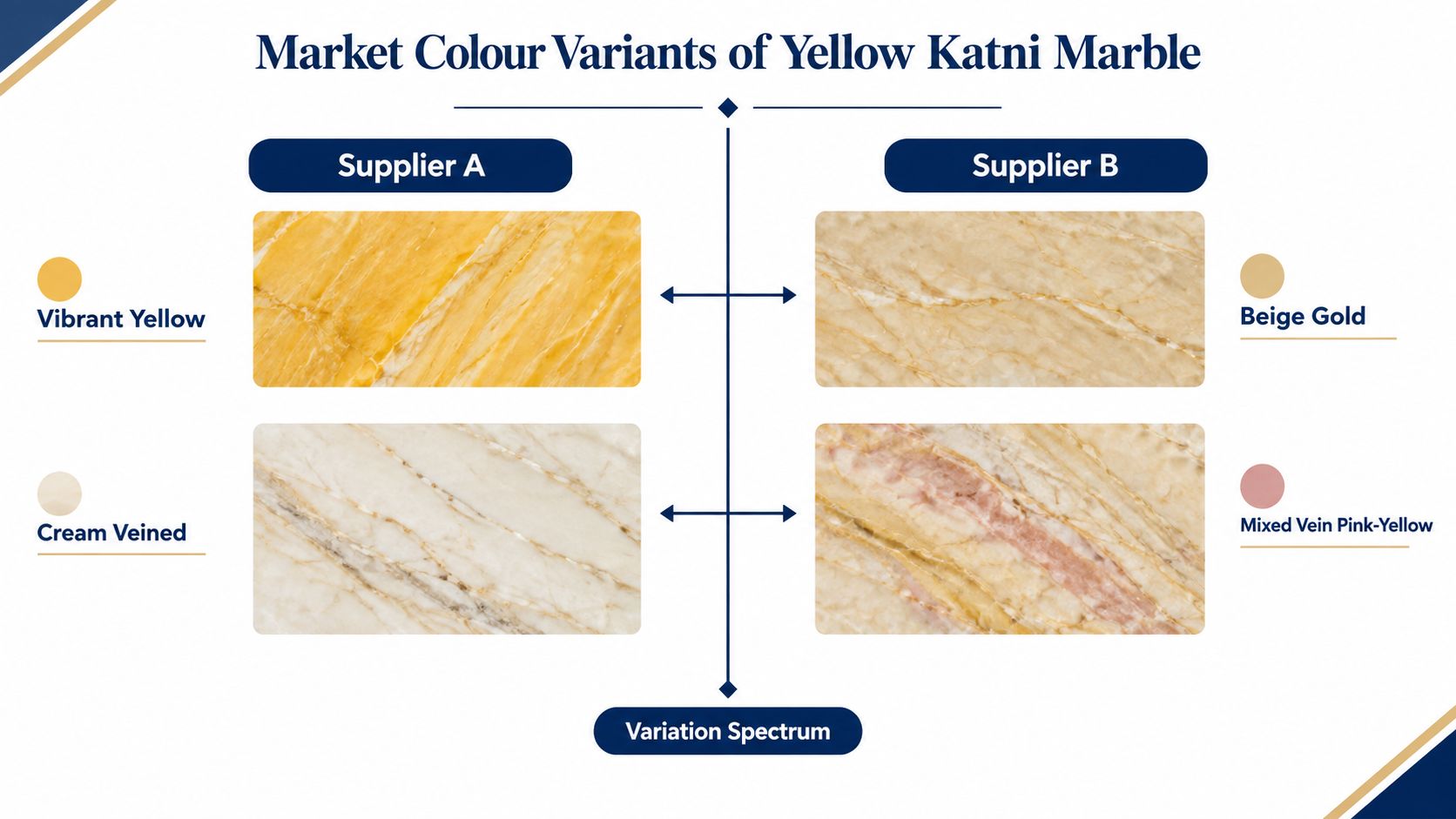
“Yellow Katni” is a market description, not a guaranteed visual formula. Supplier listings use names such as yellow, beige, cream, pink, and mixed vein, and the same broad family can be presented as a warm, quiet surface or a more visibly patterned decorative stone. The TradeIndia Katni marble listings show this spread in both naming and quoted rates, with prices ranging roughly from ₹40 to ₹200 per sq. ft., depending on selection and processing quality.
That range shouldn't be read as a universal price list. It signals that selection and processing have a material effect on what buyers receive. A low-priced lot may be perfectly suitable for a less colour-sensitive application, while a carefully selected lot may be necessary for a formal lobby, feature wall, or continuous flooring scheme.
Read the colour name as a starting point
| Market description | What to check visually | Procurement concern |
|---|---|---|
| Yellow | Whether the base stays consistently warm across full slabs | Small samples can exaggerate uniformity |
| Beige or gold | Whether the stone reads yellow, neutral, or brown under site lighting | Artificial showroom lighting can alter perception |
| Cream veined | The direction, scale, and frequency of the veins | Adjacent slabs may not create a continuous flow |
| Pink-yellow or mixed vein | Whether the pink is a feature or a dominant base tone | The approved sample may understate the variation |
A project team should record the approved appearance in practical terms. Note the base tone, acceptable vein intensity, direction of movement, and whether a pink or beige shift is acceptable. Photographs help, but they shouldn't replace viewing the actual slabs under lighting close to the installation environment.
A product label can identify a family of stone. It can't define the appearance of every block from that family.
For a large order, request a master sample set from the same quarry lot or block group wherever possible. Ask the supplier to identify which slabs are intended for visible areas, which are reserved for cuts, and how the lot will be arranged before dispatch. That conversation is more useful than asking only whether the stone is “pure yellow”.
Technical Properties and What They Mean for Your Project
Technical data is useful only when it changes a specification decision. Reported Katni marble properties include water absorption under 0.1%, bulk density around 2,857 kg/m³, Mohs hardness near 4, compressive strength around 1,649 to 2,023 kg/cm², and flexural strength around 119 to 129 kg/cm², as recorded in this Katni marble technical reference.
| Property | Value | Project implication |
|---|---|---|
| Water absorption | Under 0.1% | Low absorption supports use on many interior floors and wall surfaces, but it doesn't eliminate staining or etching concerns |
| Bulk density | Around 2,857 kg/m³ | The stone is dense, so handling, substrate preparation, and fixing must be planned properly |
| Mohs hardness | Near 4 | Suitable for decorative interiors, but vulnerable to scratching and acid etching compared with harder stones |
| Compressive strength | Around 1,649 to 2,023 kg/cm² | Supports flooring and decorative load-bearing applications when the substrate and installation are sound |
| Flexural strength | Around 119 to 129 kg/cm² | Slab support, handling, cut-outs, and unsupported overhangs still require careful detailing |
Floors and wall cladding
The density and reported strength values make yellow Katni marble a reasonable candidate for residential flooring, wall cladding, stairs, and decorative surfaces when the design and installation are appropriate. The stone can also work in commercial interiors, but the expected traffic, grit, cleaning regime, and maintenance capability should influence the decision.
The hardness figure is the important qualification. Marble is still a calcium-rich natural stone, so acidic substances and aggressive cleaning products can dull or etch the surface even when water absorption is low. A dense surface isn't the same as an acid-proof surface.
Countertops need a stricter test
For kitchen counters, inspect the actual finish and ask the fabricator how the stone will be protected around sinks, hob cut-outs, corners, and exposed edges. A technical sheet can describe general material behaviour, but it can't predict every stain, cleaner, spill duration, or household habit.
Use the data to shortlist the stone. Use a sample, a finish review, and a maintenance discussion to approve it.
Slab Thickness Standards and Tolerance Checks
Thickness affects more than the visual heft of a slab. It changes the adhesive bed, the finished floor level, the edge profile, the weight handled by installers, and the way a stair tread meets its riser. Yellow Katni marble is commonly supplied for interior work in the 15 to 20 mm range, with 16 mm, 18 mm, and 20 mm among the frequently cited stock thicknesses, as shown in this market specification for Katni marble slabs.
Select thickness by detail, not habit
A 15 mm slab may suit a planned interior application where the substrate, adhesive system, and edge treatment are designed around it. An 18 mm or 20 mm slab may be preferred where the detail needs a stronger visual edge, a deeper profile, or a more substantial stair or counter expression. The correct choice depends on the assembly, not on a generic claim that thicker is always better.
BIS marble specification documents establish dimensional bands and require conformity in size, thickness, and workmanship for supply acceptance in the Indian market. That gives the project team a basis for requiring measurable checks rather than accepting “standard thickness” as an adequate description.
What to check at receipt
- Measure several points: Check thickness across the slab, not only at one convenient edge.
- Inspect cut-outs: Ask the fabricator to recheck thickness and soundness around sink, hob, and tap openings.
- Confirm finished levels: Compare the approved slab thickness with adjacent flooring, skirting, stair nosings, and door thresholds.
- Record non-conformance: Photograph slabs that fall outside the agreed specification before cutting begins.
A tolerance conversation should happen before dispatch. Put the required nominal thickness, acceptable dimensional variation, finish, edge profile, and inspection responsibility in writing. This protects the homeowner and gives the fabricator a clear basis for rejecting or reallocating unsuitable pieces.
Is Yellow Katni Marble Suitable for Indian Kitchens and Bathrooms
The short answer is qualified. Yellow Katni marble can work in kitchens and bathrooms, but low water absorption doesn't make it maintenance-free. Available listings often promote price, finish, and colour without explaining porosity, sealing frequency, or stain resistance under Indian cooking conditions, a gap noted in this Indian marble market discussion.
Indian kitchens expose counters to turmeric, oil, tea, acidic ingredients, and cleaning products. Bathrooms add water, soap residue, cosmetics, and descaling chemicals. These substances don't all behave like plain water, so the under 0.1% absorption figure should be treated as one performance input, not as a promise of stain-proof or etch-proof use.
Where it works well
Yellow Katni marble is more defensible for bathroom vanity tops, wall sections, backsplashes, and kitchens where the owner accepts prompt cleaning and periodic resealing. It can produce a warm, continuous look that manufactured surfaces may not reproduce, particularly when the project values natural movement.
It becomes a riskier choice for a heavily used kitchen worktop when the household expects quartz-like convenience. Quartz may be the more practical option where uniformity, low routine upkeep, and resistance to everyday staining matter more than natural variation. That isn't a judgement against marble. It is a usage-based decision.
Make sealing part of the handover
Ask the installer which sealer is being used, when the surface can be used after application, and what cleaning products are prohibited. Don't accept “sealed” as a complete maintenance specification. The finish, exposure, spill habits, and cleaning routine all affect upkeep.
For broader kitchen surface comparisons, the kitchen marble and granite guide can help frame the choice between natural stone options.
Procurement Checklist for Batch Matching and Quality Verification
Procurement should treat the stone as a controlled lot, not as a collection of individually attractive slabs. A single slab can look excellent while the delivered batch creates a patchwork effect across a floor or elevation.
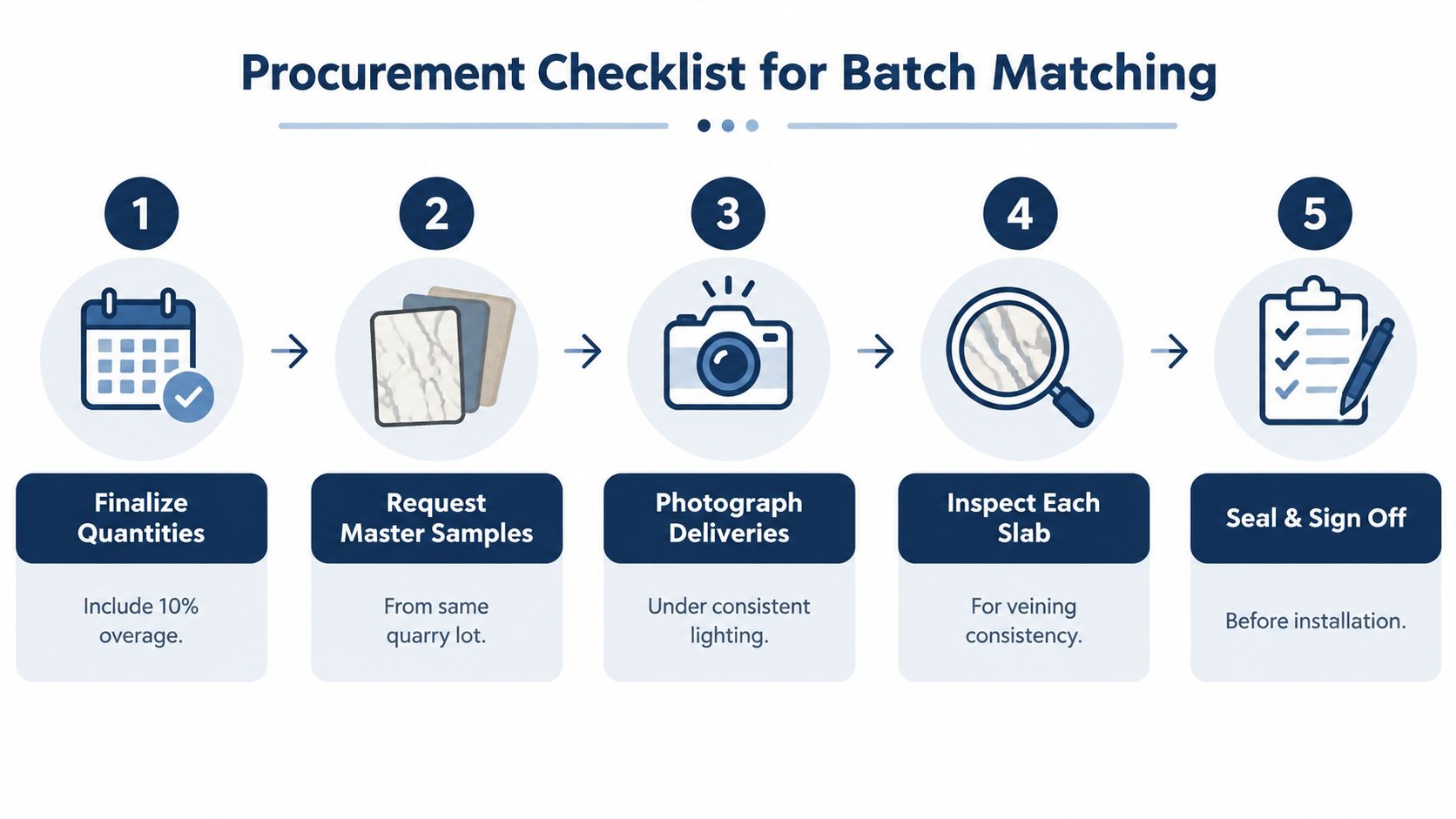
Use this sequence before dispatch
- Freeze the visual brief. Record the approved base colour, vein intensity, finish, nominal thickness, and the areas where the most consistent slabs will be used.
- Request lot identification. Ask the supplier to identify the quarry source, block or lot reference where available, and whether replacement slabs will come from the same source.
- Inspect full slabs. View the actual slabs in sequence. Check colour drift, open marks, filled areas, edge condition, polish uniformity, and visible fissures.
- Check dimensions. Measure length, width, squareness, and thickness at multiple points. Do this before the fabricator begins cutting.
- Map the installation. Mark slabs for prominent areas, bookmatching or directional flow, stairs, counters, and smaller cuts. Don't leave the visual arrangement to the installer without a layout plan.
- Photograph the delivery. Use consistent lighting and photograph identification marks with each slab. Keep the record with the purchase order and approved sample.
- Sign off before cutting. The client, designer, or authorised site representative should approve the received lot before fabrication.
Site discipline: If a slab looks wrong before cutting, cutting won't make the problem disappear. It usually makes the replacement more expensive.
The inspection should also cover packaging and transport damage. A slab that matches in colour but arrives with a damaged corner may still affect the planned countertop or stair layout. Separate visual rejection from dimensional rejection, and document both.
Finish Selection and Sealing Strategy by Application
Finish selection changes how yellow Katni marble reads and how it behaves during use. Polishing brings out colour and reflection, but it can make etching more visible. Honing reduces the reflective effect and may create a softer appearance, while leathered or brushed treatments introduce texture that needs its own cleaning and sealing discussion.
Choose the finish with the room in mind
| Application | Suitable direction | Main caution |
|---|---|---|
| Low-traffic formal floor | Polished finish can emphasise colour and movement | Scratches and etch marks may attract attention |
| Living area flooring | Polished or honed, depending on the desired visual softness | Dust, grit, and routine cleaning still affect the surface |
| Kitchen countertop | Honed or another less reflective finish may make minor etching less conspicuous | Texture can hold residue and still requires disciplined cleaning |
| Bathroom vanity | Honed or polished, with careful sealing around wet edges | Cosmetics and acidic cleaners can mark the surface |
| Feature wall | Select for colour and lighting response first | Confirm the fixing system and slab weight |
The finish doesn't remove the need for sealing. It changes the appearance of wear and the cleaning experience. A sealer can reduce liquid penetration, but it won't prevent acid etching, eliminate scratching, or compensate for poor fabrication around a sink.
For polished worktops, review the practical limitations described in this guide to polished marble countertops. The key decision is whether the household prefers the initial shine enough to accept visible maintenance marks later.
Ask for a written care sheet at handover. It should identify approved cleaners, products to avoid, spill response, and the installer's sealing recommendation. If the supplier can't explain those points, the finish hasn't been fully specified.
Quick Reference Guide for Common Project Types
Use the following as a starting specification, then confirm the actual lot and assembly with the fabricator.
| Project type | Thickness direction | Finish direction | Sealing and caution |
|---|---|---|---|
| Residential flooring | Choose from the 15 to 20 mm market range according to levels and substrate design | Polished for a reflective formal look, honed for a quieter surface | Protect from grit and acidic cleaners; approve multiple slabs together |
| Kitchen countertop | 18 mm or 20 mm may suit a substantial edge detail, subject to fabrication design | Honed or polished based on the household's maintenance tolerance | Seal and discuss turmeric, oil, acids, and cleaning products before approval |
| Bathroom vanity | Select thickness around the basin, edge, and support detail | Honed or polished | Seal cut-outs and edges; don't treat low absorption as stain-proof performance |
| Commercial lobby cladding | Coordinate thickness with the fixing system and panel size | Polished where reflection is desired, honed where glare is a concern | Confirm handling, substrate, traffic, and cleaning protocols |
| Feature wall | Use the fabricator's structural and fixing recommendation | Choose after viewing full slabs under project lighting | Prioritise lot matching and layout over a small sample |
Yellow Katni marble isn't the right answer for every high-use worktop or maintenance-sensitive interior. Where the brief demands manufactured uniformity and minimal routine care, engineered quartz or a suitable granite may offer a safer operational choice.
Related Stones and Sourcing Support from Varun Marbles
A project that begins with yellow Katni marble may also deserve a comparison with Katni family options, Indian granite, Italian marble, onyx, or engineered quartz. The relevant alternative depends on whether the priority is natural movement, hardness, translucency, colour control, or reduced maintenance. Varun Marbles also publishes buyer guidance on Wonder Katni marble, which can help when comparing related Katni selections.
For NCR projects, Varun Marbles operates showrooms in Sikanderpur Marble Market and HUDA Marble Market Sector 33–34, Gurugram. Its service covers natural and engineered stone selection, slab inspection, cut-to-size fabrication, edge profiling, and installation coordination, allowing the design team to assess the actual material before committing it to the site.
Visit Varun Marbles in Gurugram to compare yellow Katni marble with Indian and Italian marble, granite, onyx, and engineered quartz using full slabs and finish samples. Ask the team to review batch matching, thickness, fabrication details, and sealing requirements before your material is dispatched to site.