
10 Marble Floor Photos for Design Inspiration

Marble floor photos can mislead you if you judge them only by colour and veining. A polished white floor may look expansive in a hotel lobby, yet the same finish can become slippery when wet in an Indian home entry, balcony, bathroom, or monsoon-exposed corridor. The useful image is therefore not just a style reference. It's a preview of finish, reflected light, pattern scale, joint layout, moisture exposure, cleaning effort, and installation precision.
India's marble tradition also gives these images unusual context. Government-linked mineral data records 1,945 million tonnes of marble resources, while historic monuments including the Taj Mahal and Delwara temples show how long marble has shaped architectural surfaces in the country. Rajasthan's dominance in domestic production helps explain why many Indian interiors feature locally available stone families, polished slabs, and warm regional tones. You can explore the background through this India marble flooring market reference.
The gallery below moves from dramatic Italian marble and warm Indian stone to quartz, granite, onyx, porcelain, and commercial kitchen flooring. Read every image as a material decision. Look at how the surface catches light, whether the pattern supports or overwhelms the room, how visible the joints are, and whether the finish suits the people and activity using the floor.
Table of Contents
- 1. Polished Italian Marble with Veining
- 2. Matte Finish Engineered Quartz Flooring
- 3. Indian Marble with Warm Ochre and Beige Tones
- 4. Leathered Granite for High-Traffic Flooring
- 5. Backlit Imported Onyx Feature Walls
- 6. Large-Format Porcelain Tile Mimicking Marble Aesthetics
- 7. Honed Marble with Soft Matte Finish
- 8. Multi-Coloured Granite Patterns for Statement Flooring
- 9. Calcutta Gold Marble with Golden Veining
- 10. Slip-Resistant Textured Flooring for Commercial Kitchens
- 10-Point Marble Floor Photo Comparison
- Turn Inspiration Into a Confident Specification
1. Polished Italian Marble with Veining
Polished Italian marble earns attention through contrast. A pale white or cream background gives the room visual air, while grey, black, or golden veining creates movement across the floor. In a Delhi NCR hotel lobby, penthouse, jewellery showroom, or corporate reception, that reflective surface can multiply daylight and make the entrance feel more ceremonial.
The photograph should still prompt practical questions. Does the light bounce evenly, or does glare make the surface visually harsh? Are the veins aligned across adjoining slabs, or does the installation look like a random collage? Large natural slabs need a setting-out plan before cutting, particularly when a strong vein is intended to continue from one piece to the next.
For a private residence, I'd reserve highly polished marble for formal living rooms, bedrooms, low-traffic foyers, and climate-controlled luxury spaces rather than a busy kitchen or wet entry. Polishing doesn't make marble maintenance-free. Properly graded Indian marble is expected to meet maximum moisture absorption of 0.4% and minimum hardness of 3 under IS 1130, as recorded in the Indian standard for marble blocks, slabs, and tiles, but selection and installation quality still matter.
Practical rule: A polished floor photograph should always be reviewed alongside a wet-area safety decision. Consider a suitable matte protective treatment, honed alternatives, or a different material where regular water is unavoidable.
Use pH-neutral stone cleaners and agree on a professional cleaning protocol before handover. For fabrication guidance, compare the floor specification with advice on polished marble countertops, especially the relationship between gloss, sealing, and daily care.
2. Matte Finish Engineered Quartz Flooring
Matte engineered quartz gives designers a quieter alternative to high-gloss natural stone. Its consistent patterning works well in a modern Gurugram kitchen, office kitchenette, clinic, retail showroom, or other space where visual calm and straightforward upkeep matter more than geological variation.
The photograph should reveal how the surface behaves under warm and cool lighting. Matte whites and creams can make a compact kitchen feel more open without producing sharp reflections from work lights. In a contemporary office break room, that softer response also helps the floor sit behind cabinetry, joinery, and furniture rather than competing with them.
Quartz is useful when the brief demands consistent appearance and low routine maintenance. Its engineered composition supports a more uniform visual field than a natural marble floor, so designers can predict the relationship between adjoining areas more easily. That doesn't eliminate the need to inspect slabs. Pattern repetition, edge details, seams, and the relationship between floor and vertical surfaces still need approval.
Where the practical advantage shows
A mild soap-and-water cleaning routine is simpler than the care programme usually associated with porous natural marble. The quartz slab collection from Varun Marbles includes finishes suited to different visual requirements, so the design team can compare matte, polished, and leathered surfaces rather than choosing from a photograph alone.
Use a lighter neutral in a small residential kitchen if the goal is visual spaciousness. Add natural marble as a border, skirting, island detail, or wall accent when the room needs more geological character. In a hospital or clinic, confirm the complete floor build-up, joint treatment, cleaning products, and site hygiene requirements with the project consultant. A material may look clean in an image, but execution determines whether it performs cleanly in service.
3. Indian Marble with Warm Ochre and Beige Tones
Warm Indian marble changes the emotional temperature of a room. Beige, honey, ochre, and soft cream tones create a more grounded interior than a stark white floor, particularly in a villa living room, bedroom, foyer, boutique hotel, or cultural project that wants a connection to regional material traditions.
Subtle fossil marks and linear veining can give the floor character without turning it into the room's only focal point. That makes this palette effective in New Delhi and Gurugram homes that combine carved timber, brass, woven textiles, and contemporary furniture. Darker border tiles or carefully selected inlays can define circulation zones, but too much contrast may fragment the floor.
Read the surface, not just the colour
Warm stone photographs differently under daylight, warm LEDs, and decorative brass lighting. Ask to see full slabs or multiple pieces under the project's actual lighting scheme. A small sample may show the base tone but hide the scale and frequency of pattern variation that will dominate a large floor.
Domestic sourcing can also support a more practical procurement route than relying entirely on imported material. India's marble supply is strongly concentrated in Rajasthan, which accounted for about 89% of the country's marble output value in 2014–15, according to the Indian marble data reference. That supply context helps explain why Rajasthan-linked colours appear so often in Indian floor imagery.
Plan sealing with the stone supplier rather than copying a generic schedule. Marble remains vulnerable to staining from tea, coffee, turmeric, oils, and other everyday liquids, so spill response and pH-neutral cleaning should form part of the handover information. Evaluate Indian selections in person at Varun Marbles' Sikanderpur showroom before approving the final tone and slab sequence.
4. Leathered Granite for High-Traffic Flooring
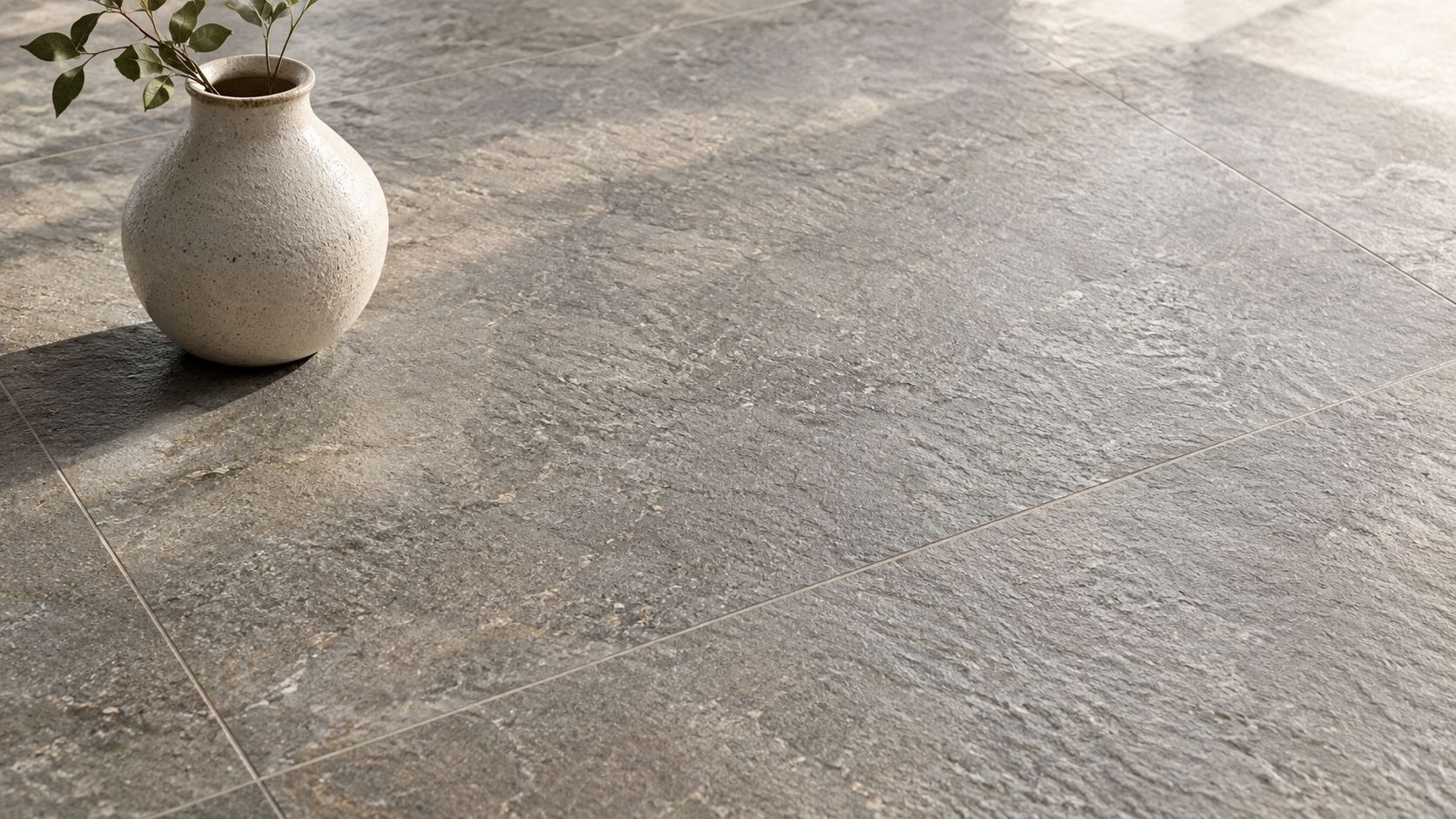
A leathered granite floor communicates durability without looking industrial. Mechanical brushing creates a tactile, low-reflection surface that reveals the mineral structure while making dust, footprints, and minor marks less conspicuous. That combination suits a busy Gurugram office foyer, hospitality kitchen, clinic corridor, spa, or open-plan residential kitchen.
The texture changes how light travels across the floor. Instead of producing a mirror-like reflection, it creates a soft variation that works particularly well with warm accent lighting and natural timber. Dark leathered granite can establish a strong base for pale cabinetry, while a mid-tone stone can support a more forgiving commercial palette.
Texture brings a maintenance trade-off
The same texture that improves visual depth can hold dust in its low points. Cleaning teams should use tools appropriate to the finish, including a stiff-bristle brush where needed, rather than assuming a soft mop will remove all residue. A natural stone sealer also needs a maintenance plan, with the responsible party and inspection interval recorded in the project documents.
For bathrooms and wellness spaces, check the complete wet-area design rather than treating texture as an automatic safety guarantee. Drainage, falls, grout, lighting, and cleaning practices all influence performance. The floor should feel stable underfoot, but the specification still needs review against the actual use.
In a high-traffic lobby, use the granite as the main field and keep decorative borders restrained. A dramatic grain can become tiring when repeated across every room. This textured stone flooring image shows how a simple object and controlled palette can let the surface provide the visual interest.
5. Backlit Imported Onyx Feature Walls
Onyx belongs in the category of architectural spectacle. Its natural translucency allows concealed lighting to turn a wall into a glowing composition, making it suitable for a five-star spa reception, luxury bedroom, restaurant wine room, nightclub lounge, or jewellery showroom display.
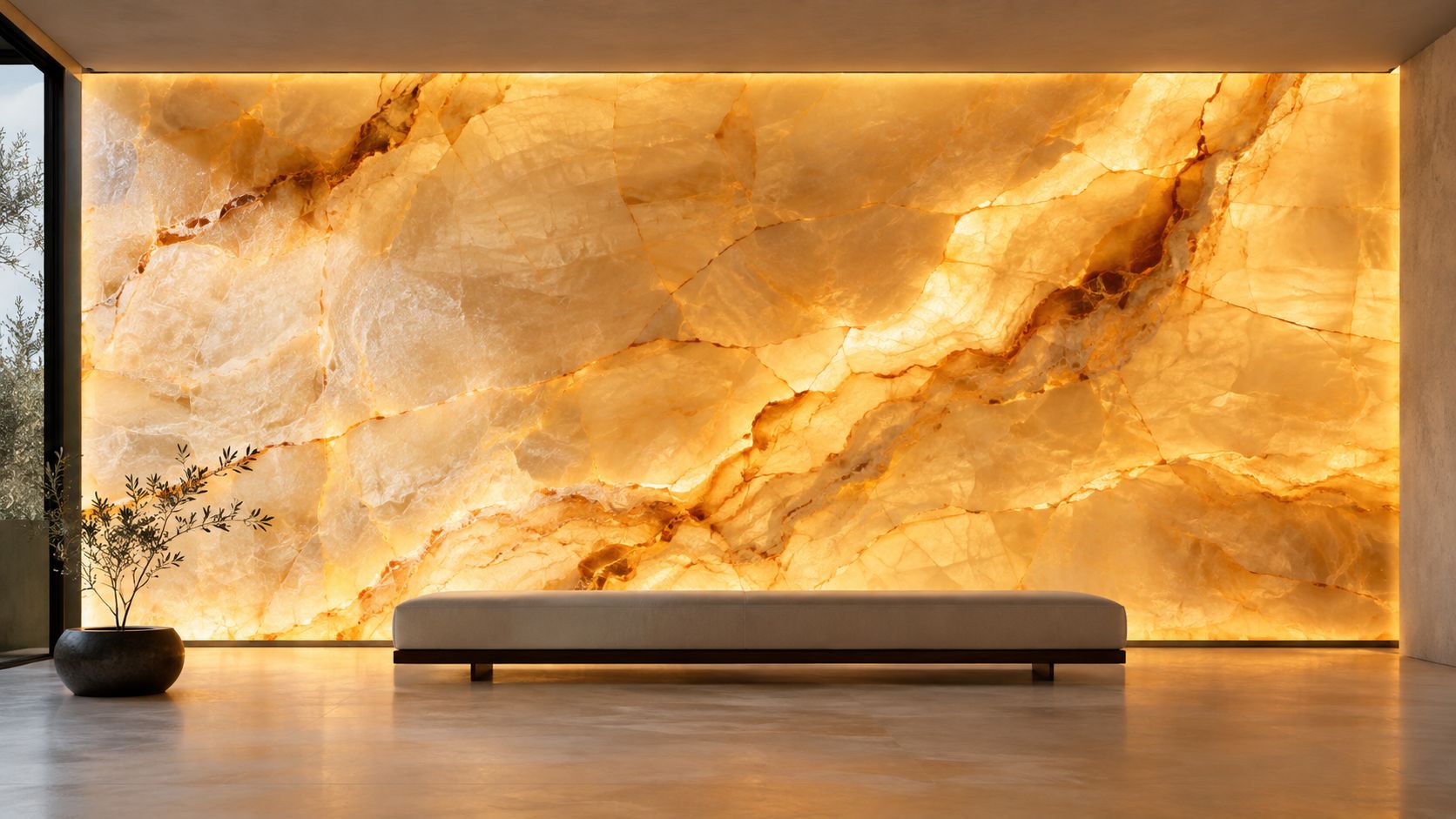
The image should be read as a coordination drawing as much as a design reference. Vein direction, slab translucency, substrate depth, LED placement, access for maintenance, heat management, and dimming all affect the finished appearance. Warm amber illumination can make golden onyx feel intimate in hospitality interiors, while cooler white light may suit a restrained commercial scheme.
A showroom viewing is especially valuable because a static photograph can't show how the stone changes when the light is switched on, dimmed, or viewed from different angles. Varun Marbles' onyx marble texture guidance provides a useful starting point for discussing the relationship between pattern and illumination.
Protect the visual investment
Onyx needs more careful handling than a commercial granite floor. Where visitors may touch the surface, specify protection suited to the design and confirm how it will affect transparency. A concealed electrical service route should remain accessible, since failed drivers or LED components shouldn't require destructive dismantling.
The same wall can appear soft and luminous in one image, then harsh and uneven if the lighting isn't distributed properly. Approve a physical mock-up or illuminated sample before fabrication. The installation team should coordinate stone selection, structural support, electrical work, and final calibration as one package rather than passing each responsibility between trades.
A short visual reference can help communicate the intended mood before technical coordination begins.
6. Large-Format Porcelain Tile Mimicking Marble Aesthetics
Large-format porcelain delivers the marble look with tighter control over repetition, durability, and cleaning. In a corporate office, healthcare facility, restaurant, retail showroom, or contemporary open-plan home, it can create a continuous visual field without asking the client to accept every maintenance characteristic of natural marble.
The photograph should be inspected for grout visibility and edge conditions. A large tile may reduce the number of joints, but the result depends on a level substrate, accurate setting-out, suitable adhesive coverage, and coordinated cuts. The installer must also plan the perimeter so narrow slivers don't appear beside walls, islands, columns, or door thresholds.
Use the image as a layout study
Marble-effect porcelain works best when the printed vein scale matches the room. A restrained pattern can extend a small living area, while a dramatic design may be better limited to a foyer or restaurant entrance. Neutral grout close to the tile tone supports continuity, but it won't hide poor alignment or inconsistent joint widths.
In a large commercial project, porcelain may reduce operational concern because its visual consistency makes replacement planning more manageable. Still, don't select it purely from a screen. Compare the surface finish under the intended lighting, inspect the printed pattern across multiple pieces, and review the transition to genuine marble skirting, stair nosing, or feature borders if the scheme combines materials.
Specify bevelled edges only when they support the design and suit the installation method. A clean square edge can look more contemporary, while a bevel may soften the transition between pieces. The right answer depends on the tile, room geometry, and site tolerances, not on the photograph's styling alone.
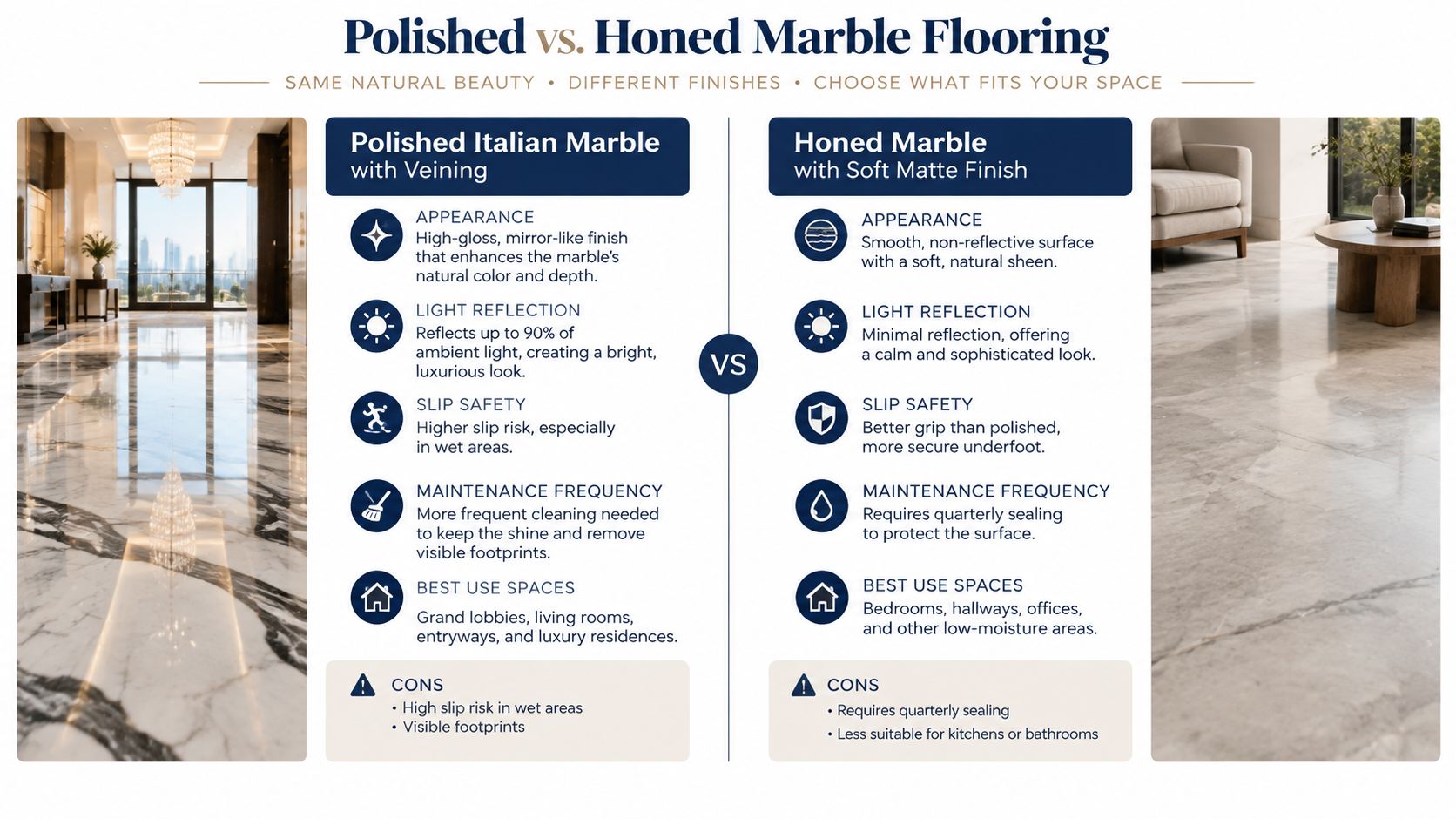
7. Honed Marble with Soft Matte Finish
Honed marble replaces mirror-like reflection with a quiet, tactile depth. The surface remains smooth, but fine sanding and buffing leave it less reflective than polished stone. That makes it a strong choice for contemporary living rooms, bedrooms, galleries, museums, refined showrooms, and boutique offices where the floor should look luxurious without dominating the view.
A honed finish can make subtle veining easier to read because glare no longer flattens the surface in bright areas. Indirect lighting and daylight are particularly effective in showing the tonal variation. In an art gallery or museum, that restraint helps the floor support displayed work rather than compete with it.
A beautiful matte floor still needs a wet-area decision. Honing reduces glare and can improve underfoot confidence, but the complete surface and drainage design must match the exposure.
Use honed marble in dry rooms when the project prioritises softness and visual calm. Kitchens, bathrooms, balconies, and entrances need closer assessment because water, grit, oils, and cleaning residues change the risk profile. A family home with older residents or frequent monsoon exposure may benefit from a matte or textured surface, but the designer should still review samples under wet and dry conditions.
Approve the finish under real light
Bring the sample into the proposed room or recreate the lighting at the showroom. A pale honed stone may look warm under decorative fixtures and cooler beside daylight. Rugs can help reduce wear patterns in circulation areas, while furniture pads and prompt spill cleanup protect the finish from avoidable marking.
Read the Indian marble flooring guidance on safety and finish selection before finalising a polished or honed specification. The key question isn't which photograph looks more luxurious. It's which surface remains appropriate after water, foot traffic, cleaning, and daily use are added to the brief.
8. Multi-Coloured Granite Patterns for Statement Flooring
Multi-coloured granite turns the floor into a composition. Black, white, grey, red, and brown mineral inclusions can create a strong first impression in a Gurugram commercial lobby, luxury residence foyer, boutique hotel, jewellery showroom, automotive display, or executive boardroom.
This material needs editing. If the granite already contains energetic movement, keep walls, furniture, and decorative objects quieter. A neutral interior allows the floor to act as the statement, while a similarly busy ceiling, rug, or feature wall can make the room feel unsettled.
Coordinate stone and illumination
Bold granite depends on good lighting. Flat illumination can make the surface appear dull, while harsh spotlights may exaggerate contrast and create distracting reflections. Honed or leathered finishes usually offer better control than a high gloss when the stone contains dense mineral variation.
Review more than one section of the slab. Natural patterning can shift considerably from one area to another, and a small sample may not represent the movement that appears at the entrance or along the main sightline. Ask the fabricator to mark the intended cutting plan directly on slab photographs, then approve the position of the strongest features.
Use statement granite selectively. A foyer, reception zone, or central inlay often has more impact than covering every room with the same visual intensity. Varun Marbles' design team can help compare pattern direction, adjacent tones, and edge details, but the final decision should remain tied to the room's lighting, furniture, circulation, and maintenance plan.
9. Calcutta Gold Marble with Golden Veining
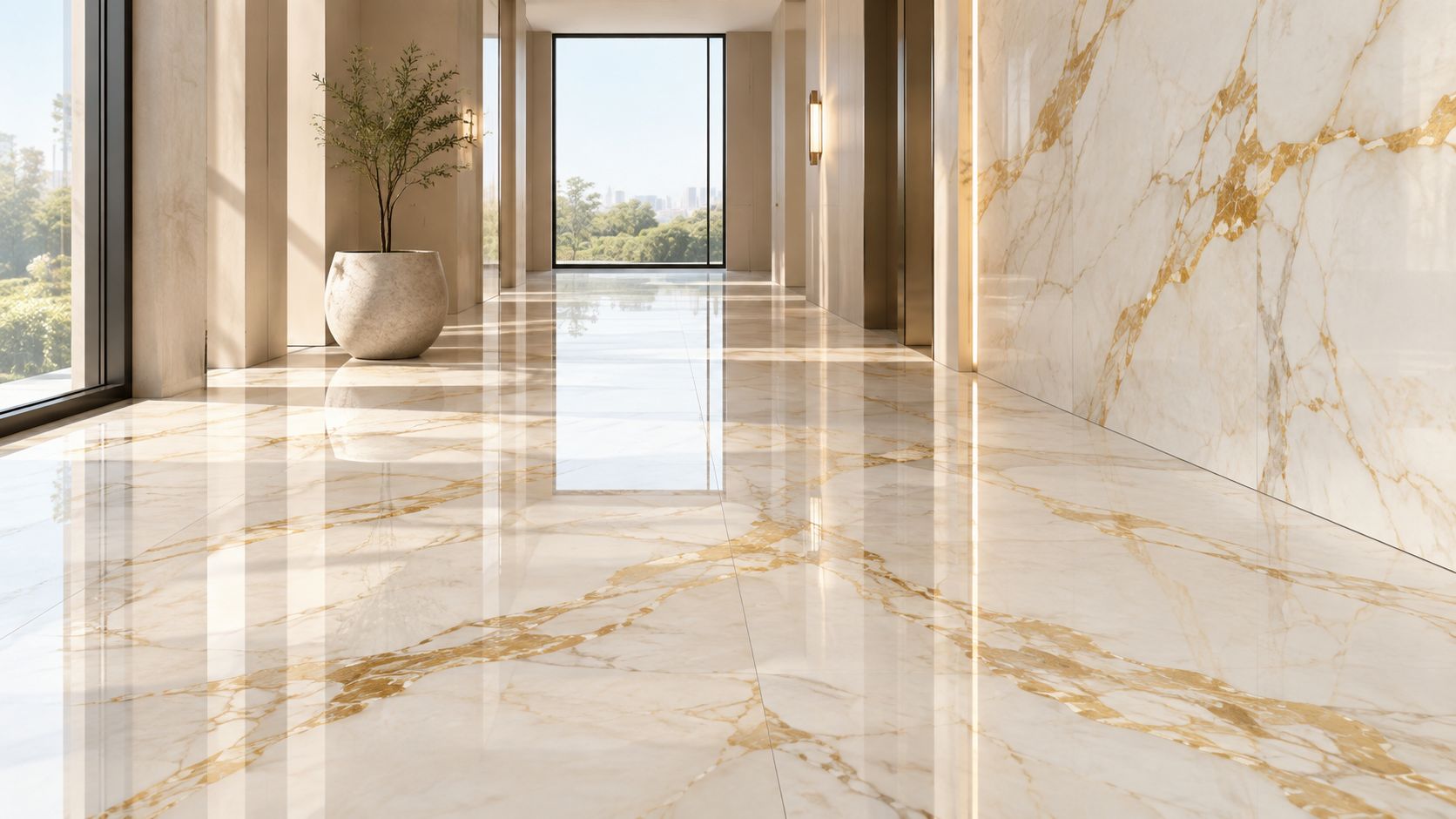
Calcutta Gold creates warmth through its contrast between a pale base and amber, honey, or golden veining. In a Delhi or Gurugram penthouse, five-star suite, luxury spa, boutique, or palatial residence, the stone can connect the floor to brass, champagne metal, warm timber, and soft neutral upholstery.
The image often makes the surface look effortless. Installation is not. Golden veins need a deliberate layout, particularly where the floor extends through a hallway or open-plan room. The design team should review full slabs, identify the visual hierarchy, and decide which areas deserve the strongest movement before fabrication begins.
Treat the finish as a long-term commitment
This is a premium natural stone choice, so the project should allow for disciplined care. Use marble-specific, pH-neutral cleaners, control moisture exposure, and seal the surface after installation according to the supplier's technical recommendation. Regular inspection matters more than blindly following a calendar because cleaning intensity, traffic, spills, and environmental conditions vary from project to project.
The marble flooring maintenance guidance for Indian interiors highlights the practical gap between an attractive photograph and the work required to preserve it. Tea, coffee, turmeric, oils, and other liquids can mark porous marble if spills remain unattended. A floor that looks perfect in a styled image may be a poor choice for an uncontrolled, high-spill environment.
Specify professional installation and confirm the cleaning, sealing, repair, and approval process in writing. The stone should support the lifestyle, not force the household or facilities team to protect a photograph every day.
10. Slip-Resistant Textured Flooring for Commercial Kitchens
Commercial kitchens need a different visual standard from hotel lobbies. The floor must support safe movement, frequent cleaning, drainage, equipment loads, and demanding service routines. A textured granite, leathered finish, or professionally specified anti-slip surface can still look considered, but appearance follows operational performance.
For a Gurugram hospitality kitchen, cloud kitchen, catering facility, healthcare food-preparation area, or food-processing environment, review the floor as part of the complete working system. Standing water, grease, food residue, unsuitable grout, and poor cleaning can undermine a good material choice. A photograph can show texture, but it can't confirm traction, falls, drainage, or chemical compatibility.
Coordinate the floor with the kitchen plan
Set the finished floor toward drainage so water doesn't remain around work zones. The plan notes call for a slight 1 to 2% slope, and that quantitative specification should be checked against the project engineer's drawings and applicable requirements before construction. Use sealed grout and durable edge details, then make sure stainless-steel fixtures, floor drains, skirtings, and wall protection meet the same cleaning expectations.
Textured granite and leathered surfaces can provide a more appropriate grip than polished marble. Engineered quartz may suit selected hygiene-sensitive areas where its non-porous character is useful, but confirm suitability for heat, impact, chemicals, and the specific food-service application before ordering.
Staff training is part of the material specification. Cleaning teams need approved solvents, brushes, schedules, and spill procedures. Speak with Varun Marbles' commercial specialists about the kitchen assessment, fabrication details, finish selection, and installation coordination before the floor package is released.
10-Point Marble Floor Photo Comparison
| Material / Finish | 🔄 Implementation Complexity | ⚡ Resource Requirements | 📊 Expected Outcomes | ⭐ Key Advantages | 💡 Ideal Use Cases |
|---|---|---|---|---|---|
| Polished Italian Marble with Veining | High, skilled cut/lay, anti‑slip treatment and frequent sealing | High, premium imported slabs, sealing, specialist installers | Dramatic reflective luxury, amplified light and depth | Iconic luxury look, unique natural veining | Lobbies, high‑end residences, boutique retail |
| Matte Finish Engineered Quartz Flooring | Moderate, standard slab installation, careful handling | Moderate, engineered slabs, adhesives; low ongoing maintenance | Consistent marble-like look with stain‑free hygiene and long life | Non‑porous, low maintenance, high durability | Kitchens, bathrooms, healthcare, high‑traffic commercial |
| Indian Marble (Warm Ochre & Beige) | Moderate, normal stone installation, periodic sealing | Moderate‑Low, local supply chain, more frequent sealing | Warm, inviting aesthetic with cost savings | Affordable, culturally authentic, warm palette | Living rooms, bedrooms, boutique hotels, cultural centres |
| Leathered Granite for High‑Traffic Flooring | Moderate‑High, textured finishing, experienced fitters | Moderate, granite supply, annual sealing, brush cleaning tools | Durable, low‑glare surface that masks wear and footprints | High slip safety, durable, dust‑masking texture | Kitchens, bathrooms, corridors, spas, commercial areas |
| Backlit Imported Onyx Feature Walls | Very High, structural framing, electrical integration, specialist handling | Very High, rare imported slabs, LED systems, engineering costs | Strong focal impact, luminous architectural statements | Translucent backlit drama, adjustable mood lighting | Luxury hotel spas, ultra‑luxury residences, exclusive venues |
| Large‑Format Porcelain Tile Mimicking Marble | Low‑Moderate, standard tile install; large formats need precision | Low, factory‑consistent tiles, minimal maintenance, lower cost | Marble appearance with high durability and negligible upkeep | Cost effective, zero sealing, consistent finish | Contemporary kitchens, commercial spaces, healthcare |
| Honed Marble with Soft Matte Finish | Moderate, honing process, regular sealing required | Moderate, natural stone supply, quarterly maintenance | Subtle, refined matte aesthetic with improved grip vs polished | Sophisticated matte look, better slip resistance than polished | Living rooms, galleries, staircases, showrooms |
| Multi‑Coloured Granite Patterns for Statement Flooring | Moderate‑High, complex layout planning and batch matching | Moderate, varied granite slabs, skilled installers | Bold visual focal floors that hide dirt and wear | Visually striking, extremely durable, conceals imperfections | Foyers, lobbies, boardrooms, hospitality feature floors |
| Calcutta Gold Marble with Golden Veining | Very High, precision install, controlled environment and lighting | Extremely High, rare premium slabs, frequent professional maintenance | Ultra‑luxury prestige, significant value enhancement | Unparalleled prestige, distinctive golden veining | Ultra‑luxury residences, premium hotel suites, exclusive retail |
| Slip‑Resistant Textured Flooring for Commercial Kitchens | Moderate, specialised finishes, drainage and slope considerations | High, textured materials, specialised cleaning equipment | Improved worker safety, hygiene compliance, reduced liability | Exceptional slip resistance, regulatory compliance, durability | Commercial kitchens, food prep areas, healthcare facility kitchens |
Turn Inspiration Into a Confident Specification
The best marble floor photos don't tell you what to buy. They help you ask better specification questions. Start with the application, then define the traffic, moisture, cleaning, lighting, and safety conditions before you become attached to a colour or vein.
For a formal living room or luxury lobby, polished Italian marble may deliver the reflection and drama you want. For a family entry, bathroom, balcony, or monsoon-exposed threshold, a honed, matte, leathered, textured, porcelain, or granite option may provide a more sensible balance. Quartz can offer consistent patterning and straightforward upkeep. Porcelain can reproduce marble aesthetics with fewer natural-stone maintenance concerns. Onyx can create a memorable illuminated wall, but it needs structural and electrical coordination. The material should follow the use case, not the other way around.
Use a simple selection sequence:
- Define the application: Record whether the space is a bedroom, foyer, kitchen, bathroom, lobby, gallery, or commercial food-preparation area.
- Assess traffic and moisture: Identify daily movement, wet exposure, grit, spills, cleaning intensity, and vulnerable users.
- Choose the finish: Compare polished, honed, matte, leathered, and textured options for reflected light, grip, touch, and upkeep.
- Review full slabs: Small samples can hide vein scale, colour movement, edge variation, and slab-to-slab inconsistency.
- Test project lighting: View the material in daylight and under the actual warm or cool fixtures planned for the room.
- Confirm care requirements: Agree on sealing, pH-neutral cleaning, spill response, repair expectations, and responsible maintenance.
- Coordinate execution: Finalise setting-out, joints, skirtings, edge profiles, drainage, fabrication, and installation before ordering.
Thickness deserves specific attention in expansive public interiors. A referenced Indian marble flooring project used about 80,000 square feet of white Makrana marble, with 35 mm-thick flooring and 15 mm coloured inlay, as described in the Shri Ram Janmabhoomi Temple brochure. That example doesn't establish one universal thickness for every project. It does show why designers should treat section, stability, edge retention, inlay depth, substrate, and installation method as coordinated decisions rather than selecting a tile format from an image.
The same discipline improves digital presentation. A carefully rendered or photographed material board should show the floor beside walls, furniture, light sources, thresholds, and wet zones. For a broader workflow around visualising interiors, see MerchLoom's decor imaging guide, then validate every visual decision against physical slabs and samples.
Varun Marbles can support that physical review through its Gurugram showrooms at Sikanderpur Marble Market and HUDA Marble Market Sector 33–34. Its portfolio includes Italian and Indian marble, granite, engineered quartz, porcelain and vitrified surfaces, and imported onyx. The team also supports slab selection, cut-to-size fabrication, edge profiling, finishing, and installation coordination, which helps reduce the gap between a chosen image and the completed fit-out.
Choose the stone after the room's demands are clear. Then approve the slab, finish, layout, maintenance plan, and installation details as one specification.
Visit Varun Marbles in Gurugram to compare full slabs, finishes, and natural pattern variation for your project. Discuss your floor application with the team, review fabrication and installation coordination, and select marble, granite, quartz, porcelain, or onyx according to performance as well as appearance.