
Crema Marfil Tiles: A Practical Buyer's Guide for 2026

Natural Crema Marfil marble is commonly sold in India at about ₹165 to ₹220 per sq ft, while ceramic and porcelain look-alikes can be found around ₹61 to ₹63 per sq ft. The right choice depends less on the beige colour and more on whether you want real stone with sealing and upkeep, or a printed tile with simpler maintenance.
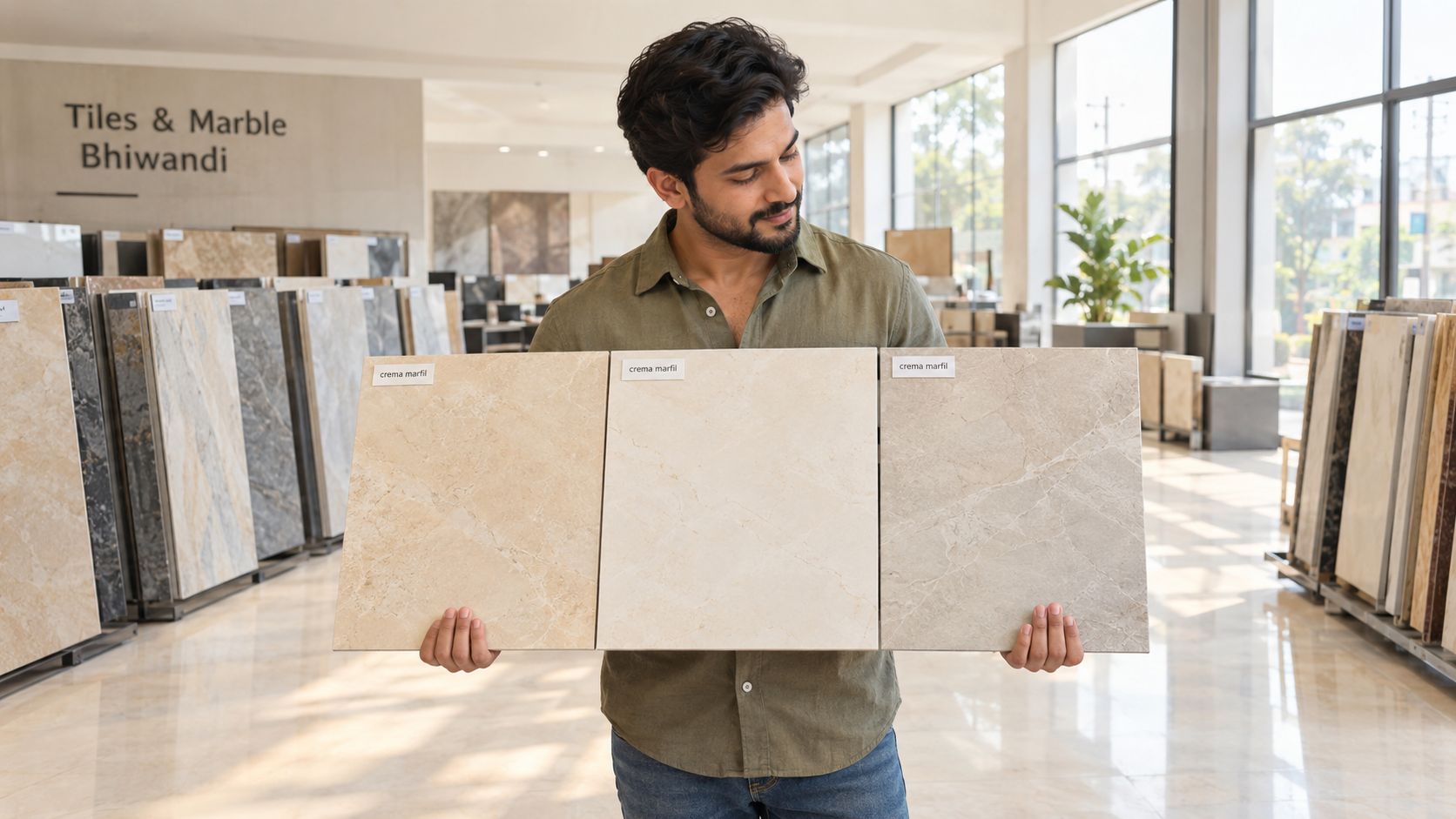
You're in a Bhiwandi or Morbi showroom with three samples labelled “Crema Marfil”. One looks like soft cream marble, another has heavier brown veining, and the third is a glossy ceramic tile. All three carry the same name, but they aren't the same product.
That naming confusion causes most buying mistakes. In India, Crema Marfil tiles may mean genuine natural marble slabs, Indian beige marble sold under a familiar design name, or ceramic and porcelain tiles printed to imitate the same warm cream background. The room, traffic, moisture, cooking habits, and maintenance tolerance should decide the material, not the label alone.
This guide will help you settle four decisions: natural stone or printed tile, polished or matte finish, what sealing involves, and which type of supplier deserves your visit. I'll also be candid about where I'd specify marble and where I'd talk you out of it.
Table of Contents
- Why Crema Marfil Is on Every Indian Buyer's Shortlist
- What Crema Marfil Actually Is and Where It Comes From
- Sizes, Thicknesses, and Finishes Worth Knowing
- Where Crema Marfil Works Best in the Home
- Installation and Grout Decisions That Decide the Outcome
- Maintenance Reality for Indian Kitchens and Bathrooms
- Cost Expectations and Where to Source in India
- A Short Checklist Before You Visit the Showroom
Why Crema Marfil Is on Every Indian Buyer's Shortlist
Crema Marfil sells because its colour works hard without demanding attention. The cream-beige base sits comfortably beside teak furniture, brass fittings, walnut cabinetry, and both cool daylight and warm artificial lighting. It makes rooms feel brighter without the starkness of white marble, and it gives compact Indian apartments a calmer, more continuous background.
Indian retail listings consistently position Crema Marfil for flooring, wall cladding, countertops, bathrooms, and staircases. The same listings commonly show slab thicknesses of 18–20 mm or 20 mm, which tells you something practical: the material is being sold as a full-format architectural stone, not just as a decorative accent. One India-based listing gives typical slab sizes of 10×6 ft, 8×6 ft, and 7×5 ft, with prices of ₹165 per sq ft, while another lists it at around ₹220 per sq ft. You can review the product details in this Indian Crema Marfil marble listing.
Start by identifying the product class
Ask the salesperson one direct question: “Is this natural marble, porcelain, or ceramic?” Don't accept “Crema Marfil finish” as an answer. That phrase may describe a printed surface rather than the stone itself.
Natural marble has individual movement, pores, filled pinholes, and variation from slab to slab. A porcelain look-alike has a repeated printed pattern, factory-controlled dimensions, and a finish selected for a particular performance requirement. Indian catalogues now use the Crema Marfil name across both categories, including glazed and matte tile products made in India. A catalogue example lists a 600×600 mm glossy tile with a coverage area of 3.88 sq ft per tile, while another Indian product line uses a 300×450 mm matte format for spaces such as bathrooms, kitchens, and balconies. The beige marble texture guide is useful for comparing the visual character before you visit a yard.
Showroom rule: Never approve a quote until the invoice names the material class, finish, size, thickness, and country of origin.
The rest of your decision follows from that description. Natural marble suits buyers who want authentic variation and accept sealing. Porcelain suits households and projects that want a consistent beige look with fewer maintenance demands.
What Crema Marfil Actually Is and Where It Comes From
Crema Marfil is traditionally associated with a pale beige natural stone from Spain, especially the Alicante region. Buyers value it for its uniform cream background, restrained veining, and warm visual tone. Those characteristics explain its popularity in formal living areas, hotel interiors, staircases, and feature walls.
You'll often see the name applied loosely in Indian yards. Some sellers use it for Indian beige marbles, some use it for imported material, and tile manufacturers use it for ceramic or porcelain surfaces that reproduce the colour family. The name therefore describes a market identity as much as it identifies a geological origin.
How to inspect natural material
Look at a slab under direct light, then ask the salesperson to show it under raking light from the side. Natural Crema Marfil may show:
- A warm cream base, rather than a cold grey beige.
- Soft walnut or tan veining, with movement that doesn't repeat mechanically.
- Small filled or unfilled pits, especially visible when light skims across the surface.
- Subtle batch variation, even where the overall colour remains consistent.
A printed tile can look more perfect, but perfection is often the clue. If the same vein appears at regular intervals across several pieces, you're looking at a manufactured design.
The maintenance difference starts with chemistry
Natural marble is calcium-based and porous. It can absorb liquids, and acidic substances can etch the surface. Lemon, vinegar, acidic food, and unsuitable bathroom cleaners may leave dull marks that polishing alone won't erase. The relevant Indian standard, IS 1130, specifies maximum moisture absorption of 0.4% by weight after 24-hour cold-water immersion and minimum specific gravity of 2.5 for marble. Supplier-declared Crema Marfil samples are often published around 0.2% to 0.34% water absorption, with bulk density near 2680 to 2690 kg/m³, as shown in this Crema Marfil tile specification.
That performance doesn't make natural marble stain-proof. It means the stone can work well indoors when correctly selected, installed, and sealed. Ceramic and porcelain alternatives remove much of that uncertainty, which is why the same beige look has spread through Indian tile manufacturing.
Sizes, Thicknesses, and Finishes Worth Knowing
The first specification mistake is choosing a tile by colour alone. The second is assuming a thicker product is automatically better. On upper floors, the structural system, adhesive bed, substrate, and installer's method matter more than adding thickness.
Natural marble is commonly selected as slab material and then cut to suit the project. In a showroom, you may encounter formats such as 60×60 cm, 60×90 cm, and 80×80 cm. Ceramic and porcelain look-alikes are available in smaller modular sizes, larger rectangular formats, and slab-like panels. Confirm the actual product specification because a salesperson may use “tile” and “slab” interchangeably.
| Material | Common Sizes (cm) | Thickness (mm) | Typical Finishes | Best For |
|---|---|---|---|---|
| Natural Crema Marfil marble | 60×60, 60×90, 80×80 | Confirm by supplier | Polished, honed, brushed | Bedrooms, formal living rooms, walls, staircases |
| Ceramic look-alike | 30×30, 30×45, 60×60 | Confirm by supplier | Glossy, matte | Bathrooms, balconies, budget renovations |
| Porcelain look-alike | 60×60, 60×120, large panels | Confirm by supplier | Matte, polished, lapatto, textured | Kitchens, busy floors, wet zones, commercial interiors |
Match the finish to the traffic
Polished marble gives the strongest luxury effect in a formal living room or low-traffic master bedroom. It reflects light and makes the cream tone look richer, but it also reveals scratches, dull spots, and etching more clearly.
Honed marble has a softer, less reflective surface. It handles everyday visual wear more gracefully in family living and dining areas. If you're comparing these surfaces in a showroom, this guide to honed and polished marble explains the difference without relying on marketing language.
For bathrooms and entrances, choose a textured, anti-skid, or matte porcelain finish rather than a highly polished natural surface. Brushed or tumbled natural stone can work on walls, where slip resistance matters less, but I wouldn't use a decorative finish as an excuse to ignore cleaning and water exposure.
Thickness should support the installation system, not compensate for a weak substrate or poor workmanship.
Where Crema Marfil Works Best in the Home
I'd specify natural Crema Marfil first for rooms where appearance matters more than abuse. A formal living room, master bedroom, entrance wall, TV backdrop, or staircase gives the stone enough visual authority to justify its upkeep. Its warm beige tone softens large surfaces and works particularly well with timber, brushed metal, and warm lighting.
Room-by-room verdict
| Room | Recommended Format | Verdict |
|---|---|---|
| Formal living room | Polished marble, 60×60 or 80×80 cm | Natural stone earns its place |
| Master bedroom | Polished or honed marble | Strong choice for low traffic |
| Family living and dining | Honed marble or matte porcelain | Choose porcelain if traffic is heavy |
| Kitchen floor | Matte or textured porcelain | Safer recommendation for daily cooking |
| Bathroom floor | Anti-skid porcelain | Natural marble is the weaker option |
| Bathroom wall | Matte porcelain or sealed marble cladding | Both can work, porcelain is easier |
| Balcony | Textured porcelain | Avoid natural marble where weather and salts are concerns |
| Staircase | Substantial natural marble tread with porcelain riser | Good use, provided edges are fabricated correctly |
| TV wall or feature panel | Natural marble or large-format porcelain | Choose by budget and desired variation |
Bathrooms are where buyers most often let the showroom win the argument. A polished cream surface looks beautiful in a dry sample room, but shower water, hard-water deposits, shampoo, and cleaning chemicals create a different operating environment. Use porcelain on shower floors and bathroom floors. Natural marble can still work on a wall if the installer seals it properly and the homeowner accepts regular care.
Kitchens need a sharper distinction. A lightly used vegetarian kitchen may manage sealed marble, but daily oil, turmeric, spice, and acidic ingredients make porcelain the more sensible floor surface. I'd reserve natural Crema Marfil for a kitchen backsplash or island panel only when the owner understands the care involved.
Staircases remain a convincing natural-stone application. A carefully selected tread with a softened or bullnosed edge feels substantial underfoot and gives the material a visible architectural role. Pairing it with a lower-maintenance porcelain riser reduces the number of exposed natural-stone surfaces without losing the overall look.
Installation and Grout Decisions That Decide the Outcome
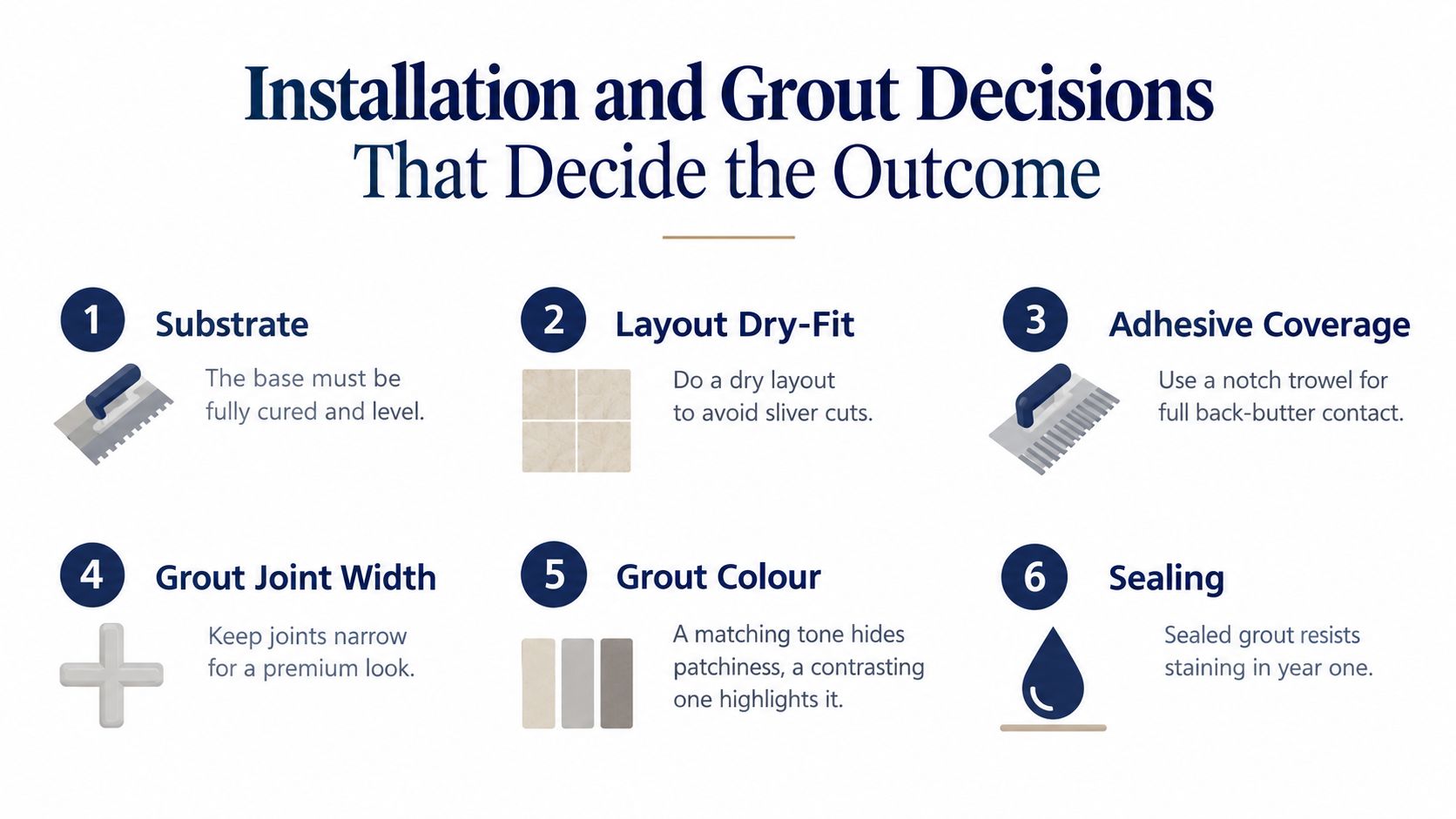
A costly stone can look cheap after installation if the base is uneven, damp, or stained by the wrong adhesive. Before the first box or slab reaches the floor, make the installer prove that the substrate is fully cured, level, and dry. Check the surface across a long straightedge, and reject visible hollows rather than expecting adhesive to correct them.
Use a white or light-grey polymer-modified thin-set for light natural stone and pale tiles. Grey cement slurry can telegraph through porous marble and create a dirty or uneven appearance. Full adhesive contact matters, especially on larger pieces. The installer should use the correct notched trowel and back-butter where required, rather than dotting adhesive at isolated points.
Decide the layout before cutting
A straight stack gives a clean contemporary grid. A brick layout feels more relaxed but can emphasise variation between pieces. Vein-matching or book-matching can create a dramatic wall, but it requires careful slab selection and creates more offcuts. Don't approve a book-match layout from a small sample. View the full slabs, mark the sequence, and agree on where the visible joints will fall.
Calibrated tiles generally look most refined with narrow, consistent joints. A joint around 1.5 to 3 mm can give a continuous stone effect, while wider joints collect more dirt and draw attention to every alignment error. Matching beige grout visually unifies the floor. Grey or white grout outlines each piece, which can be useful for a graphic tile installation but rarely flatters inconsistent marble.
For kitchens and bathroom walls, epoxy grout gives better resistance to staining than ordinary cement-based grout. Cement-based grout remains suitable for many dry-floor installations when it is allowed to cure and the surface is sealed appropriately. For general flooring terminology and maintenance planning, a specialist flooring resource such as Giorgi Bros. Furniture flooring can help you compare installation contexts.
Hand this checklist to your installer:
- Substrate: Confirm the base is cured, dry, and level.
- Dry layout: Arrange pieces before adhesive to avoid awkward slivers.
- Adhesive: Use a light-coloured suitable adhesive with full coverage.
- Joint: Agree the joint width before laying.
- Grout: Approve the colour on a dry sample panel.
- Sealing: Seal natural stone and grout only after the installation system has cured.
Maintenance Reality for Indian Kitchens and Bathrooms
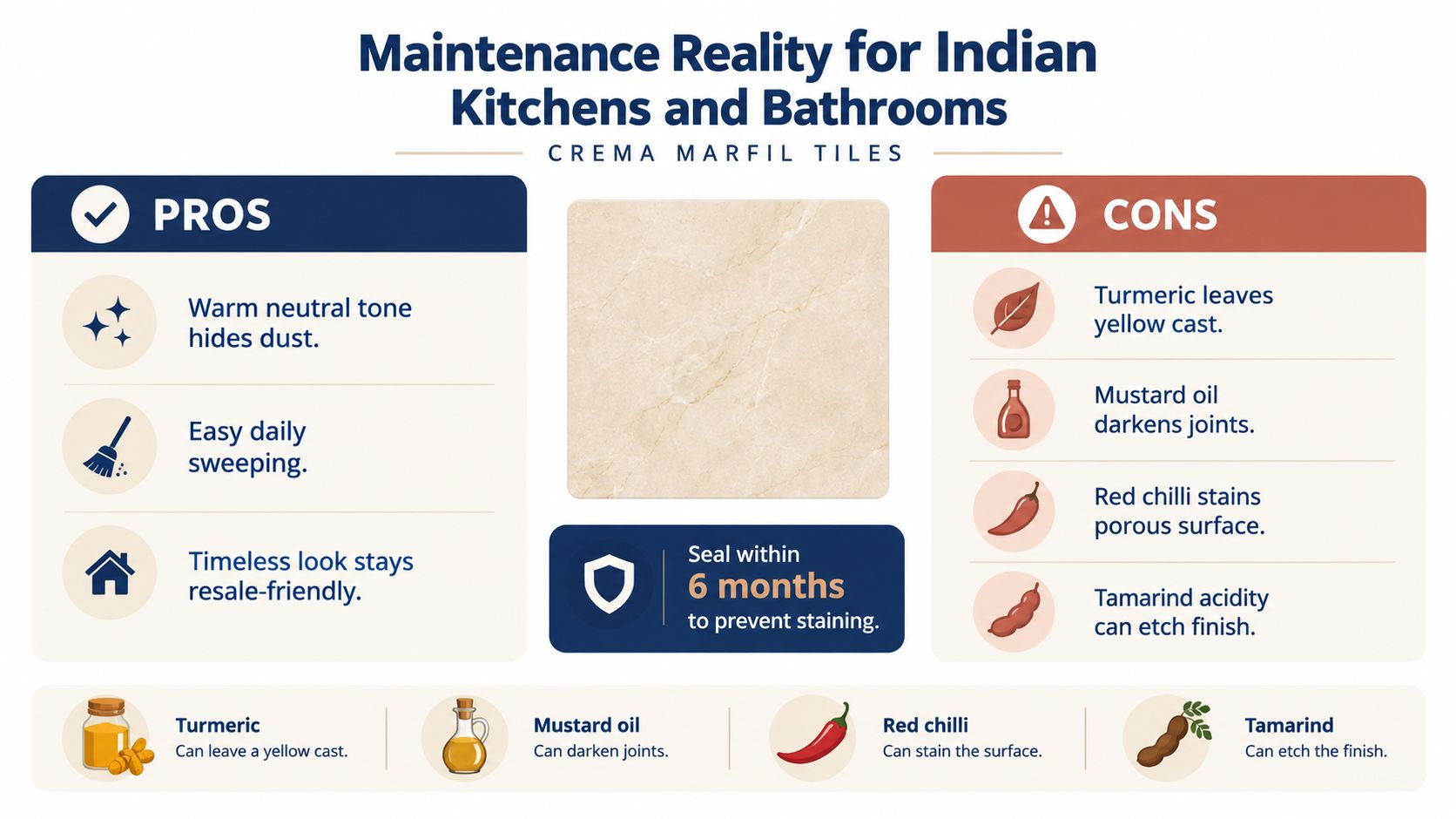
Natural Crema Marfil looks forgiving until an Indian kitchen tests it. Turmeric, mustard oil, red chilli, tamarind, lemon, vinegar, and unsuitable bathroom cleaners create problems that a showroom sample cannot demonstrate. On unsealed or poorly sealed marble, stains and etched patches can become permanent visual defects rather than ordinary cleaning marks.
The practical routine is simple but essential. Dry sweep first, use a pH-neutral cleaner, wipe spills quickly, and dry the surface with a microfiber cloth. Kitchen marble needs planned resealing rather than a one-time treatment, and bathroom surfaces need regular attention to hard-water deposits. This guide to hard-water stains on marble is useful before you choose natural stone for a wet area.
The daily-use test
If your household cooks daily with oil and spice, choose porcelain for the kitchen floor. It gives you the beige marble appearance without asking you to treat every turmeric splash as an emergency. The same applies to rental homes, busy family kitchens, and commercial projects where maintenance depends on multiple people following the same routine.
If the surface is in a formal living room used for entertaining, the maintenance burden drops. In that setting, natural marble can be worth the care because its variation and depth are difficult to reproduce convincingly.
A porcelain look-alike still needs sensible cleaning and good grout detailing, but it doesn't carry the same acid-etching and absorption risk as natural marble. You can compare general tile-cleaning practices in this resource on keeping floors fresh with J G Carpet.
The video below demonstrates the kind of cleaning and care conversation buyers should have before installation.
Cost Expectations and Where to Source in India
The headline price doesn't tell you the installed cost. Natural Crema Marfil may be listed at ₹165 per sq ft by one India-based seller and around ₹220 per sq ft by another, as shown in the retail evidence cited earlier. Indian tile listings also show Crema Marfil designs in a much lower price segment, including products around ₹61 to ₹63 per sq ft, which reflects a different product class rather than a cheaper slab of identical marble. See this Crema Marfil porcelain tile listing to understand how the name appears in the manufactured-tile market.
| Cost Component | Natural Crema Marfil Marble | Ceramic/Porcelain Look-Alike |
|---|---|---|
| Material price | Supplier- and slab-dependent, with Indian listings at ₹165 and around ₹220 per sq ft | Tile-SKU dependent, with listings around ₹61 to ₹63 per sq ft |
| Sealing | Required for practical stain protection | Usually not required in the same way |
| Polishing | May be needed after fabrication or during upkeep | Factory finish is supplied with the tile |
| Edge profiling | Relevant for stair treads, counters, and exposed edges | Relevant for selected fabricated pieces |
| Transport | Depends on slab movement and delivery distance | Depends on carton volume and location |
| Wastage | Allow for cutting, vein selection, and damaged pieces | Usually easier to manage through standardised pieces |
| Installation | Requires stone-aware handling and finishing | Requires tile-aware levelling and joint control |
Ask for a written quotation that separates material, transport, cutting, edge work, adhesive, grout, sealing, and installation. Two similar-looking quotes can differ because one includes fabrication and protection while the other covers only the tile or slab. A cheap natural-stone quote can become expensive once polishing, edge profiling, delivery, and replacement pieces appear as additions.
Buy the evidence, not just the sample
Visit a stockist with full slabs or a broad tile display. A small polished sample hides variation, joint rhythm, print repetition, and edge quality. Ask to see the actual batch, the product box or slab identification, country of origin where relevant, thickness confirmation, and the recommended adhesive and sealer.
For natural marble, inspect several slabs together. For porcelain, lay multiple pieces side by side and look for obvious pattern repetition. Your supplier should also explain whether the product is calibrated, rectified, suitable for wet areas, and available in enough quantity to complete the project.
A Short Checklist Before You Visit the Showroom
Don't begin with the colour board. Begin with the room. A bedroom, kitchen, bathroom, staircase, and balcony impose different demands, so the same Crema Marfil appearance may require completely different materials.

Use this showroom sequence:
- Pick the room: Note traffic, water exposure, sunlight, furniture movement, and cooking activity.
- Choose the material: Decide whether you want natural marble variation or a ceramic or porcelain reproduction.
- Select the format: Match tile size to the room, drainage, slope, doorway transitions, and installation skill.
- Select the finish: Use polished for formal low-traffic areas, honed for softer natural-stone character, and matte or textured porcelain where grip matters.
- Set the budget: Compare the complete installed system, not only the quoted rate per sq ft.
- Accept the maintenance: If you won't wipe spills, use neutral cleaners, and maintain sealing, don't choose natural marble for a working kitchen.
Take room photographs, a cabinet or paint sample, and a daylight reference when you visit. Ask the stockist to show full slabs or multiple pieces from the same batch, and request written details for thickness, finish, origin, adhesive, grout, sealing, and replacement availability.
Varun Marbles supplies natural and engineered stone, including Italian and Indian marble, and supports selection, fabrication, and installation coordination through its Gurugram showrooms. Visit Varun Marbles with your room measurements and maintenance requirements, then compare natural Crema Marfil against suitable porcelain alternatives before placing an order.