
Blue White Marble: A Complete Design and Selection Guide

You're in a Gurugram showroom with a mood board open on your phone, comparing one blue white marble slab after another. The photographs look effortless, with cool white fields, cloud-like movement, and blue-grey veining that could turn a plain lobby, powder room, or master bath into the most memorable space in the home. Then the practical questions arrive. Will the next slab match? Can it handle a kitchen? Is the stone actually marble, or is it a marble-look imported product?
Those questions matter more than the catalogue image. Blue white marble is a decorative natural stone with strong visual appeal, but it isn't a universal worktop material. Its mineralogy, surface finish, slab variation, sourcing route, and installation details all affect the result. For NCR projects, the right approach is simple: select at slab level, specify it for the right use, and move to granite, quartzite, or engineered quartz when daily wear matters more than dramatic movement.
Table of Contents
- Why Blue White Marble Is Capturing Interior Attention
- Visual Characteristics That Define Blue White Marble
- How Blue White Marble Compares to Granite and Quartz
- Best Interior Applications for Blue White Marble
- Coordinating Blue White Marble With Interior Palettes
- Selecting and Sourcing Blue White Marble Slabs
- Where to Invest in Blue White Marble and Where to Pivot
Why Blue White Marble Is Capturing Interior Attention
A homeowner may first encounter blue white marble through a showroom display or a carefully styled interior photograph. The reaction is immediate. The stone feels cooler than conventional cream marble, more distinctive than plain white, and more natural than a printed surface. In a reception area, a single dramatic slab can establish the design language before furniture, lighting, or artwork enters the room.
That emotional pull is legitimate. Blue-grey movement gives white interiors depth, while softer blue tones can support a calm bathroom or a restrained bedroom palette. The material also feels connected to India's established marble industry rather than being merely a niche decorative trend. India's official mineral reporting classifies marble as metamorphosed limestone and identifies blue marble in Desuri, Pali district, Rajasthan, within the country's major marble belt (Indian Minerals Yearbook 2021).
The supply context gives designers more choice, but it also creates a selection problem. India's reported marble resources total 1,945 million tonnes, while Rajasthan produced 16,159,347 tonnes in 2020–21, compared with 10,621,000 tonnes in 2019–20 and 8,252,000 tonnes in 2018–19 (Indian Minerals Yearbook 2021). A large supply base doesn't mean every bundle has the same colour, movement, or structural quality.
Practical rule: Treat the first photograph as an invitation to inspect, not as approval to order.
This guide takes the position that blue white marble earns its cost in visible, lower-abrasion areas. It's a poor choice when a client expects a kitchen counter to behave like quartz or a busy commercial floor to perform like granite. The design should celebrate the stone's natural variation while protecting the project from avoidable fabrication, maintenance, and scheduling problems.
Visual Characteristics That Define Blue White Marble
Blue white marble isn't a single fixed appearance. The base can move from a chalky, cool white to a softer ivory, and the veining can range from almost invisible threads to broad blue-grey bands with a storm-like character. Mineral deposits and calcite movement create tonal depth, which is why two slabs from the same general category can produce very different interiors.
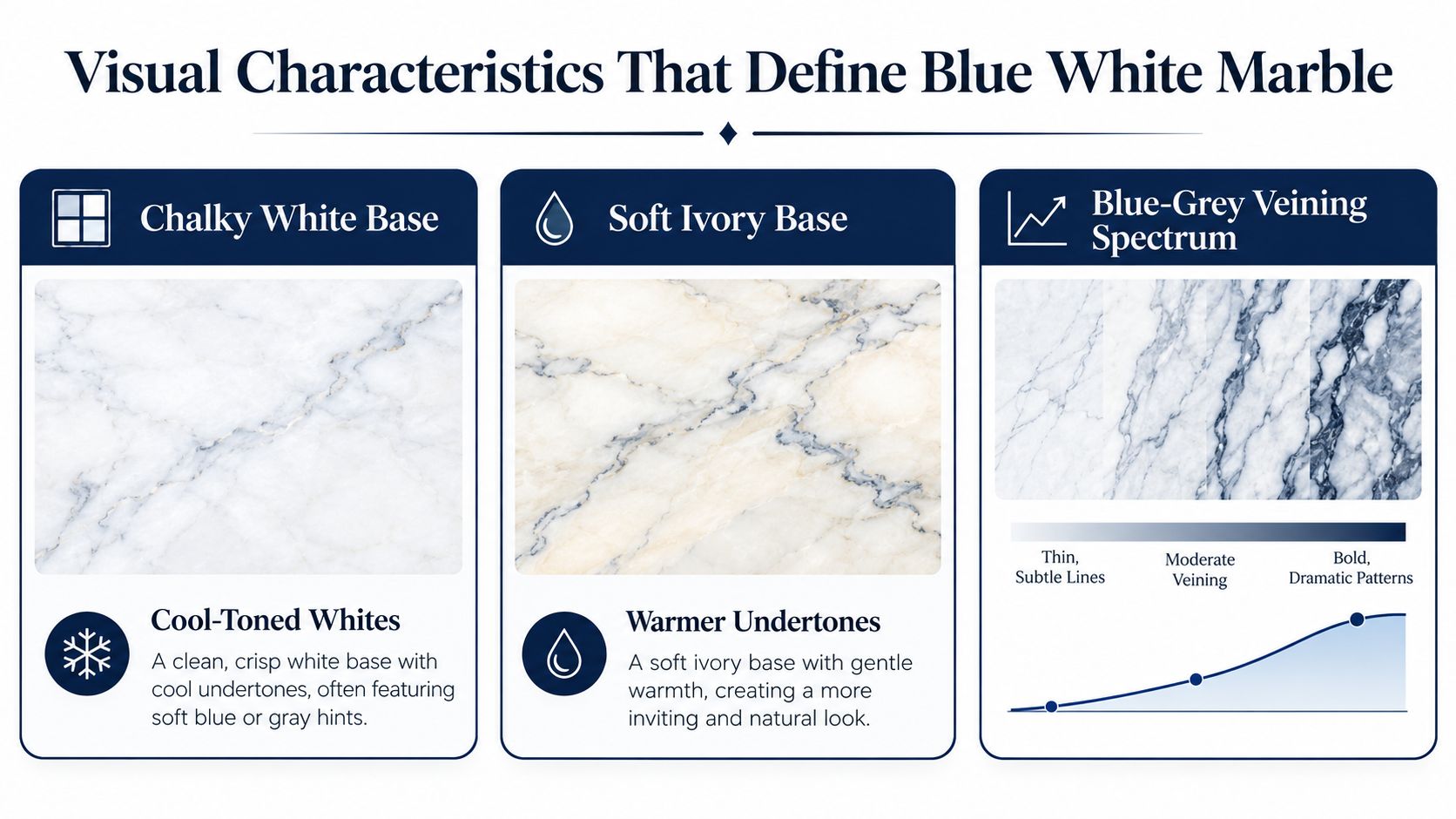
Read the base before the vein
Start by standing several feet away from the slab. The overall field should support the room's intended palette. A crisp chalky white works with cool cabinetry, stainless steel, and restrained black detailing. A soft ivory base sits more comfortably beside oak, taupe upholstery, warm brass, and cream-painted walls.
The blue-grey pattern deserves equal scrutiny. Fine, wispy lines can produce a quiet surface for a vanity or bedroom floor. Stronger streaks work better as a feature wall, fireplace surround, or book-matched lobby installation. Don't judge movement from a small sample. A narrow sample can conceal a large mineral patch, a sudden change in direction, or a concentration of colour that dominates the finished elevation.
Excessive yellowing, muddy areas, and disconnected blotches should make you pause. They may not automatically disqualify a slab, but they can weaken the clean blue-white intention that attracted you in the first place. Ask to see several slabs together, under the project's proposed lighting, rather than approving one isolated piece.
Finish and layout change the mood
A polished finish increases reflection and makes the veining feel more dramatic. It suits formal wall cladding, vanity tops, and reception counters where visual impact matters. Honed marble has a quieter, tactile appearance and is often the more forgiving option in wet or relaxed residential settings, although it can still react to acids and needs proper care. Brushed finishes add texture and are most effective on feature walls where the surface is meant to be felt as well as seen.
Layout determines whether the pattern looks intentional. Book-matching two slabs can create symmetry across a lobby wall or master-bath backdrop. Random matching is less formal and can work for bathroom floors or smaller areas where continuous visual alignment isn't the design objective.
Approve the actual slabs, the proposed layout, and the finished sample together. A catalogue image can't guarantee any of those three.
How Blue White Marble Compares to Granite and Quartz
For a kitchen countertop, the material decision should begin with behaviour, not colour. Blue white marble offers natural depth and one-of-a-kind veining, but marble remains a relatively soft decorative stone. The Indian Minerals Yearbook describes marble as calcite-dominant, typically around Mohs 3–4, with density around 2.55–2.7 g/cm³, compressive strength roughly 70–140 MPa, and water absorption usually below 0.5% in standard Indian classifications (Indian Minerals Yearbook 2016).
That profile explains the trade-off. Marble polishes beautifully, but it's more vulnerable to scratching and acid etching than granite. Engineered quartz generally offers a more uniform appearance and a non-porous surface, which reduces sealing and staining concerns. Granite is the safer natural-stone workhorse for heat, abrasion, and busy preparation areas.
The table below is a practical specification guide. Cost varies by origin, grade, thickness, finish, fabrication, and installation, so don't treat a generic market quote as a guaranteed price.
Blue White Marble vs Granite vs Quartz Performance Comparison
| Material | Mohs Hardness | Porosity & Sealing | Maintenance Level | Cost Range (INR/sq ft) | Best-Fit Applications |
|---|---|---|---|---|---|
| Blue white marble | Around 3–4 | Requires suitable sealing and careful spill management | Moderate to high | Confirm current slab and fabrication quote | Feature walls, powder-room vanities, fireplace surrounds, low-abrasion floors |
| Granite | Varies by variety, generally harder than marble | Lower-maintenance natural stone, sealing may be specified | Low to moderate | Confirm current slab and fabrication quote | Kitchen worktops, high-traffic floors, utility areas |
| Engineered quartz | Manufacturer-specific composition and performance | Non-porous, normally selected for reduced sealing needs | Low | Confirm current slab and fabrication quote | Modular kitchens, rental homes, consistent commercial surfaces |
For a deeper look at why engineered quartz suits demanding kitchen routines, review this guide to quartz slabs for modern kitchens. My recommendation is firm: use blue white marble where staining and etching are manageable, not where the client expects maintenance-free performance.
Best Interior Applications for Blue White Marble
Blue white marble performs best when the project gives it visibility without subjecting it to constant abrasion, grit, heat, and acidic spills. The strongest applications are usually powder-room vanities, feature walls, fireplace surrounds, master-bath backdrops, and reception desks. These areas let the stone act as a focal material instead of forcing it to function as an industrial work surface.
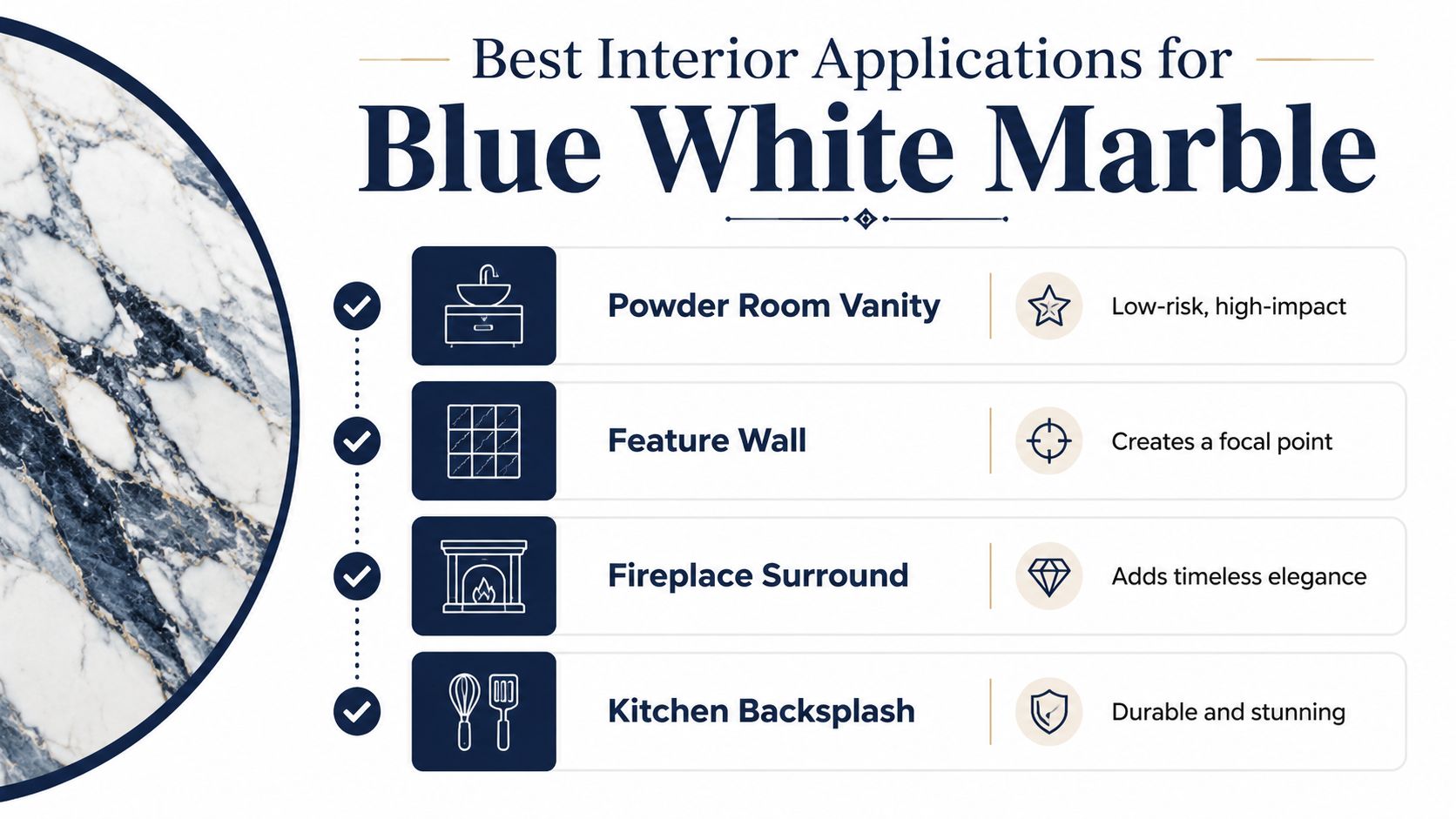
Specify the high-impact zones first
A powder-room vanity is an easy place to commit. It has strong visual value, limited food preparation, and a controlled footprint that makes slab selection easier. A feature wall offers even more freedom. Use a bold vein for a reception backdrop, TV wall, staircase landing, or lobby elevation, then keep adjacent surfaces quiet.
Fireplace surrounds also suit the material because the stone can frame the focal point without becoming a daily cutting or cleaning surface. In a master bath, blue white marble can create a calm, refined setting around a vanity wall or tub surround. For a presentation-quality concept, an architectural rendering of a penthouse can help test how the stone's movement behaves beside furniture, lighting, and adjoining finishes before fabrication begins.
Use wet areas with discipline
Bathroom floors and shower niches can work when the substrate is properly prepared, joints are planned, and the stone receives an appropriate sealing and maintenance regime. A honed finish is generally more sensible than a highly polished surface in areas where water affects slip perception and visual uniformity. Shower floors still deserve caution, especially where soap, hard-water deposits, and regular cleaning create a demanding routine.
Kitchen countertops are the main warning zone. Marble can be used there if the client accepts patina, wiping discipline, and the possibility of etching. If the client wants to place lemon, vinegar, wine, or aggressive cleaners on the surface without concern, recommend quartz or granite instead.
Fabrication details matter as much as the stone. Confirm slab thickness and tolerance before templating, use a suitable substrate, avoid unsupported projections, and select edge profiles that don't create fragile corners. A simple eased edge is usually safer than an excessively sharp or ornate profile.
Coordinating Blue White Marble With Interior Palettes
Blue white marble becomes difficult only when the rest of the room competes with it. Treat the stone as the primary pattern, then make cabinetry, flooring, upholstery, and accessories support its base tone and movement. A warm ivory slab needs a different surrounding palette from a crisp, blue-toned white slab, even if both are sold under the same broad category.
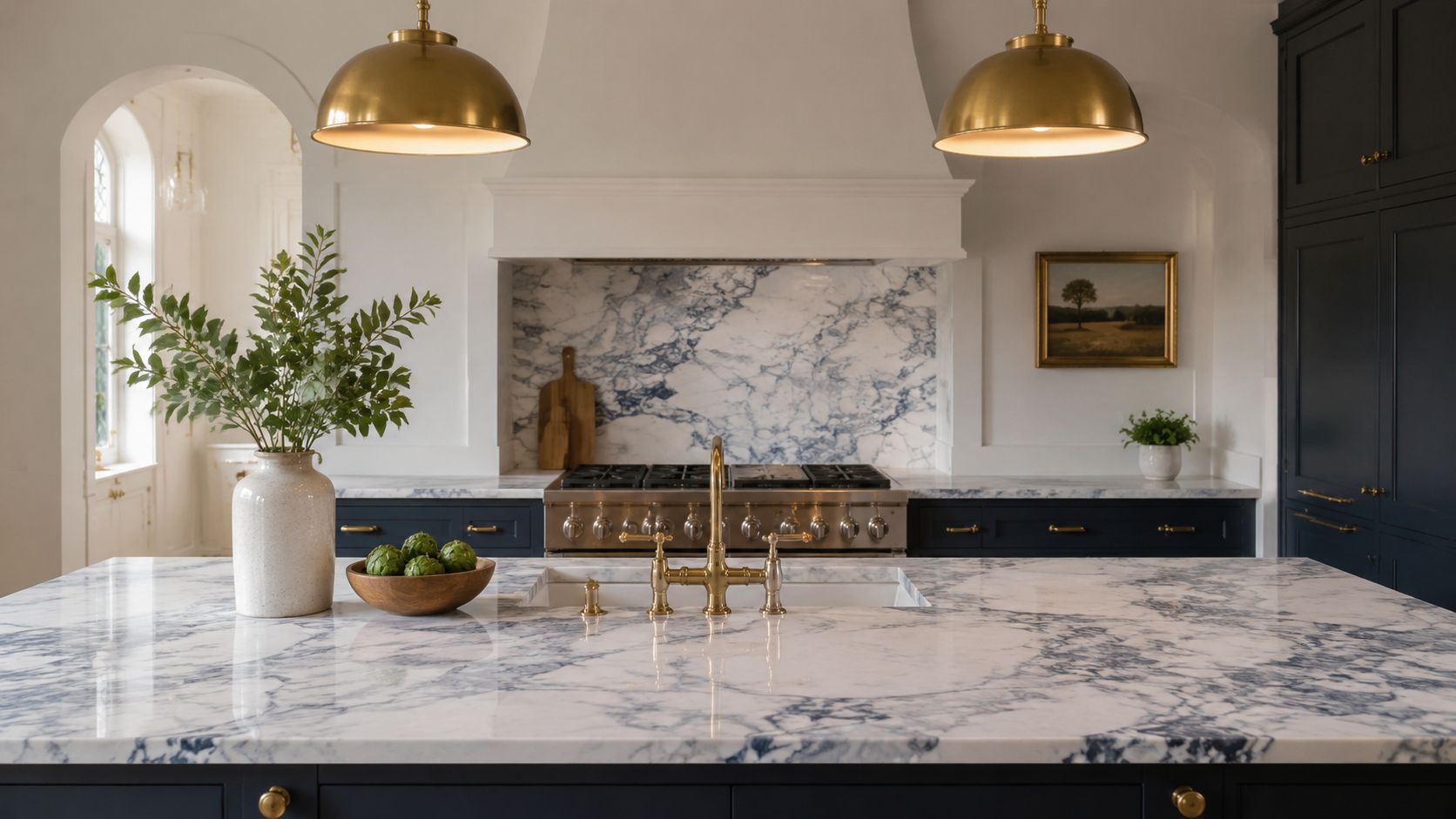
Build around one dominant pattern
Warm brass and unlacquered bronze are strong partners for cool blue-grey veining because they introduce heat without adding another competing pattern. Matte black fixtures create sharper contrast and suit contemporary kitchens, powder rooms, and hospitality counters. Soft taupe, greige, and warm off-white walls allow the marble to remain the visual anchor.
Flooring should recede. Wide-plank oak, calm limestone-look porcelain, or a quiet large-format porcelain surface can bridge the marble to the rest of the interior without creating visual noise. Avoid pairing expressive marble with patterned flooring, heavily grained cabinetry, and decorative backsplash tile in the same sightline. The room needs hierarchy.
The same principle applies in a dark palette. If you're considering a deeper stone elsewhere, compare its undertone and movement with the marble through a physical sample, not a digital swatch. This guide to dark grey marble can help when the scheme needs a darker counterpoint, but the two materials shouldn't compete for attention.
Lighting changes the stone more than many homeowners expect. Warm sources around 2700K–3000K can bring out cream and ivory notes, while cooler 4000K daylight makes blue movement appear more pronounced. Use one coherent lighting strategy across the room. Mixed colour temperatures can flatten the relationship between the white field and the blue veining.
Texture prevents a cool marble scheme from feeling clinical. Add linen curtains, velvet upholstery, oak, woven rugs, brushed metal, and matte painted surfaces. In a hospitality lobby, the combination can feel polished without becoming flashy. In a residence, the same approach makes the marble feel integrated rather than staged.
Selecting and Sourcing Blue White Marble Slabs
Start before visiting the yard. Ask the supplier for high-resolution photographs of the available slabs, the block or quarry origin where it can be disclosed, the bundle composition, and the finish options. Photographs help narrow the search, but they can't replace physical inspection because blue white marble can shift significantly from slab to slab.
India's trade pattern also makes sourcing discipline important. India imported 16,546 shipments of marble blocks between June 2024 and May 2025, and recorded 16,973 shipments of marble under HSN 2515 during the same period (Volza marble blocks import data). Recent trade reporting also states that Q1 2025 marble import value rose 69% year over year to $94.5 million, volume rose 80% to 389,678 tons, and raw marble represented 97% of volume and 90% of value (Volza marble block and marble import data). The practical point is clear: raw material sourcing and fabrication decisions remain central to the buying process.
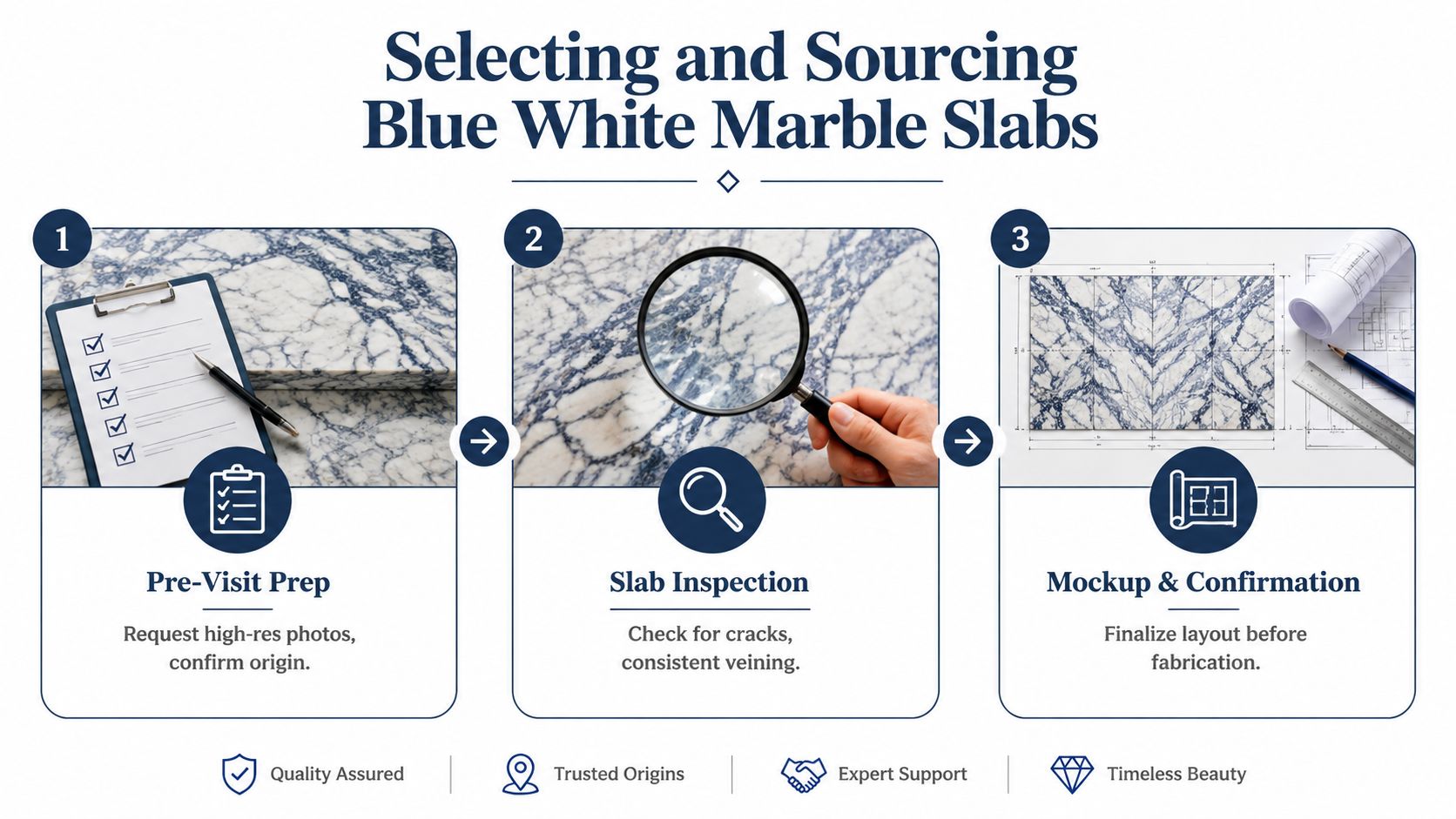
Inspect the stone, not just the label
At the yard, view the complete bundle if possible. Look for:
- Fissures and cracks: Separate natural surface fissures from structural cracks, and ask how any repairs were made.
- Resin and mesh: Check whether resin fills are stable and whether heavy mesh backing is concealing weakness.
- Tone continuity: Lay slabs beside one another to identify sudden changes in base colour or vein density.
- Book-match potential: Mark vein direction and select paired slabs before cutting.
- Thickness and edges: Check for variation that could affect levelling, countertop joints, or edge profiles.
Request a dry lay or full-size layout approval before fabrication. Number each slab on-site, photograph its orientation, and mark the approved face. This prevents a fabricator from reversing a slab or placing the strongest vein in an unintended location.
High-resolution supplier photography also matters when a decision-maker can't attend the yard. Guidance on how to improve your e-commerce images is useful for creating clearer remote references, but digital images still shouldn't override physical approval for a high-value installation.
A supplier unwilling to permit inspection, disclose basic material details, or document the approved layout is a risk. For a broader view of curated natural-stone selection, compare the sourcing approach described in signature marble and granite. In NCR, coordinate the yard visit, fabrication template, and site-readiness check early. Tight project schedules leave little room for replacing an unsuitable slab after cutting.
Where to Invest in Blue White Marble and Where to Pivot
Invest in blue white marble where people will notice and appreciate its movement, but won't subject it to relentless abrasion. Powder-room vanities, feature walls, fireplace surrounds, master-bath walls, and reception desks are strong choices. Book-matched slabs can turn these locations into architectural moments rather than ordinary finishes.
Pivot when the surface must function as a daily workhorse. Kitchen countertops, high-traffic entrances, utility areas, and demanding shower floors create more opportunities for scratching, etching, staining, and maintenance fatigue. Quartz, granite, or quartzite will usually be the safer recommendation when consistency and lower upkeep matter more than natural variation.
The best NCR interiors rarely use one material everywhere. They place blue white marble where it creates identity, then use performance-led materials for the surfaces that take the daily punishment. That isn't compromising the design. It's specifying each stone according to what it can realistically do.
Varun Marbles supplies Indian and Italian marble, granite, engineered quartz, onyx, and fabrication support for residential and commercial interiors, with showrooms in Gurugram's Sikanderpur and HUDA Marble Markets. Visit Varun Marbles with your plans, palette, and application list, and ask the team to help shortlist blue white marble slabs alongside safer quartz or granite alternatives.