
White Sparkle Marble: Specification and Design Guide

A client asks for a bright, reflective kitchen island. The showroom sample looks almost luminous, with a white ground, crystalline flashes, and restrained grey movement. The difficulty begins when the design team has to answer the questions that the sample cannot: will the slabs match, how will turmeric and citrus affect the surface, what does the test report say, and is the stone suitable for daily kitchen use?
White sparkle marble is a natural material, not a single standardised product category. Its appearance depends on mineral composition, metamorphic history, quarry selection, slab orientation, finish, lighting, and fabrication. In India, a responsible specification therefore has to join visual judgement with BIS-based physical testing, realistic maintenance planning, and slab-level inspection.
Table of Contents
- Defining White Sparkle Marble and Its Visual Traits
- Geological Origins and Regional Sourcing Profiles
- Technical Specifications and Quality Benchmarks
- Design Applications and Feature Installations
- Comparing Natural Marble with Engineered Quartz
- Maintenance Protocols for Indian Climates and Kitchens
- Procurement and Slab Selection Strategies
- Quick Reference Guide for Architects and Designers
Defining White Sparkle Marble and Its Visual Traits
A useful starting point is to separate the marketing description from the material itself. “White sparkle” usually refers to a white or near-white marble whose visible crystals catch and reflect light across the surface. The effect can appear as fine glints, soft crystalline depth, or a more pronounced scattered shimmer. It isn't the result of polishing, although a polished finish increases reflection and can make the crystals appear brighter.
Marble forms when carbonate rock recrystallises under heat and pressure. Calcite or dolomite crystals grow and interlock during metamorphism, producing the depth, movement, and light response that distinguish natural marble from a printed surface. The balance between crystal size, background colour, veining, translucency, and finish determines whether a slab reads as quiet and elegant or visually busy.
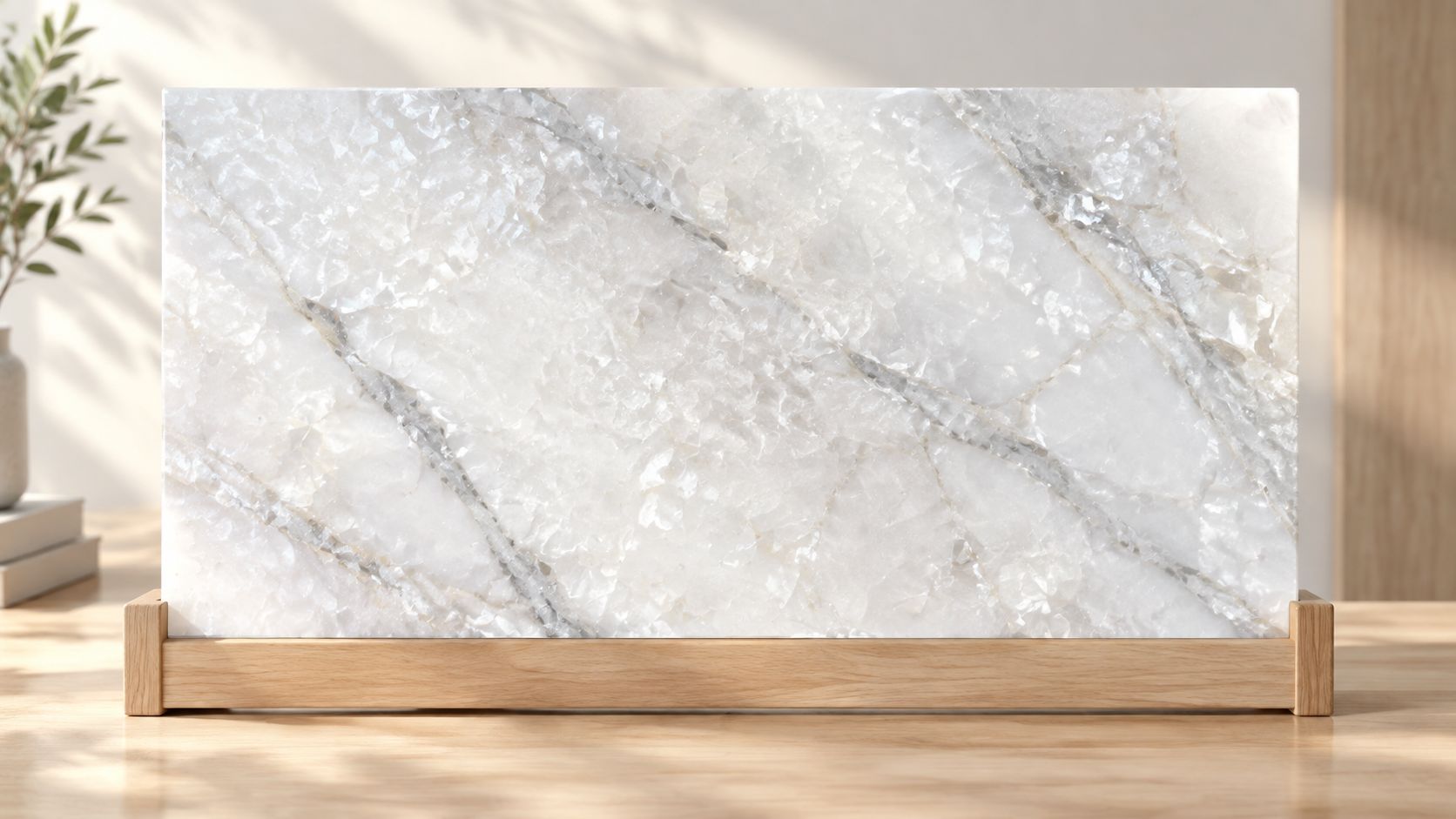
How the surface changes under light
Daylight tends to reveal the full structure of a slab. Directional sun can expose crystal boundaries, faint fissures, and differences in translucency that aren't obvious under showroom lighting. Warm LED lighting may soften a cool white background and bring out beige or grey undertones, while a neutral light source generally gives the most reliable impression of colour.
A polished surface reflects light directly, so the sparkle may read as crisp and high contrast. Honed marble scatters light and usually presents a calmer, softer appearance. Leathered or lightly textured finishes can reduce glare, but they may also make the white background appear less uniformly bright.
Practical rule: Approve the actual slab, or a representative group of slabs, under the lighting planned for the finished room. A small sample can't show every change in crystal density, veining, or translucency.
What buyers should clarify
The phrase can describe several different commercial realities. A supplier may use it for a naturally crystalline white marble, a white marble with reflective mineral inclusions, or a stone selected mainly for its visual resemblance to a sparkle effect. It may also be confused with quartzite, engineered quartz, or other imported decorative stones.
Ask for the commercial name, quarry or country of origin, mineral classification where available, finish, slab thickness, and treatment history. Don't assume that a glittering surface is evidence of superior performance. Sparkle is a visual characteristic, not a durability certificate.
For a design team, the better brief describes the required background whiteness, acceptable grey movement, desired crystal visibility, degree of translucency, and finish. That gives the supplier a selection target instead of leaving “white sparkle” open to interpretation.
Geological Origins and Regional Sourcing Profiles
A design team can approve a bright, glittering slab and still face inconsistent supply at the quarry or during fabrication. India's marble resource base is substantial, but the available figures show why a uniform high-grade white selection requires careful sourcing. The Indian Minerals Yearbook 2021 data summarised in the marble reference estimates total Indian marble resources at 1,945 million tonnes. Only about 4.5 million tonnes, or 0.23%, are classified as reserves. White colour grade represents 17% of resources, compared with 55% in off-colour grades and 28% unclassified or not-known.
A geological resource is not an immediately extractable, commercially consistent reserve. Even within a white deposit, quarry benches can vary in crystal structure, veining, soundness, and recoverable slab yield. Those variables affect matching, wastage, and the number of slabs a project can approve as one visual batch.
India's regional concentration
Rajasthan accounts for about 63% of India's marble resources, followed by Jammu and Kashmir at 21%, Gujarat at 6%, and Chhattisgarh at 4%, according to the same Indian marble resource reference. For white sparkle marble, origin therefore belongs in the procurement record, not only in the sales description.
The Makrana belt in Rajasthan remains the historic Indian reference for pure white crystalline marble. Official Indian mining literature describes Makrana marble as formed through recrystallisation under thermal and regional metamorphism. Geological descriptions place it in steeply dipping bands of the Ajmer Formation, with metamorphism associated with the Delhi Orogeny about 1,450 million years ago, as documented in the Indian Bureau of Mines marble publication.
That publication identifies Makrana as one of only two calcitic marble varieties in India, while most other Indian marbles are dolomitic. The mineralogical distinction helps explain the brightness and translucency associated with premium white material from the belt. It does not remove slab-to-slab variation, so approval must remain based on the actual material supplied.
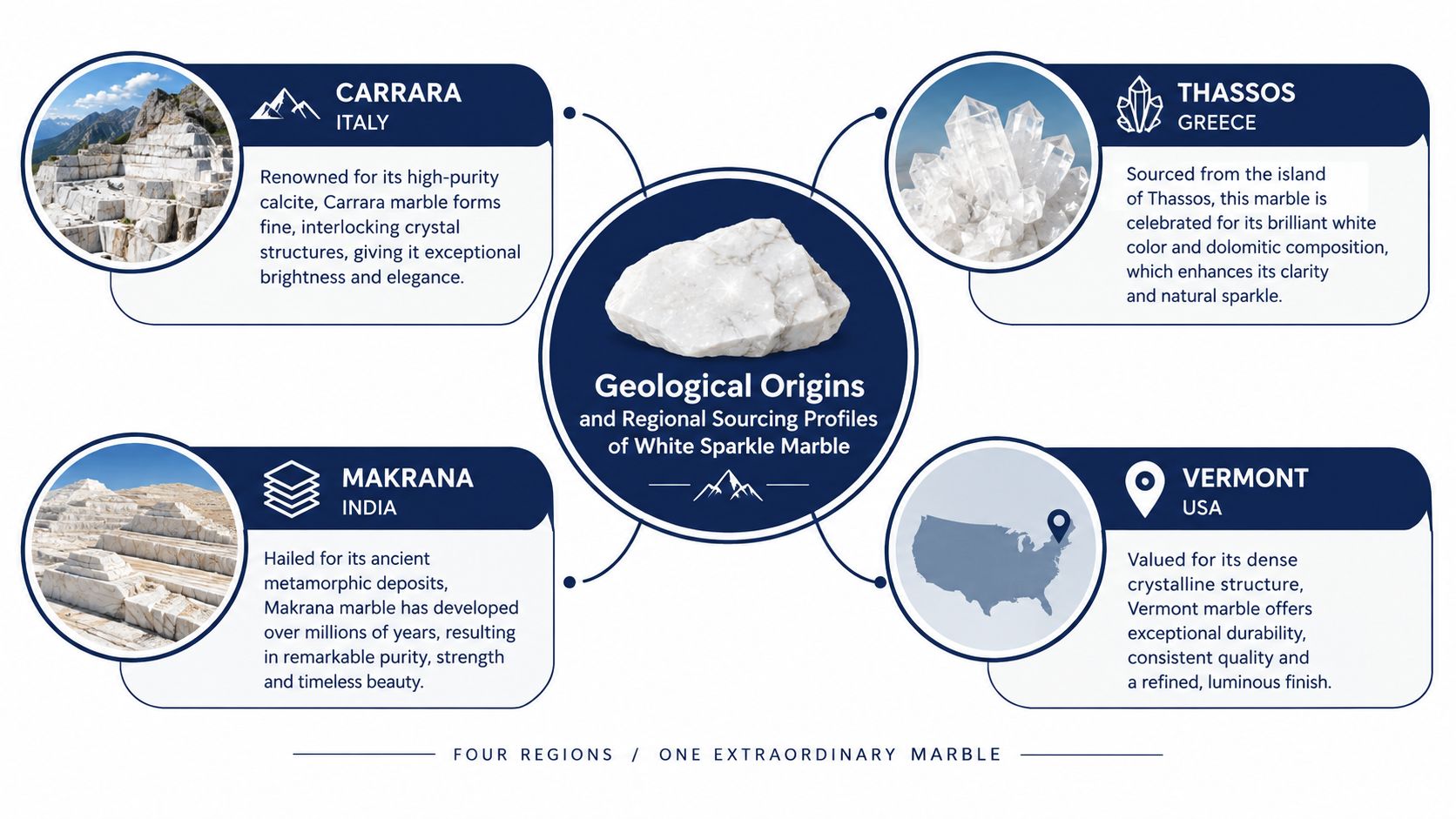
Why origin doesn't guarantee uniformity
International names indicate a broad visual or geological family, not identical performance or appearance. Slabs sold as Carrara, Thassos, Makrana, or Vermont can differ in background tone, crystal distribution, veining, soundness, and usable yield. Specify the quarry or country where possible, then verify the selected batch against the intended application and documented physical properties.
A project seeking a softer, more layered white stone may also compare white Volakas marble. The comparison should remain slab-specific. Quarry origin narrows the search, while inspection confirms whether the delivered stone is suitable.
Technical Specifications and Quality Benchmarks
A polished showroom slab can look flawless and still be unsuitable for a demanding application. The specification should therefore require physical-property evidence alongside photographs, samples, and finish approvals.
For Indian projects, IS 1124:1974 defines methods for testing water absorption, apparent specific gravity, and porosity. BIS marble specification material lists a maximum water absorption of 0.20% and an apparent specific gravity range of 2.60 to 2.98 for polished natural marble products, as shown in the BIS marble specification document.
The numbers that belong in the submittal
| Property | BIS Requirement | Significance for White Marble |
|---|---|---|
| Water absorption | Maximum 0.20% | Lower absorption supports better resistance to staining and moisture-related movement |
| Apparent specific gravity | 2.60 to 2.98 | Helps confirm density and supports comparison between submitted material and approved material |
| Test method | IS 1124:1974 | Creates a documented basis for evaluating absorption, density, and porosity |
The figures shouldn't be treated as a substitute for design judgement. A compliant result doesn't make polished marble appropriate for every wet-floor condition, nor does it predict every fabrication risk. It does give the project team a defensible baseline for acceptance.
How to control each consignment
Write the testing requirement into the purchase order and material submittal. Request the commercial description, source, finish, test method, laboratory report, and lot or consignment reference. The report should identify the material being supplied, not merely a generic stone family.
BIS material also indicates one sample per consignment lot, with additional samples retested when a physical requirement fails. The Indian Minerals Yearbook material separately reiterates a maximum moisture absorption of 0.4% after 24-hour cold-water immersion, so the project team should state clearly which applicable requirement, product category, and test basis govern acceptance. The relevant BIS product manual for marble should be reviewed with the testing agency and consultant before procurement.
Specification note: Approve the stone by both appearance and test report. Neither one is enough on its own.
For wet areas, finish selection is part of technical compliance. Polished marble can create slip risk when wet, while honed or textured finishes generally offer a more suitable direction for wet-zone floors. A polished finish may still work well on vertical walls, vanity fronts, dry counters, and carefully detailed feature elements.
Design Applications and Feature Installations
White sparkle marble earns its place when the design gives its crystalline structure room to work. It can become a quiet background in a restrained interior, or a focal surface when directional lighting reveals depth and translucency. The strongest installations usually control the surrounding palette rather than competing with the stone through multiple decorative materials.

Where the material performs visually
A backlit wall can emphasise translucent zones, but the design team has to inspect the slab first. Not every white marble transmits light evenly, and adhesive, substrate, joint layout, and access for future maintenance all affect the result. Use mock-ups to test the actual light temperature and source spacing rather than assuming that a slab will glow uniformly.
Kitchen islands benefit from large uninterrupted planes, waterfall edges, and carefully placed veining. The risk is practical rather than aesthetic. A sink cut-out, cooktop opening, narrow unsupported section, or existing fissure can create a vulnerable fabrication zone, so the fabricator should review the slab layout before cutting.
Commercial lobbies, reception desks, fireplace surrounds, elevator walls, and hospitality feature panels are often more forgiving than food-preparation counters because the stone faces less direct contact with acidic spills and sharp utensils. Even there, specify protection at corners, movement joints where required, and a cleaning regime that won't attack a calcitic surface.
Finish and edge decisions
Polished marble gives the strongest reflection and makes the sparkle more apparent. It suits vertical applications, formal reception areas, and dry zones where glare and slip are controlled. Honed marble reduces reflection and can make minor etching less visually prominent, which may be helpful around a kitchen sink or vanity.
Leathered or textured finishes add tactile character, but they can hold residue more readily than a smooth surface and need a cleaning method suited to the texture. Edge profiles should also match use. A small bevel or eased edge reduces the sharpness of a vulnerable corner, while an elaborate profile increases fabrication time and can draw attention away from the slab pattern.
The lighting must be coordinated with the finish. A narrow spotlight across a polished surface can exaggerate glare and reveal every irregularity. Broad, diffused illumination generally produces a more controlled reading of white sparkle marble.
The installation sequence deserves the same attention as the design. Confirm templates, supports, cut-outs, joints, appliance clearances, and final slab orientation before fabrication begins.
The following visual reference shows how a feature installation can use the material as an architectural focal point rather than as a background replacement for every surface.
Comparing Natural Marble with Engineered Quartz
The client who asks for white sparkle marble may be asking for one of two different outcomes. They may want the irregular crystal depth and individuality of natural stone, or they may want a bright white worktop that tolerates a busy kitchen with minimal intervention. Those requirements overlap visually, but they don't produce the same specification.
Natural marble offers genuine variation, mineral depth, and a surface that changes as it is used. Engineered quartz offers a manufactured appearance with greater pattern control, non-porous performance, and simpler routine care. Neither is automatically the correct choice.
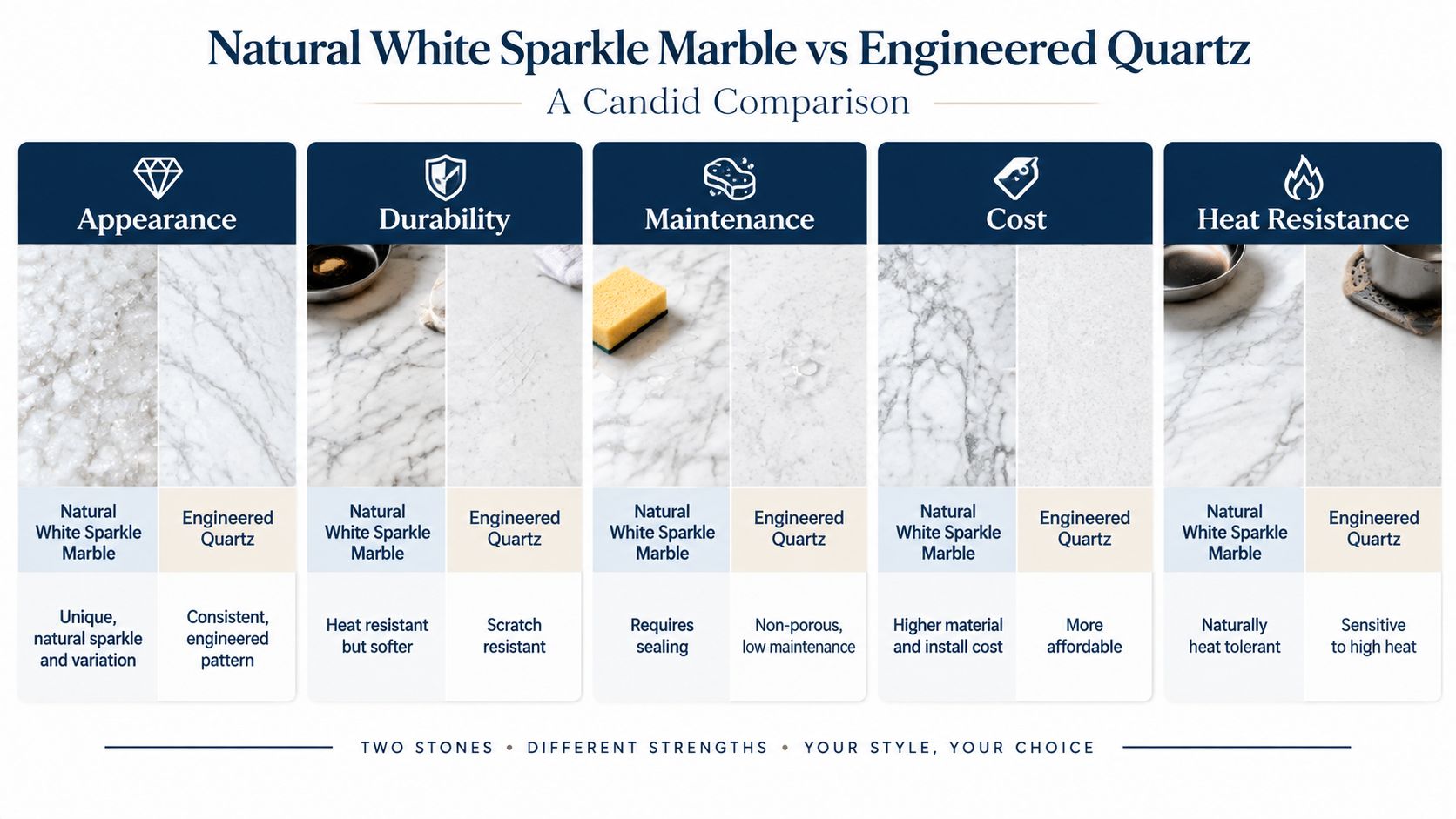
A practical decision matrix
| Decision factor | Natural white sparkle marble | Engineered quartz |
|---|---|---|
| Appearance | Unique crystals, veining, and slab variation | More consistent pattern and colour control |
| Porosity | Requires verification, sealing, and spill discipline | Non-porous surface reduces routine staining concerns |
| Maintenance | Acidic spills can etch the calcitic surface | Generally simpler daily maintenance |
| Heat behaviour | Natural stone is generally more tolerant of heat, but direct thermal shock and fabrication details still matter | High heat can damage some engineered surfaces, so hot cookware needs protection |
| Design character | Each slab has individual movement and depth | Repetition and consistency are easier across a project |
The Indian marble care guidance specifically highlights acidic spills, turmeric, and oil as risks for white marble. It recommends prompt cleaning, pH-neutral products, and periodic polishing every 12 to 18 months. That care requirement isn't a flaw. It is part of the material's operating profile.
Match the surface to the household
Choose natural marble when the client values natural variation, accepts patina, and will follow a sensible cleaning protocol. It works particularly well for statement islands, vanities, fireplaces, walls, and lower-abuse surfaces where the stone's depth is central to the design.
Choose engineered quartz when consistent colour across adjoining worktops matters, the user wants low-maintenance behaviour, or the kitchen sees frequent exposure to staining ingredients. A quartz surface won't reproduce every natural crystalline nuance, but it may solve the client's actual risk concern more effectively. For a related kitchen material comparison, see why quartz slabs suit modern kitchens.
The heat comparison needs careful wording. Natural marble's mineral composition makes it a heat-tolerant material, but that doesn't justify placing hot cookware against vulnerable edges or ignoring support at cut-outs. Engineered quartz also needs heat protection. Use trivets and follow the manufacturer's care instructions for either surface.
Maintenance Protocols for Indian Climates and Kitchens
White marble remains attractive when the household treats it as a responsive natural surface rather than an indestructible coating. Indian kitchens introduce familiar staining and etching risks, including turmeric, oil, citrus, vinegar, tomato-based ingredients, and cleaning products that are too acidic or abrasive for carbonate stone.
The daily routine
Remove spills as soon as they're noticed. Blot rather than scrub, especially when the spill contains colour or oil. Wipe the surface with a soft cloth and a pH-neutral cleaner, then rinse away residue and dry the area.
Avoid lemon-based cleaners, vinegar solutions, bathroom descalers, abrasive powders, and strong acidic products. These can react with calcitic marble and leave a dull etched patch even when the colour stain has been removed. A sealer can reduce absorption, but it won't stop acid from reacting with the polished surface.
Keep separate cleaning cloths for the worktop and for harsher household tasks. Grit trapped in a cloth can create fine scratches, while a rough pad can change the sheen around a frequently used area.
Spill response by material
- Turmeric and coloured food: Lift the residue quickly, clean with a neutral product, and avoid aggressive rubbing that spreads pigment into the surface.
- Oil and ghee: Absorb excess material first, then clean with a suitable neutral stone cleaner. Don't leave an oily film to attract dust.
- Citrus and acidic liquids: Wipe immediately and rinse. If a dull mark remains, treat it as possible etching rather than assuming it is a stain.
- Metal and heavy objects: Use boards, mats, and trivets. Dropped items can chip an edge or create a visible impact mark even when the surface feels smooth.
Professional maintenance should include inspection of high-use zones, especially around sinks, appliance edges, and joints. The cited Indian care guidance recommends polishing every 12 to 18 months, but the appropriate interval depends on traffic, finish, cleaning habits, and the client's visual tolerance.
For a worktop-specific discussion of finish, care, and use conditions, refer to polished marble countertops. Put the care instructions in the handover pack. A client who understands the operating rules is less likely to treat an avoidable mark as a product failure.
Procurement and Slab Selection Strategies
Natural stone selection should happen at the slab yard, not only through a digital image or a small showroom sample. White sparkle marble can vary in background tone, crystal visibility, grey movement, fissure pattern, edge quality, and translucency. A project that needs a calm continuous wall requires a different selection strategy from a compact vanity.
India's import profile reinforces the need for inspection. The country imported $318 million of marble, travertine, and alabaster in 2023, and $282 million in 2024, remaining the world's second-largest importer in that category, according to the trade coverage referenced in the brief. The same background also reports that 97% of imported volume consists of raw marble blocks and slabs rather than finished products, so buyers are often selecting material before fabrication rather than purchasing a fully standardised surface.
Inspect the actual inventory
Take the approved elevation, cutting plan, sink and hob locations, joint positions, and required quantities to the yard. Lay templates over the slabs where possible. This reveals whether the preferred crystal field will disappear into a cut-out, whether a fissure crosses a vulnerable zone, and whether adjoining slabs can be sequenced coherently.
Look at slabs vertically and horizontally. Examine them under the project's likely lighting conditions, then inspect the back and edges for repairs, resin, open fissures, or damage. A natural fissure isn't automatically unacceptable, but it must be evaluated against the intended use and fabrication method.
Record the acceptance decision
Photograph each approved slab with an identification mark visible. Note the acceptable range for background white, grey veining, sparkle density, filled areas, and translucency. If the project allows variation, describe it. If it doesn't, reserve the selected slabs and make the restriction part of the purchase order.
Use a simple review checklist:
- Structural review: Identify fissures, repairs, edge damage, and cut-out risks.
- Visual review: Compare tone, crystal distribution, veining direction, and slab-to-slab continuity.
- Layout review: Place templates before approval, not after the slabs reach fabrication.
- Documentation review: Match slab identifiers to the quotation, test report, photographs, and delivery record.
- Mock-up review: Approve a representative fabricated edge, joint, and finish where the installation is prominent.
A supplier's commercial name won't resolve a mismatch between the approved slab and the delivered slab. The project team must control identity and sequence from yard selection through installation.
Quick Reference Guide for Architects and Designers
Use this guide during the material submittal, client presentation, and pre-fabrication meeting. It keeps the conversation anchored to the points that affect the finished installation: appearance, physical performance, finish, maintenance, and control of natural variation.
Technical review
| Checkpoint | What to request | Why it matters |
|---|---|---|
| Material identity | Commercial name, origin, finish, and slab identifiers | Prevents substitution with a visually similar stone |
| Water absorption | Test result using the applicable BIS method | Supports evaluation of stain and moisture behaviour |
| Apparent specific gravity | Laboratory result within the specified range where applicable | Helps confirm density of the submitted material |
| Lot control | Consignment reference and sampling record | Connects the report to the material delivered |
| Finish suitability | Polished, honed, or textured finish approval | Links appearance and slip-risk decisions to the use area |
Finish selection
- Polished: Use for dry vertical features, formal counters, and areas where reflection is controlled.
- Honed: Use where a softer appearance and less visible etching are preferred.
- Leathered or textured: Consider for tactile feature surfaces, with cleaning access and residue control planned.
- Wet-floor applications: Treat polished marble cautiously. A honed or textured option generally aligns better with wet-zone requirements.
Slab-yard checklist
- Approve the actual slabs, not only a sample.
- Review all visible faces under suitable lighting.
- Mark cut-outs, joints, edges, and appliance positions on the layout.
- Record acceptable variation in writing.
- Photograph slab identifiers before fabrication.
- Confirm supports and access for installation.
- Issue cleaning and maintenance instructions at handover.
Client decision test
Ask the client which priority carries more weight: natural depth and individuality, or uniform appearance and low routine maintenance. If the answer is natural character, white sparkle marble may justify its care requirements. If the answer is predictable kitchen performance, engineered quartz may be the more honest recommendation, even when the client initially asks for marble.
Varun Marbles supplies natural Indian and Italian marble, engineered quartz, granite, and onyx, with slab selection, cut-to-size fabrication, edge profiling, finishing, and installation coordination through its Gurugram showrooms and yard. Visit Varun Marbles to review white sparkle marble-style options alongside quartz alternatives and discuss the test documents, slab layout, and finish required for your project.