
Quartz Countertops That Look Like Marble: A Buyer's Guide

The most repeated buying advice is simple. Choose quartz countertops that look like marble, and you get the marble look without the marble problems. That advice is only half right, and the wrong half is the expensive one.
A marble-look slab is a workhorse, not a perfect stand-in for quarried stone. It wins on stains, etching and daily wiping. It loses on depth, on heat, and on the one-off movement that makes a real slab worth its care. Cover a whole open kitchen in the boldest white-and-gold pattern and the repeat can look manufactured, even when the material itself is excellent.
Match the surface to the job. Use quartz where hands, oil and turmeric land every day. Keep natural marble for the piece people look at more than they work on.
Table of Contents
- Quartz vs Natural Marble at a Glance
- Matching the Veining Style to Your Space
- Choosing Between Polished, Matte and Leathered Finishes
- When Natural Marble Still Makes More Sense
- Slab Checks That Keep the Marble Look Consistent
- Maintenance, Heat and Stain Limits to Plan For
- Fabrication Records to Request Before Installation
- Confirm the Slab and Finish Before You Order
Quartz vs Natural Marble at a Glance
Marble-look quartz wins on porosity. Natural marble wins on authenticity. Quartz is non-porous, needs no sealing, and shrugs off tea, oil and turmeric that mark a calcite stone. Every marble slab carries depth, movement and irregular veining that an engineered surface only imitates. For a typical kitchen worktop, upkeep decides it. For a wall, a bath vanity or a low-use feature, the trade-off shifts toward the stone.
| Criterion | Marble-look quartz | Natural marble |
|---|---|---|
| Porosity and stain resistance | Low porosity, no sealing needed | Porous, needs regular sealing |
| Acid etching from lemon or vinegar | Resists etching | Etches and dulls |
| Scratch resistance | High | Moderate, softer surface |
| Heat tolerance | Limited, use trivets for hot cookware | Better heat tolerance, can crack under thermal shock |
| Pattern consistency across slabs | Repeatable veining and tone | Each slab differs in tone and vein |
| Natural depth and movement | Imitated, less depth | Unique, genuine depth |
| Daily care | Wipe with mild soap and water | Gentle cleaners and periodic sealing |
Why each row changes the buy
Porosity is the daily difference. Spills sit on quartz. On marble they travel into the stone unless you seal on a schedule.
Acid etching is not a stain. Lemon and vinegar dull the polish on marble and leave a pale patch. Quartz does not etch in that way, so a citrus spill is a wipe, not a repair.
Scratch resistance favours quartz. Marble is softer, so knives, grit and dragged pans leave a finer haze sooner.
Heat splits the other way in character, not in carelessness. Quartz resin needs trivets. Marble tolerates brief heat better, yet a cold wet slab under a scorching pan can crack from thermal shock.
Pattern is where buyers get misled by photographs. Quartz repeats tone and vein across slabs, which helps a long run. Marble will not match that tightly, and that mismatch is the point of the material.
Daily care follows the same split. Mild soap and water keep quartz presentable. Marble wants gentle cleaners and periodic sealing.
Practical rule: If the surface takes heavy daily use, quartz usually wins on upkeep. If you want the one-off character of stone above all, natural marble justifies its care routine.
That same logic applies off the worktop. A guide to choosing a black marble coffee table from Critelli Furniture is useful when the stone is a low-use accent, not a chopping zone. For how a slab behaves once cabinets, lighting and cooking come together, read why quartz slabs suit modern kitchens.
Matching the Veining Style to Your Space
Vein style decides more than brand or price, because it controls how visible joins and repeats will be. Four reference looks cover most rooms. Calacatta puts bold gold-grey veining on a bright white or ivory base and suits a statement island, though wide sweeps repeat visibly on a long run. Carrara uses fine grey veins on white or soft grey, and those small veins hide joins in a calm, working kitchen. Statuario pairs a bright white ground with dramatic grey strokes, which suits a high-contrast bath, with repetition tied to how wide the strokes are. A Crema or beige marble-look runs warm cream with soft veins, and it forgives joins in traditional rooms.
A practical split works well in larger homes. Give the working runs a quiet, fine-veined quartz that hides seams and daily wear, and reserve the bold-vein look for one focal slab such as an island face. For a busy family kitchen, I would take the fine-veined option over the dramatic one every time. Where a surface sees little use, natural marble can carry the character while quartz does the hard work elsewhere.
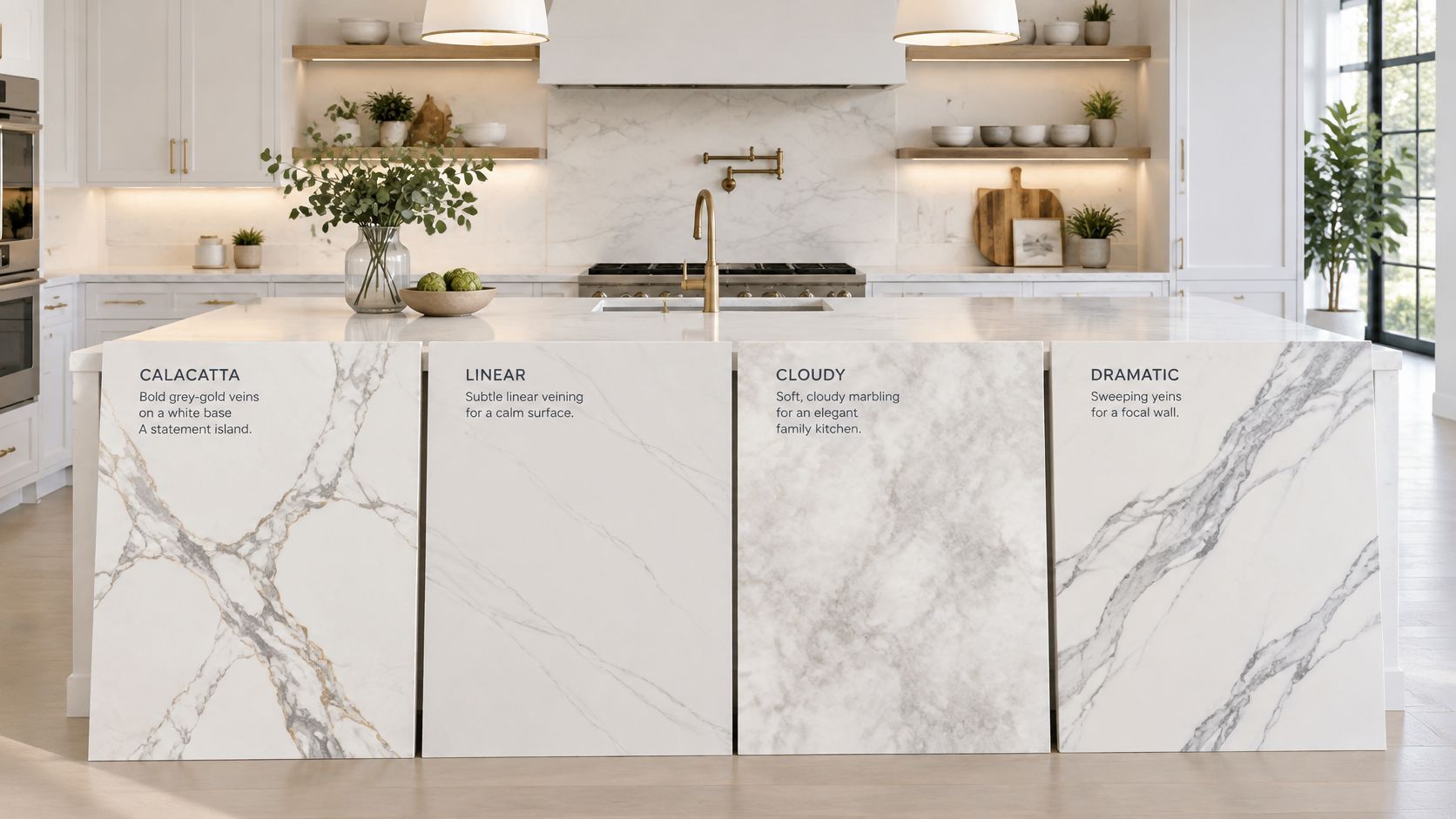
Indian quartz production did not start here. Early lines concentrated on plain and speckled colours. Demand has since moved toward veined, premium marble-look slabs that need tighter pigment control, and the result is a more consistent background colour than many natural stones deliver slab to slab.
| Pattern style | Background | Vein character | Best use | Repetition risk |
|---|---|---|---|---|
| Calacatta | Bright white or ivory | Bold gold-grey veining | Statement island or focal wall | High on large runs |
| Carrara | White to soft grey | Fine, feathery grey veining | Calm, understated kitchen | Low, hides repeats |
| Statuario | Bright white | Dramatic grey strokes | High-contrast bath or vanity | Medium when veins are wide |
| Crema or beige marble-look | Warm cream | Soft, subtle veining | Warm, traditional interiors | Low, forgiving across joins |
Through-body colour versus a surface print
Ask whether the vein is through-body or only a surface print. Through-body colour continues through the slab, so edges, mitres and minor chips still read as stone. A surface vein can vanish at a cut or a polished edge, which is obvious on a waterfall end or a thick mitre.
Hold full slabs, not small chips, under daylight and under warm kitchen light. Resin tone shifts between the two. Match vein scale to room size and to the length of the run: a sweeping Calacatta vein needs a long, unbroken span, while a fine Carrara pattern survives being cut into short worktop pieces. Plan joins so a bold vein does not stop mid-island. If the kitchen is still on paper, explore modern kitchen styles for 2026 from Everti before you lock a bold vein against pale cabinets.
A short walk-through of full-slab reading helps before you commit.
Choosing Between Polished, Matte and Leathered Finishes
Choose polished for a formal bath or vanity. Choose matte or leathered for a busy kitchen worktop where fingerprints are constant. Finish changes how the vein reads, so compare samples in the finish you will order, not a polished chip against a matte slab.
| Finish | Look | Visible marks | Scratch visibility | Best room |
|---|---|---|---|---|
| Polished | High gloss, closest to polished marble | Shows dust and water spots | Fine scratches show more | Formal bath, vanity or feature wall |
| Matte | Soft sheen, closest to honed marble | Hides light smudges, oil shows more | Moderate | Busy kitchen worktop |
| Leathered | Fine texture, stone-like feel | Hides marks well | Low visibility | High-use kitchen or island |
Polished is the nearest match to polished marble. High gloss pulls the vein forward and throws light across an island. It also shows dust, water spots and streaks, so expect frequent wiping in a cooking zone.
Matte softens the colour and sits closer to honed marble. Light smudges disappear. Oil and grease still show, so a mild cleaner matters more than extra elbow grease with a scourer.
Leathered has a fine texture that hides marks and small scratches, and it feels nearer to natural stone under the hand. Crumbs sit in the grain. A soft brush, not a pad, clears them.
A polished sample beside a matte order is how buyers approve the wrong slab. The vein that looked crisp in gloss can look flat once the sheen is gone.
For how each surface is produced and where it belongs, see types of surface finishes.
When Natural Marble Still Makes More Sense
The most photogenic marble-look quartz can read as manufactured once it covers a whole open-plan home. Uniform repeats, bright white backgrounds and large-scale veins announce their pattern across a long run. If you wanted the irregularity, depth and movement of genuine stone, a perfect match is the wrong success.
Quartz is still the exception in Indian kitchens: a market note cited by Studio Matrx puts penetration at roughly 3–5% of kitchen-renovation projects. Demand for white, beige and grey surfaces is real. So is the risk that every island in a building ends up looking like the same drawing.
A hybrid you can specify
Use quartz on the heavily used worktop. Use natural marble on a focal island, a vanity, a feature wall or a low-use bar. Three questions settle it.
- How hard is the surface worked? Daily frying, children and turmeric belong on quartz, which is non-porous and never needs sealing. A bar that sees a glass in the evening can carry marble.
- How close do the patterns sit? Two bold veins side by side fight. Give the marble the view, and keep the quartz quieter beside it.
- Will you keep the stone's routine? Sealing and gentle cleaners are the price of that depth. If nobody will do them, do not specify the marble.
Vein-book matching, edge profiles and lighting decide whether a convincing quartz still looks fake at island scale. A sweeping vein that dies at a seam gives the game away. So does a gloss that mirrors a downlight into a repeated motif.
Take an L-shaped kitchen with a separate island. Put quartz on the L, where the hob and the sink live. Put natural marble on the island, so the piece people gather around carries the stone's own character. A slab of Statuario, bright white with dramatic grey strokes, does that job on its own. Care for that polished surface is covered in this note on polished marble countertops.
Use natural stone where the stone is the design. Use quartz where the surface is a workhorse.
Slab Checks That Keep the Marble Look Consistent
Approve the slabs as a set, not as a single pretty face. Tone and vein density shift between batches, and a join only looks honest when the vein continues.
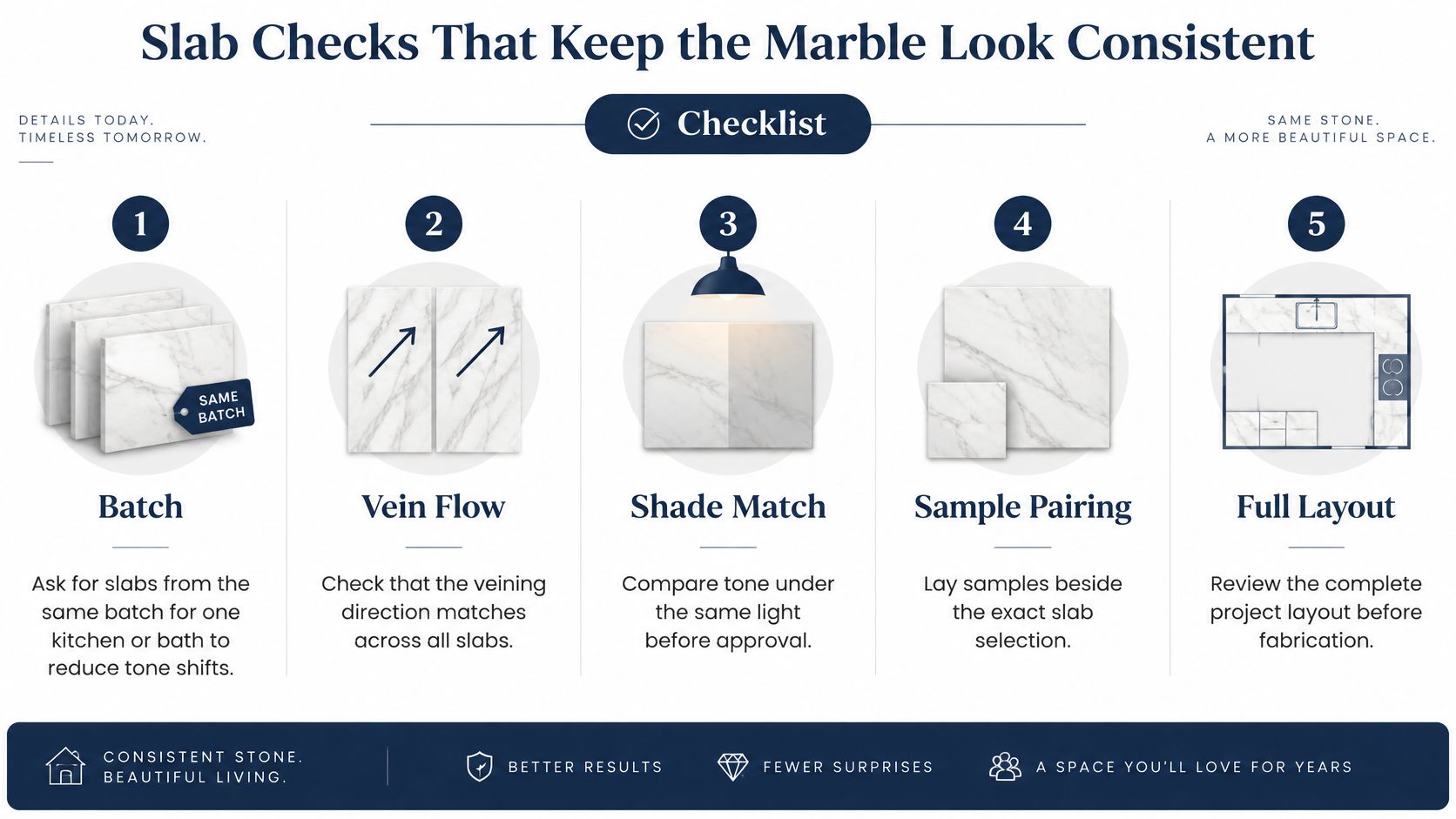
| Check | What to verify | Why it matters |
|---|---|---|
| Batch | Same batch number for all slabs in one space | Batch shifts change tone and vein density |
| Layout | Vein continuity across seams and visible edges | Breaks in the vein read as a fake join |
| Colour under light | Daylight and warm kitchen light against the sample set | Resin tone shifts between light sources |
| Thickness and overhang | Slab thickness and unsupported overhang limit | Thin slab on a long overhang risks cracking |
| Cut-out placement | Sink and hob cut-outs away from focal veins | Keeps the feature vein intact |
| Documentation | Technical data sheet, batch number and thickness tolerance | Proof for warranty and disputes |
Run the checks in the yard
Batch. Ask for one batch for one kitchen or bath. Mixing lots is how a "white" run becomes two whites once the cabinets are in.
Layout. Lay the slabs before anyone cuts. The most visible edges should share a continuous vein field. A vein that stops on the front of an island is the join everyone notices.
Colour under light. Stand the slabs in daylight, then under the warm lamps you will live with. Compare them to the sample set, not to a phone photo. Resin can look cooler at noon and creamier at night.
Thickness and overhang. Confirm the thickness the design needs and the unsupported overhang the fabricator will allow. A thin slab on a long breakfast overhang is a crack waiting for someone to lean on it.
Cut-outs. Place the sink and the hob away from the vein you bought the slab for. A feature streak that vanishes into a basin was a layout mistake, not a material flaw.
Documentation. Leave with the technical data sheet, the batch number and the thickness tolerance. Those three lines settle most arguments later.
Maintenance, Heat and Stain Limits to Plan For
Specify documented water absorption of no more than 0.05%, and make the fabricator name the test method before you pay: this solid-surface standards note ties that threshold to ASTM D570 in engineered-quartz specifications and to IS 13630 Part 2 in Indian Bureau of Standards laboratory scopes. Quartz aggregate bound in a polymer-resin matrix has far fewer interconnected pores than many natural stones, which cuts capillary uptake of tea, turmeric, oil and hard-water residue. Low absorption still permits staining. A spill left overnight, a harsh cleaner or resin discoloration will mark the face.
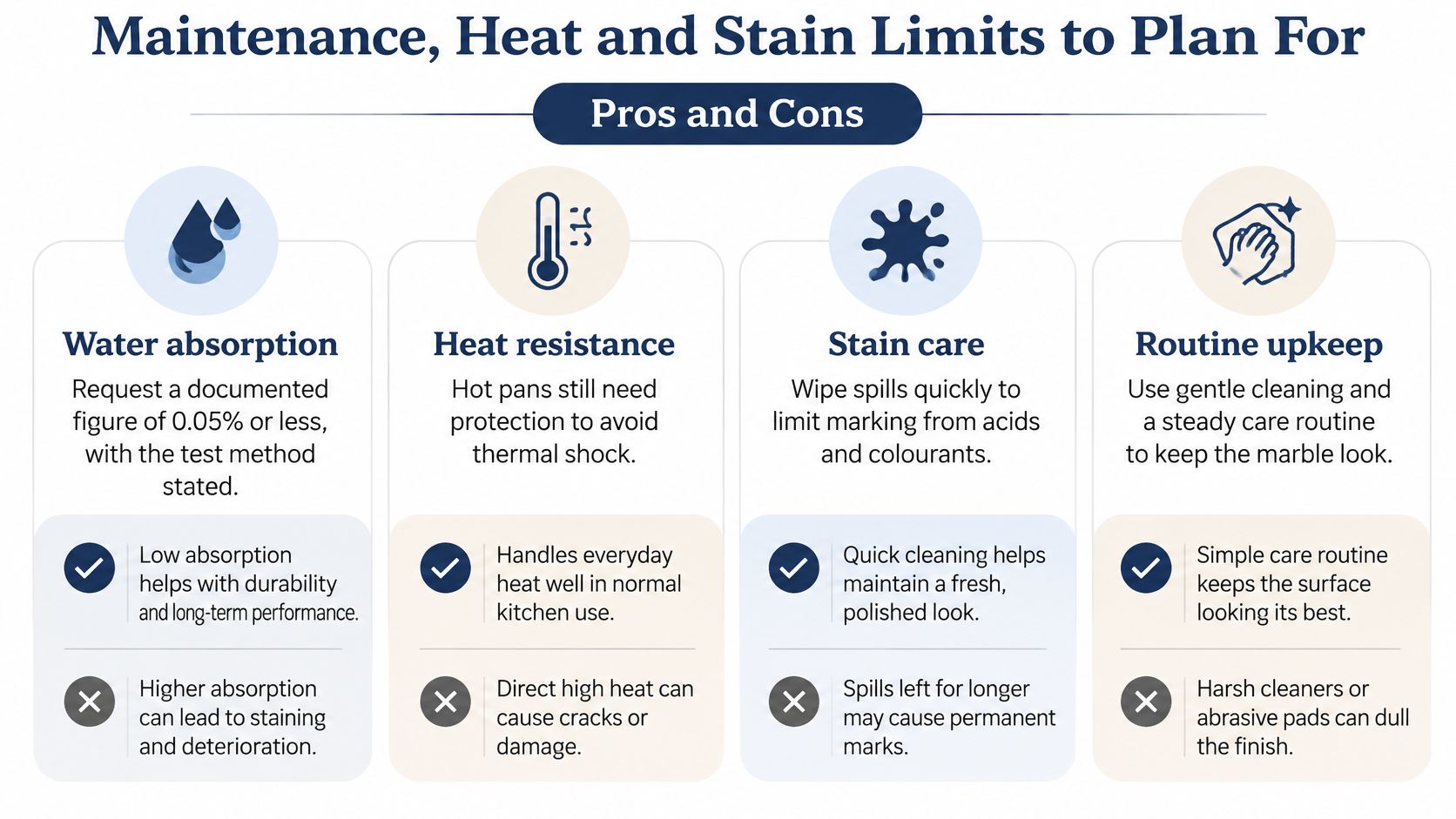
Heat is a separate risk from staining
An India-focused comparison on Construction Flux states that quartz should not meet direct flame or red-hot cookware, and that sustained heat above about 120°C may damage resin binders. Treat that ceiling as a design input. Trivets belong under hot pressure cookers, tawas and baking trays, including on a premium white slab. Keep clear space around gas burners and induction units, and reinforce the support beside sink and hob cut-outs so the opening does not become the weak line.
What to use, and what to leave in the cupboard
- Do wipe with warm water and mild soap.
- Don't use solvent-based cleaners, strong alkalis or abrasive pads on polished or matte faces.
- Do lift spills within minutes, especially turmeric, oil and coloured drinks.
- Don't park a hot pan "just for a second" while you find a trivet.
Finish still changes what you see. A polished face shows a water ring sooner than a leathered one, even when bulk absorption is the same, so a matte or leathered run beside the sink hides day-to-day marks better. Keep the absorption result and the written care limits in one file. They are the reference when a mark appears and someone asks whether it counts as staining or misuse.
A short routine is enough. Wipe spills as they happen, clean once a week with a mild cleaner, and once a year check the sealant lines around the sink for cracks. The same restraint suits stone that is looked at more than cooked on: timeless accent furniture for Atlanta homes shows how a marble-top side table lives a quieter life than a hob run, which is exactly why the kitchen run gets quartz and the corner table can keep its natural marble.
Fabrication Records to Request Before Installation
Cutting, drilling, grinding and edge profiling can release respirable crystalline-silica dust, and that dust is the reason the cutting method belongs in the contract. NIOSH guidance identifies countertop processing as a source of hazardous exposure and recommends water-fed tools, local exhaust, shrouded tools on HEPA extraction, and wet or HEPA vacuum cleanup instead of dry sweeping or compressed air.
Wet fabrication in a controlled yard knocks the dust down at the tool and leaves a cleaner site. Dry cutting indoors raises exposure for the crew and for the household. A CDC/NIOSH field approach in the same guidance supplies water to the tools and treats compressed air as the wrong way to clean up.
What to put in writing
- Wet methods for sink and hob cut-outs, mitres and edge profiles wherever they are feasible.
- Slurry collection and controlled disposal, not a hose into the nearest drain.
- Cleanup by wet methods or a HEPA vacuum, with dry sweeping prohibited after installation.
- Ventilation or extraction named for any cut that must happen on site, plus any site restriction before indoor cutting.
- Training that is task-specific. Respiratory protection supplements engineering controls. It does not replace them.
A useful handover records the fabrication method, the extraction provisions, the cleanup procedure, the care restrictions and the warranty terms. If those lines are missing, the slab is not ready to be cut, however good it looked in the rack.
Confirm the Slab and Finish Before You Order
The last step is a same-day slab confirmation, not another round of material theory.
- Shortlist one vein style and one finish already chosen for the room and its daily use.
- Bring cabinet drawings, photos of the room, and a note of morning light versus evening light.
- View full slabs, not website crops. Photographs hide resin tone and vein scale.
- If a hybrid plan is still open, stand the quartz beside Italian or natural Indian marble and keep the natural stone only where it is the focal piece. Signature Italian looks such as Statuario, Calacatta Vagli, Panda White, Flawless White, Bianco Oro and New Perlato Royal make that comparison concrete.
Our showrooms at Sikanderpur Marble Market and HUDA Marble Market, Sector 33–34, Gurugram, display marble-look quartz in polished, matte and leathered finishes next to natural marble. Staff can mark vein direction, seams, sink cut-outs and edge profiles on the chosen slab before cutting and installation. The quartz we stock is non-porous and scratch-resistant, and it needs no sealing. Leave with the batch number, the finish name and a sample in the finish you will order. Place the order only after that full slab has been approved in person.
Varun Marbles supplies engineered quartz with marble-look veining alongside Italian and Indian marble, so a workhorse worktop and a focal stone can be chosen in the same yard. You can compare polished, matte and leathered quartz against real slabs, then have the stone cut, finished and installed from Gurugram. Visit Varun Marbles and approve the full slab before anyone cuts it.