
Granite Flooring vs Vitrified Tiles: Which Wins Where?
The usual advice, choose granite for durability and vitrified tiles for affordability, skips the decisions that cause trouble on site. A hard floor can still become slippery during the monsoon, a low-absorption tile can still fail over installation voids, and a cheap purchase can become an expensive replacement.
The useful comparison of granite flooring vs vitrified tiles starts with the room, the exact finish and the installer's specification. Showroom appearance matters, but it shouldn't decide how a wet entrance, busy kitchen or heavily used staircase performs.
Table of Contents
- Granite and Vitrified Tiles Side by Side
- How India Classifies Granite and Vitrified Tiles
- Durability, Wear and Slip Resistance Compared
- Maintenance and Lifecycle Cost Over Ten Years
- Installation, Sizing and Replacement Matching
- Choosing the Right Floor and Checking Before You Buy
Granite and Vitrified Tiles Side by Side
Neither material is better everywhere. Granite favours natural character and durable stone surfaces; vitrified tiles favour manufacturing consistency, controlled absorption and simpler routine upkeep.
Granite flooring vs vitrified tiles at a glance
| Criterion | Granite flooring | Vitrified tiles |
|---|---|---|
| Origin | Quarried stone, cut into slabs or tiles. Inspect the actual pieces. | Pressed and fired mineral body. Check the declared product class. |
| Pattern | Natural grain and veining differ between slabs. Approve a dry layout. | Designed patterns repeat. Check how repetition looks across the room. |
| Water absorption | Request results for the selected variety rather than assuming all granite behaves alike. | Specify the declared absorption group, not the retail label alone. |
| Hardness | Strong natural stone, but inspect fissures and vulnerable edges. | Select documented abrasion performance for the intended traffic. |
| Slip resistance | Choose and assess the finish for wet conditions. | Request slip information for the exact surface, not a similar collection. |
| Stain resistance | Establish whether the selected stone needs a penetrating sealer. | A low-absorption body simplifies spill care, but joints still need attention. |
| Maintenance | Allow for stone-compatible cleaning and condition-based restoration. | Plan routine cleaning and grout care. |
| Typical material cost, indicative INR per sq ft | Obtain a dated quote naming variety, thickness and finish. | Obtain a dated quote naming product, size and finish. |
| Installation | Agree the bedding system, cutting, seams and finishing before ordering. | Specify compatible adhesive, substrate preparation and controlled joints. |
No reliable current supplier quotations support a rupee range here. Compare written, like-for-like quotations, including delivery, cutting, laying, skirting and wastage, rather than treating an unverified starting price as a budget.
The visual comparison is a useful starting point, not a substitute for product checks.
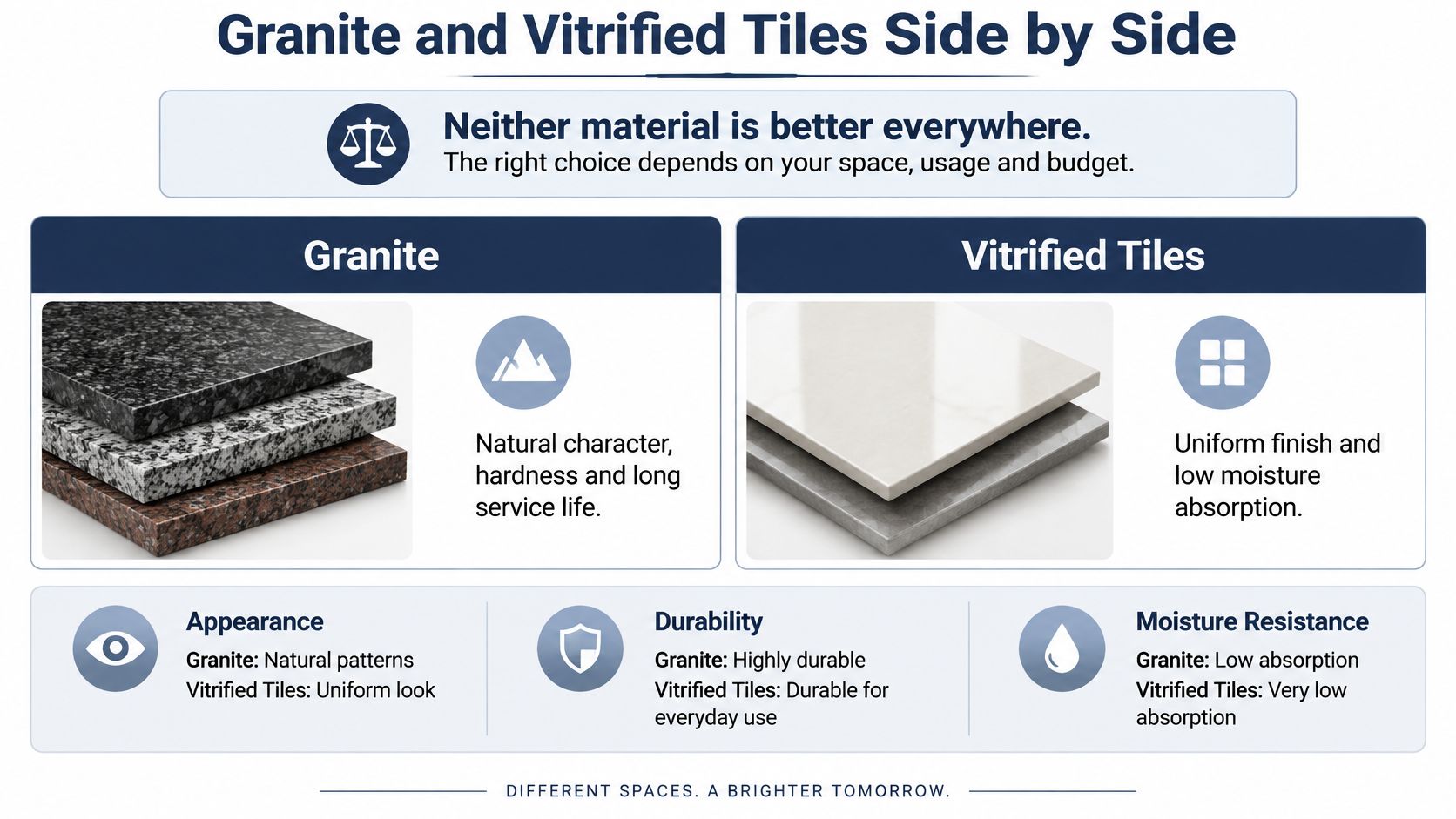
Compare the supplied finish
Browse granite flooring options by actual variety and finish, then compare them with a named tile product. Thickness, slab quality, surface treatment and workmanship can change the result more than the material label suggests.
For most rooms, the deciding rows are stain resistance, slip resistance and maintenance. Those determine what happens after the showroom shine meets everyday use.
How India Classifies Granite and Vitrified Tiles
India doesn't classify these materials through the same product standard. The Member of Architecture flooring guide identifies IS 15622 for pressed ceramic tiles and IS 14223 (Part 1) for polished building granite, and summarises the tile water-absorption groups below.
| Tile group | Water absorption |
|---|---|
| BIa | 0.5% or less |
| BIb | Above 0.5%, up to 3% |
| BIIa | Above 3%, up to 6% |
| BIIb | Above 6%, up to 10% |
| BIII | Above 10% |
The same guide records a legacy vitrified-flooring figure of below 0.08% in older Indian construction references. Treat that as a historical specification reference, not a replacement for the current BIa limit of 0.5%.
What absorption actually tells you
Water absorption indicates how readily moisture enters the material body. A lower result generally supports better resistance to moisture penetration and staining, which makes a declared low-absorption tile easier to evaluate for spill-prone rooms.
It doesn't prove that a floor assembly is waterproof. Water can still pass through joints, perimeter gaps or defective detailing, so bathroom waterproofing remains a separate construction requirement.
The specification comparison makes more sense when you examine the material alongside its test documentation.
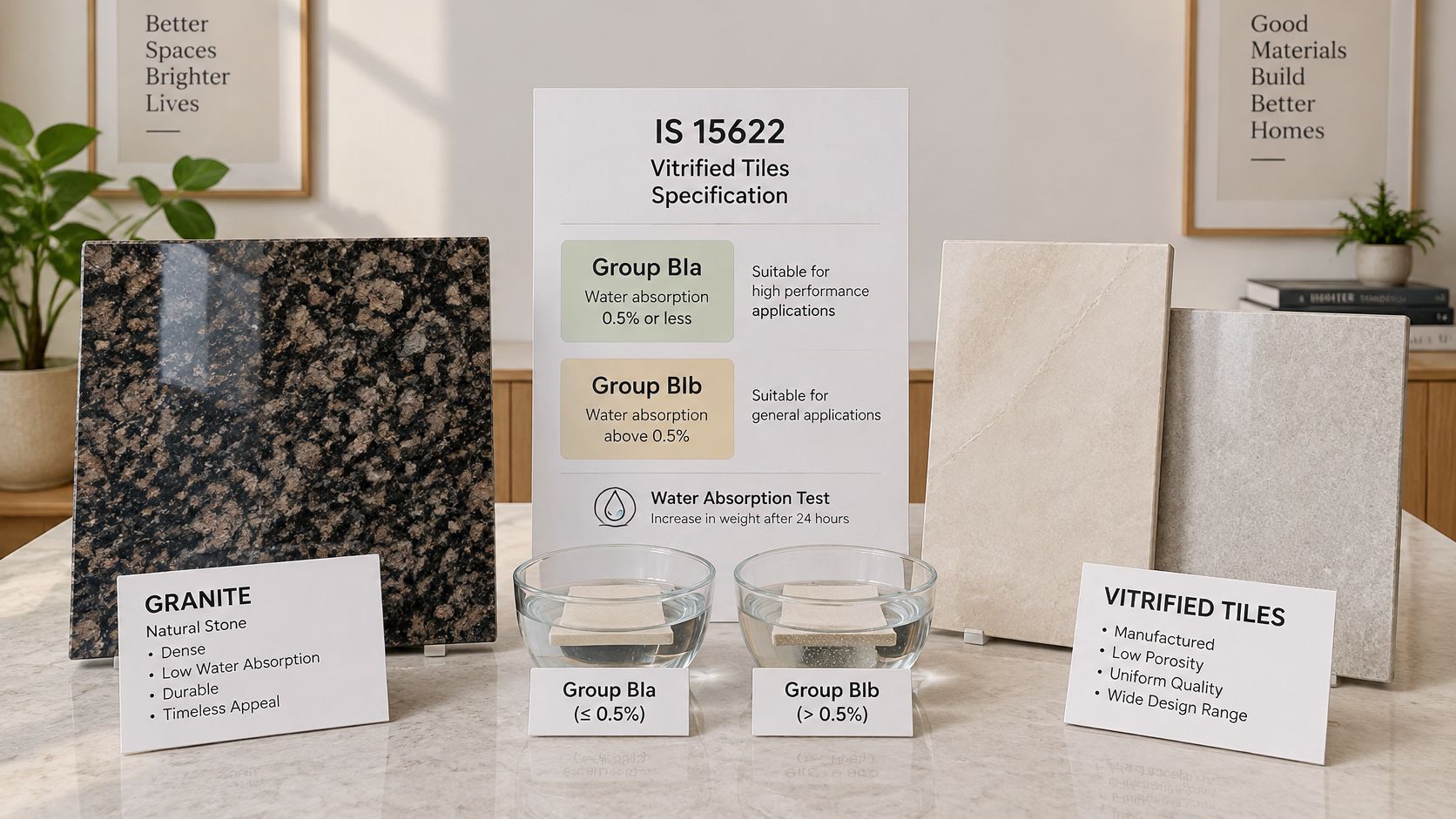
Why granite needs a different assessment
Granite isn't a ceramic tile, so asking for its ceramic absorption group is the wrong procurement question. Assess the selected variety, slab soundness, thickness, finish and intended application instead.
For stone, inspect resin-filled areas, fissures, edge condition and consistency across the delivery. For tiles, check that the carton description and test report identify the product you're buying, rather than another product sold under the same brand.
Procurement rule: Compare a named stone selection with a documented tile specification, not granite with a showroom promise of fully vitrified performance.
A dry bedroom and a frequently wet kitchen don't need identical specifications. Check the group on the carton or test report before comparing prices, then assess whether that product suits the room.
Durability, Wear and Slip Resistance Compared
A polished surface in a wet circulation area is a more immediate concern than which material is harder. Rain carried through an entrance, kitchen splashes and cleaning residue can make a visually impressive floor unsuitable for its actual use.
Hardness, abrasion resistance and slip resistance aren't interchangeable. A surface can resist scratching yet offer poor footing when contaminated with water.
Wear and impact require separate decisions
Granite's strength makes it a credible candidate for heavily used interiors, but that doesn't mean every slab or finish will age identically. Doorway grit, furniture movement and concentrated circulation deserve attention when choosing the finish and planning maintenance.
For vitrified tiles, request the declared abrasion result and its suitability for the proposed use. Don't assume that a bedroom product and a retail-floor product are equivalent because their printed designs look alike.
Impact introduces another variable: support beneath the flooring. Either material can suffer at an exposed edge or over a poorly supported area, so a claim that one never chips isn't a useful purchasing criterion.
- At entrances: Provide effective dirt trapping and select a finish assessed for rainwater carried indoors.
- Under movable furniture: Fit suitable protective pads and remove trapped grit rather than relying on material hardness.
- At exposed corners: Agree edge detailing and inspect cut pieces before installation.
- Across circulation routes: Evaluate the finish where people turn, stop and change direction, not just on a display board.
Assess the finish under the right conditions
Polished granite and polished vitrified tiles both warrant caution in wet locations. Honed, flamed, matte and textured surfaces offer different tactile qualities, but a finish name alone isn't proof of wet-slip suitability.
A guide to types of surface finishes can help you narrow the options. Follow that visual selection with product-specific slip information and an assessment of the expected contamination, footwear and cleaning method.
Say a home has a glazed entrance, a polished granite living room and a matte vitrified bathroom. The entrance needs scrutiny because rainwater may reach the walking surface; the living room needs grit control; the bathroom needs evidence that the selected texture performs in wet use.
A matte appearance isn't a slip certificate, and a polished appearance isn't evidence of superior durability.
Don't use an unsupported ramp-rating recommendation as a universal bathroom rule. Ask what test was performed, which finish was tested and whether its conditions represent the intended application.
There's no defensible blanket winner on durability. Granite offers natural-stone permanence and potential restoration options; vitrified tiles offer specified manufactured surfaces. The better choice is the product whose wear, finish and installation requirements match the traffic.
Maintenance and Lifecycle Cost Over Ten Years
Granite and vitrified tiles shift upkeep to different tasks. Granite care depends on the stone variety and finish: some selections may need an impregnating sealer, and worn surfaces may call for restoration. With vitrified tiles, routine cleaning is generally straightforward, while grout condition and the availability of matching replacement tiles deserve attention.
A reliable ten-year rupee total requires a defined maintenance scope and contractor quotations. Without them, a single figure would conceal assumptions about cleaning, sealing, repairs and restoration.
Ten-year upkeep for 100 sq ft, granite vs vitrified
| Cost item | Granite flooring | Vitrified tiles |
|---|---|---|
| Penetrating sealer | Need varies by stone variety; follow product-specific guidance and reseal when needed. | Tile body sealing is generally not required; grout may need resealing. |
| Re-polishing | May be needed if the finish wears; assess the surface before deciding. | Conventional stone re-polishing is not routine maintenance. |
| Routine cleaning products | Use a stone-compatible, pH-neutral cleaner. | Use a cleaner compatible with the tile and grout. |
| Chip repair | Colour-matched repair or replacement may be needed; the result depends on the match. | A retained matching tile can be used if replacement is needed. |
| Expected service life | Depends on stone quality, support, wear and restoration potential. | Depends on abrasion suitability, installation and replacement availability. |
Don't prescribe sealing by the calendar
Granite does not have one sealing schedule that suits every home. Ask whether the selected variety needs an impregnating sealer, which product is compatible, and how to tell when treatment is due.
Before applying sealer, clean and dry the stone, test the product in an inconspicuous area and remove excess as directed. The aim is to address absorption without leaving an unwanted surface film.
For everyday care, remove loose grit before damp mopping. Use a stone-compatible cleaner on granite, and avoid acidic descalers or aggressive abrasive pads.
For porcelain-type vitrified products, J.G. Carpet Cleaning LLC's guide to how to clean porcelain floors provides a maintenance reference. Check its advice against the tile and grout manufacturers' instructions, especially for polished or specially treated surfaces.
Price the inconvenient work
Matching can matter as much as the repair itself. A granite patch may remain visible if its colour or grain differs from the surrounding stone. A replacement tile can also stand out when the original batch is unavailable. Keeping labelled spare pieces can reduce that matching risk.
- Ask for an itemised scope: Separate cleaning, stain treatment, sealing, polishing and repair.
- Record access assumptions: Furniture removal, protection and restricted working hours can affect the quotation.
- Retain material: Store spare pieces where they will not be damaged.
Granite may suit owners willing to maintain the stone and consider restoration over time. Vitrified flooring suits owners who prefer straightforward surface cleaning, but grout care and replacement matching still require attention. Budget for the upkeep standard you expect, rather than relying on a generic lifespan claim.
Installation, Sizing and Replacement Matching
Installation quality can erase the advantage of either material. Before work starts, agree who is responsible for the substrate, bedding system, cutting, joints and protection after installation. In Indian homes, monsoon humidity and heavy daily use make correct preparation and compatible products especially important.
Granite may require site cutting, seam finishing and polishing, depending on the supplied product. Vitrified tiles need an adhesive system suited to the tile, substrate and application. Large formats are harder to install over an uneven base, so check the substrate before laying begins.
Use a granite slab measurement guide to plan the layout, then have the fabricator confirm site dimensions before cutting. Coordinate door thresholds, stair landings, skirting and floor build-up in drawings rather than relying on assumptions at delivery.
Check the work in sequence
- Survey the substrate. Use a straightedge and level to identify high spots, depressions and changes at doorways. Record the acceptable tolerance in the installer's written specification.
- Approve the bedding system. Match mortar or adhesive to the material, substrate and service conditions. Availability alone is not a sound basis for choosing it.
- Verify contact beneath large tiles. Back-butter where the specified system requires it, then lift trial pieces to inspect coverage. Correct voids while the adhesive is workable.
- Set out joints deliberately. Agree joint width, movement accommodation and alignment before laying. The request for a nearly jointless floor should not override the installation system.
- Confirm stone treatment and grout compatibility. If pre-grout sealing is specified, test it first. Keep treatment off bonding faces unless the system permits it.
Protect completed flooring from scaffold feet, dragged equipment and following trades. Inspect before covering it, so chips or lippage present at that point are recorded before handover.
A large supply chain doesn't guarantee a match
India has a substantial domestic granite supply base, but that does not guarantee the availability of a particular quarry selection. Natural variation can make a later granite purchase visibly different. Manufactured tiles are more repeatable within an identified batch, yet later production or discontinued designs can also make close matching difficult.
Keep the identity, not just the invoice: Retain carton labels, lot details, stone-selection photographs and labelled spare pieces.
Ask the installer to calculate replacement stock from the layout and likely repair needs. Store spare material from the original purchase. Neither material can be assumed to match years later.
Choosing the Right Floor and Checking Before You Buy
Choose granite when natural character, feature stone and long-term retention matter, and you're prepared to follow a stone-specific care plan. Choose vitrified tiles when controlled moisture performance, visual consistency and uncomplicated routine cleaning are the priorities.
Bring representative samples together before deciding. A small showroom piece can hide pattern repetition, texture differences and the colour changes you notice under your own lighting.
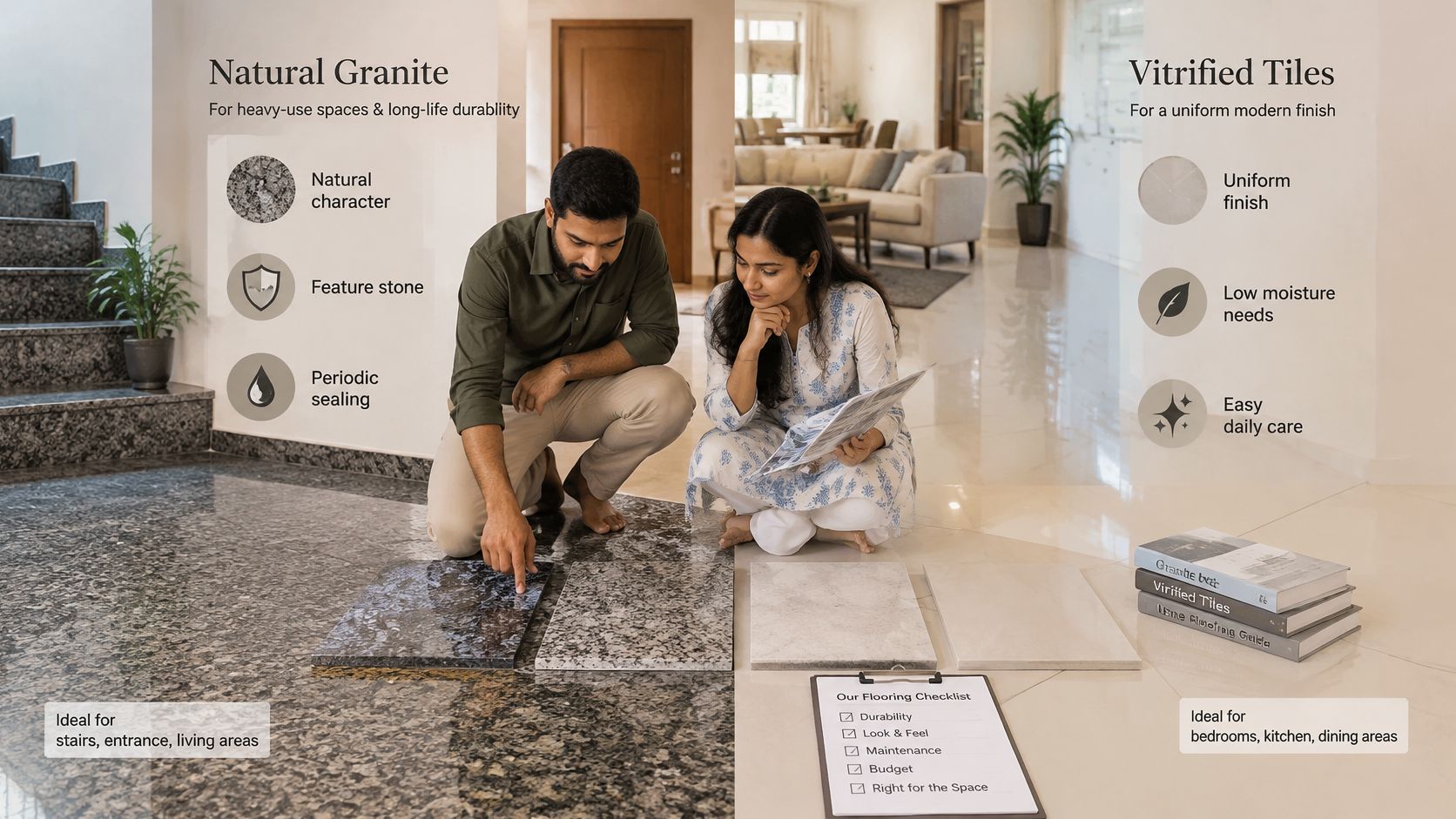
Match the material to the space
Best flooring choice by space
| Space | Better fit | Reason |
|---|---|---|
| Kitchen floor | Low-absorption vitrified tile | Supports spill management and straightforward cleaning. |
| Bathroom and wet areas | Textured vitrified tile with documented wet-use suitability | Combines moisture control with an assessed walking surface. |
| Living and dining room | Granite, or vitrified for a uniform look | Choose natural variation or controlled visual repetition. |
| Bedrooms | Either, selected against the installed quotation | Light-use rooms allow appearance and budget greater weight. |
| Staircases | Granite with an appropriate grip finish and sound edge detailing | Offers a durable stone solution when carefully fabricated. |
| Commercial lobby or retail floor | Abrasion-specified vitrified for broad areas; honed granite for feature zones | Separates repeatable field flooring from natural-stone features. |
| Hospitality with frequent cleaning | Vitrified with a compatible cleaning specification | Supports consistent finishes and organised maintenance. |
| Rental or budget homes | Vitrified with retained replacement stock | Simplifies repair planning and product identification. |
A mixed scheme can be more rational than selecting one material for the entire home. Granite may suit a living room and staircase, while specified vitrified products address kitchen, bathroom and entrance requirements.
Coordinate the transitions carefully. Changes in thickness, texture and joint alignment should be resolved before ordering, especially where a wet zone meets a dry circulation area.
For commercial projects, ask the facilities team how they clean. The product must suit the equipment, detergents, operating hours and expected contamination, not merely the architect's sample board.
Read the documents before approving the order
The BIS ceramic-tile compendium identifies IS 15622:2017 for pressed ceramic tiles and IS 13630 for tests including absorption, breaking strength, abrasion and chemical resistance. Its standards framework supports checking measured performance rather than relying on a fully vitrified sales description.
The same guidance doesn't provide one universal national slip minimum for every application. That distinction matters: a supplier should explain the suitability of the exact finish for the intended wet-use condition, not offer a generic assurance that all matte tiles are safe.
- Request product identification and the test report. Match the manufacturer, product code, declared absorption group and delivery lot. For stone, obtain the variety description and agreed slab selection.
- Ask for abrasion and slip information. Confirm that the report concerns the finish being supplied. Ask the specifier to interpret the test method for the room's conditions.
- Examine samples in daylight and artificial light. Wet a sample to inspect its changed appearance, but don't treat touching or walking on it as a substitute for slip testing.
- Record the lot and approve the delivery. Keep labels, invoices and photographs. Check shade, dimensions and visible damage before installation begins.
- Close the installation responsibilities. Require written substrate acceptance, adhesive selection and joint details using the checkpoints agreed with the contractor.
Vitrified tiles accounted for approximately 30% of India's tile market in 2025, according to Maximize Market Research. That establishes their market presence, not the suitability of an individual product.
The video below provides another visual reference for comparing flooring options.
Keep design inspiration separate from specification
Pattern references can help you decide whether the floor should be quiet or decorative. Aureli Construction's encaustic tile inspiration for Boston homes is useful for exploring patterned-floor composition, but it isn't evidence that an encaustic product shares vitrified tile's performance.
Use inspiration to establish the design direction, then specify the actual material independently. This avoids choosing a product for its appearance and only later discovering its care requirements.
Shortlist a named granite variety and a named vitrified product for each demanding room. Request their documentation, an installed quotation and a sample layout before making the final choice.
Varun Marbles offers granite and other flooring surfaces, with support for selection, cutting, finishing and installation coordination. Visit Varun Marbles at Sikanderpur Marble Market or HUDA Marble Market, Sector 33-34, Gurugram, with your room plan and shortlisted specifications to compare samples and discuss the work from cutting to fit.