
Exterior Marble Wall Cladding: A Practical Guide
You're standing in a Gurugram stone yard with two samples in your hands. One is a glossy Makrana marble, the other an imported Statuario with dramatic grey veining. Both look convincing under showroom lights, but the question is harder: which one will still look controlled after monsoon rain, summer heat, dust, pollution and years of cleaning on a north-facing facade?
That decision isn't about colour alone. Exterior marble wall cladding is a facade system, and the stone is only one part of it. Panel thickness, back-anchoring geometry, joints, sealants, drainage and inspection determine whether the finished wall develops staining, bowing, efflorescence, anchor movement or surface loss.
India's Marble Division records marble use in buildings, monuments, sculptures, wall cladding, facades and flooring, and estimates India's total marble resources at 1,931 million tonnes according to the Indian Bureau of Mines. Marble is therefore not an experimental exterior finish. It's an established architectural stone that demands a more disciplined specification than an interior lobby or bathroom.
Table of Contents
- Why Exterior Marble Wall Cladding Demands More Thought Than Interiors
- Understanding Marble as an Exterior Building Material
- Choosing the Right Marble for Indian Climate Conditions
- Anchoring Systems and Structural Detailing for Marble Facades
- Weathering, Sealing, and Long-Term Maintenance Cycles
- Lessons from Centuries-Old Marble Facades in India
- Cost Drivers and Budget Planning for Marble Cladding
- Is Exterior Marble Wall Cladding the Right Choice for Your Project
Why Exterior Marble Wall Cladding Demands More Thought Than Interiors
An interior marble wall sits within a relatively protected envelope. A facade faces wind-driven rain, ultraviolet radiation, airborne dust, polluted runoff and repeated shifts between hot and cool surfaces. In Delhi-NCR, that exposure affects the stone, joints, anchors and every path through which water can enter.
A polished Makrana sample and a Statuario sample may both look convincing in a showroom. For a lobby, the decision can centre on veining, reflection and lighting. On an exposed elevation, the specification must also address staining, movement, drainage, cleaning access and the behaviour of the fixing system over time.
Specification principle: A marble facade should be designed as a coordinated envelope, not purchased as a decorative surface.
Marble is widely used for exterior vertical wall cladding, polished wall panelling and facades. The Indian Bureau of Mines cites a 1993 survey reporting marble use at 30% to 35% of total constructed area in commercial, private and government buildings, compared with 20% to 25% in residential buildings Indian Bureau of Mines. That pattern helps explain its presence in institutional, commercial and premium projects. These buildings often use substantial quantities of stone, so their detailing, inspection routes and maintenance access must be planned with equal care.
The facade has a longer memory
An interior finish can be replaced during refurbishment. A facade is connected to the structure, weather barriers, movement joints, access equipment and public safety requirements. Its performance must therefore be judged across a long service period, not only during the short fit-out decision.
The recurring failures are familiar:
- Staining, commonly concentrated around joints, fixings and drainage paths.
- Bowing or cracking, associated with thermal movement, weak stone or excessive restraint.
- Anchor pull-out, when the fixing or substrate cannot safely support the panel.
- Efflorescence, caused by moisture carrying soluble salts to the surface.
- Surface loss, including etching, dulling and granular deterioration.
The Taj Mahal shows both the potential and the limits of marble. Built from Makrana marble, it has remained in service for centuries, while its conservation history shows how pollution can affect a marble facade. Britannica describes damage to the mausoleum's marble facade from air pollution produced by nearby factories and motor vehicles Britannica's Taj Mahal overview. Long service is achievable, but it depends on stone selection, back-anchoring geometry, sealant cycles, drainage and a maintenance regime that keeps the facade inspectable.
Understanding Marble as an Exterior Building Material
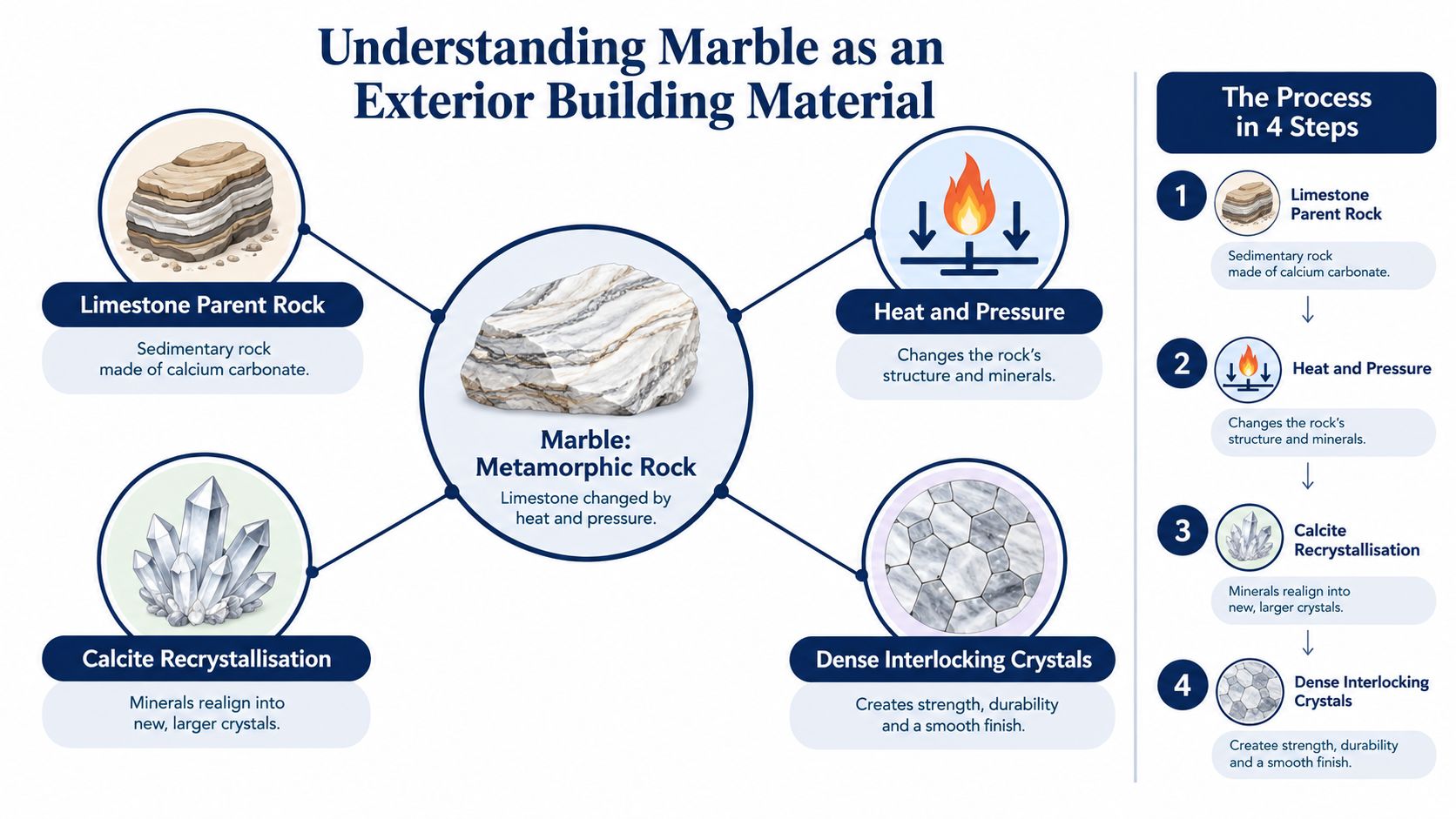
Marble begins as limestone. Over geological time, heat and pressure alter the parent rock, causing calcite crystals to recrystallise and form a new interlocking structure. The result is a metamorphic rock, not a harder version of ordinary limestone.
A useful visual analogy is the difference between tightly packed sugar cubes and loose sand. Interlocking crystals can create a compact, load-bearing matrix, while microscopic boundaries and fissures still provide routes for water, staining agents and chemical attack. The stone can perform well in compression, but its behaviour depends on the particular quarry block, mineral composition, fissures and fabrication quality.
Three properties control exterior suitability
Porosity determines how readily water can enter and move through the stone. Dense marble may have low absorption, while softer or more fissured varieties can take in substantially more moisture. On an exterior wall, that difference affects staining, efflorescence, freeze-related concerns in other climates, biological growth and the performance of sealants.
Density affects dead load and handling. A suitable facade panel still imposes weight on its support system, and the engineer must account for that load alongside wind actions, movement and the capacity of the substrate. The stone's weight doesn't disappear because it has been cut into a thin panel.
Mineral composition changes chemical resistance. Calcite-dominant marble is vulnerable to etching from acidic substances, including polluted rainwater and unsuitable cleaning chemicals. Dolomitic marble generally offers better resistance to some acidic exposure, but that doesn't remove the need for compatible cleaning and drainage details.
Marble also needs to be judged against alternatives. Granite is generally harder and less chemically sensitive, quartzite can offer high resistance to wear and etching, and sandstone brings a different porosity and weathering profile. The correct comparison isn't “which stone is strongest?” It's “which stone, finish and fixing system suit this exposure and maintenance capability?”
Cutting marble creates dust containing respirable crystalline silica. Fabricators and installers should follow proper wet-cutting, extraction and respiratory protection procedures, with practical workplace guidance available in this silica exposure prevention guide.
Choosing the Right Marble for Indian Climate Conditions
A showroom sample tells you how a stone looks. It doesn't tell you how a particular quarry batch will behave on a sun-exposed wall, beside a polluted road or beneath a leaking coping. Exterior selection should begin with water absorption, fissuring, mineral stability, finish, batch consistency and available panel formats.
Indian marbles often offer a practical advantage because local supply, fabrication knowledge and replacement matching are easier to manage. Dense options such as Makrana Dungri, Rainforest Green, Andhra Green and selected Kishangarh browns can be considered where testing confirms suitability. Imported Statuario, Carrara and Calacatta may deliver a refined visual language, but softer veined whites often demand tighter control of sealing, cleaning and panel selection.
| Marble Variety | Origin | Porosity / Absorption | Weather Resistance | Colour Stability | Availability in Exterior Thickness |
|---|---|---|---|---|---|
| Makrana Dungri | India | Must be verified by batch testing | Established Indian architectural use, subject to detailing | Generally stable, with natural variation | Often practical through local fabrication |
| Rainforest Green | India | Verify fissures and absorption before approval | Suitable only when the selected batch and system are engineered correctly | Pattern and mineral variation should be reviewed in full slabs | Availability depends on block and fabricator |
| Andhra Green | India | Confirm absorption and discontinuities | Can suit feature facades with controlled moisture management | Green tones require mock-up review under sunlight | Local sourcing can support replacement planning |
| Kishangarh browns | India | Test for porosity and clay-rich bands | Depends heavily on quarry selection and joint detailing | Earth tones can be forgiving of surface dust | Exterior sizing should be confirmed before order |
| Statuario, Carrara and Calacatta | Italy | Softer or more fissured selections need careful testing | Higher maintenance exposure on open facades | Veins, iron staining and surface etching need review | Large exterior panels may require special fabrication planning |
Select the block, not just the name
Avoid highly fissured slabs, clay-laden bands and pieces with open seams that fabrication may expose. Ask for quarry-batch test certificates covering water absorption and flexural strength, then review the actual slabs intended for the project. A written stone name on a quotation isn't a substitute for inspection.
Mock-ups matter because veining changes the visual reading of joints, corners and panel transitions. A polished white marble may look impressive initially but reveal rust marks, biological staining or dull patches more readily than a honey, brown or green stone with stronger visual variation.
For design references around practical marble applications, the parking marble design guide can help broaden the conversation beyond indoor floors and walls. The final decision, however, should be based on exposure and tested performance, not a catalogue photograph.
Anchoring Systems and Structural Detailing for Marble Facades
Most exterior marble failures begin in the interface between panel, anchor, substrate and movement joint. A beautiful stone can fail if the fixing geometry concentrates stress at a weak edge or if the installer expects adhesive to carry loads that belong to a mechanical support system.
For panels above pedestrian level, Indian facade guidance referenced in the brief says adhesive alone isn't acceptable and recommends mechanical back-anchoring or ventilated rainscreen systems, with local wind-load sizing and movement accommodation India-focused facade guidance. The same guidance points towards mechanically fixed exterior panels in the 20 to 25 mm range, while the final thickness remains an engineering decision based on stone properties, panel dimensions, wind loads and fixing arrangement.
How the fixing options differ
| Method | Panel Hold | Best Application |
|---|---|---|
| Adhesive-only fixing | Relies on bond strength and substrate compatibility | Limited, sheltered applications where the system designer explicitly permits it |
| Kerf slotting | Transfers load through edge slots and clips | Regular panels with controlled slot geometry and experienced fabrication |
| Back anchors | Provides mechanical restraint through the rear of the panel | Exterior elevations requiring concealed support and engineered load transfer |
| Ventilated rainscreen | Combines mechanical restraint with a drained cavity | Exposed facades where moisture removal and movement control are priorities |
Thinner panels may reduce material and handling demands, but they also reduce the margin around kerfs, dowels and anchors. Slots placed too close to edges can split the stone, while anchors set without allowance for movement can force the panel to bear against adjacent units or the structural frame.
Stainless steel selection also follows exposure. A2-grade hardware may suit some inland conditions, but A4 stainless steel is the safer discussion for coastal districts and chloride-rich environments, subject to the engineer's corrosion assessment. The anchor type, embedment, edge distance and substrate capacity must be documented rather than left to site improvisation.
Build movement into the detail
The stone shouldn't carry the building's structural movement. The system needs horizontal and vertical joints that separate panels, accommodate differential movement and prevent rigid bearing. Sealants should bond to compatible joint faces, use suitable backing materials and avoid three-sided adhesion.
The same discipline used for other mechanically restrained elements applies here. A structural balustrade fixing guide is useful background when reviewing resin anchors, substrate behaviour and load transfer, although a marble facade still requires its own engineered calculations and tested assembly.
Site rule: Never approve a marble facade from a sample panel alone. Approve the stone, anchor detail, joint layout, substrate interface and installation method as one mock-up.
Weathering, Sealing, and Long-Term Maintenance Cycles
Exterior marble is exposed to a repeating combination of water, ultraviolet radiation, pollution and temperature change. A 2024 literature review identifies temperature variation combined with moisture in pore spaces as a major driver of marble deterioration, while a 2024 chapter on marble weathering also discusses thermal weathering, efflorescence and cracking literature review source. Indian facades face the same interaction in a particularly demanding monsoon and heat-swing context.
Water enters through fissures, joints, failed sealant lines and porous edges. It can carry dirt inward, transport salts towards the surface and keep shaded joints damp enough for biological staining. Polluted runoff can also etch calcite, especially where water repeatedly follows the same path below sills, parapets and projections.

Use breathable protection
For most calcite-based exterior marble, a compatible penetrating impregnator is preferable to a heavy film-forming coating. An impregnator can reduce liquid uptake while allowing vapour movement, whereas a topical film may trap moisture, peel, yellow or create patchy gloss under ultraviolet exposure.
That doesn't mean every penetrating sealer is suitable. The applicator should test for darkening, colour change, reduced vapour transmission and compatibility with the chosen finish. Polished marble, honed marble and textured marble won't respond identically. The sealing stone tiles guide 2026 offers useful general context on sealing natural stone, but the project team should follow the selected product's technical data and a facade-specific mock-up.
A maintenance plan should distinguish sheltered and exposed elevations rather than applying one calendar to the whole building:
- After each monsoon: Inspect drainage paths, open joints, parapet interfaces and areas showing damp staining.
- At a fixed cleaning interval: Remove pollution deposits using a neutral, stone-compatible method. Avoid acids and aggressive abrasives.
- After major heat or weather extremes: Review sealants, anchor zones, corner panels and areas with new movement.
- At regular professional inspections: Check accessible anchor points, joint adhesion, panel alignment and water entry indicators.
- At sealer review: Reapply only when testing shows the impregnator has lost effectiveness. Spot repair is better than blanket application when performance remains sound elsewhere.
Cleaning chemistry matters
Acidic cleaners can etch marble. Harsh pressure washing can drive water into joints or damage a weathered surface. A controlled test patch should confirm dilution, dwell time, agitation method and rinsing procedure before the crew cleans the full elevation.
For finish selection and care expectations, Varun Marbles' discussion of the difference between honed and polished marble is relevant because surface texture changes how marks, reflection and maintenance are perceived. A facade that's intended to retain a mirror-like polish will demand more visual inspection than one designed to develop a controlled patina.
Lessons from Centuries-Old Marble Facades in India
The Taj Mahal remains a useful technical case study because it combines centuries of service with clear evidence of environmental vulnerability. Construction began about 1632, the mausoleum was completed about 1638–39, and the full complex was finished in 1653, according to Britannica. Built from white Makrana marble, it shows what careful material selection and construction can achieve over time, while also warning against treating longevity as proof of zero maintenance.

Pollution linked to nearby factories and motor vehicles has damaged the monument's facade. A separate historical account records that India's Supreme Court ordered anti-pollution measures in 1998 to address deterioration. The practical lesson for Indian projects is direct: surrounding air quality, traffic and industrial activity can change while the stone and original construction remain unchanged. A specification should therefore account for the exposure a facade will face during its operating life, not only its appearance at handover.
Historic marble buildings also show why mass and detailing matter. Traditional construction often relied on substantial stone members, generous joints and assemblies that could accommodate minor irregularities. Modern thin panels must achieve comparable tolerance through engineered back-anchors, correctly positioned support points, movement joints, drainage paths and inspection access. Panel thickness cannot be separated from anchor geometry or substrate behaviour.
Surface finish changes the maintenance burden. A highly polished facade exposes deposits, etching and water tracks quickly. Honed or lightly textured marble may absorb minor weathering more, but it still requires compatible cleaning and controlled runoff. Finish selection should match the owner's willingness to inspect, clean and repair the elevation.
Conservation practice supports a cautious cleaning specification. Acidic products can attack calcite, while abrasive methods may permanently change the surface. Require a test-cleaning protocol before the first full wash, covering the approved agent, dilution, equipment, dwell time and rinse method. Record the accepted result so future contractors cannot substitute a harsher process.
The following video provides additional visual context on the monument and its marble envelope.
Cost Drivers and Budget Planning for Marble Cladding
A reliable exterior marble budget starts with scope separation. Stone procurement is only the visible line. Fabrication, edge profiling, anchor hardware, access, installation, mock-ups, structural support and future sealing can materially change the final figure.
The brief does not provide verified prices or project-specific cost ranges, so a responsible budget should not attach invented rupee values to a facade. Instead, request itemised quotations for the actual stone, panel format, fixing design and elevation access.
| Cost Line | Indian Marble (₹/sqft) | Imported Marble (₹/sqft) | Key Driver |
|---|---|---|---|
| Stone procurement | Obtain project quotation | Obtain project quotation | Quarry, grade, block selection, veining and wastage |
| CNC fabrication and edge profiling | Obtain project quotation | Obtain project quotation | Panel geometry, mitres, grooves, tolerances and finish |
| Stainless-steel anchoring hardware | Obtain engineered rate | Obtain engineered rate | Anchor type, steel grade, panel size and substrate |
| Installation and access | Obtain site-specific rate | Obtain site-specific rate | Skilled labour, scaffolding, lifting and elevation complexity |
| Sealing and planned cleaning | Obtain product and service rate | Obtain product and service rate | Sealer system, exposure, cleaning method and inspection needs |
Ask vendors to price the hidden work
Include structural steel augmentation where the existing substrate lacks capacity. Price a full-scale mock-up, replacement panels, fabrication wastage, lifting arrangements and access equipment separately. A low stone rate can be misleading if the quotation excludes the engineering and site controls that make the assembly safe.
The most useful comparison is a lifecycle schedule. Ask what the owner will inspect, clean, reseal and repair, who can access the facade, and whether replacement panels from the same quarry batch can be stored or sourced later. Anchoring and sealing shouldn't be treated as optional extras because they directly influence the serviceability of the stone system.
Varun Marbles can be considered as one local sourcing and execution option for projects requiring Indian or Italian marble selection, cut-to-size fabrication, edge profiling and installation coordination. Its Gurugram showrooms allow teams to inspect slab tone and veining in person, which is particularly useful when planning panel sequencing and replacement strategy.
Is Exterior Marble Wall Cladding the Right Choice for Your Project
Marble is appropriate when the design value justifies the engineering and maintenance burden. It works particularly well for heritage-inspired residences, carefully sheltered feature walls, premium entrances and selected commercial or hospitality elevations where owners accept controlled weathering and planned care.
It becomes a weaker choice when the project demands the lowest initial cost, minimal access for inspection or a permanently uniform polished appearance in an exposed environment. Coastal exposure, high-rise construction and polluted runoff don't automatically rule marble out, but they raise the standard for stone testing, mechanical restraint, drainage and maintenance planning.
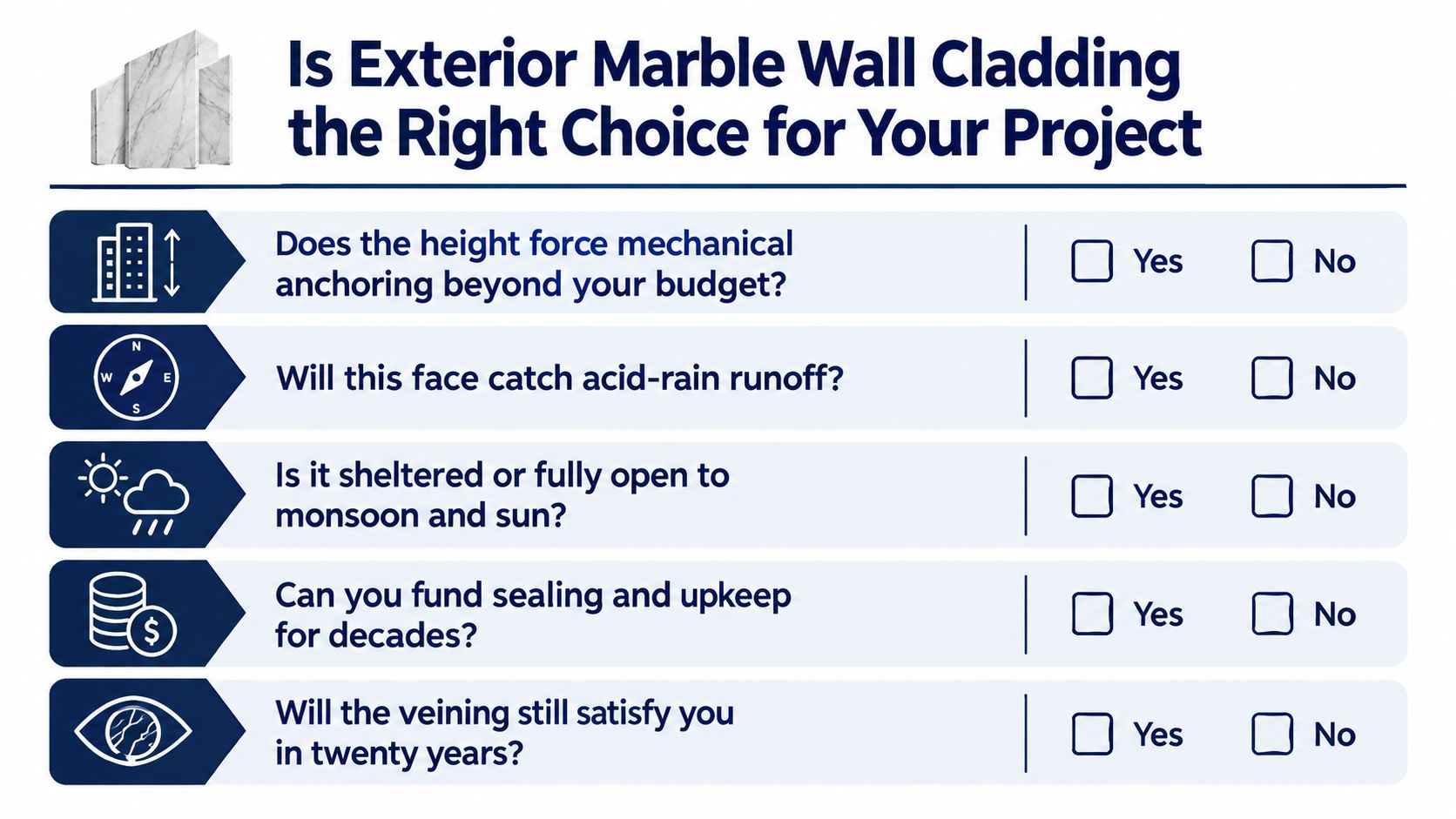
Use this go-or-no-go test
- Height: Does the building require mechanical anchoring that the budget and structure can support?
- Orientation: Will the elevation receive polluted runoff from parapets, ledges or nearby traffic?
- Exposure: Is the wall sheltered, or will it take direct monsoon rain and intense sun?
- Stone: Has the proposed quarry batch been tested for absorption, fissures and flexural performance?
- Maintenance: Can the owner fund inspection, compatible cleaning and sealing over the facade's life?
- Appearance: Will the owner accept gradual patina, or expect the stone to remain visually unchanged?
The comparison with vitrified surfaces should also be made on system terms, not just on purchase price. The practical differences outlined in marble versus vitrified tiles become more important outdoors, where fixing, movement, weather exposure and replacement logistics govern the result.
Final decision: Choose marble when you're prepared to specify the whole envelope. If the project can fund only the stone and installation, it isn't ready for exterior marble wall cladding.
For a facade review in the NCR, visit Varun Marbles to inspect Indian and Italian marble slabs, compare tone and veining, and discuss cut-to-size fabrication and installation coordination. Take your elevation drawings, exposure requirements and fixing concept so the material selection supports a buildable, maintainable exterior rather than a showroom-only finish.