
Parking Marble Design That Actually Lasts
Polished marble is generally the wrong choice for Indian parking because it becomes slippery when wet, absorbs oil, and rarely meets the durability envelope needed for vehicle traffic. For a safer parking marble design, choose a honed, flamed, or bush-hammered surface, then treat drainage, joints, and base preparation as seriously as the stone itself.
The popular advice says marble makes a driveway look expensive. That advice stops at the photograph. On an actual Indian site, a glossy surface meets monsoon water, tyre grit, oil drips, turning loads, and an installer who may be trying to save time beneath the finished slab. The result can look premium on day one and perform like a liability soon after.
India has an enormous marble resource base, but the supply picture is concentrated. The Indian Minerals Yearbook records 1,945 million tonnes of total marble resources, while only about 4.5 million tonnes, or 0.23%, are classified as reserves. Rajasthan also contributed about 89% of output value in 2014–15, compared with about 10% from Gujarat and roughly 1% from other states, according to the Indian Minerals Yearbook marble data. That concentration makes marble widely available through Rajasthan-linked supply chains, but availability doesn't make every slab suitable for a vehicle surface.
The correct question isn't, “Which marble looks most luxurious?” It is, “Which stone, finish, base, slope, joint, and maintenance plan can survive this exact parking area?” In most Indian homes, the answer won't be polished marble.
Table of Contents
- Why Most Parking Marble Designs Fail Before They Are Even Laid
- What a Parking Floor Has to Survive Every Single Day
- Marble, Granite and Engineered Quartz Compared for Parking Use
- Choosing the Right Finish for a Safe, Good-Looking Parking Surface
- Design Details That Decide Whether the Stone Will Last
- Stone Parking Floors and the Alternatives Worth Considering
- Common Misconceptions About Parking Marble Design
- A Practical Decision Checklist Before You Finalise the Stone
Why Most Parking Marble Designs Fail Before They Are Even Laid
A buyer's showroom choice often clashes with driveway demands. Polished marble attracts attention through strong colour, sharp veining, and the reflective finish associated with luxury interiors. The same specification can become unsafe outdoors when a contractor treats an interior slab as a vehicle surface.
For most Indian parking areas, finish and detailing matter more than the stone family. A honed, flamed, or bush-hammered surface gives you a more credible grip strategy than mirror polish, especially on ramps and exposed driveways. The base, slope, joints, and maintenance plan still determine whether that choice performs.
Outdoor parking guidance warns against polished marble because wet conditions can make it slippery. The parking stone guidance from Tiles Finders recommends textured materials and better drainage planning. During an Indian monsoon, a smooth calcite surface can lose grip where a car brakes, turns, or climbs a ramp.
Four decisions made before stone selection
Finish selection controls friction more directly than the stone's name. Choose honed, flamed, or bush-hammered finishes for vehicle areas. Texture cannot rescue a weak base, but polished stone creates an avoidable slip and maintenance problem.
Joint width and filler decide where water and dirt collect. Tight, poorly filled joints can open after movement. An unsuitable grout may trap moisture or crumble under tyre action.
Drainage slope determines whether rainwater leaves the surface or sits against edges and joints. A beautiful slab installed over a flat area with ponding will age badly, whatever its origin.
Base preparation carries the vehicle load before the stone does. If the sub-base settles beneath a wheel path, slabs can crack, rock, or lose support at their corners.
Site rule: Never approve a parking stone sample without approving its finish, joint detail, drainage drawing, and base build-up.
Rajasthan's strong role in Indian marble production makes sourcing convenient, but catalogue-led purchasing can shift attention towards pattern matching. Designers may secure a familiar Indian or imported look quickly, then leave performance decisions to the installer. Set the installation requirements before ordering the slab.
Start with the site's actual use. Covered porch parking with slow, occasional movement differs from an exposed driveway, ramp, or commercial forecourt. Wet tyres, hard turning, oil exposure, and regular traffic justify a textured granite or quartzite recommendation in many cases. The attractive polished look is often the poorer lifecycle choice.
What a Parking Floor Has to Survive Every Single Day
A parking floor faces repeated, uneven contact rather than one uniform load. Tyres turn at low speed, braking forces concentrate near edges, and a jack or stand can create severe point pressure on a small area. Grit beneath a tyre acts as an abrasive, gradually dulling the surface. Polished marble shows that wear early, often before structural damage becomes visible.
Water adds another failure route. Monsoon runoff enters joints, wash water remains in low spots, and oil can penetrate porous or poorly sealed stone. Marble generally handles wet-service conditions less comfortably than granite within the indicative ranges in Indian natural-stone standards guidance. Those absorption figures were covered earlier, so this section focuses on what water does at the installation: it raises slip risk, exposes weak drainage, and carries contaminants into open pores. Marble's thermal response also makes exposed surfaces sensitive to heat from the substrate and changing weather.
The daily stress test
- Point loading: A wheel, jack, or stand can stress a small contact area far more severely than ordinary foot traffic.
- Turning and braking: Low-speed steering creates lateral force across joints and slab edges, particularly where the base lacks full support.
- Heat exposure: Dark external finishes absorb more solar heat. India-focused parking guidance reports that exposed dark driveways can reach 60 to 70°C in summer, so colour and surface texture deserve attention alongside strength. See the parking tile selection guide from H&R Johnson India.
- Oil and fuel: A spill can move through open pores before anyone notices it. Later cleaning may remove the visible mark without drawing out the absorbed stain.
- Rain and wash water: Water makes polished finishes more slippery and reveals weaknesses in slope and joint detailing.
- Grit: Sand, dust, and road debris scratch softer surfaces beneath moving tyres.
Northern Indian sites also face cold winter conditions, especially where wet stone experiences repeated temperature changes. Specify weather tolerance, not merely an interior flooring grade.
Facility teams managing larger sites should broaden material discussions to include inspection, cleaning, drainage, and repair planning. This guide for facility managers on lots provides a useful framework for those operational tasks.
Set the performance threshold before discussing colour or veining. The surface needs reliable wet grip, a stable and well-drained base, resistance to staining and edge damage, and a finish that remains maintainable under repeated vehicle movement. For most Indian parking areas, honed, flamed, or bush-hammered finishes deserve priority over polished marble. If the proposed stone cannot meet that standard, choose another material.
Marble, Granite and Engineered Quartz Compared for Parking Use
For most Indian parking areas, the stone family is only half the decision. Finish, drainage, joint detailing, and maintenance access determine whether the surface remains safe and presentable. Marble may offer the richest veining, but showroom gloss is a poor basis for an exposed vehicle floor. Evaluate abrasion, staining, weather, repairability, and finish performance before choosing the colour.
BIS provides a useful reference for specified marble. IS 1130 sets maximum water absorption at 0.4% under current standards, with a proposed 0.20% threshold, as recorded in this IS 1130 reference. Those values are specification checkpoints; they do not authorize polished marble installation outdoors. Use the absorption figures in the table alongside the broader interpretation from the earlier performance discussion.
| Property | Marble | Granite | Engineered Quartz |
|---|---|---|---|
| Water absorption | Indicative range around 0.2% to 0.6% in Indian guidance. BIS marble references include a 0.4% maximum under IS 1130 and a proposed 0.20% threshold. | Indicative range around 0.1% to 0.5% in Indian guidance. | Generally low porosity, but confirm the manufacturer's technical sheet for the exact product. |
| Strength and hardness | Attractive but generally softer and more vulnerable to abrasion, edge damage, and acid attack. | Strong, hard, and dependable for vehicle traffic when correctly specified and finished. | Consistent and dense, with product-specific performance that must be checked for external heat and UV exposure. |
| Slip-resistant finishes | Honed and textured options are preferable to polished marble. | Honed, flamed, and bush-hammered finishes make it the strongest practical option for many driveways. | Matte and leathered finishes may improve grip, but availability and outdoor suitability vary. |
| Staining behaviour | Oil and dirt can enter pores, particularly where sealing and cleaning are neglected. | More forgiving, though spills still require prompt removal. | Low porosity helps routine stain resistance, but seams, edges, and surface damage still need care. |
| Weather tolerance | Use cautiously outdoors, especially in constantly wet or heavily trafficked areas. | Better suited to exposed vehicle zones and repeated turning. | Confirm UV, heat, and exterior warranty conditions before using it on sun-baked drives. |
| Lifecycle cost | Can become expensive if it needs frequent stain treatment, repairs, or refinishing. | Usually the dependable lifecycle choice for heavy-use parking. | Offers visual consistency and low routine upkeep, subject to exterior limitations. |
For a typical open driveway, flamed or bush-hammered granite is the default recommendation. It gives vehicle areas a stronger margin for wet grip, turning stress, and repeated cleaning. Honed marble can suit a covered porch or entry bay with slow, intermittent traffic, provided the slab is sealed and the supporting details are sound.
Engineered quartz has a narrower role. Its consistent colour and low porosity suit selected covered applications, but external heat, ultraviolet exposure, and manufacturer warranty conditions require written confirmation. Review engineered quartz slab options for visual consistency, then verify the exact product's technical approval before specifying it.
Polished marble remains a decorative choice, not the default parking specification. If the design requires marble, reserve it for protected areas and select a surface treatment that supports grip and maintenance. For exposed Indian parking, granite with a textured finish offers the clearest balance between appearance and service life.
Choosing the Right Finish for a Safe, Good-Looking Parking Surface
Finish matters more than most buyers expect. The same stone family can behave very differently after polishing, honing, flaming, or bush-hammering. For parking, the finish controls the compromise between grip, cleanability, tyre-mark visibility, and visual refinement.
| Finish | Wet Slip Resistance | Cleanability | Visual Appeal | Best Use |
|---|---|---|---|---|
| Polished | Poor choice outdoors when wet, particularly on ramps and exposed drives. | Easy to wipe initially, but scratches, etching, and oil marks can become conspicuous. | Highest showroom gloss and strongest colour contrast. | Interior feature areas, not ordinary open parking. |
| Honed | Better grip than polished, though the result depends on the stone and exact texture. | Practical for routine cleaning, with a softer, calmer appearance. | Refined and understated, with less glare. | Covered parking, porches, and low-speed residential areas. |
| Flamed | Strong option for wet outdoor use because thermal treatment creates a textured face. | Dirt can sit in the texture, so washing must be organised. | Natural, slightly rugged, and effective at hiding minor tyre marks. | Open driveways, ramps, and exposed parking. |
| Bush-hammered | Very good grip when correctly produced, with pronounced surface relief. | Less convenient to clean than honed stone because grit settles in the texture. | Bold, architectural, and highly tactile. | Ramps, wheel paths, and locations where grip outranks smoothness. |
My ranking for Indian conditions
Flamed granite leads for exposed parking. It provides a strong balance between traction, durability, and a finish that doesn't advertise every tyre mark. Honed granite follows for covered parking, where rain exposure is reduced and owners want a calmer visual surface.
Bush-hammered stone is the specialist choice. It makes sense where vehicles climb, turn, or stop on a wet gradient, but the owner must accept more involved cleaning. Honed marble can suit a sheltered porch with light traffic, provided the stone is tested and the detailing is excellent.
Polished marble belongs in a showroom, foyer, or feature wall. It doesn't belong on the place where people step out of a car carrying wet footwear while tyres manoeuvre over a damp surface. Buyers who want a strong colour statement can explore material references such as red marble flooring ideas, then request a honed or textured sample rather than assuming polish is the only premium finish.
Sandblasted, leathered, and shot-blasted surfaces can solve particular design problems, but they aren't automatic upgrades. Ask to see the exact finish wet, dry, and under side lighting. A finish that looks subtle in the showroom may prove difficult to clean, while a dramatic texture may be unnecessarily aggressive for a covered porch.
Design Details That Decide Whether the Stone Will Last
Stone rarely fails alone. Water, movement, poor support, and careless edges usually create the first weakness. The installer may blame the marble after a crack appears, but defect often began beneath it.
Build the support before placing the finish
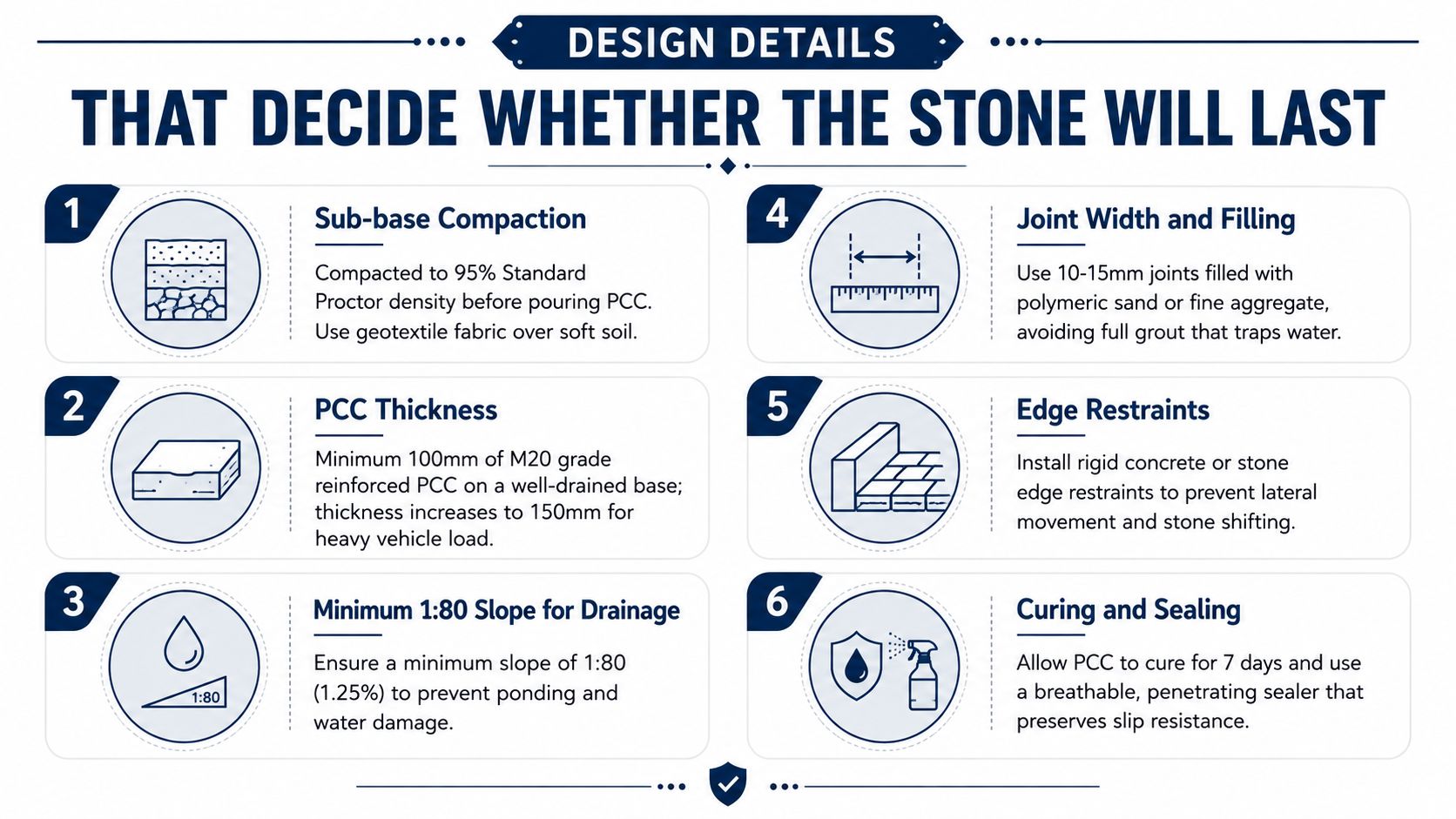
Start with a properly compacted sub-base. Soft soil needs correction, and the base must be shaped so water can leave rather than remain below the paving. A minimum 100 mm PCC layer is a useful design reference for ordinary stone paving, but the actual build-up should reflect vehicle loading, soil conditions, and site engineering.
The finished surface needs a clear drainage fall. A minimum slope of 1:80, or 1.25%, is identified in the supplied design brief as a practical target for preventing ponding. Direct the fall towards a suitable drain, not towards a doorway, wall, or neighbouring property.
Joints deserve the same attention as slabs. For vehicular stone, use the project's engineered joint specification and choose a filler that tolerates movement and moisture. Don't allow a contractor to fill every joint with a brittle material because it is familiar.
Control movement and water at the edges
Provide movement joints at fixed boundaries, column edges, walls, and other restraints. Without them, thermal movement and settlement can push slabs against rigid elements and cause corner failure.
Seal the stone only after the surface is clean, dry, and fully prepared. A breathable penetrating sealer can reduce stain penetration without creating a glossy film that changes the slip character. Reapply according to the product and exposure conditions, then clean oil spills promptly instead of expecting the sealer to perform miracles.
Ramps need rigid edge restraint. A wheel turning against an unsupported edge can shift paving even when the centre of the installation appears sound. Practical planning references, including Riverside Sealing on parking lot planning, reinforce the importance of treating drainage, movement, and edge conditions as part of the parking design rather than as finishing details.
Installer test: Ask for the base section, drainage fall, joint specification, edge detail, and sealer data sheet in writing before approving the stone order.
Stone Parking Floors and the Alternatives Worth Considering
Natural stone isn't the only premium-looking answer, and it isn't always the most rational one. The right choice depends on whether the parking area is exposed or covered, easy or difficult to repair, heavily trafficked or lightly used, and judged mainly on prestige or long-term practicality.
| Option | Cost (Rs/sq ft) | Slip Resistance | Repairability | Best For |
|---|---|---|---|---|
| Natural stone | Varies widely by stone, thickness, finish, fabrication, and installation. Obtain a project quotation. | Strong when honed, flamed, or bush-hammered. Weak when polished and wet. | Individual slabs may be replaced if the installation and stock allow it. | Driveways, entry bays, and prestige residential work with proper detailing. |
| Vitrified parking tiles | Often more predictable than natural stone, but the installed price depends on size, series, base, and labour. | Choose a product with an appropriate anti-skid rating. Supplied guidance recommends R10 or higher for residential parking and R12 for ramps, as discussed by H&R Johnson India. | A damaged tile can usually be replaced without removing the whole surface, if matching stock remains. | Basement parking and projects needing consistent colour and controlled maintenance. |
| Concrete pavers | Site-specific pricing depends on thickness, pattern, base, and laying method. | Good when textured and correctly laid. Joints assist water management. | Excellent for spot replacement and local re-levelling. | Large open compounds, accessible repairs, and flexible layouts. |
| Exposed aggregate or stamped concrete | Often economical for broad areas, subject to reinforcement, access, finish, and drainage requirements. | Exposed aggregate generally offers useful texture; stamped finishes need careful wet testing. | Cracking can require patching or section replacement rather than a simple unit swap. | Budget-conscious layouts requiring continuous falls and broad coverage. |
Natural stone wins on prestige and the visual depth of a carefully selected slab. It can also deliver a long service life when the finish and foundation suit the site. It loses its advantage when an owner chooses polish, ignores ponding, or installs a delicate stone in a busy turning area.
Vitrified tiles offer consistency and a controlled appearance. Pavers are the practical repair champion because individual units can be lifted and reset. Concrete gives the designer broad control over slope and layout, often with a lower initial material burden.
For a high-visibility driveway and entry bay, choose textured stone when the budget supports proper construction. For basement stack parking, vitrified parking tiles are often more sensible. For a large open compound, use concrete pavers unless a continuous concrete surface is more appropriate. A useful material-level comparison is available in this marble versus vitrified tiles guide.
Common Misconceptions About Parking Marble Design
“Marble is premium, so it must be durable.” Premium describes appearance, rarity, sourcing, or finish. It doesn't automatically describe resistance to tyre abrasion, oil, wet slip, or repeated edge loading. A beautiful calcite-rich stone can be the wrong engineering choice for an exposed driveway.
“Granite is always safe.” Granite is usually the more dependable stone family for vehicle traffic, but a mirror-polished granite can become dangerously slick in wet weather. A honed marble can provide better practical grip than polished granite in a specific sheltered location. Finish and detailing still govern the decision.
“Sealer will solve the problem.” A penetrating sealer can reduce stain absorption, but it doesn't turn a polished surface into an anti-skid surface. It also can't correct ponding, weak bedding, failed joints, or a settling base.
“Imported marble is automatically better outdoors.” Country of origin is not a performance certificate. An Indian stone selected for the right absorption, strength, finish, and weather exposure can be more suitable than an imported slab chosen solely for its pattern.
The real specification is not a stone name. It is stone, finish, slope, joint, edge restraint, and maintenance.
Showroom displays encourage buyers to compare colour under dry, clean lighting. Parking areas demand a different test. Look at the sample wet, drag a gritty shoe across it, inspect the edges, and ask how the surface will be cleaned after oil exposure.
The same principle applies to other hard-surface finishes. A resource on polished concrete for Atlanta businesses can help illustrate why polished appearance and traffic suitability must be evaluated separately. The climate and material differ, but the lesson is transferable: a finish should be selected for the service environment, not just the showroom photograph.
A Practical Decision Checklist Before You Finalise the Stone
Take this checklist to the supplier, architect, and installer. Verbal assurances are not enough. Ask for a drawing, product sheet, test report, or physical sample.
Surface performance
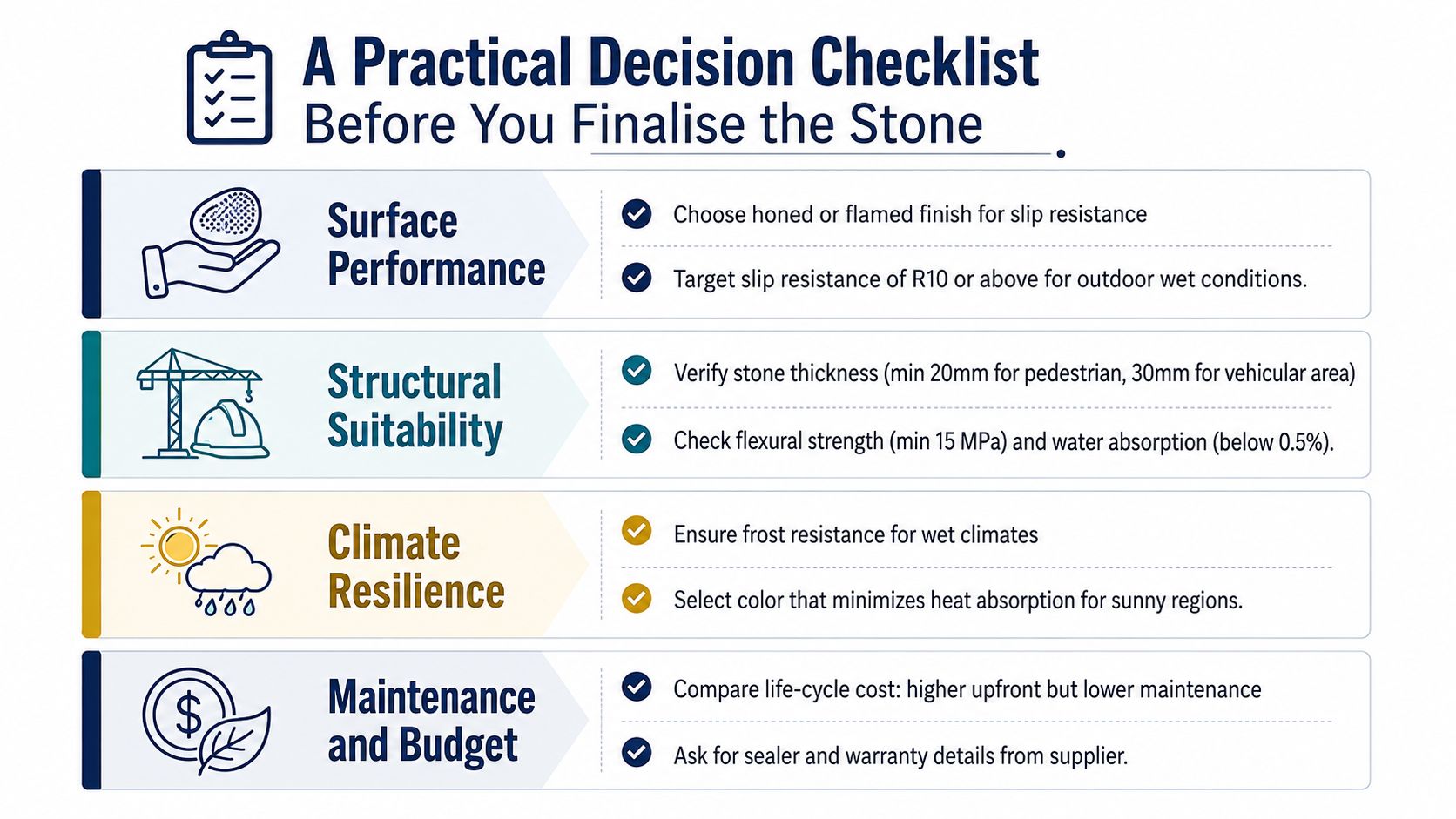
For most Indian parking areas, specify honed, flamed, or bush-hammered stone instead of a polished surface. Finish and edge detailing usually matter more than the stone family. Confirm the selected product's actual slip classification, using the R10 or R12 guidance discussed in the finish comparison rather than accepting a general claim of safety.
Check water absorption against the intended application. Refer to the IS 1130 thresholds discussed earlier, 0.4% current and 0.20% proposed. “Premium marble” is not a technical specification.
Required question: Will the exact finished surface provide acceptable grip when wet?
Structural suitability
Request the complete build-up: soil treatment, compacted sub-base, PCC, bedding, stone thickness, reinforcement where required, and edge restraint. The supplied design visual references 100 mm minimum PCC, but vehicle loading may require a different engineered section.
Review technical data for strength, absorption, and intended use. Do not accept an interior slab specification for a vehicular area without written suitability confirmation from the responsible designer or installer.
Required question: Has the base been designed for vehicle loading rather than pedestrian flooring?
Climate resilience
Open parking must discharge monsoon water quickly. Confirm the fall towards drains, remove low spots, and inspect how water will move beside walls, ramps, thresholds, and expansion joints.
Select colour and finish for solar exposure, not only showroom appearance. The earlier temperature discussion covers the heat risk of dark exposed finishes in Indian summer conditions. Use that guidance when reviewing samples, especially for uncovered driveways.
Required question: Has the completed design been checked for drainage and hot-sun exposure?
Maintenance and budget
Ask who will clean oil, which chemicals are approved, when sealing begins, and how chipped slabs will be repaired. Compare installed cost with the expected repair and maintenance burden, not just the material invoice.
Keep spare slabs from the same selection where possible. Natural variation makes future matching difficult, while textured surfaces can hide routine tyre marks better than glossy ones.
Required question: Do you have a written cleaning, sealing, repair, and replacement plan?
A strong parking marble design can look premium without polish. For most Indian homes, I would specify textured granite or another tested hard stone for exposed vehicle areas, reserve marble for sheltered, low-speed zones, and require proof of drainage and base design before ordering slabs.
Varun Marbles can help compare Indian and Italian marble, granite, engineered quartz, and other natural stones by slab character, finish, fabrication, and intended use. Visit Varun Marbles for material selection, cut-to-size fabrication, finishing, and installation coordination for parking or exterior projects.