
Blue Onyx Marble Guide: Sourcing, Selection, and Care
The most popular advice about blue onyx marble is also the most misleading: that its colour and translucency make it suitable for almost any luxurious surface. They don't. Blue onyx is a visually dramatic, relatively soft carbonate stone, and choosing it well means matching the slab to the sightline, the handling it can withstand, and the care the owner will provide.
For buyers in Gurugram and across India, the colour name alone tells you very little. Ask where the slab came from, how it performs, whether its pattern and translucency suit the intended location, and how it will be supported from transport through installation. Those questions are what separate a striking feature from an expensive repair.
Table of Contents
- What Blue Onyx Marble Is
- Sourcing Realities in the Indian Market
- Technical Profile and Performance Limits
- Translucency and Backlit Design Choices
- Where Blue Onyx Should and Should Not Be Used
- Slab Selection and Inspection Checklist
- Fabrication and Installation Requirements
- Durability, Maintenance, and Common Buyer Questions
What Blue Onyx Marble Is
Blue onyx marble is a banded carbonate stone, not conventional marble coloured blue. Formed as mineral-rich water deposits material over time, it consists mainly of calcium carbonate. Indian government mineral literature describes onyx marble as typically transparent to translucent, with varied colour layers formed by mineral deposition. It records onyx marble in Kupwara district, Jammu and Kashmir, as an Indian geological reference point (Indian Minerals Yearbook information on marble and onyx).
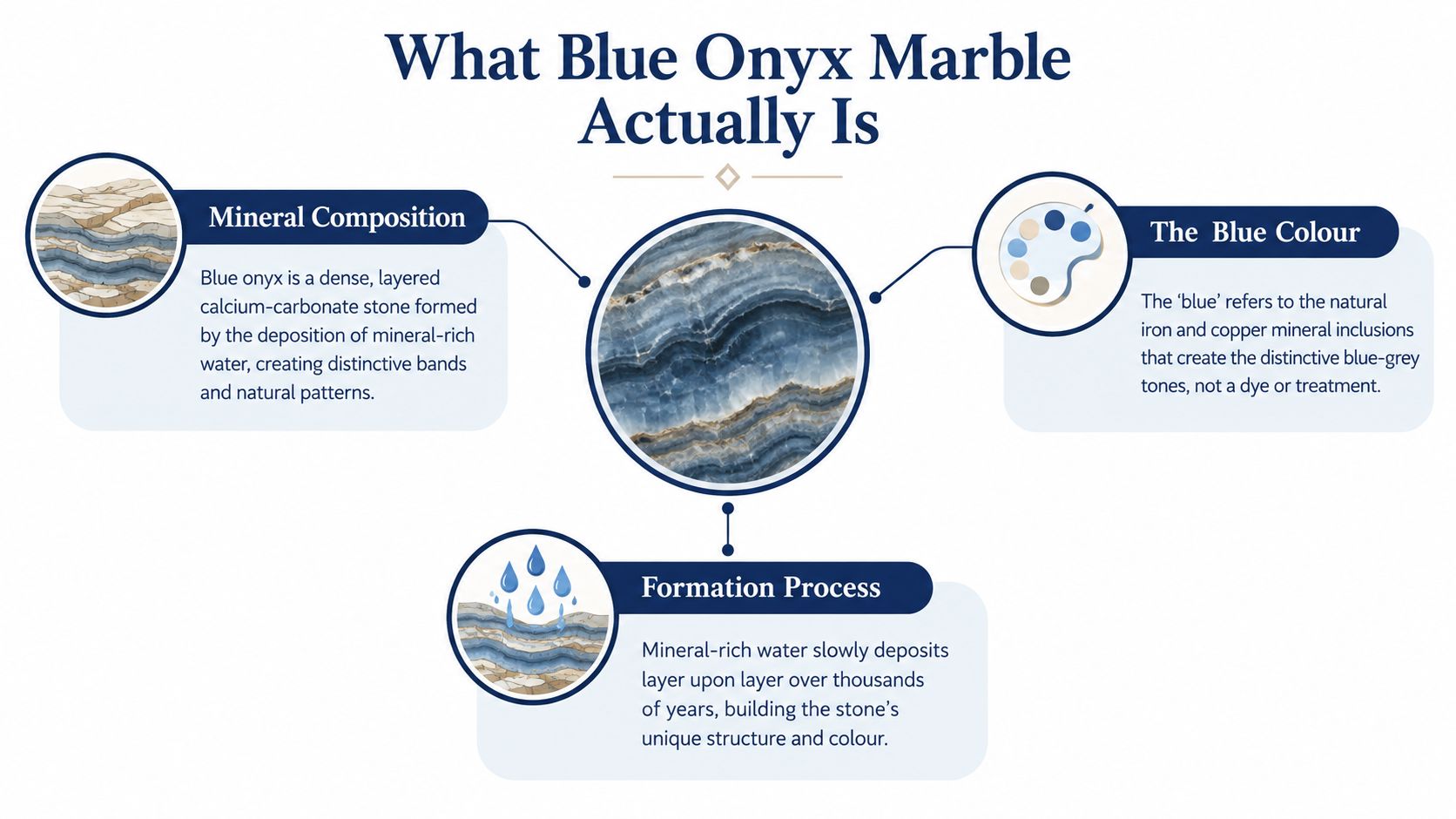
Blue is a visual description, not a nationally standardised mineral grade. Indian official mineral statistics generally classify onyx under broader marble or ornamental-stone categories, rather than publishing a separate series for blue onyx. So a blue label does not establish a slab's mineral composition, shade, banding, or performance. Inspect the stone itself, not just its tag.
Three characteristics should guide your choice. Onyx can transmit light, making it suitable for carefully designed backlit panels. Its colour usually runs in layers and bands, so neighbouring pieces may differ markedly. And calcitic onyx is relatively soft. Rough handling by fabricators or installers can leave it scratched, chipped, or broken.
Those traits shape the result beyond the showroom. A striking vein can turn into a dark patch under backlighting. A slab that appears sound across its face may still need close inspection near a cut-out. Choose a finish for the intended use, because visual impact alone says nothing about its resistance to abrasion.
Working definition: Blue onyx marble is a translucent, banded carbonate stone chosen for visual impact rather than mechanical toughness.
Sourcing Realities in the Indian Market
India's marble resources are extensive, but those figures do not mean buyers can order a consistent blue onyx by colour name. The Indian Bureau of Mines estimated 1,945 million tonnes of marble resources, of which approximately 4.5 million tonnes, or 0.23%, were classified as reserves. Rajasthan accounted for about 63%, Jammu and Kashmir 21%, Gujarat 6%, and Chhattisgarh 4% of the resources (Indian Bureau of Mines marble resource figures). These figures cover marble broadly, not blue onyx.
For Gurugram buyers, the distinction matters at the slab level. A large national resource base says little about how many blocks will yield slabs with the colour, banding, continuity, and soundness a project needs. A supplier's trade label cannot fill that gap. Ask for the quarry or lot information, and inspect the actual slab selected for cutting.
“Indian marble” does not identify a precise source, and “blue onyx” does not guarantee a consistent grade. Showrooms may carry Indian material alongside imported stone. If you are comparing imports, review a selection of imported onyx slabs, then judge each slab individually rather than buying on the name alone.
What scarcity means at the slab level
A resource estimate counts geological material, not premium slabs ready for a feature wall. Colour-specific stone is a selective segment, and a usable block must provide the look and soundness the installation requires. Choose a yard that screens material carefully, and ask what its inspection process checks before accepting a slab.
Reject any claim that a fixed share of slabs will pass inspection as a general market rule. Acceptance depends on the supplier and the project. Specify what matters for your installation, then choose the slab that meets those requirements.
Technical Profile and Performance Limits
Blue onyx doesn't have a single technical profile that applies to every slab. Where a separately standardised blue variety isn't available, Indian-origin Ice Onyx provides a useful technical analogue, not a guarantee of how a particular blue slab will perform. Reported composition is approximately 90–95% calcite or aragonite, with a bulk density of 2.68–2.74 g/cm³, water absorption of 0.15–0.25%, compressive strength of 85–105 MPa, flexural strength of 12–16 MPa, and Mohs hardness of 3–4 (reported Ice Onyx properties).
Those figures point to a stone that needs thoughtful placement and careful handling. Its low water absorption can limit capillary staining, but it doesn't make the surface impervious to spills or chemical damage. Mohs hardness of 3–4 means scratching is a real concern, while moderate flexural strength means poorly supported edges and cut-outs can chip or break, particularly during fabrication and transport.
| Typical Properties of Indian Translucent Onyx | Typical range | Practical implication |
|---|---|---|
| Calcite/aragonite composition | Approximately 90–95% | Treat it as a carbonate stone, not silicate marble |
| Bulk density | 2.68–2.74 g/cm³ | Confirm handling and support plans with the fabricator |
| Water absorption | 0.15–0.25% | Low absorption doesn't prevent etching or eliminate maintenance |
| Compressive strength | 85–105 MPa | A useful reference, not a project-specific approval |
| Flexural strength | 12–16 MPa | Support cut-outs and vulnerable edges continuously |
| Mohs hardness | 3–4 | Avoid abrasive use and protect exposed surfaces |
Why the colour name can't set the specification
A comparison with another Indian translucent stone makes the point. A technical sheet for Himalayan Green Onyx from Rajasthan reports a density of about 2,452 kg/m³, water absorption of no more than 0.1% by weight, and flexural strength above 36.5 MPa (Himalayan Green Onyx technical data). That profile differs materially from the Ice Onyx range. “Onyx” and a colour description aren't substitutes for test results from the lot you plan to install.
For Gurugram projects, ask for the quarry or lot origin, petrographic description, thickness, absorption, flexural strength, and compressive-strength report for the actual slab. The cited Ice Onyx values are typical, not a project-certified report. Require batch-specific testing to relevant Indian or ASTM methods before approving large-format cut-to-size work.
Translucency and Backlit Design Choices
Backlighting can make blue onyx marble worth the premium, but the effect depends on the actual slab. Calcite banding, thickness, resin reinforcement, and mineral inclusions all influence how much light passes through. Two slabs from the same lot can produce noticeably different bright and dark zones, so photographs and a small sample don't tell the whole story.
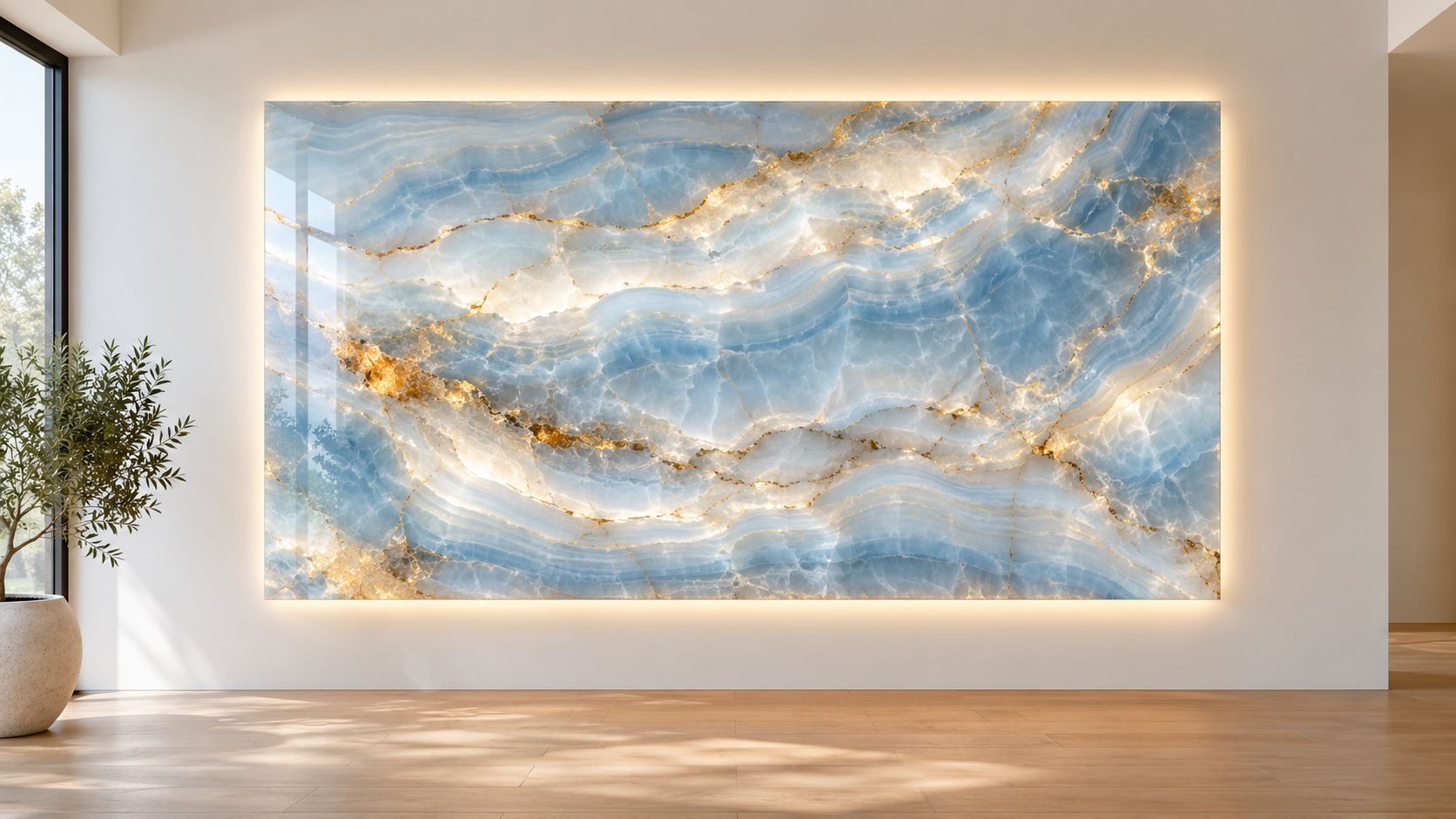
Start by laying the intended slab flat and viewing it with a torch from behind, where practical. This gives you a first look at transmission and dense veins, but it isn't a substitute for a full mock-up. Resin can alter the appearance, and thickness variation can make an installed panel glow unevenly.
Build the light around the stone
Choose an LED system only after assessing the slab's pattern and intended appearance. The panel, mounting space, and diffuser must work together to distribute light across the stone. Dense veins may block more light than the surrounding material, while a poorly planned light source can create visible hot spots instead of an even field. Have the fabricator and lighting designer coordinate before cutting.
If you're comparing material patterns and finishes, a guide to onyx marble texture and natural variation can help you prepare questions for the yard. For adjacent glazed surfaces, consult the relevant satin obscure glass safety standards rather than assuming the stone and glass have the same specification or safety requirements.
Before you approve the panel, make sure the team has checked the actual slab under the proposed lighting conditions. Then confirm uniformity after mounting, not just on a showroom floor.
Here's a demonstration of how onyx can be used in a backlit installation:
Use this showroom checklist:
- Mock up the actual slab: Don't approve the effect from a photograph.
- Match the proposed LED colour: Evaluate the stone under the lighting specified for the finished room.
- Check light uniformity: Look for dense veins and areas likely to appear dark.
- Confirm the mounted result: Review the panel once it's installed with its intended diffuser and backing arrangement.
Where Blue Onyx Should and Should Not Be Used
Don't approve blue onyx marble because someone has labelled an entire room “suitable for marble.” The right question is whether the surface will face abrasion, water, cleaning chemicals, heat, and repeated contact, and whether its visual contribution justifies those risks.
Best candidates are vertical and protected surfaces. Feature panels, lobby accent walls, bar fronts, and vanity fronts let the stone's pattern take centre stage without asking it to endure constant wear. Backlit installations can work particularly well when the actual slab and lighting system have been tested together.
A protected counter can also make sense when the owner accepts careful use and the fabricator gives the cut-outs and edges proper support. That's a considered design decision, not a blanket recommendation for every countertop.
Room-by-room verdict
- Kitchen worktops: Choose engineered quartz or granite for heavily used preparation areas. Blue onyx is softer and vulnerable to scratching, etching, and heat-related damage, so a dramatic appearance doesn't make it the practical default.
- Bathrooms: Use it confidently on vertical surfaces when the detail is sound. Vanity tops are a more exposed choice, so require a care plan and suitable support. Standing water and harsh or acidic cleaners can damage a calcite-based surface.
- High-traffic floors: Don't specify it as a default flooring stone. Repeated abrasion and foot traffic make a softer decorative stone a poor fit unless a specific slab has been independently tested and the project accepts the risk.
- Outdoor applications: Avoid treating an interior ornamental stone as an exterior material without project-specific testing and a clear exposure plan.
- Feature walls and bar fronts: These are defensible uses because the material can serve as a focal point without taking the same daily punishment as a kitchen worktop or busy floor.
For homeowners weighing worktop materials in damp or busy environments, this practical guide to countertops for a humid climate can help frame the broader trade-offs. It doesn't replace a slab-specific assessment.
Assign blue onyx by sightline and traffic, not by room name. If the location is both highly visible and heavily used, decide which priority wins before you order.
Slab Selection and Inspection Checklist
A website image can't show you how a translucent slab will read in your room, where its veins interrupt light, or whether its surface contains a visible repair. Inspect the actual slab at the yard before the fabricator cuts it. Keep the selection practical: record the material identity, evaluate visual risks, and confirm the dimensions and test documents for the piece you're buying.
Run the inspection in order
- Confirm the quarry and lot origin. Ask the supplier to identify the source of the slab, not just its trade name.
- Request the petrographic description. This helps you understand the stone's material character and compare the slab with any available test results.
- Check thickness and consistency. Measure at multiple points and ask the fabricator whether the slab suits the planned cut-outs and installation.
- Inspect resin treatment under raking light. Angled light makes repairs, resin, and surface irregularities easier to see.
- Follow the veins. Look for crack lines or suspicious openings, especially where a vein approaches an edge or a proposed cut-out.
- Test translucency with a torch. Move the light across the slab and note changes in transmission. Treat this as an initial check, not proof of a uniform backlit effect.
- Compare the finish edge to edge. Check whether polish, tone, and surface character remain consistent across the slab.
Bring the cut list or elevation drawing to the yard. That lets you assess whether the intended piece will include a strong vein at a vulnerable corner, place a darker band behind a focal point, or require a joint through a prominent pattern.
A translucent stone should be approved slab by slab, not by a small photograph or a loose sample.
Before authorising cutting, obtain the material identification and any batch-specific test report available, and record which slab the approval covers. If the supplier can't show you the piece that will be fabricated, you can't reliably approve its colour, veins, or translucency. Hand inspection at slab level is the sensible standard for a visually driven stone.
Fabrication and Installation Requirements
Onyx can fail between the yard and the finished room if a team treats it like an ordinary hard worktop material. Plan the route from selection through cutting and installation together. The fabricator, supplier, and site team should agree on support, edge details, and the final backing before the slab leaves the yard.
Transport the slab upright on a rigid A-frame with appropriate restraint and support. During cutting, the fabricator should choose a controlled method suited to the specific slab and its reinforcement. Dry cutting can introduce dust and heat, while wet cutting requires control of water exposure and drying. The right choice depends on the stone and workshop process; ask the fabricator to explain how the selected method protects the slab.
Cut-outs need special attention. Use rounded internal corners rather than sharp internal angles, which concentrate stress. Provide continuous support beneath sinks and other openings, and don't leave narrow sections unsupported during handling or installation.
| Blue Onyx Fabrication and Installation Reference | Specification | Why it matters |
|---|---|---|
| Transport | Rigid A-frame with restraint and continuous slab support | Reduces movement and stress during handling |
| Cut-outs | Rounded internal corners; support vulnerable sections | Helps limit corner cracking and edge chipping |
| Sink and cooktop areas | Continuous support beneath cut-outs | Prevents unsupported sections from carrying the load |
| Backlit wall | Coordinate the backing and lighting layout before fabrication | Helps achieve a stable panel and a more even visual result |
| Sealer | Use a compatible product only after a concealed sample test | Checks whether the treatment changes the stone's appearance |
For backlit walls, prepare a stable, even substrate and coordinate the light source, diffuser, mounting arrangement, and stone thickness before installation. A final lighting test on the mounted panel can reveal uneven areas that weren't obvious during slab selection. Don't leave those decisions until the stone is already cut.
The supply-to-installation gap is a project risk. A clean reveal depends on the slab, the support plan, the cutting, the finish, and the site team working to the same details.
Durability, Maintenance, and Common Buyer Questions
Use a compatible impregnating sealer where the project specification calls for one, and test it on a concealed area first because sealers can alter a slab's appearance. Clean with a pH-neutral product, wipe spills promptly, and keep acidic cleaners, beverages, and cement residues away from the surface. Follow the sealer manufacturer's guidance for inspection and resealing rather than relying on a fixed interval that hasn't been matched to the product and use.
Minor etching may need professional honing or refinishing. A crack, chip, or deeper break is a different problem, so ask a stone professional to assess the damage before attempting a repair. For bathroom care and mineral deposits, this guide to hard-water stains on marble offers relevant cleaning context.
Buyer questions
Can blue onyx go outdoors? Don't assume it can. Approve exterior use only when the specific slab and exposure conditions have been assessed.
Is it a sensible kitchen substitute for quartz? Not for a busy worktop. Choose engineered quartz for a more forgiving, lower-maintenance surface, or reserve onyx for a protected feature.
How long will a backlit wall last? Don't accept a lifespan estimate based on the stone name alone. Ask for the lighting and backing specifications, installation warranty, and maintenance responsibilities.
How should I budget for wastage? Ask the fabricator to calculate it from the actual slab layout and pattern, not a generic allowance. Translucent slabs vary, and matching veins can affect how much usable material remains after cutting.
Varun Marbles helps clients in Gurugram assess natural onyx slabs in person and coordinates selection, fabrication, and installation support for feature panels and backlit designs. Visit Varun Marbles to discuss your project and inspect slabs before approving a cut.