
Black Marble Price Per Square Foot: Complete Guide
Standard Indian black marble typically costs ₹100–₹250 per square foot for material only, while premium imported varieties can reach ₹400–₹1,500 per square foot, depending on origin, grade, and thickness. The final installed rate can be considerably higher once cutting, polishing, transport, wastage, taxes, and laying are included.
You may be standing in a showroom in Gurugram with two quotations in front of you. One supplier has written ₹120 per sq ft. Another has offered a dark slab at ₹550 per sq ft. Both call it black marble, both look convincing under showroom lights, and neither quotation appears obviously wrong.
That's the problem with searching for black marble price per square foot as though it were a standard commodity rate. The colour name covers Indian stones, imported marbles, plain slabs, heavily veined varieties, tiles, full slabs, polished surfaces, and cut-to-size work. A professional comparison starts by identifying what the quotation includes.
Table of Contents
- The Quotation That Makes No Sense
- What Drives the Black Marble Price Range
- Origin, Grade, and Quality Indicators
- From Slab Price to Installed Cost
- What to Ask Before You Buy
- Why Curated Selection Matters More Than Price
- Making the Right Choice for Your Project
- Frequently Asked Questions
The Quotation That Makes No Sense
The ₹120 quotation usually isn't competing directly with the ₹550 quotation. It may describe a standard Indian variety, a thinner piece, a selected tile, or a material-only rate based on available stock. The higher figure may refer to a premium Black Fantasy or Black Marquina slab, with stronger veining, more consistent tone, a better finish, or an imported origin.
Marketplace listings in India span roughly ₹35–₹600 per sq ft, which shows the scale of the confusion rather than establishing one reliable market rate. Indian marketplace listings for black marble distinguish between Indian varieties, Black Marquina, polished finishes, slab thicknesses, and intended applications. The spread reflects different products and different scopes of supply.
Why the colour name isn't enough
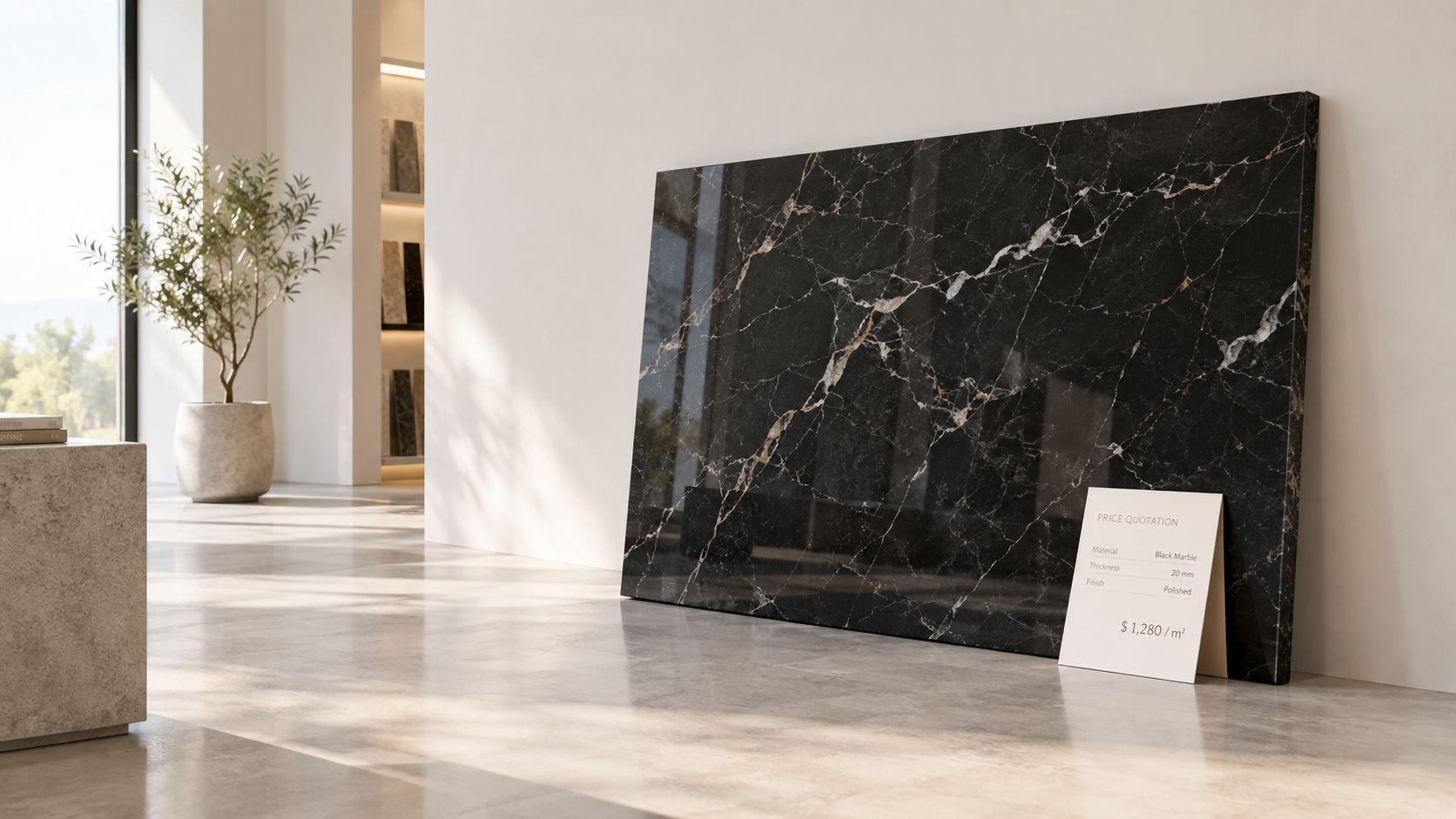
A black marble sample can hide differences that become obvious on a full slab. One piece may have a deep, even tone. Another may show grey patches, open veins, resin repairs, chips, or directional movement that affects how the finished wall, floor, island, or staircase will look.
The quotation may also use different measurement bases. One supplier might price a full slab at the material rate, while another may quote cut-to-size pieces that already account for selection and fabrication. Transport, edge work, polishing, installation, and breakage liability can sit outside either number.
Practical rule: Never compare two black marble quotations until both suppliers confirm origin, thickness, finish, usable area, and included services in writing.
The right question isn't “Which supplier has the cheaper black marble?” It's “Are these two suppliers offering the same stone specification and the same project scope?” Once that distinction is clear, a price difference becomes easier to explain, and a low headline rate becomes easier to assess.
What Drives the Black Marble Price Range
For standard Indian varieties, a practical material-only benchmark is ₹100–₹250 per sq ft. A narrower listing range for black Indian marble sits at ₹120–₹250 per sq ft, while wider Indian marble listings extend from ₹50–₹300 per sq ft. These figures are useful for initial budgeting, but they're not installed prices. Regional Indian marble listings also underline that quality and market location influence the rate.
At the lower end, some listed products fall near ₹60–₹80 per sq ft. At the premium end, listed examples include Black Marquina around ₹400–₹475 per sq ft and Black Fantasy at ₹550 per sq ft. Imported Marquina, Portoro, and Nero varieties may range from ₹400–₹1,500 per sq ft for material, depending on origin and specification. India-facing black marble specifications and pricing provide a useful distinction between Indian and imported materials.
| Category | Price range (₹/sq ft) | Key characteristics |
|---|---|---|
| Lower-priced Indian varieties | ₹60–₹100 | Basic selection, greater visual variation, often material-only |
| Standard Indian black marble | ₹100–₹250 | Domestic origin, common polished finishes, suitable for like-for-like comparison |
| Black Marquina and similar premium listings | ₹199–₹475 | Stronger contrast, more controlled selection, varied thickness and finish |
| Black Fantasy and comparable premium stones | Up to ₹550 | Richer movement, stronger visual character, premium selection |
| Imported Marquina, Portoro, and Nero | ₹400–₹1,500 | Imported origin, distinctive patterning, premium grade and specification |
The five variables behind the quote
Origin affects quarrying, freight, availability, and the consistency buyers can expect from a particular stone family. Indian black marble and imported Marquina may both look dark in a photograph, but they shouldn't be priced as equivalent materials.
Grade and veining determine how much of the slab is visually acceptable. Uniform dark slabs, dramatic gold veining, and bookmatched pieces require different selection standards. A supplier may reject more material when the layout demands close visual matching.
Thickness changes both the material specification and the fabrication approach. A tile or thinner piece isn't automatically interchangeable with a thicker countertop or stair slab.
Finish also matters. A polished surface highlights depth and reflection, while honed or other treatments create a different appearance and may carry separate processing costs.
Scope is often the biggest source of confusion. Ask whether the rate covers a slab, tiles, cut-to-size pieces, or a delivered and installed surface. For broader context on how material rates fit into a complete flooring budget, compare this with the marble flooring cost guide.
Origin, Grade, and Quality Indicators
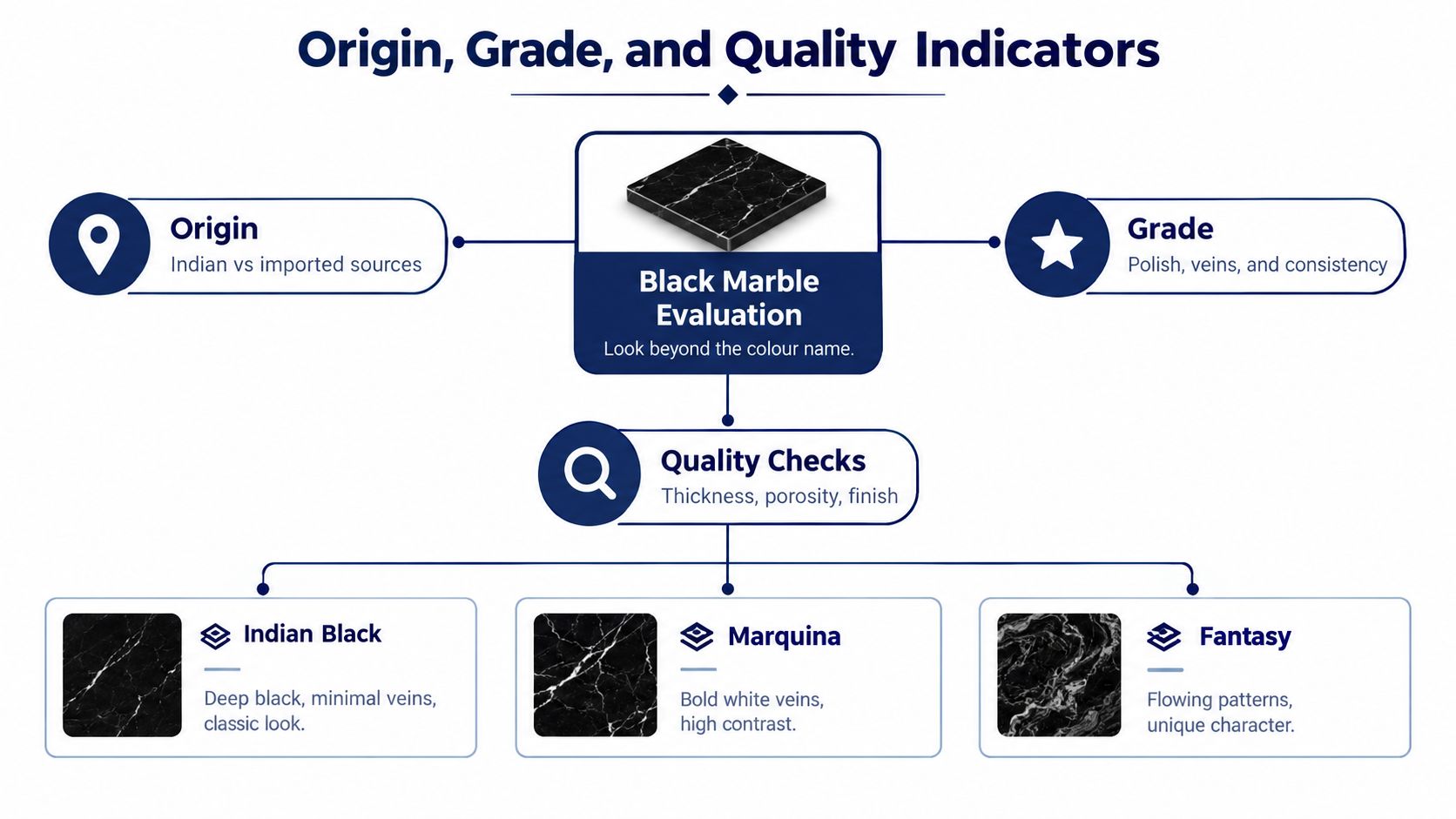
A quote for black marble becomes meaningful only after the stone is identified properly. Two slabs sold under the same colour label can differ in density, water absorption, thickness, polish, veining, resin treatment, and usable yield. Those variables affect both the finished appearance and the amount of material that survives fabrication.
Trade specifications for Black Marquina may list density at 2.71 grams per cubic centimetre, water absorption at 0.10%, slab thickness at 15–20 millimetres, and a polished finish. The trade specifications for Black Marquina and other black marbles illustrate why “black marble” is not enough information for comparing two quotes.
Compare the stone, not just the sample
Indian black varieties can provide a practical balance between availability and cost for flooring, wall applications, and designs that allow natural variation. Imported Marquina may justify a higher quote when the buyer wants a more defined pattern or deeper, more consistent tone. Black Fantasy suits projects where the veining is intended to carry the design.
Review the full slab under more than one lighting condition. Check polish consistency, corners, edges, repaired areas, and any visible resin treatment. A small showroom sample can look uniform while the complete slab contains substantial tonal movement. A supplier that selects blocks at the quarry and examines slabs individually can remove pieces with excessive variation or visible repairs before they reach the gallery.
Technical checks that influence suitability
Lower water absorption can help in wet areas, but it does not settle the purchase decision. Cracks, resin work, edge condition, fabrication quality, and installation workmanship can influence the result just as much. Typical black marble specifications may report water absorption in the 0.18–0.25% range and compressive strength of 1,400–1,600 kg/cm². Confirm those figures on the supplier's specification sheet rather than using them alone to justify a premium.
Thickness must match the application. Typical tiles may be 15–20 mm, while slabs are generally 20–30 mm. A thicker piece can suit a countertop, staircase, or edge profile requiring more fabrication control. A thinner product may work for another application, provided the fabricator confirms its suitability. Buyers comparing kitchen or vanity surfaces can also review Excellent Home Improvement marble countertops for additional application context.
From Slab Price to Installed Cost
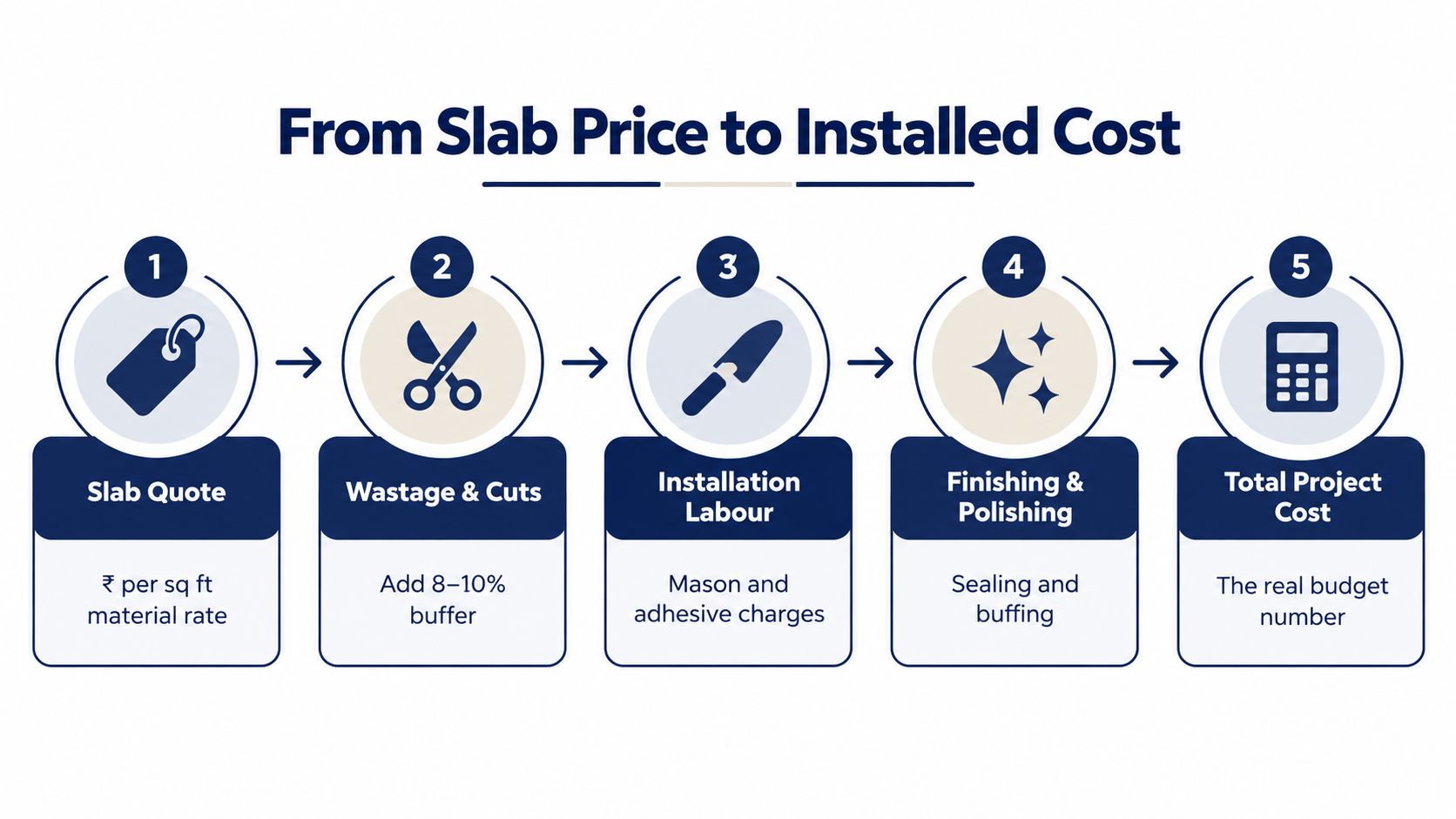
A slab quotation is a starting figure, not a project budget. The finished cost includes the material that arrives at the site, the pieces lost during cutting, the labour needed to prepare and lay them, and the finishing work required after installation.
Indicative marble installation labour in India is approximately ₹80–₹200 per sq ft. Post-installation or double-charge polishing may add another ₹30–₹80 per sq ft, depending on the required finish and site conditions. Indicative marble fitting labour costs help illustrate why a supplier's material-only rate can be misleading.
A simple calculation
Suppose an Indian black marble slab is quoted at ₹200 per sq ft. Adding ₹80–₹200 per sq ft for laying and ₹30–₹80 per sq ft for polishing produces an indicative range of ₹310–₹480 per sq ft before transport, adhesive, skirting, stair nosing, GST, or unusual fabrication.
That example doesn't mean every installation will land in this range. It shows how quickly the headline material rate changes once labour and finishing are separated correctly. A kitchen counter with cut-outs and edge profiles won't follow the same cost structure as a straightforward floor layout.
Wastage must be calculated against the gross area purchased, not just the finished area visible in the room. Indian construction guidance places typical marble and granite slab wastage around 10–15%, while plain layouts may be closer to 5%. Borders, diagonal layouts, bookmatching, vein-sensitive designs, edge polishing, breakage, and rejected pieces can increase the allowance. Construction material wastage guidance explains why layout planning changes the material requirement.
Budgeting insight: The important number isn't only the rate per finished square foot. It's the number of square feet you must purchase to obtain the acceptable pieces for the final layout.
Get the scope in writing
A proper quotation should separate:
- Stone supply: Origin, selection grade, thickness, finish, slab or tile format, and net usable area.
- Fabrication: Cutting, sink or hob openings, edge profiles, mitres, borders, and polishing.
- Site work: Transport, unloading, adhesive, laying, levelling, sealing, and final polishing.
- Risk allocation: Breakage liability, replacement terms, rejected pieces, and responsibility for site measurements.
A written delivered-and-installed rate is more useful than a very low material figure. For comparison with other worktop materials, use the quartz slab pricing guide, but keep natural marble and engineered quartz specifications separate rather than comparing colour names.
The process can include more than a price review. Use the following video as a visual reference for how the cost components fit together.
What to Ask Before You Buy
A supplier's first quotation should start a conversation, not end your assessment. Ask for the information below before paying an advance or approving fabrication.
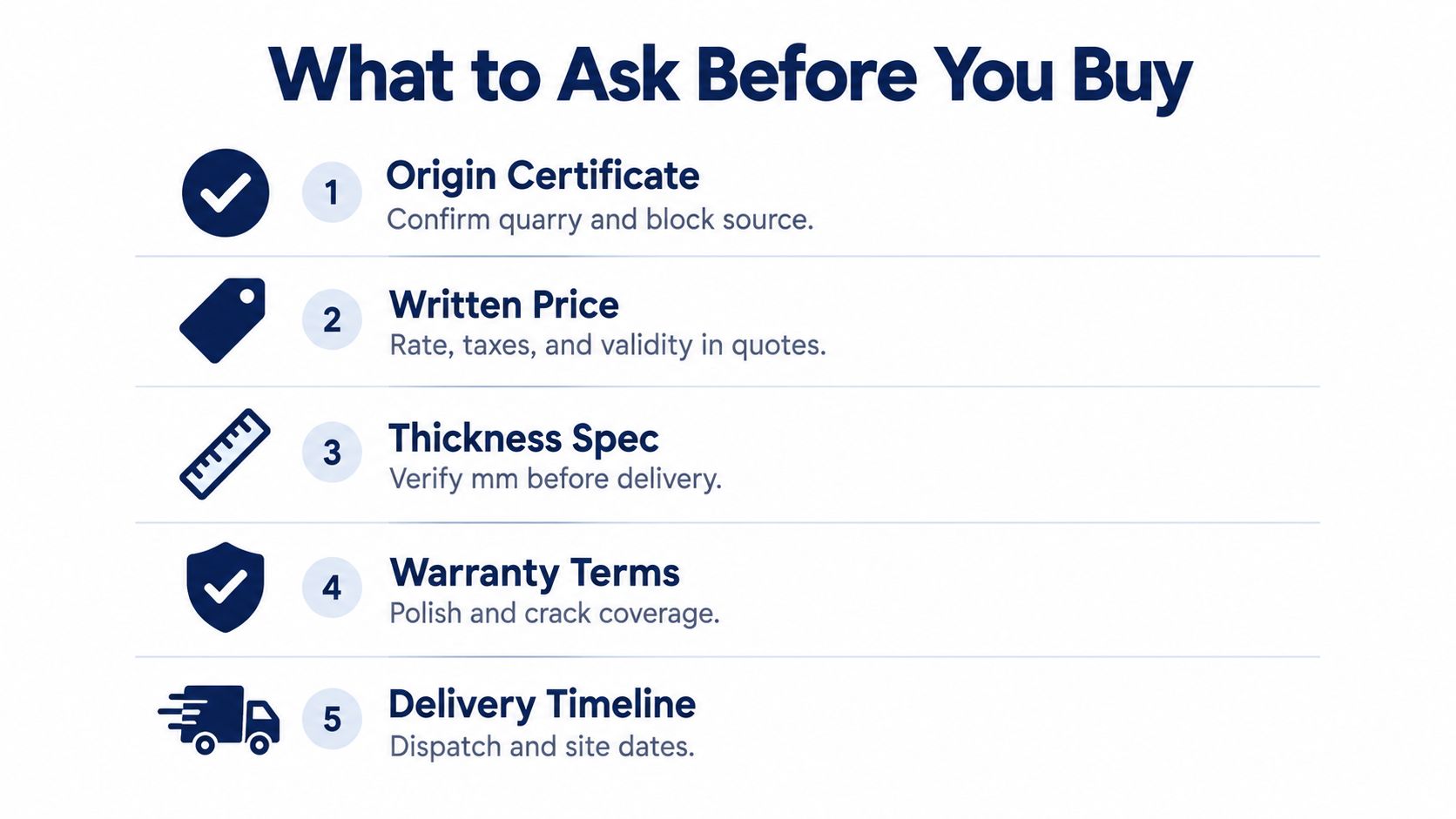
Your written procurement checklist
Where did the stone come from? Confirm whether it's an Indian variety or an imported product, and ask for the quarry or block origin where available. Origin helps explain availability, visual characteristics, and the quoted price.
What is the exact thickness? Ask for the measurement in millimetres, not “standard slab”. A 15 mm piece and a 20 mm piece may have different fabrication and edge requirements, even if both are described as black marble.
Which finish is included? Confirm whether the rate covers polished, honed, leathered, or another surface treatment. View the finish on the actual slab or a representative piece under lighting similar to the installation site.
Can I see the actual lot? Request slab photographs that show the full piece, not only a small catalogue image. For a high-value countertop, wall, or bookmatched feature, inspect the slabs in person before cutting.
How much area is usable? Ask for gross slab area, expected cutting loss, and net usable area. A low price on a slab with poor yield may cost more than a higher-priced slab that produces the required pieces efficiently.
Clarify the commercial terms
Your quotation should state whether GST, transport, cutting, edge profiling, installation, polishing, sealing, and site handling are included. If the supplier has priced only material, ask for each additional service as a separate line item so you can compare offers fairly.
Replacement terms deserve particular attention for hospitality, retail, and commercial projects. A chipped edge or broken slab can create a delay if the contract doesn't say who carries the liability or how replacement material will be matched.
Send this short script when requesting a quote:
“Please quote the black marble by origin, exact thickness, finish, gross and net usable area. Separate material, wastage, cutting, edge work, polishing, transport, GST, installation, and sealing. Please attach photographs of the actual slab lot and confirm breakage and replacement terms.”
That request encourages suppliers to price the same scope. It also exposes whether a low headline rate depends on unspecified charges appearing later.
Why Curated Selection Matters More Than Price
The cheapest slab can become the most expensive choice when the finished surface shows mismatched tone, obvious resin repairs, chipped edges, or uneven veining. Black stone makes these problems particularly visible because reflections and tonal changes stand out across a large uninterrupted surface.
Price-driven marketplace buying often begins with a colour name. Specification-driven buying begins with the full slab, the intended application, the acceptable amount of variation, and the cutting plan. That shift matters for kitchen islands, feature walls, staircases, reception counters, and bookmatched layouts where one unsuitable piece can affect the entire design.
What inspection should cover
Blocks should be selected at the quarry face before slab production. Each slab should then be inspected for vein, tone, and translucency, rather than accepted solely because it carries a familiar product name.
A tightly selected gallery may accept fewer than one in ten slabs, which demonstrates how selection standards can narrow the available inventory. The objective isn't to make every natural stone piece identical. It's to reduce the chance that the material delivered to site differs materially from what the designer approved.
A photograph can confirm colour family. It can't confirm full-slab consistency, repair visibility, or whether the vein direction works with your cutting plan.
For buyers assessing a premium quote, the relevant question is whether the supplier can show the characteristics that justify it. Ask to see the slab, confirm the finish, and review how the pieces will be cut. A guide to signature marble and granite selection can help frame that discussion around material character rather than a colour label.
Curation doesn't remove natural variation, and it doesn't replace skilled installation. It does give the buyer a clearer basis for accepting or rejecting a slab before fabrication begins.
Making the Right Choice for Your Project
A homeowner choosing a black marble kitchen countertop has a different risk profile from a contractor flooring a commercial interior. The material rate may overlap, but the acceptable variation, fabrication scope, and consequences of delay won't.
For a homeowner, visual inspection should take priority. Select a slab whose tone and veining work with the cabinet colour, then confirm thickness, edge profile, cut-outs, polishing, transport, and installation in the quotation. A slightly higher material rate may be sensible if it delivers the required usable pieces without forcing a second slab purchase.
An architect specifying a hospitality feature wall may value consistent vein direction and slab matching more than the lowest available price. The quotation should show the cutting plan, gross slab requirement, expected waste, finish, and replacement terms. Bookmatching or strong vein alignment can make procurement more demanding because acceptable pieces must work together as a composition.
A contractor managing a commercial fit-out needs predictable supply and a clearly divided scope. The useful comparison is the delivered-and-installed rate, supported by an approved slab sample or inspection record. Cutting, edge work, breakage liability, site access, and installation sequencing should be settled before the material reaches the project.
The same ₹120 per sq ft rate can be appropriate for one application and unsuitable for another. Likewise, ₹550 per sq ft may reflect a premium visual specification, but it still needs to be supported by the slab's origin, grade, thickness, finish, and usable yield.
For final verification, visit the showrooms at Sikanderpur Marble Market and HUDA Marble Market, Sector 33–34, Gurugram, inspect the available slabs in person, and request a complete project quotation rather than relying on a search result.
Frequently Asked Questions
Is engineered quartz a practical alternative to black marble?
Yes, especially where consistent appearance, low routine upkeep, and resistance to staining are priorities. Engineered quartz is non-porous, so it doesn't require the same sealing considerations as natural stone, and its manufactured composition can provide a more uniform visual result.
Natural black marble offers individual veining, depth, and variation that engineered quartz may not reproduce exactly. Quartz also has its own application requirements, including protection from direct heat and careful selection of finish for highly visible surfaces. The sensible comparison is total installed cost, maintenance expectations, appearance, and the conditions of the room, not just the price of a black slab.
Is imported black marble worth the premium?
It can be, when the project needs a specific pattern, tone, origin, or level of visual consistency that an Indian variety doesn't provide. Imported Marquina, Portoro, and Nero products may occupy a higher price band because origin, selection, freight, finish, and specification differ.
The premium isn't automatically proof of better performance. Inspect the actual slab, verify water absorption and thickness where relevant, assess repairs and cracks, and compare usable yield. A well-selected Indian slab can be a better purchase than an imported slab that doesn't suit the layout or arrives with unacceptable variation.
How long does selection, fabrication, and installation take?
The timeline depends on availability, approval of the actual slab, the cutting plan, fabrication complexity, site readiness, and installation scope. Quarry-face block selection and hand inspection happen before a slab enters the approved inventory, while cutting, edge work, polishing, transport, and site installation follow after the design and measurements are confirmed.
Ask the supplier for a written sequence covering slab approval, measurement, fabrication, dispatch, installation, and final finishing. For a project with bookmatching, multiple cut-outs, stair nosing, or a sensitive vein direction, allow the team to confirm the cutting plan before promising a site date. Early slab approval prevents fabrication from starting against an unsuitable photograph or sample.
Varun Marbles supplies Indian and imported natural stone, engineered quartz, slab fabrication, edge profiling, finishing, and installation coordination for residential and commercial projects in the NCR. Visit Varun Marbles to inspect black marble options in Gurugram and request a quotation that separates material, wastage, fabrication, delivery, and installation.