
Rough Granite Blocks: Sourcing Guide 2026

A Gurugram fabricator can approve a block from three photographs, reserve a cutting slot, and still discover the actual problem only when the gang saw opens it. The outside looks sound, the colour appears close to the sample, and the dimensions seem suitable. Then an internal fissure splits several slabs, a vein changes direction across the cut, and the order begins consuming time, labour, and replacement material.
That risk sits inside every purchase of rough granite blocks. The block is not the finished product. It's the starting geometry from which usable slabs, cut-to-size pieces, edges, and waste must be produced. A good buying decision therefore connects quarry inspection with workshop yield, installation requirements, and delivery commitments.
Table of Contents
- Why Rough Granite Block Selection Matters for Fabricators
- Sourcing Rough Granite Blocks from Indian Quarries
- Inspecting Block Quality Before Purchase
- Transport, Handling, and Yield Calculations
- Slab Production Implications and Fabrication Tips
- Making the Right Block Sourcing Decision
Why Rough Granite Block Selection Matters for Fabricators
The most expensive mistake is judging a rough block as if it were already a slab. A quarry photograph may show an attractive face, but it says little about the material hidden behind that face. Granite can change in tone, carry irregular veins, or contain fissures that become obvious only after sawing.
A commercial flooring project exposes this weakness quickly. Suppose a fabricator has committed to a large floor order in Gurugram based on a limited visual sample. The block arrives, the first cuts reveal a different vein direction, and the production team must either alter the laying pattern or source replacement stone. The delay affects cutting schedules, polishing capacity, installation sequencing, and the client's confidence.
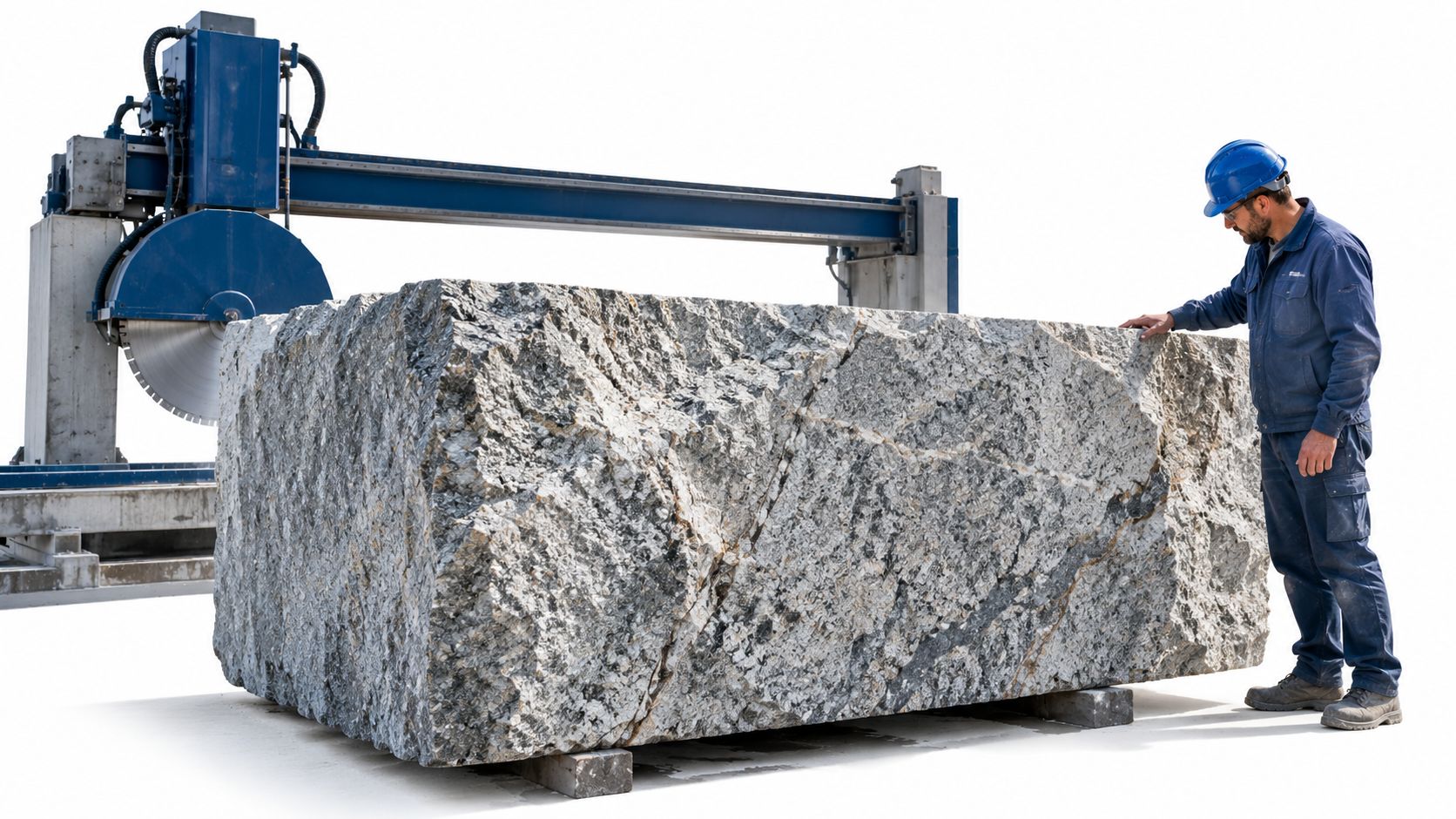
The block controls more than appearance
A fabricator should assess a block through three connected questions:
- Will it stay intact during cutting? Fissures, weak zones, and open seams can turn a sound-looking purchase into unstable slabs.
- Can the saw produce the required orientation? The block's natural grain and vein direction determine whether the selected face will deliver the visual effect promised to the client.
- How much of the block can become saleable material? Gross volume is not usable slab area. Saw kerf, trimming, edge squaring, cracks, colour variation, and rejected sections all reduce output.
This is why block inspection belongs at the beginning of production control, not at the paperwork stage. The workshop can adjust blade selection, cutting sequence, reinforcement, and finishing, but it can't remove every defect that was accepted at the quarry.
Practical rule: Buy the block for the slab layout you need, not for the most attractive face visible at the quarry.
A rough block also carries extraction history. Drill marks, wire-saw marks, blasting damage, and handling impacts can indicate how carefully the material was recovered. These signs don't automatically make a block unusable, but they deserve a closer examination before payment or loading.
The commercial importance of this trade is clear in India's export structure. The Indian Bureau of Mines granite review.pdf) recorded crude or roughly trimmed blocks at about 35% of total granite export value in 2013-14, approximately ₹3,471 crore out of ₹9,869 crore, and about 29% in 2015-16, approximately ₹2,700 crore out of ₹9,272 crore. Rough blocks are therefore not a peripheral quarry product. They sit inside a long-established commercial chain, and the buyer's quality decision affects every stage that follows.
Why the first cut is a financial decision
A block with an attractive colour but poor internal continuity may produce fewer consistent slabs than a less dramatic block with predictable structure. For a fabricator, predictable material often protects margin better than visual excitement.
Before approving a block, match its likely cutting result to the job:
- Large repeated floors need stable tone, consistent thickness, and a layout that can be repeated.
- Feature walls may justify stronger movement, but only if the client accepts variation and the block can be bookmatched or sequenced correctly.
- Kitchen worktops demand close attention to fissures, edge zones, sink cut-outs, and reinforcement requirements.
- Small cut-to-size orders can sometimes absorb variation, provided the usable areas align with the cutting plan.
The correct question isn't just, “Is this granite attractive?” It's, “Can this block reliably produce the pieces this project requires?”
Sourcing Rough Granite Blocks from Indian Quarries
India offers a broad quarry base, but broad availability doesn't mean every source suits every workshop. A recent industry report cited India's FY2024 granite production at approximately 18,208 thousand tonnes, with Rajasthan contributing about 57%, Telangana 18%, and Andhra Pradesh 14%. It also placed granite and granite-product exports at about USD 1,289.01 million in FY2024-25, after a 5.15% year-over-year decline, according to Ken Research's India natural stone market overview.
For an NCR fabricator, Rajasthan is often the practical first conversation because of its geographic relationship with Delhi and the wider northern market. That doesn't make every Rajasthan block the right choice. Transport distance, quarry access, extraction consistency, available dimensions, and the supplier's ability to show recent production matter more than the state name alone.
| Region | Share of production | Notable characteristics | Best for |
|---|---|---|---|
| Rajasthan | About 57% | Major production base with strong relevance for northern supply chains | NCR projects, domestic fabrication, repeat sourcing |
| Telangana | About 18% | Important southern production centre with its own quarry and shipment network | Regional supply and selected export-oriented materials |
| Andhra Pradesh | About 14% | Established production area within India's ornamental-stone pipeline | Domestic and export sourcing where the specific quarry fits the brief |
A sourcing sequence that protects the workshop
Start with the project requirement, not the quarry catalogue. Write down the preferred colour range, acceptable movement, target slab orientation, minimum block dimensions, finish, thickness, and the number of matching pieces required. If the supplier can't answer those points, the buyer is still shopping by impression.
Ask the quarry for:
- Extraction method: Was the block recovered by wire saw, controlled drilling, or another method? Are there visible blast or impact zones?
- Block history: Has the block been inspected after trimming, and are all faces available for review?
- Dimensions: What are the measured length, width, and height, rather than estimated sizes from a listing?
- Cutting direction: Which face does the quarry recommend for the intended pattern?
- Defect disclosure: Are there filled seams, open cracks, colour transitions, or repaired corners?
- Loading evidence: Can the supplier provide current photographs, video of all faces, and the block identification mark?
For remote buying, request photographs with a measuring reference and ask for the camera to move around every face. A single polished sample can hide the variation that determines whether a block will work for a large order.
Transport should be priced as part of the stone decision. Review loading access, route restrictions, unloading equipment, insurance responsibility, and the handover point before confirming the purchase. A clear aprovisionamiento logístico de materiales resource can help teams think through procurement and logistics as one process rather than treating transport as an afterthought.
Imported blocks from Italy, Brazil, or Turkey can make sense when a project needs a particular colour, pattern, or international specification that local supply can't provide. They also introduce longer planning cycles, more complex claims, and greater exposure to documentation and handling errors. For standard domestic work, a reliable Indian source may offer better responsiveness. For a signature interior, the imported option may justify the additional coordination.
Keep a written approval record, including the selected block photographs, measurements, agreed defect tolerances, payment milestones, and rejection procedure. Fabricators looking for finished granite alternatives or complementary material can also review the granite collection from Varun Marbles before deciding whether block procurement is necessary for the project.
Inspecting Block Quality Before Purchase
Inspection should be systematic enough that two people can reach a similar conclusion. Walk around the block slowly, examine every face, compare the visible pattern, and record defects before anyone applies water or begins loading. A wet surface can improve colour visibility, but it can also make cracks and transitions harder to interpret if the team relies only on appearance.
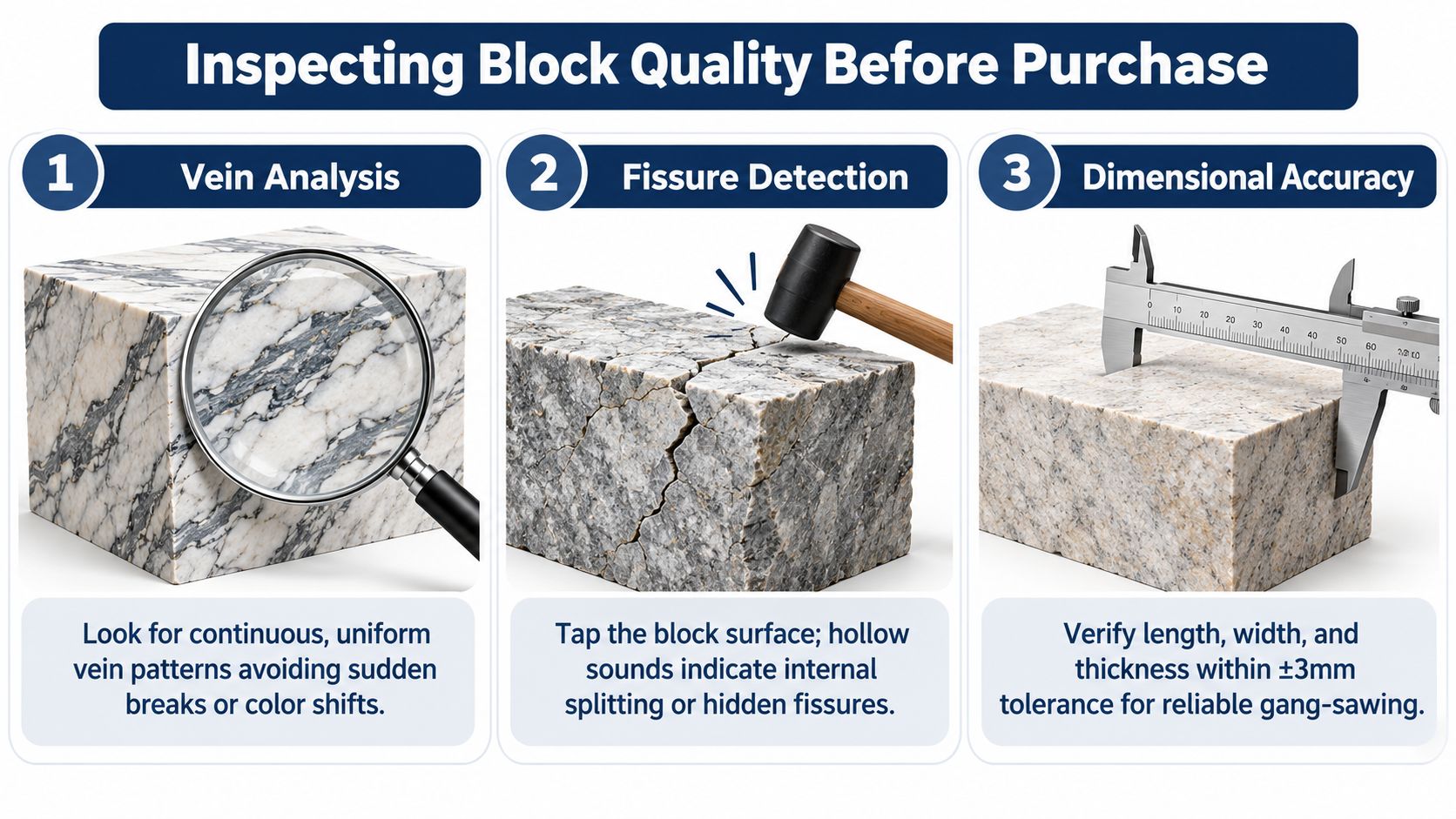
Veins need to be read as a cutting pattern
Don't inspect a vein only as a decorative line. Follow it across adjacent faces and ask how it will appear after the block is squared and sawn. A vein that remains continuous may create a coherent slab sequence. One that breaks suddenly, changes width, or shifts colour can produce slabs that don't match across a floor or wall.
Mark the block with a simple orientation system:
- Top and bottom: Identify the faces that will control slab orientation.
- Primary direction: Draw the expected vein or grain direction.
- Defect zones: Circle areas that should be avoided for visible work.
- Cutting face: Record the face selected for the gang-saw setup.
This record gives the workshop something more useful than a general statement such as “similar to sample”. It defines what similarity means for that particular purchase. A fabricator assessing unusual movement can compare the block with guidance on signature marble and granite selection, while still relying on the physical block inspection for the final decision.
Fissures rarely announce themselves clearly
Run a clean surface over the block and look for hairline openings, rust-coloured traces, filled seams, edge bruising, and changes in texture. Tap the surface with a light metal tool and compare the sound across several locations. A clear, consistent response is encouraging. A noticeably hollow or dull response deserves further investigation because it may indicate a void, separation, or hidden fissure.
The tap test is a screening method, not a certificate of internal soundness. If the block is valuable or the order is critical, request a more thorough assessment from the supplier and document the agreed inspection method. A quarry should not object to recording known problem areas. Concealed defects create much larger disputes after sawing than before loading.
Colour consistency is a production question
Natural granite varies. The issue isn't whether every part of the block is identical. The issue is whether the variation is compatible with the client's layout and the workshop's selling plan.
Compare colour in shade and direct light, then review the block face after wetting. Look for abrupt transitions, clusters of dark patches, iron staining, cloudy areas, and a change between the visible front and side faces. Photograph the block in a consistent sequence, include its identification mark, and keep the original files with the purchase order.
For imported and domestic material alike, the same discipline applies. A reputed source may have better sorting and documentation, but no origin eliminates natural variation. The buyer still needs to inspect the actual block, not assume that the quarry name guarantees a predictable slab.
Before approval, ask one final question: If the block produces fewer matching slabs than expected, which parts of the project can use the variation without creating a dispute?
Record measurements, face condition, vein direction, fissure locations, colour changes, corner damage, and loading condition. If the supplier won't provide a clear answer about any of these, pause the order. A delayed purchase is usually easier to manage than a block that enters production without a defined quality record.
Transport, Handling, and Yield Calculations
A sound block can still become a poor purchase if transport and unloading are improvised. Confirm the trailer's load capacity, platform condition, tie-down arrangement, access to the workshop, and the equipment available for unloading. The block should sit on stable supports, with restraints that prevent movement without concentrating damaging pressure on one corner.
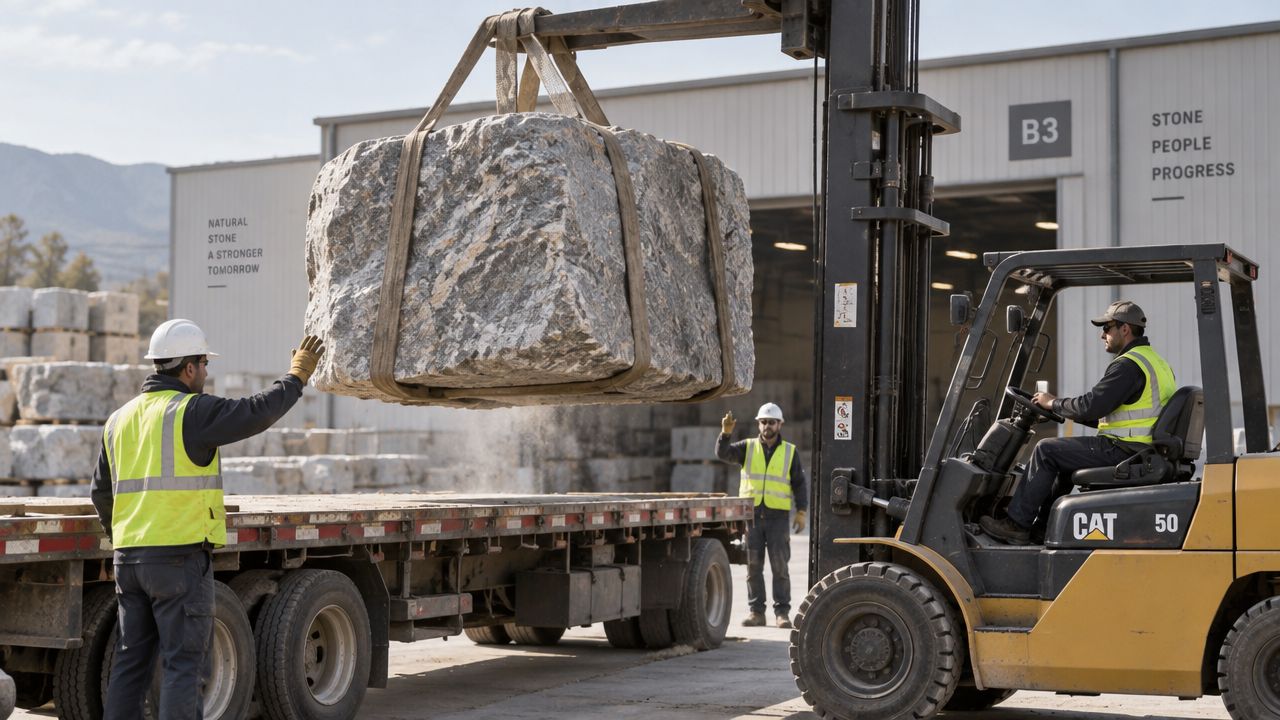
Protect exposed faces from road impact and contamination, but don't wrap the block in a way that hides damage at delivery. Photograph the block before loading, during loading, and after unloading. Note corner condition and any new marks on the delivery record.
Turn volume into a realistic slab plan
Begin with gross block volume:
Length × width × height = gross volume
That figure is only a starting point. Subtract the material lost to:
- Saw kerf: The width consumed by each blade passage.
- Squaring and trimming: Irregular outer edges must be removed before saleable slabs are produced.
- Defect removal: Fissures, weak zones, stains, and incompatible colour areas reduce usable output.
- Slab rejection: Some pieces may be structurally sound but unsuitable for the specified finish or visual sequence.
- Handling damage: Cracked corners or chipped edges can reduce the dimensions available for fabrication.
A practical estimate should therefore produce three values, not one: gross volume, expected slab output, and conservative saleable output. Price the project against the conservative figure. If the workshop later gets extra usable material, that becomes protection, not a rescue plan.
After one or two test cuts, compare actual results with the estimate. Record kerf, average trimming loss, defect location, and the number of slabs accepted for the intended job. That internal record becomes more useful than a generic yield assumption because it reflects the quarry, block type, saw, operator, and finish standard.
A costing reference such as Uptool's material cost guide can help organise material, labour, and project-cost inputs. Use it alongside your own production records, not instead of them.
The safest unloading procedure keeps non-essential workers outside the lifting zone, checks the support points before releasing restraints, and uses equipment rated for the actual load. Never ask a forklift to correct an unstable landing through sudden movement. Slow positioning protects the block, the equipment, and the people around it.
The operational sequence is worth documenting for every delivery:
- Receive: Match the block identification with the purchase order.
- Inspect: Photograph faces, edges, corners, and any transport marks.
- Measure: Confirm dimensions and record deviations.
- Plan: Mark orientation and intended cutting direction.
- Reconcile: Update the yield estimate before the gang saw is scheduled.
A useful estimate is not a promise that every cubic unit becomes product. It's a decision tool that tells the fabricator whether the order has enough material margin to survive natural variation.
Slab Production Implications and Fabrication Tips
The quarry decision becomes visible in the workshop as soon as the block is positioned. A regular block with a documented cutting face lets the operator set the gang saw with confidence. An irregular block with uncertain vein direction encourages conservative cutting, repeated checks, and more trimming.
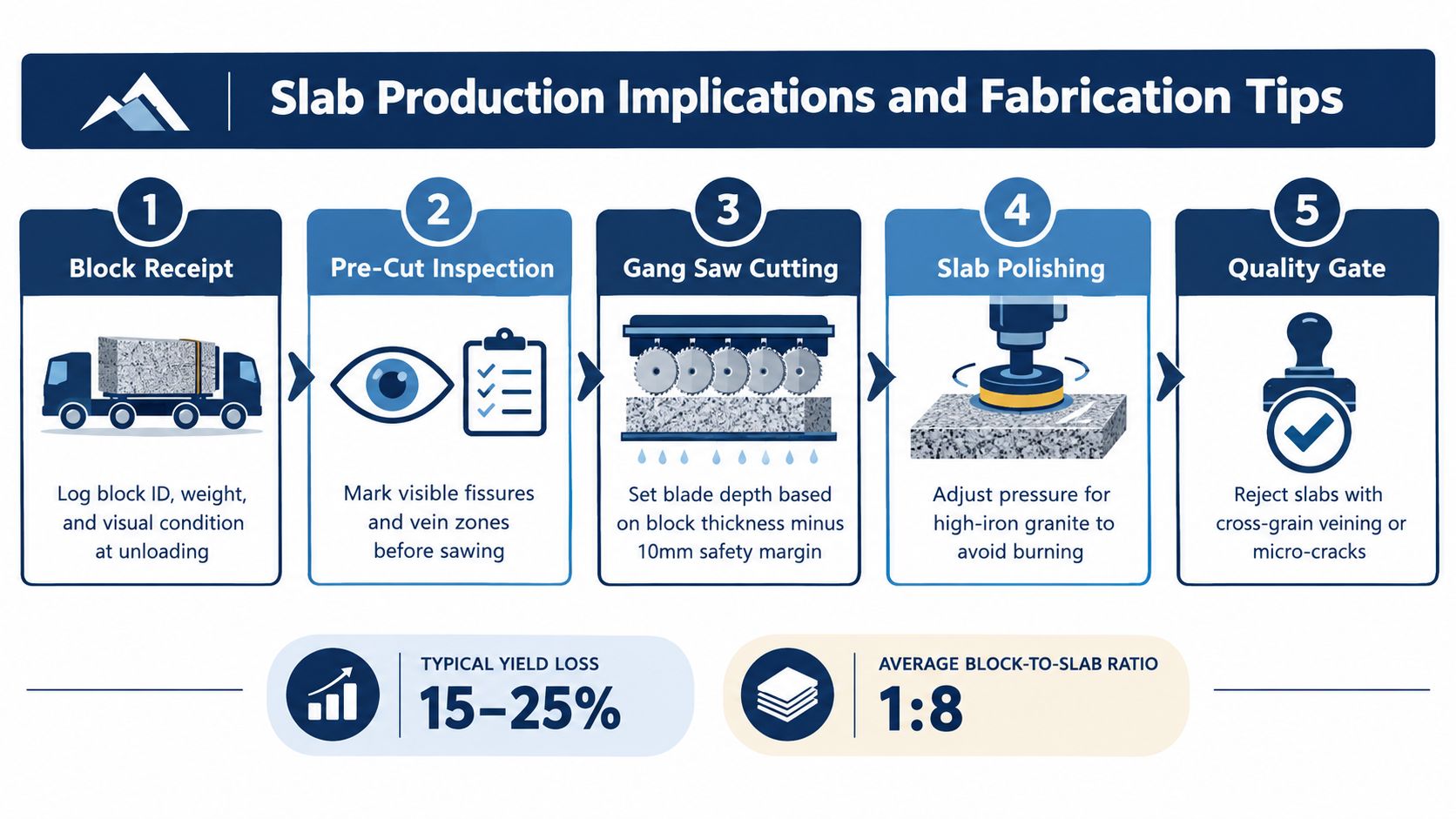
Set the cut from the material, not habit
Before sawing, rotate the block on paper first. Compare the expected slab face with the client's approved pattern, the largest required pieces, and the locations of known fissures. A small change in orientation can move a defect away from a sink cut-out or place a stronger vein where the design can use it.
Operators should also confirm:
- Blade condition: Dull or unsuitable tooling can increase heat, vibration, and edge damage.
- Cutting speed: The setting should respond to the block's hardness and internal structure, not a standard number copied from another material.
- Cooling and flushing: Slurry removal and stable cooling help maintain a clean cut and protect the equipment.
- Marking discipline: Number slabs in sequence so the workshop can preserve the block's visual order during polishing and installation.
Don't treat a visible fissure as an automatic reason to discard the entire block. Some defects can be isolated, reinforced, or allocated to smaller pieces. Others run through the slab field and make the material unsuitable for structural or high-visibility work. The decision belongs to the intended application.
Finishing reveals what cutting concealed
Polishing can strengthen the visual effect of good granite, but it can also expose pits, iron-related colour, resin repairs, and inconsistent density. Adjust pressure and abrasive progression to the actual material. If the operator tries to force a uniform finish across a variable surface, burning, uneven reflection, or over-polishing can appear.
Inspect slabs at several checkpoints:
- After sawing: Look for open cracks, breakage, thickness variation, and unexpected pattern changes.
- After calibration: Check flatness and whether defect areas have opened further.
- After polishing: Review colour, gloss, filled areas, edge integrity, and surface pinholes.
- Before fabrication: Match each slab to the cutting drawing and identify high-risk cut-outs.
- Before dispatch: Confirm that the approved sequence and finish are maintained.
Workshop rule: A defect is easier to manage when it is identified before nesting. Once cut-outs and edge profiles are committed, the cost of a wrong decision rises sharply.
Imported and Indian blocks can both perform well, but they shouldn't be processed on assumptions about origin. Let the actual block determine the saw response, reinforcement requirement, polishing sequence, and handling method. The same principle applies to dimensions. Fabricators can use the granite slab measurements guide to structure measurement checks, then confirm every received slab against the job drawing.
The value of rough block procurement appears when the workshop can convert inspection information into a cutting plan. If the team buys cheaply but records nothing about orientation, defect zones, or expected output, the supposed saving disappears in rework. If the team pays more for a well-documented block but reduces uncertainty, the higher purchase price may be justified by production control.
Making the Right Block Sourcing Decision
Rough block procurement suits fabricators who can inspect material, plan cutting, manage heavy handling, and sell or allocate the resulting slabs. It isn't automatically the right choice for every project. A short programme, a small quantity, or a tightly specified colour match may favour pre-cut slabs because the buyer can inspect the finished surface before committing to fabrication.
Use the project conditions to make the decision:
| Project condition | Rough block route | Pre-cut slab route |
|---|---|---|
| Large quantity of related pieces | Strong fit when the workshop controls sawing and sequencing | Useful when matching stock is already available |
| Tight completion date | Riskier if transport, cutting, or inspection time is limited | Often simpler because finished material can be selected directly |
| Highly specific pattern | Suitable when the block can be oriented and sequenced correctly | Easier to approve visually, but stock may be limited |
| Limited lifting or sawing capacity | Poor fit without a capable partner | More practical |
| Need for maximum procurement flexibility | Requires commitment to a larger material unit | Allows selection by slab and application |
Price alone is a poor filter. A low block price can be offset by trimming, rejected slabs, extra polishing, transport damage, and idle production time. A higher-priced block may make commercial sense if its structure, dimensions, and documentation support the required output.
Build a supplier standard that can be checked
Put the specification in writing. Include acceptable colour range, permitted filled areas, visible fissure rules, required photographs, block dimensions, identification marks, inspection rights, loading responsibility, and the process for handling a disputed delivery. Keep the same form for every supplier so comparisons remain practical.
For a repeat relationship, share feedback after sawing. Tell the quarry which faces produced the best sequence, where defects appeared, and whether the dimensions supported the planned cuts. Good suppliers can then improve selection. Fabricators also gain a usable record of which sources deliver consistently.
Choose rough granite blocks when:
- the project requires substantial volume or repeated pieces;
- the workshop controls sawing and polishing;
- the team can inspect the actual block;
- the timeline allows for transport and production variables;
- the client accepts a natural range that has been defined in advance.
Choose finished slabs when:
- the client needs immediate visual approval;
- the quantity is modest;
- the workshop lacks heavy cutting capability;
- the installation schedule leaves little room for block-to-slab uncertainty;
- the design depends on selecting exact individual slabs.
Varun Marbles is one option for buyers who prefer to evaluate finished granite and other natural-stone surfaces through a local showroom, with support that can extend from selection to fabrication and installation coordination. The practical choice is the route that gives the project the clearest control over appearance, yield, timing, and responsibility.
The best purchase is not the block with the lowest quoted rate. It's the block whose structure, orientation, logistics, and expected slab output have been understood before the order becomes irreversible.
Review your next block purchase against the inspection, transport, and yield checks above before confirming the supplier. For finished granite selection, cut-to-size fabrication, and installation coordination in Gurugram, visit Varun Marbles and discuss the material requirements with the team before production begins.