
Labradorite Blue Granite: A Complete Stone Profile
You're standing in an NCR stone showroom with a kitchen elevation on your phone and two blue slabs leaning against A-frame racks. One carries the regional identity of Srikakulam Blue Granite. The other is imported material from Madagascar, sold under a trade name such as Lemurian Blue or Labrador Blue Pearl. Under the showroom spotlights, both appear dramatic. The difficulty begins when you ask which one will still look right after fabrication, installation, cooking, cleaning, and daily use.
That choice depends on three separate decisions: visual character, structural suitability, and finish behaviour. The blue flash must suit the lighting and design scheme, the slab must meet the demands of its application, and the finish must provide the right balance between colour, grip, glare, and maintenance.
Table of Contents
- Why Labradorite Blue Granite Demands a Closer Look
- Understanding the Stone and Its Visual Character
- Technical Properties and BIS Benchmarks That Matter
- Labradorite Blue Granite Against Quartz and Marble
- Where This Stone Works Best in Your Project
- Choosing the Right Finish for Each Application
- Fabrication and Installation Best Practices
- Decoding the Price Spread in the Indian Market
- A Practical Selection Framework for Buyers
- Quick Reference Card for Project Specification
- Common Questions Buyers Ask After the Profile
Why Labradorite Blue Granite Demands a Closer Look
The phrase labradorite blue granite describes a commercial family rather than one perfectly uniform material. Indian buyers may encounter Srikakulam Blue Granite from Andhra Pradesh alongside imported labradorite varieties traded as Labrador Blue Pearl, Lemurian Blue, or Blue Night. The regional family is tied to the Srikakulam colour-granite belt, while imported stock often enters India as rough blocks before being processed into slabs. This distinction matters because the stone's blue schiller, or labradorescent flash, can change considerably from block to block.
A slab that looks electric blue beside a dark showroom wall may appear quieter in a residential kitchen with diffuse daylight. Conversely, a quieter slab can read beautifully under carefully directed lighting. Supplier photographs rarely show enough information about the base tone, mineral distribution, resin work, or full-slab continuity for a purchase decision.
Practical rule: Never approve labradorite blue granite from a small photograph or a single sample tile. Select the actual slabs intended for the project.
The three inspection questions are straightforward:
- Visual character: Is the base charcoal, blue-grey, green-grey, or heavily mottled? Does the flash appear across the working area or only in isolated crystals?
- Structural suitability: Does the slab have test documentation covering density, absorption, hardness, and strength for the intended use?
- Finish behaviour: Will polishing maximise the flash at the expense of floor grip? Would honing or leathering create a better surface for the room?
For NCR projects, showroom selection should be treated as a procurement exercise, not a colour-shopping exercise. The geological story is also substantial. An India-focused stone reference places the Srikakulam blue-granite-bearing zone in the Precambrian Eastern Ghats Mobile Belt and dates its geological origin to roughly 1,500 million years ago, while reporting government-recorded reserves of about 29.25 lakh cubic metres around Tekkali, Nadigama, Saravakota, and nearby areas. Those facts establish provenance and history, but they don't remove the need for slab-level testing.
Understanding the Stone and Its Visual Character
The signature effect comes from labradorescence, a metallic blue, green, or teal flash produced when light interacts with layered intergrowths inside calcium-sodium feldspar crystals. It isn't a painted surface or a decorative coating. The visible effect depends on crystal orientation, the viewing angle, the polishing quality, and the light falling across the slab.
In practical showroom language, describe four things instead of asking for “the shiny blue one”. Start with the base tone, which may read as deep charcoal, blue-grey, green-grey, or nearly black. Then assess schiller intensity, meaning how strongly the blue or green flash appears and whether it remains visible when you move away from the direct light source. Finally, look at veining pattern and crystal size. Broad continuous bands create a different installation strategy from scattered coarse crystals.
Indian yards can include Srikakulam Blue and Paradiso-related variants from Andhra Pradesh, along with imported material such as darker Volga Blue from Ukraine and Lemurian Blue from Madagascar. These trade families aren't interchangeable. A regional Indian stone may offer a more granular, patterned appearance, while imported material may be selected for broad, dramatic feldspar flashes. The actual slab still takes priority over the label.
Labradorite Blue Granite Varieties at a Glance
| Variety | Origin | Base Tone | Schiller Character | Typical Application |
|---|---|---|---|---|
| Srikakulam Blue Granite | Andhra Pradesh, India | Blue-grey to dark grey | Regional variation, often mineral and granular | Flooring, counters, wall features |
| Paradiso variants | Andhra Pradesh, India | Grey, brown-grey, or mixed tones | Pattern-led rather than uniformly luminous | Floors, staircases, commercial interiors |
| Volga Blue | Ukraine | Dark blue-grey | Deep, controlled blue flashes | Premium counters and feature surfaces |
| Lemurian Blue | Madagascar | Deep charcoal, blue-grey, or green-grey | Stronger dramatic blue-green flash in selected slabs | Islands, bars, book-matched walls |
Lighting can mislead even experienced buyers. Ask the yard to view the slabs under neutral daylight conditions, then examine them under the project's proposed lighting. A 4000K daylight reference is useful for comparing the blue balance, but the important point is consistency. Inspect the complete slab from several angles, not just the section where a spotlight creates the strongest reflection.
A good selection has a deliberate visual rhythm. It may have a dark field with concentrated flashes around an island edge, or a relatively even distribution suited to a large wall. A poor selection often relies on one attractive corner while the rest of the slab turns muddy, fractured, or visually empty.
Technical Properties and BIS Benchmarks That Matter
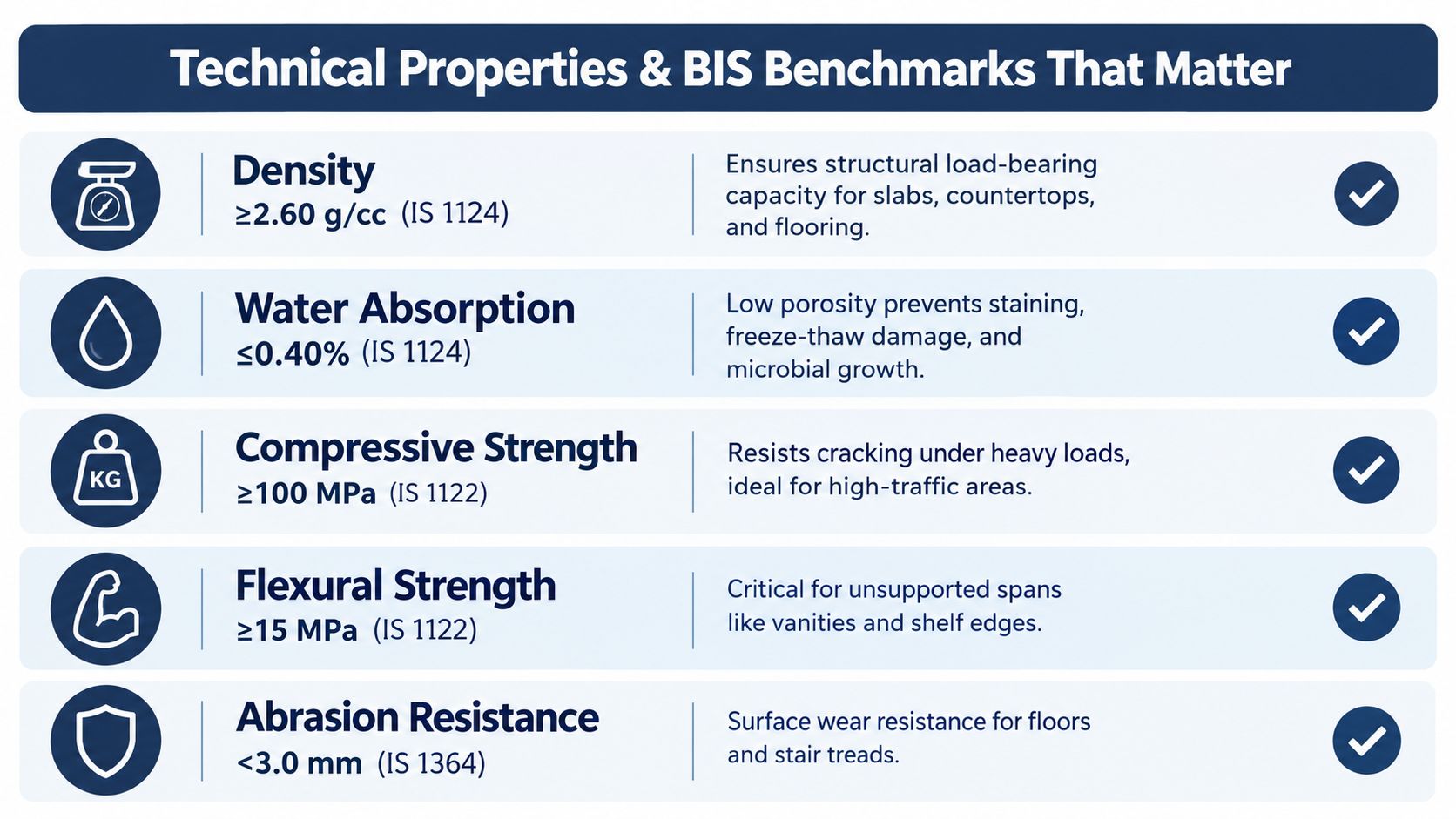
A decorative slab still needs a technical file. The most useful Indian reference for polished granite and similar polished building stones is IS 14223 (Part 1): 2023, listed by the Bureau of Indian Standards under the CED 06 Stones standards set. The older BIS-backed technical summary gives procurement benchmarks including apparent specific gravity of at least 2.75, water absorption of no more than 0.50%, Mohs hardness of 6 to 7, tensile strength of at least 90 kg/cm², shear strength of 300 to 540 kg/cm², and compressive strength in the 1300 to 2200 kg/cm² band for multicoloured and grey granites. These figures come from the BIS published standards reference.
The figures must be read as acceptance benchmarks, not as a promise that every slab sold under a trade name meets them. A fabricator should provide a test report tied to the supplied material, preferably at slab or batch level.
Turn the test report into a site decision
- Density: A slab listing for Lemurian Granite in India gives a density of 2.7 g/cm³, with a listed hardness of 7 Mohs and slab dimensions of 240 × 120 cm. Treat supplier specifications as a starting point, then verify them against independent test documentation.
- Water absorption: The BIS ceiling of 0.50% matters in kitchens, vanities, flooring, and cladding because higher absorption increases the risk of staining and moisture-related deterioration.
- Compressive and tensile strength: These values help determine whether a material is appropriate for loaded floors, stair components, and counters with cut-outs. A sink opening or narrow edge is a stress concentration, so visual inspection alone is inadequate.
- Structural granite: IS 3316:1974 sets a compressive-strength floor of 1,000 kg/cm² and limits water absorption to 0.50% for structural granite, as recorded in the BIS structural granite document.
Also request the quarry or block identification, slab thickness, resin disclosure, finish specification, test method, and date of testing. If the dealer can't connect the report to the material being offered, don't treat the paper as proof of compliance. For a broader colour reference, see Varun Marbles' guide to sky blue granite, but keep the project decision anchored to the actual slab and its test report.
Labradorite Blue Granite Against Quartz and Marble
The right comparison isn't “which material is most luxurious?” It's “which compromise can this project tolerate?” Labradorite blue granite offers natural optical variation and a feldspar flash that engineered quartz doesn't reproduce exactly. Quartz offers more predictable patterning and simpler routine care. Marble brings superior veining drama, but its porosity and sensitivity to acids make it a demanding kitchen surface.
| Parameter | Labradorite Blue Granite | Engineered Quartz | Italian Marble | Standard Grey Granite |
|---|---|---|---|---|
| Hardness | Usually suitable for demanding interior work, subject to testing | Consistent manufactured surface | Softer and more vulnerable to scratching | Generally practical for heavy use |
| Stain resistance | Stronger when absorption is within BIS limits and the surface is sealed | Non-porous options reduce routine sealing | More porous and maintenance-sensitive | Usually dependable with suitable sealing |
| Heat tolerance | Good for normal countertop use, with sensible protection | Follow the manufacturer's heat guidance | Heat and thermal shock still require care | Practical for kitchens and utility surfaces |
| Slab variation | High, block and slab dependent | Low relative to natural stone | High | Moderate, depending on range |
| Maintenance cycle | Initial sealer and ongoing inspection | Low routine maintenance | More frequent care and spill control | Straightforward sealing and cleaning |
| NCR price band | Wide, from budget listings to exotic slabs | Varies by brand and design | Wide, based on origin and grade | Usually more cost-efficient |
Pick labradorite blue granite when the project needs a natural focal point and the owner accepts slab selection, sealing, and fabrication discipline. Pick engineered quartz when colour consistency and low routine maintenance matter more than geological variation. Pick Italian marble when veining is the priority and the client understands the risks around acids, staining, and scratching. Pick standard grey granite when the brief prioritises dependable performance and cost control.
For outdoor kitchens, compare the complete exposure, finish, edge, and installation specification rather than copying an indoor countertop detail. A practical reference on durable outdoor kitchen countertops is useful because the base material is only one part of outdoor performance.
Where This Stone Works Best in Your Project
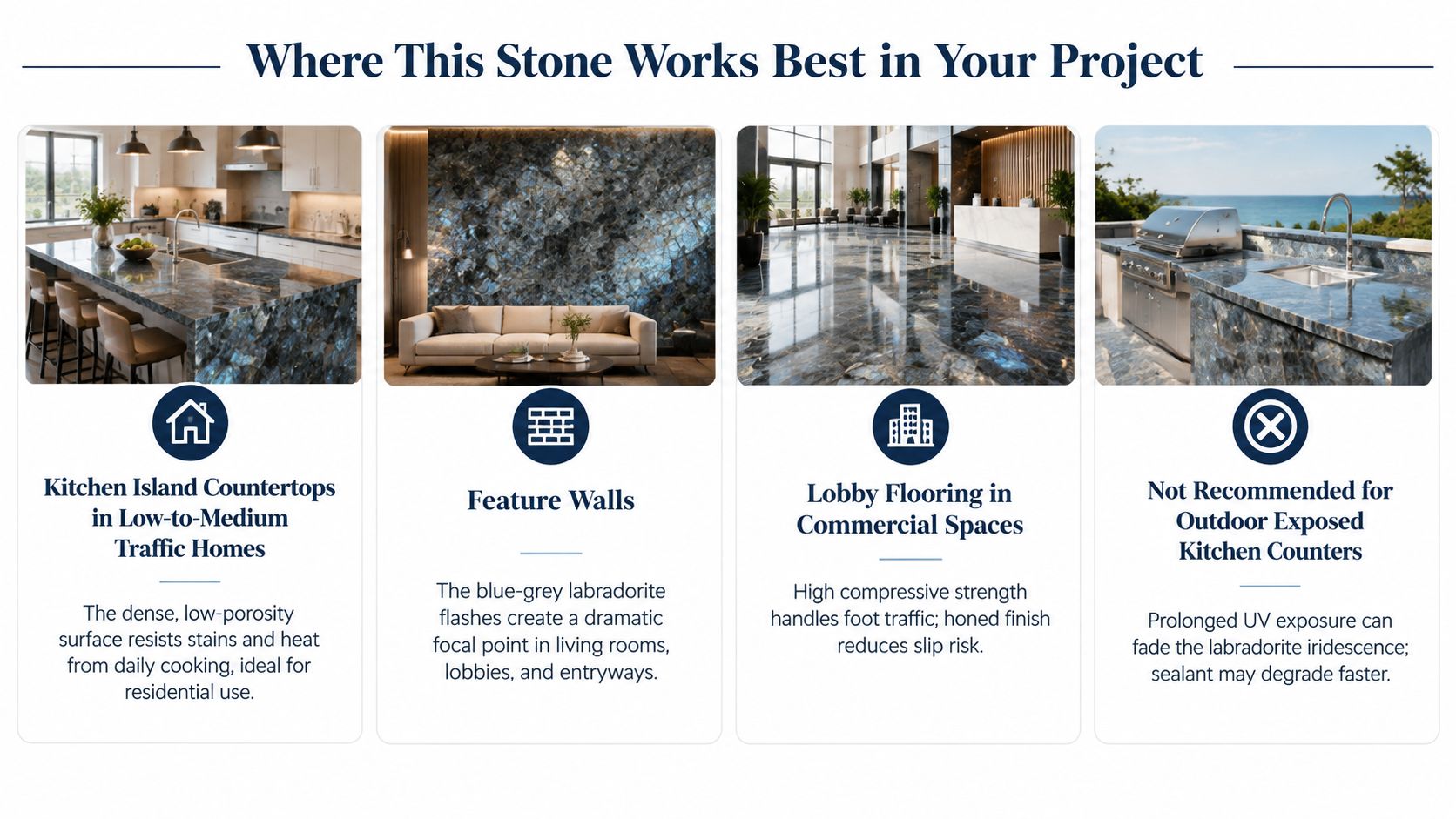
Labradorite blue granite performs best where its visual impact can be seen clearly and where the installer can control the substrate, joints, edge details, and cleaning regime. A residential kitchen island in a low-to-medium traffic home is a strong use case. The owner gets a dense natural surface with a distinctive flash, while the fabricator can reinforce sink cut-outs, support overhangs, and specify an appropriate sealer.
A bathroom vanity, bar top, reception desk, or feature wall can be even more forgiving. Vertical applications reduce the risks associated with heavy abrasion and standing water, while raking light can reveal the stone's mineral depth. In boutique hospitality interiors, lobby flooring can work when the designer chooses a surface that balances appearance with grip and the installer controls lippage and joint detailing.
Match the material to the exposure
- Kitchen islands: Give a green signal for low-to-medium traffic homes, provided the slab is tested and the cut-outs are properly supported.
- Feature walls: Strong choice for living rooms, lobbies, bars, and entry spaces. Backing mesh or lamination may be required where the slab has fissures or where panel size creates handling risk.
- Flooring: Suitable for selected residential and boutique commercial areas. Heavy traffic requires abrasion review and a finish with adequate slip resistance.
- Stair treads: Use only with sound slab selection, correct support, a durable edge profile, and a properly detailed bullnose or eased edge.
Thickness changes the engineering conversation. 16 mm material usually needs a carefully designed substrate or laminated edge. 18 mm can suit many interior applications with appropriate support. 20 mm or greater gives the fabricator more room for edge shaping and detailing, but it still doesn't replace a strength check.
Use caution for exposed outdoor paving in hill stations where freeze-thaw conditions may create risks, and for heavily used floors with a highly polished surface. Avoid combining the stone with routine acidic cleaning or areas where iron-bearing minerals could leach and create visible staining. Sealers won't correct poor drainage, unsuitable adhesive, weak substrate support, or a bad finish choice.
Choosing the Right Finish for Each Application
Finish selection changes both the appearance and the risk profile. Polished surfaces produce the strongest labradorescence because the reflective face returns more light to the eye. They suit kitchen islands, bar tops, reception counters, and feature walls, but a polished floor can become slippery when wet and may reveal scratches or surface marks more readily.
Honed granite has a low-sheen surface that reads calmer and more contemporary. It reduces glare and can disguise minor surface marks, making it useful for cladding and selected floor applications. It won't deliver the same visual intensity as a mirror polish, so approve a finished sample before ordering the full quantity.
Leathered finishes use texturing to create a tactile surface. They can hide fingerprints and soften the severity of a dark slab on an island or vanity. Flamed finishes are created through thermal treatment and can improve grip for suitable exterior or stair applications, but the process mutes much of the labradorescent effect. Brushed finishes offer an aged, tactile appearance suited to rustic or materially layered interiors.
Don't accept an R11, R12, or R13 claim without a test report for the actual finish and application. Slip performance depends on surface texture, contamination, footwear, slope, and wetness, not on the stone name alone. Likewise, a resealing interval should follow the sealer manufacturer's instructions and a site water-bead test, rather than a salesperson's fixed promise.
| Finish | Labradorescence Intensity | Slip Resistance | Resealing Interval | Best Application |
|---|---|---|---|---|
| Polished | Highest visual flash | Lower when wet than textured finishes | Set by product instructions and water-bead testing | Kitchen islands, counters, feature walls |
| Honed | Softer, lower sheen | Better glare control | Test periodically | Cladding, calm interiors, selected floors |
| Leathered | Moderate, tactile flash | Improved texture compared with polish | Test periodically | Islands, vanities, hospitality surfaces |
| Flamed | Muted flash | Appropriate where a tested textured finish is required | Test periodically | Exterior paving and selected stair details |
| Brushed | Subdued, aged appearance | Texture-dependent | Test periodically | Rustic interiors and feature surfaces |
For finish references related to worktops, Varun Marbles also publishes guidance on kitchen marble and granite. In a coordinated project, polished labradorite on an island with honed or leathered surrounding surfaces can create visual rhythm without making every surface compete for attention.
Fabrication and Installation Best Practices
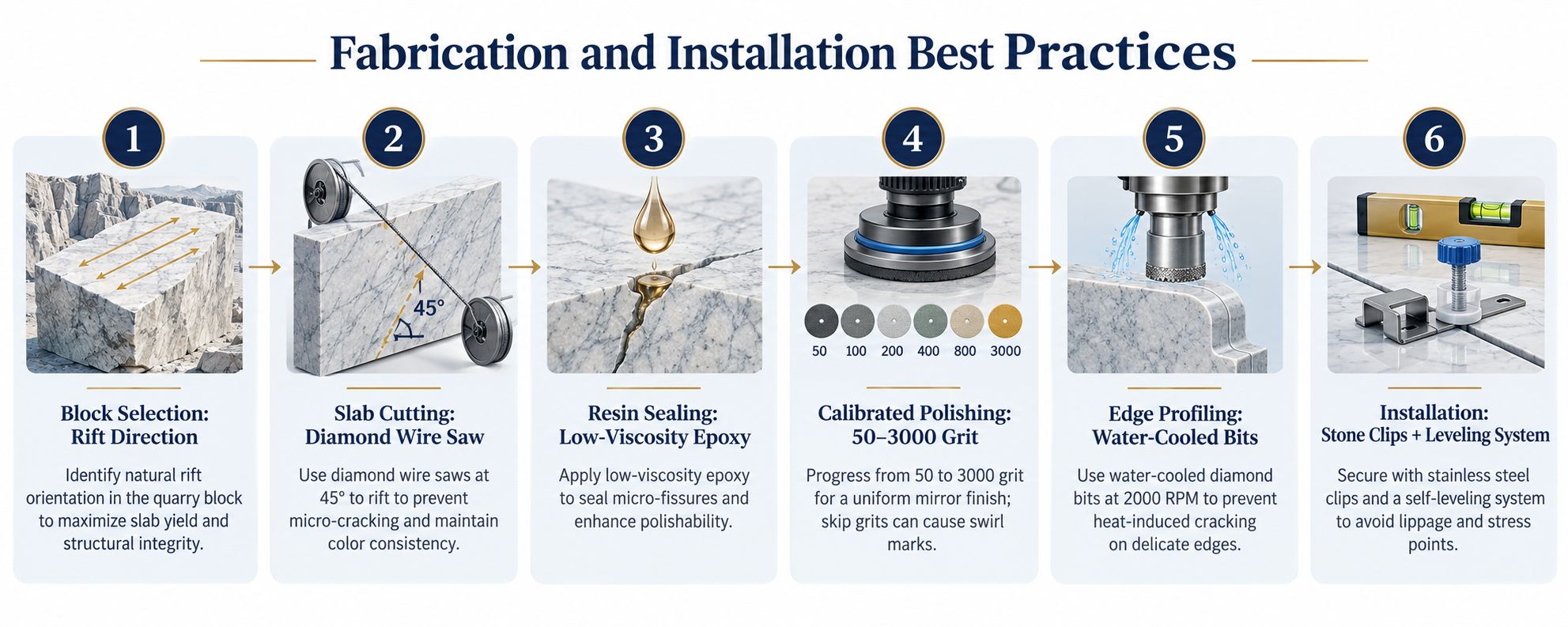
The fabrication sequence starts with the block. Inspect the block or slab bundle for rift direction, crystal continuity, fissures, resin fills, and the way the schiller bands will run through the finished piece. A striking face can become a poor countertop if the sink cut-out crosses a weak mineral boundary or if the installer positions a natural fissure at a narrow unsupported edge.
At the slab yard, inspect the front and back faces under angled light. Look for epoxy fills, resin pools, mesh separation, hairline cracks, and abrupt colour changes. Photograph and approve the layout before cutting. For book-matched walls or large islands, mark the feature zones on the actual slabs rather than relying on a digital rendering.
Control each handover
- Block to slab: Audit dimensions, thickness, fissures, and colour continuity before the slab leaves the yard.
- Cutting: Use diamond tooling and water-cooled equipment. The cutting direction should follow the approved layout, not maximise yield.
- Edge profiling: Select an eased, pencil, bevel, or bullnose edge based on the use. Inspect the cut-out corners for chips and micro-cracks.
- Dry layout: Place pieces in position before permanent fixing, especially where two slabs meet or where a flash band is a design feature.
- Installation: Use a compatible stone adhesive for the substrate and application. Keep the base level and fully supported.
- Sealing: Allow adhesive, grout, and moisture to cure according to the product system before applying the impregnating sealer.
NCR interiors experience seasonal temperature and humidity changes, so large-format flooring needs a properly designed joint and movement strategy. Don't close every joint tightly and assume the stone will absorb installation movement. Crate slabs upright with controlled support, stage lifting equipment before delivery, and never drag finished faces across unfinished surfaces.
Decoding the Price Spread in the Indian Market
Online prices for labradorite blue granite can range from roughly ₹90 to ₹4,500 per square foot, according to Indian marketplace listings for labradorite slabs. That isn't a clean market continuum. It usually represents different products, grades, origins, thicknesses, finishes, and selling conditions grouped under a similar name. The range is visible in Indian labradorite slab listings, but a listing alone doesn't tell you what will arrive at site.
A low teaser may describe quarry-run or commercial material, while a premium quote may cover a selected imported block with stronger flash, better continuity, thicker stock, and more controlled fabrication. Domestic Srikakulam material and imported Madagascar blocks also carry different freight and handling economics. Trade data records Madagascar-to-India shipments of rough blocks labelled Lemurian Blue and Labradorite, including 12,320 kg valued at US$13,717.71 on 27 April 2023 and 110,420 kg valued at US$33,947.72 on 8 April 2023, as shown in this Madagascar-to-India trade reference.
| Price Tier | Origin | Grade | Thickness | Typical Use |
|---|---|---|---|---|
| ₹90 per sq ft range | Unclear or domestic commercial stock | Quarry-run or basic commercial | Confirm in writing | Utility areas or low-risk selections |
| Mid-market quote | Indian or imported, origin documented | Standard selected slabs | Confirm whether 16 mm, 18 mm, or 20 mm | Residential counters and walls |
| Premium quote | Selected imported or exceptional domestic block | Premium visual grade | Often thicker or specially fabricated | Islands, bars, feature walls |
| ₹4,500 per sq ft range | Exotic selected slab | High visual selectivity and low availability | Confirm slab and fabrication basis | Statement interiors and book-matched work |
Compare quotes only after matching origin, grade, thickness, finish, slab selection, wastage basis, cut-outs, edge profile, crating, freight, sealing, and installation. Ask whether transportation from Kishangarh or South India is included, and whether CNC work and site labour are separate. India's granite and granite-product exports fell 5.15% year over year to USD 1,289.01 million in FY2024-25, according to the industry report linked in the brief, so dealer availability and pricing behaviour can shift with broader trade conditions.
A Practical Selection Framework for Buyers
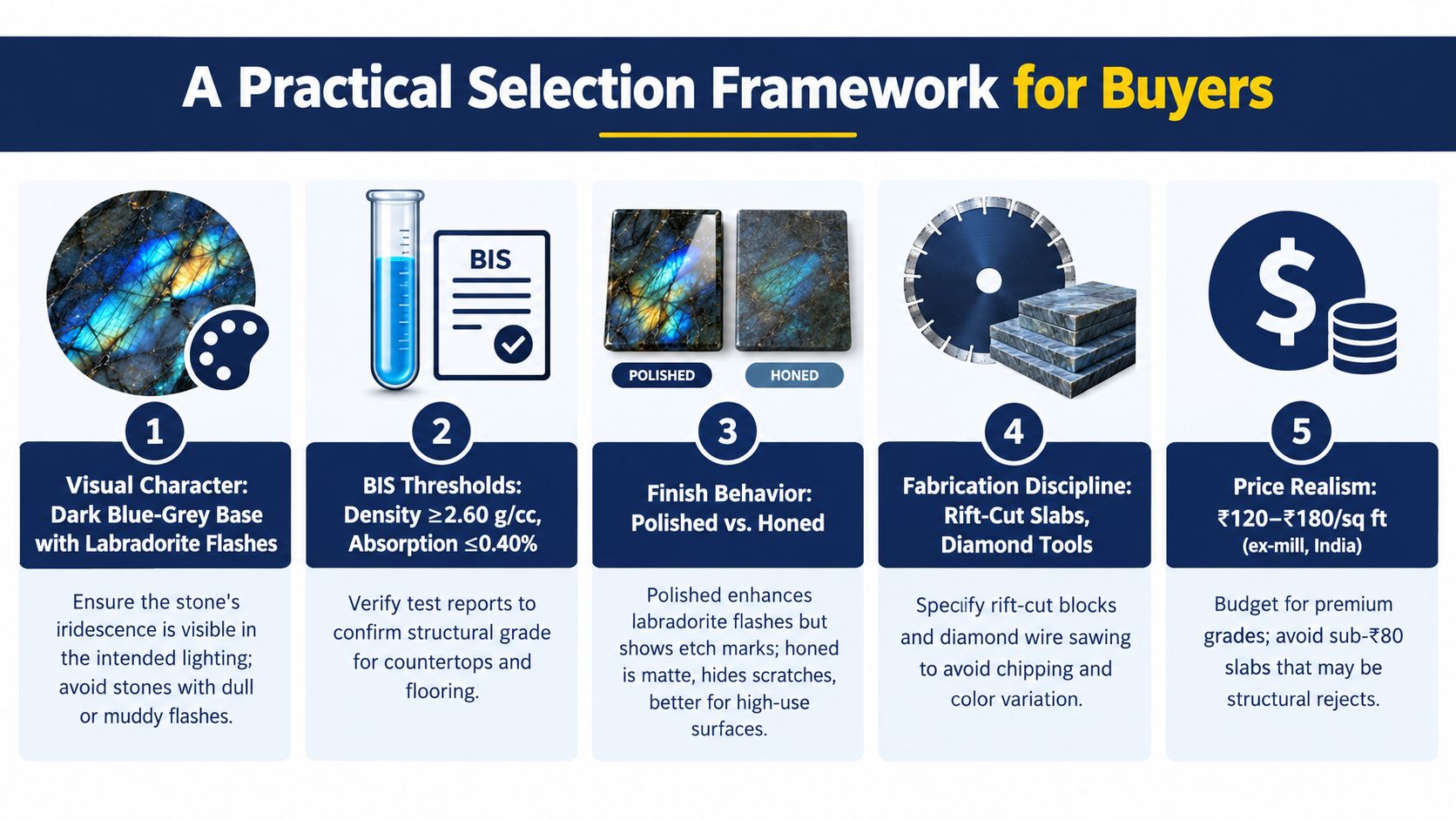
A showroom visit should end with a documented decision, not a verbal promise. Use five yes-or-no gates.
- Technical gate: Is there a test certificate for the supplied material? Check density, absorption, and strength against the applicable BIS requirements. If the report is generic or untraceable, stop.
- Visual gate: Inspect at least three full slabs under raking light and the project's likely lighting. Confirm the base tone, flash distribution, fissures, resin work, and slab-to-slab continuity.
- Finish gate: Approve the actual finish sample for the intended location. A polished island and a honed wall may use the same stone, but they won't look or behave the same way.
- Fabrication gate: Confirm the cutting layout, cut-out positions, edge profile, support, backing, dry-lay procedure, and installation responsibility in writing.
- Commercial gate: Compare like with like. The quote should identify origin, grade, thickness, finish, fabrication, freight, sealing, and installation rather than hiding them inside one square-foot figure.
If any gate fails, move on instead of negotiating around the defect. Varun Marbles' granite collection is one place an NCR buyer can inspect natural-stone options in person, but the same selection discipline should apply at every yard.
Quick Reference Card for Project Specification
Material: Labradorite blue granite, origin and trade name recorded on the purchase order.
Minimum technical checks:
- Apparent specific gravity: At least 2.75 under the older BIS-backed granite benchmark, verified through the supplied test report.
- Water absorption: No more than 0.50% for the cited polished-building-stone and structural-granite benchmarks.
- Mohs hardness: The relevant granite benchmark is 6 to 7.
- Structural compressive strength: IS 3316:1974 sets a floor of 1,000 kg/cm² for structural granite.
- Slab specification: Record thickness, finish, dimensions, resin or mesh treatment, and intended application.
Finish selection: Use polished for a kitchen island or feature wall where flash is the priority. Consider honed or leathered where glare and fingerprints matter. Use a tested textured finish for floors or stair details where grip is more important than maximum iridescence.
Sign-off checklist: Approve the actual slabs, inspect dye and resin work, confirm the edge profile, document the sealer system, review the cutting layout, and retain origin and test documentation with the project file.
Common Questions Buyers Ask After the Profile
Does it need sealing? Usually, yes. Apply an appropriate impregnating sealer initially, then check performance with a water-bead test rather than accepting an automatic quarterly resealing schedule.
Will it scratch? It resists ordinary kitchen wear, but ceramic blades and abrasive grit can still mark the surface. Use a cutting board and avoid dragging hard objects across the slab.
Will the blue flash fade? Properly selected and maintained stone should retain its natural labradorescence. Longevity depends more on slab quality, support, cleaning, sealing, and exposure than on the sales label.
How do I verify the source? Ask for the stated quarry origin, block or bundle identification, test report, and a clear invoice. Srikakulam and imported Lemurian stock can differ substantially in appearance and pricing, so be suspicious of a “Lemurian” slab that looks like ordinary grey granite, has unexplained resin coverage, or arrives without provenance documentation.
Varun Marbles can help NCR buyers compare imported and Indian granite slabs, inspect visual character in person, and coordinate cut-to-size fabrication, edge profiling, and installation support. Visit Varun Marbles with your application, lighting plan, and required finish so the selection is based on the actual slab, not a catalogue photograph.