
Sky Blue Granite: A Practical Guide for Indian Buyers

You're standing in a Gurugram stone yard with a kitchen layout, a lobby drawing, or a contractor's quote in hand. You ask for sky blue granite, and the salesperson shows you a blue-grey Indian slab, a glittering Blue Pearl, and an imported Azul variant. All carry similar names. None will behave the same on site.
That confusion is the buying risk. Sky blue granite is a colour family, not a single standardised stone. Quarry origin, mineral structure, resin treatment, slab grading, finish, and matching requirements determine whether the material works for your kitchen, façade, bathroom, or commercial floor. I've seen buyers approve a photograph and regret the delivery because the installed slabs had a different tone, movement, or polish response.
This guide separates the main categories available in India and focuses on the decisions that matter in NCR procurement, from slab inspection and BIS documentation to thickness, fabrication, logistics, and lot consistency.
Table of Contents
- Why Sky Blue Granite Is a Category, Not One Stone
- What Makes Blue Granite Look Blue
- Main Varieties Available in India
- Comparing the Standard Finishes
- Sizing, Thickness, and Cut-to-Size Decisions
- Inspecting a Slab Before You Buy
- Why Hand-Inspection and Curation Matter
- BIS Standards and Technical Specs to Verify
- Best Applications for Each Finish and Variant
- Procurement Realities for Indian Buyers
- Related Stones in the Blue Family
- Quick-Reference Buyer Checklist
Why Sky Blue Granite Is a Category, Not One Stone
A Gurugram architect can request blue granite for a lobby and receive quotes for four different materials: domestic migmatite from Andhra Pradesh, coarse Indian Blue Pearl, imported Brazilian Azul, or resin-treated commercial stock. Similar names do not mean similar performance. Mineral structure, pattern, density, finish response, and fabrication risk can change from one category to another.
In India, sky blue granite describes an appearance more than a geological identity. Srikakulam Blue belongs to a commercial blue-granite family from Andhra Pradesh's North Coastal belt. Tekkali, Nadigama, Saravakota, and nearby areas are associated with this material, which is described geologically as migmatitic rock from the Precambrian Eastern Ghats Mobile Belt. The trade name still covers variation between quarry lots, so the name alone cannot confirm consistency.
Imported Azul materials require a separate procurement approach. Their colour may be stronger, veining more dramatic, and availability less predictable. Domestic Blue Pearl-type stones can show reflective feldspar, yet the appearance may change sharply between lots.
Buying rule: put the quarry origin and commercial name on the quotation. “Sky blue granite” is not a sufficient material description.
For a kitchen, confirm whether the slab is natural, resin-treated, or mesh-backed. For a lobby, approve the complete lot instead of one attractive slab. For cladding, confirm thickness, anchoring, and finish before cutting begins. Ask one direct question: which material is this, and does its behaviour suit the application?
What Makes Blue Granite Look Blue
Natural blue colour comes from the stone's mineral composition, not from a generic blue coating. Minerals such as lazulite, sodalite, and certain feldspars can contribute blue hues, while labradorite and iridescent feldspar create the metallic flash seen in Blue Pearl-type stones. The result depends on crystal size, orientation, background minerals, and the way light enters and leaves the slab.
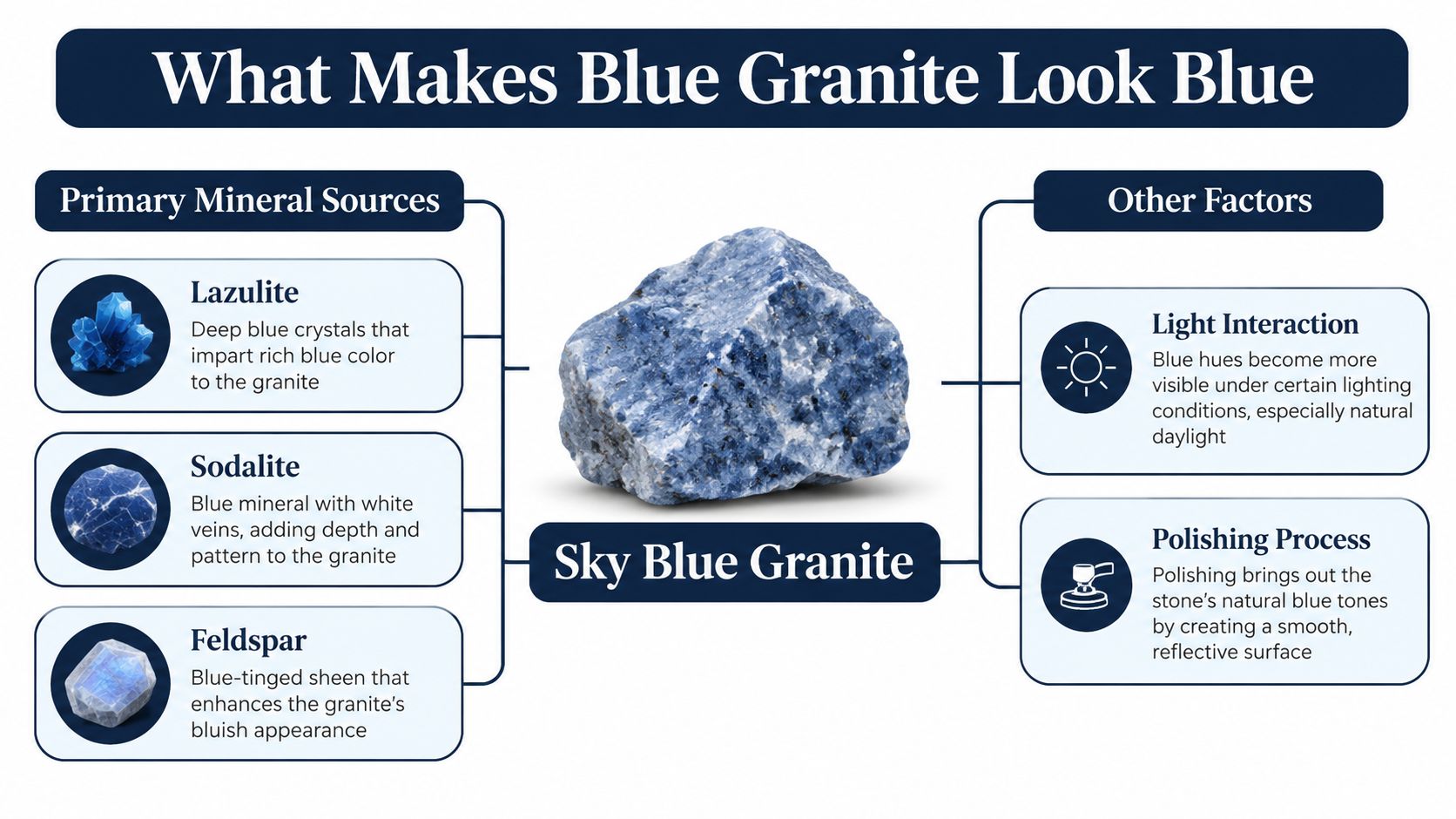
A fine-grained migmatite usually reads more subtly across a large surface. A coarse-grained blue granite shows stronger crystal movement and may look different from one end of the slab to the other. That isn't automatically a defect, but it must match the design intent.
Natural colour versus enhanced appearance
Some commercial slabs receive resin treatment to fill pits, stabilise weak areas, or deepen an uneven face. Resin isn't always unacceptable. The problem starts when the supplier doesn't disclose it, or when the buyer assumes a uniform showroom colour will continue through every cut piece.
Inspect the face and edges under angled light. Look for glossy patches, filled pits, colour pooling around fissures, and a different appearance on the cut edge. A polished sample can hide issues that become obvious after cutting, edge profiling, or honing.
Natural mineral movement is part of the stone. Undisclosed treatment is a procurement problem.
Ask the supplier to identify the quarry, treatment, finish, and intended use in writing. If the slab's blue appearance depends heavily on surface enhancement, treat it as a different grade from naturally consistent material and price the risk accordingly.
Main Varieties Available in India
A buyer in Gurugram may receive three very different slabs under the name “sky blue granite.” Indian quarry material, imported Azul stones, and commercial blue-grey slabs vary in structure, movement, treatment, and supply risk. Approve the actual lot, not the trade name.
Srikakulam Blue is the domestic option I check first for soft blue-grey movement and a layered architectural look. Its migmatitic structure can show smoky swirls and natural bands. Properly matched slabs suit flooring, cladding, and feature surfaces. The Srikakulam belt has a substantial domestic supply base, including recorded reserves, mines, and processing plants, as outlined in this Srikakulam Blue Granite reference. That availability does not make every slab consistent. Colour, crystal scale, fissures, and resin treatment still require inspection.
Blue Pearl-type materials depend on reflective feldspar for their shimmer. Indian versions can resemble imported stock, but quarry variation affects the blue tone, crystal size, and slab-to-slab match. Imported Azul Bahia and Azul Macaubas sit in a higher design bracket, with stronger movement and supply tied to importer inventory.
| Variant | Origin | Typical Appearance | Best Suited For |
|---|---|---|---|
| Srikakulam Blue | Andhra Pradesh | Blue-grey migmatitic flow, smoky movement, natural bands | Flooring, cladding, feature walls |
| Indian Blue Pearl variants | Indian quarry belts | Blue-grey base with reflective feldspar | Countertops, statement islands, wall panels |
| Imported Blue Pearl | South Africa | Strong iridescent blue and crystalline flash | Premium counters and feature surfaces |
| Azul Bahia | Imported, commonly Brazilian supply | Richer blue with pronounced movement | Designer islands, feature walls, selected floors |
| Azul Macaubas | Imported | Blue material with bold linear or flowing movement | Premium interiors and focal installations |
| Commercial blue granite | Multiple domestic sources | More uniform, sometimes resin-enhanced blue-grey | Budget-led worktops and general fit-outs |
Before approving any name, compare full slabs under the project's lighting. Buyers can review categories through the granite collection at Varun Marbles, but the purchasing rule remains the same at every yard: select the material, then confirm the label.
Comparing the Standard Finishes
Finish changes how sky blue granite looks and how it behaves. A polished face gives the strongest colour depth and reflects light across feldspar, but it also exposes fingerprints, scratches, patches, and uneven polishing. On a kitchen counter, that can be an advantage if you want visual depth. On a wet floor, it can be a poor decision.
Honed granite has a softer, low-sheen appearance. It hides minor glare and feels less formal, but oil marks can show if the surface isn't sealed correctly. Brushed and leathered finishes add texture, reduce the visual impact of small etches, and work well on feature walls or tactile counters.
Flamed finishing needs special caution. Thermal treatment can affect feldspar-rich material and may create a rougher, less saturated appearance. I wouldn't approve it for a blue granite until the fabricator has tested the exact slab or lot.
| Finish | Slip Resistance | Stain Resistance | Maintenance | Best Use | Effect on Blue Tone |
|---|---|---|---|---|---|
| Polished | Lower when wet | Good when sealed | Regular wiping, prompt spill removal | Counters, walls, selected dry floors | Deepest and most reflective |
| Honed | Better grip than polished | Depends strongly on sealing | Periodic sealing and careful cleaning | Kitchens, matte counters, interior floors | Softer and more muted |
| Flamed | High texture potential | Generally practical outdoors | More effort in textured pores | External paving, selected outdoor areas | Can appear greyer |
| Brushed | Moderate to good | Hides minor marks well | Brush texture needs cleaning | Feature walls, counters, façades | Tactile, less reflective |
| Leathered | Moderate to good | Practical visual masking | Sealing and textured-surface cleaning | Islands, walls, hospitality interiors | Rich but subdued |
Don't compare a polished sample with a honed sample and then blame the stone for looking inconsistent. Approve the finish on the same material you'll install.
Sizing, Thickness, and Cut-to-Size Decisions
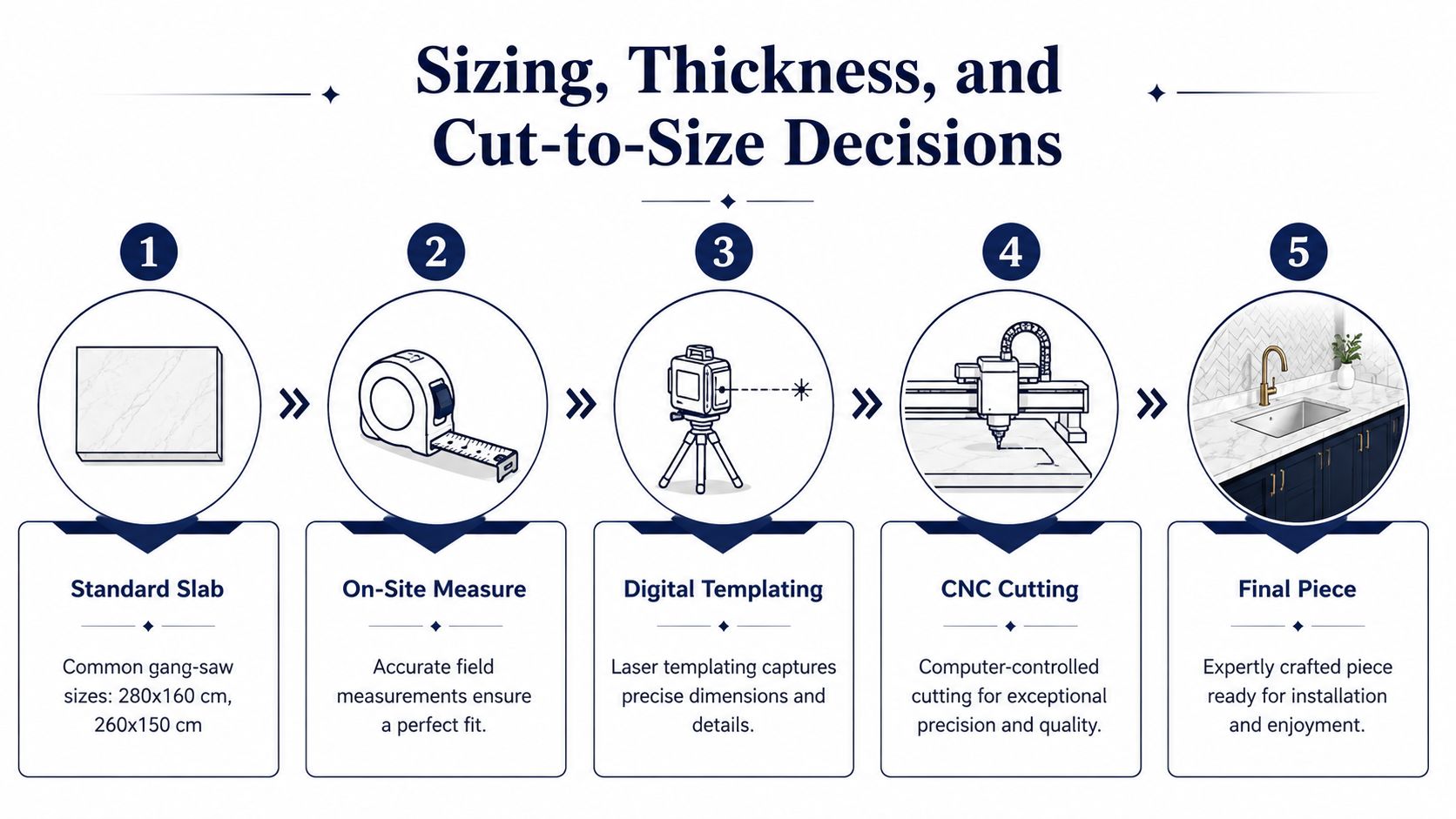
The slab size must fit the design, the fabrication plan, the lift, the staircase, and the access route. Seller-side listings commonly show sky blue granite in 20 mm and 30 mm thicknesses, with polished, honed, flamed, and brushed finishes and slab sizes often around 6'–10' x 2'–6', as outlined in this sky blue granite technical listing. Treat those as supply formats, not a promise that every lot will match your drawing.
Start with a measured template. Mark sink cut-outs, hob openings, joints, support walls, overhangs, and the direction of movement. A fabricator should confirm whether the chosen slab can produce the required pieces without placing a fissure at a sink corner or a visually strong vein through an unwanted joint.
Choose thickness by function
- Vertical cladding and backsplashes: use a thickness suited to the fixing system and structural design, rather than selecting solely by appearance.
- Kitchen counters: 20 mm is a common commercial format, but support, edge build-up, sink type, and overhang decide whether it's adequate.
- High-traffic flooring: specify the thickness with the substrate, traffic, joint layout, and abrasion requirements in mind.
- Cut-to-size tiles: useful where full slabs create handling or access problems, but matching must be approved before production.
Edges should be designed before cutting. Chamfered, bullnose, ogee, and mitred profiles consume material and alter the visual weight of the slab. Don't leave the edge decision to installation day.
Inspecting a Slab Before You Buy
At a Gurugram showroom, a kitchen-island buyer should inspect slabs standing vertically, not lying flat under bright ceiling lights. Upright inspection reveals the face at a realistic viewing angle and makes it easier to compare tone, crystal movement, and the direction of prominent bands.
Ask the yard team to move at least three slabs from the same lot together. View them in daylight or neutral light, then tilt each slab under raking light. This exposes shallow fissures, resin-filled pits, dull polishing, and patches that disappear in a straight-on photograph.
What I check first
- Face and edge: compare the polished face with a visible cut edge. A sharp difference can indicate surface treatment or a weak outer layer.
- Reverse side: look for mesh backing, repairs, or heavy filling. Mesh may support a weaker block, so it deserves documentation rather than automatic approval.
- Sound: tap lightly and consistently. A dull response can justify further inspection for a hidden crack, but tapping alone isn't a laboratory test.
- Movement: chalk the preferred vein direction on the face. Never rely on how the slabs were stacked in the yard.
- Cut zones: inspect the areas likely to become sink edges, hob openings, corners, and narrow strips. A beautiful centre doesn't rescue a fragile fabrication zone.
Reject slabs with conspicuous resin patches, structural cracks, or polish inconsistency. Don't buy from stack photographs alone. If the supplier won't show the actual lot, you're being asked to accept a visual risk without control.
Why Hand-Inspection and Curation Matter
Open-yard buying treats stone like a packaged commodity. That works poorly for veined blue materials, where two slabs with the same trade name can create an obviously mismatched installation.
A curated supplier pre-screens tone, movement, surface condition, and structural concerns before the buyer commits. Varun Marbles states that its gallery accepts fewer than one in ten slabs after hand inspection, according to the publisher information supplied for this guide. That approach is valuable when the project needs adjacent slabs to read as one composition.
The commercial logic is straightforward. Paying for selection can reduce rework, replacement arguments, unusable cuts, and the cost of discovering a mismatch after fabrication. It matters most for waterfall islands, reception desks, large floors, book-matched walls, and stair runs.
| Purchase Mode | Slabs Inspected | Slabs Accepted | Acceptance | Typical Site Risk |
|---|---|---|---|---|
| Open-yard purchase | Lot selected in bulk | Supplier-defined | Not established before selection | Tone mismatch, hidden defects, rework |
| Curated purchase | Selected and reviewed before approval | Pre-filtered by visual and technical criteria | Supplier-specific | Lower selection risk, subject to written terms |
A curated yard still needs your approval. Ask to see the complete lot, mark slab order, and record the selected pieces on the invoice. The discussion of signature marble and granite is useful context for understanding why individual slab selection matters in premium natural-stone work.
BIS Standards and Technical Specs to Verify
Documentation should be your first filter, not paperwork added after the deposit. For polished granite used as building stone, IS 14223 (Part 1) covers practical acceptance areas including dimensions, finish, water absorption, strength, and abrasion resistance. An India-linked summary of the standard cites maximum water absorption of 0.50% by mass, minimum modulus of rupture of 12.0 N/mm² for general use, and abrasion limited to 1.0 mm wear, as described in this IS 14223 granite standard reference.
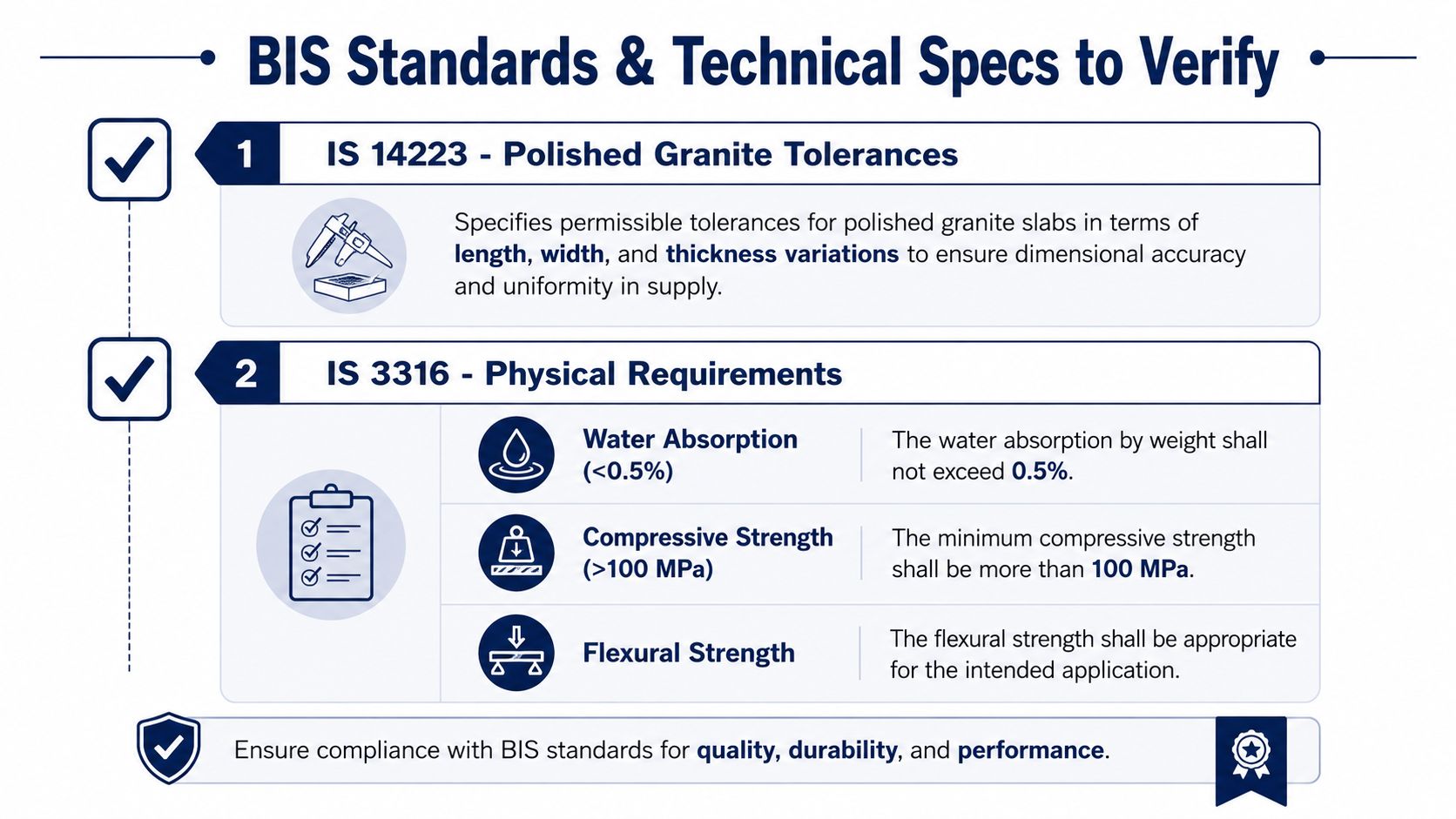
Ask for the certificate for the actual lot, not a generic brochure. The document should identify the material, quarry or source, finish, thickness, test date, and laboratory.
Your technical request should include
- Water absorption and strength: obtain values for the supplied lot and compare them with the relevant project requirement.
- Dimensions: confirm length, width, thickness, squareness, and flatness tolerances before fabrication.
- Abrasion suitability: verify the requirement for floors, especially in commercial areas.
- Surface treatment: request written disclosure of resin, mesh backing, filling, or colour enhancement.
- Fabrication information: record the approved grain direction, edge profile, cut-outs, and replacement terms.
For architects and contractors, a clear material clause prevents arguments later. Procright's technical procurement specification writing guide offers a useful framework for recording acceptance criteria, submittals, inspections, and delivery obligations.
Best Applications for Each Finish and Variant
Application should choose the finish and variant. A polished Srikakulam-origin material can work beautifully on a feature wall or vertical cladding, where its layered movement receives controlled light. I'd be more cautious about using a polished blue granite on a wet bathroom floor or an exposed entrance where grip matters.
Honed surfaces suit kitchens where glare and fingerprints are unwelcome. Leathered finishes add tactile depth to an island or hospitality counter, while brushed faces can soften a large wall. Outdoor areas need a finish selected for texture, drainage, cleaning, and weather exposure, not just for the strongest blue colour.
| Application | Recommended Variant | Finish | Thickness | Notes |
|---|---|---|---|---|
| Kitchen platform | Medium-grain domestic blue or selected Blue Pearl | Polished or honed | 20 mm common supply format | Check sink zones, sealing, edge build-up |
| Island waterfall | Matched imported Azul or consistent domestic lot | Polished, honed, or leathered | Project-specific | Approve vein direction and both visible faces |
| Lobby floor | Consistent Srikakulam or approved imported lot | Honed or suitable low-slip finish | Project-specific | Review joints, traffic, abrasion, and maintenance |
| Feature wall | Srikakulam Blue or dramatic Azul variant | Polished, brushed, or leathered | Design and fixing dependent | Use lighting to support, not disguise, movement |
| Bathroom wall | Low-variation blue granite | Honed or polished | Fixing dependent | Keep polished finish away from wet floor zones |
| External paving | Suitable tested domestic granite | Textured finish | Structural design dependent | Confirm outdoor performance and drainage |
For kitchen planning, the kitchen marble and granite guide provides related design context, but the final choice must follow the selected slab's actual finish and fabrication behaviour. Use second-grade pieces on wall panels or risers only when the defects won't affect fixing, appearance, or safety.
Procurement Realities for Indian Buyers
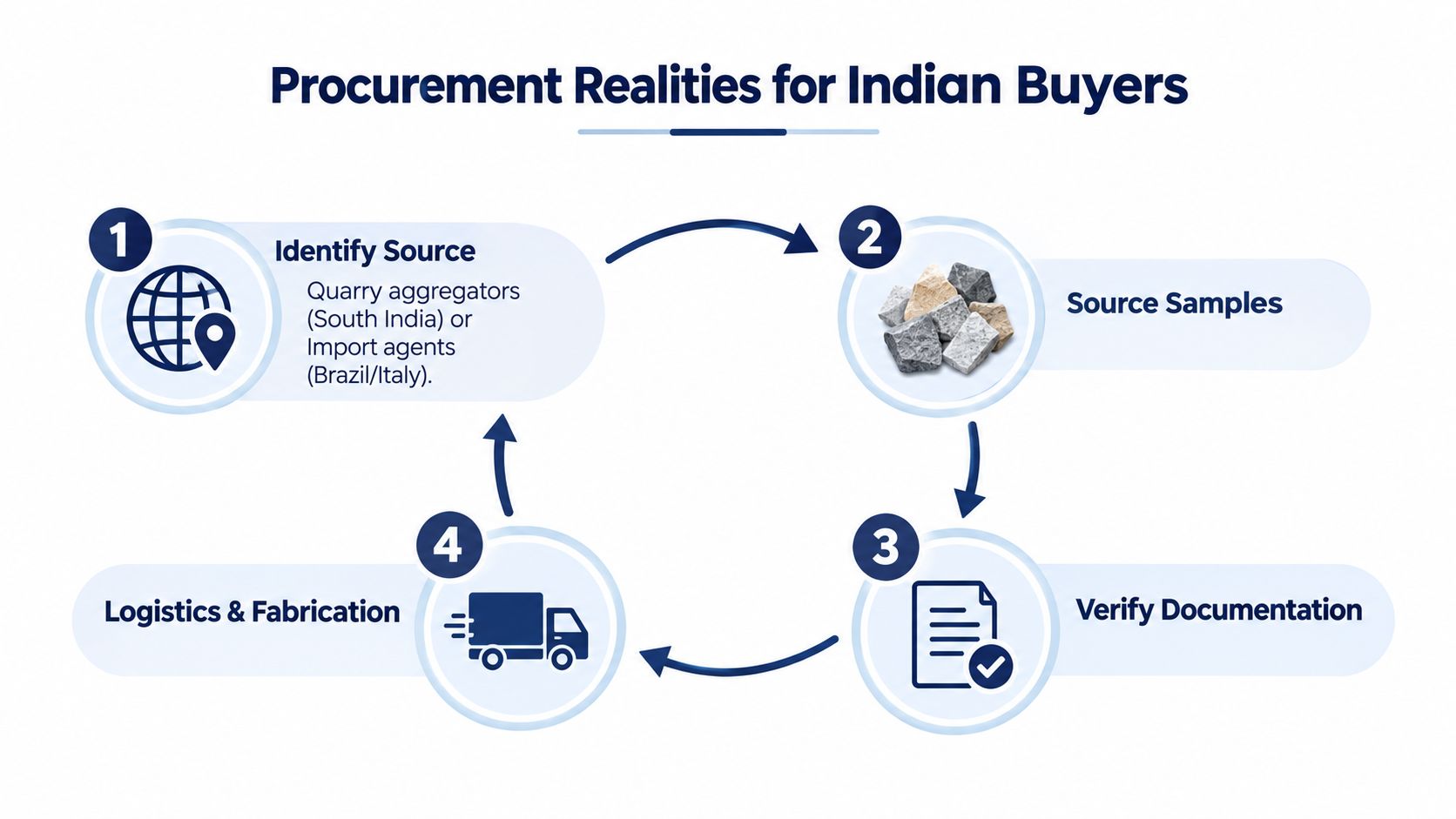
Sky blue granite isn't a purely aesthetic purchase. NCR buyers may source through South Indian quarry aggregators, Rajasthan stockist yards, or importer agents handling Brazilian and other international materials. Each channel uses different grading practices, stock visibility, documentation standards, and transport arrangements.
Granite is a minor mineral under state control, so quarry access, approvals, and availability vary by state. India also has a broad and fragmented supplier base. One trade snapshot cited 1,283 Indian exporters, 3,245 customers, and 55.9K granite exports in 2024, as reported in this India blue granite market overview. For a project buyer, that scale means choice, but it also means supplier quality and follow-through aren't uniform.
Plan the commercial chain before approving the stone:
- Ex-yard rate: material collected from the supplier's yard.
- Fabricator rate: includes cutting, edge work, openings, and finishing.
- Installed rate: includes handling, transport, site fixing, and coordination.
Deposits can lock the selected slabs early, so the invoice should identify the lot, slab photographs, finish, thickness, measurement basis, wastage responsibility, and replacement process. Transport from distant sources can create corner chips, especially when packing and unloading are rushed.
Order continuity matters during weather-related quarry interruptions and busy fabrication periods. Keep enough approved material from the same lot to complete the project rather than assuming a later replacement will match.
Related Stones in the Blue Family
Buyers often widen the brief after seeing the first yard. Vizag Blue and Sapphire Blue can offer deeper domestic blue tones, while Azul Bahia and Azul Macaubas suit projects that need stronger imported movement. Lavender Blue and Imperial Blue sit closer to mid-tone blue-grey schemes.
Kashmir White and River White aren't blue granites in the strict sense, but their lighter backgrounds and grey-blue movement can work when a room needs brightness rather than saturated colour. Stock reliability depends on the local yard and current imports, so approve actual slabs instead of relying on catalogue names.
| Stone | Origin | Tone | Price Band | Best Fit |
|---|---|---|---|---|
| Vizag Blue | India | Deeper blue-grey | Relative to sky blue, supplier-specific | Floors and exterior applications |
| Sapphire Blue | India | Darker, stronger blue | Relative to sky blue, supplier-specific | Counters and feature walls |
| Azul Bahia | Imported | Rich blue with bold movement | Premium relative to sky blue | Designer islands and focal walls |
| Azul Macaubas | Imported | Linear or flowing blue movement | Premium relative to sky blue | High-end interiors |
| Lavender Blue | India or variable trade sourcing | Softer mid-tone blue | Comparable or variable | Residential counters and walls |
| Imperial Blue | India or variable trade sourcing | Mid to deep blue | Comparable or variable | Feature surfaces |
| Kashmir White | India | Light white-grey with cool movement | Relative to sky blue, supplier-specific | Bright kitchens and floors |
| River White | India or variable trade sourcing | Light background with grey-blue pattern | Relative to sky blue, supplier-specific | General interiors and larger surfaces |
Use a related stone when it solves a design or supply problem. Don't substitute it after approval.
Quick-Reference Buyer Checklist
Take this list to the yard and mark each item before paying the deposit:
- Confirm identity: Record the commercial name, quarry or source, finish, thickness, and lot or batch reference on the invoice.
- View the actual slabs: Inspect at least three pieces from the same lot in daylight or neutral light.
- Check structure: Look for hairline cracks, resin-filled pits, mesh backing, edge damage, and suspicious repairs.
- Check polish: Examine the face and edges for dull patches, waviness, and inconsistent reflection.
- Verify thickness: Measure all four corners and the centre with a caliper, then record the agreed tolerance.
- Request test reports: Ask for lot-wise water-absorption, strength, and abrasion data relevant to the application.
- Approve direction: Mark vein or flow orientation before cutting.
- Confirm fabrication: Put cut-outs, edge profiles, joints, and templating responsibilities in writing.
- Define wastage: Clarify who carries unusable offcuts and how additional material will be priced.
- Protect the schedule: Reserve matching slabs for repairs, extensions, or late design changes.
- Walk away when needed: Reject undisclosed treatment, unverified lot identity, or a supplier who won't show the selected material.
Varun Marbles offers granite selection, hand-inspected slab review, cut-to-size fabrication, edge profiling, and installation coordination through its Gurugram showrooms. Visit Varun Marbles with your drawings and application details, and approve the actual sky blue granite slabs before fabrication begins.