
Jade Green Marble: A Practical Design Reference
You've selected a green marble for a feature wall, the designer has approved the colour, and the contractor is waiting for a final slab decision. Then the yard shows three materials sold as “green marble”. One is dark and heavily veined, another has cloudy patches, and the third is a calmer jade tone. They may share a broad trade label, but they won't produce the same room, cost the same, or carry the same fabrication risk.
Jade Green Marble deserves to be specified as a distinct regional quarry product, not as a generic coloured stone. Its character comes from the Rajasthan green-marble belt, its slab consistency depends on block selection, and its performance depends on finish, sealing, detailing, and where you use it. This reference is written for Indian architects, designers, contractors, and homeowners who need to make those decisions before the material reaches site.
Table of Contents
- What Jade Green Marble Is
- Geology and Mineral Composition
- Varieties Within the Green Marble Family
- Veining Patterns and Visual Character
- Surface Finishes and Their Design Effects
- Suitable Interior Applications
- Design Pairings and Complementary Materials
- Quality Standards and Inspection Checklist
- Pricing and Cost Variables in the Indian Market
- Sourcing, Imports, and Procurement Strategy
- Care, Sealing, and Long-Term Maintenance
What Jade Green Marble Is
Jade green marble is a natural metamorphic stone associated with Rajasthan's green-marble belt, particularly the Udaipur and Dungarpur districts in the Aravalli range. The Indian Minerals Yearbook record on marble identifies the internationally recognised green-marble variety with the Rikhabdeo-Kesariaji area, about 60 km from Udaipur. That geography matters because this isn't an imported-look colour reproduced by different suppliers. It's a material with a recognisable quarry origin and a long commercial history in Rajasthan.
In Indian trade, jade green is generally used for a more even, mid-tone green selection within the broader green-marble family. It's usually calmer than dark forest varieties and less dramatically fragmented than strongly brecciated stones. Even so, no natural slab is perfectly uniform. Background shade, pale patches, white veining, resin treatment, and the direction of the block can all change how a sample reads after polishing.
The word “jade” also creates confusion. Imported jade-look quartzites, onyxes, and engineered surfaces may carry similar marketing language, but they aren't the same stone. Indian projects with controlled budgets often default to domestic jade green marble because local supply, processing, replacement matching, and site coordination are more practical than importing a visually comparable material.
Use it as an interior natural stone for wall cladding, flooring, vanities, counters, and feature elements, provided the specification reflects its mineral structure. It belongs to the marble trade, but it shouldn't be judged only by comparison with white calcite marble. Its colour, cutting behaviour, moisture response, and finish selection require their own inspection process.
Geology and Mineral Composition
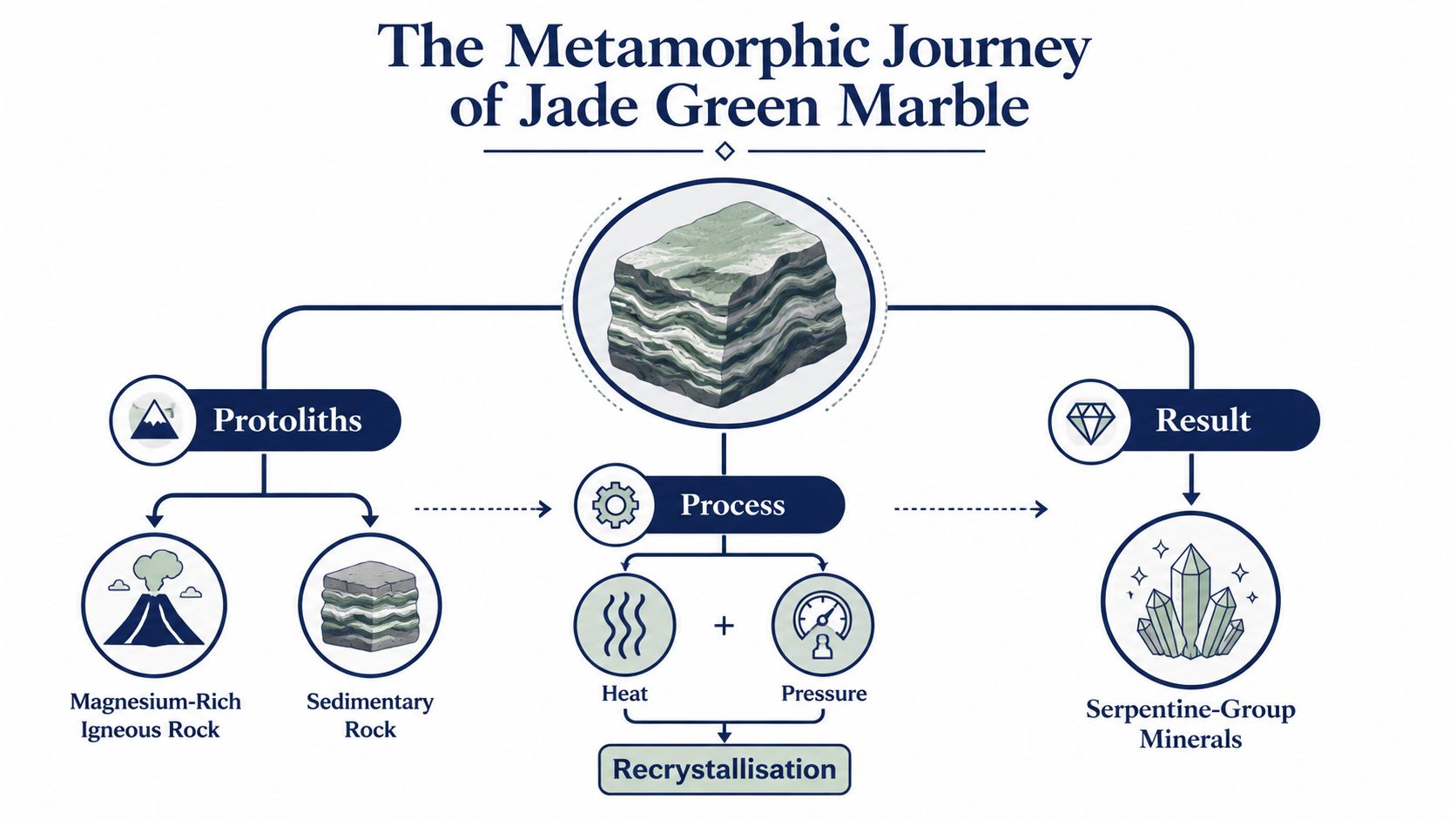
The stone's behaviour starts with its formation. Magnesium-rich igneous or sedimentary protoliths were altered by heat and pressure, allowing the original minerals to recrystallise into serpentine-group minerals. Antigorite and chrysotile are central to the green appearance, while dolomite and smaller amounts of calcite can create lighter areas and pale veining.
That geological sequence explains several things a designer sees at the slab yard:
- Serpentine content creates the green field. Changes in mineral concentration produce shifts from softer mid-green to deeper green.
- Dolomitic areas interrupt the background. These may appear as cloudy patches, pale islands, or white lines rather than clean, predictable stripes.
- The metamorphic structure isn't optically clear like onyx. Light penetration is limited, so standard jade green marble shouldn't be specified for dramatic backlighting without testing the actual slab.
Serpentine-rich material can also show directional weakness and uneven hardness. A fabricator needs to understand the slab's grain and cleavage tendencies before placing sink cut-outs, narrow returns, or sharp internal corners. A cutting plan that ignores the pattern direction may turn a sound block into a difficult installation.
Moisture deserves equal attention. The stone may feel dense and substantial, yet wet zones still require proper sealing and edge treatment. For a broader comparison of how natural stones behave in architectural interiors, see this reference on signature marble and granite. The practical lesson is simple: geological identity isn't academic information. It tells you how the slab will cut, transmit light, accept finish, and respond to water.
Varieties Within the Green Marble Family
The Rajasthan belt produces several commercial names under the larger green-marble category. These names help buyers begin a conversation, but they don't replace slab inspection. A supplier's “Rainforest Green” from one block may have a very different balance of fragments and background from another block carrying the same label.
| Variety | Base Shade | Veining Character | Best Suited For |
|---|---|---|---|
| Rainforest Green | Deep forest green | Bold, brecciated movement | Feature walls, statement islands, reception panels |
| Spider Green | Mid to dark green | Sharp white, spider-like veining | Vanity fronts, niches, selected feature surfaces |
| Plain Green | Light or dark green | Low movement and restrained variation | Volume flooring, stair elements, budget-led interiors |
| Verde Guatemala-type dark options | Dark green | Stronger directional or contrasting movement | Dramatic walls, hospitality counters, focal installations |
| Jade Green Marble | Consistent mid-tone green | Light to moderate veining, generally calmer | Large floor fields, wall cladding, coordinated residential interiors |
Jade Green Marble sits between decorative drama and visual control. Rainforest Green can dominate a room because its darker fragments create a rich, textured pattern. Spider Green draws the eye towards its sharper lines. Plain Green may work better where the material has to cover a larger area without becoming the primary artwork.
That makes jade green useful for projects where designers want colour continuity across several surfaces. A consistent tone supports a quieter floor, a long TV wall, or a reception backdrop that needs presence without excessive visual noise. It's also easier to coordinate with timber, brass, ivory paint, and warm neutral textiles.
Still, “uniform” should never mean “identical”. Ask to see the full selected lot, not only a small polished sample. Two slabs with the same trade name may differ in background saturation, clouding, and vein direction, especially when they come from different blocks or processing runs.
Veining Patterns and Visual Character
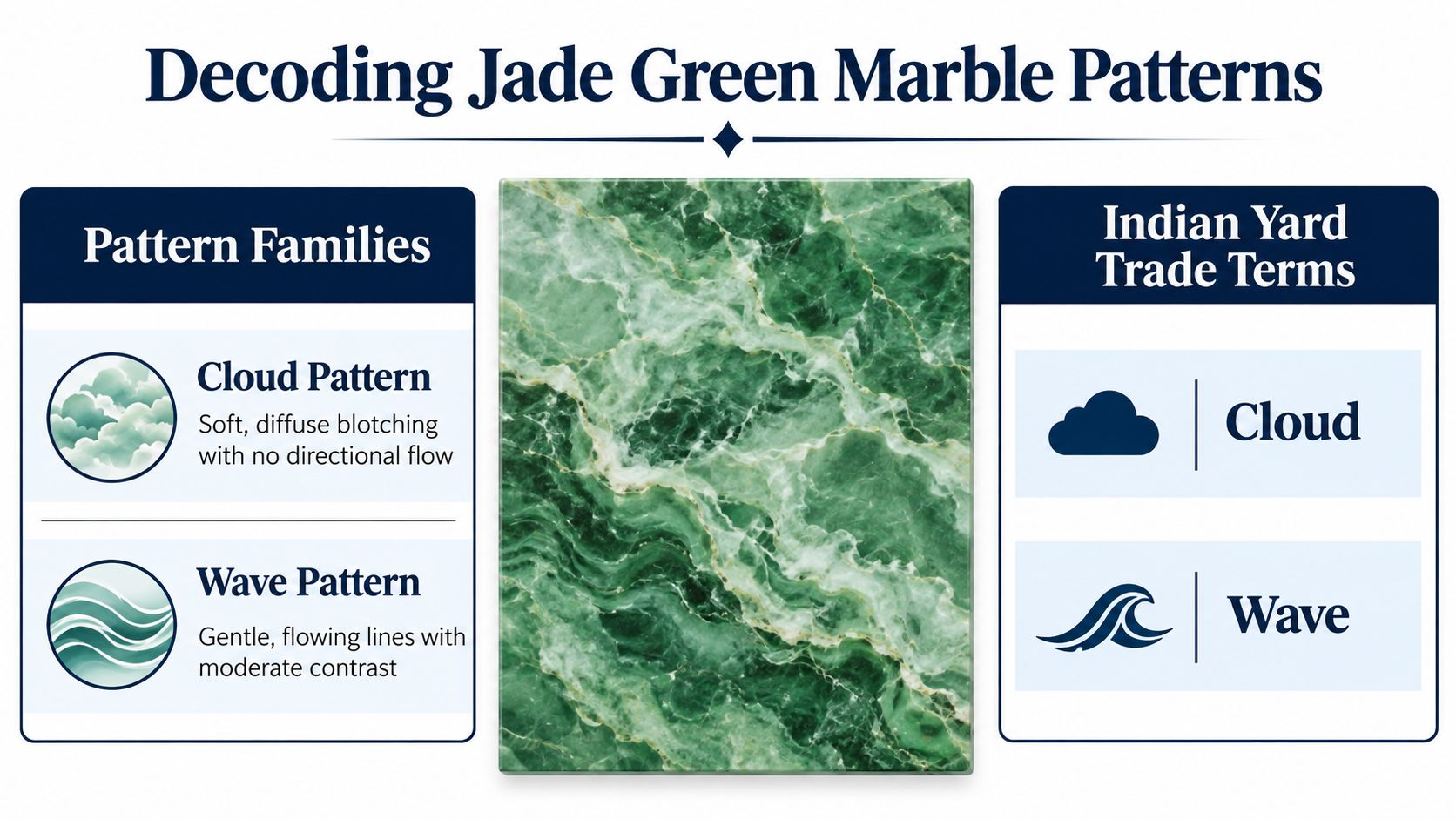
A supplier's terminology becomes useful when it helps you describe what you need. On jade green slabs, four pattern families appear frequently in yard conversations.
Cloud pattern has soft, diffuse blotching. It doesn't travel in a clear direction, so it can sit comfortably across a large floor or a wall where the design needs calm movement.
Wave pattern introduces gentle, flowing bands. It gives a long run some rhythm, but it's less aggressive than a sharp vein. Designers often use it when they want the slab to guide the eye horizontally or vertically.
Vein pattern contains more defined white or pale-green streaks. Veins can be excellent around a niche, headboard, or island waterfall, but they need to be positioned deliberately. A strong line crossing a tap hole or ending abruptly at a joint may look accidental.
Breccia pattern consists of angular darker fragments held within a lighter matrix. This is the most visually assertive family and usually works better as a feature than as a repetitive floor field.
The pattern begins in the block, but the quarry and processing yard determine what reaches your project. Block orientation, gang-saw direction, slab sequence, resin application, and edge trimming can all change the visible result. A small showroom sample may show only a quiet corner of a much busier slab.
Selection rule: Choose slabs as a composition, not as isolated pieces. Lay them out in sequence before approving cutting.
For a book-matched wall, quieter cloud or wave movement usually gives the most controlled result. For a console top, island panel, or recessed niche, a busier vein or breccia can turn the stone into the focal element. Thin selected pieces may show limited light variation, but don't treat jade green marble as onyx without testing translucency slab by slab.
Surface Finishes and Their Design Effects
The finish changes more than sheen. It alters colour depth, tactile response, visibility of marks, and maintenance expectations.
Polished jade green marble deepens the green and makes pale veining appear sharper. It's effective for formal reception desks, statement walls, and carefully detailed counters. The reflective surface can become slippery when wet, and acidic substances may leave visible etching, particularly around kitchen work areas.
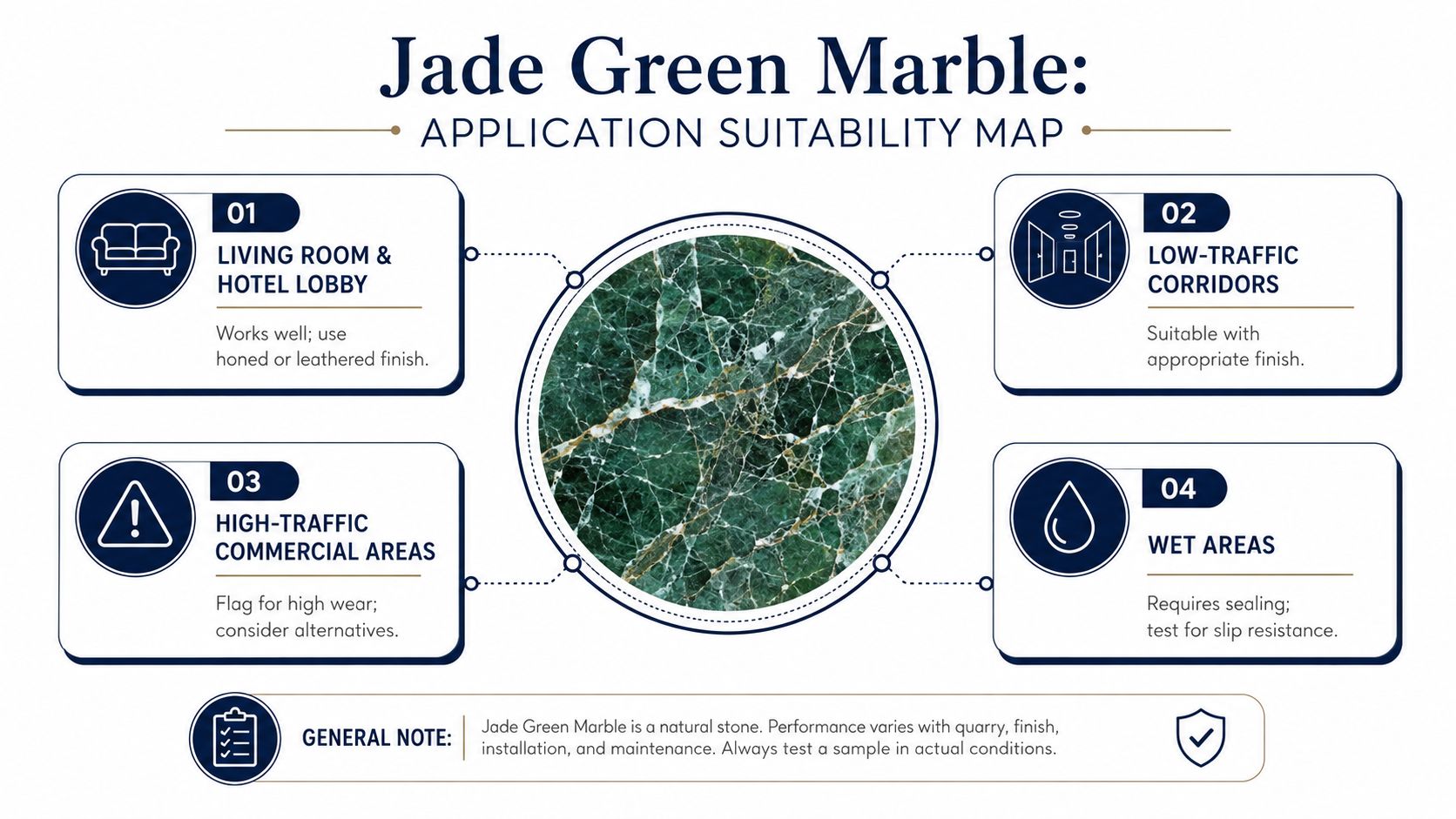
Honed marble has a soft, matte appearance. It reduces glare, suits contemporary floors, and makes minor surface marks less conspicuous. It remains a sensible choice for living rooms, hotel lobbies, and low-traffic corridors where a quieter finish is preferred.
Leathered marble adds texture and grip while bringing out the stone's mineral grain. It works well on feature walls, console tops, and selected counter applications. The texture can hold dust and product residue, so cleaning needs to follow the surface profile rather than relying on a quick wipe.
| Finish | Visual Effect | Best Use | Slip Rating | Maintenance |
|---|---|---|---|---|
| Polished | Deep colour and sharp reflection | Feature walls, formal counters | Lower when wet | Wipe spills promptly, avoid acids |
| Honed | Matte, softer colour response | Interior floors, vanities | Better than polished | Neutral cleaning, periodic resealing |
| Leathered | Tactile grain and low reflection | Feature walls, console tops | Generally improved grip | Clean grooves carefully |
| Bush-hammered or flamed | Strong rough texture | Limited exterior or covered use | Higher grip potential | More difficult cleaning |
| Sandblasted or brushed | Aged, softened surface | Heritage and rustic interiors | Depends on texture | Remove dust from surface texture |
Indian processors may offer sandblasted or brushed treatments for an aged appearance. Bush-hammered and flamed finishes are rougher and create more waste, so they're uncommon choices for refined jade green interiors.
Thickness also affects design intent. Sixteen to eighteen millimetres is commonly used for standard slab work, while 20 to 30 millimetres may be selected for book-matched feature walls, subject to supplier and fabrication availability. Resin treatment can close pits and stabilise handling, but it may also make the surface look more uniform or alter how veins read under strong lighting. Approve the finished sample, not only the raw stone.
Suitable Interior Applications
Jade green marble performs best when the surface, finish, and traffic level agree with one another. It's strongest as a wall material, where the slab can be appreciated without constant abrasion underfoot.
Where it earns its place
- Feature walls: Use it behind TV units, bedheads, reception counters, and lift lobbies. Book matching can create a strong architectural centrepiece, but the slab sequence must be approved before cutting.
- Living-room flooring: Honed or leathered material can work in residential living areas and quieter circulation zones. Keep joints aligned and avoid mixing unrelated lots.
- Hotel lobbies: The stone can suit a controlled hospitality palette, but high footfall requires a solid maintenance plan, walk-off mats, and careful finish selection.
- Counters and islands: Honed or leathered surfaces are practical options. Use chopping boards, wipe citrus and wine quickly, and specify sealed edges around sinks and appliances.
- Bathrooms: Vanity tops, shower walls, and bathtub surrounds are suitable when ventilation is good and the stone is sealed. Shower floors need a tested slip-resistant finish, not an automatically polished surface.
- Staircases: Treads and risers can work with anti-slip detailing. Keep exposed edges protected and coordinate nosing dimensions with the fabricator.
- Outdoor areas: Restrict use to covered porches or sheltered architectural elements. Don't specify it casually for pool decks, where water, slip risk, and weather exposure create a different performance brief.
Grout should support the stone rather than compete with it. A warm neutral grout often sits more naturally with jade undertones than a stark white line, but the final choice should be checked against the actual slab and lighting. Warm-white lighting can bring out the green's depth, while very cool lighting may make pale veins appear harder and flatter.
For kitchen-specific planning, the practical detailing in this guide to kitchen marble and granite is useful alongside the slab inspection process.
Design Pairings and Complementary Materials
Jade green marble can look traditional, contemporary, or distinctly regional depending on what surrounds it. Start with the intended mood rather than collecting materials at random.
| Design Intent | Best Material Pairings | Palette Cues |
|---|---|---|
| Warm classic | Antique brass, teak, ivory plaster | Ochre, mushroom, muted terracotta |
| Contemporary hospitality | Brushed brass, gunmetal, smoked oak | Charcoal, stone grey, deep green |
| Light residential | Blonde ash, white oak, pale limestone | Ivory, soft beige, warm white |
| Jewel-like Indian interior | Teak, antique gold, textured textiles | Ochre, terracotta, deep cream |
| Contrast-led bathroom | White Statuario or Carrara, brushed metal | Ivory, soft grey, restrained green |
| Dramatic feature wall | Dark forest-green or black marble, bronze | Black, tobacco, deep olive |
Metal is the quickest way to establish direction. Brass and antique gold warm the green and make pale veins feel richer. Brushed brass gives a cleaner contemporary effect, while gunmetal grey reduces ornament and works well in hospitality interiors with darker joinery.
Wood changes the temperature of the room. Walnut and smoked oak deepen a darker scheme, whereas blonde ash and white oak keep the marble from becoming heavy. Teak is particularly effective in traditional Indian settings because its honeyed warmth allows the green to read as a jewel rather than a cold accent.
For contrast, pair jade green with white Statuario or Carrara in bathrooms and powder rooms. The white stone provides visual relief and keeps the green from spreading across every surface. Beige limestone suits warm minimalism, while forest-green or black marble can create a layered, tonal feature wall when the project calls for drama.
Paint and fabric should repeat undertones rather than compete with them. Mushroom, ivory, ochre, and deep terracotta are reliable starting points. Use samples under the room's actual lighting, because a green that looks blue in a showroom may read warmer beside timber and brass.
Quality Standards and Inspection Checklist
The relevant Indian reference is BIS IS 1130:1969, reviewed in 2022, which covers marble blocks, slabs, and tiles. It classifies marble into white and coloured categories, expects freedom from foreign inclusions and prominent cracks, and gives dimensional guidance for slabs and tiles. The standard also identifies physical benchmarks such as maximum water absorption of 0.4%, minimum Mohs hardness of 3, and minimum specific gravity of 2.5, as recorded in the BIS marble specification.
Those benchmarks don't eliminate the need for visual inspection. A project can receive a technically acceptable slab that still fails the design brief because the tone, vein placement, or polish differs from the approved sample.
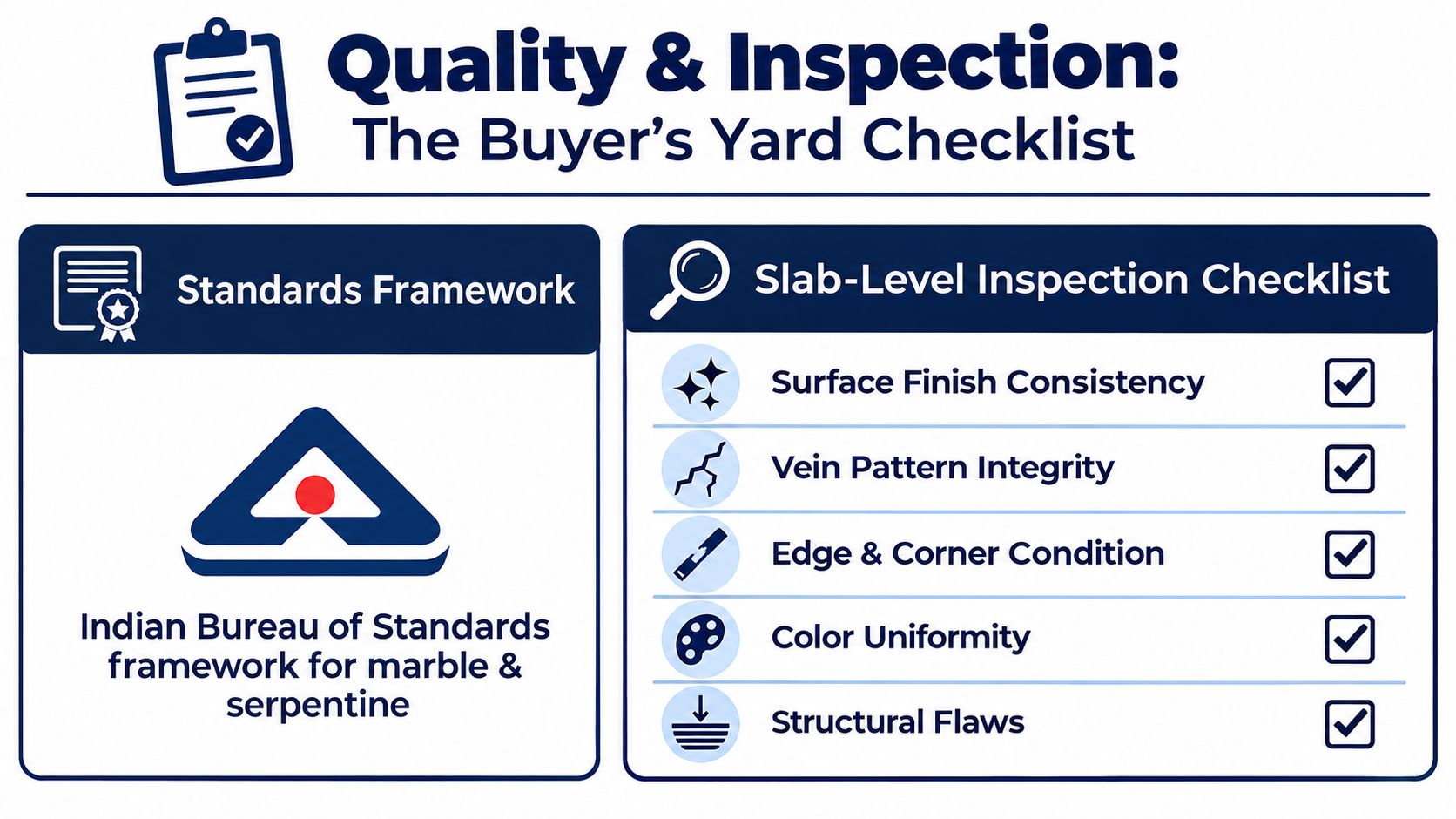
Inspect the actual slabs
- Surface finish: View the slab under angled light. Look for dull bands, swirl marks, patchy gloss, and inconsistent resin polish.
- Vein integrity: Follow pale veins with your hand and eye. Hairline cracks or open fissures along the same path deserve fabricator review.
- Thickness and edges: Measure more than one point. Check corners, edges, chips, and saw marks before approving cut-outs.
- Back face: Look for mesh reinforcement, repair patches, filled breaks, and signs that the slab has received extensive remedial work.
- Soundness: A careful tap test can reveal a change in tone around a weak area, but it should support, not replace, professional assessment.
- Porosity: A controlled water test on an offcut or agreed test area helps the team understand absorption before sealing.
Select slabs from one lot and mark the sequence with arrows, room names, and cutting allowances. Natural variation is normal, but mixing unrelated lots across a continuous floor or wall can produce an obvious change at the joint.
If your decision also involves engineered surfaces, this resource on comparing quartz and marble countertops helps clarify maintenance and material trade-offs. Require delivery documentation covering stone name, finish, thickness, quantity, inspection approval, and any agreed repair or replacement terms.
Pricing and Cost Variables in the Indian Market
Indian market listings place Jade Green and similar green marble around ₹70–₹140 per sq ft for 18–20 mm polished slabs, according to the Jade Green marble market reference. Other live marketplace entries for related green marble stones show prices around ₹35–₹60 per sq ft, which confirms that the label alone doesn't establish a dependable quote.
The difference usually comes from more than colour. Grade, background consistency, vein density, thickness, finish, supplier location, slab size, and selected-lot quality all move the price. A plain green slab for a volume floor shouldn't be benchmarked against a carefully matched jade sequence for a book-matched wall.
| Cost Variable | Effect on Price | What to Ask Supplier |
|---|---|---|
| Quarry source and block | Changes tone, movement, and availability | Which quarry or belt supplied this lot? |
| Colour consistency | More uniform slabs may command a premium | Can I inspect the complete lot? |
| Vein and pattern | Feature movement can increase selection value | Are the slabs sequence matched? |
| Thickness | Thicker material increases stone and handling cost | Is the quoted thickness consistent throughout? |
| Finish | Polishing, honing, leathering, and edge work add processing | Is the finish included or charged separately? |
| Wastage and cutting | Complex layouts consume more material | What cutting allowance and wastage basis are included? |
| Transport | Rajasthan-to-site distance affects landed cost | Is delivery to site included? |
| Installation | Fabrication, joints, cut-outs, and fixing may be separate | Please itemise edge work and installation. |
Retail pricing and project pricing also behave differently. A homeowner buying a small quantity may receive a showroom quote, while a contractor ordering a coordinated lot may negotiate material and processing separately. Ask for an itemised proposal covering slab cost, transport, loading, fabrication, edge profiles, cut-outs, sealant, fixing, and installation. Installation and edge work often appear late in the invoice if they weren't defined at selection stage.
Sourcing, Imports, and Procurement Strategy
Domestic jade green marble is tied to Rajasthan's quarry network, with processing and distribution handled through established stone centres and stockyards. Project buyers commonly work with processors rather than quarry owners because the processor arranges block conversion, gang-sawing, resin treatment, polishing, storage, selection, fabrication, and delivery as one chain.
The practical procurement sequence is straightforward:
- Define the design brief. Specify background tone, acceptable movement, finish, thickness, slab dimensions, and intended application.
- Inspect a meaningful lot. Don't approve only a small sample. Ask to see slabs together and identify the sequence.
- Reserve before fabrication. Mark slab numbers, orientation, room allocation, cut-outs, and book-match direction.
- Confirm the commercial terms. Record material grade, inspection approval, transport responsibility, breakage handling, replacement conditions, and dispatch sequence.
- Coordinate site readiness. Wall substrates, cabinetry, plumbing points, access routes, and lifting arrangements must be ready before dispatch.
Imported Italian, Iranian, or Chinese green stones may compete on appearance or provide a different visual character. Imported material can make sense where the project requires a specific exotic pattern that domestic stock cannot reproduce. It also brings exposure to international availability, shipping, customs, replacement matching, and schedule changes.
India's import picture shows why procurement needs a broader view. In Q1 2025, raw marble import value rose 69% year over year to $94.5 million and volume rose 80% to 389,678 tons, with raw blocks and slabs representing 97% of imported volume and 90% of value, according to the StoneNews report on India's marble import strategy. A separate World Bank trade snapshot records India's 2023 imports of marble and travertine cut into squares at $323.8 million. These movements don't automatically make imports wrong, but they do make domestic matching and replacement availability valuable risk controls.
Care, Sealing, and Long-Term Maintenance
Jade green marble is more forgiving than many owners expect, but it isn't acid-proof or stain-proof. Citrus, wine, vinegar, harsh bathroom products, pigment-heavy cosmetics, and cement residue can mark the surface, especially when spills remain undisturbed.
Use a penetrating impregnating sealer where the surface and supplier recommend it. A penetrating product enters the stone without creating a thick film, while a topical coating can change sheen and may wear unevenly on floors. Test the chosen chemistry on an offcut first, allow the stone and installation materials to dry properly, and seal exposed cut edges around sinks, taps, appliance openings, and joints.
A workable maintenance routine
- Daily: Dust or sweep with a soft tool, then clean with a neutral-pH stone cleaner and a clean microfibre mop.
- After spills: Blot rather than wipe aggressively. Remove acidic or strongly coloured liquids promptly.
- In kitchens: Use chopping boards, trays under bottles, and coasters. Don't place hot cookware directly on the stone without checking the fabricator's guidance.
- In bathrooms: Keep ventilation active, dry standing water, and inspect silicone joints and corners for failure.
- On floors: Use walk-off mats at entries and lift furniture rather than dragging it across the surface.
Resealing should follow traffic, use, cleaner exposure, and the product manufacturer's test method rather than a fixed calendar promise. A simple absorption check on an inconspicuous area can indicate whether the protection is still active, but professional assessment is sensible for large commercial floors.
Etch marks usually need refinishing rather than a household cleaner. Stains may require a poultice chosen for the contaminant, and aggressive home remedies can spread damage or dull the polish. Owners should also expect a natural patina over time. Proper care preserves the stone's character, but it won't keep a frequently used surface permanently identical to the day it was installed.
For kitchen worktops and maintenance-sensitive surfaces, compare the practical detailing in this guide to polished marble countertops before finalising the finish.
Varun Marbles helps architects, homeowners, and contractors evaluate Indian and imported marble, inspect slab tone and veining, and coordinate cut-to-size fabrication, edge profiling, and installation support. Visit Varun Marbles to review suitable jade green marble options and plan the selection, finishing, and site-delivery details before procurement.