
Irish Brown Marble Guide for Indian Interiors

A Gurugram designer is choosing a warm brown stone for a residence with a large entrance, a compact kitchen island and a formal living room. The client wants something richer than white marble, but the contractor needs predictable slab thickness, clean fabrication and a finish that won't become a maintenance problem after handover. The showroom sample looks excellent. The risk begins when the full shipment arrives and the team discovers that tone, vein direction, thickness or finish doesn't match the approved piece.
Irish Brown Marble can work exceptionally well in Indian interiors, but it shouldn't be specified as a colour swatch alone. Architects, interior designers, contractors and homeowners in the NCR need to evaluate four things together: appearance, technical suitability, maintenance discipline and procurement control. A warm brown surface can make a lobby feel grounded and a residence feel more intimate, yet the same stone can disappoint in a busy kitchen if the finish and care routine are poorly chosen.
This guide takes a specification-first view. It focuses on how to identify the material, place it within India's brown marble tradition, read its performance characteristics, select appropriate applications and write a procurement brief that fabrication teams can use. It also addresses the less attractive part of the decision, including acid etching, sealing, batch matching and the difference between an attractive slab and a dependable project supply.
Table of Contents
- Introduction to Irish Brown Marble for Designers and Specifiers
- What Irish Brown Marble Looks Like and How to Identify It
- Geological Context and Brown Marble Tradition in India
- Technical Performance and Durability Essentials
- Best Uses and Where to Avoid Irish Brown Marble
- Specification Standards and Sizing Under BIS IS 1130
- Maintenance Reality and Lifecycle Cost in Indian Homes
- Procurement Guide and Quick Reference for NCR Projects
Introduction to Irish Brown Marble for Designers and Specifiers
Irish Brown Marble is generally selected for its warm brown base, natural movement and premium interior character. It suits schemes built around timber, brass, cream textiles, dark cabinetry and muted stonework. In a Gurugram residence, it can anchor a formal foyer or create a strong island surface. In a hospitality setting, it can bring visual weight to a reception desk or feature wall without relying on a cold monochrome palette.
The material deserves more disciplined treatment than sales-led descriptions usually provide. A photograph may show the colour, but it won't confirm whether the slabs belong to one consistent batch, whether the available thickness suits the edge detail, or whether the proposed finish is sensible for a high-use room. Those decisions require a physical inspection and a specification that names measurable requirements.
Who should use this guide
For an architect, the relevant question is whether the stone supports the design intent without creating avoidable site risk. For an interior designer, the question includes how the slab will read under warm artificial lighting, daylight and adjacent materials. Contractors and fabricators need a different level of clarity, especially around thickness, edge profiling, cutting allowance, joint placement and delivered-lot inspection.
Homeowners face the same decisions in simpler language. They need to know whether a polished brown marble island will show etching, whether a honed bathroom surface will require more careful cleaning, and whether a showroom sample represents the slabs that will be installed.
Consultant's view: Approve the visual character and the technical conditions separately. A stone can pass one test and fail the other.
The decision sequence
Start with visual identification. Confirm the base tone, movement, vein direction and finish on full slabs, not only on a small sample. Then assess the intended application against the stone's strength, absorption and acid sensitivity. The technical properties and application guidance later in this guide should be read together because a suitable material can still become unsuitable when placed in the wrong room.
Finally, control procurement. Record the approved slab, finish, thickness, batch reference and fabrication expectations in the project file. Ask the supplier to show matching slabs before cutting, particularly for book-matched walls, long counters and continuous flooring. This approach gives the design team a defensible basis for approval and gives the contractor fewer opportunities to make assumptions.
What Irish Brown Marble Looks Like and How to Identify It
Irish Brown Marble is best understood as a brown natural stone family with variation, not as a perfectly uniform manufactured colour. The base may read as chocolate, coffee, walnut or a deeper earthy brown, depending on the slab and lighting. Veins can appear subdued or more pronounced, and movement may range from relatively calm fields to stronger flowing patterns.
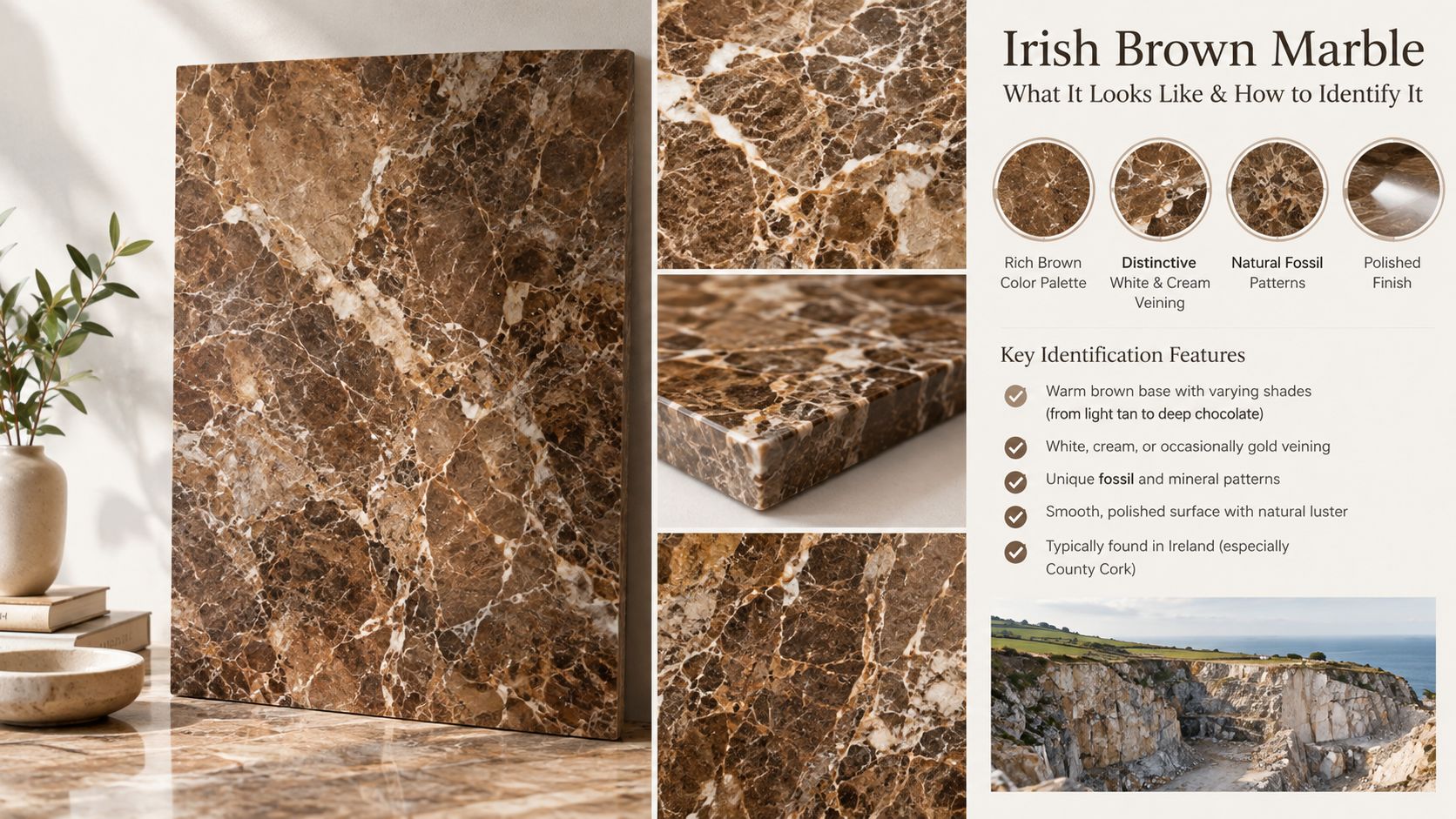
A showroom inspection should follow a repeatable sequence rather than a quick visual reaction.
Start with the base tone
Stand several steps away from the slab and assess its overall colour. Then view it under the lighting conditions closest to the project. Warm spotlights can deepen brown tones, while cooler daylight can make the same slab appear flatter or more grey. Ask the supplier to show adjacent slabs from the proposed lot, because one appealing piece doesn't establish consistency.
Look for abrupt shifts that could create a patchwork effect across a floor or wall. Natural variation is part of the material's value, but the design team should decide whether it wants controlled variation or a more expressive installation.
Read movement and vein direction
A slab with directional movement should be laid out before fabrication. Mark the intended top edge, grain direction and visible face. This matters on an island, reception counter or tall feature wall, where a rotated slab can make the pattern appear accidental.
For a lobby feature wall, stronger movement may be desirable because the surface is viewed as a composition. On a kitchen island, the same movement needs careful placement around the sink, hob and overhangs so that cut-outs don't interrupt the most important visual lines.
Compare finishes in the intended room
Polished surfaces intensify colour and reflect light, making them effective for decorative walls, formal floors and lower-abrasion living areas. They also reveal etching and surface marks more clearly. Honed finishes soften reflection and can make minor surface changes less conspicuous, while leathered or textured finishes add tactile depth but need careful cleaning because texture can retain dust and residue.
Check the slab under side lighting, not only from the front. Raking light exposes waviness, resin-filled areas, scratches and uneven polish that may be missed in a bright showroom. Also inspect the reverse and edges for cracks, repairs or conditions that could affect cutting.
Geological Context and Brown Marble Tradition in India
Irish Brown Marble should be assessed within India's established brown-stone tradition, not as a colour label alone. Industry references drawing on IBM data identify Rajasthan, Gujarat, Haryana and Madhya Pradesh as major marble-resource regions, with Rajasthan associated with strong-quality resources. The Indian Bureau of Mines marble reference also lists Rajasthan's principal marble belts as Udaipur-Rajsamand-Chittorgarh, Makrana-Kishangarh, Banswara-Dungarpur, Andhi-Jhiri and Jaisalmer.
For a Gurugram specifier, this matters at procurement stage. Rajasthan connects quarry output with processing yards, transporters, fabricators and North Indian markets. That supply network can support NCR projects, but it does not guarantee consistency between lots. Require slab inspection, block information where available, and written confirmation of replacement availability before approving the stone.
Brown varieties are part of India's stone tradition
Indian marble references include chocolate-brown and English teak wood marble from Jodhpur district, along with chocolate-brown or wood-finish marble from Mandaldeh in Chittorgarh district. Brown marble therefore has a documented place in regional production. It is not merely a showroom colour invented for imported or locally traded material.
Use that distinction in client presentations. The brown family fits established Indian stone preferences, while the commercial name Irish Brown Marble may describe a supplier's selected material, sourcing route and grading practice. Colour, geological origin and trade name are separate specification questions.
Turn origin into procurement checks
Ask what the supplier means by “Irish Brown,” where the present lot was sourced, whether the slabs came from one block, and whether future replacements can be matched. If the design repeats the stone across floors, walls or counters, inspect the complete lot before fabrication. Batch variation in base tone, veining and filled areas can change the finished composition and create avoidable wastage.
For comparison with another recognised Indian stone category, review Katni marble and its place in Indian stone selection. The comparison should clarify selection criteria, not push an automatic substitute. In NCR projects, approve the actual slab, record its lot details, and coordinate fabrication around the confirmed visual range.
Technical Performance and Durability Essentials
Specify Irish Brown Marble as a durable interior stone, not an indestructible work surface. For BOQ and approval records, verify the selected lot against project testing requirements and cite recognised methods such as BIS IS 1124 for water absorption and ASTM C97, together with ASTM C170 where compressive strength is being assessed. The commonly referenced ranges are compressive strength around 60 to 100 MPa, density around 2,500 to 2,700 kg/m³, and water absorption around 0.5 to 1%, as summarised in this technical reference for marble properties. Treat those values as reference ranges, not a substitute for testing the supplied stone.
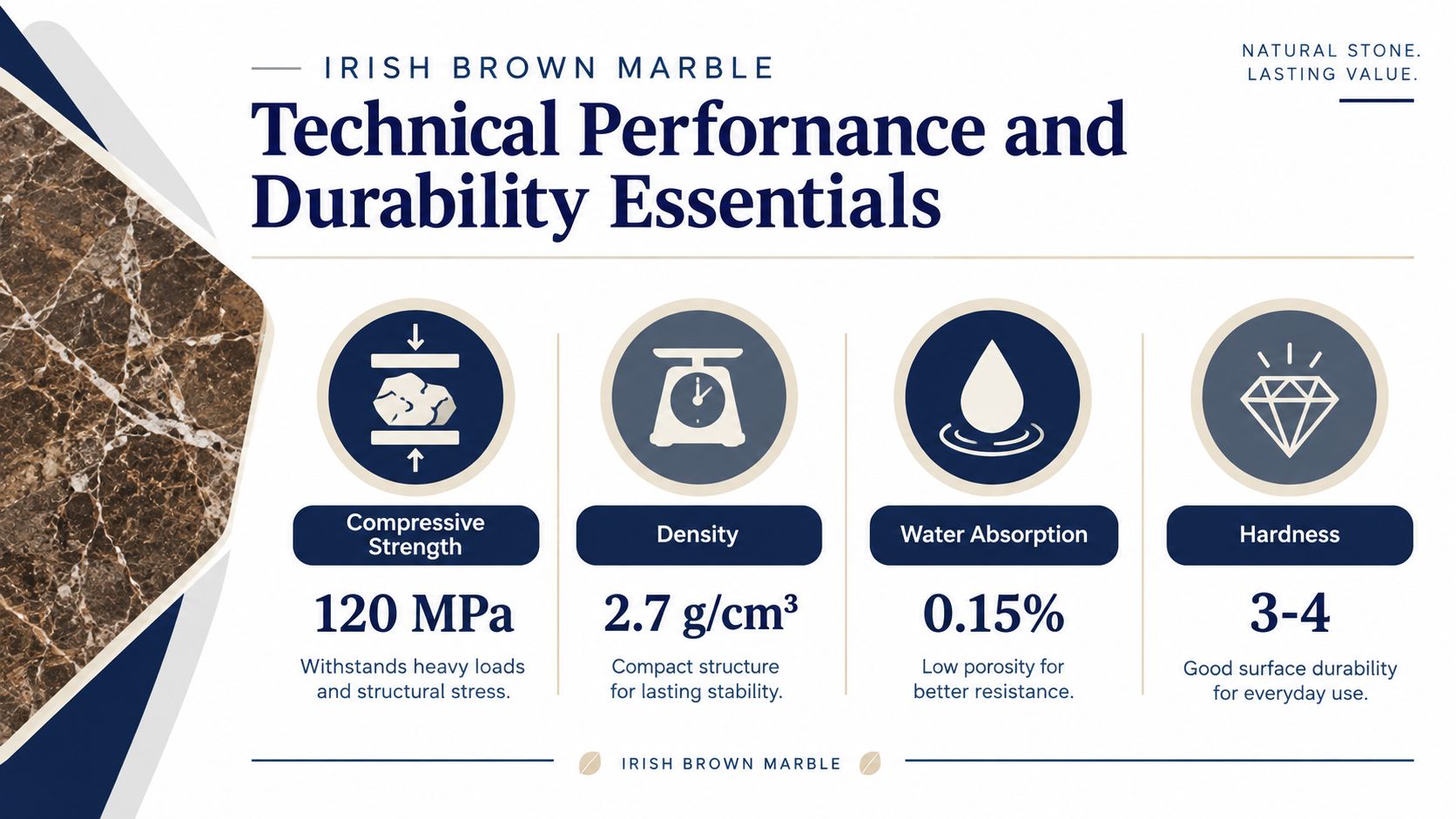
Each property controls a different specification decision. Compressive strength relates to crushing loads, but it does not correct a weak substrate or an unsupported overhang. Density affects handling and planning. Water absorption supports requirements for joint detailing, sealing and moisture control. Calcite-based marble rates at about 3 on the Mohs scale, used here as a scratch-test reference. That hardness level means grit can mark the surface, so do not evaluate Irish Brown Marble like granite or engineered quartz.
Acid sensitivity matters more than a hardness headline
Lemon juice, tomato and vinegar can etch the surface, particularly when a spill remains on polished marble. Etching creates a dull reacted patch rather than a conventional stain, and routine cleaning may not restore the original polish.
For a kitchen, specify expected behaviour with the finish and care plan. A client demanding a flawless, low-maintenance island should choose a non-porous engineered quartz option. Irish Brown Marble suits clients who accept patina and will follow disciplined care, provided the fabricator and installer understand its mineral sensitivity. For a broader material comparison, review marble versus vitrified tiles for interior specification.
Match finish to exposure
Polished marble belongs in decorative indoor areas with controlled cleaning and lower abrasion. Honed or textured finishes hide etching more effectively, while texture can improve perceived slip resistance where the project permits it. Bathrooms and entrance zones in Gurugram still require a specific review because moisture, grit and cleaning practices determine performance.
Stairs and feature cladding need sound support, accurate jointing, suitable adhesive or mechanical fixing, protected edges and a controlled curing sequence. Thin unsupported pieces, misaligned joints and rushed installation can cause cracking or debonding even when the stone's test results are acceptable. Approve the actual batch before fabrication, especially where replacement slabs must match the installed tone and veining.
Best Uses and Where to Avoid Irish Brown Marble
The strongest applications are those where visual impact is high and exposure is controlled. Irish Brown Marble works well on feature walls, formal foyers, low to medium traffic flooring, fireplace surrounds, vanity fronts and selected stair elements. It can also suit a kitchen, but only when the owner accepts acid sensitivity and the project includes correct sealing, edge treatment and prompt spill response.
A hospitality lobby is a better fit than a heavily used service counter. A residence with a formal powder room may be a better fit than a family bathroom where standing water, abrasive cleaners and constant traffic are routine. The decision should follow the room's behaviour, not the stone's popularity.
Match application, finish and maintenance
| Application | Recommended Finish | Suitability and Key Consideration |
|---|---|---|
| Formal foyer or low to medium traffic floor | Polished or honed | Suitable when grit is controlled and the substrate is properly prepared. |
| Feature wall or reception backdrop | Polished | Highly suitable for visual impact. Plan slab layout and vein direction before cutting. |
| Fireplace surround | Polished or honed | Suitable for decorative surrounds, provided the design avoids direct heat stress and unsupported projections. |
| Vanity top | Honed or polished | Suitable with sealing, careful cleaning and prompt removal of toiletries or acidic products. |
| Stair cladding | Honed or textured | Conditional. Require firm support, accurate jointing, safe edge details and slip-conscious detailing. |
| Busy kitchen worktop | Honed, with strict care protocol | Conditional to unsuitable for clients seeking maintenance-free performance. Acid etching remains a real risk. |
| Wet family bathroom floor | Textured or carefully honed | Conditional. Address slip, standing water, grout maintenance and cleaning discipline. |
| High-abrasion commercial floor | Project-specific review | Usually avoid unless traffic, cleaning and replacement planning are tightly controlled. |
Counters need a candid conversation
The polished surface that looks impressive in a showroom can become the most demanding surface in a kitchen. A sink run collects water, food acids and cleaning products. A breakfast counter sees cups, grit, hot objects and repeated wiping. Edge profiles can also chip if the design creates a thin vulnerable section around cut-outs.
Before approving a worktop, compare the client's tolerance for patina against alternatives discussed in this guide to polished marble countertops. If low maintenance is the priority, engineered quartz or granite may be a more rational recommendation. If natural variation and ageing are part of the design brief, Irish Brown Marble can remain appropriate.
Application rule: Don't specify Irish Brown Marble for a high-use surface unless the owner has agreed to the care routine in writing.
Specification Standards and Sizing Under BIS IS 1130
For Indian projects, write Irish Brown Marble specifications against BIS IS 1130, which covers marble blocks, slabs and tiles. It addresses dimensions, tolerances, workmanship, marking and basic physical requirements. The standard was reaffirmed in 2022, as summarised in this BIS IS 1130 specification reference.
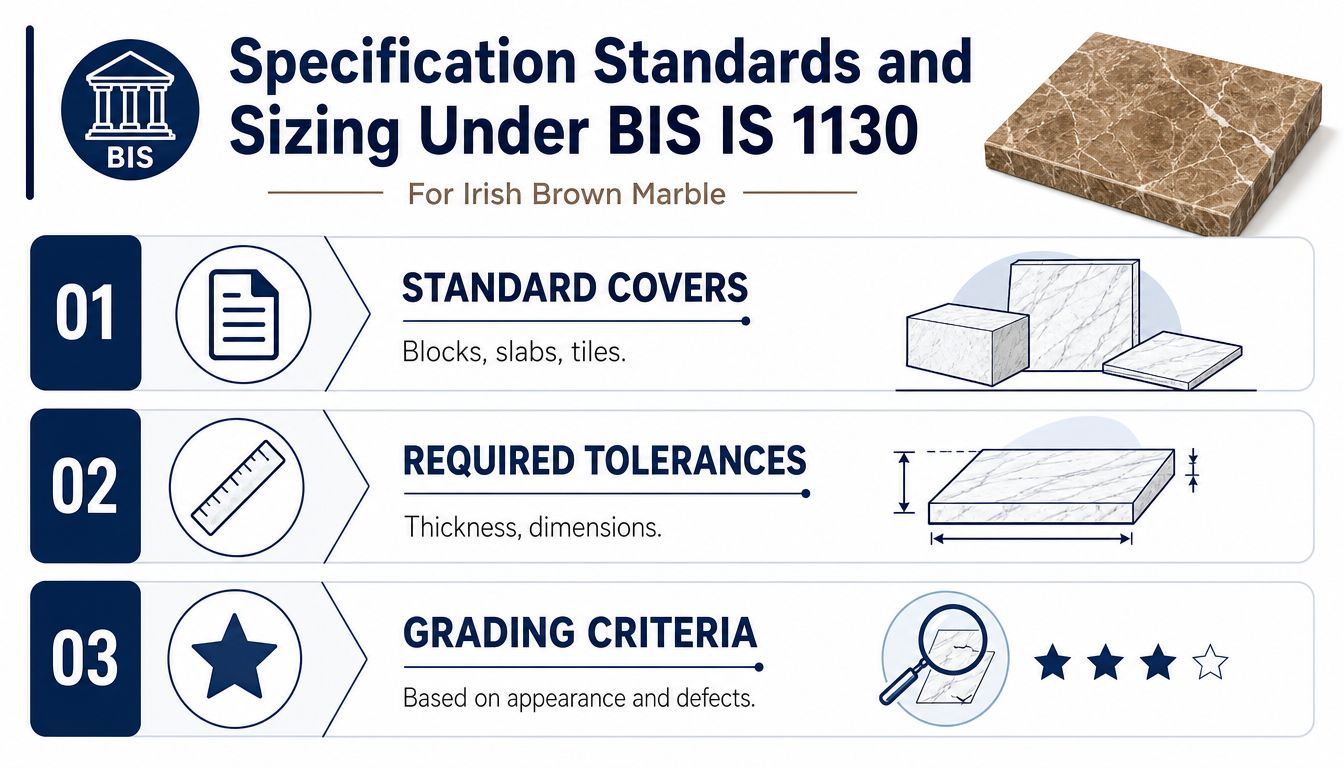
Treat the standard as a baseline, not a substitute for physical inspection, approved samples or fabrication drawings. A compliant slab may still be visually wrong for a prominent wall. A visually attractive slab may still fail the installation brief if its delivered thickness cannot support the required edge or fixing method.
Plan around actual formats
Practical slab ranges under the standard include lengths of roughly 70 to 250 cm, widths of 30 to 100 cm and thicknesses of 20 to 150 mm. Common modular tile sizes include 60 × 60 cm, 50 × 50 cm, 40 × 40 cm, 30 × 30 cm, 20 × 20 cm and 10 × 10 cm, per the same standard's size schedule.
Use these ranges to prepare the cutting plan. Do not treat a slab like a factory-standard tile. Confirm delivered thickness before edge profiling, allow for site cuts and coordinate joints with the slab layout. For an island, mark the sink, hob, supports and overhangs before fabrication begins.
Use clear BOQ language
A practical BOQ entry should name Irish Brown Marble, approved finish, nominal thickness, required dimensions, edge profile, surface quality, marking and inspection requirements. For visually prominent work, require slab photographs or physical approval before fabrication. This protects the project from batch variation and unsuitable veining being accepted after cutting.
At delivery, inspect the following:
- Dimensions and thickness: Measure the lot instead of relying on the sales description.
- Surface workmanship: Check polish, honing or texture under suitable light.
- Visible defects: Record cracks, open fissures, repairs, staining, edge damage and unacceptable patches.
- Marking and traceability: Retain lot details so replacement pieces can be compared with the approved material.
- Fabrication readiness: Confirm that the selected thickness supports the specified profile and installation detail.
For NCR projects, approve the actual batch, not only a showroom sample. Irish Brown Marble can vary in shade, veining and patch character, so batch matching belongs in the procurement record before cutting starts.
Maintenance Reality and Lifecycle Cost in Indian Homes
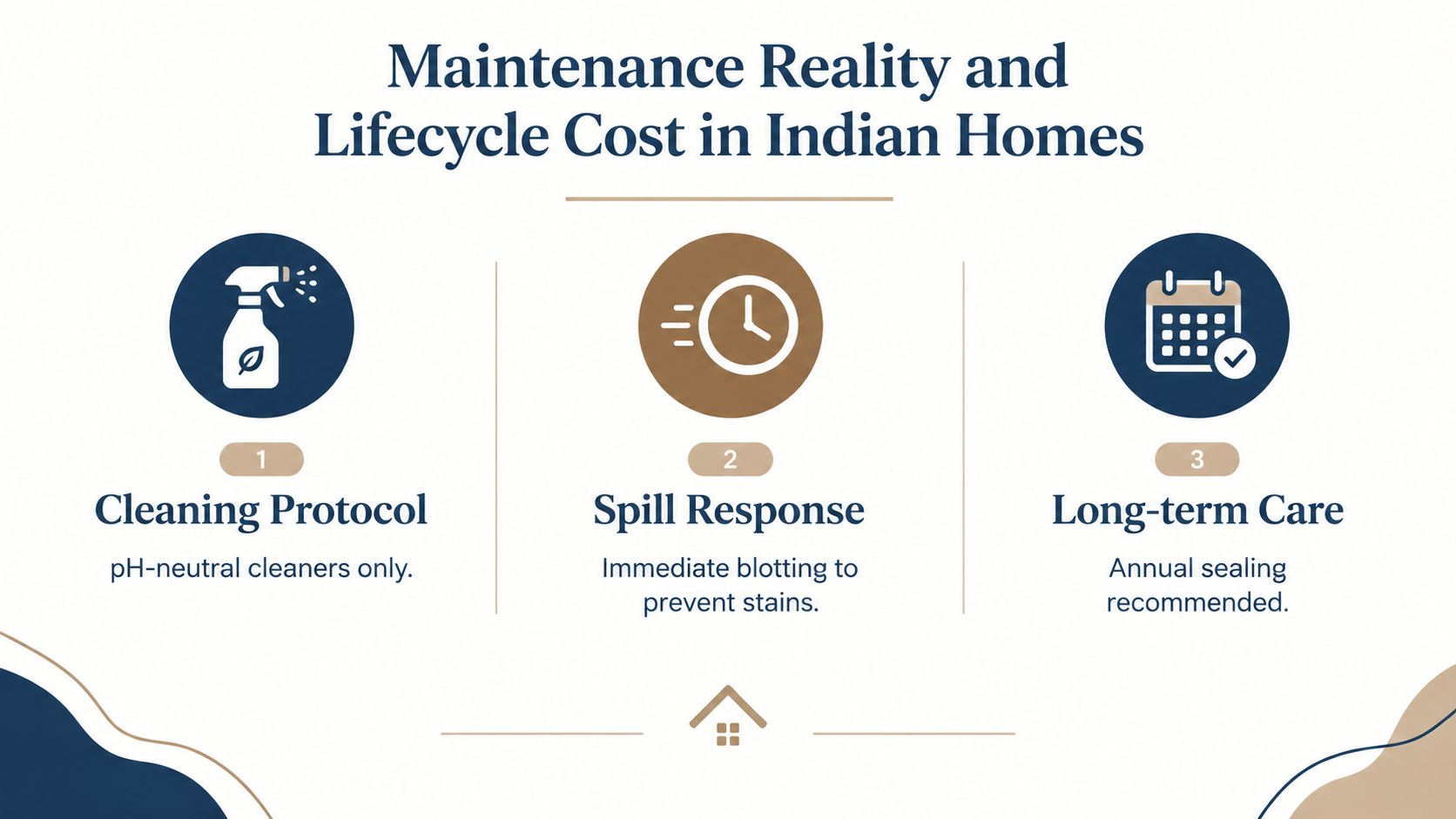
The purchase price is only one part of the decision. Maintenance discipline often determines whether Irish Brown Marble remains attractive, particularly in Indian kitchens, entrance areas and bathrooms where grit, moisture and cleaning chemicals are common. Independent guidance for Indian homes recommends pH-neutral cleaning, prompt spill removal and regular resealing, as outlined in this marble maintenance guide for Indian homes.
A household that wipes spills immediately and uses suitable products may enjoy the stone for years. A household that uses bathroom acid, abrasive powder or an aggressive multipurpose cleaner can dull the finish quickly. The material isn't necessarily wrong in the second home, but the ownership expectations are mismatched.
The daily routine is simple, but non-negotiable
Use a soft cloth or mop with a pH-neutral cleaner. Remove grit rather than dragging it across the surface. Blot coffee, oils, sauces, lemon and other liquids promptly, especially on polished counters and vanity tops.
Don't use vinegar, lemon-based cleaners, acidic descalers or abrasive powders as routine products. These can affect the surface finish or leave a dull area that requires professional repolishing. Bathroom teams should also control standing water and avoid allowing mineral deposits or soap residue to build up.
Sealing supports care, but doesn't make marble stain-proof
Sealing can reduce the risk of staining, but it won't prevent acid etching and it doesn't turn marble into a maintenance-free material. Resealing should be planned as part of the ownership routine, with timing based on the surface, usage and product manufacturer's instructions.
The finish influences how damage is perceived. Polished marble highlights reflection and can reveal etching clearly. Honed or textured surfaces may make surface changes less obvious and can offer a more practical visual response in certain rooms, though they still require proper cleaning and spill management.
Lifecycle advice: If the client won't accept pH-neutral cleaners, prompt blotting and planned resealing, specify another surface for the high-use area.
Procurement Guide and Quick Reference for NCR Projects
NCR procurement goes wrong when a commercial name is treated as a fixed geological specification. Irish Brown Marble can vary in source, grading, thickness, finish and pattern. Public listings place the price at about ₹210 per sq ft to ₹285 per sq ft, as shown in these listed Irish Brown Marble prices from ₹210–₹285 per sq ft. Use that range for preliminary budgeting only. It does not confirm the quality, shade or availability of the slabs allocated to your project.
For Gurugram and wider NCR work, inspect the actual lot before issuing approval. A small digital image cannot show variation across a full slab, and a single showroom sample cannot establish batch consistency.
Inspect the lot, not just the sample
Use this checklist before approval:
- Confirm identity: Ask what the supplier means by Irish Brown Marble and record the stated source or commercial classification.
- Review several slabs: Compare base tone, movement, vein direction, thickness and surface finish.
- Check batch matching: Confirm whether the slabs come from the same block or a coordinated lot. Do not assume a later replacement will match.
- Approve the layout: Dry-lay important surfaces and mark orientation before cutting.
- Record measurements: Verify delivered dimensions and thickness against the BOQ and BIS IS 1130 requirements.
- Agree replacement terms: Specify how visually mismatched, chipped or damaged slabs will be rejected and replaced.
- Coordinate fabrication: Finalise cut-outs, edge profiles, joints, supports and installation details before production.
- Plan maintenance: Provide written cleaning and sealing instructions at handover, with responsibility assigned to the owner or facility team.
Put batch matching and rejection language in the purchase order. The BOQ should identify stone type, finish, thickness, permitted variation, inspection procedure and approval authority. This protects the architect when the delivered material differs from the approved reference.
Varun Marbles provides natural stone and engineered quartz selection, hand-inspected slab viewing, cut-to-size fabrication, edge profiling and installation coordination through its Sikanderpur and HUDA Market Sector 33–34 showrooms. These services may suit projects requiring coordinated selection and fabrication, but the architect should retain approval authority over the actual slab lot.
Irish Brown Marble suits briefs that value warmth, movement and natural variation, provided the client accepts disciplined care. Choose another surface where uniformity, acid resistance and minimal upkeep are the priority. Record that decision before the purchase order, not after installation.
If your Gurugram or NCR project needs Irish Brown Marble, bring the drawings, application schedule and finish requirements for a physical slab review. Visit Varun Marbles to compare natural stone and quartz options, evaluate available slabs and coordinate fabrication and installation details before approval.